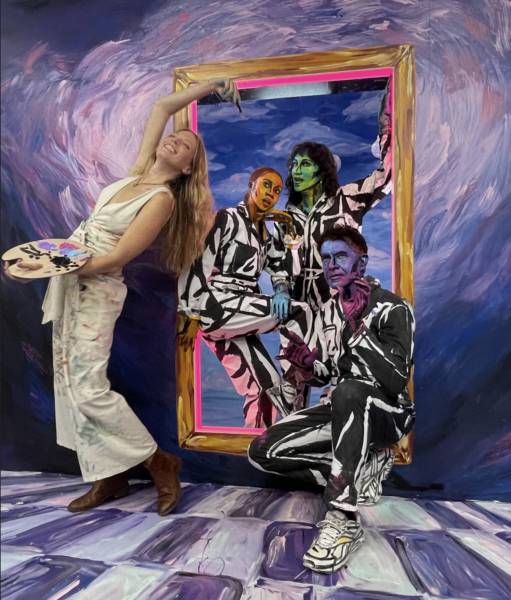
Alexa Meade paints Hailee Kaleem Wright, Eden Espinosa, and Brian Stokes Mitchell at Wonderland Dreams (photo by twi-ny/mdr)
WONDERLAND DREAMS
529 Fifth Ave. between Forty-Third & Forty-Fourth Sts.
Wednesday – Monday through September 10, $33.50-$44.50 www.wonderlanddreams.com online slideshow
If you’re looking for that elusive rabbit hole to bring respite to your harried life — and we’re not talking about the proverbial rabbit hole but something more akin to the real deal — then you can’t go wrong with Wonderland Dreams.
Washington, DC–born installation artist Alexa Meade has transformed a 26,000-square-foot midtown space into an immersive version of Lewis Carroll’s classic nineteenth-century novels, Alice’s Adventures in Wonderland and Through the Looking-Glass. Thankfully, it’s nothing like the overhyped shows in which works by such artists as Vincent van Gogh, Claude Monet, and Gustav Klimt “come to life,” morphing in projections on the floor, walls, ceilings, and mirrored sculptures.
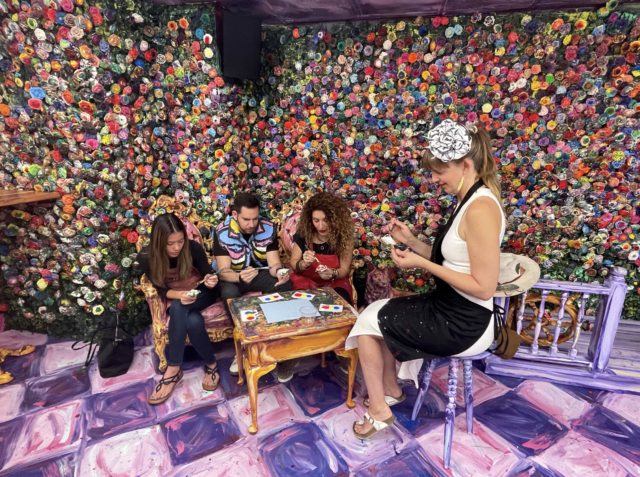
Everyone is invited to paint their own acrylic flowers at Wonderland Dreams (photo by twi-ny/mdr)
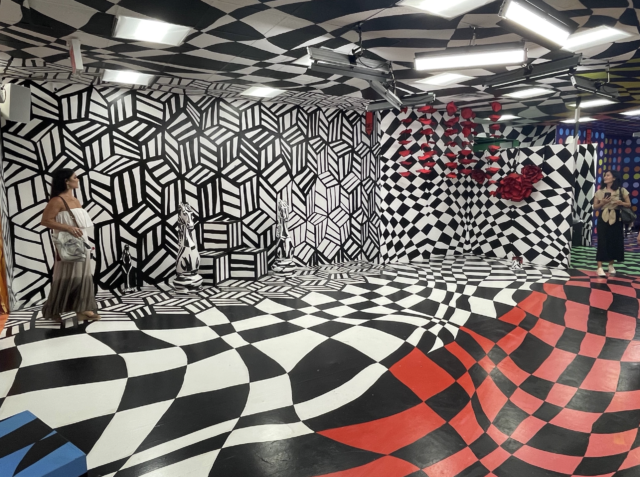
For Wonderland Dreams, Meade and her team hand-painted every inch of the space; as you walk, crawl, or glide through the many rooms, you’ll encounter fanciful chairs and couches, giant mushrooms and flowers, tiny houses, an inviting keyhole, a large chess set and playing cards, a hedge maze, a carousel horse, a swirling tea party, out-of-sync clocks, empty picture frames, and photographs and portraits of celebrities whose bodies Meade has painted on. Everything can be touched, handled, and ridden on; essentially, it’s a gigantic playhouse for kids and adults. Be sure to pick up 3D glasses to enhance your experience in several cool rooms, and stop by the café and the gift shop for bonus surprises, even if you’re not seeking to eat, drink, or buy anything.
In July, I attended Broadway Night, during which stars Eden Espinosa (Wicked,Rent), two-time Tony winner Brian Stokes Mitchell (Man of La Mancha,Kiss Me, Kate), and Hailee Kaleem Wright (Six,Paradise Square) donned black-and-white jumpsuits and then, standing in a full-length empty frame, were painted all over by Meade, who is currently the artist-in-residence at the Perimeter Institute for Theoretical Physics in Waterloo, Ontario; the actors held the palette as Meade covered every bit of their skin, including their faces, necks, hands, and wrists. They then posed in the frame, individually and together, as if the paintings were, well, coming to life. The next Broadway Night is August 21, with guests to be announced; the Grand Finale closing party is set for September 9.
Every room holds a different surprise in Wonderland Dreams (photo by twi-ny/mdr)
There are various places where visitors are encouraged to put on masks, hats, coats, and other props for further immersion into the world of Alice, the Mad Hatter, the Cheshire Cat, the Red Queen, the White Rabbit, the Caterpillar, and Tweedledum and Tweedledee. In the back is a studio where you can paint an acrylic flower and add it to the wall. There’s also the family-friendly Mad Hatter’s Adventure on Saturday and Sunday mornings at ten.
“If I had a world of my own, everything would be nonsense,” Alice says in the first book.
As Meade reveals in Wonderland Dreams, there’s nothing wrong with that.
[Mark Rifkin is a Brooklyn-born, Manhattan-based writer and editor; you can follow him on Substack here.]
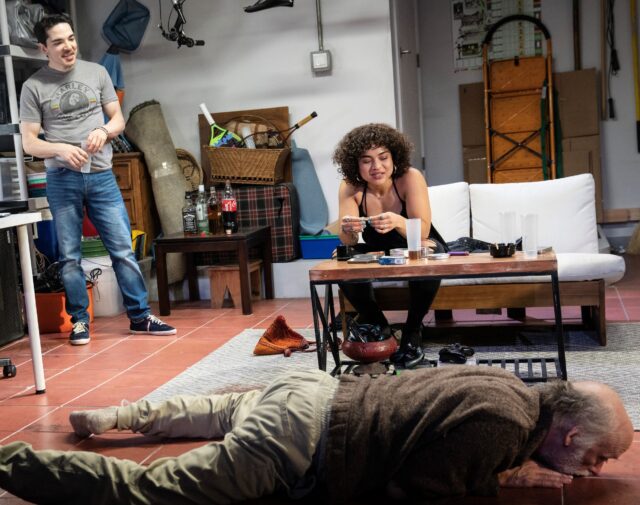
Frank Wood plays an ailing golden retriever in Danny Tejera’s Toros (photo by Joan Marcus)
TOROS
Second Stage Theater Uptown, McGinn/Cazale Theater
2162 Broadway at Seventy-Sixth St.
Through August 13, $60-$75 2st.com/shows/toros
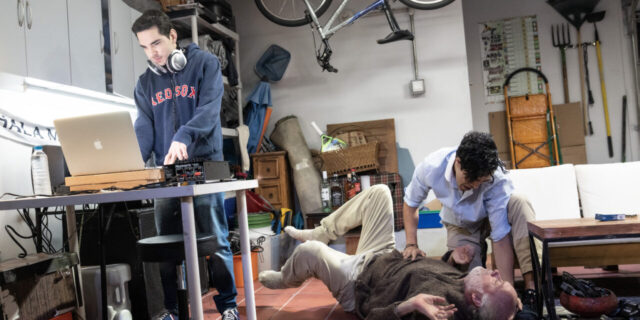
Three twentysomething friends who attended the same international grade school in Madrid reconnect in Danny Tejera’s beguilingly quirky and unpredictable Toros. Juan (Juan Castano) is a wannabe DJ who works on his music in the garage. Toro (Abubakr Ali) has just returned from an unhappy stint in New York City. And the free-spirited Andrea (b) teaches kindergarten when she’s not rolling joints. All three live at home as they try to figure out what they want to do with their lives, spending their evenings drinking, smoking, going to clubs, and hoping there is something better out there.
All the while, Juan’s ailing, elderly golden retriever, Tica (Frank Wood), is curled up in her bed at the front corner of the stage. Throughout the show, she adjusts her positions, lets out small snores, howls, and barks, and moves awkwardly across the floor, her ancient bones wasting away. The dog soldiers on but is a constant reminder that everyone is eventually going to die, and it might be ugly and painful.
The bullheaded Juan — “toro” means bull in Spanish — is a nasty guy who is mean to Toro, unable to say anything kind. Toro is a lost soul who can’t decide whether he wants to be with his friends or be alone. Andrea is the only one of the trio who has a firm grasp of who she is, although the recent tragic death of her sister has her reevaluating her future. Another death impacts the way they interact with themselves and the world.
Tejera (Scary Faces Happy Faces) and director Gaye Taylor Upchurch (Wish You Were Here,Animal) don’t make it easy for the audience at Second Stage’s McGinn/Cazale Theater, but only in the best ways. Each of the characters has serious flaws and does things that they can’t take back even if they wanted to. The dialogue, which is mostly in English with occasional Spanish, crackles with unexpected lines.
Toro (Abubakr Ali) scratches Tica (Frank Wood) while Juan (Juan Castano) tends to his music in Toros (photo by Joan Marcus)
Set designer Arnulfo Maldonado has crafted an intricate and realistic garage, complete with a fancy car under a white sheet, gardening equipment, and a bathroom that continually overflows. Curiously, there is a wall of plants and trees right outside the garage, which would prevent the car from pulling out into the driveway; perhaps it’s meant to imply that the characters are trapped. (Juan and Toro work for Juan’s father’s real estate company, finding houses for others as they are still stuck living with their parents.)
On the subway home, we heard a few people who had been at the show questioning that scenic choice as well — the designer achieved a thought-provoking response, as do the unique writing, acting, and direction. I’ve seldom been on a train coming home from the theater with as many lively discussions going on.
Castano (A Parallelogram,Transfers), b (American (Tele)Visions,Unprincess Non-Bride), and Ali (We Live in Cairo,Kiss) are terrific as childhood friends who don’t necessarily have much in common anymore, but Wood steals the show as Tica, who is onstage nearly the entire smoothly paced ninety minutes. “Tica” can be translated as ethics, which is something that Juan can learn a lot about.
“All the things people usually want: money, or fame, or — raising a family or doing social work — I was just like, none of that seems that great or useful anyway, you know?” Toro says. “And — I just sort of like, stopped believing in reality. . . . Like, it just seemed like, no matter what I saw in front of me, it was all so obviously performed.”
There’s nothing obvious about the wonderfully performed Toros.
[Mark Rifkin is a Brooklyn-born, Manhattan-based writer and editor; you can follow him on Substack here.]
Imelda (Arielle Jacobs) and Ferdinand Marcos (Jose Llana) dance their way to power in Here Lies Love (photo by Billy Bustamante, Matthew Murphy, and Evan Zimmerman)
HERE LIES LOVE
Broadway Theatre
1681 Broadway at 53rd St.
Tuesday – Sunday through September 3, $49 – $299 herelieslovebroadway.com
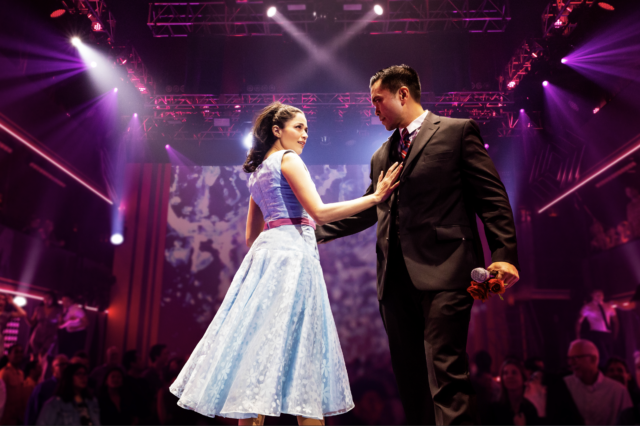
“Why don’t you love me?” Imelda Marcos (Arielle Jacobs) asks in Here Lies Love, the fast-paced extravaganza thrilling audiences at the reconfigured Broadway Theatre. Obviously, she hasn’t been paying attention, too obsessed with greed, corruption, and power.
Here Lies Love started out as a 2010 concept album about Marcos by former Talking Heads leader David Byrne and musician and DJ Fatboy Slim, featuring Tori Amos, Steve Earle, Martha Wainwright, Natalie Merchant, Florence Welch, Cyndi Lauper, Nellie McKay, and others. The full-on show opened at the Public’s LuEsther Hall in 2013, when I called it “a spectacular, must-see event, an immersive, endlessly creative theatrical experience.” It’s still all that and more.
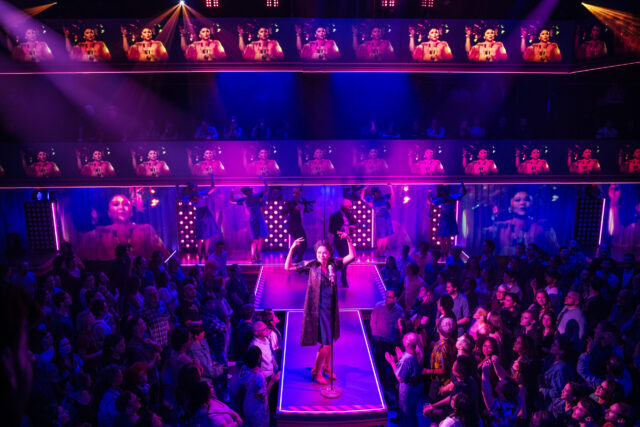
Set designer David Korins has ripped out most of the seats in the theater, so hundreds of people gather on the floor, where large rectangular platforms (nearly four feet high) are pushed around by stagehands while other crew members guide the audience like airplane safety ground handlers so revelers don’t get smushed. There are a few mezzanine rows on two sides of the theater; at one end there are two dozen rows of more traditional balcony seating, while at the other is the main stage. In the center of the room is a giant disco ball, evoking Marcos’s New York City penthouse, where she had one installed over a dance floor, and Studio 54, where she liked to party with celebrities.
Throughout the ninety-minute show, Peter Nigrini projects archival news footage, sociopolitical information, images of Johanna Poethig, Vicente Clemente, and Presco Tabios’s 1986 Lakas Samabayanan (“People’s Power”) mural, and live action, documenting Imelda’s determined rise from a poor childhood by winning a local beauty contest and moving to Manila, meeting and falling in love with the ambitious Ferdinand Marcos (Jose Llana), a military veteran and lawyer with major political aspirations.
Soon she’s swept into a life of position and wealth, although her public statements seem touchingly ingenuous. “The most important things are love and beauty. / It doesn’t matter if you’re rich or poor. / To prosper and to fly — / a basic human right. / The feeling in your heart that you’re secure,” she sings in the opening title number. “Is it a sin to love too much? Is it a sin to care? / I do it all for you. / How can it be unfair?” Most of the lyrics are taken directly from interviews, films, and public statements made by the characters; “here lies love,” for example, is the phrase Imelda wants engraved on her tombstone.
The Marcoses’ rise to power is being challenged by reformer Ninoy Aquino (Conrad Ricamora), a provincial mayor and governor who briefly dated Imelda before becoming a senator who correctly predicted what she and Ferdinand would do to the Philippines. “Out ev’ry night in New York and Paris / Champagne and dancing — while back here at home / People barely surviving — they’re living in shanties! / Our country’s in trouble — but the party goes on!” he declares, earning himself the top spot on their long list of enemies.
Here Lies Love follows the story of Imelda Marcos (Arielle Jacobs) through music and dance (photo by Billy Bustamante, Matthew Murphy, and Evan Zimmerman)
Another sad observer of Imelda’s transformation into an egotistical despot is her childhood friend Estrella Cumpas (Melody Butiu), who in some ways represents both the audience and the people of the Philippines. Once wealth and power come her way, Imelda quickly dumps Estrella. In one of the most touching scenes in the show, Estrella watches Imelda on her wedding day, but she is kept on the other side of a gate. Estrella is intent on standing by her friend as long as she can, explaining, “I know that you are in there somewhere / Letters get misplaced in the mail / Guess that there was some confusion / Amidst those throngs and swells / Did you see me outside? / Did you see me wave? / When you passed in your car / Ah, well, that’s okay — / How she looked when she passed by / How she looked when she passed by.” But Imelda has moved on, trying to erase her poverty-stricken past from her official story.
In 1965, Ferdinand became the tenth president of the Philippines, and for more than twenty years he ruled with an iron fist, having his rivals jailed and murdered, cheating on Imelda, silencing the media, establishing martial law, and lying to the populace as he grew ridiculously rich.
Shortly after the wedding, a press attaché (Jeigh Madjus) announces, “And the whole world can see / They’re our Jackie and John . . . What a picture they make / I’m so proud for us all.” But that’s not at all the way things turned out.
Tony-winning director Alex Timbers (Bloody Bloody Andrew Jackson,Moulin Rouge!) infuses Here Lies Love with nonstop energy spreading across the theater; while the central action follows Ferdinand, Imelda, and Ninoy, the ensemble moves and grooves to Olivier nominee Annie-B Parson’s electric choreography on podiums in the balcony, as if featured dancers in a nightclub. A ladder is occasionally wheeled to the balcony so the main characters can interact with the audience there.
The staging works on multiple levels, but, most important, it helps attendees experience some of what the Filipino people felt during the Marcoses’ ascent. At first, the crowd on the floor is sucked into Ferdinand’s populist campaign, cheering, shaking hands with him and Imelda, and eagerly posing with them for photos and videos. But soon after, they are at an Aquino rally, joining in the rage against the Marcoses’ rampant corruption.
Justin Townsend’s lighting is flashy and bold, splashing flickering colors everywhere. Clint Ramos’s colorful costumes are inspired by such traditional Filipino styles as the terno and the barong. M. L. Dogg and Cody Spencer’s pumping sound shakes the house, led by a fast-talking DJ (Moses Villarama) who keeps the party going even after the show is over. Music director J. Oconer Navarro guides the band across tender ballads and splashy disco and pop, with Joe Cruz on guitar, Derek Nievergelt on bass, and Jacqueline Acevedo, Gustavo Di Dalva, Brandon Ilaw, Paula Winter, and Yuri Yamashita on percussion.
Broadway’s first all-Filipino cast has Llana (The King and I,The 25th Annual Putnam Country Spelling Bee), Ricamora (The King and I,Soft Power), and Butiu (Doctor Zhivago,South Pacific) reprising their roles from the Public Theater production, and all three embody their characters with skill and confidence; Butiu is particularly touching as the friend left behind, essentially representing all the people the Marcoses steamrolled. Jacobs (In the Heights,Between the Lines) is almost too likable as Imelda, although you run out of sympathy for the woman known as the Iron Butterfly by the end. Jasmine Forsberg (Broadway Bounty Hunter,A Grand Night for Singing) is Maria Luisa and Imelda’s inner voice.
Through August 13, Tony winner Lea Salonga (Miss Saigon,Once on This Island) brings down the house as Aurora Aquino, Ninoy’s mother, singing the heartfelt “Just Ask the Flowers” dressed in all black, surrounded by black umbrellas. Kristina Doucette plays Ninoy’s wife, Cory; Timothy Matthew Flores is their son.
Oscar, Grammy, and Tony winner Byrne (Joan of Arc: Into the Fire,American Utopia) and Grammy winner Fatboy Slim (“Praise You,” “The Rockafeller Skank”) have ingeniously transformed the story of despicable despots into a cautionary tale and all-out dance celebration — and with only one mention of shoes.
Ferdinand died in 1986 at the age of seventy-two; Imelda, who concluded a nine-year run in the Philippine House of Representatives in 2019, is still alive, now ninety-four, and their son Bongbong, aka Ferdinand Marcos Jr., was elected president of the country in a landslide in 2022.
“Don’t let them look down on us,” Imelda calls out in “Please Don’t.” It seems she has little to worry about.
[Mark Rifkin is a Brooklyn-born, Manhattan-based writer and editor; you can follow him on Substack here.]
The thirty-first annual Coney Island Sand Sculpting Contest will take place at the People’s Playground on August 12, as amateurs, semiprofessionals, and professionals will create masterpieces in the Brooklyn sand, many with a nautical theme. It’s a blast watching the constructions rise from nothing into some extremely elaborate works of temporary art. The event, which features cash prizes, is hosted by the Alliance for Coney Island and features four categories: Adult Group, Family, Individual, and People’s Choice. There are always a few architectural ringers who design sophisticated castles, along with a handful of gentlemen building, well, sexy mermaids. You can register as late as eleven o’clock Saturday to participate. While visiting Coney Island on August 12, you should also check out the Coney Island Museum,the Coney Island Circus Sideshow,the Music of Curiosities Viva concert with Mystical Children and host PNK VLVT WTCH, and the New York Aquarium in addition to riding the Cyclone and the Wonder Wheel.
[Mark Rifkin is a Brooklyn-born, Manhattan-based writer and editor; you can follow him on Substack here.]
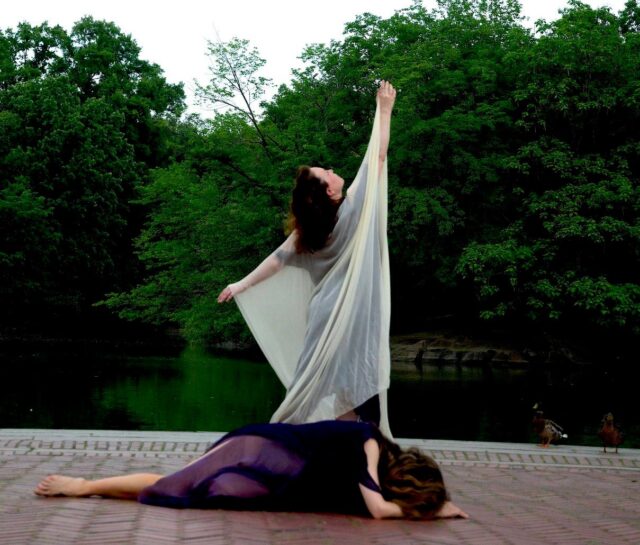
Battery Dance will perform The Wind in the Olive Grove at annual outdoor summer festival
BATTERY DANCE FESTIVAL
Rockefeller Park, Battery Park City
75 River Terr., North Esplanade
August 12-18, free with advance RSVP, 7:00 batterydance.org
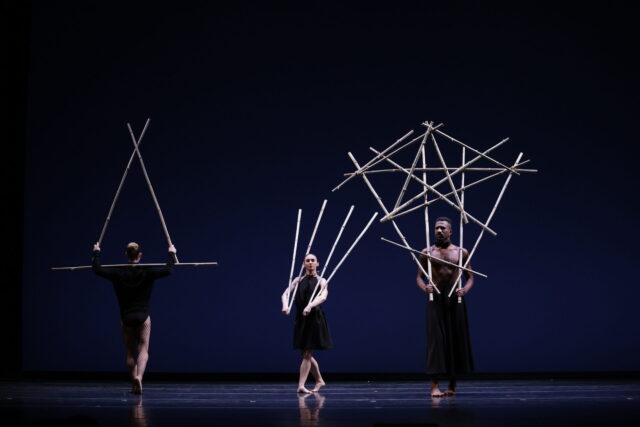
The forty-second annual Battery Dance Festival goes hybrid this summer, with live presentations of works from more than forty companies from around the country and the globe, including numerous New York City and world premieres and US debuts. Free performances take place August 12-18 at 7:00 at Rockefeller Park in Battery Park City — a move from its previous home in Robert Wagner Jr. Park — and will be livestreamed as well.
“When Super Storm Sandy flooded lower Manhattan, Battery Park City Authority reached out a helping hand, providing a beautiful site for the Battery Dance Festival which we’ve all enjoyed every summer since 2013,” Battery Dance founding artistic director Jonathan Hollander said in a statement. “With the prospect of rising seas in the future, BPCA is enacting a proactive resiliency plan, lifting Wagner Park up to twelve feet, making it inaccessible this summer. But fear not! BPCA has invited us to move to Rockefeller Park this summer, where we’ll benefit from the large lawn and riverfront views as we bask in the glow of performances by local and international companies.”
As always, the Battery Dance Festival offers dance fans the chance to see multiple disciplines all in a single evening, for free, with a wide range of pieces from international troupes that explore original movement and celebrate unique culture while often taking on contemporary issues and sharing personal stories. Among this year’s special programs are “Young Voices in Dance” on August 12, “India Independence Day” on August 15, and “Tribute to Turn of the 20th Century American Modern Dance Pioneers” on August 17, honoring Isadora Duncan and Jennifer Muller, who passed away in March at the age of seventy-eight.
In addition, $1 community workshops are being held every morning at 10:30 at Battery Dance Studios (380 Broadway #5), led by festival choreographers, artistic directors, and company members; advance registration is required. Below is the full dance schedule.
Saturday, August 12: Young Voices in Dance
The Bowery Mission, Dancing to Connect
Marley Poku-Kankam, All Four
Aliyah Banerjee & Shashank Iswara, Taraana
Dareon Blowe, How Do Five Parts Construct a Whole?
Mateo Vidals, There Is Always Something Happening
Luke Biddinger, La Vie en Rose
Cameron Kay, Interface
Samanvita Kasthuri, Krtaghna
Micah Sell, Outline
Queensborough Community College, Discovering
Willem Sadler, Soullessly Flying
Tulia Marshall, A fraction of a true self
Joanne Hwang, Static State of Perfection
Sunday, August 13
Battery Dance, A Certain Mood
Reuel Rogers, Power
Keturah Stephen, A Yearning Desire
Circumstances, ON POINT
Nu-World Contemporary Danse Theatre, The Called and the Chosen
Trainor Dance Inc., Courante
IMGE Dance, (no)man
Monday, August 14
SOLE Defined, SOLE Defined LIVE
Teatr Nowszy, Close (excerpt)
Erv Works Dance, Veiled from the Womb
Jiemin Yang, Here We Root (excerpt)
Teodora Velescu and Lari Giorgescu, Special People
Circumstances, ON POINT
Fanike! African Dance Troupe, UPLIFTED!
Tuesday, August 15: India Independence Day
Rudrakshya Foundation, Kali Krishna
Durgesh Gangani, The Legacy
Amarnath Ghosh, Maragatha Manimaya
Wednesday, August 16
Julian Donahue Dance, Displacement
Citadel + Compagnie, Soudain l’hiver dernier
Tabanka Dance Ensemble, Progress
Teatr Nowszy, Close (excerpt)
Teodora Velescu and Lari Giorgescu, Special People
Jerron Herman, Lax
Carolyn Dorfman Dance, NOW
Dancers Unlimited, Edible Tales (excerpts), Soul Food & Kanaloa
Dances by Isadora will honor Isadora Duncan at Battery Dance Festival (photo by Melanie Futorian)
Thursday, August 17: Tribute to Turn of the 20th Century American Modern Dance Pioneers
Dances by Isadora, Isadora Duncan: Under a New Sky
Time Lapse Dance, American Elm and Piece for a Northern Sky
Denishawn, Denishawn (excerpts)
In memoriam: Jennifer Muller (1944-2023), Jennifer Muller/The Works, Miserere Nobis
Friday, August 18
Adriana Ogle & Toru Sakuragi, Softly as in a Morning Glow
Amanda Treiber, Wind-Up
Bruce Wood Dance, In My Your Head
Citadel + Compagnie, Soudain l’hiver dernier
Boca Tuya, Like Those Playground Kids at Midnight
Tabanka Dance Ensemble, Progress
Reuel Rogers, Power
Battery Dance, The Wind in the Olive Grove
[Mark Rifkin is a Brooklyn-born, Manhattan-based writer and editor; you can follow him on Substack here.]
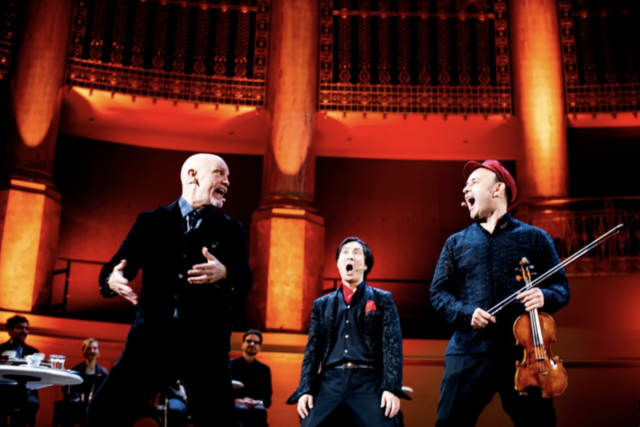
John Malkovich, Hyung-ki Joo, and Aleksey Igudesman star in The Music Critic, coming to the Beacon for one night only
Who: John Malkovich, Aleksey Igudesman,Hyung-ki Joo What:The Music Critic, play with live classical music and opera Where:Beacon Theatre, Broadway at 74th St. When: Saturday, October 28, $66-$257, 7:30 Why: In such films as Being John Malkovich and cable series as The New Pope, two-time Oscar nominee and Emmy winner John Malkovich (Places in the Heart,In the Line of Fire) has shown that he has a wickedly clever sense of humor, especially when it comes to himself. Since appearing on Broadway four times from 1984 to 1987 (Death of a Salesman,Arms and the Man,The Caretaker,Burn This), his stage work in New York has been limited. In 2011, he starred as the title murderer in The Infernal Comedy: Confessions of a Serial Killer at BAM, and two years later he portrayed Giacomo Casanova at City Center in The Giacomo Variations; both traveling productions combined classical music, opera, and theater.
On October 28, Malkovich will return to the city for one night only with his latest traveling show, The Music Critic, in which he plays a cynical expositor who argues that Antonín Dvořák “indulges in ugly, unnatural music,” calls Johannes Brahms a “giftless bastard,” and claims that “the music of Debussy has the attractiveness of a pretty, tubercular maiden.” It was created and conceived by Russian violinist, poet, author, director, composer, and conductor Aleksey Igudesman, who performs in the international hit with his longtime comedy partner, Korean-British pianist, composer, and educator Hyung-ki Joo; both trained at the prestigious Yehudi Menuhin School. The irreverent comic duo of Igudesman & Joo has previously staged such productions as And Now Rachmaninoff,And Now Mozart, and BIG Nightmare Music.
“We are all happy to be back on the road, and for the first time also in the USA, participating in an evening which consists of some of the greatest compositions in the history of classical music, paired with the perhaps rather unexpected initial reactions those compositions elicited from some of the world’s renowned music critics, along with some other surprises,” Malkovich said in a statement. Igudesman added, “The Music Critic is a project very close to my heart, and bringing it to the USA is something I dreamed of from its inception. My dear friend John Malkovich in the role of the evil critic is despicable and lovable at the same time and evokes the critic in every one of us.”
The score of The Music Critic features Bach, Mozart, Beethoven, Chopin, Brahms, Schumann, Debussy, Prokofiev, Eugène Ysaÿe, Giya Kancheli, Astor Piazzolla, and Igudesman; Igudesman and Joo will be joined by cellist Antonio Lysy, violist Hsin-Yun Huang, and violinist Claire Wells. Be prepared for an unpredictable evening of fab music and comic high jinks.
[Mark Rifkin is a Brooklyn-born, Manhattan-based writer and editor; you can follow him on Substack here.]
Biopic follows N.W.A straight outta Compton as they take their case to the people
STRAIGHT OUTTA COMPTON (F. Gary Gray, 2015)
Metrograph
7 Ludlow St. between Canal & Hester Sts.
Saturday, August 19, 9:40, and Sunday, August 20, 9:10
Series runs August 11-20 www.straightouttacompton.com metrograph.com
Born in New York City and raised in South Los Angeles, F. Gary Gray got his start making hip-hop videos for such artists as Outkast, Dr. Dre, TLC, and Ice Cube before directing his first film, the 1995 favorite Friday, starring cowriter Ice Cube, Chris Tucker, and Nia Long. Since then he has nine more films under his belt, focusing on action crime thrillers.
Running at Metrograph August 11-20, “F. Gary Gray in Action” consists of five of his hottest flicks, beginning with 2009’s Law Abiding Citizen, in which an honest man (Gerard Butler) battles a prosecutor (Jamie Foxx) after a home invasion. In 1996’s Set It Off, Jada Pinkett, Vivica A. Fox, Kimberly Elise, and Queen Latifah play friends who decide to rob a bank. In 2005, Gray helmed Be Cool, the sequel to the 1995 smash Get Shorty, both based on Elmore Leonard novels; this follow-up brings back John Travolta as Miami mobster Chili Palmer, who now gets involved in the music industry, joined by Uma Thurman, Vince Vaughn, Cedric the Entertainer, Andre Benjamin, Steven Tyler, Christina Milian, Harvey Keitel, Dwayne Johnson, and Danny DeVito. Gray’s 2003 remake of Peter Collinson’s 1969 heist comedy, The Italian Job, upped the action ante, with Mark Wahlberg, Charlize Theron, Edward Norton, Jason Statham, Mos Def, Franky G, and Donald Sutherland.
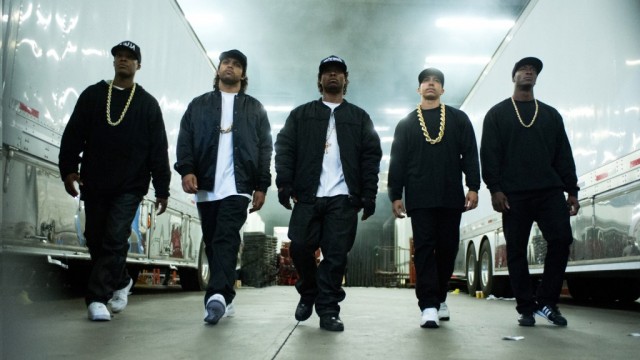
The ten-day series concludes with 2015’s Straight Outta Compton, which comes barreling out of the gates with all the rage and fury of the 1988 title track that kicks off with Dr. Dre declaring, “You are now about to witness the strength of street knowledge.” The energetic film traces the rise and fall, or creation and dissolution, of N.W.A, the seminal south L.A. hip-hop group that changed music forever. In the late 1980s, Ice Cube (O’Shea Jackson Jr.), Dr. Dre (Corey Hawkins), Eazy-E (Jason Mitchell), MC Ren (Aldis Hodge), and DJ Yella (Neil Brown Jr.) formed a rap group that sought to capture the sound and feel of what was happening on the streets of Compton, from drugs and gangs to racist cops and poverty.
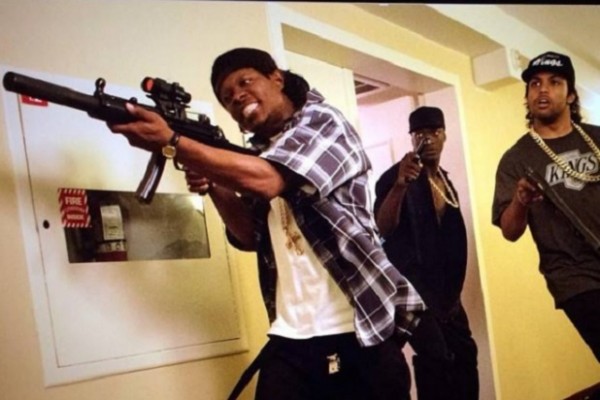
They were a smash hit, particularly their controversial song “Fuck Tha Police,” which set up confrontations with authorities as the band hit the road on a nationwide tour. But when Cube and Dre start questioning where all the money is going — Eazy-E and manager Jerry Heller (Paul Giamatti) seem to be doing a lot better than the rest of them — everything they have built up threatens to unravel. And once Suge Knight (R. Marcus Taylor) enters the picture, the violence level increases, and things start getting even more out of control.
Life threatens to get outta control for N.W.A in Straight Outta Compton
With Ice Cube, Dr. Dre, and Tomica Woods-Wright, Eazy-E’s widow, among the producers, Straight Outta Compton doesn’t pussyfoot around as the various characters make their cases for artistic and financial freedom while reinventing the music business. Juilliard graduate Hawkins (BlacKkKlansman,In the Heights) is outstanding as Dre, maintaining a calm demeanor even as all hell breaks loose around him, while Jackson Jr. (Just Mercy,Cocaine Bear) has trouble hitting the high notes portraying his father, Cube, and Mitchell (Detroit,Mudbound) gives Eazy-E an unpredictable nuance. Taylor (Baby Driver) wreaks havoc as Knight, the extremely dangerous cofounder of Death Row Records, who makes sure he gets what he wants, while Oscar nominee and Emmy winner Giamatti (Cinderella Man,Sideways) has a steady disposition as a white man in a black man’s world.
The music scenes are spectacular, especially a Detroit concert that turned into a showdown between the cops and N.W.A, and it’s cool to see Snoop Dogg (Keith Stanfield), Chuck D (Rogelio Douglas Jr.), and Tupac Shakur (Marcc Rose). The film wavers a bit when it tries to get overly sentimental or inject too many side stories; it’s best when it just forges ahead with the frenzy and furor that was N.W.A, taking on exasperating social conditions the only way they knew how. Straight Outta Compton also features several scenes in which primarily white cops harass black men and women that evoke what is still going on today around the country. Gray (Men in Black: International,A Man Apart) even throws in a fun reference to Friday when the band throws a naked woman out of a hotel party, telling her, “Bye, Felicia.” (If you don’t get the reference, look it up.) At the end of the song “Straight Outta Compton,” N.W.A concludes, “Damn, that shit was dope.” The same can be said of Gray’s dynamic film. Up next for Gray is the January 2024 Netflix heist thriller Lift, starring Kevin Hart.
[Mark Rifkin is a Brooklyn-born, Manhattan-based writer and editor; you can follow him on Substack here.]