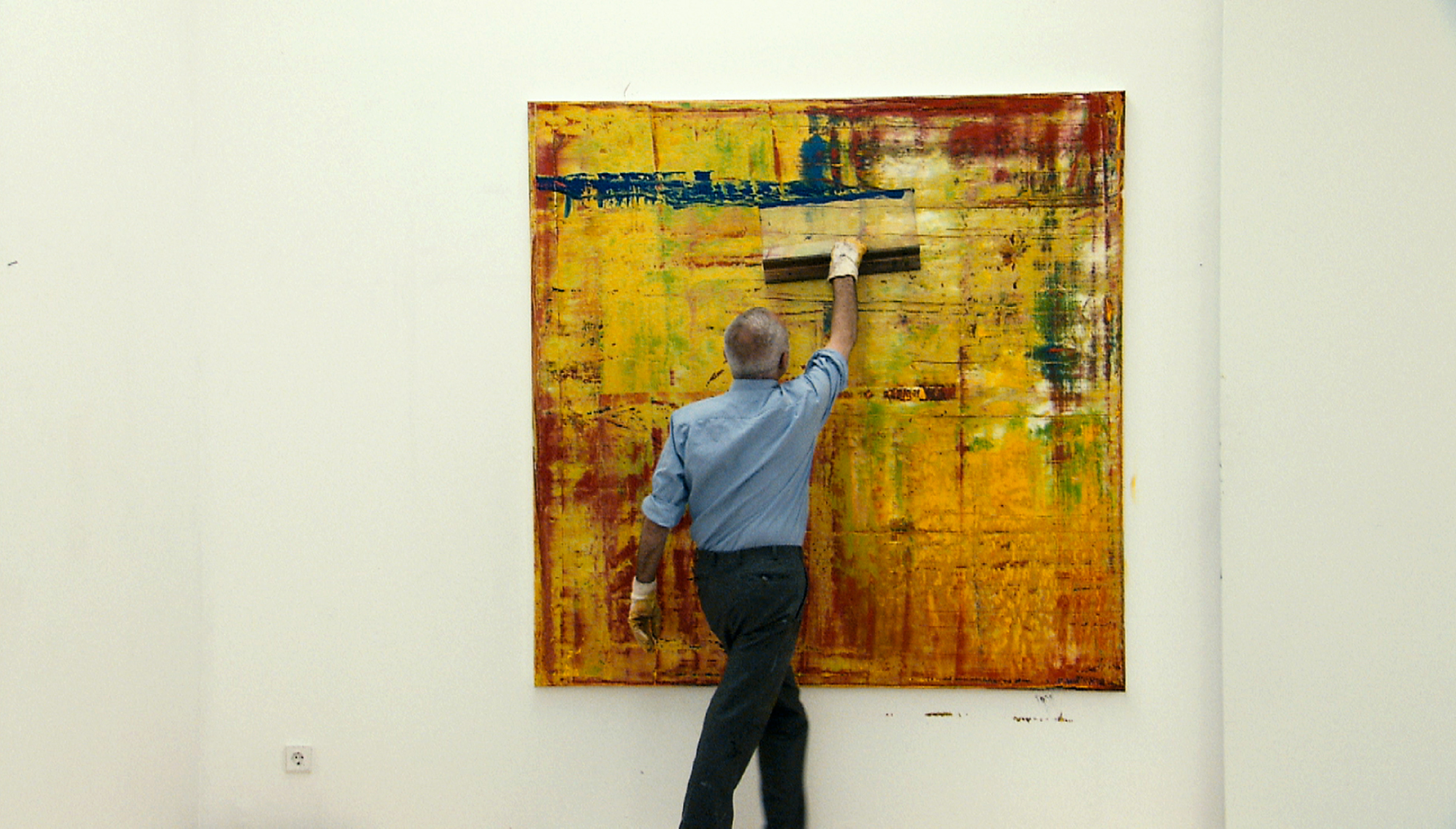
Gerhard Richter reveals his creative process in fascinating new documentary (photo courtesy of Kino Lorber)
GERHARD RICHTER PAINTING (Corinna Belz, 2011)
Symphony Space, Leonard Nimoy Thalia
2537 Broadway at 95th St.
Sunday, July 8, 15, 22, $14, 8:00
212-864-5400
www.symphonyspace.org
www.gerhard-richter-painting.de
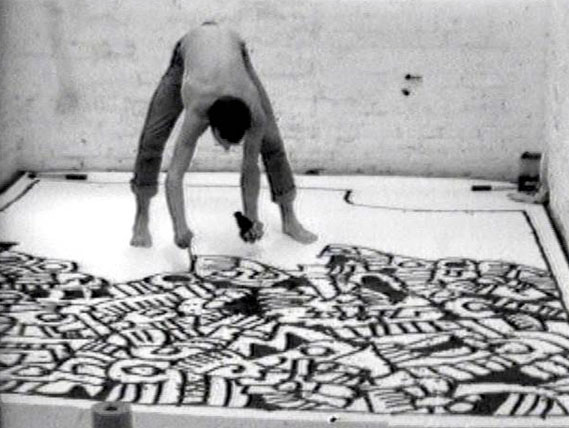
 There’s nothing abstract about the title of Corinna Belz’s documentary on German artist Gerhard Richter, no missing words or punctuation marks. Gerhard Richter Painting is primarily just that: Ninety-seven minutes of Gerhard Richter painting as he prepares for several exhibitions, including a 2009 show at the Marian Goodman Gallery in New York City. In 2007, Belz got a rare chance to capture Richter on camera, making a short film focusing on the stained-glass window he designed for the Cologne Cathedral. Two years later, the shy, reserved German artist, who prefers to have his art speak for itself, invited Belz into his studio, giving her remarkable access inside his creative process, which revealingly relies so much on chance and accident. Belz films Richter as he works on two large-scale canvases on which he first slathers yellow paint, adds other colors, then takes a large squeegee and drags it across the surface, changing everything. It’s fascinating to watch Richter study the pieces, never quite knowing when they are done, unsure of whether they are any good. It’s also painful to see him take what looks like an extraordinary painting and then run the squeegee over it yet again, destroying what he had in order to see if he can make it still better. “They do what they want,” he says of the paintings. “I planned something totally different.” About halfway through the film, a deeply concerned Richter starts regretting his decision to allow the camera into his studio. “It won’t work,” he says. “At the moment it seems hopeless. I don’t think I can do this, painting under observation. That’s the worst thing there is.” But continue he does, for Belz’s and our benefit. Belz (Life After Microsoft) even gets Richter to talk a little about his family while looking at some old photos, offering intriguing tidbits about his early life and his escape to Düsseldorf just before the Berlin Wall went up. Belz also includes clips from 1966 and 1976 interviews with Richter, and she attends a meeting he has with Goodman about his upcoming show, lending yet more insight into the rather eclectic artist. “To talk about painting is not only difficult but perhaps pointless, too,” Richter, who turned eighty last month, says in the 1966 clip. However, watching Gerhard Richter Painting is far from pointless; Belz has made a compelling documentary about one of the great, most elusive artists of our time. “Man, this is fun,” Richter says at one point, and indeed it is; watching the masterful artist at work is, well, a whole lot more fun than watching paint dry. Gerhard Richter Painting is screening at Symphony Space on July 8, 15, and 22 at 8:00 as part of the ongoing series Thalia Film Sundays.
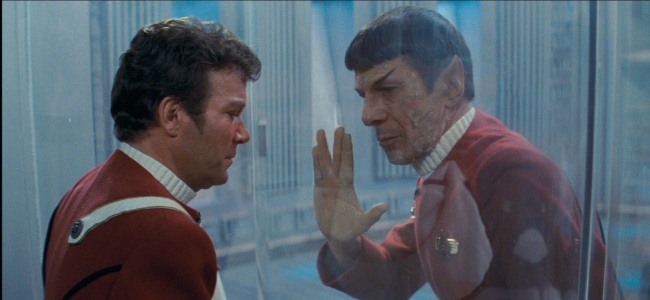
 With all the movies, TV series, and everything else, Star Trek II: The Wrath of Khan just might be the best thing that has ever come out of Star Trek land. We’re talking the Genesis project here, earwigs, Kirk’s offspring, Khan’s superior intellect, Kirstie Alley as a Vulcan, Spock bending the truth, the Kobayashi Maru no-win scenario, and Kirk screaming out his enemy’s name in unforgettable fashion, a classic movie moment. Everybody’s on board the USS Enterprise for this journey, including Dr. Leonard McCoy (DeForest Kelley), Montgomery Scott (James Doohan), Hikaru Sulu (George Takei), Lt. Uhura (Nichelle Nichols), Chekhov (Walter Koenig), Captain Spock (Leonard Nimoy), and Admiral James T. Kirk (William Shatner). The enemy is the conniving but brilliant Khan Noonien Singh, played with delightful relish by Ricardo Montalban, returning from an episode of the original television series. Just the way Montalban pronounces “Kirk” is worth the price of admission; the film serves up a bevy of memorable quotes throughout. The ending is both surprising and surprisingly heartwarming, laying the groundwork for the third film. The Wrath of Khan is about loyalty, friendship, honor, honesty, midlife crisis, fathers and sons, aging — and a bunch of great characters coming together yet again to do a far, far better thing than they have ever done before, or since.
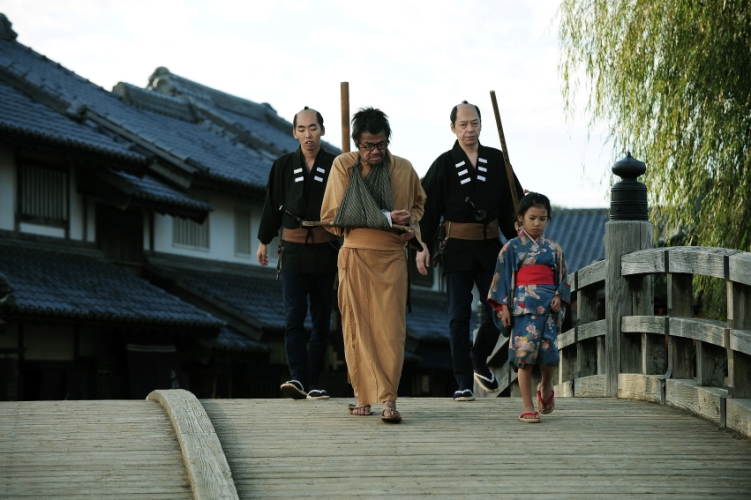
 Having given up on life following the death of his wife, wayward samurai Nomi Kanjuro (first-time actor Takaaki Nomi) roams nineteenth-century Japan with an empty scabbard, running away from confrontation while accepting the verbal wrath of his extremely embarrassed nine-year-old daughter, Tae (Sea Kumada). After surviving three fanciful and fantastical — and far too silly and stylized — attacks by a trio of oddball bounty hunters (Ryo, Rolly, and Zennosuke Fukkin), Nomi is arrested and brought to a castle where the boy prince has not cracked even the hint of a smile since the recent death of his mother. Nomi is faced with the 30-Day Feat — every day for a month, he has the opportunity to try to make the prince smile. If Nomi fails, he must commit a very public seppuku. And so begins a comic series of events in which the dour Nomi, who barely ever speaks, turns into a kind of dark clown, but it’s clear that it’s going to take something very special to end the prince’s dilemma. Written and directed by Hitoshi Matsumoto (Big Man Japan,