Ai Weiwei lets the camera follow him everywhere in revealing documentary about art and activism
AI WEIWEI: NEVER SORRY (Alison Klayman, 2011)
IFC Center, 323 Sixth Ave. at Third St., 212-924-7771
Lincoln Plaza Cinema, 1886 Broadway at 63rd St., 212-757-2280
Opens Friday, July 27
aiweiweineversorry.com
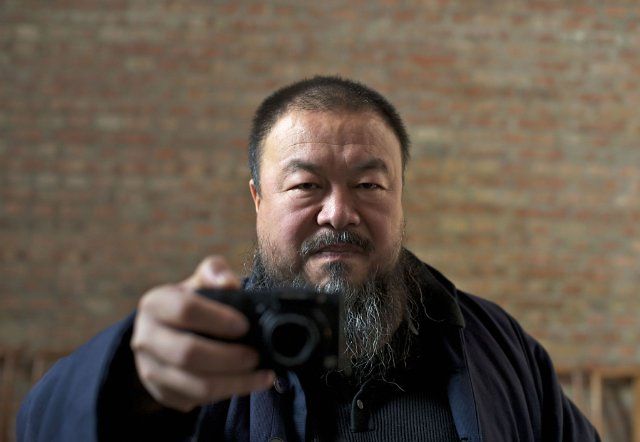
 “I consider myself more of a chess player,” Ai Weiwei says at the beginning of Never Sorry, Alison Klayman’s revealing documentary about the larger-than-life Chinese artist and dissident. “My opponent makes a move, I make a move. Now I’m waiting for my opponent to make the next move.” Over the last several years, Ai has become perhaps the most famous and controversial artist in the world, primarily since he participated in the design of Beijing National Stadium, known as the Bird’s Nest, for the 2008 Summer Olympics, then denounced the Games on political grounds. Ai gives director, producer, and cinematographer Klayman, making her first full-length film, remarkable access to his personal and professional life as he gets physically abused by Chinese police, prepares to open major exhibits in Munich and London, and visits with his young son, Ai Lao, the result of a tryst with Wang Fen, an editor on his underground films. Klayman speaks with Ai Weiwei’s devoted wife, Lu Qing, an artist who publicly fought for his freedom when he disappeared in 2011; his mother, Gao Ying, who spent time in a labor camp with her dissident-poet husband, the late Ai Quing; and such fellow Chinese artists and critics as Chen Danqing, Feng Boyi, Hsieh Tehching, and Gu Changwei, who speak admiringly of Ai’s dedication to his art and his fearless search for the truth. A round man with a long, graying bear, Ai is a fascinating, complicated character, a gentle bull who openly criticizes his country because he loves it so much. He is a social media giant, making documentaries that are available for free on the internet and revolutionizing the way Twitter and the blogosphere are used. Ai risks his own freedom by demanding freedom for all, calling for government transparency before and after he is secretly arrested, not afraid of the potential repercussions. And he is also a proud cat lover — more than forty felines regularly roam around his studio — eagerly showing off one talented kitty that has a unique way of opening a door. Ai Weiwei: Never Sorry shows Ai to be an honorable, supremely principled human being who has deep respect for the history of China and a fierce determination to improve its future, no matter the personal cost. Klayman will be on hand at the IFC Center for half a dozen screenings opening weekend, July 27-29, to talk about the film and her extraordinary subject. (To find out more about Ai Weiwei’s art, specifically his recent projects in New York City, please follow these links: “Sunflower Seeds,” “Circle of Animals: Zodiac Heads,” “Ai Weiwei: New York Photographs 1983-1993,” and “1001 Chairs for Ai Weiwei.”


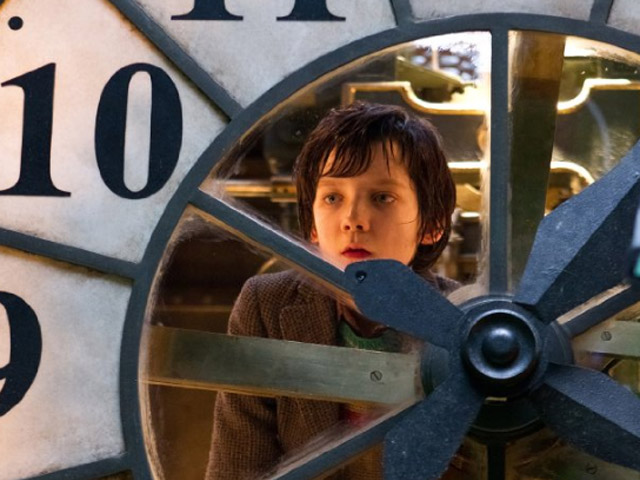
 Martin Scorsese wears his cinematic heart on his sleeve in his first family-friendly film, Hugo. Based on Brian Selznick’s Caldecott-winning 2007 illustrated historical-fiction novel The Invention of Hugo Cabret, the movie follows the adventures of the title character, a homeless orphan boy (Asa Butterfield) who survives by his wits in a Paris train station in the early 1900s. He spends his days stealing small bits of food, winding the big clock, avoiding Inspector Gustav (Sacha Baron Cohen), and trying to find parts for an automaton he is rebuilding, hoping it will have a message for him from his father (Jude Law). He soon makes his only friend, a girl named Isabelle (Chloë Grace Moretz) who is being raised by her godparents, the bitter Papa Georges (Ben Kingsley) and his wife, Mama Jeanne (Helen McCrory). When it turns out that Papa Georges is the one and only Georges Méliès, who made the world’s first science-fiction film, A Trip to the Moon, among hundreds of others, then was thought to have died in obscurity, all of his work destroyed, Hugo and Isabelle, along with the help of film historian René Tabard (Michael Stuhlbarg), are determined to resurrect Papa Georges and his reputation. Gorgeously shot by Robert Richardson and featuring marvelous period sets by Dante Ferretti, Hugo is beautiful to look at, the camera roaming through the immense train station and up the tall clock tower like in a Jules Verne story. Such side plots as the budding romances between a café owner (Frances de la Tour) and the newspaper seller (Richard Griffiths) and between Gustav and a shy flower girl (Emily Mortimer) feel forced, and the main narrative meanders its way into treacly territory as all the parts slowly come together. At its heart, Hugo is a movie about the love of movies, paying tribute to the early cinema of Méliès, Harold Lloyd, and others but it gets too stuck on the underlying theme of the preservation of old films, one of Scorsese’s driving forces. Still, Hugo is a visual treat, particularly in the first half, before things get a little too sticky (and slickly) sweet, even for a children’s film. Hugo is being shown on Pier 46 in Hudson River Park on July 27 as part of the free River Flicks for Kids series, which continues August 3 with Puss in Boots, August 10 with Rango, August 17 with Back to the Future, and August 24 with The Smurfs.