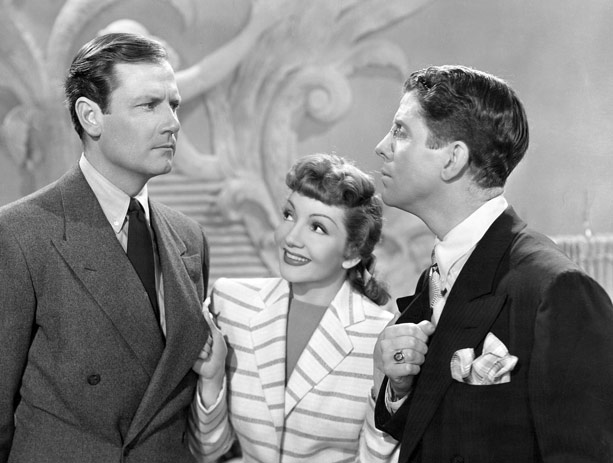
Joel McCrea, Claudette Colbert, and Rudy Vallée are caught up in a romantic triangle in Preston Sturges’s THE PALM BEACH STORY
THE PALM BEACH STORY (Preston Sturges, 1942)
BAMcinématek, BAM Rose Cinemas
30 Lafayette Ave. between Ashland Pl. & St. Felix St.
Friday, August 17, 4:30 & 9:15
Series runs through September 17
212-415-5500
www.bam.org
 Writer-director Preston Sturges was on quite a roll in the early 1940s, making a string of memorable pictures that included The Great McGinty, Christmas in July, The Lady Eve, Sullivan’s Travels, The Miracle of Morgan’s Creek, and Hail the Conquering Hero. In the midst of that amazing run is The Palm Beach Story, one of the craziest of the classic screwball comedies. Running out of money, married couple Tom (Joel McCrea) and Geraldine (Claudette Colbert) Jeffers are preparing to leave their ritzy Park Ave. apartment until a straight-talking, shriveled old wienie king (Robert Dudley) hands Gerry a wad of cash so she doesn’t have to move out. She pays off their many bills, but Tom is suspicious of how she got the money, demanding to know if any sex was involved, a rather risqué question for a 1942 Hays Code-era romantic comedy. Gerry decides that she is no good for Tom and insists on getting a divorce even though they still love each other. So she grabs a train to Florida, meeting the wacky Ale & Quail Club and John D. Hackensacker III (Rudy Vallée), a kind, soft-spoken gentleman who takes a liking to her and helps her out of a jam. Things reach a manic pace as Tom heads to Palm Beach as well, trying to save the marriage while fending off the advances of the the Princess Centimillia (Mary Astor). McCrea and Colbert make a great comic duo in, displaying a fiery sex appeal that is still hot all these years later. What’s not hot is the film’s use of black characters, who are horribly stereotyped and are even referred to as “colored” in the credits. It might have been a different time, but there aren’t a whole lot of quality movies that were that blatant about it. In addition, the shooting scene with the Ale & Quail Club goes way over the top. But when the film focuses on Tom and Gerry, caught up in their own endlessly charming game of cat and mouse, The Palm Beach Story shines. The Palm Beach Story is screening August 17 in the BAMcinématek series “American Gagsters: Great Comedy Teams,” which runs through September 17 and consists of fifty films (all but one in 35mm) featuring fabulous comedic pairings; Sturges’s Sullivan’s Travels, the socially conscious comedy starring McCrea and Veronica Lake, is also being shown on Friday.
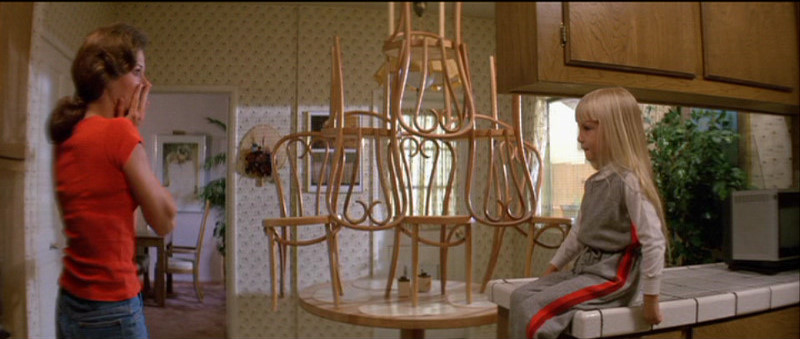
 When psychic Tangina Barrons (Zelda Rubinstein) says “Don’t go into the light,” she means it in more ways than one, so be sure to take heed when Tobe Hooper’s classic modern ghost story screens for free in tree-lined Tompkins Square Park on August 16. Inspired by the 1962 Twilight Zone episode “Little Girl Lost,” Poltergeist, which also features the significant involvement of cowriter and producer Steven Spielberg, has all the elements in all the right places to just plain scare the hell out of you. Shortly after Steven (Craig T. Nelson) and Diane (JoBeth Williams) Freeling move into their new home in the planned California community of Cuesta Verde, things start getting very creepy, especially when youngest daughter Carol Anne (Heather O’Rourke) announces, “They’re here,” then disappears into the television. Meanwhile, older sister Dana (Dominique Dunne) freaks out, and brother Robbie (Oliver Robins) has a bit of a problem with a clown doll and a tree branch. Hooper (The Texas Chain Saw Massacre, Lifeforce) lets the tension build slowly until it eventually explodes in a no-holds-barred ending that will have you digging into the cuticles of whoever is sitting next to you. And yes, those skeletons are real human bones, not replicas. The success of Poltergeist led to two sequels, a television series, and, unfortunately, a possible remake, but there’s nothing quite like the original, a deviously delicious frightfest that continues to send shivers down the spine no matter how often one sees it. And yes, Steven’s boss is indeed played by the Pathmark man (James Karen). Sadly — some say the result of a curse — O’Rourke died in 1988 at the age of twelve, and Dunne, the daughter of writer Dominick Dunne, was murdered by a former boyfriend in 1982 when she was just twenty-two. The Tompkins Square Park screening will be preceded by live music from East Village African rock group
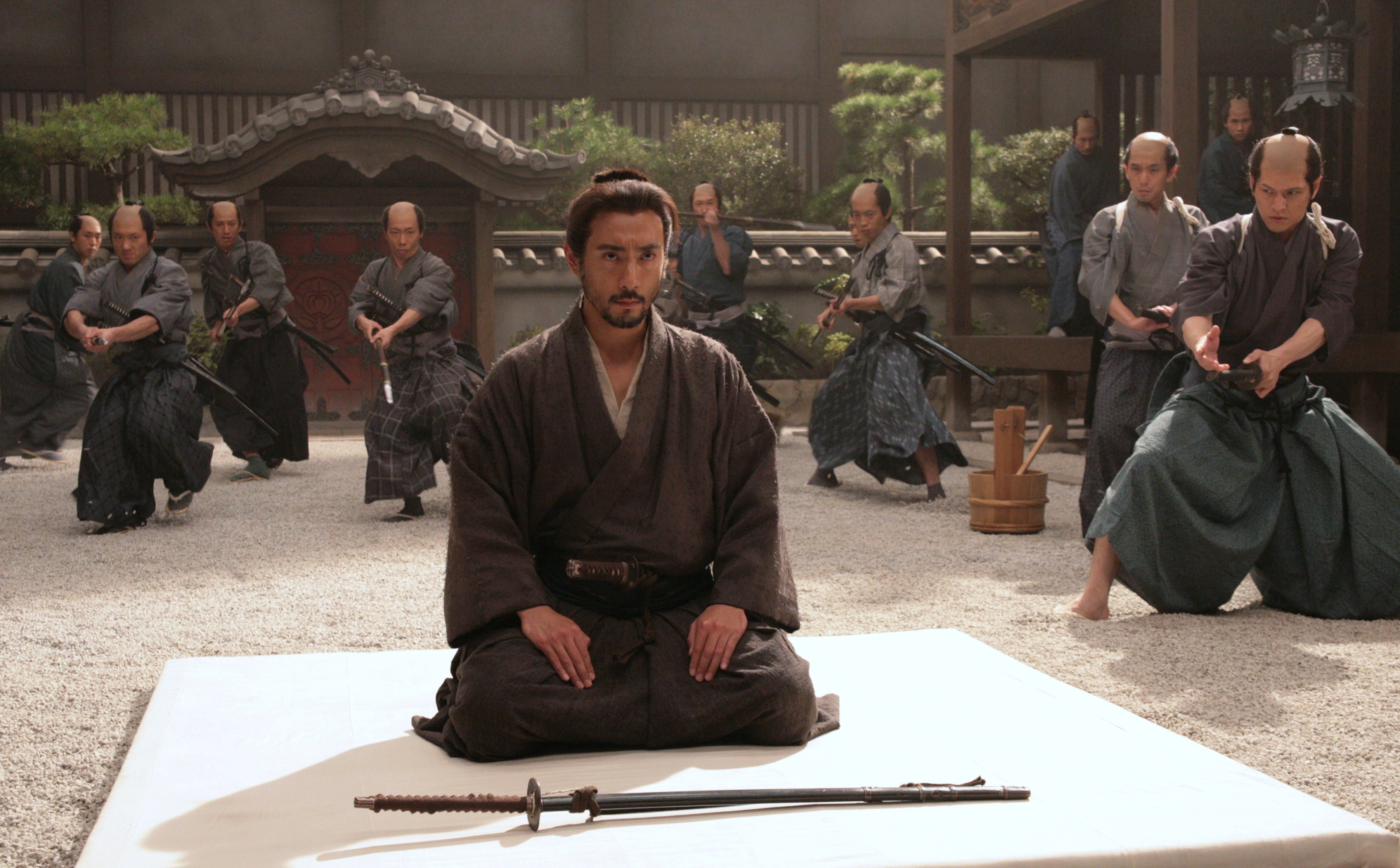
 Nearly fifty years after Masaki Kobayashi’s Harakiri won the Special Jury Award at the 1963 Cannes Film Festival, Takashi Miike’s magnificent 2011 remake was also entered into competition at the prestigious French event. During peaceful times in 1634 Edo, a masterless samurai named Hanshiro Tsukumo (Kabuki star Ebizo Ichikawa) comes to the Lyi clan, requesting permission to commit seppuku in the estate’s courtyard, seeking an honorable death. But clan retainer Kageyu Saito (Kōji Yakusho) and his right-hand man, Hikokuro Omodaka (Munetaka Aoki), believe he might be yet another penniless samurai using a suicide bluff in order to get either a job or money. Trying to discover if the man is serious about wanting to commit hara-kiri, the retainer tells him the horrific story of a young samurai named Motome Chijiiwa (Eita) who requested the same thing two months before. But soon Hanshiro has his own story to tell, one that turns everything around in surprising ways. Miike, who has directed more than eighty movies across a multitude of genres during his twenty-two-year career, including such masterworks as Audition, Ichi the Killer, and Thirteen Assassins, has made his most emotional, compassionate film yet with Hara-Kiri: Death of a Samurai. Ichikawa, taking on the role played in the original by Tatsuya Nakadai, is brilliant as Hanshiro, a deeply thoughtful samurai with a fierce dedication to honor and loyalty. As he stares into Yakusho’s eyes, the tension can be cut with a steel sword. Miike and cinematographer Nobuyasu Kita shot the film in 3D, but they chose not to get gimmicky with the effects, just making the film they wanted to as if it were in regular 2D. “There was no change to my approach other than I was able to go brag to the director shooting at the studio next door and say, ‘Huh? Yours is flat and level? Ours is bumpy and convexo-concave,’” Miike explains in the press notes. Although he adds, “I definitely anticipate making more 3D movies. Next, if I have the chance, I want to have things that shouldn’t come out of our bodies be hurled at the audience.” The 3D adds a beautiful depth to Akira Sakamoto and Kazuto Kagoo’s gorgeous sets, which are enhanced by Yuji Hayashida’s rich art direction, bathed in deep black, white, gray, and red. The 3D also makes it easier to read the subtitles, which pop off the screen, along with the snow. Hara-Kiri might be a thinking person’s samurai movie, but it is still a Miike film, so it also features one of the most brutal suicides ever depicted on celluloid, and it ends with one helluva fight scene.