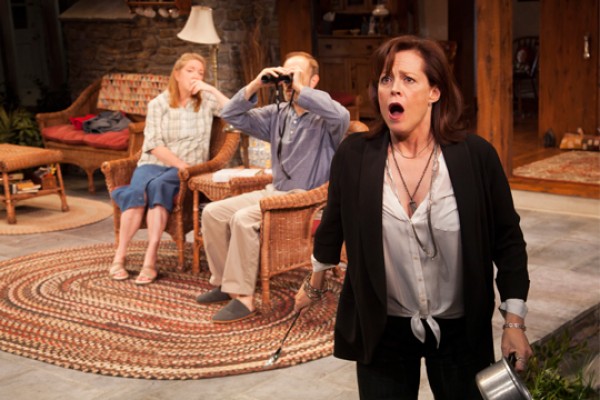
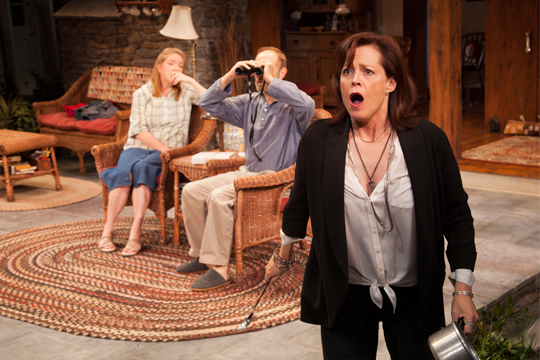
Three siblings (Kristine Nielsen, David Hyde Pierce, and Sigourney Weaver) examine their lives and don’t necessarily like what they see in Christopher Durang’s delightful Chekhovian satire (photo by T. Charles Erickson)
Lincoln Center Theater at the Mitzi E. Newhouse
150 West 65th St. between Broadway & Amsterdam Ave.
Tuesday – Saturday through January 13, $85
212-362-7600
www.lct.org
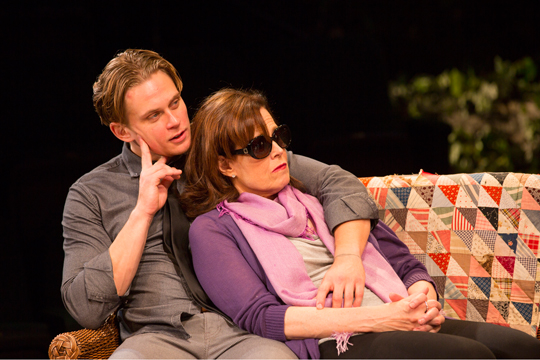
When he was at Yale in the 1970s, Christopher Durang teamed with Albert Innaurato and Jack Feldman on The Idiots Karamazov, a musical about a Russian translator that begins with a song titled “O, We Gotta Get to Moscow,” as she confuses Dostoevsky with Chekhov and other writers. That line shows up again in Durang’s delightful new satire, Vanya and Sonia and Masha and Spike, running through January 13 at Lincoln Center’s Mitzi E. Newhouse theater. Durang sets his latest play in a Bucks County farmhouse by a lake where a blue heron stops by daily, based on the Bucks County farmhouse by a lake with a blue heron where Durang and his partner reside. Living in the fictional house are Vanya (David Hyde Pierce) and Sonia (Kristine Nielsen), a pair of fiftysomething step-siblings who have essentially sacrificed what lives they might have had by taking care of their ill, elderly parents while their sister, Masha (Sigourney Weaver), became a famous movie star gallivanting around the world with five husbands. Clearly, their parents had a thing for Chekhov; Masha is named after characters from The Seagull and Three Sisters, Vanya and the adopted Sonia from Uncle Vanya. Invited to a neighbor’s costume party, Masha arrives at the house in grand diva fashion, overemoting and unable to keep her hands off her hot new boy toy, Spike (Billy Magnussen), who enjoys taking off most of his clothes at a moment’s notice and striking muscular poses. Masha quickly grows jealous when Spike meets young, pretty ingénue Nina (Genevieve Angelson), a wannabe actress named after the young, innocent actress in The Seagull. Meanwhile, the cleaning lady, Cassandra (Shalita Grant), makes dire predictions that keep coming true, just like her namesake, the Greek mythological figure with second sight. As Vanya, Sonia, Masha, Spike, and Nina prepare for the party — Masha insists they all go as characters from Snow White, with Masha as the beautiful protagonist, slyly referencing Weaver’s portrayal of the evil stepmother in the 1997 television movie Snow White: A Tale of Terror — jealousy, fear, deception, childhood resentment, and more bubble to the surface and threaten to erupt, albeit in primarily wacky, hysterical ways, until Vanya lets loose in a tirade to end all tirades.
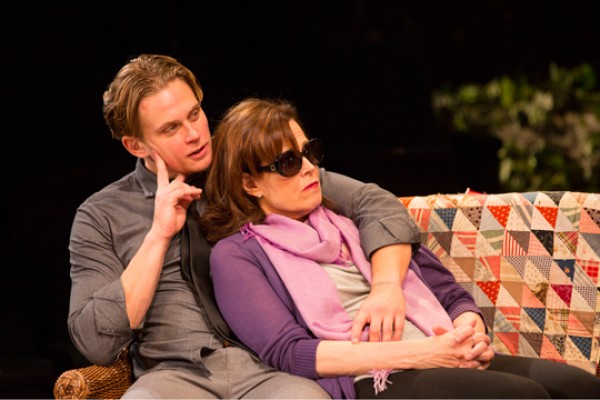
Spike (Billy Magnussen) and Masha (Sigourney Weaver) flaunt their sexual desire in thoroughly enjoyable Durang comedy (photo by T. Charles Erickson)
You don’t need to know anything about Chekhov and his searing dramas about seriously dysfunctional families to get a huge kick out of Vanya and Sonia and Masha and Spike, which has a unique family feel itself — Weaver has been working with Durang since the Yale days, Hyde Pierce starred in the Broadway production of the playwright’s Beyond Therapy (as well as Peter Brook’s The Cherry Orchard), and Nielsen is Durang’s acknowledged muse, having appeared in many of his shows, in parts specifically written for her. Director Nicholas Martin, who previously helmed Durang’s Why Torture Is Wrong, and the People Who Love Them at the Public, keeps things relatively natural and grounded even with Weaver, Magnussen, and Grant playing things deliciously way over the top, as the story’s tender heart is wonderfully captured by Nielsen and Hyde Pierce, who agonize over their loneliness and advancing age, the importance of family, and, perhaps most Chekhovian, a world that seems to be passing them by. Vanya and Sonia and Masha and Spike is a thoroughly enjoyable, if often goofy, mashup from one of America’s most engaging satirists at the top of his game. (On November 30 at 6:00, there will be a Platform Series talk between Durang and Martin in the lobby of the Vivian Beaumont Theater, free and open to the public. And be sure to pick up a copy of the fall 2012 Lincoln Center Review, which includes Durang’s “My Life with Chekhov,” an essay detailing seven encounters he had with the Russian playwright, dating back to when he was fourteen.) [ed note: As of March 1, the production can now be seen on Broadway at the Golden Theatre, where it is running through the end of June.]

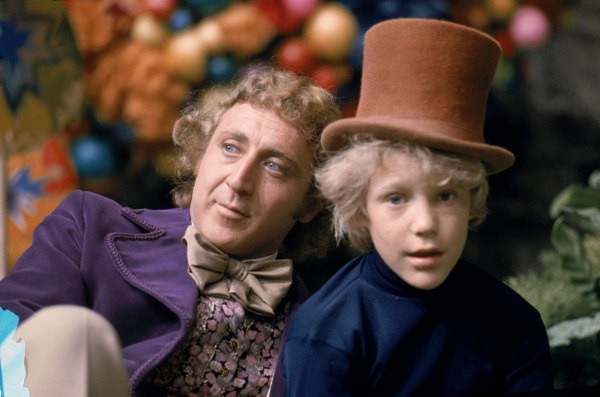
 Based on a 1964 Roald Dahl novel, Willy Wonka & the Chocolate Factory is a fanciful frolic through a children’s wonderland, filled with fear, trepidation, love, and lots of candy, both sweet and sour. Charlie Bucket (Peter Ostrum, in his only film appearance) lives with his dirt-poor family in a ramshackle room, where Grandpa Joe (Jack Albertson) can’t even get out of bed. But when goodhearted Charlie finds one of the golden tickets that will allow him to join a once-in-a-lifetime tour of Willy Wonka’s chocolate factory, Grandpa Joe is suddenly up and about, singing and dancing, and so will you be. Among the other kids with the golden tickets are the spoiled Veruca Salt (Julie Dawn Cole), the selfish Violet Beauregarde (Denise Nickerson), the tube-loving Mike Teevee (Paris Themmen), and the rather sloppy Augustus Gloop (Michael Bollner). As they are led through this dreamland by the unpredictable Willy Wonka (Gene Wilder), they encounter chocolate rivers, bubble machines that make people float, and small Oompa Loompas who are quick to clean up any messes. The soundtrack of this thoroughly entertaining, charming family film includes “The Candy Man Can,” “(I’ve Got a) Golden Ticket,” “Pure Imagination,” and, of course, “Oompa Loompa, Doompa-Dee-Do.” Directed by Mel Stuart, who passed away in August after a career that also included Wattstax, Four Days in November, and If It’s Tuesday, This Must Be Belgium, the film was remade by Tim Burton in 2005 starring Johnny Depp as Wonka with mixed results, but you can catch the original at the Nitehawk Cinema this weekend, with special family screenings at 11:45 am Saturday and Sunday.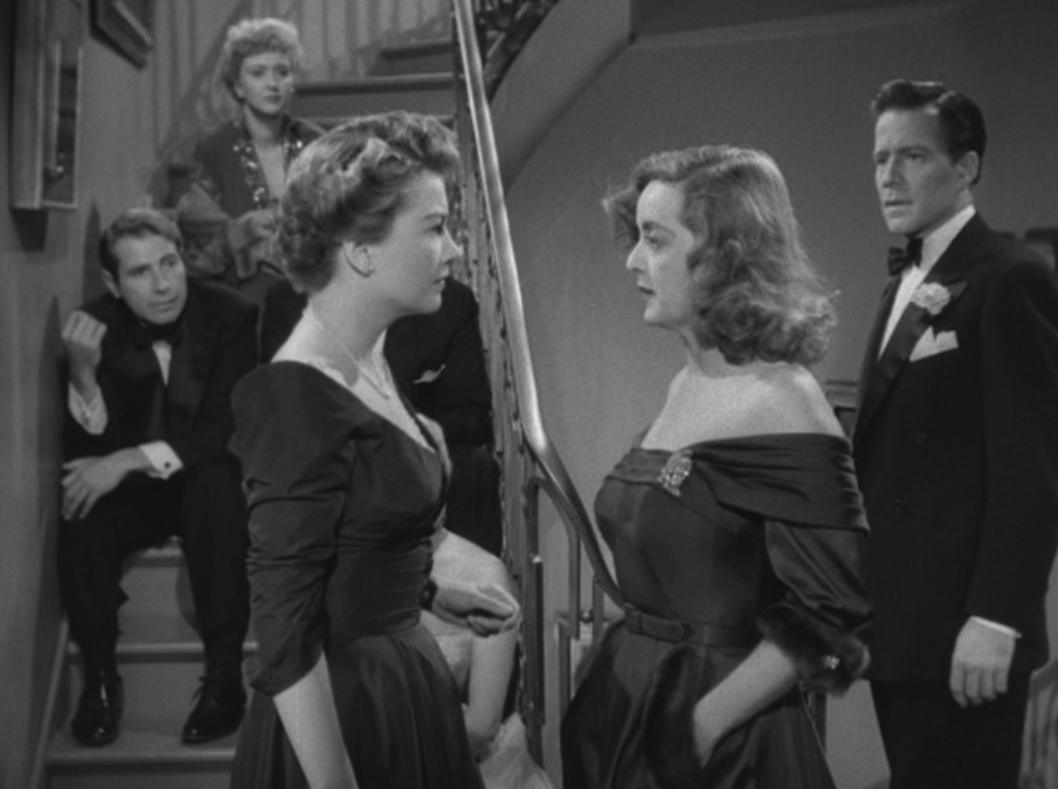
 Nominated for fourteen Academy Awards and winner of six, including Best Picture, Best Director, and Best Screenplay, All About Eve is one of Hollywood’s all-time greatest movies, a searing depiction of naked ambition set on the Great White Way. Based on Mary Orr’s 1946 short story “The Wisdom of Eve,” writer-director Joseph L. Mankiewicz’s flawless drama stars Anne Baxter as Eve Harrington, who is not exactly the mousey wallflower she at first appears to be. She quickly worms her way into an inner circle of Broadway vets populated by superstar Margo Channing (Bette Davis), her younger lover, Bill Sampson (Gary Merrill), playwright and director Lloyd Richards (Hugh Marlowe), and Richards’s wife, Karen (Celeste Holm), who takes Eve under her wing. Joining in on all the fun is powerful theater critic Addison DeWitt (Oscar winner George Sanders), who marvels at all the manipulation and backstage drama, much of which he wickedly orchestrates himself. “There never was, and there never will be, another like you,” DeWitt tells Eve in one of the film’s most poignant moments. All About Eve is filled with classic quotes, including the iconic “Fasten your seatbelts, it’s going to be a bumpy night,” boldly proclaimed by Davis. In a movie about acting and the theater, Mankiewicz never shows anyone onstage; instead, he focuses on the characters and the intrigue with a sly flair that is deliciously entertaining. All About Eve is screening November 23 & 25 as part of the Museum of the Moving Image series “The Cinema and Its Doubles,” consisting of films that involve physical, fantastical, or psychological doppelgängers; the festival continues through December 16 with such films as Alfred Hitchcock’s Shadow of a Doubt, Don Siegel’s Invasion of the Body Snatchers, Robert Mulligan’s The Other, and David Cronenberg’s Dead Ringers.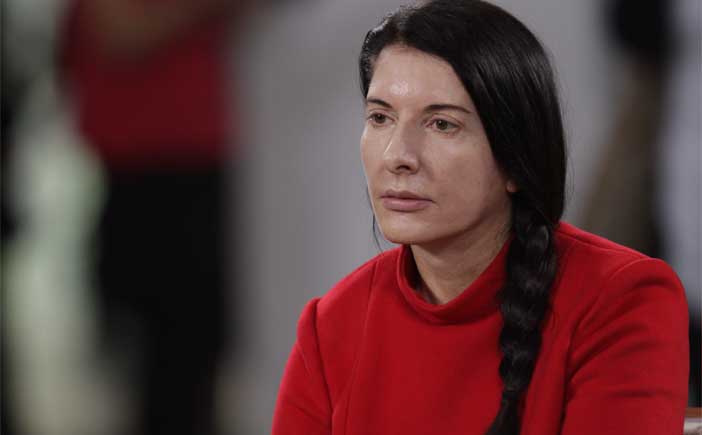
 For forty years, Belgrade-born performance artist Marina Abramović has been presenting cutting-edge, often controversial live works that redefine what art is. For her highly anticipated major career retrospective at MoMA in 2010,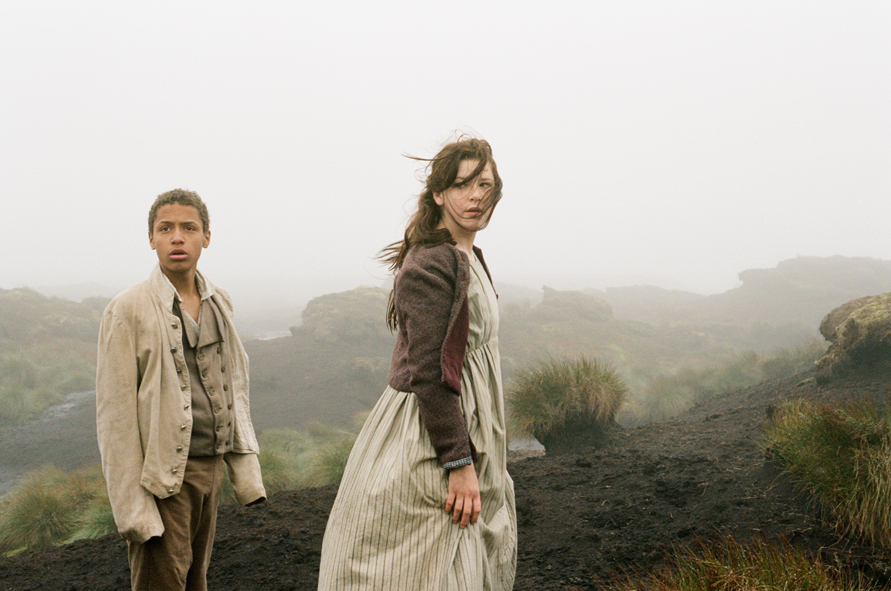
 Digging deep into Emily Brontё’s classic — and only — novel, writer-director Andrea Arnold creates a radically different Wuthering Heights from such previous versions starring Laurence Olivier and Merle Oberon (1939), Keith Michell and Claire Bloom (1962), and Ralph Fiennes and Juliette Binoche (1992). Setting the bar high following her exceptional first two films,