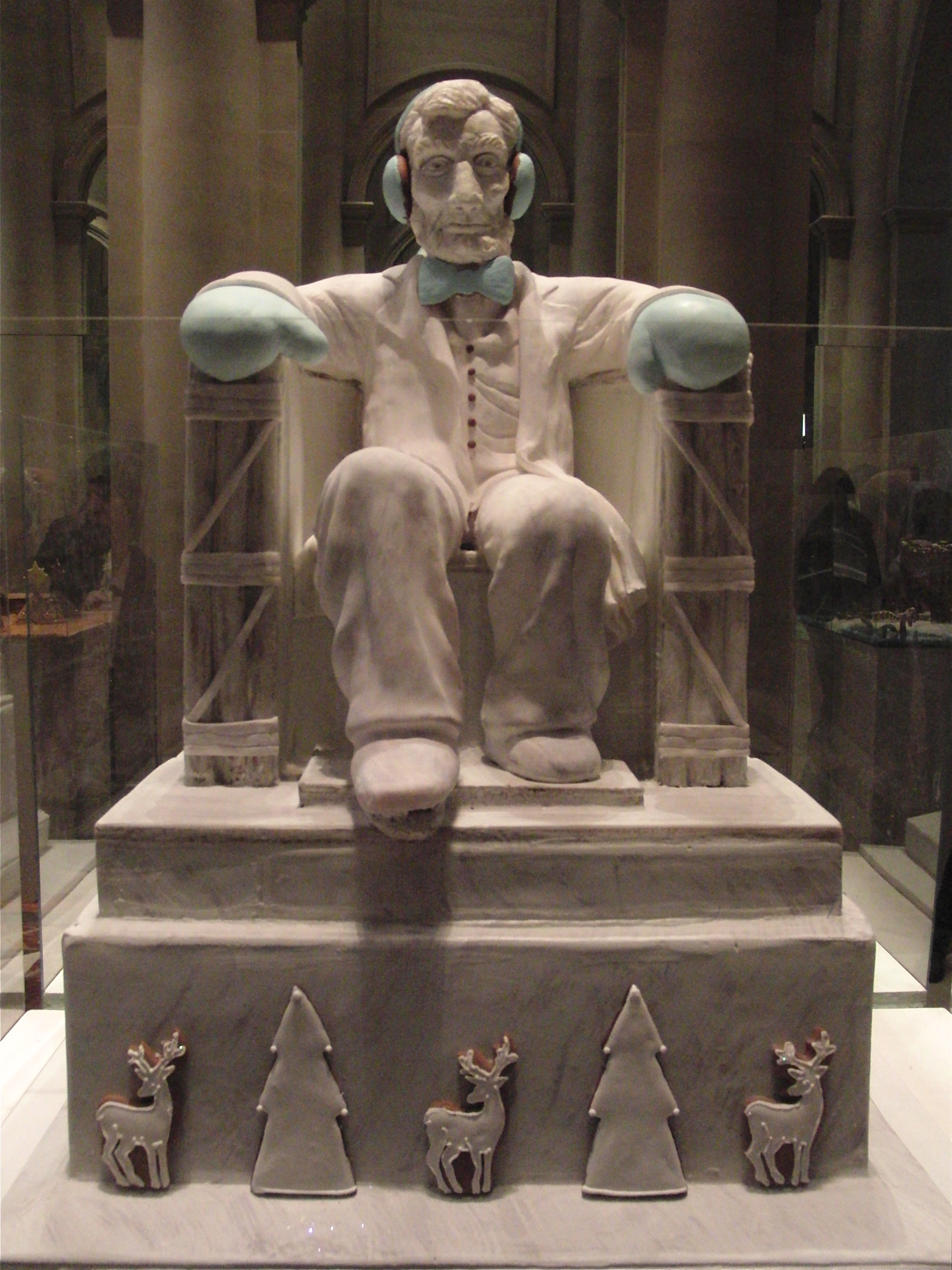
Baked Ideas honors the sixteenth president of the United States in its creative gingerbread house at Le Parker Meridien (photo by twi-ny/mdr)
LANDMARKS FROM AROUND THE WORLD
Le Parker Meridien, 56th St. atrium lobby
119 West 56th St. between Sixth & Seventh Aves.
Daily through January 3, free
212-245-5000
www.parkermeridien.com
gingerbread extravaganza slideshow
Gingerbread dates back thousands of years, to the time of the ancient Greeks and Egyptians. In the late sixteenth century, Queen Elizabeth I had gingerbread cookies designed to look like visiting guests. In the early seventeenth century, German families would pick up gingerbread creations in the Christlindlmarkt, baked by the Lebkuchler. And in 1812, the Brothers Grimm published “Hansel and Gretel,” a story of two children who get trapped by a witch in a house made of gingerbread and candy. The result is that wonderfully designed gingerbread cakes and cookies have become a longtime Christmas tradition in America. And fantastical gingerbread houses have now become a tradition at Le Parker Meridien in Midtown Manhattan, where the third annual Gingerbread Extravaganza continues through January 3. This year’s theme is “Landmarks Around the World,” with a half dozen inventive constructions made out of gingerbread. Baked Ideas has built a fabulous white-iced version of the Lincoln Memorial, featuring the sixteenth president keeping warm with charming blue earmuffs and mittens, looking rather regal in his blue bowtie. Hell’s Kitchen dessert bar Kyotofu has re-created the Edo-era Toji Tower, a World Heritage Site. Butterfly Bakeshop has constructed a gingerbread model of the Mayan city Chichen Itza. Rolling Pin Productions and Park Slope’s Aperitivo restaurant have designed one of the Seven Wonders of the Ancient World, the Great Sphinx of Giza — with a fondant Santa hat. Downtown’s North End Grill has come up with a model of Scotland’s historic Urquhart Castle, complete with the Loch Ness Monster rising from the water. And Le Parker Meridien’s own Norma’s has hoisted “Hurri-Crane,” a depiction of the dangling crane that hovered over Midtown after Sandy hit, surrounded by police cars, fire trucks, and curious onlookers. (There appears to have been a seventh entry, David Burke’s Chrysler Building, but it doesn’t seem to have made it.) The event is a fundraiser for City Harvest; visitors are encouraged to vote for their favorite gingerbread display, with individual ballots available for one dollar each or five dollars for eight. One winning voter will win a five-day trip to the Parker Palm Springs in California.
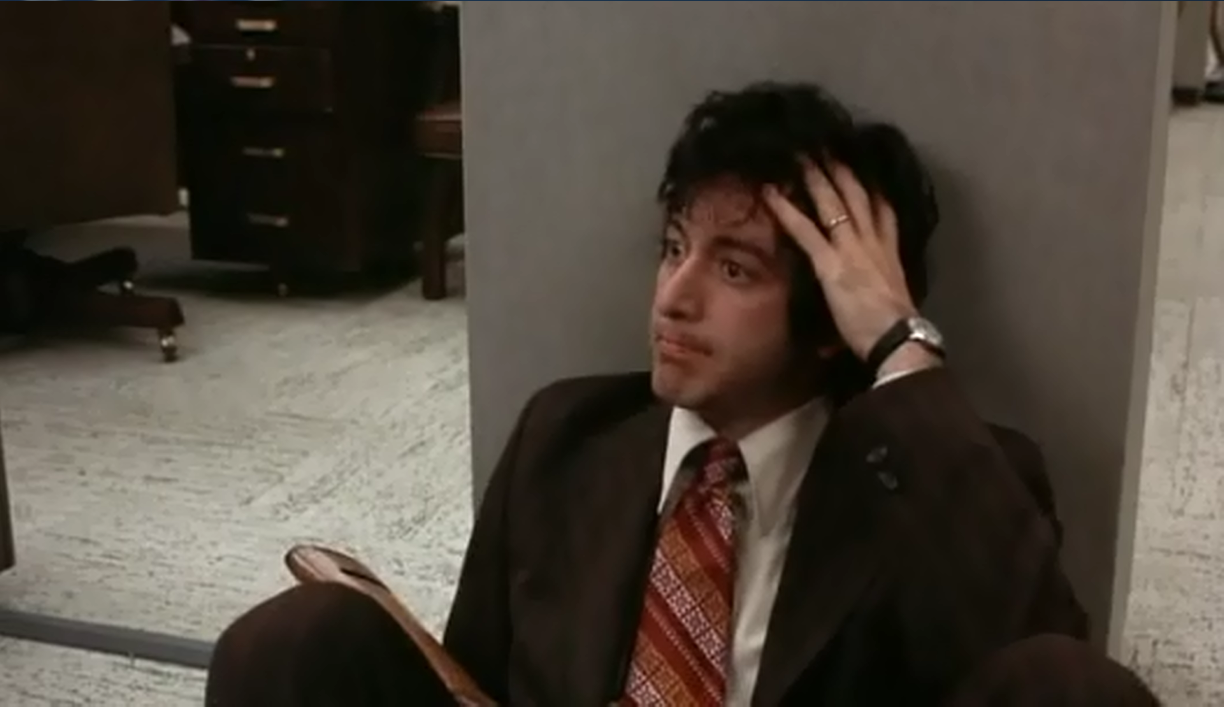
 Anthology Film Archives’ “From the Pen of . . .” series, honoring some of the great cinema scribes and source writers, continues with a pair of tense, powerful fact-based dramas directed by Sidney Lumet and starring Bronx native Al Pacino that helped define the 1970s, both onscreen and off. In Dog Day Afternoon, one of the most bizarre bank robberies gone wrong you’ll ever see, Pacino stars as Sonny, a confused young man desperate to get money to pay for his boyfriend’s (Chris Sarandon) sex-change operation. But things don’t go quite as planned, and soon Sonny is leading the gathered crowd in chants of “Attica! Attica!” while his partner, Sal (John Cazale), wants a plane to take them to Wyoming and Det. Moretti (Charles Durning) is trying to get them to surrender without hurting anyone, primarily themselves. Written by Frank Pierson — who won an Oscar for Best Original Screenplay — Dog Day Afternoon is a blistering, funny, biting commentary on mid-’70s New York as well as a fascinating character study of a deeply conflicted man. In Serpico, another gritty, realistic drama, Pacino gives an unforgettable performance as an undercover cop single-handedly trying to end the rampant corruption that has spread like a disease throughout the NYPD. When his fellow officers and supposed friends turn their back on him, he is left on his own, vulnerable but still committed, risking both his career and his life to do what he thinks is right. Based on Peter Maas’s book, Serpico earned a Best Adapted Screenplay Oscar nomination for Waldo Salt and Norman Wexler. Pacino is explosive in both films, playing two very different protagonists on different sides of the law yet similar in so many ways. The series runs through December 10 with such other films as Midnight Cowboy, Cat Ballou, French Connection II, and The Seven-Ups.
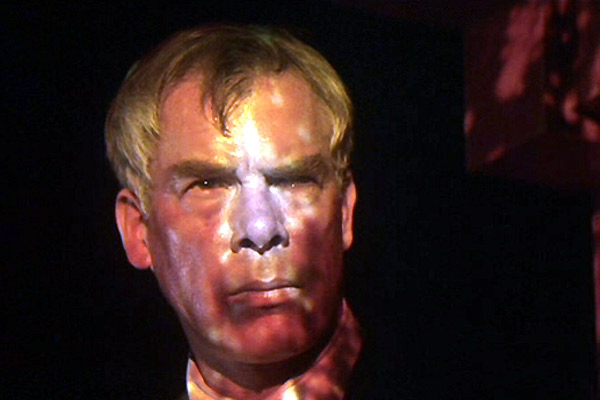
 John Boorman’s Point Blank is an oxymoronic psychedelic film noir, a violent psychological thriller about a determined man dead set on vengeance. Lee Marvin — on quite a hot streak following Cat Ballou, Ship of Fools, The Professionals, and The Dirty Dozen — stars as the one-named Walker, a sincere, old-fashioned man who is double-crossed by his wife, Lynne (Sharon Acker), and friend, Mal Reese (John Vernon, in his film debut), when a deal goes bad on Alcatraz. Searching for Reese, Walker hooks up with Lynne’s sister, Chris (Angie Dickinson), a sexy femme fatale who owns a hot club in the Bay Area. As Walker makes his way up the criminal organization ladder in his quest to get the $93,000 he’s owed, he leaves behind a bloody trail that keeps getting messier and messier. Adapted by Alexander Jacobs and David and Rafe Newhouse from Donald Westlake’s first Parker novel, The Hunter, Boorman’s film is like the antihero Walker himself, purposefully out of time and place. Walker is essentially an anachronism as he makes his way through Point Blank, evoking John Wayne’s Ethan Edwards in John Ford’s classic Western The Searchers. The Summer of Love seems to have had no effect on Walker, who still primarily dresses in dull colors — until Chris brings out the color in him, particularly in one memorable scene in which they both are wearing bright yellow and spy on Reese’s hideaway through a yellow telescope. Film noir is by definition set in a black-and-white world, but Walker can’t hide from the old ways anymore, as he shows when groovy colored lights flash on him in Chris’s club.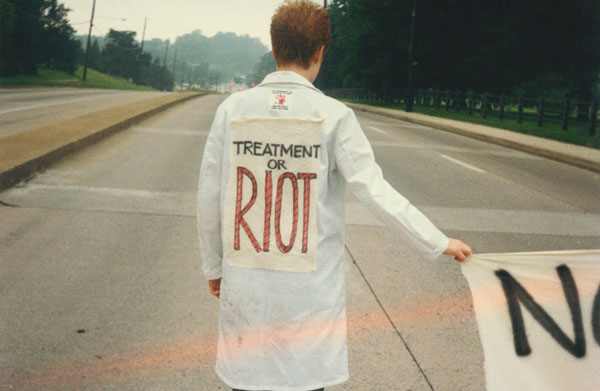
 Contemporary activists stand to learn a lot from the gripping documentary How to Survive a Plague. For his directorial debut, longtime journalist David France, one of the first reporters to cover the AIDS crisis that began in the early 1980s, scoured through more than seven hundred hours of mostly never-before-seen archival footage and home movies of protests, meetings, public actions, and other elements of the concerted effort to get politicians and the pharmaceutical industry to recognize the growing health epidemic and do something as the death toll quickly rose into the millions. Focusing on radical groups ACT UP and TAG (Treatment Action Group), France follows such activist leaders as Peter Staley, Mark Harrington, Larry Kramer, Bob Rafsky, and Dr. Iris Long as they attack the policies of President George H. W. Bush, famously heckle presidential candidate Bill Clinton, and battle to get drug companies to create affordable, effective AIDS medicine, all while continuing to bury loved ones in both public and private ceremonies. France includes new interviews with many key activists who reveal surprising details about the movement, providing a sort of fight-the-power primer about how to get things done. The film also shines a light on lesser-known heroes, several filled with anger and rage, others much calmer, who fought through tremendous adversity to make a difference and ultimately save millions of lives. How to Survive a Plague is being shown on World AIDS Day, December 1, at 7:00 as part of MoMA’s annual series “The Contenders,” consisting of exemplary films they believe will stand the test of time, with France on hand to participate in a postscreening discussion; upcoming entries include Peter Ramsey’s Rise of the Guardians, Ben Lewin’s The Sessions, and Behn Zeitlin’s Beasts of the Southern Wild.