live performance

RONALD K. BROWN/EVIDENCE: OPEN DOOR/THE EQUALITY OF NIGHT AND DAY/GRACE

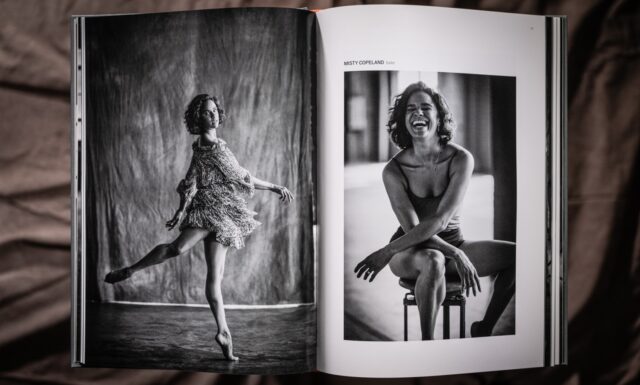
Ronald K. Brown’s The Equality of Night and Day makes its stunning NYC premiere at the Joyce this week (photo by Rose Eichenbaum)

Ronald K. Brown/EVIDENCE, a Dance Company
The Joyce Theater
175 Eighth Ave. at 19th St.
January 17-22, $51-$71
212-691-9740
www.joyce.org
www.evidencedance.com

“When I work, in all situations, people meet me and they say, ‘You create family wherever you go,’ and so I think I have a nurturing side but I demand a lot,” Brooklyn-based choreographer Ronald K. Brown explains in an Alvin Ailey video about the making of Open Door, a piece Brown made for Alvin Ailey American Dance Theater in 2015. “Why do you have to open the door, how do you open the door, this whole thing of easing, pushing through the door . . .”

Brown created a sense of family and community yet again when his troupe, EVIDENCE, a Dance Company, kicked off its home season at the Joyce on January 17. The program started, appropriately enough, with the company premiere of Open Door, which was inspired by Brown’s travels to Cuba. In front of a screen that changes colors (the lighting is by Tsubasa Kamei), Arturo O’Farrill’s eight-piece Afro Latin Jazz Ensemble performs Luis Demetrio’s “La Puerta,” Tito Puente’s “Picadillo,” and O’Farrill’s “All of the Americas” (from his “Afro Latin Jazz Suite”) and “Vaca Frita” as nine dancers move about the stage, led by solos and duets by Shaylin D. Watson and Isaiah K. Harvey. Originally commissioned for AAADT in 2015, it’s an uplifting twenty-six minutes, with the dancers often putting out their palms in gestures of welcome, beckoning not only fellow dancers but immigrants from Cuba and around the globe.

Open Door is just the right aperitif for the world premiere of The Equality of Night and Day (TEND), a sizzling emotional work in which Brown gets more explicit as he tackles his recurrent themes of social injustice and racism. Five men (Demetrius Burns, Austin Coats, Randall Riley, Christopher Salango, Harvey) and five women (Watson, Shayla Caldwell, Joyce Edwards, Stephanie Chronopoulos, Breana Moore), in loose-fitting flowing blue costumes by Omotayo Wunmi Olaiya, gather and separate to a powerful original score by pianist Jason Moran and the rallying words of activist and writer Angela Davis, who declared in a 2017 speech at Brown, “During the coming period, our primary job will be to build community, to create community — in ways that allow us to understand that the work that we do now does matter, even if we cannot see in an immediate sense the consequences of the work we are doing. It will matter eventually.”

Photos of protests from the last half century and more, curated by Debra Wills, are projected on the back screen, instilling a sense of immediacy in the proceedings, which are highlighted by poignant movement by Burns, Caldwell, and Edwards, the men at one point covering their faces and letting out primeval screams. Later the dancers remove their tops and walk around in a kind of memorial prayer for Black bodies, reacting to Davis’s facts about the racial imbalance in crime and punishment.

The evening concludes with Brown’s half-hour classic, Grace, an appropriate finale providing subtle elegance following the exuberance of Open Door and the psychological intensity of TEND. Commissioned for AAADT in 1999, the deeply spiritual piece begins with Edwards standing in a large doorway at the back of the stage; as opposed to the first two works, where the dancers often came onto the stage with a swagger, here they mostly walk on and off calmly, five women and six men in lovely white or red costumes by Olaiya. They strut out their elbows and their hands reach for the sky to songs by Duke Ellington, Roy Davis Jr., and Fela Kuti, spreading the energy to the audience.

Some years back, I saw Grace at the Joyce with Brown himself dancing a major role. The Bed-Stuy native saved one final, exhilarating moment for the curtain call on January 17, cementing the loving community he had built over the course of the program. He came onstage to uproarious applause, walking gently with a four-pronged cane and being helped by his partner and associate artistic director, Arcell Cabuag. Brown suffered a debilitating stroke in April 2021, at the age of fifty-four, shortly after a residency at Jacob’s Pillow to develop TEND, but has vowed to walk again on his own, and he is ahead of his doctors’ prognosis. The smile on his face was infectious, assuring everyone that there is a promising future to look forward to for all of us.

THEASTER GATES: YOUNG LORDS AND THEIR TRACES — SPECIAL EVENTS

Theaster Gates pays homage to his father and his own childhood in Sweet Chariot and Seven Songs for Black Chapel #1–7 at the New Museum (photo by twi-ny/mdr)

THEASTER GATES: YOUNG LORDS AND THEIR TRACES
New Museum
235 Bowery at Prince St.
Tuesday – Sunday through February 5, $12-$18
www.newmuseum.org
online slideshow

“I make designations between a thing that I made that’s art, a thing I had fabricated that’s art, and a thing that was a preexisting thing that I put alongside other things that were made or fabricated. I don’t necessarily say, ‘Oh, this is all art,’ even though it’s all art, but I think that there are moments when I’m just trying to put things alongside each other like you would in your house or like you would in a shrine,” Chicago-born multidisciplinary artist Theaster Gates says in a video for his elegiac, beautiful, deeply moving “Theaster Gates: Young Lords and Their Traces,” continuing at the New Museum through February 5. “This show is about people who I’ve lost and the things that they left for me, or people who I love and the monument of love that I want to show for them.”

In the three-floor exhibition, curated by Massimiliano Gioni and Gary Carrion-Murayari, Gates pays homage to curator Okwui Enwezor, writer bell hooks, fashion designer Virgil Abloh, scholar Robert Bird, and enslaved potter David Drake (Dave the Potter) as well as his mother (Bathroom Believer), a devout Christian, and his father, a roofer (Roof Strategies for Museum Corridor, Sweet Chariot). Gates repurposes found objects gathered from demolished buildings and construction, including from St. Laurence Church on the South Side of Chicago and Park Avenue Armory in Manhattan, where he hosted “Black Artists Retreat 2019: Sonic Imagination.” Among the highlights of the show are Black Madonna, encased in a vitrine; the short film A Clay Sermon; a music video of Gates and the Black Monks of Mississippi performing an extended improvisational “Amazing Grace”; the fifty-foot-long Roof Strategies for Museum Corridor; and the silver monochrome Seven Songs for Black Chapel, which harkens back to Gates’s childhood.

There are still several special events being held at the New Museum in conjunction with this first-ever museum retrospective of the work of Gates, who turns fifty this year. On January 19 at 6:30 ($10), the panel discussion “Resurrections: Theaster Gates” features curators Jessica Bell Brown and Dieter Roelstraete and LAXART director Hamza Walker, moderated by Carrion-Murayari. On January 21 at noon (free with museum admission), independent archivist and memory worker Zakiya Collier will facilitate an “Out of Bounds” gallery talk about Gates’s archiving practices. On January 21-22 and from January 31 to February 3 (except January 30; free with museum admission), keyboardist and composer Shedrick Mitchell will activate the Hammond B3 organ in A Heavenly Chord, performing his unique mix of Gospel, reggae, R&B, jazz, and new age music. From February 3 to 5, Gates and the Black Monks will play impromptu performances in the fourth-floor gallery. And on February 4 at 4:00 ($8), Gates will be in conversation with writer and scholar Saidiya Hartman. But you needn’t rely on a special event to get you to the New Museum to see this well-designed, uncluttered, intimate exhibit, which also deals with social injustice, racism, and faith.

KIMBERLY AKIMBO

Kimberly (Victoria Clark) and Seth (Justin Cooley) become good friends in Kimberly Akimbo (photo © Joan Marcus)

KIMBERLY AKIMBO
Booth Theatre
222 West 45th St. between Broadway & Eighth Ave.
Tuesday – Sunday through March 26, $84 – $419
kimberlyakimbothemusical.com

Broadway shows about death and dying tend to be serious affairs. Plays such as The Shadow Box, Marvin’s Room, Angels in America, ’night, Mother, and Whose Life Is It Anyway? are not lighthearted comedies; Wit is not exactly a laugh riot. (By the way, those six works have four Pulitzers between them.) But right now, Mike Birbiglia is facing his own mortality every night in his hilarious one-man show The Old Man & the Pool, at the Vivian Beaumont, while Kimberly Akimbo, an unusual, life-affirming musical about a high school girl with a terminal illness, is delighting audiences at the Booth.

Making a smooth transition from its fall 2021 debut at the Atlantic, Kimberly Akimbo is the must-see musical of the season. Adapted by Pulitzer winner David Lindsay-Abaire from his 2000 play of the same name, the show tackles how awkward kids can be during their teen years, as evidenced by the title. Kimberly Levaco (Victoria Clark), who is approaching her sixteenth birthday, becomes friends with super-nerd Seth (Justin Cooley), who is obsessed with anagrams; rearranging the letters in her name, he rechristens her Cleverly Akimbo. The show, the character, and Clark are all that and more.

Kimberly has an extremely rare genetic disorder, similar to progeria, in which she ages at four or five times the normal rate. Most girls look forward to turning sweet sixteen, but for Kimberly, she would be nearing the equivalent of eighty; she is magnificently portrayed by Tony winner Clark, who is sixty-three but infuses the part with a glorious enthusiasm and affection for life and what it offers, living every minute to its fullest, understanding it could — and will — all be over at any second.

Kimberly’s mother, Pattie (Alli Mauzey), is pregnant, stuck at home with carpal tunnel in both hands and making videos for her unborn child. “There’s a high probability that I might be dead soon. / So I won’t be around when you’re growing up, / and this video is the only way for you to know who I was. / And I want you to know who I was because / people are going to tell you things about me that just aren’t true,” she sings insensitively, bringing up her own potential death and focusing on her fetus instead of paying attention to Kimberly, who really is dying and might never get to meet her sibling.

Kimberly’s father, Buddy (Steven Boyer), is a low-level gambler and drinker who works at a gas station and does not know how to express love for his daughter; he’s still too much of a child himself. “I should be happy for her,” he sings when she makes a new friend, but he doesn’t know how. “I should be happy.” Later, he says, “I never pictured myself a father. I mean, I like kids, I just . . . I’m more of a bachelor uncle type.” He is more excited than Kimberly when he wins a Game Boy in a bet.

Kimberly (Victoria Clark, center) has issues with her parents (Alli Mauzey and Steven Boyer) in Broadway musical (photo © Joan Marcus)

Kimberly teams up with Seth for their sophomore bio class project, in which they have to explore a disease. Seth wants to use Kimberly’s condition, but she’s not so sure. Meanwhile, the quartet of Delia (Olivia Elease Hardy), Martin (Fernell Hogan), Aaron (Michael Iskander), and Teresa (Nina White) is pairing up for the project and preparing for Show Choir, a competition against other schools. In a fab subplot, they are also trying to figure out how to pair up relationship-wise, not quite knowing yet who’s gay or straight and who likes who.

They are planning on performing a medley from Dreamgirls.. It’s no accident that Lindsay-Abaire chose that particular musical, whose title song begins, “Every man has his own special dream / and your dream’s just about to come true / Life’s not as bad as it may seem if you / open your eyes to what’s in front of you.” High school kids are supposed to dream about the future, but Kimberly is running out of time. Meanwhile their main rival, West Orange, is doing Evita, a musical about Argentinian leader Eva Perón, whose life was cut short by cancer at the age of thirty-three.

Everything goes even more akimbo when Buddy’s sister, Debra (Bonnie Milligan), the black sheep of the family, arrives unexpectedly; the Levacos had escaped Lodi to get away from Debra, who has a penchant for breaking the law with a greedy selfishness and spending time in the hoosegow. She has a master plan involving bank fraud and a stolen US mailbox — itself a funny prop because the younger generations today mainly think of them as relics in the age of social media and texting, similar to pay phones — and attempts to get Kimberly, Seth, Delia, Martin, Aaron, and Teresa to help her with the scheme.

As Kimberly’s sixteenth birthday approaches, the cleverly askew storylines all come together for a poignant finale.

Debra (Bonnie Milligan) finds a crew to attempt a heist in Kimberly Akimbo (photo © Joan Marcus)

Kimberly Akimbo is about much more than a teen with a horrible disease; it’s a spectacularly insightful depiction of the joys and fears that teens experience, at school and at home, with friends and family, as they mature into young adults. Kimberly has an illness that strikes only one in fifty million people — meaning only seven people in the United States might have it — but she represents us all, children and grown-ups. Lindsay-Abaire’s (Rabbit Hole, Ripcord) book and lyrics capture the exhilarating highs and the devastating lows that are parts of everyday life, which is like an endless series of anagrams we try to unravel; when Pattie says, “I hate getting old,” she’s not just speaking for herself. And when she shares her anxiety over having another baby and Kimberly declares, “Scared it would be like me?,” it’s a feeling many can relate to. As Kimberly sings in “Anagram”: “With a change of perspective . . . ha-ha-ha-ha . . . / nothing’s defective / I wonder what you see / when you look at me.”

Tony winner Jeanine Tesori’s (Fun Home, Caroline, or Change) score matches the ups and downs of the plot, from the tender piano of “Anagram” to the jubilance of “Skater Planet” and “This Time,” with playful choreography by Danny Mefford (how do they ice skate like that?), realistic costumes by Sarah Laux, and terrific sets by David Zinn that range from a suburban skating rink to a high school hallway to the Levaco living room.

Mauzey (Wicked, Cry-Baby) and Boyer (Hand to God, Time and the Conways) are terrific as Kimberly’s parents, who attempt to navigate through what for them is also a traumatic situation, knowing their teenage daughter will not be with them much longer, while Jimmy Awards finalist Cooley excels as the awkward but determined and hopeful Seth, and Milligan (Head Over Heels, Gigantic), as a thief, essentially steals every scene she’s in.

But the centerpiece of the show is the unforgettable performance by Clark (Gigi, Sister Act), who won her Tony for The Light in the Piazza before most of the rest of the cast members were born, or were mere babes. Her every movement and gesture, her voice, and, most critically, her bright, searching eyes will have you convinced she is a fifteen-year-old high school student carrying all the requisite baggage — while also knowing that any day could be her last. But the show is not about aging and death; it’s an infectious celebration of life.

At one point, Martin says, “Who cares? It’s not like any of this counts.” Seth responds, “What do you mean?” Martin answers, “I mean, high school. This town. It’s not even real life. It’s just the crap you have to get through before you get to the good part.” Teresa chimes in, “And what’s the good part?” Martin answers, “Um, the rest of our lives?” Kimberly Akimbo makes it clear that right now is the good part, no matter how long the rest of your life is.

BLOOD COUNTESS

Countess Elizabeth Báthory (Sara Fellini) is surrounded by her husband (Luke Couzens) and a demon (Jillian Cicalese) in spit&vigor’s Blood Countess (photo by Giancarlo Osaben)

BLOOD COUNTESS
The Players Theatre
115 MacDougal St. between West Third & Bleecker Sts.
Thursday – Sunday through February 5, $52-$99
www.spitnvigor.com

I specifically chose Friday the thirteenth to see spit&vigor’s Blood Countess, about real-life Hungarian serial killer Countess Elizabeth Báthory de Ecsed. I had previously enjoyed the NYC-based company’s The Wake of Dorcas Kelly, about an eighteenth-century Irish murderer, and the livestreamed Luna Eclipse, which involved yet another serial killer, the Axeman of New Orleans.

Alas, this Friday the thirteenth proved to be unlucky.

I cannot in good faith review the production, as several unforeseen distractions prevented me from having the experience the talented troupe intended. During the first ten minutes, a man sitting across the aisle from me continually checked his cell phone. The fourth time was enough for me; I got up and asked him to please keep it off. He looked at me as if I were a lunatic; I told him the light was distracting — turning on a cell phone in a dark theater instantly gets the attention of anyone in the proximity of the digital abuser — and he begrudgingly turned it off. As I sat back down, both he and the woman with him gave me accusatory stares, as if I had done something untenable. Later in the first act, the woman turned her cell phone on, bathing her face in a majestic glow; if she had left it on for one second longer, I would have said something again, but I did not want to interfere with other people’s experience or with the cast itself in the small, intimate Players Theatre.

However, another light bothered me as well; the set includes several long, vertical mirrors, and during the scenes that take place in the countess’s living room, one of the lights reflected right into my eyes, forcing me to twist uncomfortably in my chair to avoid the glare. It is general admission, so I could have moved, but I did not want to get up again and disturb those around me or onstage.

Evil doings are afoot in Blood Countess at the Players Theatre (photo by Giancarlo Osaben)

Finally, and inexplicably, during the first half of the second act, another conversation could be distinctly heard. My wife and I could not tell whether it was coming from the comedy club or the theater on either side of the Players, from The Dog Show upstairs, or from a radio or television in a connected apartment. At times we could make out specific words and statements, and the noise came at inopportune moments. At one point, a threatened young woman asked a priest about her stay at the countess’s estate, “Will I die there, Father?” and one of the people in the disembodied conversation let out a loud “Ha ha ha!”

When Elizabeth tells her Goth-Shakespearean fool, “I’m exhausted. The sound of their chirpy voices is a knife in my head,” I thought it might have been an ad-lib, especially when that was shortly followed by Elizabeth’s pronouncement: “I need more wine. If I hear another giggle I think I will chop them all up now and gorge myself.”

The horror-comedy, which runs 135 minutes with intermission, was written by Kelleen Conway Blanchard and is directed by producer Nick Thomas. I have to give kudos to the cast for soldiering on despite this terrible interference: visual designer Sara Fellini as the countess; fight choreographer Luke Couzens as Ferenc Nádasdy, Elizabeth’s husband; Sara Santucci as Dorkus, the embattled family maid; Perri Yaniv as the priest; Samantha Haviland as Fitzco, the evil harlequin fool; Andrea Woodbridge as Elizabeth’s high-brow mother; Jillian Cicalese as the demonic Horned Woman, in a stunning costume on stilts; and Chloé Bell, Silvana Carranza, and Cait Murphy as potential victims.

Thus, while I feel I can’t objectively review the show, I can say that I was rooting for one more murder, the bloodier the better: whoever was responsible for that baffling, godforsaken noise, especially on Friday the thirteenth.

RONALD K. BROWN/EVIDENCE AT THE JOYCE

Ronald K. Brown/EVIDENCE presents New York premiere at the Joyce next week (photo by Rose Eichenbaum)

Ronald K. Brown/EVIDENCE, a Dance Company
The Joyce Theater
175 Eighth Ave. at 19th St.
January 17-22, $51-$71
212-691-9740
www.joyce.org
www.evidencedance.com

Discussing “the grief and the weight of everything that we feel,” choreographer Ronald K. Brown says, in a Jacob’s Pillow behind-the-scenes video of the making of his latest work, The Equality of Night and Day (TEND), “I want us to find that joy and make sure that everyone understands that this is the destination in the word equality. That it’s the destination of this kind of . . . serenity.”

Since 1985, Bed-Stuy native Brown has been choreographing illuminating works for his Brooklyn-based troupe, EVIDENCE, melding classical ballet and traditional West African movement to create powerful and exhilarating contemporary pieces steeped in social justice, honoring the ancestors, and celebrating community. Through January 15, Brown is curating American Dance Platform at the Joyce, featuring Les Ballet Afrik, B. Moore Dance, and waheedworks. “I remember the first time EVIDENCE, a Dance Company was on the Joyce stage over twenty years ago,” Brown writes in the program. “It was a monumental moment for us and I hope that these three companies will benefit from the exposure that the platform provides.”

Following American Dance Platform, EVIDENCE returns to the Joyce stage for its 2023 home season, presenting three works. Commissioned for Alvin Ailey American Dance Theater in 1999 and added to the EVIDENCE repertory in 2004, Grace is a rapturous tribute to Ailey’s legacy, set to music by Duke Ellington, Roy Davis Jr., and Fela Anikulapo Kuti. Also choreographed for AAADT, 2015’s Open Door will have its company premiere, a twenty-six-minute piece with live music by Arturo O’Farrill’s Afro Latin Jazz Ensemble.

The centerpiece is the New York premiere of TEND, which explores balance, equity, and fairness, with a score by pianist and visual artist Jason Moran, spoken word by Angela Davis, flowing costumes by Omotayo Wunmi Olaiya, set design and lighting by Tsubasa Kamei, and photographs curated by Debra Wills; the company consists of associate artistic director Arcell Cabuag, rehearsal directors Demetrius Burns and Shayla Caldwell, assistant rehearsal director Joyce Edwards, Stephanie Chronopoulos, Austin Coats, Isaiah Harvey, and Breana Moore, with guest artists Randall Riley, Christopher Salango, Shaylin D. Watson, Kirven Douthit-Boyd, Daniel Harder, Hannah Alissa Richardson, Annique S. Roberts, and Keon Thoulouis. There will be a Curtain Chat following the January 18 performance and a family matinee on January 21.

Don’t miss what is sure to be one of the highlights of the dance year. Brown/EVIDENCE knows how to get the crowd going like no other company; every time I see them feels monumental.

OHIO STATE MURDERS

Audra McDonald stars in Adrienne Kennedy’s long-in-coming Broadway debut, Ohio State Murders (photo by Richard Termine)

OHIO STATE MURDERS
James Earl Jones Theatre
138 West Forty-Eighth St. between Sixth & Seventh Aves.
Tuesday – Sunday through January 15, $114-$244
212-362-7600
www.lct.org

One of my favorite virtual presentations during the pandemic lockdown was “The Work of Adrienne Kennedy: Inspiration & Influence,” a collaboration between DC’s Round House Theatre and Princeton’s McCarter Theatre Center, a deep dive into the career of playwright Adrienne Kennedy, who was born in Pittsburgh in 1931 and has only recently become more well known for her outstanding oeuvre. The Round House and McCarter hosted panel discussions and staged excellent recorded productions of He Brought Her Heart Back in a Box, which made its world premiere at TFANA in 2018; Kennedy’s very personal 1996 play, the Obie-winning Sleep Deprivation Chamber, which she wrote with her son, Adam P. Kennedy; the world premiere of Etta and Ella on the Upper West Side, adapted from a 1999 story; and 1992’s Ohio State Murders, one of Kennedy’s Alexander Plays, featuring her alter ego, writer Suzanne Alexander. (Chicago’s Goodman Theatre also put on an exemplary livestreamed version of Ohio State Murders.)

I was excited when I heard that Ohio State Murders would mark Kennedy’s Broadway debut, at the age of ninety-one, in a new production starring six-time Tony winner Audra McDonald and inaugurating the James Earl Jones Theatre (previously the Cort), named after the ninety-one-year-old award-winning actor. And then I was devastated to find out that the show would be closing about a month early, shutting down January 15 instead of February 12 (following a December 8 opening), despite mostly rave reviews, the latest in a series of notable Black plays posting early closing notices since the end of the lockdown, including Ain’t No Mo’, for colored girls who have considered suicide/when the rainbow is enuf, Chicken & Biscuits, and Thoughts of a Colored Man. I was even more shocked after seeing Tony winner Kenny Leon’s splendid production.

As the audience enters the theater, a recording of a 2015 interview with Kennedy, conducted by her grandson, Canaan Kennedy, plays on a loop, with the playwright talking about her life and career, focusing on having a family and studying and teaching at universities. Beowulf Boritt’s intellectual set consists of more than a dozen bookshelves at multiple angles, on the floor and hanging from the ceiling, as if Alexander is surrounded by an education that will not be available to her or other Black people. A metaphoric chill is in the air from a tear on the back wall through which appears a video projection of falling snow.

Ohio State Murders takes place at Ohio State University in Columbus, where Kennedy earned her BA. The frame story is that Suzanne has returned to Ohio State to give a lecture. She begins: “I was asked to talk about the violent imagery in my work; bloodied heads, severed limbs, dead father, dead Nazis, dying Jesus. The chairman said, we do want to hear about your brief years here at Ohio State but we also want you to talk about violent imagery in your stories and plays. When I visited Ohio State last year it struck me as a series of disparate dark landscapes just as it had in 1949, the autumn of my freshman year.”

Audra McDonald shifts between past and present in Ohio State Murders at James Earl Jones Theatre (photo by Richard Termine)

Suzanne goes on to share a heartbreaking tale of what happened to her at the school, involving a white English professor, Robert Hampshire (Bryce Pinkham), her violin-playing roommate, Iris Ann (Abigail Stephenson), her landlady, Mrs. Tyler (Lizan Mitchell), dorm head Miss Dawson (Mitchell), Aunt Louise (Mitchell), close friend Val (Mister Fitzgerald), and law student David Alexander (Fitzgerald), who will become her husband. Hampshire has a particular fondness for Thomas Hardy’s Tess of the d’Urbervilles, which deals with a rape/seduction and a strong-willed woman, and King Arthur, about whom Hampshire reads, “‘Till the blood bespattered his stately beard. / As if he had been battering beasts to death. / Had not Sir Ewain and other great lords come up, / His brave heart would have burst then in bitter woe: / ‘Stop!’ these stern men said, ‘You are bloodying yourself!’ ” Meanwhile, Suzanne is deeply affected after seeing Sergei Eisenstein’s 1925 silent classic, Battleship Potemkin, about the 1905 Russian Revolution. Tess, Arthur, and the film all relate to Suzanne’s personal experience at college and illuminate the sources of her violent imagery.

McDonald (Lady Day at Emerson’s Bar and Grill, Frankie and Johnny in the Clair de Lune) is marvelous as Suzanne, a role usually performed by two actors, one in the present, one in the past. (The original had Ruby Dee and Bellary Darden, while Lisagay Hamilton and Cherise Boothe shared the part in the New York premiere from TFANA in 2007.) Despite the tragedies and disappointments that hover around Suzanne, McDonald portrays her as remarkably even-tempered, almost to the point of being detached from the horrific truth. She weaves between 1950 and today with a graceful ease and a mere adjustment to her costume (a button-down blouse and long skirt, designed by Dede Ayite). Tony nominee Pinkham (A Gentleman’s Guide to Love & Murder, Love’s Labour’s Lost) is calm and steady as Hampshire, who hides a dark secret. It’s always a pleasure to see Mitchell (On Sugarland, Cullud Wattah), who switches between three roles.

Tony winner Leon (Topdog/Underdog, A Soldier’s Play) maintains a gentle, almost frustrating pace, giving room for Kennedy’s words to tell the story without melodramatic embellishment. Justin Ellington’s sound and Allen Lee Hughes’s lighting enhance the mysterious atmosphere that pervades the play, along with Jeff Sugg’s projections and Dwight Andrews’s original music.

Following the curtain call, which includes the cast honoring a large photograph of Kennedy, the interview starts again. As with the rediscovery of Alice Childress, the Charleston-born Black playwright who made her posthumous Broadway debut last season with 1955’s Trouble in Mind, followed shortly by TFANA’s production of her 1966 drama Wedding Band: A Love/Hate Story in Black and White, Kennedy’s is a voice that deserves to be heard, must be heard; her plays, many of which are experimental and challenge traditional narrative techniques, shine a light on racial injustice in America over the last half century and more, up to today. See Ohio State Murders on Broadway while you still can and help celebrate Adrienne Kennedy while she is still with us.

SOME LIKE IT HOT

Christian Borle and J. Harrison Ghee star in Some Like It Hot on Broadway (photo by Marc J. Franklin)

SOME LIKE IT HOT
Shubert Theatre
225 West Forty-Fourth St. between Broadway & Eighth Ave
Tuesday – Sunday through September 3, $94-$278
somelikeithotmusical.com

Call it “Some Like a Plot.”

Fifty years ago, Tony-winning composer Jule Styne, five-time Tony-nominated lyricist Bob Merrill, and two-time Tony-winning book writer Peter Stone turned Billy Wilder’s Oscar-winning 1959 comedy, Some Like It Hot, into the Broadway musical Sugar, which ran for more than a year and was nominated for four Tonys. In 2002, Tony Curtis, who played Joe in the film, portrayed Osgood Fielding III in a national road tour revival.

Lighting does not strike thrice with the latest Broadway adaptation, titled Some Like It Hot, a lukewarm show scheduled to run at the Shubert into September. Among other things, book writers Matthew López and Amber Ruffin fiddle with the original plot so much that it ends up insulting the film as well as the audience, updating the story to supposedly make it more palatable for modern times.

The basic narrative is still intact. It’s 1933, and saxophonist Joe (Christian Borle) and stand-up bassist Jerry (J. Harrison Ghee) are having a difficult time making ends meet in Depression-era Chicago. After witnessing a gangland killing, they need to get out of town fast, and they disguise themselves as women — Joe as Josephine, Jerry as Daphne — to get jobs with Sweet Sue’s all-woman Society Syncopators, who are on a train trip heading to a big gig. Spats Columbo (Mark Lotito) and his goons are on the two men’s trail, with Detective Mulligan (Adam Heller) not far behind, tracking down Spats for racketeering, loan sharking, bootlegging, and now murder. Meanwhile, Joe has fallen madly in love with the lead singer of the Society Syncopators, Sugar Kane (Adrianna Hicks), and creates a fake male character in order to win her affections, while an older millionaire, the goofy but charming Osgood Fielding III (Kevin del Aguila), has taken an immediate shine to Daphne. Mistaken identity, slapstick comedy, clever dialogue, and more than a touch of misogyny ensue in the film, but the musical shoehorns in themes of race and gender identity that are as inconsistent as they are disrespectful to the original and the themes themselves.

Auditioning for a nightclub manager, Joe is furious when the man rejects Jerry because he’s Black, leading into the song “You Can’t Have Me (If You Don’t Have Him),” in which Joe actually sings, “Yes, he’s my brother through and through / Like the Marx, the Wrights, the Grimm! / Yeah, you can’t have ‘tea’ without the ‘two’ / And you can’t have me if you don’t have him.” Jerry: “You can’t break up a winning team.” Joe: “Like that crutch and Tiny Tim.” Jerry: “And you can’t have ‘ah’ without the” — Joe: “‘choo!’” It’s not exactly Tony Curtis and Sidney Poitier on the run, shackled together in The Defiant Ones. Meanwhile, most people won’t get the inside joke when the manager and Jerry refer to Jerry as Houdini, a role Curtis played in a 1953 biopic.

The big show that Sweet Sue believes will make or break the band is in California instead of Florida as in the film, perhaps because California is a more liberal state and Florida is no favorite of the LBGTQIA+ community and allies. The casting is not race-blind; sometimes it’s important that a character is Black, and sometimes it’s not, which left me scratching my head more than once. Meanwhile, instead of Joe impersonating an oil scion who sounds like Cary Grant in order to woo Sugar, as in the film, in the musical Joe pretends to be screenwriter Kiplinger Von Der Plotz, who speaks in an insensitive fake-German accent (referencing the Austrian Wilder), saying such things as “Ah! Break a leg! Or, as we say in Vienna, ‘Brekken . . . ein lekken . . . gedorf.’”

Classic Hollywood film is transformed into a lukewarm musical at the Shubert (photo by Matthew Murphy)

One major new twist does work, and that involves Jerry’s transformation into Daphne, a change that the character embraces, even if it does screw around with the finale, one of the most famous final lines in Hollywood history, delivered by Joe E. Brown.

Faced with movie roles created by Curtis as Joe/Josephine, Jack Lemmon as Jerry/Daphne, Marilyn Monroe as Sugar, George Raft as Spats, Joan Shawlee as Sweet Sue, and Pat O’Brien as Agent Mulligan, the cast tries its best to make us forget about those actors, but it’s a mountainous task. Ghee (Mrs. Doubtfire, Kinky Boots) is wonderful as Jerry/Daphne, using his long, lithe body to challenge preconceptions and prejudices about race and gender. Unfortunately, Borle (Little Shop of Horrors, Something Rotten!) appears to be in a completely different show, lost in vaudeville shtick that even he doesn’t understand. In addition, while Ghee’s transformation into Daphne is both delightful and believable, Borle always looks like himself as Josephine, with nary an adjustment of voice or movement.

Hicks (Six) gives more agency to Sugar, famously played by Monroe as a dumb blond with a heart of gold, but she still has to sing such lines as “Tell the boys in the band Sugar’s giving up sax / I’m California bound / Cause I’m safer in the long run with an all-girl band / And it’s time to say adieu to every one night stand.” NaTasha Yvette Williams (Chicken & Biscuits, Porgy and Bess) nearly brings the house down whenever Sweet Sue McGinty belts one out, but a surprise revelation diminishes what was previously an intelligent, dedicated character. Lotito is hamstrung as Spats, but Del Aguila (Frozen, Rocky) has fun as Osgood.

Director and choreographer Casey Nicholaw (The Book of Mormon, Mean Girls) cannot leave well enough alone, turning nearly part of Scott Pask’s set into a prop for a dance, no matter how improbable; a late scene with rows of doors drones on and on and on and was better done in Bugs Bunny cartoons. There’s also an inordinate amount of tap-dancing by Joe and Jerry as the Tip Tap Twins, which sent my tap-dancing-fan friends into paroxysms of joy but brought the narrative to a screeching halt every time for me. The music, by Marc Shaiman, and the lyrics, by Shaiman and Scott Wittman, who have previously collaborated on such Broadway musicals as Hairspray, Catch Me If You Can, and Charlie and the Chocolate Factory, are unmemorable.

Turning movies into Broadway musicals is often problematic, especially when adapting a beloved, star-studded Hollywood classic. While changes and updates are often necessary and welcome, they are ideally done within the spirit of the original, or at least make sense and don’t feel haphazard. As Sue says in the musical, “Our entire future depends on this show being perfect.” But as we know from the film, “nobody’s perfect.”