live performance

THE APIARY

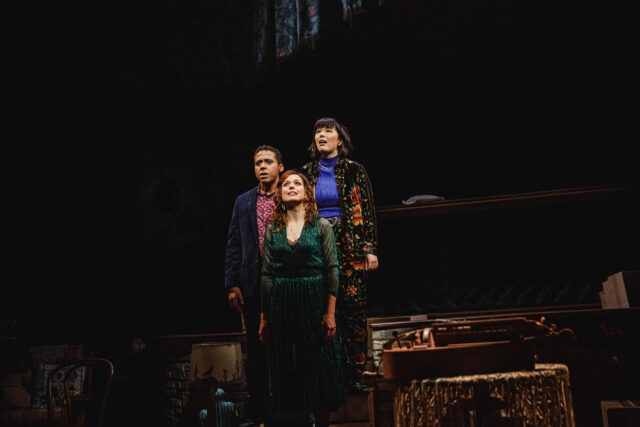
Zora (April Matthis) and Pilar (Carmen M. Herlihy) try to save the bees in Kate Douglas’s The Apiary (photo by Joan Marcus)

THE APIARY
Second Stage Theater
Tony Kiser Theater
305 West 43rd St. between Eighth & Ninth Aves.
Tuesday – Sunday through March 3, $62-$106
2st.com/shows

There is no evidence that theoretical physicist Albert Einstein ever said, “If the bee disappeared off the face of the Earth, man would only have four years left to live.” That doesn’t mean that the apocryphal viral quote doesn’t have some truth in it, as explored in Kate Douglas’s The Apiary, making its world premiere at Second Stage’s Tony Kiser Theater.

As the audience enters the space, Pilar (Carmen M. Herlihy) is working at a desk stage right in a beekeeping suit, filling test tubes with dead bees, one by one, while listening to beloved 1970s hits by ABBA and others. There’s a similar desk stage left (which curiously goes unused); in the center is a lab shrouded in floor-to-ceiling netting, which contains four small beehives, a rolling table, industrial lighting, and a large yellow-tinted cube known as the graveyard. It’s not only bees who are endangered; the play is set twenty-two years in the future, but it could just as easily be tomorrow.

Cece (Nimene Wureh) walks in, sits in a chair in front of the lab, and talks to an unseen person about the proper way to treat bees. “Mama said — ‘If you don’t tell the bees about important events in your life, the bees will die. And lay a curse on the whole family.’” She then describes how, when her brother got married and did not tell the bees, the bees stopped making honey and nearly died until her mother intervened, showing the bees the wedding album. “They recovered,” Cece explains. “That time, they recovered.”

Gwen (Taylor Schilling) has some intriguing questions for Bryn (Nimene Wureh) in Second Stage world premiere (photo by Joan Marcus)

The employees in this synthetic apiary are attempting to restore the fading bee population, facing disappointment after disappointment. Pilar is joined by Zora (April Matthis), a biochemist who has left a plum position in pharmaceuticals to become a low-level functionary in the downstairs of this mediocre facility, where “upstairs” never deigns to visit. When Pilar asks Zora why she made the change, Zora answers simply, “I like bees.” Pilar compares the job to be being a palliative caregiver, warning Zora, “This may be hard for you then. A lot of sweeping up dead bees. A lot of dead bees. A lot a lot of dead bees.” Zora replies, “I think it’s important. Not everyone wants to be there for the end. But someone should be here. Give them that.”

Their supervisor is the ultraserious, by-the-book Gwen (Taylor Schilling), who is immediately angry that proper hiring procedure and notifications have not been followed. She is suspicious of Zora, telling her that it is a bare-bones operation. “This isn’t some flashy experimental job with lots of funding and vacations and a 401K, okay. This isn’t — space exploration,” she states.

Zora is soon suggesting methods that might get the bee numbers back up, but Gwen, who has an ambitious five-year plan to become project director, argues that she is too busy trying to save their jobs to write reports requesting more funding, which could take months and months. Zora says that she’ll pay for all the materials herself, which intrigues Gwen. After one research method fails, a second, more promising and secretive one falls in Zora’s lap — but at a formidable cost.

Cece (Nimene Wureh) offers insight into how to restore the bee population in The Apiary (photo by Joan Marcus)

The bees’ life force is represented by Stephanie Crousillat, who occasionally pops up in the graveyard and performs interpretive dance; the more energetic she is, the more time the bees have, and, sadly, the more tired and withdrawn she is, the closer the bees are to the end. Her tight-fitting, barely there costume includes a vaguely insectlike mask, a stark contrast to the white lab suits worn by Zora, Pilar, and Gwen. (The costumes are by Jennifer Moeller, with scenic design by Walt Spangler, lighting by Amith Chandrashaker, sound by Christopher Darbassie, and original music by Grace McLean.)

At one point, Gwen, condemning space travel, shouts, “Like WE HAVE THINGS TO DO ON THIS PLANET YOU KNOW WHAT I MEAN!!!” The cry gets to the heart of Douglas’s sharply stinging plot, which is as much about the bee crisis as the human one. When Cece describes how her mother related to bees, she could have just as well been talking about how people relate to one another and to the natural world; personal communication is vital, and in 2024, as well as 2046, people need to interact with others and with the earth’s creatures. When Zora explains about being there at the end for bees, she could have just as well been talking about how humans face death, that people need to be cared for and not merely left alone to die.

Director Kate Whoriskey (Clyde’s, Sweat) cleverly pollinates the story as it evolves into a taut thriller. Emmy nominee Schilling (Orange Is the New Black, A Month in the Country) is on target as Gwen, who has trouble seeing the forest for the trees as she battles so much red tape and personal ambition. Lucille Lortel nominee Herlihy (Bachelorette, A Delicate Balance) is sweet as honey as Pilar, who always tries to find the good in everything. Obie winner Matthis (Primary Trust, Toni Stone) again demonstrates her impressive range as Zora, who is determined to do whatever is necessary to save the planet. [ed. note: Matthis will be replaced by two-time Tony nominee Kara Young for the final week of the run, due to a scheduling conflict.] And Wureh shines in four roles, giving Cece, Kara, Anna, and Bryn distinct characteristics as they get involved in the project in a surprising way.

“The bees are very sensitive and so so smart,” Pilar tells Zora. “They dance! They tell jokes.”

She’s not just talking about the bees.

[Mark Rifkin is a Brooklyn-born, Manhattan-based writer and editor; you can follow him on Substack here.]
THE UNEXPECTED MAN

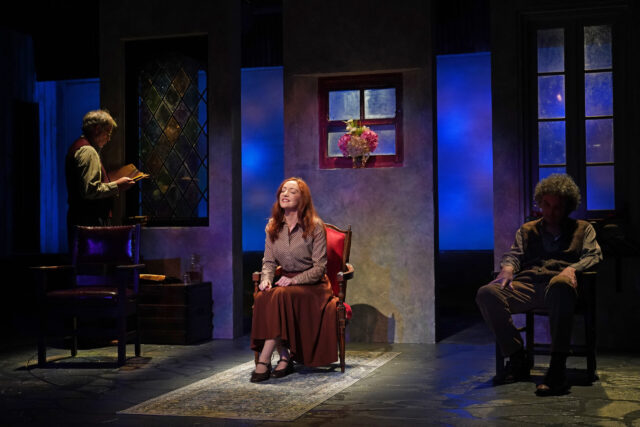
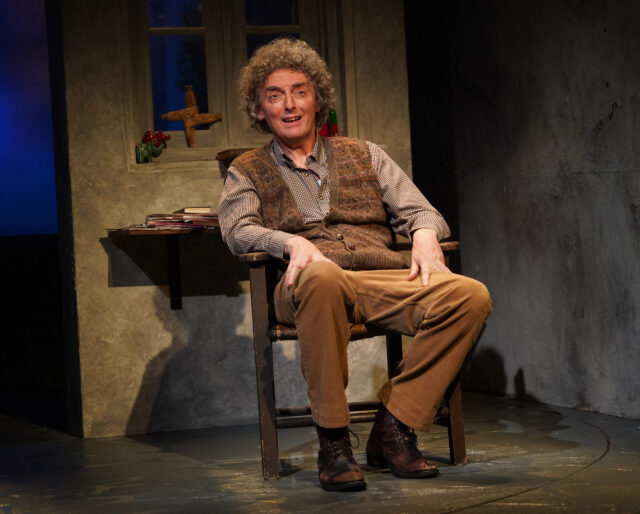
Revival of Yasmina Reza’s The Unexpected Man runs February 16-25 at IATI Theater (photo by Marina Levitskaya)

THE UNEXPECTED MAN
IATI Theater
64 East Fourth St. between Bowery & Second Ave.
February 16-25, $49.87
www.eventbrite.ca

“I’m prepared to risk any kind of adventure with you,” Martha imagines telling Paul in French playwright Yasmina Reza’s The Unexpected Man. Martha then imagines Paul responding, “Come on, Martha, life is short.”

STEPS Theatre and Art Against Humanity are presenting a unique revival of the show February 16-25 at IATI Theater in the East Village, starring Roman Freud as the man and Mickey Pantano as the woman. As the play opens, they are sitting in the same train compartment, going from Paris to Frankfurt; Martha recognizes Paul as the author of the novel she is reading, The Unexpected Man, but she hesitates to take it out of her purse and read it right in front of him, believing it would be insensitive. Over the course of ninety minutes, they deliver internal monologues about their lives.

“Can never sleep on a train. Hard enough in bed, let alone on a train. Strange this woman never reads anything,” he wonders to himself.

“I like traveling. As soon as I set foot in Frankfurt, I shall be another person: the one who arrives is always another person, And so it is that one progresses, from one person to another, until it’s all over,” she explains to herself.

Their “conversation” touches on a wide range of topics, from art and religion to friendship and ex-lax. As the train approaches its destination, so does their connection.

The Unexpected Man debuted in England in 1998, starring Eileen Atkins and Michael Gambon. Two and a half years later, Christopher Hampton’s translation ran at the McGinn/Cazale Theater, with Atkins and Alan Bates, earning a slew of award nominations.

This new version is directed by Slava Stepnov (White on White; Enemies, A Love Story) and produced by Polina Belkina, with set and costumes by Arcady Kotler and Elina Kotler. Reza’s previous works include two Tony winners for Best Play, Art and God of Carnage.

“Today I was thinking about what The Unexpected Man and Yasmina Reza brought to my life,” Freud recently posted on social media. “One of the huge accomplishments of this play is that so many characters are left outside the main storyline — friends, lovers, spouses, critics, writers, kids. They are mentioned frequently throughout the play, which creates a crowded feeling, as if you’re in the presence of many people, some invented on the spot, some already dead. The play has a cast of probably twenty people, reflected by only two storytellers. All those offstage characters live and breathe in the play. Also, The Unexpected Man — the book in the heroine’s purse. After my first reading of the play, this imaginary book became a point of obsession for me.”

The play runs for ten performances; tickets are $49.87.

“Did I write what I wanted to write? No, never. I wrote what I was capable of writing, not what I wanted to,” Paul says, encapsulating the human experience. “All you ever do is what you’re capable of.”

[Mark Rifkin is a Brooklyn-born, Manhattan-based writer and editor; you can follow him on Substack here.]
IZZARD HAMLET NEW YORK

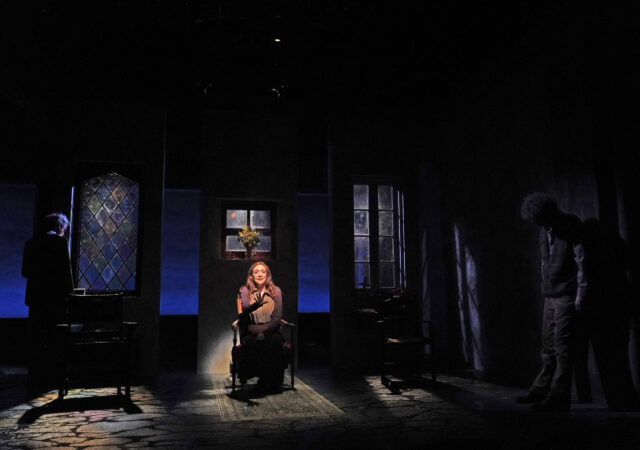
Eddie Izzard plays nearly two dozen characters in one-woman Hamlet (photo by Carol Rosegg)

IZZARD HAMLET NEW YORK
The Greenwich House Theater
27 Barrow St. at Seventh Ave. South
Tuesday – Sunday through March 16, $81-$125
Orpheum Theatre
126 Second Ave. between Seventh & Eighth Sts.
Tuesday – Sunday, March 19 – April 14
www.eddieizzardhamlet.com

Eddie Izzard doesn’t make things easy for herself.

In winter 2022–23, she presented a one-woman version of Charles Dickens’s Great Expectations at the Greenwich House Theater. The wonderful two-hour, two-act show was adapted by Izzard’s brother Mark and directed by Selina Cadell. Now the trio is taking on William Shakespeare’s classic revenge tragedy, Hamlet, with the full crew from the previous play. The production more than lives up to its great expectations.

Izzard once again is dressed in a goth steampunk outfit, designed by Tom Piper and Libby DaCosta, this time consisting of black boots, tight black leather pants, and a silvery black-and-green long peplum blazer over a neckline-revealing top. Piper’s set is a long, rectangular space with three narrow, vertical windows, recalling a room in a tower where damsels in distress are imprisoned as well as a room in a psychiatric facility where someone having difficulty with reality is treated. Tyler Elich’s lighting shifts among several emotional colors that shine through the windows and a panel running along the underside of the set’s ceiling.

Izzard casts an impressive figure onstage, appearing much bigger than her five-foot-seven frame. In a mesmerizing tour de force, she portrays twenty-three characters, including Prince Hamlet; the ghost of Hamlet’s father, the recently murdered king; Claudius, the king’s brother and Hamlet’s uncle, who now wears the crown; Gertrude, Hamlet’s mother who married her former brother-in-law before her husband’s body was cold; Hamlet’s best friend, Horatio; Hamlet’s true love, Ophelia; Ophelia’s father, Polonius, Claudius’s most trusted councilor; Laertes, Ophelia’s brother; and Fortinbras, the prince of Norway; in addition to the leader of a traveling theater company, two gravediggers, various Danish soldiers and courtiers, and others.

Eddie Izzard’s Hamlet has been extended at Greenwich House Theater and will then move to the Orpheum (photo by Carol Rosegg)

There are no costume changes; when shifting between characters, Izzard slightly alters her voice and position onstage, running back and forth, twisting her body, or adjusting her posture. But she brings down the house with Rosencrantz and Guildenstern, for whom she uses her hands when they speak, the effect enhanced by the deep red polish on her fingernails. (Just wait till you see how she deals with a fencing duel; the movement direction is by Didi Hopkins.)

Izzard delivers all the famous monologues (“O, that this too too solid flesh would melt,” “To be, or not to be,” “O, what a rogue and peasant slave am I!” et al.) beautifully, lending each line its own nuance; it is never mere recitation. The few times Izzard, who is dyslexic, stumbled over a word or two, she quickly corrected it, displaying that she is in complete command of not only the text but what it means. The lack of props enhanced the power of the language and the intricacies of the plot. At one point, when a loud, distracting crinkling noise could be heard in the mezzanine, Izzard, in stride, directed a laserlike gaze at the perpetrator without missing a beat. She also occasionally ambles determinedly offstage, wandering through the aisles, making eye contact with the crowd as Hamlet shares his foibles.

The Aden-born Izzard is best known as a comedian, which might explain some of the inappropriate laughter intermittently coming from a handful of audience members the night I went. There are some very funny moments, but overall it’s a pretty serious drama.

In the last nine years, I’ve seen ten productions of and/or involving Hamlet, ranging from a German avant-garde version at BAM and an intense intellectual staging at Park Avenue Armory to a modern-day BIPOC update at the Public and on Broadway and a wildly unpredictable and flatulent interpretation at Japan Society.

Izzard Hamlet New York is another memorable adaptation to add to the ever-growing list.

[Mark Rifkin is a Brooklyn-born, Manhattan-based writer and editor; you can follow him on Substack here.]

THE FOLLOWING EVENING

Ellen Maddow and Paul Zimet explore their relationship on- and offstage in The Following Evening (photo by Maria Baranova)

THE FOLLOWING EVENING
Perelman Performing Arts Center (PAC NYC)
251 Fulton St.
Tuesday – Saturday through February 18, $69
pacnyc.org

The Following Evening is a touching love letter to independent theater creators and New York City. It also goes much deeper than a proverbial passing of the torch.

The seventy-five-minute work, making its world premiere through February 18 at PAC NYC, was written and directed by Abigail Browde and Michael Silverstone specifically for Ellen Maddow and Paul Zimet. Browde, forty-two, and Silverstone, forty-three, started the experimental company 600 Highwaymen in 2009, the same year they got married. Maddow, seventy-five, and Zimet, eighty-one, cofounded the experimental company Talking Band, with Tina Shepard, in 1974 and got married in 1986. (Zimet and Shepard had been wed previously as well.)

Browde and Silverstone have a young child and are considering leaving New York. Maddow and Zimet have three grandchildren and can’t imagine living anywhere other than the city, especially with two more shows coming up, Existentialism at La MaMa later this month and Shimmer and Herringbone at Mabou Mines @122CC in May as part of their troupe’s fiftieth anniversary season.

In the play, the two couples portray somewhat fictionalized versions of themselves as they explore their lives and creative process. The line between fact and fantasy is further blurred by Jian Jung’s set, which features a piano on one side, a few chairs in the middle, and a pile of large canvases collected at the right, except for one painting of a window, taunting us about the world outside. In the back, large white sheetrock panels cover only some of the wall, a constant reminder that we are not in Ellen and Paul’s downtown loft but in a theater. In addition, Eric Southern’s lighting often keeps it bright, as if the characters are not actors but just people sharing their time with the audience.

The show opens with Paul delivering a long prologue, moving his hands and body in sharp, heavily mannered ways as he discusses being raised on the Upper West Side, riding his bike, dropping out of medical school, and performing around the globe. He talks about his family history going back to his great-grandmother, who was born in New York City in 1863, and continuing through Ellen and their children and grandchildren, setting up the multigenerational aspect of the narrative.

“Does this all sound romantic? I really hope it doesn’t,” he says. “Nothing is going to happen in this play.” He then turns to Ellen, asks if she is ready, and welcomes the audience to The Following Evening.

Ellen brings up disappointment, memory, and variation as the couple dances, then sings a song for their neighbor, an ill painter named Katherine. “I imagine a play that takes place over a thousand years,” Ellen says, never wanting their life in the theater to end. Paul, ever hopeful, later adds, “I imagine a play about the end of the world. Where the world is crumbling. Civilization on fire. But it is a love story.”

The Following Evening brings together two theater couples at different stages of life (photo by Maria Baranova)

In the second section, Abby and Michael enter, directing Ellen and Paul. When Ellen is having trouble with a scene, she says resignedly, “I had it yesterday. This is the thing about getting older.” Paul immediately counters, “You don’t have any harder of a time than any other actor.” When Abby suggests they improvise, Ellen quickly points out, “No, I like the way you wrote it,” praising the ideas of the next theatrical standard-bearers even though the older couple is more confident about the future than the younger pair.

“Hmm. I just had this, uh. I just got incredibly jealous. You guys have so much life ahead of you,” Paul says, to which Abby replies, “Oh. Isn’t that funny? I don’t feel any of that.” Michael later opines, “I can see the two of you so clearly. I can sort of see you. But I can’t see myself. . . . You were pioneers and we are just — jerks.”

The third and final part focuses more on Abby and Michael as they examine the state of their existence, sometimes speaking in the third person, describing their actions to each other. “I feel like I could run / Like I could run really fast if I wanted to / That you would keep pace with me,” Michael says. “It wouldn’t be that hard / We could go on forever. We could do it.” Abby explains, “Here, hold this, you tell me as if we are the last people on earth.”

They are eventually joined by Ellen and Paul, and the last moments grow even more abstract than what came before.

The Following Evening is like a visual tone poem, a brutally honest look at aging and artistic creation. Things occur slowly, in movement and speech; the dialogue is spoken plainly, unadorned, carefully modulated but not dispassionate. Ellen and Paul are marvelous together; watching them slowly take off their shoes, sit on the floor, or dance together is aspirational.

Abby and Michael are compelling as the younger couple who fear they will never be like Ellen and Paul, either as a married couple, parents, grandparents, or theater makers. All four of them have their fair share of doubt and questions, but the play puts a defining emphasis on experience in a country where the elderly are not given the respect they deserve, something 600 Highwaymen (A Thousand Ways, The Fever) is rectifying, without being overly congratulatory or sentimental about Talking Band (Lemon Girls or Art for the Artless, Painted Snake in a Painted Chair), which collectively has won fifteen Obie Awards.

The title promises that life goes on; I can’t wait to see what each couple has in store for us next evening.

[Mark Rifkin is a Brooklyn-born, Manhattan-based writer and editor; you can follow him on Substack here.]

THE FEST FOR BEATLES FANS

THE FEST FOR BEATLES FANS
TWA Hotel at JFK Airport
One Idlewild Dr., Queens
February 9-11, $49.50-$325 for various packages for children and adults, $24 virtual
www.thefest.com
www.twahotel.com

On February 7, 1964, a Pan Am plane carrying John Lennon, Paul McCartney, George Harrison, and Ringo Starr landed at JFK Airport in Queens, and Beatlemania was unleashed on America. So it makes sense that the fiftieth anniversary edition of the Fest for Beatles Fans is taking place this weekend at the TWA Hotel at JFK. Even after all that time, the lads from Liverpool are as popular as ever, recently releasing the new song “Now and Then,” winning a Grammy for Best Music Video for the lushly animated “I’m Only Sleeping,” and being the subject of the eight-hour Peter Jackson documentary Get Back.

Running February 9-11, the fest features live performances by Liverpool, the Weeklings, Black Ties, Blac Rabbit, Cellophane Flowers, the Meetles, James Gray, Jeff Slate’s Weekend Wilburys, and others, signing sessions, panel discussions, and more, including the Giant Beatles Marketplace, the Annual Friday Night Dance Party (with ’60s Dress-Up Night and best outfits and lookalike contests), a You Sing the Beatles contest, the Beatles Museum (and art contest), the interactive FABoratory, an indoor pool, the Beatles Ashram, trivia games, participatory lobby jams, an auction, yoga, karaoke, and activities for kids.

Among the special guests are Micky Dolenz from the Monkees, Wings guitarist Laurence Juber, Wings drummer Steve Holley, Billy J. Kramer from the Dakotas, Chris O’Dell from Apple Records, original Beatles Fan Club president Freda Kelly, roadie Mal Evans’s son Gary Evans, former NEMS and Apple employee Tony Bramwell, Pattie Boyd’s sister Jenny Boyd, Paul’s stepmother and stepsister Angie and Ruth McCartney, and Gregg Bissonette and Mark Rivera from Ringo’s All-Starr Band. Deejay Ken Dashow serves as emcee, assisted by Tom Frangione.

Below are four fab highlights for each day:

Friday, February 9
Beatle World Biographies: Brian Epstein & Yoko Ono, with Vivek Tiwary and Madeline Bocaro, Paperback Writer Discussion Room, 7:15

Good Ol’ Freda, Q&A with Freda Kelly, Mop Top Room, 8:00

Lucy in the Sky with Diamonds: A Dreamhouse Party for Brian Epstein, with DJ sets by Justin Cudmore and Danny Clobber, runway show by PVR x Tillium, drag show by Thee Suburbia with live music by Plastic Tizzy Band, and a ’60s salon by Sean Bennett, 1964 Room, 10:00 pm – 2:00 am

The First Origin Story, with Beatles Fest founder Mark Lapidos, Main Stage, 11:15

Saturday, February 10
The Beatles on Film, with Steve Matteo and Darren DeVivo, Paperback Writer Discussion Room, 12:15

Micky Dolenz: Special Guest Interview with Ken Dashow, Main Stage, 4:00

Historians Panel — Free as a Bird, Real Love, and Now and Then: The End of Beatles History?, with Susan Ryan, Jim Ryan, Janet Davis, Kit O’Toole, Andy Nicholes, and Caitlin Larkin, Paperback Writer Discussion Room, 4:30

Live Beatles Concert by Liverpool, featuring Micky Dolenz, Billy J. Kramer, Mark Rivera, Gregg Bissonette, Gary Burr, Laurence Juber, and Steve Holley, with a Wings tribute to Denny Laine, Main Stage, 9:00

Sunday, February 11
Live Broadcast: Breakfast with the Beatles, with Ken Dashow and guests, 8:00

The Beatles Are Coming! Beatles Parade, meet in the Twister Room, 2:00

Super Peace Bowl: Bed-In for Peace, 1964 Room, 5:00

Live Beatles Concert by Liverpool, featuring Micky Dolenz, Billy J. Kramer, Laurence Juber, and Steve Holley, plus grand jam finale, Main Stage, 9:00

[Mark Rifkin is a Brooklyn-born, Manhattan-based writer and editor; you can follow him on Substack here.]
BRENDAN HUNT: THE MOVEMENT YOU NEED

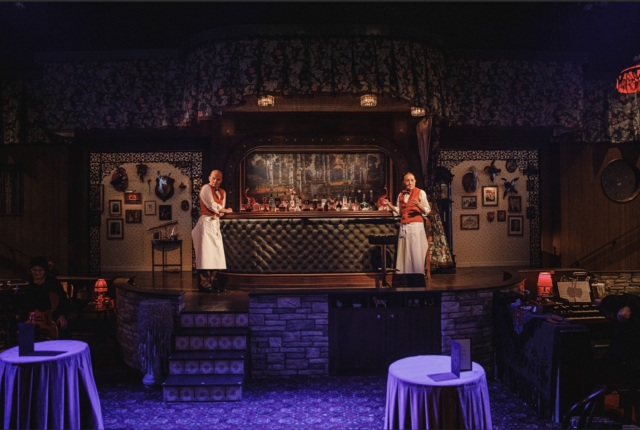
Brendan Hunt returns to SoHo Playhouse for encore run of one-man show The Movement You Need

THE INTERNATIONAL FRINGE ENCORE SERIES: THE MOVEMENT YOU NEED
SoHo Playhouse
15 Vandam St. between Sixth Ave. & Varick St.
February 7-10, $40
212-691-1555
sohoplayhouse.com
fringeencoreseries.com

Chicago native Brendan Hunt might be best known for his portrayal of Coach Willis Beard on Ted Lasso — in addition to writing several episodes and serving as producer, executive producer, and codeveloper — but he also has a deep affection for theater. The Emmy winner and Jeopardy! contestant has written and performed the solo works Five Years in Amsterdam: The True Story of How a Regular Guy from Chicago Became Absolute Eurotrash and Still Got It as well as the plays The Poe Show (where he was Edgar Allan Poe alongside Dracula, Emily Dickinson, Mary Shelley, Gen. Custer, Charlotte Brontë, Dr. Frankenstein, and the Raven) and Absolutely Filthy (An Unauthorized Peanuts Parody) (in which he appears as the mess). And he won a 2010 LA Ovation Award for Lead Actor in a Musical for Sacred Fools’ Savin’ Up for Saturday Night.

Last November, he brought his autobiographical one-man show The Movement You Need to SoHo Playhouse as part of the International Fringe Encore Series: Comedy Festival, and it’s now back for a bonus encore run, February 7-10. For seventy-five minutes, Hunt explores his complex relationship with his late mother and the only thing they could both agree on: their shared love of the Beatles. When Hunt has the opportunity to talk about that with Sir Paul McCartney himself, it doesn’t go quite as planned. The show is named after a line in “Hey Jude” — “And don’t you know that it’s just you? / Hey Jude, you’ll do, / the movement you need is on your shoulder” — a song the very young Hunt thought was about him because his mother called him Na Na (“Na, na, na, na, na na, na”).

In his high school yearbook photo, Hunt, who is now fifty-one, wore a pin that featured the Fab Four’s infamous butcher cover for the Yesterday and Today album; I wouldn’t be surprised if he makes a detour this weekend to “The Fest for Beatles Fans,” taking place February 9-11 at the TWA Hotel at JFK Airport.

In “Being for the Benefit of Mr. Kite!,” the Beatles promise, “A splendid time is guaranteed for all.” For The Movement You Need, Hunt will only say, “A decent time is guaranteed for all.” He shouldn’t be so self-deprecating. As Sir Paul sings, “And anytime you feel the pain, / Hey Jude, refrain, / Don’t carry the world upon your shoulder.”

QUEER NEW YORK INTERNATIONAL ARTS FESTIVAL

Bruno Isaković and Nataša Rajković’s Yira, yira (Cruising, cruising) is part of QNYIAF (photo by Silvija Dogan)

QUEER NEW YORK INTERNATIONAL ARTS FESTIVAL
NYU Skirball Center for the Performing Arts
566 La Guardia Pl. between Third & Fourth Sts.
February 7 – 17, $25
212-945-2600
nyuskirball.org

After a six-year break, the Queer New York International Arts Festival returns to the city, taking place February 7-17 at NYU Skirball. Started by Queer Zagreb founder Zvonimir Dobrović in 2012 at Abrons Arts Center, the fest consists of works that address queerness in today’s society, this year with presentations from Argentina, Brazil, Canada, Croatia, and Germany, including live performances, installations, and public talks.

The 2024 QNYIAF kicks off February 7 with Croatian artist Arijana Lekić Fridrih’s From5to95, a hybrid video installation and online project in which Croatian women from the ages of five to ninety-five share their personal stories about gender inequality. On February 7 and 8, Croatian artists Bruno Isaković and Nataša Rajković’s Yira, yira (Cruising, cruising), which premiered in Argentina in 2019, is performed by sex workers Juan Ejemplo, Leandra Atenea Levine Hidalgo, Pichón Reyna, and Sofía Tramazaygues, exploring the relationship between client and sex worker.

Bruno Isaković and Mia Zalukar’s Kill B. reimagines the Bride from Quentin Tarantino films (photo by Hrvoje Zalukar)

Isaković collaborates with fellow choreographer and dancer Mia Zalukar on Kill B., inspired by Quentin Tarantino’s Kill Bill. Playing February 9 and 10, the piece focuses on the character of the Bride as well as artistic hierarchical structures and their own professional partnership. On February 13, Toronto-based performance artist Clayton Lee goes through his sexual history in The Goldberg Variations, which mashes up Johann Sebastian Bach with WCW and WWE wrestler and actor Bill Goldberg, host of the 2018-19 competition series Forged in Fire: Knife or Death and a contestant on The Celebrity Apprentice. Some iterations have included smells and live snakes, so be ready.

On February 15, Argentinian interdisciplinary artist Tiziano Cruz will deliver the autobiographical performance lecture Conference, followed by a discussion. His piece Soliloquy — I woke up and hit my head against the wall was about his mother; in Conference he turns his attention to his ancestors and his late sister. On February 16, Brazilian artist Wagner Schwartz’s performance lecture La Bête is an interactive solo in which he activates a plastic replica of one of Lygia Clark’s rearrangeable hinged metal sculptures known as bichos, or “beasts,” and then the audience does the same, except with Schwartz’s naked body.

QNYIAF concludes February 17 with Raimund Hoghe Company members Emmanuel Eggermont and Luca Giacomo Schulte’s An Evening with Raimund, a tribute to German choreographer, dancer, and journalist Raimund Hoghe, who died in 2021 at the age of seventy-two; excerpts from his works will be performed by seven dancers. “To see bodies on stage that do not comply with the norm is important — not only with regard to history but also with regard to present developments, which are leading humans to the status of design objects,” Hoghe said. “On the question of success: It is important to be able to work and to go your own way — with or without success. I simply do what I have to do.”

[Mark Rifkin is a Brooklyn-born, Manhattan-based writer and editor; you can follow him on Substack here.]