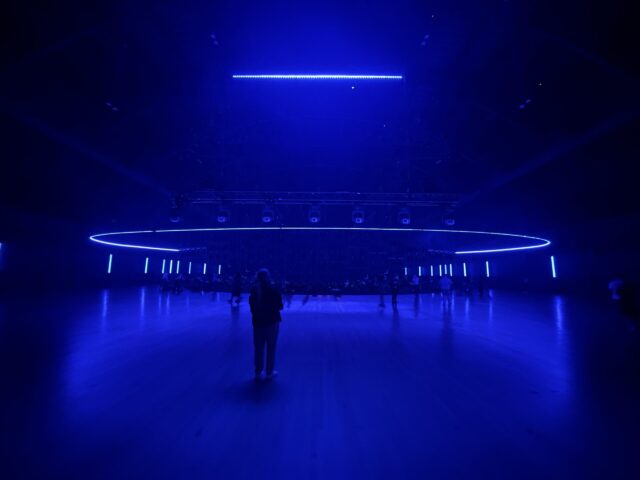
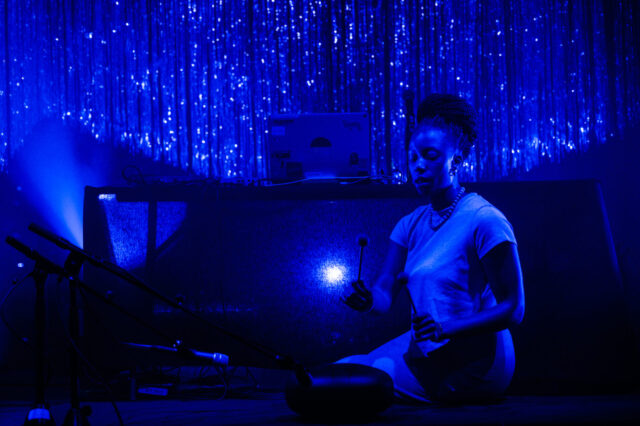
Karlheinz Stockhausen’s Inside Light is a multimedia marvel at Park Ave. Armory (photo by twi-ny/mdr)
INSIDE LIGHT
Park Avenue Armory, Wade Thompson Drill Hall
643 Park Ave. at 67th St.
Friday, June 14, $70, 6:30
212-933-5812 www.armoryonpark.org online slideshow
“I hope that the future will bring us auditoriums with permanent technical installations where we can listen to music like Weltraum as often as we like — including the individual layers, sounds, and tones in listening seminars,” Karlheinz Stockhausen wrote in the program notes for his 141-minute 1992 Weltraum (Outer Space). “Listeners may perceive every sound from beginning to end, experience every movement and maintain their concentration.”
While it might not be permanent, the experimental German composer has found a home at Park Ave. Armory, where his work has been staged to dramatic impact. In 2012, the New York Philharmonic performed Stockhausen’s tri-orchestral Gruppen (Groups), with 109 musicians divided into three ensembles. In 2013, the armory presented Oktophonie, a sixty-nine-minute layer from Act II of Dienstag aus Licht, the Tuesday portion of his 1977–2003 twenty-nine-hour opera cycle Licht: The Seven Days of the Week, set in an immersive environment created by Thai contemporary artist Rirkrit Tiravanija.
The legacy of Stockhausen, who died in 2007 at the age of seventy-nine, is now being celebrated at the armory with the meditative and mesmerizing Inside Light, comprising five sections over nearly six hours; although it ostensibly relates the story of Eve, the archangel Michael, and Lucifer, don’t search too hard for a narrative. Conceived by armory artistic director Pierre Audi, the multimedia extravaganza takes place in a huge oval at the center of the massive Wade Thompson Drill Hall, where audience members can use BackJack chairs or spread out on the floor; try not to get too settled in, as it’s strongly advised that you occasionally walk inside and outside the space to enhance the experience, moving your chair as different segments unfold and even listening from the hallway.
The stunning installation, by Urs Schönebaum, whose previous breathtaking lighting at the armory includes Claus Guth’s Doppelganger and William Kentridge’s The Head & the Load, features a large screen hanging at the west end, constructed of eleven connected pieces that increase in height from the edges to the center; at the east end are five vertically oriented screens of slightly different widths, separated by critical negative space. A thin, oval strip of light encircles the area, and some two dozen ceiling lights are arranged in a wide spiral, surrounded by speakers. The enveloping, prerecorded sound design, from basset-horns and keyboards to wind, ocean waves, and ominous laughter that wash over the audience, is by musician and longtime Stockhausen collaborator Kathinka Pasveer, with expert engineering by Reinhard Klose.
The droning, contemplative music is accompanied by hit-or-miss video projections by Robi Voigt. Hypnotic black, white, and gray grids shimmer, evoking Sol LeWitt and Tetrus, while a misty green is haunting. (I advise staring at the white and gray grids, then shutting your eyes quickly to see the reverse images in the darkness.) Reddish-orange abstract shapes are less interesting, moving like mathematical fractals. Feel free to close your eyes and just listen, or get up and walk around when the visuals fail to engage. However, Schönebaum’s lighting is spectacular, as beams of white, red, blue, and green intersect across the vast space, spots shine down on the floor, a planetlike object emits at times nearly blinding dullish color, and an empty square of white lights hovers above like a UFO about to beam up audience members.
Inside Light can be experienced in two parts, the first consisting of Montags-Gruss (Monday Greeting and Eve Greeting), Unsichtbare Chöre from Donnerstag (Invisible Choirs from Thursday), and Mittwochs-Gruss (Wednesday Greeting), the second Freitags-Gruss (Friday Greeting) and Freitags-Abschied (Friday Farewell), but it’s best experienced in one full marathon, which I saw on June 8 and is being repeated June 14, beginning at 6:30 pm, with a one-hour dinner break. Be sure to check out the Mary Divver Room, where you’ll encounter some of the inspiration for Voigt’s videos.
As previously noted, don’t stay glued to your seat; get up, turn your chair around, walk across the space, and let the music guide you. However, watch out for a transformative moment when the horizontal screen, displaying a black-and-white grid, appears to start moving into itself, something I won’t soon forget.
[Mark Rifkin is a Brooklyn-born, Manhattan-based writer and editor; you can follow him on Substack here.]
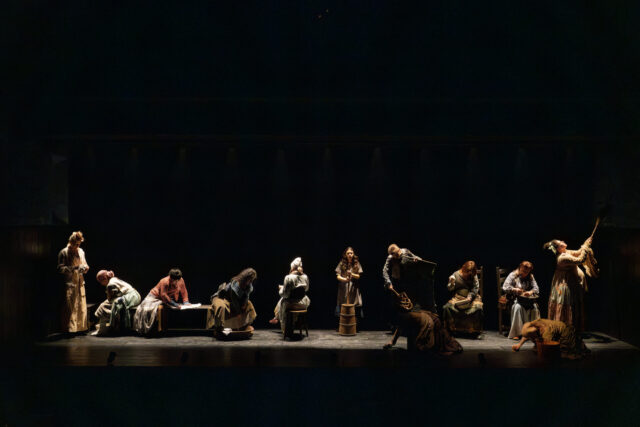
A jury of matrons must decide the fate of a convicted woman in Lucy Kirkwood’s The Welkin (photo by Ahron R. Foster)
THE WELKIN
Atlantic Theater Company
Linda Gross Theater
336 West 20th St. between Eighth & Ninth Aves.
Tuesday – Sunday through July 7, $56.50-$121.50 atlantictheater.org
Twelve Angry Men meets The Crucible by way of horrormeister Peter Straub and George Cukor’s The Women in Lucy Kirkwood’s gripping and intense, if messy and overlong, The Welkin, running at the Atlantic’s Linda Gross Theater through July 7.
Kirkwood’s previous works include Chimerica, in which a Chinese dissident and an American photojournalist attempt to find the Tank Man, who became an international symbol of resistance during the 1989 Tiananmen Square protest, and The Children, which takes place shortly after a devastating nuclear accident on the East Coast of Britain. In The Welkin, Kirkwood contemplates female autonomy — the right of a woman to control her body — directly and indirectly bringing up such issues as capital punishment, abortion, gender identity, and sexuality while celebrating individuality over groupthink stereotypes. It’s set in March 1759 on the border of Norfolk and Suffolk in England, but it relates all too closely to what is occurring in America today in the wake of the overturning of Roe v. Wade.
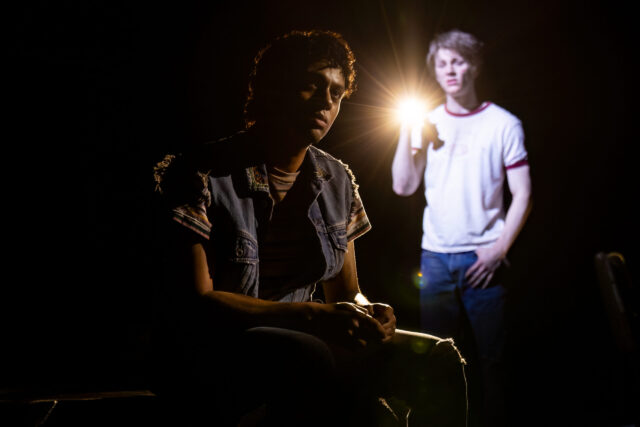
The play opens with a harrowing scene, cast in shadowy darkness in front of the curtain. After an absence of four months, Sally Poppy (Haley Wong) has returned home to her laborer husband, Frederick (Danny Wolohan); she is naked and bloodied, soon pulling out a hammer. We instinctively assume something awful has happened to her, but it turns out that she has apparently done something awful herself: She tells Frederick that the blood is not hers but that of Alice Wax, a young girl her lover brutally murdered and she helped dismember and stuff up a fireplace. She demands ten shillings from her cuckolded husband to pay the midwife for the baby she claims she is carrying, which she coldly says is not his. Her lack of guilt or remorse is disconcerting — as well as rife with sociocultural complications.
The curtain then rises on widowed midwife Lizzie Luke (Sandra Oh) churning butter when bailiff Billy Coombes (Glenn Fitzgerald) arrives, informing her that the judge wants Lizzie to serve on the twelve-woman jury to determine whether the convicted Sally is truly with child, in which case she cannot be hanged for her crime and would instead be transported to Australia. Lizzie shows no immediate concern about the murder. “Expect that is the closest a Wax child ever got to sweeping a chimney,” she says.
The married Mr. Coombes flirts with Lizzie — it appears that they might have an undefined thing for each other — who first refuses to participate on the jury but eventually acquiesces, leaving her daughter, Katy (MacKenzie Mercer), to churn the butter, passing female responsibilities to the next generation, who might actually want more out of life.
The jurors, each doing some kind of traditional women’s work, are sworn in one by one, sharing an aspect of their personal story before kissing “the book.” It’s a ponderous scene, but we learn that Mary Middleton (Susannah Perkins) has five children and a haunted tankard in her home. Ann Lavender (Jennifer Nikki Kidwell) is married to a poet and is raising their four daughters in “peasant honesty.” The eighty-three-year-old Sarah Smith (Dale Soules) has twenty-one children with three husbands and until recently could do a handstand for one minute. Helen Ludlow (Emily Cass McDonnell) has had twelve miscarriages in eight years. Peg Carter (Simone Recasner) is married to the third-generation gardener for the family whose child was murdered and has “this thing he is able to do with his tongue which I find very amenable.” And Charlotte Cary (Mary McCann) is a stranger in town who has a dinner engagement at five that she would prefer not to miss.
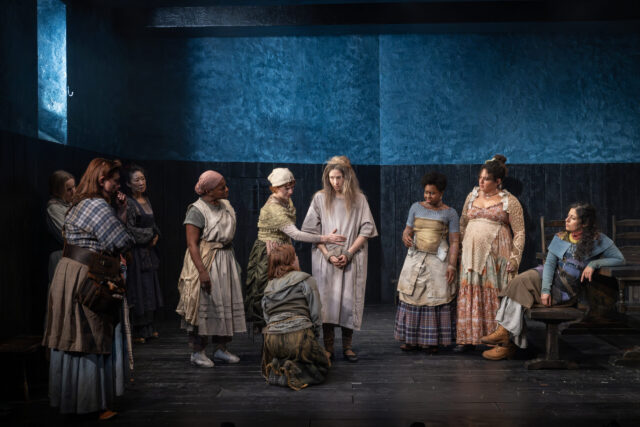
Sally Poppy (Haley Wong) must prove she is pregnant to save herself from the gallows in 1759 England (photo by Ahron R. Foster)
The rest of the two-and-a-half-hour play (with intermission) unfolds in a dungeonlike room where the dozen women have been sequestered until they reach a verdict on Sally’s supposed pregnancy. At stage left is a fireplace, serving as a constant reminder of what Sally and her lover did to Alice; at stage right is a narrow window through which a sliver of at times heavenly light peeks in. When the window is opened, the sound of the unruly mob gathered outside to await Sally’s execution comes pouring in. Sally is there to be poked and examined, her hands bound by rope. Mr. Coombes is present to “keep this jury of matrons without meat, drink, fire, and candle” and to speak only when asking if the matrons have reached a verdict.
The women take sides, chastise one another, divulge secrets, and make accusations as they debate how to determine whether Sally is pregnant. Sally does herself no favors by being nasty and difficult. “Shut up Helen what are you even doing here everyone knows you’re barren,” she barks at the intimidated Helen. Meanwhile, Sarah Hollis (Hannah Cabell) is unable to contribute much because she hasn’t spoken in twenty years, since her son was born; Kitty Givens (Tilly Botsford) and Hannah Rusted (Paige Gilbert) believe Halley’s Comet might have something to do with all the strange goings-on; Judith Brewer (Ann Harada) is a nosy gossiper; and Emma Jenkins (Nadine Malouf) is clamoring for Sally to swing.
Being a midwife, Lizzie often finds herself in the middle of it all and has a unique perspective on the matter, determined to give Sally the benefit of the doubt, explaining in a monologue that is as relevant today as it was 265 years ago: “Because she has been sentenced to hang on the word of a cuckolded husband. Because every card dealt to her today and for many years before has been an unkind one, because she has been sentenced by men pretending to be certain of things of which they are entirely ignorant, and now we sit here imitating them, trying to make an ungovernable thing governable, I do not ask you to like her. I ask you to hope for her, so that she might know she is worth hoping for. And if you cannot do that for her sake, think instead of the women who will be in this room when that comet comes round again, and how brittle they will think our spirits, how ashamed they will be, that we were given our own dominion and we made it look exactly like the one down there,” referring to the courtroom.
“Please. This whole affair is a farce. We are cold, hungry, tired, thirsty women and all of us’ve had our housework interrupted. . . . It is a poor apparatus for justice. But it is what we have. This room. The sky outside that window and our own dignity beneath it. Mary’s view is as important as Charlotte’s, and together we must speak in one voice. It is almost impossible we should make the right decision.”
A shocking event at the end of act one leads to a riveting, wildly unpredictable second act that threatens to go off the rails at any moment.
A welkin is defined as the vault of the sky, the firmament separating heaven and earth. Genesis states, “And God said, ‘Let there be lights in the vault of the sky to separate the day from the night, and let them serve as signs to mark sacred times, and days and years.’” In Act 5, Scene 5 of Shakespeare’s King John, Lewis, the dauphin, says, “The sun of heaven methought was loath to set, / But stay’d and made the western welkin blush.” Light is one of several themes underlying the play. The women are not allowed to use a candle or light the fireplace, but when Dr. Willis (Wolohan) comes to examine Sally and asks to use a candle, Mr. Coombes looks the other way.
The role of women is emphasized throughout, focusing on how they are essentially needed only for cooking, cleaning, mending, and having babies. “A woman is not a laundry list!” Lizzie declares. The only sexual pleasure mentioned in the filthy room is Mary’s enjoyment when Lizzie rubs her “down . . . there.”
The men are inept, incompetent, insensitive fools: Frederick initially wants to whip Sally; one of Mr. Coombes’s arms is in a sling and he has only one testicle, as if he has been castrated; and Dr. Willis has invented a speculumlike metal instrument to insert into Sally to examine her. When Sally says that her supposed pregnancy was not intended, that “the gentleman did not withdraw when I told him to,” Judith responds, “That’s not a method you can rely on; they’re senseless at the last post. With Mr. Brewer I always kept a piece of brick in a handkerchief under the bed; if you time your strike right you can save yourself a lot of trouble in the long run.”
Religion and truth are also on the docket as the characters argue over God’s authority. Frederick, explaining how he had to cover up Sally’s absence, admits, “At church I had to make out you’d gone to mind a sick cousin in Stowmarket. A lie, I told, in the house of God.” Later, Lizzie, discussing how twelve fetuses under her care have not survived in the past year, says, “I am the very first person they blame, God? No, they don’t blame God. Nobody blames God when there is a woman can be blamed instead.”
As the jurors continue their deliberations, Lizzie offers, “You cannot mean to ignore the truth simply cos that’s inconvenient to you.” And when Lizzie doesn’t understand why the other matrons won’t listen to her and want the male doctor to look at Sally, Sally says, “Are you dense? You have no authority here. If they must hear the truth from someone a foot taller with a deep voice, then let them.”
The always inventive director Sarah Benson, who has helmed such wide-ranging shows as Teeth,Fairview,Samara,In the Blood, and An Octoroon, throws too much at the wall in The Welkin, resulting in a choppy narrative in need of editing. In fact, at one point the women scrub the walls after the aforementioned shocking event. Now, I realize that this opinion is coming from a male member of the human species, but I hope it’s not interpreted as mansplaining.
The appropriately claustrophobic set is by dots, with splendid period costumes by Kaye Voyce, stark lighting by Stacey Derosier, creepy sound by Palmer Hefferan, and eerie special effects by Jeremy Chernick. The diverse ensemble cast is outstanding, led by Oh (Office Hour,Satellites), in a welcome return to the New York stage after eighteen years; her portrayal of Lizzie is dense and complex, instantly relatable to the modern era. Wong (Mary Gets Hers,John Proctor Is the Villain) is a force as Sally, Harada (Into the Woods,Avenue Q) offers comic relief (for a while) as Judith, Malouf (Grief Hotel,The School for Scandal) is vividly spirited as Emma, and the ever-dependable Soules (I Remember Mama,Hair) is as dependable as ever.
One of the most bizarre moments of the play occurs when the women start singing a contemporary pop song that deals with the drudgery of work and the release of sex. In the British premiere of The Welkin, it was Kate Bush’s “Running Up That Hill (A Deal with God),” but here they sing a cheerful tune that was written by a man of musical royalty but performed by an all-female group, maintaining the idea that the women are speaking out and the men are remaining quiet. There’s a lot to be said for that.
The next perihelion of Halley’s Comet is expected on July 28, 2061, so be ready.
Oh, I’ll shut up now.
[Mark Rifkin is a Brooklyn-born, Manhattan-based writer and editor; you can follow him on Substack here.]
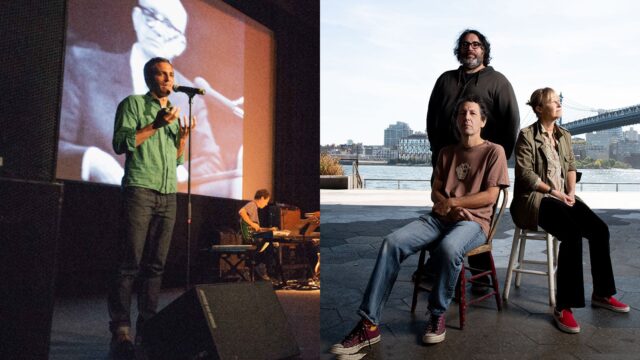
Sam Green and Yo La Tengo will team up for live documentary at Alice Tully Hall
LINCOLN CENTER’S SUMMER FOR THE CITY: THE EPHEMERAL CINEMA OF SAM GREEN
Alice Tully Hall
1941 Broadway at Sixty-Fifth St.
June 13-16, choose-what-you-pay ($5 minimum) www.lincolncenter.org 32sounds.com
Lincoln Center’s Summer for the City heads indoors for the three-part series “The Ephemeral Cinema of Sam Green,” consisting of a trio of documentaries by the American filmmaker featuring on-site narration by Green and live music.
On June 13 at 7:30, JD Samson and Micheal O’Neill will be performing Samson’s score to 2022’s 32 Sounds, with the audience listening on headphones that will be distributed at the theater. On June 14 at 4:00 and 8:00, Kronos Quartet (David Harrington, John Sherba, Hank Dutt, Paul Wiancko) will be on hand to accompany 2018’s A Thousand Thoughts, which Green wrote and directed with Joe Bini about the history of the group. And on June 16 at 7:30, local faves Yo La Tengo (Ira Kaplan, Georgia Hubley, James McNew) will play along with 2012’s The Love Song of R. Buckminster Fuller, which explores the career of the twentieth-century futurist.
Sam Green delves into how we listen and connect with humanity and nature in 32 Sounds
32 SOUNDS (Sam Green, 2022)
Alice Tully Hall
Thursday, June 13, choose-what-you-pay ($5 minimum), 7:30 www.lincolncenter.org 32sounds.com
Sam Green’s 32 Sounds might be about how we hear the world, but it’s also filled with a barrage of stunning visuals that, combined with the binaural audio, creates a unique and exciting cinematic journey.
Green was inspired by his relatively new friendship with experimental composer and musician Annea Lockwood, which blossomed over Skype during the pandemic, and by François Girard’s 1993 biographical anthology Thirty Two Short Films About Glenn Gould, in which Colm Feore portrays the Canadian classical pianist most famous for his interpretations of such Bach works as the Goldberg Variations. In 32 Sounds, Green teams with composer, DJ, and musician JD Samson, from such bands as Le Tigre and MEN, to present ninety-five minutes of remarkable delicacy and insight.
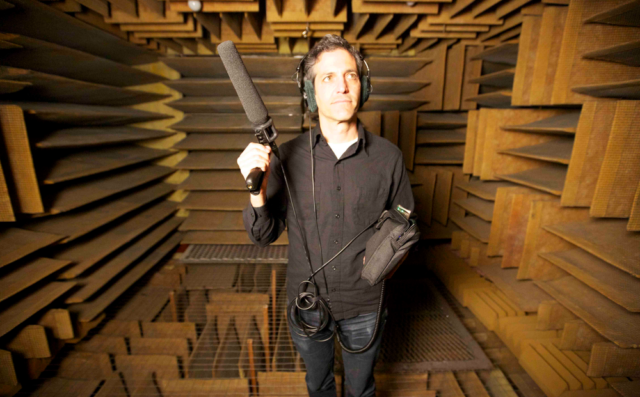
The film is best experienced on headphones, which is how it is being shown at Alice Tully Hall, with specially customized headphones with the audio mixed live inside the theater. The sound was recorded binaurally, so the audience can hear speech and movement as if it’s to your left or right, behind you, far away, or close up.
In 32 Sounds, Princeton professor and scientist Edgar Choueiri introduces us to Johann Christoff, a recording device shaped like a human head that “captures sound exactly how you hear it.” Similar technology has been used for such theatrical presentations as The Encounter and Blindness. Hollywood veteran and two-time Oscar winner Mark Mangini (Dune,Mad Max: Fury Road) designed the sound for the film, immersing the viewer into what feels like a three-dimensional universe.
The film kicks off with Green and Samson in a playful scene that sets the stage for what is to follow. “This is a little bit of an odd movie in that we’re going to ask you to do some things,” Green explains. “Simple things, like close your eyes. If you don’t want to do them, don’t worry about it. But the truth is, the more you give yourself to the experience” — Samson then cuts in, finishing, “the more you get out of it.”
The first sound Green explores, appropriately enough, is of the womb, recorded by former midwife Aggie Murch, whose husband is Oscar-winning film editor and sound designer Walter Murch (Apocalypse Now,The English Patient,The Conversation). Over a purplish white screen with no figuration, Green discusses Walter Murch’s 2005 essay “Womb Tone,” in which Murch writes, “Hearing is the first of our senses to be switched on. . . . Although our mature consciousness may be betrothed to sight, it was suckled by sound, and if we are looking for the source of sound’s ability — in all its forms — to move us more deeply than the other senses and occasionally give us a mysterious feeling of connectedness to the universe, this primal intimacy is a good place to begin.”
Green then jumps from birth to death, taking out old cassette tapes of voice messages he has saved from decades past, telling us how “they hold the voices of so many people I’ve loved who are gone. I was wondering, How does that work? How does a little piece of eighth-of-an-inch magnetic tape hold a person? Make it seem like they are alive and in front of you more than any photo or piece of film ever could. I was wondering if sound is somehow a way to understand time, and time passing, and loss, and the ephemeral beauty of the present moment, all the things that I keep coming back to in my movies.”
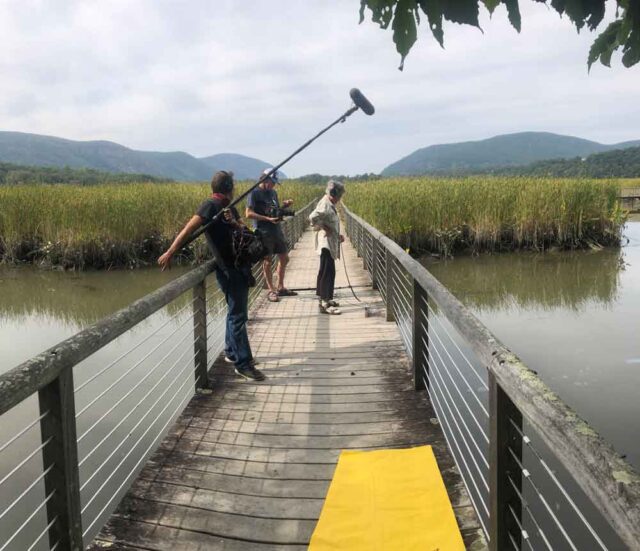
He meets with Cheryl Tipp, curator of Wildlife and Environmental Sounds at the British Library Sound Archive, who shares the poignant and heartbreaking story of the mating call of the Hawaiian bird the moho braccatus. Lockwood, the subject of a short companion film Green directed, demonstrates how she has recorded the sound of rivers for fifty years, after gaining notoriety for her burning-piano installations.
Foley artist Joanna Fang reveals how she creates sound effects for films using unusual items in her studio, from a bowling ball to a wet cloth. “Art can elevate a truth beyond what is feasibly there,” she says. “And if we pull it off right, hopefully the emotional experience of hearing it and being part of it is enough to make you fully accept the poetry of what you’re hearing. Because isn’t that what we’re all trying to do, trying to take what we’re feeling on the inside and show it to somebody else, or let them listen to it, and have them feel the same way we do?”
Black revolutionary and fugitive Nehanda Abiodun listens to a tape of McFadden & Whitehead’s “Ain’t No Stopping Us Now,” transporting her to another place and time. Poet and cultural theorist Fred Moten marvels about “ghost sounds” of his relatives. Bay Area military veteran and environmental journalist Harold Gilliam postulates about sleep and foghorns in the context of “being part of this total community of life and nonlife on Earth.” Lebanese artist and musician Mazen Kerbaj recalls being able to make sound art during bombings when others were trapped in their homes or dying.
Green gives examples of recording “room tones,” a documentary process in which the subject is silent for thirty seconds as the sound recordist grabs the natural sound in order to help with later editing. It’s fascinating watching Philip Glass, Laurie Anderson, Rebecca Solnit, and others sit or stand uncomfortably as they wait, and we wait; we are not used to seeing such stagnation in a motion picture.
Annea Lockwood has been recording rivers for more than fifty years
Deaf sound artist Christine Sun Kim uses ASL to describe vibration and how she was taught when she was a child that sound was not part of her life, a concept that infuses her art. “I realized that sound is like money, power, control; it’s social currency,” she explains.
Along the way Green also looks at inventor Thomas Edison, polymath Charles Babbage, electronics engineer Alan Blumlein, and a classic Memorex commercial starring Ella Fitzgerald. We see and hear Glass playing piano, church bells ringing in Venice, Don Garcia driving through the city in his red Mazda blasting Phil Collins’s “In the Air Tonight,” and John Cage performing 4’33” outdoors. A Zamboni cleans the ice at a hockey rink. A cat purrs. Evel Knievel jumps over obstacles on his motorcycle. Samson blasts away on a whoopee cushion. Danny drives his Big Wheel through the empty halls of the Overlook Hotel in The Shining. Different groups dance to Donna Summer’s “I Feel Love.”
Oscar nominee Green (The Weather Underground,A Thousand Thoughts) edited the documentary with Nels Bangerter; the new, sharp cinematography is by Yoni Brook. The visuals range from a deluge of quick cuts of archival footage to nearly blank screens when Green asks the audience to close their eyes and just listen.
While the film is a technical marvel, it also becomes deeply emotional, as Green and several subjects listen to recordings of friends and family no longer with us, something you can’t get out of a photo album. It made me think of the messages I had saved on my answering machine of my mother, who passed away in 2017; while I try to avoid hearing them — they used to pop up after I went through new messages, sending me screaming into another room — it is comforting to know that they exist, that I can hear her whenever I need to. Such is the power of sound.
[Mark Rifkin is a Brooklyn-born, Manhattan-based writer and editor; you can follow him on Substack here.]
The phrase “Familiarity breeds contempt” has been around for millennia, dating back to Aesop, Chaucer, and St. Augustine. It usually means that the more we know someone, the less we like them.
But the opposite seems to be true when it comes to Broadway, where the more familiar the public is with something, the more likely producers are going to stage it and the crowds will follow, often in adoration.
Such is the case with six current musicals on the Great White Way, each of which started as a book, was turned into a film, and then was adapted into a musical, with varying degrees of success.
As the Drama Desk Awards and the Tonys approach, here is a look at these shows, two of which I heartily recommend — and four of which you might want to take a pass on.
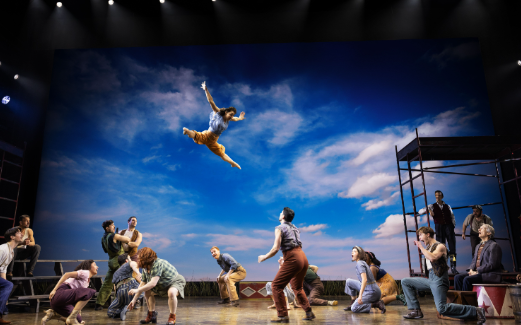
The acrobatic Water for Elephants is a high-flying triumph (photo by Matthew Murphy)
WATER FOR ELEPHANTS
Imperial Theatre
249 West 45th St. between Broadway & Eighth Ave.
Tuesday – Sunday through December 8, $59-$299 www.waterforelephantsthemusical.com
“Only three people were left under the red and white awning of the grease joint: Grady, me, and the fry cook. Grady and I sat at a battered wooden table, each facing a burger on a dented tin plate. The cook was behind the counter, scraping his griddle with the edge of a spatula. He had turned off the fryer some time ago, but the odor of grease lingered,” Sara Gruen writes at the beginning of her 2006 New York Times bestseller, Water for Elephants. Francis Lawrence directed the 2011 film, which was written by Richard LaGravenese and stars Reese Witherspoon, Robert Pattinson, Christoph Waltz, and Hal Holbrook.
I have not read the book nor seen the movie, but I love the musical, which is built around a traveling circus. When Jacob Jankowski (Grant Gustin) is caught wandering around behind the scenes after a performance as the tent is being taken down, circus boss Charlie (Paul Alexander Nolan) and horse rider June (Isabelle McCalla) are about to ask him to leave until he starts to tell them about how he was present at a famous, awful circus tragedy decades in the past. The narrative heads back decades as the younger Jacob (Grant Gustin), who lost his parents in a car accident, is searching for his place in the world, hops on a train, and ends up at a circus run by August (Nolan), who is in love with horse rider Marlena (McCalla). Jealousy rears its ugly head as Jacob falls for Marlena while dealing with an unsavory group of characters during the Great Depression.
The solid, if sentimental, book is by Rick Elice, with rollicking music and lyrics by PigPen Theatre Co.. Director Jessica Stone gives the narrative plenty of room to breathe amid Shana Carroll and Jesse Robb’s acrobatic choreography on Takeshi Kata’s wood-based sets and David Israel Reynoso’s period costumes.
“Man, this place . . . The sawdust, the smells . . . it’s old but it’s new,” the older Mr. Jankowski says, and he could be talking about the musical itself
THE OUTSIDERS
Bernard B. Jacobs Theatre
242 West Forty-Fifth St. between Seventh & Eighth Aves.
Tuesday – Sunday through January 5, $69-$379 outsidersmusical.com
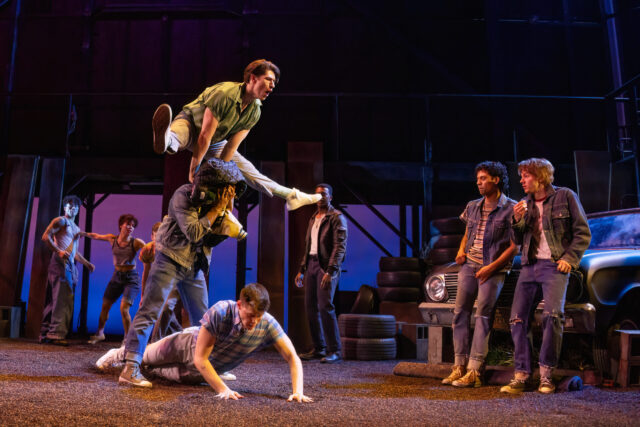
“When I stepped out into the bright sunlight from the darkness of the movie house, I had only two things on my mind: Paul Newman and a ride home. I was wishing I looked like Paul Newman — he looks tough and I don’t — but I guess my own looks aren’t so bad. I have light-brown, almost-red hair and greenish-gray eyes. I wish they were more gray, because I hate most guys that have green eyes, but I have to be content with what I have. My hair is longer than a lot of boys wear theirs, squared off in back and long at the front and sides, but I am a greaser and most of my neighborhood rarely bothers to get a haircut. Besides, I look better with long hair,” S. E. Hinton writes at the beginning of her beloved 1967 YA novel, The Outsiders. Francis Ford Coppola directed the 1983 film, which was written by Kathleen Rowell and stars C. Thomas Howell, Matt Dillon, Ralph Macchio, Patrick Swayze, Rob Lowe, Diane Lane, Emilio Estevez, Tom Cruise, and Leif Garrett.
Both the book and the movie had a profound influence on me, so I was anxious about seeing the musical, which is outstanding. Adam Rapp and Justin Levine’s book captures the essence of teen angst not only in 1967 Tulsa, Oklahoma, but anytime, anywhere, with superb country folk-pop and potent lyrics by Jamestown Revival and Levine. Director Danya Taymor and choreographers Rick and Jeff Kuperman avoid genre clichés as the battle between the wealthy Socs and the poor Greasers heats up. The Socs are led by the smarmy Bob Sheldon (Kevin William Paul), who drives around in his fancy car, his girl, Cherry Valance (Emma Pittman), at his side. When Bob nearly kills Greasers Johnny Cade (Sky Lakota-Lynch) and Ponyboy Curtis (Brody Grant) and ends up himself in a pool of blood, Johnny and Ponyboy — whose parents died in a car crash, so he is living with his older brothers, Darrel (Brent Comer) and Sodapop (Jason Schmidt) — are on the run from the only home they’ve ever known, being helped by legendary Greaser Dallas Winston (Joshua Boone), fresh out of county lockup. It gets more complicated when Cherry and Ponyboy grow close and a rumble is on the horizon.
The Outsiders is highlighted by an unforgettable fight scene in the rain, complete with strobe lights that enhance the slow-motion clash. The one low point is changing Ponyboy’s favorite novel from Gone with the Wind to Great Expectations, resulting in a disappointing and unnecessary underlying theme. It gets everything else right, from Sarafina Bush’s costumes and AMP’s (Tatiana Kahvegian) sets to Brian MacDevitt’s powerful sound and Hana Kim’s projections.
As Ponyboy says, “Unlike in the movies and the books I like to read, nothing in this town plays out the same.”
The Great Gatsby takes a much-needed pause to figure out where it all went wrong (photo by Matthew Murphy and Evan Zimmerman)
THE GREAT GATSBY
Broadway Theatre
Fifty-Third St. at Broadway
Tuesday – Sunday through November 24, $48-$298 broadwaygatsby.com
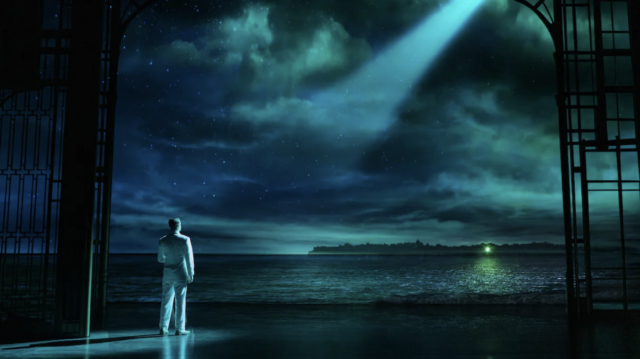
“In my younger and more vulnerable years my father gave me some advice that I’ve been turning over in my mind ever since. ‘Whenever you feel like criticizing any one,’ he told me, ‘just remember that all the people in this world haven’t had the advantages that you’ve had.’ He didn’t say any more but we’ve always been unusually communicative in a reserved way, and I understood that he meant a great deal more than that. In consequence I’m inclined to reserve all judgments, a habit that has opened up many curious natures to me and also made me the victim of not a few veteran bores,” F. Scott Fitzgerald writes at the beginning of his 1925 novel, The Great Gatsby. Jack Clayton directed the 1974 film, which was written by Francis Ford Coppola and stars Robert Redford, Mia Farrow, Bruce Dern, Sam Waterston, and Karen Black. There were also lesser-known adaptations made in 1926 and 1949, and Baz Luhrmann turned it into a glitzy spectacle in 2013, with Leonardo DiCaprio, Tobey Maguire, Carey Mulligan, Joel Edgerton, Isla Fisher, Jason Clarke, and Elizabeth Debicki.
The magnificent novel about a wealthy man stirring things up in East and West Egg during the Jazz Age is still a must-read; the 1974 film was a snoozy bore, but Luhrmann’s glitzy interpretation was a sumptuous delight. Coming on the heels of a fun, immersive version at the Park Central Hotel last year, the new musical at the Broadway Theater is, essentially, a glitzy bore. There’s no need to reserve judgment about this utter mess, which focuses on the wrong plot points and is more concerned with style over substance; it looks and sounds good for about ten minutes before falling into chaos.
The basic elements are there: The mysterious millionaire Jay Gatsby (Jeremy Jordan) likes throwing fashionable parties he doesn’t attend. He is still in love with his onetime flame, the debutante Daisy Buchanan (Eva Noblezada), who is married to the nasty Tom (John Zdrojeski), who is having an affair with Myrtle Wilson (Sara Chase), who wants more out of life than her hardworking husband, George Wilson (Paul Whitty), can manage. It’s all seen through the eyes of Yale grad and WWI vet Nick Carraway (Noah J. Ricketts), who is renting a small bungalow and soon winds up on the arm of amateur golfer Jordan Baker (Samantha Pauly).
But the similarities end there as book writer Kait Kerrigan dumbs everything down — who needs character development? — director Marc Bruni seems more lost than the audience, Dominique Kelley’s choreography calls so much attention to itself that it becomes purposeless quickly, Paul Tate dePoo III’s overwrought sets and projections and Linda Cho’s haughty costumes will cure you of ever wanting to go to such parties, Jason Howland’s score has little unique to it, and Nathan Tysen’s lyrics leave much to be desired. It’s all best exemplified by the head-scratching second act opener, “Shady,” in which Meyer Wolfsheim (Eric Anderson), Gatsby’s questionable business associate, declares, “We all need a distraction / We all need a hobby / We also need a second exit / That doesn’t go through the lobby / We enjoy a favorite cut of meat / But it’s rarely ever all we eat / What comes on the side makes a meal complete.”
You won’t have to worry about whether any exit goes through the lobby if you don’t enter the Broadway Theatre in the first place, old sport.
When it’s not underdone, The Wiz is overdone (photo by Jeremy Daniel)
THE WIZ
Marquis Theatre
210 West Forty-Sixth St. between Seventh & Eighth Aves.
Tuesday – Sunday through August 18, $88.75-$319.50 wizmusical.com
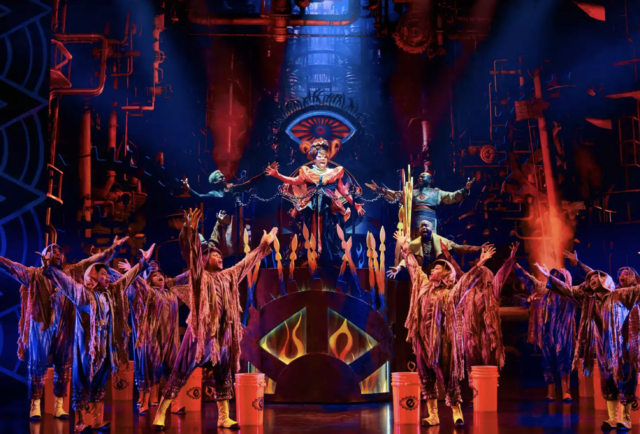
“Dorothy lived in the midst of the great Kansas prairies, with Uncle Henry, who was a farmer, and Aunt Em, who was the farmer’s wife. Their house was small, for the lumber to build it had to be carried by wagon many miles. There were four walls, a floor and a roof, which made one room; and this room contained a rusty looking cooking stove, a cupboard for the dishes, a table, three or four chairs, and the beds,” L. Frank Baum writes at the beginning of the first of his fourteen Oz books, the 1900 classic The Wonderful World of Oz. “Uncle Henry and Aunt Em had a big bed in one corner, and Dorothy a little bed in another corner. There was no garret at all, and no cellar — except a small hole, dug in the ground, called a cyclone cellar, where the family could go in case one of those great whirlwinds arose, mighty enough to crush any building in its path. It was reached by a trap-door in the middle of the floor, from which a ladder led down into the small, dark hole.” Victor Fleming, with assistance from George Cukor and King Vidor, directed the 1939 film, which was written by Noel Langley, Florence Ryerson, and Edgar Allan Woolf and stars Judy Garland, Frank Morgan, Ray Bolger, Bert Lahr, Jack Haley, Billie Burke, and Margaret Hamilton.
The story was turned into the 1975 Broadway show The Wiz: The Super Soul Musical “Wonderful Wizard of Oz,” starring Stephanie Mills as Dorothy, Hinton Battle as Scarecrow, Tiger Haynes as Tin Man, Ted Ross as the Lion, and André De Shields as the Wiz. Sidney Lumet directed the 1978 Motown film version, which was written by Joel Schumacher and stars Diana Ross as Dorothy, Michael Jackson as Scarecrow, Nipsey Russell as Tin Man, Ted Ross as the Cowardly Lion, and Richard Pryor as the Wiz. The show won nine Tonys, including Best Musical, while the critically panned movie earned four Oscar nominations.
However, something rather unpleasant must have happened when the 2024 revival eased on down that Yellow Brick Road, because this iteration is dull and lifeless; Dorothy’s house should have fallen on the whole production. The shell is still there: Dorothy (Nichelle Lewis) has ended up in Oz after a tornado swept across her home in Kansas. In order to get back, she must find the Wiz (Wayne Brady), but along the way she picks up a ratty scarecrow (Avery Wilson), a sad tin man (Phillip Johnson Richardson), and a meek lion (Kyle Ramar Freeman). She gets a bit of help from a good witch named Glinda (Deborah Cox), who has advised her to avoid her sister, Evillene (Melody A. Betts), a wicked witch.
“Don’t nobody bring me no bad news,” Evillene declares to her numerous flunkies. Too late.
The original book, by William F. Brown, has been updated by Amber Ruffin, Dorothy has been aged up a few years, and Toto is nowhere to be found, none of which works. Just because everyone basically knows what happens doesn’t mean director Schele Williams should forget about actual drama, while choreographer JaQuel Knight keeps any momentum at a low ebb with tired repetition. Hannah Beachler’s sets and Sharen Davis’s costumes are colorful, but Joseph Joubert’s orchestrations and arrangements are lackluster. The crows who harass Scarecrow are kinda nifty, so there’s that.
So what’s missing? Well, just a little heart, some smarts, and a dose of courage.
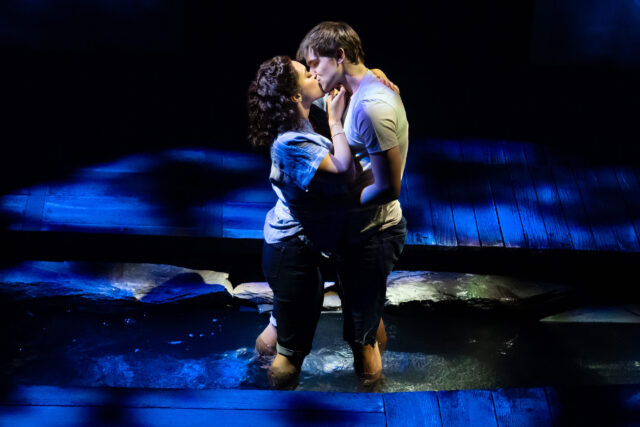
Musical version of The Notebook is all wet (photo by Julieta Cervantes)
THE NOTEBOOK
Gerald Schoenfeld Theatre
236 West 45th St. between Broadway & Eighth Aves.
Tuesday – Sunday through November 24, $74-$298 notebookmusical.com
“Who am I? And how, I wonder, will this story end?” Nicholas Sparks writes at the beginning of his 1996 debut novel. The Notebook. “The sun has come up and I am sitting by a window that is foggy with the breath of a life gone by. I’m a sight this morning: two shirts, heavy pants, a scarf wrapped twice around my neck and tucked into a thick sweater knitted by my daughter thirty birthdays ago. The thermostat in my room is set as high as it will go, and a smaller space heater sits directly behind me. It clicks and groans and spews hot air like a fairytale dragon, and still my body shivers with a cold that will never go away, a cold that has been eighty years in the making. Eighty years, I think sometimes, and despite my own acceptance of my age, it still amazes me that I haven’t been warm since George Bush was president. I wonder if this is how it is for everyone my age. My life? It isn’t easy to explain. It has not been the rip-roaring spectacular I fancied it would be, but neither have I burrowed around with the gophers. I suppose it has most resembled a blue-chip stock: fairly stable, more ups than downs, and gradually trending upward over time. A good buy, a lucky buy, and I’ve learned that not everyone can say this about his life. But do not be misled. I am nothing special; of this I am sure. I am a common man with common thoughts, and I’ve led a common life. There are no monuments dedicated to me and my name will soon be forgotten, but I’ve loved another with all my heart and soul, and to me, this has always been enough.” Nick Cassavetes directed the 2004 film, which was written by Jeremy Leven and stars Ryan Gosling, Rachel McAdams, James Garner, Gena Rowlands, James Marsden, and Sam Shepard.
The novel and film had plenty of naysayers, decrying it as sentimental claptrap; the third time is unlikely to be the charm for the haters out there. The show is nothing special, with underwhelming music and lyrics by American singer-songwriter Ingrid Michaelson and a tepid book by Bekah Brunstetter.
The plot is the classic hardworking tough guy meets rich girl, rich girl’s parents (Andréa Burns and Dorcas Leung) break them apart, boy joins the army with his best friend (Carson Stewart), girl finds a respectable lawyer (Chase Del Rey) to marry, boy and girl imagine what might have happened had they stayed together. The older Noah believes that by telling the story to Allie over and over again, it might help her regain at least some of her memories, while the nurse (Burns) insists Noah follow the rules and his physical therapist (Stewart) tries to get him to accept treatment for his ailing knee, but Noah has more important things on his mind.
Codirectors Michael Greif and Schele Williams are unable to rein in the overall befuddlement on David Zinn and Brett J. Banakis’s rustic set, which switches from a nursing home to a historic house that needs significant work; there’s also a pool of water in the front of the stage where Allie and Noah swim and play. When boredom sets in, you can check out Ben Stanton’s lighting design, which features dozens of narrow, cylindrical, fluorescent lights hanging from the ceiling with bulbs at the bottom that make them look like big pens (that one might, say, use to write in a notebook?). The lighting also casts a cool shimmer when it focuses on the pool.
The score, with arrangements by Michaelson and music supervisor Carmel Dean and orchestrations by Dean and John Clancy, can’t keep pace with the narrative, slowing it down dramatically. When teenage Allie asks teenage Noah if he has a pen and he says, “Why would I have a pen?,” I pointed up at the lights. When Middle Noah sings, “Leave the Light On,” I suddenly felt as if I were in a Motel 6 advertisement. And when the young Allie and Noah sing about his chest hair — twice — but Cardoza doesn’t have any, I wondered if it was meant to be a tongue-in-cheek joke. (If it was, it didn’t draw laughs.)
The musical probably has a big future ahead of itself too, naysayers be damned.
Yes, this is a picture from the current Broadway revival of Cabaret (photo by Marc Brenner)
CABARET AT THE KIT KAT CLUB
August Wilson Theatre
245 West Fifty-Second St. between Seventh & Eighth Aves.
Monday – Saturday through March 29, $99-$529 kitkat.club/cabaret-broadway
“From my window, the deep solemn massive street. Cellar-shops where the lamps burn all day, under the shadow of top-heavy balconied façades, dirty plaster frontages embossed with scrollwork and heraldic devices. The whole district is like this: street leading into street of houses like shabby monumental safes crammed with the tarnished valuables and second-hand furniture of a bankrupt middle class,” Christopher Isherwood writes at the beginning of his semiautobiographical 1939 novel, Goodbye to Berlin, the second part of The Berlin Stories. “I am a camera with its shutter open, quite passive, recording, not thinking. Recording the man shaving at the window opposite and the woman in the kimono washing her hair. Some day, all this will have to be developed, carefully printed, fixed.”
Straying slightly from the theme, Goodbye to Berlin was first adapted into the 1951 play I Am a Camera by John Van Druten, then into the musical Cabaret, which opened on Broadway in November 1966, with a book by Joe Masteroff, music by John Kander, and lyrics by Fred Ebb, directed by Harold Prince and choreographed by Ron Field; Joel Grey was the emcee, with Jill Haworth as Sally Bowles, Bert Convy as young American writer Clifford Bradshaw, Lotte Lenya as Fräulein Schneider, and Jack Gilford as Herr Schultz. The production was nominated for ten Tonys, winning seven, including Best Musical. Bob Fosse directed the 1972 film, which was written by Jay Allen and stars Liza Minnelli as Sally, Michael York as renamed young American writer Brian Roberts, and Grey reprising his role as the enigmatic emcee. The film was nominated for ten Oscars, winning eight.
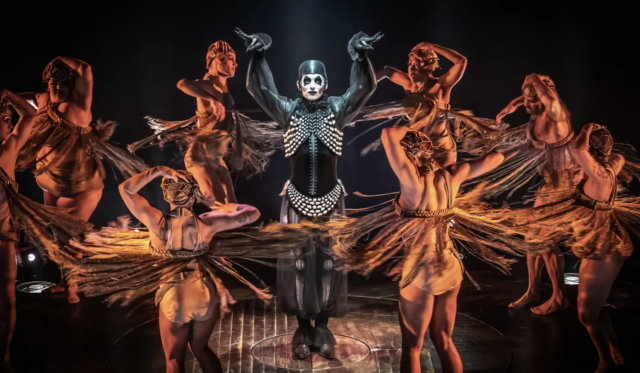
It has been revived on the Great White Way four times, the latest bamboozling audiences at the August Wilson Theatre, which has been transformed into the Kit Kat Club to attempt to create a more intimate and immersive environment. Instead, the atmosphere is cold and alienating. Ticket holders are encouraged to arrive more than an hour before curtain so they can order pricey drinks at bars on several floors, where dancers perform behind beaded curtains and on platforms. The preshow is better than the show, which is set in the round, so half the time the audience is watching the characters’ back on Tom Scutt’s circular stage, which rises and descends because, well, why not. Director Rebecca Frecknall, choreographer Julia Cheng, and costume designer Scutt choose to focus on the grotesquerie of 1929–30 Weimar Germany, with Fascism right around the corner. Cabaret needn’t be clean and pretty, but you shouldn’t leave the theater in desperate need of a cold shower.
Oscar and Tony winner Eddie Redmayne does all he can to make the attendees deeply dislike him as he portrays the emcee as if he’s auditioning to be the Joker from hell in the next Batman movie, not making anyone feel welcome. Tony nominee Ato Blankson-Wood sleepwalks through his role as Cliff. Gayle Rankin brings the house down with the torrid title song but otherwise has no chemistry with the rest of the cast. Only Tony winner Bebe Neuwirth as Fraulein Schneider and Obie winner Steven Skybell as Herr Schultz manage to exhibit sensitivity and heart.
In one of the few scenes that work, Neuwirth poignantly and gorgeously sings, “With a storm in the wind, / What would you do? / Suppose you’re one frightened voice / Being told what the choice must be, / Go on, tell me, I will listen. / What would you do if you were me?”
What should you do? Avoid the Kit Kat Club — and choose one of Broadway’s many other excellent offerings, especially something that you might not be so familiar with, old chum.
[Mark Rifkin is a Brooklyn-born, Manhattan-based writer and editor; you can follow him on Substack here.]
DRAMA DESK AWARDS
NYU Skirball Center for the Performing Arts
566 La Guardia Pl.
Monday, June 10, $105-$205, 6:15 nyuskirball.org dramadeskaward.com
Balcony tickets are still available for the sixty-ninth annual Drama Desk Awards, honoring the best of theater June 10 at the Skirball Center. Founded in 1949, the Drama Desk (of which I am a voting member) does not differentiate between Broadway, off Broadway, and off off Broadway; all shows that meet the minimum requirements are eligible. Thus, splashy, celebrity-driven productions can find themselves nominated against experimental shows that took place in an East Village elevator or Chelsea loft. But that doesn’t mean there won’t be plenty of star power at the awards presentation.
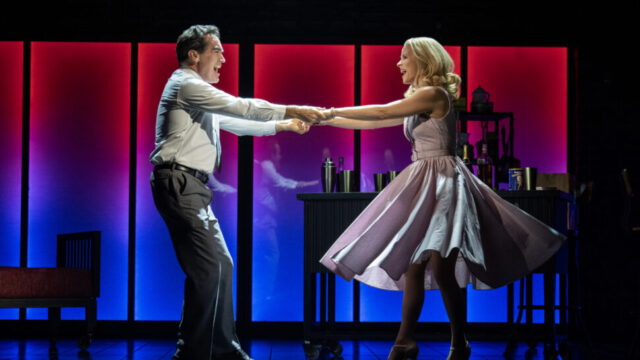
Sutton Foster and Aaron Tveit will cohost the event; among the nominees this year are Jessica Lange for Mother Play, Patrick Page for All the Devils Are Here: How Shakespeare Invented the Villain, Rachel McAdams for Mary Jane, Leslie Odom Jr. for Purlie Victorious: A Non-Confederate Romp Through the Cotton Patch, Sarah Paulson for Appropriate, Brian d’Arcy James and Kelli O’Hara for Days of Wine and Roses, Bebe Neuwirth for Cabaret at the Kit Kat Club, Dorian Harewood for The Notebook, and Michael Stuhlbarg for Patriots. The Drama Desk also does not distinguish between male and female; the acting categories have ten nominees each, regardless of gender, with two winners. Thus, d’Arcy James is competing against his costar, O’Hara, for the same prize, although they both could take home the award.
Brian d’Arcy James and Kelli O’Hara are both nominated for Days of Wine and Roses and will participate in the 2024 Drama Desk Awards (photo by Joan Marcus)
Among this year’s presenters are Laura Benanti, Matthew Broderick, Montego Glover, Lena Hall, James Lapine, Debra Messing, Ruthie Ann Miles, Andrew Rannells, Brooke Shields, Seth Rudetsky, Shoshana Bean, Corbin Bleu, James Monroe Iglehart, and Steven Pasquale. O’Hara will perform a special tribute to William Wolf Award honoree André Bishop, Foster and Nikki M. James will both sing, and Nathan Lane will receive the Harold S. Prince Award for Lifetime Achievement. Others being honored are the How to Dance in Ohio Authentic Autistic Representation Team, lighting designer Isabella Byrd, and press agent Lady Irene Gandy.
[Mark Rifkin is a Brooklyn-born, Manhattan-based writer and editor; you can follow him on Substack here.]
Thursday, May 30
through
Sunday, June 23
Hudson Classical Theater Company: The Complete Works of William Shakespeare (abridged), Soldiers’ and Sailors’ Monument, Riverside Park
Wednesday, June 5
through
Sunday, June 23
Smith Street Stage: Love’s Labor’s Lost, Carroll Park, Brooklyn
Friday, June 7
Contemporary Dance: David Dorfman, Soles of Duende, and Joffrey Concert Group, Bryant Park Picnic Performances, 7:00
Friday, June 7
and
Saturday, June 8
Interventions: You Look Like a Fun Guy, by Dance Heginbotham, Fort Jay Moat, Governors Island, 6:30
Saturday, June 8
BRIC Celebrate Brooklyn!: Family Day, with the Halluci Nation, Xiuhtezcatl, Asase Yaa Youth Ensemble, Lena Horne Bandshell, 3:00
Sunday, June 9
Summer on the Hudson: Face the Music, with students from the Kaufman Music Center and members of the Metropolis Ensemble, 125th & Marginal Sts., Hudson River Park, 1:00
Lazy Daze: The Soul of Yacht Rock, with Scott Barkham, Gary Katz, and Greg Caz, Pier 6 Liberty Lawn, Brooklyn Bridge Park, 4:00
Tuesday, June 11
through
Sunday, June 30
New York Classical Theatre: Henry IV, Central Park
Wednesday June 12
Jazz at Pier 84: Antoine Roney, Hudson River Park, 7:00
Lincoln Center Presents Summer for the City: Soundcake: Aural Confections by Sapphira Cristál & Monét X Change, Damrosch Park, 7:30
Lincoln Center Presents Summer for the City: Silent Disco, with Sissy Elliott, 8:00
Thursday, June 13
Lincoln Center Presents Summer for the City: Young People’s Chorus of New York City — Red Light, Green Light, Damrosch Park, 11:00 am
Lincoln Center Presents Summer for the City — Sound Bites: Salsa Music with DJ Sabrosura, Outdoor Reading Room Terrace, 5:00 pm
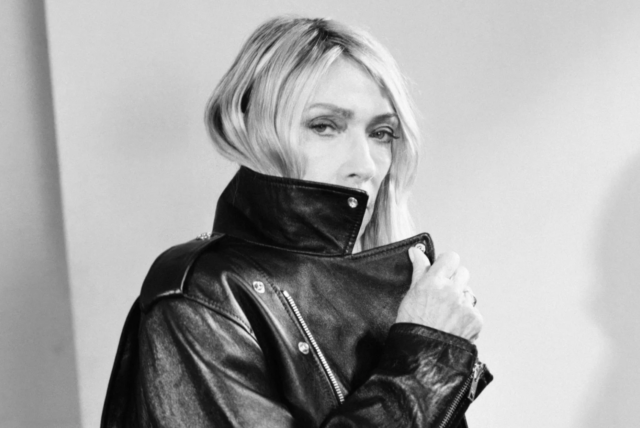
Kim Gordon / Sun Ra Arekstra / Slauson Malone 1, SummerStage, Central Park, Rumsey Playfield, 6:00
Blues by the Boardwalk: Jonathan Kalb, Pier 97, Hudson River Park, 6:30
Lincoln Center Presents Summer for the City: Social Dance with the Tony Succar Orchestra Featuring Mimy Succar, the Dance Floor, 6:30
Sofar Summer Music Series, Pier 3 Plaza, Brooklyn Bridge Park, 8:00
Thursday, June 13
through
Sunday, June 23
Shakespeare Downtown: Macbeth, Castle Clinton, Battery Park
Friday, June 14
Porch Stomp, Nolan Park, Governors Island, 11:00 am – 5:00 pm
Lincoln Center Presents Summer for the City: Social Dance with Eyal Vilner Big Band’s Swingin’ Uptown: Album Release Dance Party, the Dance Floor, 6:30
Sunset on the Hudson: Viva Deconcini & People’s Champs, Pier 45, Hudson River Park, 6:30
Contemporary Dance: Ronald K. Brown/EVIDENCE, Robin Dunn’s ‘SHOUT,’ and Kevin Wynn Tribute, Bryant Park Picnic Performances, 7:00
Summer on the Hudson — Jazz Foundation Presents: Sunset Sounds, Pier at 125th & Marginal Sts., Riverside Park, 7:00
Lincoln Center Presents Summer for the City: Visions of Ubuntu, with Young People’s Chorus of New York City, Damrosch Park, 8:00
Lincoln Center Presents Summer for the City: Funny Puppet, the Underground at Jaffe Drive, 8:00
Lincoln Center Presents Summer for the City: Silent Disco — the Brooklyn Cumbia Festival Presents Noche Romantica with DJ Tenosh, the Dance Floor, 10:00
Saturday, June 15
SummerStage: The Aussie BBQ, with Jebediah, Last Dinosaurs, Northeast Party House, Sheppard, Sycco, Thelma Plum, Rumsey Playfield, Central Park, 4:00
Lincoln Center Presents Summer for the City: Jazztopad Presents Hand to Earth, Hearst Plaza, 4:30
SummerStage: Andy Montañez, Charlie Cruz, People of Earth, DJ García, Coney Island Amphitheater, 6:00
Lincoln Center Presents Summer for the City — Kumbia Queers Live: Paraíso Tropical, the Dance Floor, 6:00
Lincoln Center Presents Summer for the City: Cultura Profética, with Por Más, Damrosch Park, 8:00
Lincoln Center Presents Summer for the City: Silent Disco, with JFUSE & Dada Cozmic, the Dance Floor, 9:00
Sunday, June 16
SummerStage: Corinne Bailey Rae, Dixson, DJ Rellyrell & Dj Ooochild, Rumsey Playfield, Central Park, 7:00
Tuesday, June 18
SummerStage: The Metropolitan Opera Summer Recital Featuring Leah Hawkins, Mario Chang, Michael Sumuel, Rumsey Playfield, Central Park, 8:00
Wednesday, June 19
BRIC Celebrate Brooklyn!: Juneteenth UNITYFEST, Lena Horne Bandshell, 6:00
Lincoln Center Presents Summer for the City — Some Sing: A Juneteenth Celebration, curated by Carl Hancock Rux, Hearst Plaza, 6:00
Opera in the Garden: Juneteenth Celebration, curated by Kenneth Overton, West Side Community Garden, 6:00
Lincoln Center Presents Summer for the City — Toshi Reagon’s Songs of the Living: Freedom Songs, Damrosch Park, 7:30
Thursday, June 20
Summer Solstice, Socrates Sculpture Park, 4:30
Blues by the Boardwalk: Jimmy Hill and the Allstarz, Pier 97, Hudson River Park, 6:30
Lincoln Center Presents Summer for the City: Social Dance | Silent Disco, with Joe McGinty & the Loser’s Lounge and DJ Bill Coleman, the Dance Floor, 6:30
The Metropolitan Opera Summer Recital Featuring Leah Hawkins, Mario Chang, Michael Sumuel, Brooklyn Bridge Park, 7:00
Sofar Summer Music Series, Pier 3 Plaza, Brooklyn Bridge Park, 8:00
Lincoln Center Presents Summer for the City: Silent Disco, with DJ Bill Coleman, the Dance Floor, 10:00
Friday, June 21
Kyo Shin An Shakuhachi Ensemble, Granite Prospect, Brooklyn Bridge Park, 4:00
Sounds at Sunset: Steely Dan Happy Hour, Pier 3 Plaza, Brooklyn Bridge Park, 6:00
Summer on the Hudson: Harlem Moves with Jose Limón Dance Company, 125th & Marginal Sts., Riverside Park, 6:00
Lincoln Center Presents Summer for the City: Social Dance, with Abaddón Tango, the Dance Floor, 6:30
Sunset on the Hudson: Resistance Revival Chorus, Pier 45, Hudson River Park, 6:30
BRIC Celebrate Brooklyn! with Ana Tijoux, Ambar Lucid, Lena Horne Bandshell, Prospect Park, 7:00
Jazzmobile: Sarah Vaughan Centennial, with Charenée Wade, Bryant Park Picnic Performances, 7:00
Lincoln Center Presents Summer for the City: Silent Disco, with Bembona, the Dance Floor, 10:00
Saturday, June 22
SummerStage: The Yussef Dayes Experience, Aneesa Strings, Dana and Alden, Rumsey Playfield, Central Park, 6:00
BRIC Celebrate Brooklyn! meets NPR Tiny Desk Contest on the Road — Thee Sacred Souls, Adi Oasis, the Philharmonik, Lena Horne Bandshell, Prospect Park, 6:00
Summer on the Hudson — Jazz Foundation Presents: Sunset Sounds, Pier at 125th & Marginal Sts., Riverside Park, 7:00
Summer on the Hudson: RCTA Summer Sunset Concert Series 2024, with Ron McClure & Friends, 96th St. Tennis Courts, Riverside Park, 7:00
Lincoln Center Presents Summer for the City — Electric Fields & DEM MOB: Celebrating South Australian First Nations, Damrosch Park, 8:00
Saturday, June 22
through
Sunday, July 14
Boomerang Theatre Company: Romeo and Juliet, Central Park
Sunday, June 23
Lincoln Center Presents Summer for the City: San Juan Procession, the Garden at Damrosch Park, 1:00
Lazy Daze: Friends & Lovers, Liberty Lawn, Brooklyn Bridge Park, 4:00
Riverside Opera Company: Black Voices, Conference House Park, Staten Island, 4:00
Lincoln Center Presents Summer for the City: Jazz Underground, with Charenée Wade, the Underground at Jaffe Drive, 6:00
Lincoln Center Presents Summer for the City: Silent Disco with Papi Juice, the Dance Floor, 8:00
Lincoln Center Presents Summer for the City: Rosanne Cash, Damrosch Park, 8:00
Monday, June 24
The Metropolitan Opera Summer Recital Featuring Brittany Olivia Logan, Hannah Jones, Matthew Cairns, Jackie Robinson Park, 7:00
Wednesday, June 26
The Metropolitan Opera Summer Recital Featuring Brittany Olivia Logan, Hannah Jones, Matthew Cairns, Williamsbridge Oval, Bronx, 7:00
Lincoln Center Presents Summer for the City: Emily King and Louis Cato, Damrosch Park, 7:00
Jazz at Pier 84: George Braith, Hudson River Park, 7:00
Lincoln Center Presents Summer for the City: ABT Silent Disco with DJ Remeice and Connor Holloway, the Dance Floor, 9:00
Thursday, June 27
Opera in the Garden: La Traviata excerpts, West Side Community Garden, 6:00
Lincoln Center Presents Summer for the City: Double Dutch Fusion Freestyle & Open Jump, with the National Double Dutch League, the Dance Floor, 6:00
Blues by the Boardwalk: Seydurah Avecmoi, Pier 97, Hudson River Park, 6:30
Lincoln Center Presents Summer for the City: Le Jazz Est Mort, Damrosch Park, 7:30
Central Astoria LDC 40th Annual Independence Day Celebration, with Fleur Seule and fireworks, Astoria Park Great Lawn, 7:30
Sofar Summer Music Series, Pier 3 Plaza, Brooklyn Bridge Park, 8:00
Thursday, June 27
through
Sunday, July 21
Hudson Classical Theater Company: Coriolanus, Soldiers’ and Sailors’ Monument, Riverside Park
Friday, June 28
Lincoln Center Presents Summer for the City: Social Dance, with NYC Ska Orchestra, the Dance Floor, 6:30
Sunset on the Hudson: the Bad Judies and Randy Jones, Pier 45, Hudson River Park, 6:30
Summer on the Hudson: Bridge Matter/The Reach: An evening of performance and River views, Little Red Lighthouse, Fort Washington Park, 6:30
The Metropolitan Opera Summer Recital Featuring Brittany Olivia Logan, Hannah Jones, Matthew Cairns, Socrates Sculpture Garden, 7:00
Sounds at Sunset: Igmar Thomas & Musical Guests, Pier 6 Picnic Tables, Brooklyn Bridge Park, 7:00
Summer on the Hudson: Friday Freshen Up, with Granite Garden, 125th & Marginal Sts., Riverside Park, 7:00
Lincoln Center Presents Summer for the City — Silent Disco: The People Power Disco Hour Is Back! with DJ CherishTheLuv, the Dance Floor, 10:00
Emerging Music Festival Day One, with Chanel Beads, Mei Semones, and Los Esplifs, Bryant Park Picnic Performances, 7:00
Saturday, June 29
Lincoln Center Presents Summer for the City — The Art of Wellbeing: Movement Session With New York City Ballet, LeFrak Lobby, David Geffen Hall, 11:00 am
Emerging Music Festival Day Two, with Horsegirl, Hannah Jadagu, Bloomsday, and Greg Mendez, Bryant Park Picnic Performances, 5:00
Shakespeare at Sunset: Theater 2020 presents The Tempest, Granite Prospect, Brooklyn Bridge Park, 5:30
Lincoln Center Presents Summer for the City: Silent Disco | The Dream Machine Experience, with DJ Ultra Naté, the Dance Floor, 10:00
BRIC Celebrate Brooklyn! with Fishbone, Son Rompe Pera, Lena Horne Bandshell, Prospect Park, 6:30
Sunday, June 30
Summer on the Hudson: Bridge Matter/The Reach: An evening of performance and River views, Little Red Lighthouse, Fort Washington Park, 4:00
Lincoln Center Presents Summer for the City: Voices of a People’s History Pop-Up Performance, Hearst Plaza, 5:00
Shakespeare at Sunset: Theater 2020 presents The Tempest, Granite Prospect, Brooklyn Bridge Park, 5:30
Lincoln Center Presents Summer for the City: Jazz Underground, with Dezron Douglas, the Underground at Jaffe Drive, 6:00
Lincoln Center Presents Summer for the City: Social Dance, with ARS NOVA NAPOLI and E SENZA L’ACQUA LA TERRA MORE, the Dance Floor, 6:00 pm
Lincoln Center Presents Summer for the City: Silent Disco, with RARA TECH and Gardy Girault, the Dance Floor, 8:00 pm
Lincoln Center Presents Summer for the City — 20th Annual NYC in C: Terry Riley’s in C, Damrosch Park, 8:00 pm
Monday, July 1
Madison Cunningham / La Lom / John-Robert / Corrente: Beatriz Mira & Tiago Barreiros, Rumsey Playfield, Central Park, 6:00
Tuesday, July 2
through
Sunday, July 7
New York Classical Theatre: Henry IV, Carl Schurz Park
Wednesday, July 3
Lincoln Center Presents Summer for the City — Pharoahe Monch & Friends: Internal Affairs 25th Anniversary, Damrosch Park, 8:00
Lincoln Center Presents Summer for the City: Silent Disco, with Mr. Life of Your Party fka DJ FLY TY, the Dance Floor, 10:00 pm
Friday, July 5
Lincoln Center Presents Summer for the City: Social Dance, with the Steven Oquendo Latin Jazz Orchestra, and Silent Disco, with Silent Disco With Cruz, the Dance Floor, 6:30
Carnegie Hall Citywide: Tania León and the Harlem Chamber Players, with Terrance McKnight, Josh Henderson, Leyland Simmons, and the Harlem School of the Arts, Bryant Park Picnic Performances, 7:00
Lincoln Center Presents Summer for the City: Brasil Summerfest with Rogê, David Rubenstein Atrium, 7:30
Lincoln Center Presents Summer for the City: Silent Disco, with Cruz, the Dance Floor, 10:00
Saturday, July 6
Queens Night Market, with Renaissance Youth, DJ Top Notch, Studio B Band, and the Werners, Flushing Meadows Corona Park, 5:00
Lincoln Center Presents Summer for the City — Silent Disco: Big Umbrella Day Silent Disco, the Dance Floor, 6:00
Summer on the Hudson: Silent Disco, Pier I, Riverside Park, 6:00
BRIC Celebrate Brooklyn! Film Night: Do the Right Thing, Lena Horne Bandshell, Prospect Park, 6:30
Summer on the Hudson: RCTA Summer Sunset Concert Series 2024, with Steve Sandberg Quartet, 96th St. Tennis Courts, Riverside Park, 7:00
Lincoln Center Presents Summer for the City: Anthem to US Concert, Damrosch Park, 8:00
Lincoln Center Presents Summer for the City: Silent Disco, with Khalil, the Dance Floor, 9:00
Saturday, July 6
through
Sunday, July 28
The Classical Theatre of Harlem: A Midsummer Night’s Dream, Marcus Garvey Park
Sunday, July 7
Domingo World at Edgemere Farm, with Tomoki Sanders Trio, @b.oon.e, Drone Daddies, and WIFE, Queens, 1:00
Staten Island Philharmonic, Conference House Park, Staten Island, 4:00
SummerStage: Ezra Collective, Celeste, Da Chick DJ, Rumsey Playfield, Central Park, 6:00
Lincoln Center Presents Summer for the City: Jazz Underground, with Melanie Scholtz, the Underground at Jaffe Drive, 6:00
Summer on the Hudson: Amplified Sundays feat. La Banda Chuska, Pier I, Riverside Park, 7:00
Lincoln Center Presents Summer for the City — Silent Disco: The Brooklyn Cumbia Festival Presents La Colocha, the Dance Floor, 8:00
Lincoln Center Presents Summer for the City — Passing the Crown: Celebrating the Queens of Hip-Hop, Damrosch Park, 8:00
Lincoln Center Presents Summer for the City: Seen, Sound, Scribe, the Underground at Jaffe Drive, 8:30
Federation Sound 25th Anniversary Featuring Sister Nancy / Tanto Metro & Devonte and Friends, Coney Island Amphitheater, 5:00
Tuesday, July 9
Live at the Gantries: Cheo, Gantry Plaza State Park, 7:00
Naumburg Orchestral Concerts: A Far Cry, with works by Kareem Roustom, Kinan Azmeh, Dinuk Wijeratne, and Leoš Janáček, hosted by Terrance McKnight, Naumburg Bandshell, Central Park, 7:30
Tuesday, July 9
through
Sunday, July 14
New York Classical Theatre: Henry IV, Castle Clinton, Battery Park
Wednesday, July 10
TSQ Live 2024: Live Music with MTA Music with Eyeglasses, TSQ Plaza, Times Square, 5:00
Opera in the Garden: Opera Fairy Tales, including songs from Hansel and Gretel,Cinderella, and Rusalka, West Side Community Garden, 6:00
Carnegie Hall Citywide: Alisa Amador, Oval Lawn, Madison Square Park, 6:00
LAMC and Latin Grammy 25th Anniversary, with Fonseca, Israel Fernandez, Bruses, DJ Gia Fu, Rumsey Playfield, Central Park, 7:00
Jazz at Pier 84: Santi Debriano’s Arkestra Bembe, Hudson River Park, 7:00
Blues & Greens: A Performance by Ruthie Foster and a Conversation with Suzan-Lori Parks and Majora Carter, Little Island, the Glade, 7:00
Lincoln Center Presents Summer for the City India Week — Avimukta: Where the Seeker Meets the Sacred, by Aparna and Ranee Ramaswamy for Ragamala Dance Company, Damrosch Park, 8:00
Lincoln Center Presents Summer for the City India Week: Silent Disco, with Rajuju, the Dance Floor, 9:00
Wednesday, July 10
through
Sunday, July 14
Suzan-Lori Parks hosts and curates music and conversations, the Glade, Little Island
Thursday, July 11
Lincoln Center Presents Summer for the City: Inclusive Dance Class with Mark Morris Dance Group’s Dance for PD, the Garden at Damrosch Park, 5:00
TSQ Live 2024: Jazz with Ivan Llanes & Friends, TSQ Plaza, Times Square, 5:00
Works & Process: It’s Showtime NYC!, Maimouna Keita African Dance Company, Kash Gaines’s Caged Birds, Von King Park, 6:00
Live at the Archway: Brasil Summerfest, with art wall by Noah Lyon, Manhattan Bridge Archway, Brooklyn, 6:00
Summer Evenings in the Garden, with Cheryl Pyle, Merchant’s House Museum, 6:00
Lincoln Center Presents Summer for the City India Week: Social Dance, with Garba360 Featuring Ujjval Vyas Musicals, the Dance Floor, 6:30
Central Astoria Summer Concert Series, with Emerald City Underground, Astoria Park Great Lawn, 7:30
Lincoln Center Presents Summer for the City India Week: Sonny Singh, David Rubenstein Atrium, 7:30
Plaza Theatrical presents A Grand Night for Singing, featuring Rodgers & Hammerstein classics, George Seuffert Sr. Bandshell, Forest Park, 7:30
Lincoln Center Presents Summer for the City India Week: Silent Disco, with DJ Offering Rain, the Dance Floor, 10:00
The Runway & the Street: A conversation with fashion designer Daisy Wang, with a performance by MC Corey James Gray & Freestyle Monday, the Glade, Little Island, 10:00
Friday, July 12
BRIC Celebrate Brooklyn! Travels over Feeling: Celebrating Arthur Russell, Lena Horne Bandshell, Prospect Park, 6:00
Sounds of Detroit: Celebrating 50 Years of J Dilla Feat. the Pharcyde, Slum Village, Breakbeat Lou, Rich Medina, Von King Park, 6:00
TSQ Live 2024: Summer Friday Concerts with Retrograded, TSQ Plaza, Times Square, 6:00
Carnegie Hall Citywide: Thandiswa Mazwai, Bryant Park Picnic Performances, 7:00
Sounds at Sunset: Yacouba Sissoko, Pier 6 Picnic Tables, Brooklyn Bridge Park, 7:00
Lincoln Center Presents Summer for the City India Week: Parampara and SAZ ft. Sumitra Das Goswami, Damrosch Park, 7:30
Lincoln Center Presents Summer for the City — Living Music Underground: Ringdown, the Underground at Jaffe Drive, 8:00
Lincoln Center Presents Summer for the City: Silent Disco, with Ashu Rai, the Dance Floor, 9:00
Outer Space & Inner Space: A conversation with Columbia Astronomy Professor Jane Huang, with a performance by the Psychedelic Soap Box, the Glade, Little Island, 10:00
Saturday, July 13
La Dee Streeter, Pavillion in Silver Lake Park, Staten Island, 2:00
The Big Busk with Citizen Cope and special guest Clarence Greenwood and Friends, Granite Prospect, Brooklyn Bridge Park 3:30
Mike’s Young World IV: Earl Sweatshirt, Myaap, Sideshow, Stahhr, Stacy Epps, Von King Park, 4:00
Festival Minokan 2024: Ann Tounnen Nan Matris, featuring history, talks, workshops, live music and dance, a ceremony, and more, Wyckoff House Museum, 4:00
SummerStage: LAMC, with Bresh, Rumsey Playfield, Central Park, 6:00
Work & Play: Watch Me Work with Suzan-Lori Parks & Hansol Jung, with Suzan-Lori Parks’ Sula & the Joyful Noise, the Glade, Little Island, 6:30
Summer on the Hudson: RCTA Summer Sunset Concert Series 2024, with Debbie Deane, 96th St. Tennis Courts, Riverside Park, 7:00
BRIC Celebrate Brooklyn! with Seun Kuti & Egypt 80, Lollise, Rich Medina, IAM LOVE, Lena Horne Bandshell, Prospect Park, 6:00
Lincoln Center Presents Summer for the City: Comedy Night, with Aasif Mandvi, Hari Kondabolu, Nimesh Patel, Aparna Nancherla, and Kiran Deol, Damrosch Park, 7:30
Lincoln Center Presents Summer for the City: Silent Disco, with. DJ Rekha, the Dance Floor, 9:00
Sunday, July 14
Lincoln Center Presents Summer for the City: India Week with SAZ Sunrise Concert, Hearst Plaza, 5:00 am
Bastille Day 2024 Celebration, with “Les visages de la Francophonie,” Anne Collod’s Blank Placard Dance, replay reimagining of Anna Halprin’s 1967 performance, music by DJ Julien, and more, Madison Ave. between Fifty-Ninth & Sixty-Third Sts., noon – 5:00
BRIC Celebrate Brooklyn! at Highland Park, 3:00
Common & Pete Rock, Von King Park, 5:00
Lincoln Center Presents Summer for the City: India Week with RHEOLOGY in concert, Hearst Plaza, 5:00
Golden Oldies on the Boardwalk: Oldies Is Back in Brooklyn Feat. Frank Pizarro from the Platters, Charlie Thomas’ Drifters with Jeff Hall, the Marvelettes, Bill Haley Jr’s Comets, Johnny Farina, the Excellents, the Chiclettes, and Vinnie Medugno, hosted by Joe Causi and Sal Abbatiello, music by the Coda Band, Coney Island Amphitheater, 5:00
SummerStage: Bastille Day, with IAM, Magic System, the Avener, Laurie Darmon, Femi the Scorpion, Rumsey Playfield, Central Park, 5:30
Lineup TBA, Von King Park, 6:00
Lincoln Center Presents Summer for the City: India Week Jazz Underground with Priya Darshini, the Underground at Jaffe Drive, 6:00
Lincoln Center Presents Summer for the City: India Week Silent Disco with Roshni Samlal (aka DJ Raat Ki Rani), the Dance Floor, 6:00
Summer on the Hudson: Amplified Sundays feat. Falsa, Pier I, Riverside Park, 7:00
Past & Future: A conversation with Suzan-Lori Parks and Eric Foner, and a performance by Brandee Younger, the Glade, Little Island, 7:00
Monday, July 15
Broadway by the Boardwalk, with Eden Espinosa, Clinton Cove, Hudson River Park, 6:30
Tuesday, July 16
TSQ Live 2024: DJ sets with Soul Summit, TSQ Plaza, Times Square, 5:00
Live at the Gantries: Calvin Johnson & Native Son, Gantry Plaza State Park, 7:00
Wednesday, July 17
TSQ Live 2024: Live Music with MTA Music, with Salieu Suso, TSQ Plaza, Times Square, 5:00
Carnegie Hall Citywide: JACK Quartet with Tania León, Oval Lawn, Madison Square Park, 6:00
Lincoln Center Presents Summer for the City — Silent Disco: Keep on Dancin’, a Dance Party Celebrating the Spirit of the Paradise Garage, with DJ Joey Llanos and DJ David DePino, the Dance Floor, 6:00
Jazz at Pier 84: Dick Griffin Big Band, Hudson River Park, 7:00
Lincoln Center Presents Summer for the City: Brasil Summerfest with Gilsons, Damrosch Park, 8:00
Thursday, July 18
Live at the Archway: Sonóra Nuyorkina, with art wall by 20×200 in collaboration with Joan LeMay, Manhattan Bridge Archway, Brooklyn, 6:00
Lincoln Center Presents Summer for the City: Social Dance with Jeremy Bosch & His Orchestra, the Dance Floor, 6:30
Lincoln Center Presents Summer for the City: Claudia Acuña, David Rubenstein Atrium, 7:30
Friday, July 19
Lincoln Center Presents Summer for the City: Juilliard Summer Programs Showcase, Hearst Plaza, 1:30
BRIC Celebrate Brooklyn!, with Richie Ray, Meridian Brothers, and Madame Vacile, Lena Horne Bandshell, Prospect Park, 6:00
Sounds at Sunset: Yacouba Sissoko, Pier 6 Picnic Tables, Brooklyn Bridge Park, 7:00
Carnegie Hall Citywide: Louis Cato, Bryant Park Picnic Performances, 7:00
Dance Performances: Solo & Ensemble — Suchitra Mattai: We are nomads, we are dreamers, Socrates Sculpture Park, 7:00
Lincoln Center Presents Summer for the City: Living Music Underground, with Claire Chase, the Underground at Jaffe Drive, 8:00
Lincoln Center Presents Summer for the City: The Ritual of Breath Is the Rite to Resist, Damrosch Park, 8:30
Lincoln Center Presents Summer for the City: Silent Disco with Haza, the Dance Floor, 9:00
Rena Anakwe will deliver a free sonic intervention underneath Liggett Hall archway on Governors Island on July 20
Saturday, July 20
Lincoln Center Presents Summer for the City: The Art of Wellbeing, with Corinna da Fonseca-Wollheim, Griffin Sidewalk Studio, David Geffen Hall, 10:00 & 11:30 am
Lincoln Center Presents Summer for the City: 79rs Gang, LeFrak Lobby, David Geffen Hall, noon
SummerStage: DJ Rekha’s Basement Bhangra Beyond, with Priya Ragu, Ami Dang, Lady Pista, and special guests, Flushing Meadows Corona Park, 5:00
Lincoln Center Presents Summer for the City — Civic Saturdays: WNYC’s Public Song Project — The People’s Concert, the Underground at Jaffe Drive, 6:00
Habibi Festival at BRIC Celebrate Brooklyn!, Lena Horne Bandshell, Prospect Park, 6:30
Lincoln Center Presents Summer for the City: Silent Disco with Gorgeous Gorgeous and DJ Louie XIV, the Dance Floor, 7:00
Lincoln Center Presents Summer for the City: Festival Orchestra of Lincoln Center — Symphony of Choice: A Crowd-Composed Concert, Wu Tsai Theater, David Geffen Hall, 7:30
Interventions: Rena Anakwe, Liggett Hall archway, Governors Island, 7:30
Sunday, July 21
Lincoln Center Presents Summer for the City: La Casita, Hearst Plaza, 4:30
SummerStage: DMC & Friends, Jadakiss, the Hoodies, and Statik Selektah, hosted by Ralph McDaniels, Flushing Meadows Corona Park, 5:00
Lincoln Center Presents Summer for the City: Jazz Underground with Jalen Baker Quartet, the Underground at Jaffe Drive, 6:00
Lincoln Center Presents Summer for the City: Yerin Baek, Damrosch Park, 7:30
Lincoln Center Presents Summer for the City: Silent Disco with mdnghtdiningclub, the Dance Floor, 8:00
Summerstage: Proyecto Uno, Milly y Quezada, DJ Miguelito, and Excarlet Molina, Rumsey Playfield, Central Park, 7:00
Monday, July 22
Broadway by the Boardwalk, with Ramin Karimloo, Clinton Cove, Hudson River Park, 6:30
Tuesday, July 23
Lincoln Center Presents Summer for the City: Festival Orchestra of Lincoln Center — Relaxed Open Rehearsal: Beethoven’s Pastoral Symphony, Wu Tsai Theater, David Geffen Hall, 10:30 am
Live at the Gantries: Super Yamba Band, Gantry Plaza State Park, 7:00
Tuesday, July 23
and
Wednesday, July 24
Lincoln Center Presents Summer for the City: Festival Orchestra of Lincoln Center — Beethoven’s Pastoral Symphony and a Huang Ruo Premiere, Wu Tsai Theater, David Geffen Hall, 7:30
Wednesday, July 24
TSQ Live 2024: Live Music with MTA Music, with Scott Stenten, TSQ Plaza, Times Square, 5:00
SummerStage: Arooj Aftab, Sid Sriram, Emel, and DJ Rekha, Rumsey Playfield, Central Park, 6:00
Carnegie Hall Citywide: Ekep Nkwelle, Oval Lawn, Madison Square Park, 6:00
Lincoln Center Presents Summer for the City: Social Dance with Danny Lipsitz and the Brass Tacks Ballroom Orchestra, the Dance Floor, 6:30
Jazz at Pier 84: Joaquin Pozo y la Clave Suena, Hudson River Park, 7:00
Wednesday, July 24
through
Sunday, July 28
Justin Vivian Bond: A Week of Cabaret, the Glade, Little Island, 6:30 or 10:00
Thursday, July 25
Live at the Archway: Jerron Paxton and Dennis Lichtman, with art wall by Emily Nam, Manhattan Bridge Archway, Brooklyn, 6:00
Lincoln Center Presents Summer for the City: Social Dance with Stud Country, the Dance Floor, 6:30
The Queens Jazz Trail Concert Series: Salcedo’s Latin Soul, Travers Park, 7:00
Lincoln Center Presents Summer for the City: Shallow Alcove, David Rubenstein Atrium, 7:30
Thursday, July 25
through
Saturday, August 3
The Drilling Company presents Shakespeare in the Parking Lot: Twelfth Night, 145 Stanton St.
Thursday, July 25
through
Sunday, August 18
Hudson Classical Theater Company: Twelfth Night, Soldiers’ and Sailors’ Monument, Riverside Park
Friday, July 26
Lincoln Center Presents Summer for the City — Festival Orchestra of Lincoln Center: Festival Orchestra Pre-Show Panel Discussion, Griffin Sidewalk Studio, David Geffen Hall, 6:00
Sounds at Sunset: Brooklyn Americana Music, Pier 6 Picnic Tables, Brooklyn Bridge Park, 7:00
Bryant Park Picnic Performances: Carnegie Hall Citywide, with Michael Olatuja & Lagos Pepper Soup, Bryant Park, 7:00
BRIC Celebrate Brooklyn!, with Ronald K. Brown / EVIDENCE, Lena Horne Bandshell, Prospect Park, 7:00
Lincoln Center Presents Summer for the City: Fefita La Grande, Damrosch Park, 7:30
Lincoln Center Presents Summer for the City: Living Music Underground, with Rafiq Bhatia, the Underground at Jaffe Drive, 8:00
Lincoln Center Presents Summer for the City: Silent Disco, the Dance Floor, 9:00
Friday, July 26
and
Saturday, July 27
Lincoln Center Presents Summer for the City — Festival Orchestra of Lincoln Center: Kazem Abdullah Conducts Brahms and Stravinsky, geaturing Benjamin Beilman in the Avery Fisher Legacy Concert, Wu Tsai Theater, David Geffen Hall, 7:30
Friday, July 26
through
Sunday, July 28
Lincoln Center Presents Summer for the City: Urban Bush Women’s 40th Anniversary, multiple locations and times
Saturday, July 27
Lincoln Center Presents Summer for the City: Choreograph the Future, with the NYC Hustle Dance Machine, the Dance Floor, 6:00
Rhapsody for This Land: The American Odyssey in Music, with Lara Downes, Time for Three, Christian McBride, Rosanne Cash & John Leventhal, Arturo O’Farrill, Orchestra Elena & Aram Demirjian, Emily Warren Roebling Plaza under the Brooklyn Bridge, 6:00
BRIC Celebrate Brooklyn!, with Watchhouse and Black Belt Eagle Scout, Lena Horne Bandshell, Prospect Park, 6:30
Lincoln Center Presents Summer for the City: Patrice Roberts, Damrosch Park, 7:30
Lincoln Center Presents Summer for the City: Silent Disco, Astro Disco with The Illustrious Blacks, the Dance Floor, 9:00
Sunday, July 28
Ballet Folklórico Mexicano de Nueva York’s Annual Guelaguetza Festival, Socrates Sculpture Park, noon
Sounds at Sunset: Steely Dan Happy Hour, Pier 6 Picnic Tables, Brooklyn Bridge Park, 4:00
SummerStage: Catalan Sounds on Tour, with Sidonie, Balkan Paradise Orchestra, Lau Noah, and DJ Turmix, Rumsey Playfield, Central Park, 6:00
Lincoln Center Presents Summer for the City: Jazz Underground with Jerome Jennings, the Underground at Jaffe Drive, 6:00
Lincoln Center Presents Summer for the City: Los Van Van, Damrosch Park, 7:30
Lincoln Center Presents Summer for the City: Silent Disco with S.N.O.B., the Dance Floor, 8:00
Monday, July 29
Broadway by the Boardwalk, with Bradley Gibson, Clinton Cove, Hudson River Park, 6:30
Tuesday, July 30
Live at the Gantries: Fabio Rojas Quintet, Gantry Plaza State Park, 7:00
Tuesday, July 30
and
Wednesday, July 31
Lincoln Center Presents Summer for the City: Festival Orchestra of Lincoln Center — Carlos Miguel Prieto Conducts Haydn and Ginastera, featuring J’Nai Bridges singing Lieberson’s Neruda Songs, Wu Tsai Theater, David Geffen Hall, 7:30
Tuesday, July 30
through
Saturday, August 3
Lincoln Center Presents Summer for the City: BAAND Together Dance Festival, with Ballet Hispánico, Alvin Ailey American Dance Theater, American Ballet Theatre, New York City Ballet, and Dance Theatre of Harlem, workshops at LeFrak Lobby in David Geffen Hall, live performances in David H. Koch Theater
Wednesday, July 31
TSQ Live 2024: Live Music with MTA Music, with G Wyll, TSQ Plaza, Times Square, 5:00
Lincoln Center Presents Summer for the City — Jaime Lozano & the Familia: ¿Bailamos?, the Dance Floor, 6:00
Jazz at Pier 84: Axel Tosca Trio featuring Xiomara Laugart, Hudson River Park, 7:00
Lincoln Center Presents Summer for the City: Once on This Island, in American Sign Language by Deaf Broadway, Damrosch Park, 8:00
Lincoln Center Presents Summer for the City: Silent Disco, the Dance Floor, 9:00
Thursday, August 1
Lincoln Center Presents Summer for the City: Inclusive Dance Class with Mark Morris Dance Group’s Dance for PD, the Garden at Damrosch Park, 5:00
SummerStage: Chuck Chillout 40th Radio Anniversary Party, with Ice T, Mop, Schoolly D, Peter Gunz & Lord Tariq, Super Lover Cee & Casanova Rud, CL Smooth, Joeski Love, D.J. Breakout, Funky Four + 1 More, Ultramagnetic MCs, DJ Chuck Chillout & Kool Chip, Nine, Al B. Sure!, music by Funk Flex, hosted by Ralph McDaniels & Bugsy Buggs, Crotona Park, 6:00
Live at the Archway: Gentleman Brawlers, with art wall by Annick Martin, Manhattan Bridge Archway, Brooklyn, 6:00
Lincoln Center Presents Summer for the City: Social Dance with Gordon Webster, the Dance Floor, 6:30
Lincoln Center Presents Summer for the City: Silent Disco with Madame Vacile, the Dance Floor, 10:00
Friday, August 2
SummerStage: The Tedsmooth Freestyle Jam Feat. Coro, C-Bank, DJ Serg, Anthony Mangini, Tedsmooth, JayboogieNYC, and Strafe, Crotona Park, 6:00
BRIC Celebrate Brooklyn!, with Meshell Ndegeocello — No More Water: The Gospel of James Baldwin, Talibah Safiya, Lena Horne Bandshell, Prospect Park, 6:00
Lincoln Center Presents Summer for the City: Social Dance with Luis Perico Ortiz & His Orchestra / Silent Disco with Gia Fu, the Dance Floor, 6:30
Bryant Park Picnic Performances: Carnegie Hall Citywide, with La Excelencia, Bryant Park, 7:00
Sounds at Sunset: PAAK Appreciation, Pier 6 Picnic Tables, Brooklyn Bridge Park, 7:00
Lincoln Center Presents Summer for the City: Living Music Underground with Josh Johnson, the Underground at Jaffe Drive, 8:00
Friday, August 2
and
Saturday, August 3
Lincoln Center Presents Summer for the City: Festival Orchestra of Lincoln Center — Jeannette Sorrell Conducts Bologne and Mozart: An evening of Classical revolutionaries, Wu Tsai Theater, David Geffen Hall, 7:30
Saturday, August 3
Lincoln Center Presents Summer for the City: Yacouba Sissoko & SIYA, LeFrak Lobby, David Geffen Hall, noon
Mark Morris Dance Group, Pier 1Harbor View Lawn, Brooklyn Bridge Park, 2:00
Ginetta’s Vendetta, Faber Park Recreation Center, Staten Island, 2:00
Public Pop Up: Queens Night Market, with the Gentleman Brawlers, a screening of Shakespeare in the Park’s Much Ado About Nothing, and more, Flushing Meadows Corona Park, 4:00
Lincoln Center Presents Summer for the City: globalFEST, 4:30
SummerStage: The Originals Featuring Stretch Armstrong, Clark Kent, Rich Medina, and Tony Touch, Rumsey Playfield, Central Park, 6:00
SummerStage: King Promise, Dan Price the Artist, and DJ Faddah Faddah, Crotona Park, 6:00
Lincoln Center Presents Summer for the City: globalFEST Silent Disco, the Dance Floor, 10:00
Saturday, August 3
through
Sunday, September 15
Theater for the New City: The Socialization of a Social Worker, or The Fight for Social Justice, parks across all five boroughs, 2:00 or 5:00
Sunday, August 4
Lincoln Center Presents Summer for the City: Jazz Underground with Caroline Davis’ Alula, the Underground at Jaffe Drive, 6:00
SummerStage: Galactic Featuring Irma Thomas, the Rumble Featuring Chief Joseph Boudreaux Jr., anf DJ Greg Caz, Rumsey Playfield, Central Park, 6:00
SummerStage: Nems Presents: Gorillafest Featuring Ghostface Killah, DJ Drewski & Friends, Statik Selektah, Scram Jonesn Tony Touch, and more, Coney Island Amphitheater, 5:00
Lincoln Center Presents Summer for the City: Steel Pulse, Damrosch Park, 8:00
Monday, August 5
Broadway by the Boardwalk, with Adam Jacobs and Arielle Jacobs, Clinton Cove, Hudson River Park, 6:30
Tuesday, August 6
Live at the Gantries: Sunny Jain’s Wild Wild East, Gantry Plaza State Park, 7:00
Tuesday, August 6
and
Wednesday, August 7
Lincoln Center Presents Summer for the City: Festival Orchestra of Lincoln Center — Jonathon Heyward Conducts Mendelssohn, featuring Ryan Roberts playing Vaughan Williams’s Oboe Concerto, Wu Tsai Theater, David Geffen Hall, 7:30
Wednesday, August 7
SummerStage: Ballet Hispánico, Rumsey Playfield, Central Park, 7:00
Jazz at Pier 84: Whitney Marchelle, Hudson River Park, 7:00
Wednesday, August 7
through
Saturday, August 24
Hip to Hip Theatre Company: The Winter’s Tale and A Midsummer Night’s Dream, nine parks in Queens, Jersey City, and Southampton
Thursday, August 8
Live at the Archway: Tracy Bonham, with art wall by Joshua Reynolds, Manhattan Bridge Archway, Brooklyn, 6:00
Lincoln Center Presents Summer for the City: Social Dance with Louie Vega & the Elements of Life, the Dance Floor, 6:30
Lincoln Center Presents Summer for the City Spotlight: House of Noire Presents Legends, Divas & Icons, David Rubenstein Atrium, 7:30
’70s Disco Party, George Seuffert Sr. Bandshell, Forest Park, 7:30
Friday, August 9
Lincoln Center Presents Summer for the City: Pan on the Plaza Featuring Elite Pan Consortium, Hearst Plaza, 6:00
BRIC Celebrate Brooklyn!, with Jesse Royal, Anant Pradhan & Larry McDonald, and Ayanna Heaven, Lena Horne Bandshell, Prospect Park, 6:30
Bryant Park Picnic Performances: Joe’s Pub — Broadway en Spanglish, with Jaime Lozano and Florencia Cuenca, Bryant Park, 7:00
Lincoln Center Presents Summer for the City: Living Music Underground with JACK Quartet, the Underground at Jaffe Drive, 8:00
Lincoln Center Presents Summer for the City: Silent Disco with Mr. Life of Your Party fka DJ FLY TY, the Dance Floor, 9:00
Friday, August 9
and
Saturday, August 10
Lincoln Center Presents Summer for the City — Festival Orchestra of Lincoln Center: Jonathon Heyward Conducts Schumann / Conrad Tao Plays Bach, Wu Tsai Theater, David Geffen Hall, 7:30
Friday, August 9
and
Saturday, August 10
Lincoln Center Presents Summer for the City: MVP, a multimedia stage play inspired by the music of Melvin Van Peebles, with Burnt Sugar the Arkestra Chamber, Alice Tully Hall, 7:30
Saturday, August 10
Celebrate World SteelPan Day, Brooklyn Bridge Park, noon
Blues BBQ Festival, with Alexis P. Suter, Blackcat Zydeco featuring Dwight Carrier, Sheryl Youngblood, Joe Louis Walker, and Altered Five Blues Band, Pier 76, 1:00 – 9:00
Lincoln Center Presents Summer for the City: Ruidosa Fest, 4:30
Bryant Park Picnic Performances: New Victory Theater, with Ephrat Asherie + Barkin/Selissen Project, Bryant Park, 5:00
SummerStage: Gotta Have House: Aly-Us, Lady Alma, Keith Thompson, Strafe, Entouch, and D-Train, Stapleton Waterfront Park, 6:00
BRIC Celebrate Brooklyn!, with Charlotte Adigéry & Bolis Pupul and Sinkane | Ushka, Lena Horne Bandshell, Prospect Park, 6:30
SummerStage: VP Records 45th Anniversary, with Morgan Heritage Homecoming, “A Tribute to Peetah Morgan” Featuring Morgan Heritage and Friends, Rumsey Playfield, Central Park, 7:00
Lincoln Center Presents Summer for the City: Ruidosa Fest Silent Disco, the Dance Floor, 8:00
Sunday, August 11
Open Studios: Fogo Azul, Pier 6 Picnic Tables, Brooklyn Bridge Park, 2:00
Hip to Hip Theatre Company: The Winter’s Tale and A Midsummer Night’s Dream, Socrates Sculpture Park, 4:30
SummerStage: Tito Nieves, Cynthia, DJ Lucy Euclid, and Vinnie Medugno, Stapleton Waterfront Park, 5:00
SummerStage: WBLS 50th Anniversary Celebration, with Jon B, Vivian Green, Meli’sa Morgan, Horace Brown, Jeff Redd, and music by Funk Flex, Coney Island Amphitheater, 7:00
Monday, August 12
Public Pop Up: Public Works presents Let’s Hear It for New York!, with a participatory community-led dance piece to Alicia Keys’ “Empire State of Mind,” a screening of Shakespeare in the Park’s Much Ado About Nothing, and more, Central Park Frisbee Hill, 6:00
Tuesday, August 13
Live at the Gantries: Lulada Club, Gantry Plaza State Park, 7:00
Wednesday, August 14
TSQ Live 2024: Live Music with MTA Music, with Samoa Wilson, TSQ Plaza, Times Square, 5:00
Jazz at Pier 84: Debbie Knapper and the Knappertime Band, Hudson River Park, 7:00
Wednesday, August 14
through
Sunday, August 18
Language City: Five Nights, Five Boroughs, poetry, music, and movement, the Glade, Little Island, 6:30 or 10:00
Thursday, August 15
Live at the Archway: Queerchella, with art wall by Melanie Hope Greenberg, Manhattan Bridge Archway, Brooklyn, 6:00
The Queens Jazz Trail Concert Series: Sam Martinelli & the Brazilian Jazz Collective, Rockaway Beach Park, 7:00
Queensboro Dance Festival, George Seuffert Sr. Bandshell, Forest Park, 7:00
Friday, August 16
Bryant Park Picnic Performances: World Music Institute, with Gyedu-Blay Ambolley + Natu Camara, Bryant Park, 7:00
Jazzmobile & Summerstage Present A Max Roach 100th Tribute, with M’boom, Featuring Warren Smith and Joe Chambers, the Kojo Melché Roney Experience, Marcus Garvey Park, 7:00
Friday, August 16
through
Monday, August 19
House Fest 2024, Nolan Park and Colonels Row, Governors Island
Saturday, August 17
Queens Borough Dance Festival, Fort Totten Park Lawn, Queens, 5:00
BRIC Celebrate Brooklyn! with Lila Iké and screening of Bob Marley: One Love, the Lawn at Brower Park, 5:00
SummerStage: Palmwine Festival NYC, with Show Dem Camp Feat. the Cavemen and Friends, Rumsey Playfield, Central Park, 6:00
Big Summer Chop & Vibes, Pier 3 Plaza, Brooklyn Bridge Park, 6:00
SummerStage: The Soapbox Presents The Life of the Party, Marcus Garvey Park, 6:00
Bryant Park Picnic Performances: Jalopy Theatre, with Cristina Vane, Slavic Soul Party!, and Guachinangos, Bryant Park, 7:00
Sunday, August 18
SummerStage: Funk Flex Birthday Party with Slick Rick, Dana Dane, Doug E. Fresh, DJ Maseo, and more, Rumsey Playfield, Central Park, 7:00
SummerStage: Special Uptown Edition Celebrating 40 Years of Red Alert & Ralph McDaniels Video Music Box, Marcus Garvey Park, 5:00
Wednesday, August 21
TSQ Live 2024: Live Music with MTA Music, with Hasta La Zeta, TSQ Plaza, Times Square, 5:00
Curated by Cécile McLorin Salvant: Vanisha Gould, the Glade, Little Island, 8:30
Thursday, August 22
SummerStage: Brazilian Day, with Alcione, Larissa Luz, DJ Malfeitona, and screening of Gerson King Combo, Rumsey Playfield, Central Park, 6:00
Curated by Cécile McLorin Salvant: June McDoom, the Glade, Little Island, 8:30
Friday, August 23
SummerStage: Charlie Parker Jazz Festival, with Christian McBride Big Band and Wallace Roney Jr., Marcus Garvey Park, 7:00
Curated by Cécile McLorin Salvant: Lau Noah, the Glade, Little Island, 10:00
Friday, August 23
and
Saturday, August 24
Bryant Park Picnic Performances: New York City Opera presents Tosca, Bryant Park, 7:00
Saturday, August 24
SummerStage: Charlie Parker Jazz Festival, with Carmen Lundy, Helen Sung, Isaiah Collier & the Chosen Few, Tyreek McDole, and DJ Kulturedchild aka Angelika Beener, Marcus Garvey Park, 3:00
Unrehearsed: R&J, Needs More Work Productions vs. Barefoot Shakespeare Company, Summit Rock, Central Park, 4:00
Curated by Cécile McLorin Salvant: Sullivan Fortner, the Glade, Little Island, 8:30
Sunday, August 25
SummerStage: Charlie Parker Jazz Festival, with Louis Hayes, Superblue: Kurt Elling & Charlie Hunter Ft. Huntertones, Ekep Nkwelle, Alexis Lombre, and DJ Kulturedchild aka Angelika Beener, Tompkins Square Park, 3:00
Curated by Cécile McLorin Salvant: Arooj, the Glade, Little Island, 8:30
Tuesday, August 27
SummerStage: Snail Mail, Tim Heidecker and Fenne Lily, Rumsey Playfield, Central Park, 6:00
Wednesday, August 28
TSQ Live 2024: Live Music with MTA Music, with Gabriel Aldort, TSQ Plaza, Times Square, 5:00
Wednesday, August 28
through
Sunday, September 1
Curated by Standing on the Corner: a week of music and performance art, the Glade, Little Island, 7:00 or 10:00
Friday, August 30
Bryant Park Picnic Performances: Asian American Arts Alliance, with Vijay Iyer Trio, Bryant Park, 7:00
Saturday, August 31
Bryant Park Picnic Performances: Contemporary Dance, with Mark Morris Dance Group, Blacks in Ballet, and Reed Luplau, Bryant Park, 7:00
Sunday, September 1
Staten Island Philharmonic, Conference House Park, Staten Island, 4:00
Thursday, September 5
Bryant Park Picnic Performances: Accordions Around the World, with Dwayne Dopsie, Afro Dominicano, and Lakou Mizik, Bryant Park, 7:00
Friday, September 6
Bryant Park Picnic Performances: American Symphony Orchestra presents Beyond the Hall, led by music director Leon Botstein, Bryant Park, 7:00
Monday, September 9
SummerStage: WNYC and Friends Centennial Celebration, Rumsey Playfield, Central Park, 7:00
Thursday, September 12
Bryant Park Picnic Performances: Harlem Stage, with Eddie Palmieri, Bryant Park, 7:00
Friday, September 13
Bryant Park Picnic Performances: The Town Hall and Belongó presents The Man with the Golden Horn, featuring James Bond songs, Bryant Park, 7:00
Tory Kittles is flanked by Brittany Inge and Stori Ayers, who play forty characters in Samm-Art Williams’s Home (photo by Joan Marcus)
HOME
Todd Haimes Theatre
227 West Forty-Second St. between Broadway & Eighth Ave.
Tuesday – Sunday through July 21, $49-$149
212-539-8500 www.roundabouttheatre.org
Tony-winning director Kenny Leon describes his Broadway revival of Samm-Art Williams’s rhythmic, poetic Home as a two-hundred-yard dash. It’s more like an Olympic relay, and his team wins the gold.
In December 1979, the Negro Ensemble Company debuted Home at St. Marks Playhouse, with Charlie Brown, Michele Shay, and L. Scott Caldwell, directed by Douglas Turner Ward; the show transferred to the Cort Theatre on Broadway in May, earning Tony nominations for Best Actor and Best Play. A 1982 DC version featured Samuel L. Jackson, S. Epatha Merkerson, and Elain Graham. Sadly, Williams, who was also an actor and television writer and producer, working on such series as The Fresh Prince of Bel-Air,Martin, and Frank’s Place, passed away in his hometown of Burgaw, North Carolina, on May 13 at the age of seventy-eight, just a few days before the first preview of Leon’s throughly engaging Roundabout production at the Todd Haimes Theatre.
Home takes place on Arnulfo Maldonado’s low-tech, cozy set, centered by a rocking chair on a wooden platform in front of a tall row of vegetables and a backdrop of vast green fields under a cloudy sky in the town of Cross Roads, North Carolina, a storm sometimes visible in the distance. Occasionally, a black cutout of a silhouetted house narrows the stage. The show begins with Cephus Miles (Tory Kittles) taking a deep breath — as if getting ready for the race — and two unnamed women who serve as a Greek chorus (Brittany Inge and Stori Ayers) singing, “In the great gitt’n up morning fare you well. Fare you well.” The second woman adds, “If there was ever a woman or man, who has everlasting grace in the eyes of God. It’s the farmer woman . . . and man.”
Cephus Miles (Tory Kittles) searches for home in fast-paced Roundabout revival (photo by Joan Marcus)
However, everlasting grace does not necessarily mean success and happiness. A moment later, after the first woman agrees that Cephus is blessed, the second woman says, “Shit. Big deal. He can think about grace while he’s chopping wood this winter to go in that ‘pop belly’ stove that he cooks on. Or when he has to pack mud in the cracks of his house to keep the wind out, or when he has to use newspaper to wipe his ‘behind’ because toilet paper is just not in his budget.”
Cephus is a simple man with simple desires. He cultivates the fields with his uncle Lewis and granddaddy and appears destined to marry the young and innocent Pattie Mae Wells (Inge). Though not a religious man, he agrees to be baptized by Rev. Doris (Ayers), who warns Pattie Mae, “Keep your eyes on this one, honey. He ain’t a whole Christian yet.”
The chorus lets us know early on that Cephus, like many local men before him, headed off to the big city but didn’t find what he was looking for. “Maybe they’ll all leave,” the first woman says. The second woman responds, “Most of them have. He left. But he came back. Fool.” Cephus also runs afoul of the draft board when his number comes up to go to Vietnam, as he was taught to love thy neighbor and thou shalt not kill. And to make matters more complicated, Pattie Mae decides to go to college, promising to write him every day.
Cephus undertakes a personal Great Migration in an attempt to find a new home, but amid all that befalls him, he sticks to his roots, explaining, “I have no regrets. No bitterness. I’m thankful. And I pray from time to time.”
Stori Ayers, Tory Kittles, and Brittany Inge make the Todd Haimes Theatre feel like home (photo by Joan Marcus)
Serving as the offstage anchor for this wise and very funny and intimate play that never stops once Cephus draws that first deep breath, Leon further establishes himself as contemporary theater’s most consistently successful Broadway revivalist; in the last ten years, he has directed memorable productions of A Raisin in the Sun,A Soldier’s Play,Topdog/Underdog,Ohio State Murders, and Purlie Victorious (among several off-Broadway shows and Shakespeare in the Park). Next up for Leon is Thornton Wilder’s Our Town in the fall, with Jim Parsons, Zoey Deutch, Katie Holmes, Billy Eugene Jones, Ephraim Sykes, Richard Thomas, Michelle Wilson, and Julie Halston.
Williams (The Montford Point Marine,The Dance on Widows’ Row) wrote Home while taking a bus back to where he was born and raised, Burgaw, North Carolina, influenced by the many characters he met on his journey. The play introduces us to such fanciful figures as Joe-Boy Smith, One Arm Ike, Old Chief, Hard Headed Herbert, Lottie Bell McKoy, Aunt Hannah, Pearlene Costin, Sydney Joe Murphy, Mr. Hezekiah Simmons, Miss Lizzie, and Dingles the invisible dog, each worthy of their own individual story as they tend to the fields, go to church, throw craps in the graveyard, or enjoy the fish fry.
Inge (Father Comes Home from the Wars,The Ballad of Klook and Vinette), and Ayers (Blood at the Root,Travisville) are phenomenal, taking on some forty roles between them, metaphorically passing the baton as they swiftly move from one part to the next with only small changes to their voice and demeanor and to Dede Ayite’s naturalistic southern costumes. Allen Lee Hughes’s tender lighting sharpens the focus on the character-driven narrative, while Justin Ellington’s sound maintains the sense of place even as the basic set stays the same as Cephus experiences life outside of Cross Roads, traveling miles away from his family farm (hence his last name).
Kittles (8 Hotels,Richard II) gives a career-defining performance as Cephus, a kind of southern Odysseus wondering what awaits him when he returns to a land he left years before. Kittles fully embodies the unpredictable Cephus, whether sitting in a rocking chair contemplating his fate, relaxing on the wooden platform sharing sweet memories, standing firm for his principles, or, perhaps, becoming a ghost, his right hand shaking.
The ninety-minute play concludes with a glorious finale that crosses the finish line with pure genius, reminding us all that there’s no place like home.
[Mark Rifkin is a Brooklyn-born, Manhattan-based writer and editor; you can follow him on Substack here.]