live performance

FIASCO THEATER: PERICLES

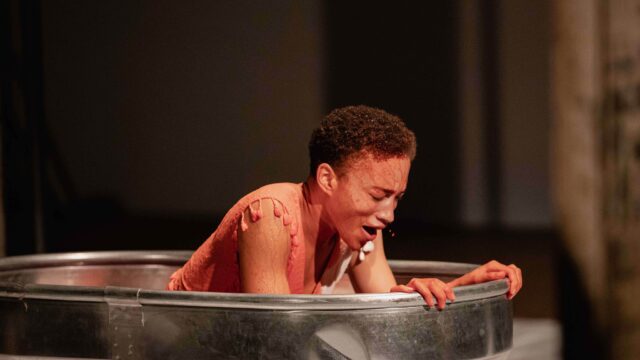
Tony nominee Andy Grotelueschen ensures everyone has a blast at Fiasco’s Pericles at Classic Stage (photo by Austin Ruffer)

PERICLES
Classic Stage Company, Lynn F. Angelson Theater
136 East 13th St. between Third & Fourth Aves.
Through March 24, $87
classicstage.org
fiascotheater.com

Fiasco Theater is not afraid to tackle difficult, challenging, lesser-known Elizabethan works, reviving them with its unique combination of joy and ingenuity. The company’s inaugural production was William Shakespeare’s Cymbeline, in 2009, and it has since staged Measure for Measure, The Two Gentlemen of Verona, and the more familiar Twelfth Night while also presenting Molière’s The Imaginary Invalid and Stephen Sondheim’s Into the Woods and Merrily We Roll Along.

Last spring Fiasco teamed up with Red Bull Theater for a rollicking version of Francis Beaumont’s 1607 comedy The Knight of the Burning Pestle. During the pandemic, Red Bull took a deep dive into the Bard’s Pericles — its inaugural show, in 2003 — featuring readings and discussions with actors and literary experts, placing the work, which has been rarely performed in New York, save for Trevor Nunn’s entertaining adaptation at TFANA in 2016, into contemporary context.

The fearless Fiasco has now breathed new life into Pericles, a mess of a play — not published in the First Folio — that meanders and wobbles through an Iliad/Odyssey-style adventure; the first two acts were most likely written by pamphleteer and innkeeper George Wilkins, author of the 1608 novel The Painful Adventures of Pericles, Prynce of Tyre, excerpts of which appear in Fiasco’s version.

As the audience enters Classic Stage’s Lynn F. Angelson Theater, members of the cast greet them with friendly chatter. The set is spare: an open space with wooden boxes of various sizes, including a coffin, that arrive and depart, carried by the actors, serving as chairs, benches, and ships. Hanging across the back is a cream-colored sheet of sackcloth with three doorways cut into it. The episodic stories follow Pericles as he escapes Tyre in Phoenicia, sails to Tarsus, gets shipwrecked in Pentapolis, and eventually decides to return home. Lovely songs appear here and then, offering a respite from the nearly incomprehensible plot.

Jessie Austrian and Emily Young play multiple roles in unique Shakespeare adaptation (photo by Austin Ruffer)

In order to gain the hand of the daughter (Emily Young) of King Antiochus (Noah Brody), Pericles must solve a riddle that will lead to his death whether he answers it correctly or not. Helped by the loyal Helicanus (Paul L. Coffey), he heads out to sea. On his trip he marries Thaisa (Jessie Austrian), daughter of Simomedes (Andy Grotelueschen), king of Pentapolis, and they have a daughter, Marina; Thaisa apparently dies in childbirth, while Pericles is later told that Marina, who he left in the care of Cleon (Devin E. Haqq) and Dionyza (Tatiana Wechsler), the king and queen of Tarsus, is dead as well. Years later, the very alive Marina (Young) is almost murdered before being captured by pirates and brought to a brothel in Mytilene run by a Bawd (Austrian), who decides to sell Marina’s virginity to the governor, Lysimachus (Paco Tolson). It all builds to an emotional, powerful conclusion.

Pericles was popular in its time, but one of the main rubs against it is how the chapters don’t flow into one another smoothly; they feel like individual short stories tossed together, as if amid a storm, with themes ranging from incest and hunger to jealousy and grief. But Fiasco has done a terrific job linking the disparate scenes, or at least as much as humanly possible; another achievement is trimming it down to two hours with intermission.

The sections are introduced by Gower, engagingly portrayed by director Ben Steinfeld, who narrates the tale, playing rather folky acoustic guitar and speaking directly to the audience. Early on, he sings, “Now Pericles, the prince of Tyre, / To honor’s grace he did aspire. / But life did send him endless trials, / As he sailed the sea for countless miles. / And with each test or twist of fate / He became a different person straight!”

Pericles’s growth as an individual, facing tragedy after tragedy as he seeks grace, unfolds by having four actors play him — Tolson, Wechsler, Brody, and Haqq — each taking over in a cleverly choreographed switch of bodies. It might be perplexing at first, but it makes sense as the show continues, adding not only a dash of inventiveness but an intriguing opportunity for the audience to guess which actor will wear the crown next and how they will depict the prince.

The nine-person cast gleefully handles more than two dozen parts, making small augmentations to Ashley Rose Horton’s somewhat makeshift classical costumes of white outfits and brown sandals. Standing out are Austrian (Cymbeline, Into the Woods), Young (Cymbeline, Bloody Bloody Andrew Jackson), and Tony nominee Grotelueschen (Tootsie, Assassins), who is boisterous and energetic throughout.

Fiasco might not have solved the many problems of Pericles — which has never been on Broadway, has never been adapted into a film, and has been staged at the Public’s Shakespeare in the Park only once, fifty years ago — but in this iteration, you’re likely not to worry too much about the details; rather, you’ll just have a grand old time.

[Mark Rifkin is a Brooklyn-born, Manhattan-based writer and editor; you can follow him on Substack here.]

MICHAEL ONDAATJE AT RIZZOLI WITH JORDAN PAVLIN

Who: Michael Ondaatje, Jordan Pavlin
What: Poetry reading and discussion
Where: Rizzoli Bookstore, 1133 Broadway at West Twenty-Sixth St.
When: Thursday, April 4, free with advance RSVP, 6:00
Why: “When you are surrounded with ornaments / of the old world, you need to hear one living vein,” Michael Ondaatje writes in “A Night Radio Station in Koprivshtitsa,” from his new poetry book, A Year of Last Things (Knopf, March 19, $28). He later adds, “Most stories remain unresolved, / undiscovered, like the breaking of a rule.” On April 4 at 6:00, the eighty-year-old Sri Lankan-born Canadian author, who has penned such novels as The English Patient, Anil’s Ghost, and Warlight, will be at Rizzoli to launch A Year of Last Things; he will read from the work, which contains such poems as “Lock,” “Definition,” “Lost,” “A Disappearance,” and “Stillness,” and sit down for a conversation with Knopf editor-in-chief Jordan Pavlin. Admission to the event, which is presented by the Authors Guild Foundation with support from the Academy of American Poets, is free, but reservations are strongly encouraged. Presigned books will be available at the end.

[Mark Rifkin is a Brooklyn-born, Manhattan-based writer and editor; you can follow him on Substack here.]
MARTA MINUJÍN: ARTE! ARTE! ARTE! / PAYMENT OF THE ARGENTINE FOREIGN DEBT TO ANDY WARHOL WITH CORN, THE LATIN AMERICAN GOLD

Marta Minujín and Andy Warhol, El pago de la deuda externa argentina con maíz, “el oro latinoamericano” (Paying Off the Argentine Foreign Debt with Corn, “the Latin American Gold”), chromogenic color print, the Factory, New York, 1985 / 2011 (collection of the artist / © Marta Minujín, courtesy of Henrique Faria, New York and Herlitzka & Co., Buenos Aires)

PAYMENT OF THE ARGENTINE FOREIGN DEBT TO ANDY WARHOL WITH CORN, THE LATIN AMERICAN GOLD
Americas Society
680 Park Ave. at Sixty-Eighth St.
Tuesday, March 26, free with advance RSVP, 6:30
www.as-coa.org

In 1985, multidisciplinary artist Marta Minujín went to the Factory to participate in a unique performance with Andy Warhol. The Argentine-born Minujín and the Pittsburgh-born Warhol sat back-to-back in red folding chairs amid one thousand ears of corn; each artist was dressed all in black, except for the platinum blond Minujín’s yellow and orange socks and the silver-wigged Warhol’s grayish-white sneakers. Titled Payment of the Argentine Foreign Debt to Andy Warhol with Corn, the Latin American Gold, the conceptual performance piece, printed in 2011 in a six-photo grid against a white background, involved the forty-two-year-old Minujín, wearing dark sunglasses, presenting the fifty-six-year-old Warhol with the international food staple maize, which had been painted yellow and orange. Over the course of the photographs, they turn to each other, look directly at the camera, and exchange a handful of ears. After the performance, Minujín and Warhol signed the corn and handed ears out to people in front of the Empire State Building, the subject of one of Warhol’s most famous films, Empire.

“Simply put, Argentina’s always owed money to the International Monetary Fund. Always. Then I thought, ‘This country’s fed the entire world by now,’ because during World War II, Argentine ships would sail out laden with seeds and corn for people to make bread and everything. So many ships sailed out, in fact, that their lives were extended by what they received from Argentina. So, for me, the dollar debt had already been settled,” Minujín says on the audioguide that accompanies the Jewish Museum exhibition “Marta Minujín: Arte! Arte! Arte!,” where Payment is part of an exciting career survey of the artist through April 1. “I wanted to be done with the subject and figured I’d pay Andy Warhol. He was a friend of mine, and our intentions, way of living, everything was aligned. So, I paid off Argentina’s foreign debt to him in Latin American gold — corn. That was the idea behind this piece. Now, many issues still remain around the dollar, but it’s as though I’ve paid off this debt. For me, it’s settled. Even for Argentina, it’s settled — it has been for many years now.” One of the photos was also on view in the recent Americas Society show “El Dorado: Myths of Gold Part I.”

On March 26, Minujín will restage the event at Americas Society; admission is free with advance registration. Americas Society director and chief curator of art Aimé Iglesias Lukin and Jewish Museum associate curator Rebecca Shaykin will introduce the performance, which will be followed by a reception.

MARTA MINUJÍN: ARTE! ARTE! ARTE!
Jewish Museum
1109 Fifth Ave. at 92nd St.
Thursday – Monday through April 1, free – $18
thejewishmuseum.org

“Marta Minujín: Arte! Arte! Arte!” is the artist’s first comprehensive US museum survey, and it’s a revelation. Five years ago, she restaged her labyrinthine Menesunda Reloaded at the New Museum, drawing long lines. She deserves long lines again for the Jewish Museum exhibition, which includes nearly one hundred paintings, sculptures, photographs, videos, and installations, alive with bright colors and immersive experiences. Conceptos entrelazados (Intertwined Concepts) is an inviting foam-stuffed mattress bursting with bold colors and patterns. Congelación a lo largo (Autorretrato de espaldas) (Long-Term Freeze [Self-Portrait with Back Turned]) at first appears to be a gentle landscape but is actually an elongated nude body that is part of Minujín’s “Frozen Sex” series. Pandemia (Pandemic) is a canvas of 27,900 pieces of hand-painted and glued mattress fabric created during the coronavirus crisis. El Partenón de libros (The Parthenon of Books) is an examination of a 1983 performance piece in which the artist built a Parthenon-shaped tower of banned books, now accompanied by contemporary American banned books. Soliloquio de emociones encontradas (Soliloquy of Mixed Emotions) undulates with enticing shapes and colors. And Implosión! is a dazzling, dizzying immersive room exploding in a whirlwind of 3D-like projections and sound.

“I don’t have origins. I have my own planet,” Minujín says in one of the above videos. The exhibition at the Jewish Museum ably displays that, as will the live performance at Americas Society.

STANDARD DEVIATIONS: THIS IS NOT A FILM

Even house arrest and potential imprisonment cannot stop Iranian auteur Jafar Panahi from telling cinematic stories

THIS IS NOT A FILM (IN FILM NIST) (Jafar Panahi & Mojtaba Mirtahmasb, 2011)
BAMcinématek, BAM Rose Cinemas
30 Lafayette Ave. between Ashland Pl. & St. Felix St.
Monday, March 25, 7:00
Series runs March 22-28
718-636-4100
canopycanopycanopy.com
www.bam.org

“You call this a film?” Jafar Panahi asks rhetorically about halfway through the revealing 2011 documentary This Is Not a Film, screening March 25 at 7:00 at BAM as part of “Triple Canopy Presents: Standard Deviations,” a weeklong festival, curated by Yasmina Price, consisting of works that challenge cinematic norms in visual and narrative storytelling. “Standard Deviations” opens March 22 with Bill Gunn’s Ganja & Hess and concludes March 28 with Ephraim Asili’s “Multisensory Alchemies: Daïchi Saïto + Konjur Collective,” featuring films accompanied by live music, followed by a Q&A. Other highlights are Stephanie Rothman’s The Student Nurses, William Greaves’s Symbiopsychotaxiplasm, and Raúl Ruiz and Valeria Sarmiento’s The Wandering Soap Opera.

After several arrests beginning in July 2009 for supporting the opposition party, highly influential and respected Iranian filmmaker Panahi (Crimson Gold, Offside) was convicted in December 2010 for “assembly and colluding with the intention to commit crimes against the country’s national security and propaganda against the Islamic Republic.” Although facing a six-year prison sentence and twenty-year ban on making or writing any kind of movie, Panahi is a born storyteller, so he can’t stop himself, no matter the risks. Under house arrest, Panahi has his friend, fellow director Mojtaba Mirtahmasb (Lady of the Roses), film him with a handheld DV camera over ten days as Panahi plans out his next movie, speaks with his lawyer, lets his pet iguana climb over him, and is asked to watch a neighbor’s dog, taking viewers “behind the scenes of Iranian filmmakers not making films.” Panahi even pulls out his iPhone to take additional video, photographing New Year’s fireworks that sound suspiciously like a military attack. Panahi is calm throughout, never panicking (although he clearly does not want to take care of the barking dog) and not complaining about his situation, which becomes especially poignant as he watches news reports on the earthquake and tsunami disaster in Japan.

“But you can’t make a film now anyhow, can you?” Mirtahmasb — who will later be arrested and imprisoned as well — asks at one point. “So what I can’t make a film?” Panahi responds. “That means I ask you to take a film of me? Do you think it will turn into some major work of art?” This Is Not a Film, which was smuggled out of Iran in a USB drive hidden in a birthday cake so it could be shown at Cannes, is indeed a major work of art, an important document of government repression of free speech as well as a fascinating examination of one man’s intense dedication to his art and the creative process. Shortlisted for the Best Documentary Academy Award, This Is Not a Film is a mesmerizing experience from a genius who has since gifted the world with Closed Curtain, Taxi, Three Faces, and No Bears, defying the government while constantly looking over his shoulder.

[Mark Rifkin is a Brooklyn-born, Manhattan-based writer and editor; you can follow him on Substack here.]
THE NOTEBOOK: THE MUSICAL

Teens Allie (Jordan Tyson) and Noah (John Cardoza) fall in love in The Notebook (photo by Julieta Cervantes)

THE NOTEBOOK
Gerald Schoenfeld Theatre
236 West 45th St. between Broadway & Eighth Aves.
Tuesday – Sunday through July 7, $74-$298
notebookmusical.com

“I don’t think there was any way I could have imagined that it would become as successful as it did. It’s like catching lightning in a bottle,” former pharmaceutical salesman Nicholas Sparks told Show Daily about his blockbuster debut novel, 1996’s The Notebook, which was lifted out of a literary agency slush pile. The tearjerker spent more than a year on the bestseller list, though it never reached number one. It caught lightning in a bottle again in 2004, when it was adapted into a hugely successful film, directed by Nick Cassavetes and starring Ryan Gosling, James Garner, Rachel McAdams, Gena Rowlands (Nick’s mom), Joan Allen, James Marsden, and Sam Shepard.

The novel and film had plenty of naysayers, decrying it as sentimental claptrap; the movie is certified Rotten on Rotten Tomatoes, but it won eight Teen Choice Awards as well as Best Kiss at the MTV Movie Awards. It knows its audience. (For the record, I have not read the book nor seen the film.)

The third time is unlikely to be the charm for the haters out there, as The Notebook is now a Broadway musical, running at the Gerald Schoenfeld Theatre through July 7. If this iteration is a hit, it won’t be because of quality, which it is sadly lacking.

The show features underwhelming music and lyrics by American singer-songwriter Ingrid Michaelson and a tepid book by Bekah Brunstetter, who has written such plays as The Cake and Oohrah! and was a writer, story editor, and Emmy-nominated producer on This Is Us. Incorporating elements from both the novel and the film, the narrative moves between 1967, 1977, and 2021 in an unnamed mid-Atlantic town.

John Cardoza, Dorian Harewood, and Ryan Vasquez portray the same character at three different times in The Notebook (photo by Julieta Cervantes)

It opens with an older man watching two teenagers meet and fall instantly in love. “Time to get up, time to get up now / And let the bones crack into place / I look in the mirror, I see an old man / But in my eyes, a young man’s face,” the old man sings. “Time, time time time / It never was mine, / mine mine mine / But you know what is? / Love, hope, breath, and dreams / As cliché as that seems.” Cliché becomes a kind of leitmotif throughout the show’s 140 minutes (with intermission).

In 2021, Noah (Dorian Harewood) is in an extended caregiving facility reading from a handwritten notebook to Allie (Maryann Plunkett), whose dementia is worsening. As he reads, scenes from the notebook are acted out onstage by the teenage Allie (Jordan Tyson) and Noah (John Cardoza) in 1967 and the twentysomething Allie (Joy Woods) and Noah (Ryan Vasquez) ten years later.

The plot is the classic hardworking tough guy meets rich girl, rich girl’s parents (Andréa Burns and Dorcas Leung) break them apart, boy joins the army with his best friend (Carson Stewart), girl finds a respectable lawyer (Chase Del Rey) to marry, boy and girl imagine what might have happened had they stayed together. The older Noah believes that by telling the story to Allie over and over again, it might help her regain at least some of her memories, while the nurse (Burns) insists Noah follows the rules and his physical therapist (Stewart) tries to get him to get treatment for his ailing knee, but Noah has more important things on his mind.

The narrative goes back and forth in time, occasionally with some Allies and Noahs watching the others. Diverse, race-blind casting is one of the best things to happen to Broadway in recent years, but The Notebook takes it to new, confusing levels. The three Noahs and the three Allies are different sizes, different heights, and different colors. Tyson and Cardoza lack the necessary chemistry to kick things off; Woods and Vasquez have more passion, but the story keeps their characters apart for too long. By the time you figure out what is happening with the older Noah and Allie, it’s too late, although there are a few touching moments between them near the end, and the handling of the painting is the most successful part of the show.

Maryann Plunkett, Joy Woods, and Jordan Tyson portray the same character at three different times in The Notebook (photo by Julieta Cervantes)

Codirectors Michael Greif (Dear Evan Hansen, Next to Normal) and Schele Williams (Aida, The Wiz) are unable to rein in the overall befuddlement on David Zinn and Brett J. Banakis’s rustic set, which switches from a nursing home to a historic house that needs significant work; there’s also a pool of water in the front of the stage where Allie and Noah swim and play. When boredom sets in, you can check out Ben Stanton’s lighting design, which features dozens of narrow, cylindrical, fluorescent lights hanging from the ceiling with bulbs at the bottom that make them look like big pens (that one might, say, use to write in a notebook?). The lighting also casts a cool shimmer when it focuses on the pool.

The score, with arrangements by Michaelson and music supervisor Carmel Dean and orchestrations by Dean and John Clancy, can’t keep pace with the narrative, slowing it down dramatically. When teenage Allie asks teenage Noah if he has a pen and he says, “Why would I have a pen?,” I pointed up at the lights. When Middle Noah sings, “Leave the Light On,” I suddenly felt as if I were in a Motel 6 advertisement. And when the young Allie and Noah sing about his chest hair — twice — but Cardoza doesn’t have any, I wondered if it was meant to be a tongue-in-cheek joke. (If it was, it didn’t draw laughs.)

It’s a treat to see Tony winner Plunkett (Agnes of God, Me and My Gal) and Emmy nominee and NAACP Image Award winner Harewood (Streamers, Jesus Christ Superstar), and Woods (Six, Little Shop of Horrors) nearly steals the show with her solo turn in “My Days”; when she sings, “Where am I going,” I could only think that she has a big future ahead of her.

The musical probably has a big future ahead of itself too, naysayers be damned.

[Mark Rifkin is a Brooklyn-born, Manhattan-based writer and editor; you can follow him on Substack here.]
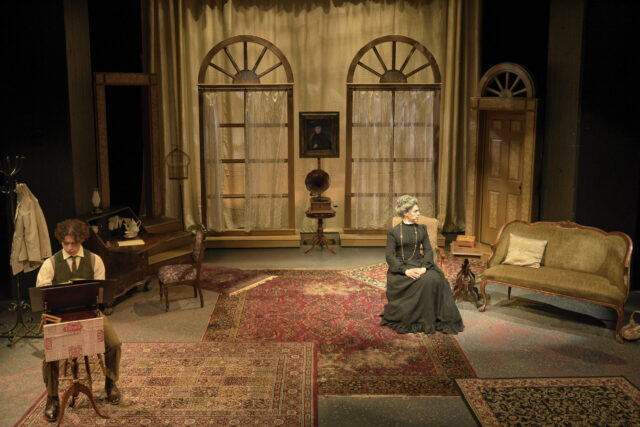
THE EFFECT

Tristan (Paapa Essiedu) and Connie (Taylor Russell) are part of a pharmaceutical experiment in The Effect (photo by Marc Brenner)

THE EFFECT
The Griffin Theater at the Shed
The Bloomberg Building at Hudson Yards
545 West 30th St. at Eleventh Ave.
Tuesday – Sunday through March 31, $109-$159
646-455-3494
theshed.org

British director Jamie Lloyd has dazzled New York audiences the last five years with stunning revivals of Cyrano de Bergerac at BAM and A Doll’s House and Betrayal on Broadway, starring such big names as James McAvoy, Jessica Chastain, and Tom Hiddleston. His stripped-down versions illuminate the story, giving the actors plenty of room to do what they do best.

Lloyd is now back with Lucy Prebble’s The Effect, but this time his spare staging, though electrifying, is not quite able to cover up the flaws in the repetitive and confusing plot.

The play debuted at the National Theatre in 2012 with Billie Piper and had its New York premiere at the Barrow Street Theatre in 2016. This revival, running at the Shed’s Griffin Theater through March 31, features a narrow rectangular video platform in the center; the audience sits on opposite sides, essentially looking at one another, implicating everyone in the proceedings. The show takes place in a pharmaceutical testing facility where Tristan Frey (Paapa Essiedu) and Connie Hall (Taylor Russell) are the subjects in a four-week study of a new antidepressant; they have agreed to surrender their phones, be honest about what they’re feeling, and abstain from sex.

They are being observed by Dr. Lorna James (Michele Austin), who sits at one end; her ambitious colleague, Dr. Toby Sealey (Kobna Holdbrook-Smith), sits at the other. The subjects are dressed all in white, the doctors all in black. Above them is an exposed flown lighting truss; there are speakers up high as well as behind the two doctors. A distant, ominous drone can be heard throughout the play’s hundred minutes. When the audience first enters the theater, loud EDM is blasting, with smoke floating across the space, as if we’re at a club. The set and costumes are by Soutra Gilmour, with lighting by Jon Clark, music composition by Michael “Mikey J” Asante, sound by George Dennis, and movement direction by Sarah Golding and Yukiko Masui of the SAY dance company.

“Have you ever suffered from depression?” Dr. James asks Connie, who responds, “No. I’ve felt depressed. But. . . . What I mean is, I’ve been sad. . . . Just. I wouldn’t say, oh I’m depressed. Or I would, but just meaning sad. You know cos. That’s. I’m not. So.” The difference between depression and sadness is key to the plot, as Connie and Tristan receive doses of agent RLU37 (or a placebo) and Dr. James measures their heart rate, pupil dilation, electro-dermal response, and blood.

Squares and rectangles light up on the platform, trying to contain Tristan and Connie, but the more time they spend together, the more they want to break the rules, especially Tristan, who has gone through previous drug trials and can’t stop flirting with Connie. Early on, they participate in a test with words and colors that flash on the floor of the platform in such a way that the audience can take the test as well, creating another bond. It could be us onstage, dealing with sadness and depression.

Meanwhile, it becomes apparent that Dr. James and Dr. Sealey have some kind of history that could impact their objectivity as Tristan and Connie try to figure out what is real and what is the result of a chemical reaction. “I can tell the difference between who I am and a side effect,” Tristan says. “With respect, Tristan, no you definitely can’t,” Connie answers.

The Effect is mesmerizing to watch; there is always something going on that will captivate your attention, from pounding beats and flashing lights to billowing smoke and unexpected movement. Austin (The Hunt, Cyrano de Bergerac), Holdbrook-Smith (Tina Turner: The Musical, The Low Road), Essiedu (The Moment Before I Am Powerful, The Convert), and Russell (Bones and All, Waves), in her theatrical debut, are a formidable ensemble, but the narrative feels repetitive in the second half, revisiting ideas it has already covered.

Prebble (A Very Expensive Poison, The Sugar Syndrome), who was a writer and Emmy-winning producer on Succession and the creator of the hilariously cringy show I Hate Suzie, which starred Piper as a former child star enveloped in a sex scandal as an adult, raises fascinating questions about fantasy and reality; personal identity and drug-manufactured social behavior; and humanity’s growing dependence on pharmaceuticals, even as the chemistry between the characters eventually hits a wall.

[Mark Rifkin is a Brooklyn-born, Manhattan-based writer and editor; you can follow him on Substack here.]
CASTING

CASTING
Gymnopedie
1139 Bushwick Ave.
March 15-17, $23.18
castinginnyc.eventbrite.com
gymnopedie.nyc

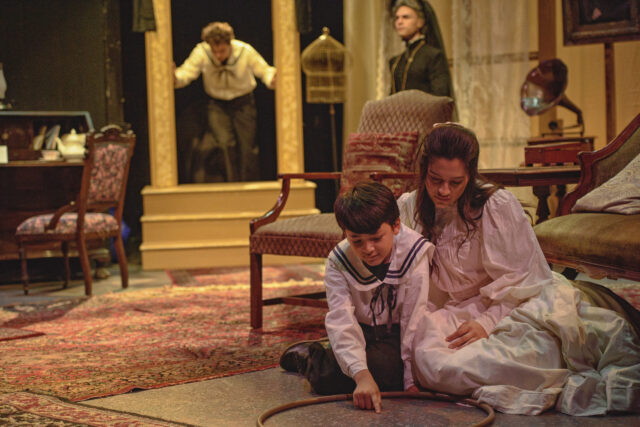
Winner of the Los Angeles Immersive Invitational Grand Prize, Koryn Wicks’s Casting is making its New York City debut March 15-17 at Gymnopedie in Bushwick. Most performers dread the audition process, but in this case up to twelve audience members at a time will participate, trying to land a big role. The thirty-minute work was created by Wicks (I love you so much, SQUEEZE ME TO DEATH; To Die in the Valley I’ve Loved) and a team of collaborators that includes writer Sam Alper, singer-songwriter Hanah Davenport, lighting and video designer and dancer Morgan Embry, sound designer and composer Alex Lough, and actors Audrey Rachelle and Jonathan Gordon. Tickets are $23.18 for your chance to be the star of the show.

[Mark Rifkin is a Brooklyn-born, Manhattan-based writer and editor; you can follow him on Substack here.]