live performance

NORTH TEXAS EPIC: THE TROJANS AT THE CELL

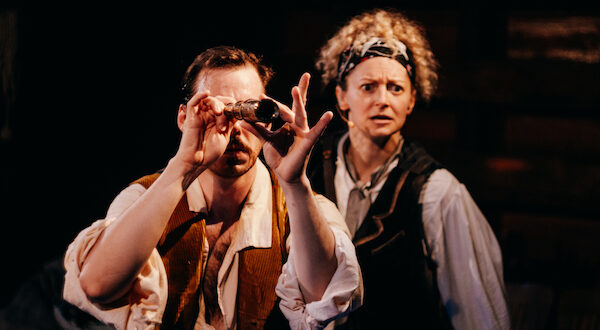
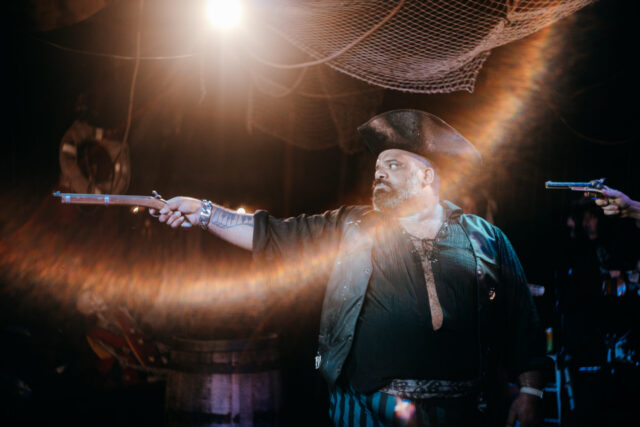
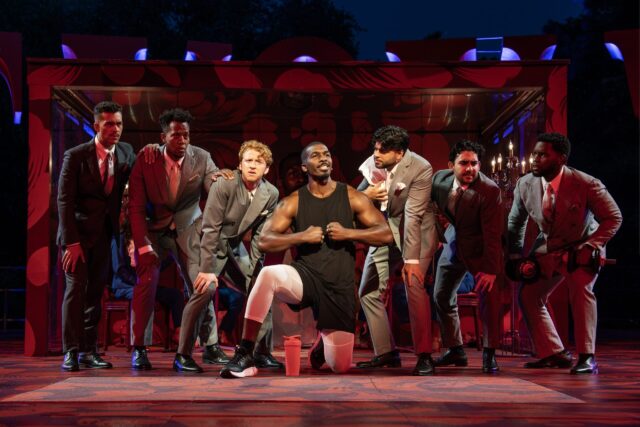
The Trojans re-creates the glory days of a group of warehouse workers in North Texas (photo by Vivian Hoffman)

THE TROJANS
The Cell Theatre
338 Twenty-Third St. between Eighth & Ninth Aves.
Thursday – Sunday through April 26
www.thecelltheatre.org

Friday Night Lights meets Homer’s The Iliad with a touch of The Outsiders in Leegrid Stevens’s outrageously entertaining synthwave musical The Trojans, which has been extended through April 26 at the Cell.

Stevens and director Eric Paul Vitale have moved the epic Greek poem to a shipping facility in Carlton, North Texas, where a group of overworked, bored employees decide to suddenly reenact their glory days revolving around a crucial homecoming high school football game between the Trojans and their archrivals, the Highland Kings.

Scenic designer Simon Cleveland has transformed the front room of the Cell into a warehouse stocked with packages ready to ship to Heodorokon Nitis in Corinth, Mississippi, Thelexis Boulos in Parthenon, Arkansas, Stylis Fotikos in Achille, Oklahoma, and Marbara Vasiloudou in Troy, Alabama. Christopher Annas-Lee’s lighting features LED strips that outline the performance area on the floor, where an audience of about fifty sits on three sides, surrounded by towering walls of boxes. Signs warn, “This department has worked 4 days without a lost time injury: Be alert . . . Accidents hurt,” and “Notice: How to lift correctly — Bend knees to lift — Prevent back injury — Don’t bend over,” things that teenagers don’t need to worry about but older adults do.

The show begins with Heather (Deshja Driggs) and Doug (Sam Tilles) complaining about their jobs. “Oh man, one of those days,” Doug says, to which Heather responds, “Every day’s one of those now.” Heather asks Doug to tell one of his stories; Doug is worried that he will be caught by their manager, Daris (Arya Grace Gaston), and get fired, but soon the gang is re-creating “the Hit,” a controversial play during a long-ago high school football game by Keeley (Erin Treadway) that initiated the feud between the Trojans and the Kings. After Sondra (Jen Rondeau) questions how truthful their version is, Heather pulls out the actual cassette from the homecoming dance, puts it in an old red tape player, and everyone is transported back to the 1980s.

The Trojans consist of star quarterback Johnny/Agamemnon (Roger D. Casey); his girlfriend, Heather/Helen, the most popular girl in school; wide receiver Doug/Diomedes; the not-too-bright but sincere Jack/Ajax (E. James Ford), the running back who has to step in for Keeley/Achilles after Keeley quits the team; Lucas/Patroclus (Daphne Always), Keeley’s devoted boyfriend; and Sondra/Cassandra, who tells fortunes with a folded origami paper device known as a cootie catcher or chatterbox. The Kings are led by teen heartthrob Daris/Paris and his brother, imposing QB Tark/Hector (Alcorn Minor).

As they prepare for the big game, loyalties are tested, secrets are revealed, and hilarious songs are sung, from “OooAhhUs” and “Not Any More” to “Something Bad’s About to Happen” and “We’ll Never Become.”

A production of Brooklyn-based Loading Dock Theatre, The Trojans has a charming DIY feel, as the warehouse employees use their hard hats as football helmets, yellow-and-black vests as uniforms, and palettes, forklifts, and ladders as cars and other forms of movement. Will Watt’s sound includes appropriately muffled music when it’s supposedly coming out of the old tape deck, while Mindy Rebman’s boisterous choreography puts the audience right in the middle of a 1980s high school pep rally gone wrong. The ensemble, which also includes Bradley Cashman, Emma Imholz, Emma Kelly, Max Raymond, and Katherine Taylor in swing roles, is terrific, both as adults worrying about their job status and as teenagers making what might be one last grab at greatness.

Stevens references The Iliad over and over without the show being a one-to-one reimagining. A particularly sly moment occurs when Tark is reciting some football plays, saying, “Trips Left-60 Flip-Y Sticks. Go. Watch the backer if so, go hot, if not, post route. Touchdown. Let’s go. Heavy right 35 Pistol Zap. Go. Play action to a bootleg. If cover three, run. If not, deep left, Touchdown. Let’s go. Bunch right, green jet, Counter 2. Go.” Daris answers, “This is like the shittiest poem ever,” not unlike what a high school student might say about Homer’s works.

Deena Kaye’s music and vocal direction is thoroughly engaging; each actor sings and dances in accordance with their character. Thus, Casey and Driggs excel in that respect, whereas Ford has a more appropriately bumpy ride.

Early on, Heather asks Johnny, “Do you think in thirty years we’ll love music as much as we do now? . . . Do you think we’ll still love to dance? . . . Do you think we’ll still love to drive under the stars?” His concentration fully on the upcoming game, Johnny replies, “I think we’ll pretty much like all the same stuff we do now.”

Ah, the glorious dreams of youth.

[Mark Rifkin is a Brooklyn-born, Manhattan-based writer and editor; you can follow him on Substack here.]


ALL ABOUT MY MOTHER: THREE PLAYS ABOUT DEAR OLD MOM

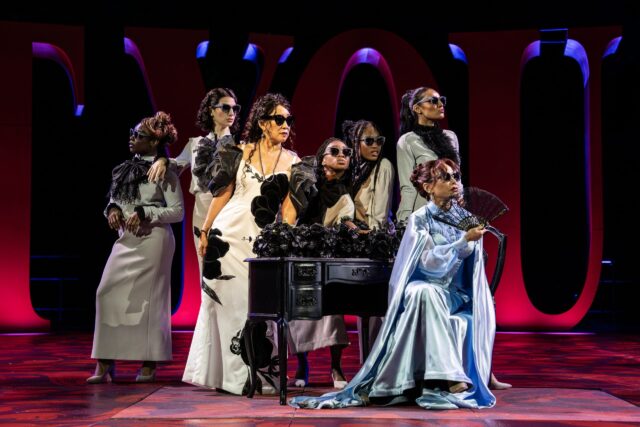
Five actors portray multiple characters in Neena Beber’s Brecht adaptation at BAC (photo by Maria Baranova)

A MOTHER
Baryshnikov Arts Center, Jerome Robbins Theater
450 West 37th St. between Ninth & Tenth Aves.
March 29 – April 13, $59-$79
www.bacnyc.org

There was already a palpable buzz at the Baryshnikov Arts Center on April 7, opening night of Neena Beber’s Brecht adaptation, A Mother, before several Jessicas arrived: Jessica Hecht, who co-conceived the show and was about to step onstage in her starring role as Pelagea Vlassova, and a resplendent Jessica Lange in the audience, who raised the event’s already high-glamour quotient. Lange, who has won three Emmys, two Oscars, and a Tony, has portrayed several memorable mothers onstage during her long career, including Phyllis in Paula Vogel’s Mother Play last year and Mary Tyrone in Jonathan Kent’s 2016 production of Eugene O’Neill’s Long Day’s Journey into Night, was there not just as a fan of Brechtian epic theater but also because Shura Baryshnikov, her daughter with BAC founding artistic director Mikhail Baryshnikov, is the show’s choreographer.

Brecht’s 1932 play, the full title of which is The Mother: The Life of the Revolutionary Pelagea Vlassova from Tver, is based on Maxim Gorky’s 1906 novel known alternately as The Mother and, more simply, Mother. Beber and her co-creator, Emmy and Tony nominee Jessica Hecht, have changed the title to A Mother, which gives it more of a universal feel. They have also updated the setting; the action takes place in 1917 Russia, 1979 Miami, and the present.

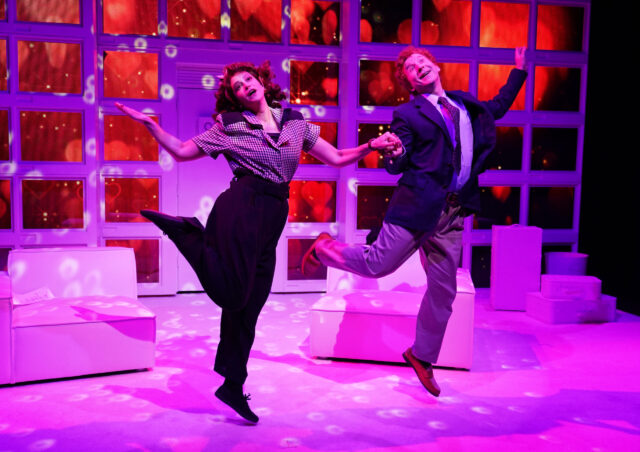
In Russia, the widow Pelagea Vlassova (Hecht) is worried that her son, Pavel (Fergie Philippe), has fallen in with dangerous revolutionaries Ivan (Portia) and Anton (Zane Pais), who are protesting the treatment of factory workers and are threatening to strike. In Miami, fifteen-year-old Jess (Hecht) is having a blast at JD’s Disco on the beach, where she dances with seventeen-year-old Daryl (Philippe), who she hopes will be her first true love. In the present, she looks back at her life, including the summer she spent at Camp Shalom Aleichem in Barkhamstead, Connecticut, where she learned about Brecht from counselor Michelle (Delilah Napier), who was determined to inject plenty of Brecht into the campers’ production of Lerner and Loewe’s 1951 musical, Paint Your Wagon.

Michelle is wrapped up in her own Brechtian world view. “Who cares what you see yourself as? Identification is the lowest form of appreciation!” she tells one camper. She advises another, “Play the opposite. Think the opposite. Do the opposite.” And she declares, “Everything artificial is less artificial if you acknowledge that it’s artificial. The best way to be real when you are doing a play is to be fake.”

That’s precisely how Beber, director Maria Mileaf, set designer Neil Patel, costumer Katherine Roth, choreographer Shura Baryshnikov, lighting designer Matthew Richards, and the cast of five approach A Mother. Their production regularly reminds us that we are in a theater watching a fictional show in 2025, from their use of Brecht curtains to Jess’s interactions with the audience and clever dialogue.

“I don’t care what they say, disco is never gonna die,” Daryl insists. One of the other clubgoers (Napier) explains, “Born in the clubs frequented primarily by gay and African-American and Latino fans in opposition to the dominant social structures!” Social structures involving race and injustice come to the fore when the narrative shifts to the real-life murder of Black insurance salesman and Marine Arthur Lee McDuffie at the hands of police officers, leading to the 1980 Miami riots. In one of the most poignant moments of the play, Arthur’s mother, Eula Bell McDuffie (Portia), sings the elegiac African American spiritual “Wade in the Water” (the tune of which Jess transforms into the Mourner’s Kaddish).

As per Brecht’s instructions for this “learning play,” music is a key contributor, with songs ranging from Lipps Inc.’s “Funkytown” and “Wade in the Water” to compositions by Mustapha Khan, William Kenneth Vaughan, and Norman (Skip) Burns. Among the new tunes are “Time to Fight” (“Take it to the street”), “Our Spot Is Desperate” (“Things can’t go on this way”), and “Let’s Make It Strange” (“You can melt gold to re-form / into shapes not quite born / with the fire of dialectical materiality”). As Michelle points out, “Think about that Brecht said: ‘Will there be singing in dark times? Yes, there will be singing, about the dark times.’”

Slyly referencing the Brecht-Gorky connection, the facade of the house at the back of the set features the number 775, a reference to Brecht’s 775th poem, “Stormbird,” which was inspired by Gorky’s “The Song of the Stormy Petrel.”

A Mother is a fun, thoroughly entertaining hundred-minute romp that maybe would have had even Brecht disco dancing at the end. “The aim was to teach certain forms of political struggle to the audience,” Brecht wrote in 1933 about the show. At the end of this production, Jess relates how copies of Brecht’s play were burned by the Nazis, then strolls through pieces of history on her way to today.

“I thought things would be different by now but dark times, dark times keep coming,” she says before reminding everyone about the hope — and revolutionary struggle — that is at the heart of epic theater.

Matt Doyle and Caroline Aaron star as son and mother in semiautobiographical play (photo by Carol Rosegg)

CONVERSATIONS WITH MOTHER
Theatre 555
555 West Forty-Second St. between Tenth & Eleventh Aves.
Wednesday – Monday through April 21, $67-$169
conversationsplay.com

Matthew Lombardo’s Conversations with Mother began life about a decade ago as a series of Facebook posts detailing verbatim phone calls the playwright had with his mother. He eventually decided to turn the daily talks into the semiautobiographical show, which closes April 21 at Theatre 555. (It had been scheduled to run through May 11.)

The play traces the relationship between Maria Collavechio (Caroline Aaron) and her son, Bobby (Matt Doyle), starting in Connecticut in 1966, when she is thirty-seven and he is eight. Bobby desperately wants to come home from sleepaway camp, and Maria says absolutely not — until he writes to her, “Dear Mom: One of the camp counselors asked me to stay with him in his van overnight. He has strawberry Charleston Chews, clicker clackers, and eyeglasses that have real X-ray vision. Can I stay with him some night? Love, Bobby.”

For the next forty years, Bobby keeps getting into trouble, refusing to follow his mother’s sage advice, as he moves to New York and falls in love with an abusive man. Often when admitting his bad choices to her, he asks if she’s mad, and when she says no, he adds, “Good. Cause there’s more.” The strong-willed Maria is not angry as much as disappointed that the tender and insecure Bobby cannot find himself a better life; she believes he is wasting his youth and his chances; he deserves more but won’t believe that. The problem never was that Bobby is gay — Maria embraces that from when he first comes out to her — but that Bobby keeps screwing up, both personally and professionally. And it gets tiring, for her and, unfortunately, the audience.

The play is told in such chapters as “Tell Me The Truth and I Won’t Get Mad,” “Why Can’t You Ever Meet a Nice Boy?,” and “If Your Phone Doesn’t Ring, It’s Me,” as Maria and Bobby go through good times and bad. Even as Bobby starts his career as a playwright, he is unable to enjoy it. He explains, “I’m just so tired. I don’t want to be hurt. I don’t want to be happy. I don’t want to be sad. I don’t want to be sorry. I don’t want to think. I don’t want to know. I just want to be numb.” Maria responds, “I don’t know what to do with you, Bobby. I really don’t know what else to do. I gave you everything. More than all the other kids combined. I gave you things in me I didn’t even know I had. And for what? So you can bitch about your shitty life? No one has a better life than you!”

The narrative takes a turn when Maria becomes ill, leading to a head-scratchingly melodramatic ending that seems to come out of nowhere.

Directed by Noah Himmelstein (The Lucky Star, Los Otros), Conversations with Mother takes place on Wilson Chin’s framed set, where various chairs, bars, and tables are wheeled on and off and props are hidden in the walls. Ryan Park outfits Aaron in fanciful dresses while Doyle wears camp T-shirts with a silly hat, a revealing apron with a silly hat, a hoodie, and eventually more grown-up clothing.

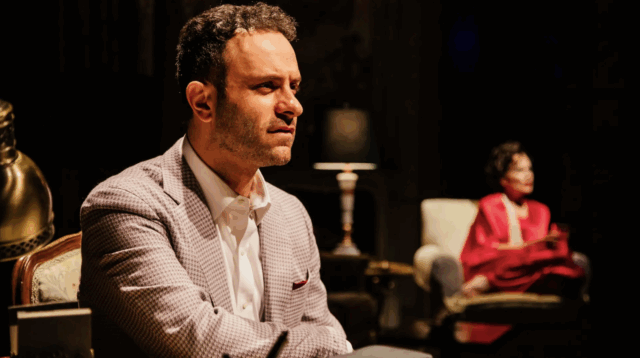
Aaron (Madwomen of the West, A Kid Like Jake) and Tony winner Doyle (Company, A Clockwork Orange) never quite connect; the characters feel like caricatures trapped in a repetitive circle that is hard for the audience to become engaged in. Lombardo, whose previous plays include Tea at Five about Katharine Hepburn and Looped about Tallulah Bankhead, doesn’t develop enough depth; perhaps he’s too close to the material.

At the conclusion of the eighty-five-minute play, you’re likely to think, thank goodness there’s not more.

Jeanine Serralles, Andrew Barth Feldman, and Joanna Gleason star as three generations of a Jewish family in New York in We Had a World (photo by Jeremy Daniel)

WE HAD A WORLD
New York City Center Stage II
131 West Fifty-Fifth St. between Sixth & Seventh Aves.
Tuesday – Sunday through May 11, 4160
www.manhattantheatreclub.com
www.nycitycenter.org

New York City native Joshua Harmon is a master at writing about families, specifically Jewish ones, as evidenced by such works as Bad Jews, Skintight, and the epic Prayer for the French Republic. He turns his focus on his own clan in the beautifully told We Had a World, exploring his relationship with his mother and grandmother — and their complicated relationship with each other.

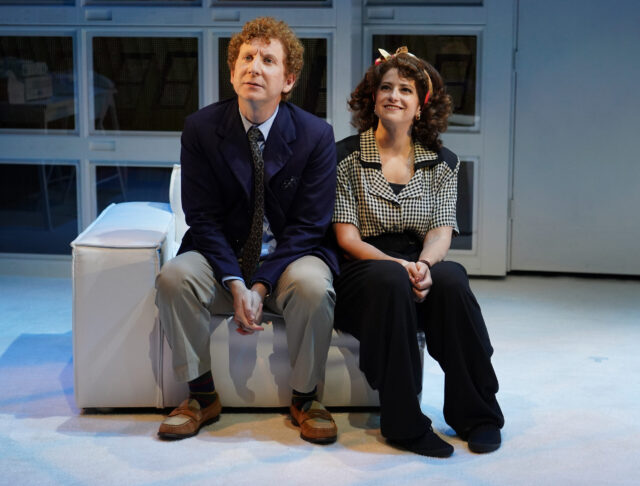
The hundred-minute play begins with Joshua (Andrew Barth Feldman) receiving a phone call from his grandmother, Renee (Joanna Gleason), whom he calls Nana, telling him that his next play should be about the estrangement between his mother, Ellen (Jeanine Serralles), and his aunt, the unseen Susan, focusing on a problematic Passover Seder — and that it should be called Battle of the Titans.

“I have — always wanted to write about our family; I didn’t know if — I had your permission?” he says. She gives him her blessing while making him promise that it will be “as bitter and vitriolic as possible. . . . You can even make your grandmother a real Medea. It ought to be a real humdinger.”

We Had a World is indeed bitter and vitriolic, and a real humdinger, but not in the way the fictionalized Joshua imagined; it is also sweetly innocent, tender-hearted, and almost too honest.

The story ranges from 1988, when Joshua is five, to 2018, when ninety-four-year-old Renee is sick. During his early years, Renee introduces Joshua to the arts, taking him to the R-rated Dances with Wolves, a Robert Mapplethorpe show, an exhibit featuring Tom Friedman’s Soap (which has a pubic hair on it), and the 1994 Broadway production of Medea starring Diana Rigg, an adaptation of the Greek tragedy in which a mother brutally murders her children.

“I don’t think my Mom would ever kill me,” Josh wonders.

“No, I don’t suppose she would,” Renee answers.

“Would you ever kill your children?” he asks.

“It would depend on the situation,” she responds.

Among the other cultural references are E. L. Konigsburg’s From the Mixed-Up Files of Mrs. Basil E. Frankweiler, Anthony Minghella’s The English Patient, and Alan Paton’s Cry, the Beloved Country.

Over time, however, Joshua learns some hard truths about his grandmother while coming to understand his mother in a much more profound way.

Tony-nominated director Trip Cullman (Cult of Love, Significant Other) artfully guides the action on John Lee Beatty’s open set, the audience on three sides, practically in the characters’ laps; you’ll want to try out Renee’s two Parisian high-backed love seats covered in pale green silk, an important plot point, but don’t.

In her return to the stage after a self-imposed twelve-year absence, Tony winner Gleason (Into the Woods, Dirty Rotten Scoundrels) is luminous as Renee, who is not quite the heroic figure Joshua initially thought she was, while two-time Drama Desk nominee Serralles (Dying for It, Gloria) vividly captures the complexities of the more heroic Ellen.

The immensely likable Feldman (Dear Evan Hansen, Little Shop of Horrors) ably navigates between eras as he also serves as the narrator, sharing information directly with the audience. “Before I can take you to Nana’s apartment, you probably want to know a few things. Like why my aunt and mother don’t want to be in the same room. But giving you the sixty-five-year blow by blow of that relationship would . . . we only have one play, so . . . just take my word,” he says near the beginning. “But first — a small family drama? There’s going to be enough ugly stuff.”

Given Harmon’s track record, it’s easy to take his word, especially if there are more wonderfully intricate family dramas in his and our future. (Meanwhile, Passover is right around the corner.)

[Mark Rifkin is a Brooklyn-born, Manhattan-based writer and editor; you can follow him on Substack here.]

GRAHAM100: PSYCHODRAMAS AND MYTHOLOGY AT THE JOYCE

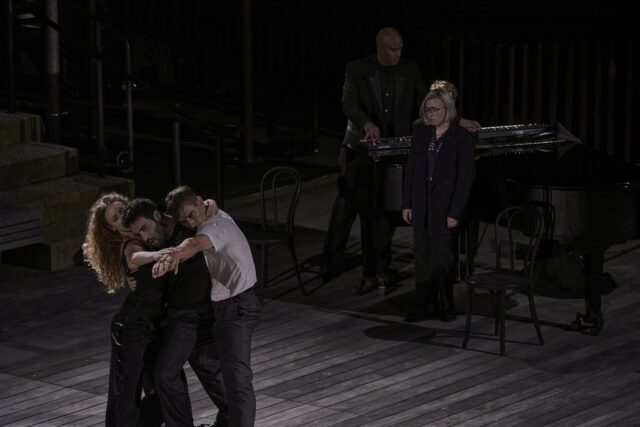
Martha Graham Dance Company will perform Baye & Asa’s Cortege and more in Joyce season (photo by Steven Pisano)

MARTHA GRAHAM DANCE COMPANY: DANCES OF THE MIND
Joyce Theater
175 Eighth Ave. at 19th St.
April 1-13, $62-$82
212-645-2904
www.joyce.org
marthagraham.org

What’s old is new again.

The Martha Graham Dance Company brings its ninety-ninth season to the Joyce for two weeks of classics, world premieres, and reimaginings of familiar pieces, in one case using — gasp! — AI.

From April 1 to 13, MGDC will present “Dances of the Mind,” three programs as part of its continuing GRAHAM100 celebration, preparing for its official centennial next year. Program A consists of Graham’s 1958 Clytemnestra Act II, with an original score by Halim El-Dabh and set by Isamu Noguchi; Baye & Asa’s Cortege, a world premiere about Charon the ferryman, inspired by Graham’s 1967 Cortege of Eagles, with music by Jack Grabow and costumes by Caleb Krieg; Xin Ying’s Letter to Nobody, based on Graham’s 1940 Letter to the World, this time honoring Graham and her legacy, incorporating generative media and AI technology, along with an Emily Dickinson poem (“I’m Nobody! Who are you? / Are you – Nobody – too? / Then there’s a pair of us!”), to craft a duet with Graham, Erick Hawkins, and Merce Cunningham; and Hofesh Shechter’s kinetic 2022 CAVE, with music by Âme and Shechter and costumes by Krieg.

Program B comprises Graham’s 1935 solo Frontier: American Perspective of the Plains, honoring the spirit of the pioneer woman, with a score by Louis Horst and set by Isamu Noguchi; two lost 1920s solos, Revolt and Immigrant, reimagined by Graham 2 director Virginie Mécène through extensive research; a new production of Agnes de Mille’s Rodeo, with Gabe Witcher’s bluegrass arrangement of Aaron Copland’s famous score, costumes by Oana Botez, and set by two-time Tony winner Beowulf Boritt; and Jamar Roberts’s 2024 We the People, which Roberts explains “is equal parts protest and lament, speculating on the ways in which America does not always live up to its promise,” with music by Rhiannon Giddens (arranged by Witcher) and costumes by Karen Young.

The third program brings together Graham’s 1943 Deaths and Entrances, made while Graham was contemplating faith and despair and inspired by the lives of Anne, Emily, and Charlotte Brontë, with music by Hunter Johnson, set by Arch Lauterer, and costumes by Oscar de la Renta; Graham’s 1947 Errand into the Maze, a duet based on the myth of Theseus and the Minotaur, with a score by Gian Carlo Menotti and set by Noguchi; and CAVE.

In addition, the April 1 gala features Clytemnestra Act II and Cortege, the April 5 University Partners Showcase highlights university and high school dancers performing works by Graham, Hawkins, José Limón, and others, the April 12 family matinee presents Graham’s 1935 call-to-action Panorama, Rodeo, and We the People, and there will be a Curtain Chat following the April 9 show.

Founded in 1926 in a tiny Carnegie Hall studio in midtown Manhattan, MGDC has an illustrious history involving a wide range of remarkable collaborators; the current troupe includes So Young An, Ane Arieta, Laurel Dalley Smith, Zachary Jeppsen-Toy, Meagan King, Lloyd Knight, Rayan Lecurieux-Durival, Antonio Leone, Devin Loh, Amanda Moreira, Ethan Palma, Jai Perez, Anne Souder, Matthew Spangler, Richard Villaverde, Leslie Andrea Williams, and Xin Ying.

[Mark Rifkin is a Brooklyn-born, Manhattan-based writer and editor; you can follow him on Substack here.]
NOT JUST MAUS-ING AROUND: ART SPIEGELMAN AT THE 2025 COMIC ARTS FEST

Art Spiegelman discusses hie life and career in Disaster Is My Muse

COMIC ARTS FEST 2025: ART SPIEGELMAN: DISASTER IS MY MUSE (Molly Bernstein & Philip Dolin, 2024)
L’Alliance New York, Florence Gould Theater, Tinker Auditorium
55 East 59th St. between Madison & Park Aves.
Friday, March 28, $30.55 – $54.20, 7:30
Festival runs March 28–30, pass $86.10
212-355-6100
lallianceny.org

In the documentary Art Spiegelman: Disaster Is My Muse, Pulitzer Prize–winning cartoonist and editor Art Spiegelman explains, “I did take comics very, very seriously, and I thought they were time turned into space, a perfect container for memory, and an incredibly maligned art form. And without being pretentious about it, I thought that this was as valid as anything that happened in literature or in painting, or in cinema.”

Winner of the 2024 DOC NYC Grand Jury Prize in the Metropolis Competition, the hundred-minute PBS American Masters film is part of the opening-night celebration of the 2025 Comic Arts Fest, taking place March 28–30 at L’Alliance New York; it will be shown on Friday evening at 7:30, followed by a Q&A with special guests and a party with food and drink, music, and a live Exquisite Corpse session with guest illustrators.

In the documentary, Bernstein and Dolin incorporate archival footage, family photos, detailed investigations of key panels from many of Spiegelman’s comics and graphic novels, and new interviews with such comic artists as Griffith, R. Crumb, Trina Robbins, Gary Panter, Charles Burns, Chris Ware, Peter Kuper, and Jerry Craft in addition to author Hillary Chute, film critic J. Hoberman, filmmaker Ken Jacobs, Spiegelman, Mouly, and their children, Dash and Nadja. “By showing in your comics stuff you’re not supposed to show, stuff you’re not supposed to deal with, the culture outside is telling you don’t go there, by doing it, you’re robbing it of its power,” Griffith says of his Arcade cofounder’s aesthetic.

Mouly offers, “Art has never separated work and life,” especially when it comes to his genre-redefining 1986 graphic novel, Maus: A Survivor’s Tale (My Father Bleeds History) and the 1991 sequel, Maus: And Here My Troubles Began. The books explore his complicated relationship with his Polish father, Vladek, who finally told his son about his experiences at Auschwitz, a subject that he and Art’s mother, Anna, had previously avoided delving into with him.

Art Spiegelman holds up the 1973 “Centerfold Manifesto” in poignant documentary

In the books — which the New York Times originally listed as fiction until Spiegelman wrote them a letter explaining that Maus was a carefully and thoroughly researched true story and should be categorized as nonfiction — Spiegelman depicted the Jews as mice and the Nazi soldiers as evil cats. “He tackled a subject that was enormous and he established the medium as a serious literary form,” Sacco says.

As deeply personal as Maus is — the documentary includes scenes of Spiegelman visiting Auschwitz in 1987 — it is primarily a human tale of innocent people trapped amid the scourge of Fascism, something Spiegelman has been warning people about given what is happening around the world this century.

“Art Spiegelman is the guy that reinvented comics as a medium that people took seriously,” artist and author Molly Crabapple says. “He showed that comics could express the darkest, most tragic, most complicated, most true things about history, about our relationships, about family.” Disaster Is My Muse was made prior to Donald Trump reclaiming the presidency in November, but Spiegelman makes his feelings about him very clear in lectures and conversations.

Speaking about his early, radical work with EC and Mad writer and editor Harvey Kurtzman, Spiegelman notes, “It was asking you to deeply question things, and I believe it was an important aspect of what led to the generation that protested the Vietnam War.” Among the other topics that are examined are several of Spiegelman’s autobiographical panels from Breakdowns: Portrait of the Artist as a Young %@&*!; 1968’s Prisoner on the Hell Planet: A Case History, about his mother’s suicide, the comic that first attracted Mouly to him; his longtime association with Topps designing Wacky Packages and Garbage Pail Kids cards; making potent New Yorker covers; his 9/11 book, In the Shadow of No Towers; Maus being banned in many school libraries across the country; such influences as Mad magazine #11 and Bernard Krigstein’s Master Race; his adaptation of Joseph Moncure March’s 1928 lost classic, The Wild Party; and his time spent in a state mental facility and the tragic death of his brother. Although his smoking habit is never mentioned, he is nearly always seen with a pipe, cigarette, or vape.

In 1973, Spiegelman and Griffith created the “Centerfold Manifesto” in Short Order Comix #1, which proclaimed, “Comics must be personal! . . . Efficient and Callous Capitalist Exploitation must be condemned and deplored at every turn . . . And replaced by Inefficient and humane Capitalist Exploitation!” More than fifty years later, he is still living by his word.

The Comic Arts Fest overflows with opportunities to appreciate the art form Spiegelman champions: Highlights include screenings of four episodes from season two of Florian Ferrier’s series The Fox-Badger Family and four episodes of Daniel Klein’s Living with Dad, the masterclass “Aleksi Briclot: My Journey with Marvel Studios,” the conversation “The Return of the Iconic Gaston Lagaffe” with Delaf, the lecture “The Rise of Afromanga” with Gigi Murakami, a screening of Anora Oscar winner Jacques Audiard’s Paris, 13th District followed by a discussion with artist Adrian Tomine, a screening of Silenn Thomas’s Frank Miller: American Genius followed by a Q&A with Thomas and artist Emma Kubert, and the closing event, “Françoise Mouly, from Indie Comics to the New Yorker,” in which Spiegelman’s wife and business partner sits down with Anita Kunz, Peter de Sève, Barry Blitt, and others to talk about her career. Spiegelman will also be at the Artist Alley & Bookstore section of the fest on March 30 from 3:30 to 5:30; among the other participants are Paul & Gaëtan Brizzi, Patrick McDonnell, Pauline Lévêque, Griffith, and Tomine.

[Mark Rifkin is a Brooklyn-born, Manhattan-based writer and editor; you can follow him on Substack here.]
CARMEN WINANT: MY MOTHER AND EYE PUBLIC ART FUND TALK AND TOUR

Carmen Winant, Arrival, “Carmen Winant: My Mother and Eye,” 2024, (photo by Nicholas Knight / courtesy of Public Art Fund, NY)

Who: Carmen Winant, Melanie Kress
What: Public Art Fund Talk and artist-led tour
Where: Talk: The Cooper Union, Frederick P. Rose Auditorium, 41 Cooper Sq.; tour: West End Ave. between West Sixty-Third & Sixty-Fourth Sts.
When: Talk: Wednesday, March 26, free with advance RSVP, 6:30; tour: Thursday, March 27, free with advance RSVP, 11:00 am
Why: In its continuing mission to bring unique, intriguing, and involving public art to New Yorkers all around the city, which it has been doing since its founding in 1977, the Public Art Fund has been teaming with JCDecaux for several years, placing art in bus shelters in all five boroughs. The latest installation is “Carmen Winant: My Mother and Eye,” consisting of eleven compositions arranged from more than fifteen hundred screen captures taken from films Carmen and her mother took when they were teenagers traveling across the country; Winant’s mother documented her trip from Los Angeles to Niagara Falls on Super 8 in the summer of 1969 with her friend Judy Carter, while Carmen traveled from Philadelphia to Los Angeles with a 35mm camera in 2001.

The montages are on view in three hundred bus shelters in New York, Boston, and Chicago through April 6. You can find Horizon on Prospect Ave. and on Roosevelt Ave., Beach on the Southwest Grand Concourse, Rainbow on Frederick Douglass Blvd. and on Pearl St., Niagara Falls on 180th St. and on Clarkson Ave., Cornfield on Victory Blvd., and Bless Our Happy Home on Myrtle Ave., among other works at other locations.

“I think of myself as a feminist artist who uses art as an expression of my politics,” Winant says in a PAF Instagram post. “That has meant thinking about existing photographs as documents or as tools of the movement, how those pictures resonate now, or what they can tell us about contemporary feminism or the space between feminist movements.”

On March 26, Winant, who was born in San Francisco, grew up in Philly, and is now based in Columbus, Ohio, will participate in a Public Art Fund Talk and experimental lecture about the project, sitting down with PAF senior curator Melanie Kress at the Cooper Union. The next day, Winant and Kress will lead a tour of some of the bus shelters, beginning on the Upper West Side. Both events are free with advance RSVP.

[Mark Rifkin is a Brooklyn-born, Manhattan-based writer and editor; you can follow him on Substack here.]
DHARMA FRIENDS: NUALA CLARKE AT TIBET HOUSE

Who: Nuala Clarke, Crystal Gandrud, Rob Ward, Megan Mook, Kevin Townley
What: “Alchemy and Art on the Spiritual Path”
Where: Tibet House NYC and online, 22 West Fifteenth St.
When: Monday, March 24, free – $20 – $225, 6:30
Why: “I swim in the sea, and my experience of cold has changed. I can no longer be trusted with the question ‘Is it cold out?’ I experience it without the tightening of torso muscles and raising of shoulders. It has become separate from the whole, less readily identifiable. In my hands it feels like leanness, the appendages pared away to the essential; in my back and around my ribs it tingles; it is fresh on my lips; in my toes it is clear and my chest, above my heart, accepts it as youngness, in need of care. I am an effervescent being.” So writes Irish artist Nuala Clarke in her new book, Irish Moss of a Dead Man’s Skull (the Owl Circus, March 18, $33).

Influenced by the work of Irish alchemist and natural philosopher Robert Boyle (1627–91), author of Experiments and Considerations Touching Colours, with Observations on a Diamond that Shines in the Dark, as well as by installation artist Robert Irwin, serigrapher and ceramicist Robert Brown, and spiritual coach and meditation teacher Robert Chender, Clarke has spent nearly five years “thinking about whether a painting could be prescribed for an ailment.” The result is a work that Clarke calls “an ode to light, color, loss, and the elements.” The 224-page book features 86 full-color images and details the impact each of the four Roberts has had on her art and her meditation practice.

On Monday, March 24, Clarke will launch the book at Tibet House as part of the Dharma Friends series, joined by experimental writer and acquiring editor Crystal Gandrud, Food Will Win the War violist, songwriter, and lead vocalist Rob Ward, and monthly Dharma Friends hosts Megan Mook and Kevin Townley, who will lead guided meditations. Having participated back in 2010 with composer Roarke Menzies, Gandrud, my wife, and others in a performance Clarke curated for her show “You Delight Me” on Shelter Island, I can vouch for how terrific her events are, and this one should offer its own numerous pleasures.

[Mark Rifkin is a Brooklyn-born, Manhattan-based writer and editor; you can follow him on Substack here.]
THE NEXT GENERATION OF DANCE: AILEY II RETURNS HOME

Ailey II brings Houston Thomas’s Down the Rabbit Hole back home in two-week NYC season (photo by Nir Arieli)

AILEY II AT CITIGROUP THEATER
Ailey Citigroup Theater
405 West Fifty-Fifth St. between Ninth & Tenth Aves.
March 26 – April 6, $62.25
ailey.org

Ailey II has been on the road, visiting more than two dozen cities, but the company called “the next generation of dance” is coming back to New York for its annual season at the Ailey Citigroup Theater on West Fifty-Fifth St. Running March 26 to April 6, the season is dedicated to longtime Ailey dancer, choreographer, and artistic director Judith Jamison, who passed away in November at the age of eighty-one.

“Ailey II is thrilled to come back to our home stage after an incredible tour across the country as we leap into our sixth decade,” artistic director Francesca Harper said in a statement. “We are eager to welcome both our loyal supporters and new audiences to experience the exciting artistry of Ailey II through two programs that bridge the past and present, celebrating how each generation shapes the future. Whether audiences find joy, connection, or a sense of empowerment, I want them to carry that discovery into their lives long after they leave the theater.”

The company of twelve dancers — Carley Brooks, Meredith Brown, Jennifer M. Gerken, Alfred L. Jordan II, Xavier Logan, Kiri Moore, Corinth Moulterie, Xhosa Scott, Kayla Mei-Wan Thomas, Darion Turner, Eric Vidaña, and Jordyn White — will present “Echoes,” comprising Harper’s Luminous, the world premiere of Houston Thomas’s Down the Rabbit Hole, and a new production of Alvin Ailey’s Streams, and “New Vintage,” consisting of an excerpt from Jamison’s Divining, excerpts from Ailey’s Blues Suite, The Lark Ascending, and Streams, Down the Rabbit Hole, and Baye & Asa’s John 4:20. Each program is approximately 105 minutes with two intermissions; tickets are $62.65.

[Mark Rifkin is a Brooklyn-born, Manhattan-based writer and editor; you can follow him on Substack here.]