live performance

STANDING ON CEREMONY: DARK OLD MEN REVIVED OFF BROADWAY

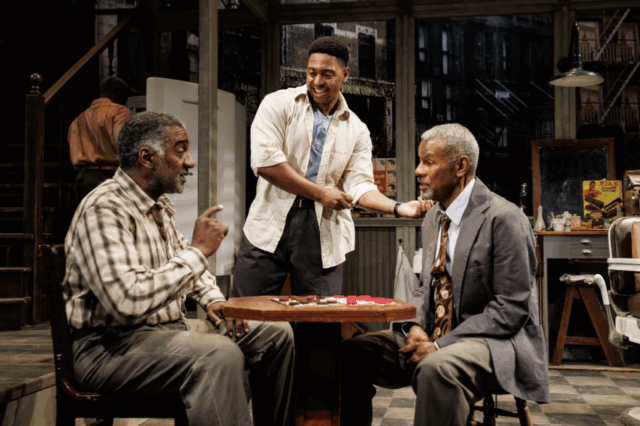
Russell Parker (Norm Lewis) and William Jenkins (James Foster Jr.) play checkers while Theo (Bryce Michael Wood) tries to get their attention in Ceremonies in Dark Old Men (photo by Maria Baranova)

CEREMONIES IN DARK OLD MEN
Theatre at St. Clement’s
423 West Forty-Sixth St. between Ninth & Tenth Aves.
Through June 29, $39-$119
thepeccadillo.com
necinc.org

The Peccadillo Theater Company and Negro Ensemble Company’s potent revival of Georgia-born Lonne Elder III’s 1969 Ceremonies in Dark Old Men firmly establishes it as a missing link between Chicago-born Lorraine Hansberry’s 1959 A Raisin in the Sun and Pittsburgh-born August Wilson’s ten-part 1982–2005 Century Cycle.

Hansberry took the title of her first play from Missouri-born writer and activist Langston Hughes’s 1951 poem “Harlem”: “What happens to a dream deferred? Does it dry up / like a raisin in the sun? / Or fester like a sore — / And then run? / Does it stink like rotten meat? / Or crust and sugar over — / like a syrupy sweet? / Maybe it just sags / like a heavy load. / Or does it explode?” In the original Broadway production of A Raisin in the Sun, the impressive cast featured Sidney Poitier, Ruby Dee, Ivan Dixon, John Fiedler, Louis Gossett Jr., Claudia McNeil, Diana Sands, Glynn Turman, Ed Hall, Douglas Turner Ward, and, as Bobo, Lonne Elder III, an experience that helped lead to his becoming a playwright dealing with social issues.

Originally produced at St. Mark’s Playhouse, Ceremonies in Dark Old Men has also had stellar actors over the years, including Billy Dee Williams, Denise Nicholas, Ward, Ruben Santiago-Hudson, Keith David, Teddy Wilson, Lawrence Hilton Jacobs, Joan Pringle, Taurean Blacque, Turman, Eugene Lee, Brandon J. Dirden, Jason Dirden, and Cara Patterson, many of whom have appeared in Wilson plays as well.

Directed by Clinton Turner Davis, who has previously helmed Wilson’s Joe Turner’s Come and Gone and Hughes’s Black Nativity, this new adaptation of Ceremonies in Dark Old Men, the first New York City revival since 1985 (which was directed by and starred Ward) is a poignant and affecting exploration of a Black family struggling to get by in Harlem. The story takes place in a barbershop on 126th St. between Seventh and Lenox Aves. in Harlem, where the widowed Russell Parker (Norm Lewis) reads the paper, plays checkers with his friend William Jenkins (James Foster Jr.), and refuses to look for a job, even though he has no customers day after day. His two sons, Theopolis (Bryce Michael Wood) and Bobby (Jeremiah Packer), also avoid work; Theo keeps hatching get-rich-quick schemes, while Bobby reads comic books and steals items from local shops.

Russell’s daughter, Adele (Morgan Siobhan Green), is the only practical one, holding down a job so she can pay the rent and feed her father and brothers. But after taking care of her ailing mother with little help from the others, not dating, and working hard while Russell, Theo, and Bobby bring in no money, she gives them an ultimatum: They have six days to find employment or they’re out on the street.

“I am not going to let the three of you drive me into the grave the way you did Mama — And if you really want to know how I feel about that, I’ll tell you,” she says. “Mama killed herself because there was no kind of order in this house — there was nothing but her old-fashion love for a bum like you, Theo — and this one — [points to Bobby]. Who’s got nothing better to do with his time than to shoplift every time he walks into a department store. And you, Daddy, you and those fanciful stories you’re always ready to tell, and all the talk of the good old days when you were the big vaudeville star, of hitting the numbers, big. How? How, Daddy? In a way, you let Mama make a bum out of you — you let her kill herself!”

Norm Lewis is sensational as Russell Parker in rare revival (photo by Maria Baranova)

Theo starts making bootleg corn liquor, which quickly becomes popular, and he teams up with the cool, crooked Blue Haven (Calvin M. Thompson) to sell it. He needs to work out of the barbershop without letting Adele know, and for that he has to get his father’s approval. Russell is initially against the idea, but he eventually acquiesces, as Jenkins and Bobby get involved as well. The lure of easy money is just too great.

“We’re going into business, Adele. I have come to that and I have come to it on my own,” he declares to his daughter. “I am going to stop worrying once and for all whether I live naked in the cold or whether I die like an animal, unless I can live the best way I know how to. I am getting old and I oughta have some fun. I’m going to get me some money, and I’m going to spend it! I’m going to get drunk! I’m going to dance some more! I’m getting old! I’m going to fall in love one more time before I die!

It doesn’t quite turn out that way.

Tony and Grammy nominee Lewis (The Gershwin’s Porgy & Bess, Chicken & Biscuits) imbues Russell with a Shakespearean dignity as he moves across the stage, walking with a hitch in his step from his years as a vaudeville dancer. He’s not a feeble old man, but he’s also in no shape to suddenly make up for lost time. It’s a complex, layered performance that fits right in with the worlds created by Hansberry and Wilson. All three playwrights died too young, Hansberry at thirty-four, Wilson at sixty, and Elder III at sixty-eight.

Elder III (Charades on East Fourth Street, Splendid Mummer) wrote only six plays in his career, but he earned an Oscar nomination for cowriting the screenplay for the 1972 adaptation of Sounder; he also penned the popular 1978 miniseries A Woman Called Moses. Ceremonies might be fifty-five years old, but it resonates in a way that makes it feel like it could have been written yesterday. The rest of the cast, which includes Morgan Siobhan Green as a young floozy, skillfully inhabits Harry Feiner’s elaborately detailed set; Green (Be More Chill, White Girl in Danger) is particularly effective as Adele, who clearly means what she says and has had it with the men in her family.

In his 1951 book-length poem Montage of a Dream Deferred, which contains “Harlem,” Hughes wrote, “Hold fast to dreams / For if dreams die / Life is a broken-winged bird / That cannot fly.” In Ceremonies, all the characters have broken wings, and no one ends up soaring.

[Mark Rifkin is a Brooklyn-born, Manhattan-based writer and editor; you can follow him on Substack here.]

MOLIÈRE IN NEW YORK: SOCIAL SATIRE IS NOT ALWAYS THE BEST MEDICINE

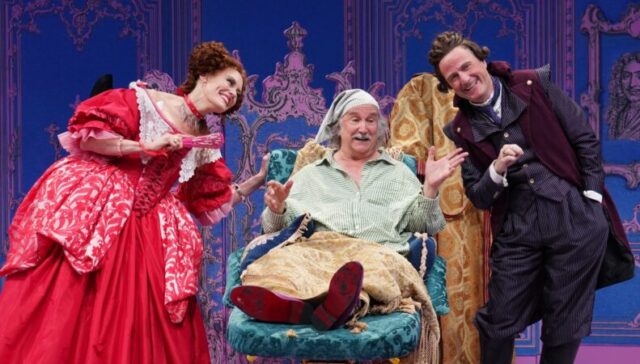
Sarah Stiles and Mark Linn-Baker stand out in Red Bull adaptation of Molière’s The Imaginary Invalid (photo by Carol Rosegg)

THE IMAGINARY INVALID
New World Stages
340 West Fiftieth St. between Ninth & Tenth Aves.
Wednesday – Monday through June 29, $69-$140
www.redbulltheater.com
newworldstages.com

Two madcap farces loosely based on Molière satires about wealth and class are currently running off Broadway, and both throw everything at the wall, hoping enough will stick. One succeeds significantly more than the other, but neither turns out to be exemplary.

In 2017, writer Jeffrey Hatcher and Red Bull artistic director Jesse Berger teamed up on a hilarious adaptation of Nikolai Gogol’s 1836 The Government Inspector, taking aim at health care, education, the court system, surveillance, class distinction, poverty, power, the institution of marriage, and government itself. They followed that up in 2021 with an overbaked version of Ben Jonson’s 1610 The Alchemist, which also skewered health care and class distinction. Their latest collaboration, an adaptation of Molière’s final play, 1673’s The Imaginary Invalid, falls somewhere in between, a frantic comedy about money, loyalty, and faith in science, based on a new translation by Mirabelle Ordinaire.

Continuing at New World Stages through June 29, The Imaginary Invalid takes place on two-time Tony winner Beowulf Boritt’s flimsy yet elegant set, a Louis XIV–style blue and pink room with a dressing screen, a mobile hospital bed, portraits of Molière and prancing cherubs on the wall, and doors at either side that will be peeked through and slammed repeatedly over the course of eighty-five frenetic, if repetitive, minutes. The master of the house, Argan (a delightful Mark Linn-Baker), is a rich hypochondriac who spends most of his time in bed, in his pajamas, slippers, and night cap, complaining about various aches and pains, losing feeling in his buttocks, and evacuating his bowels at scheduled times. His maid, Toinette (a riotous Sarah Stiles), takes care of him in a cheeky manner, lobbing subtle, and not-so-subtle, bombs at him.

Argan’s daughter from his first marriage, Angélique (Emilie Kouatchou), has fallen in love with Cléante (John Yi), but Argan has just promised her to Thomas Diafoirus (Russell Daniels), the doofus son of his surgeon (Arnie Burton). Argan is also tended to by Dr. Diafoirus’s brother, Dr. Purgon (Burton), who takes advantage of Argan’s hypochondria, and Dr. Fleurant (Burton), an enema specialist who dresses like a low-rent Batman TV villain. Meanwhile, Argan’s second wife, the voluptuous but devious Béline (Emily Swallow), is plotting with her lover, the lawyer Monsieur de Bonnefoi (Manoel Felciano), to change Argan’s will so she gets everything and Angélique nothing.

Béline (Emily Swallow) and de Bonnefoi (Manoel Felciano) try to trick Argan (Mark Linn-Baker) in Molière comedy at New World Stages (photo by Carol Rosegg)

The only one who is aware of all that is going on is Toinette, who relishes the insanity and inanity but is not about to lose her job over the scheming and deceptions.

Hatcher and Berger fill The Imaginary Invalid with inconsistent and intermittent fourth-wall breaking, clever and mundane anachronisms, self-referential inside jokes, playful props, and enough rear-end references that if I never hear another word about buttocks and enemas it will be too soon. But it’s also silly fun, even if it is more Three Stooges and Looney Tunes than Marx Brothers and Abbott and Costello, despite direct nods to Groucho and A&C.

Tilly Grimes’s costumes are a romp all their own, particularly the Joe “Stinky” Besser baby sailor outfit Daniels wears as Thomas, along with Béline’s lavish red gown and pouffy hairdo. Music director and composer Greg Pliska adds to the frivolity with parodies of such French songs as “La Vie en Rose,” “La Marseillaise,” “Hooray for Captain Spaulding,” and “I Dreamed a Dream.” Tracy Bersley’s movement choreography is appropriately frenetic.

At one point, when Toinette is arguing with Argan that he is getting bad advice from his wife and doctors, he says, “Look, when I’m sick, I call a doctor! When I want something dusted, I don’t call you because you don’t dust!” She answers, “I see. You won’t listen to me because I’m a servant.” Argan: “And a woman.” Toinette: “Well, if you need to hear the same said by a man, I refer you to Monsieur Molière.” To which Argan replies: “Molière! Molière writes plays! If I were his doctor, I wouldn’t prescribe him a single pill! I’d say: ‘Die, playwright, like a show without a star!’”

An ill Molière died on February 17, 1673, shortly after collapsing onstage during a production of The Imaginary Invalid that he was directing and starring in and which included the following lines: “To the Devil with him! If I were a doctor, I would be revenged on him for his impertinence, and when he was sick, I would let him die without relief. He would cry and beg in vain, but I would not prescribe him the least bleeding or enema, and would say to him, ‘Die! Die! Molière!, that will teach you to make fun of doctors.’”

The Imaginary Invalid makes fun of doctors and patients, of health care and the law, of greed and avarice, and of theater itself. “Is there a cure?” Argan asks. Well, both the Bible and the Mayo Clinic agree that laughter is the best medicine.

Taylor Mac reveals hypocrisy inherent in arts funding in Prosperous Fools (photo by Travis Emery Hackett)

PROSPEROUS FOOLS
Theatre for a New Audience, Polonsky Shakespeare Center
262 Ashland Pl. between Lafayette Ave. & Fulton St.
Tuesday-Sunday through June 29, $95-$125
www.tfana.org

A few years before The Imaginary Invalid, Molière wrote Le Bourgeois gentilhomme (The Middle Class Gentleman), the story of a rich bourgeois man obsessed with becoming an accepted member of the French aristocracy. Taylor Mac (who uses the pronoun judy) reimagines the play, now called Prosperous Fools, as a contemporary skewering of wealth, power, art, philanthropy, and celebrity, set at a gala fundraiser for a nonprofit ballet company. Adding elements from judy’s personal experiences at gala fundraisers — as a waiter, a guest, a performer, and an honoree — Mac delivers a frustrating, often confusing, and overly repetitive production that only settles down with a brilliant final monolog that spreads the blame for the terrible situation nonprofits find themselves in today.

Begun twelve years ago as a commission for an institution that ultimately rejected it, the show was turned down by numerous other New York City companies before being picked up by Theatre for a New Audience, which is presenting it at the Polonsky Shakespeare Center through June 29, directed by Tony and Obie winner Darko Tresnjak, who is unable to keep it from careening way out of control.

Mac stars as the Artist, who is choreographing a three-hour ballet relating the Greek myth of Prometheus, who stole fire from the gods and gave it to humans; he paid the price by being tied to a rock and having his liver eaten over and over again by an eagle throughout eternity. Just about everything that can go wrong does as the Artist, the dancer playing Prometheus (Ian Joseph Paget), and the three muses (Em Stockwell, Megumi Iwama, and Cara Seymour) prepare for the evening. The lights aren’t working, the orchestra doesn’t have the full score, and not everyone is thrilled that one of the honoree donors, dimwitted billionaire $#@%$ (Jason O’Connell), is morally and ethically challenged.

“I know you wouldn’t be able to do this work without $#@!$’s financial support, but he’s also a real estate petroleum mogul who makes pharmaceutical heroin out of endangered species,” the Intern (Kaliswa Brewster) says to the Artist, pointing out that the oligarch was also “that judge on that show where they made poor people compete for who could be the best beggar.”

The conversation continues until the Artist explains, “Buckle up! You want a life in the arts, this is what it looks like. You work for free, you beg for permission to ask for permission to do what you’ve worked for free to do, and after years of this humiliation, you finally break through, get yourself a patron, and he represents everything you’ve been fighting against your entire life. So organize the sheet music, fetch my coffee, and then go home and eat your top rhamen!”

The Philanthropoid (Jennifer Regan) readies to debase herself to both honorees, $#@%$ and glamorous actress and humanitarian activist ####-### (Sierra Boggess), whose main cause is helping impoverished children around the world. “I am not allowed happiness beyond the children,” she declares. ####-### is occasionally joined by a living prop, the Pot-Bellied Child (Aerina Park DeBoer), and uses the Intern, who is poor and Black, as an example of what is wrong with society. Walking around with a clipboard, the Stage Manager (Jennifer Smith) tries to keep everything running but doesn’t have much luck and takes offense when her clothes are ridiculed as those of “the working man.”

Meanwhile, $#@%$ demands that he needs his Wally Shawn in order to hang out with cultured people; American actor, writer, and living legend Wallace Shawn, he of The Princess Bride, Young Sheldon, My Dinner with Andre, and so many other beloved classics, is not available, so the Artist dresses up as him and fairly adequately speaks like him. “Couldn’t you hire the actual Wally Shawn?” the Artist asks. The Philanthropoid responds, “Money can’t buy everyone.”

As the gala proceeds, so does the mayhem, which describes the production as well.

The Intern (Kaliswa Brewster), $#@%$ (Jason O’Connell), the Philanthropoid (Jennifer Regan), and the Stage Manager (Jennifer Smith) aren’t the only ones who are confused about Prosperous Fools (photo by Hollis King)

Taken individually, Prosperous Fools should be another blast by Mac, whose previous works include Gary: A Sequel to Titus Andronicus, The Lily’s Revenge, and A 24-Decade History of Popular Music. Alexander Dodge’s set, with an Astor Plaza–like cube, square plastic swimming pool, and headless animals, is a hoot, as are Anita Yavich’s costumes, although $#@%$ dressed as Elon Musk in the first act and Donald Trump in the second feels like overkill. The boisterous choreography is by Company XIV’s Austin McCormick, with music by Oran Eldor.

However, there is too much of everything. Jokes go on too long and are repeated, the purposeful overacting grows tiresome, and, something I thought I’d never say, no more Wallace Shawn, please! Many of Mac’s points are currently being made in the Amazon Prime series Étoile, which deals with a dancer swap between Paris and New York, a worrisome gala, an ethically and morally challenged oligarch throwing his money around to get whatever he wants, along with an eclectic choreographer who believes he is misunderstood. (DeBoer is in both Étoile and Prosperous Fools.)

The show concludes with a marvelous monolog by the Artist that brilliantly narrows down what it’s all about, making each and every one of us complicit in the hypocrisy without even mentioning DOGE — performers, choreographers, donors, artistic directors, woke gatekeepers, and, perhaps most courageously, the audience. “Do you deserve because you try? / And do you own what you can buy? / Does charity absolve your greed? / Does wanting much make others need?” he asks. “Is selling out what you deplore? / And how then have you been a whore? / Should you be thanked for being wealthy? / Should you be shamed, is that unhealthy?”

Both The Imaginary Invalid and Prosperous Fools could use a second opinion. Calling Dr. Howard, Dr. Fine, Dr. Howard!

[Mark Rifkin is a Brooklyn-born, Manhattan-based writer and editor; you can follow him on Substack here.]

DON’T STOP THAT PIGEON: CELEBRATING JUNE 14 ON THE HIGH LINE

PIGEON FEST
The High Line
Thirtieth St. & the Spur
Saturday, June 14, free, noon – 8:00
www.thehighline.org

What did you do on Saturday, June 14, 2025? It’s looking to be quite a memorable date.

June 14 is Flag Day, when America pays tribute to the Stars and Stripes. Although it’s not a federal holiday, it is, according to Proclamation 1335, signed in 1916 by President Woodrow Wilson, a day “with special patriotic exercises, at which means shall be taken to give significant expression to our thoughtful love of America, our comprehension of the great mission of liberty and justice to which we have devoted ourselves as a people, our pride in the history and our enthusiasm for the political programme of the nation, our determination to make it greater and purer with each generation, and our resolution to demonstrate to all the world its vital union in sentiment and purpose, accepting only those as true compatriots who feel as we do the compulsion of this supreme allegiance.” The flag was approved by the Continental Congress on June 14, 1777.

June 14 is also unofficially known as Cup Day; on June 14, 1994, the New York Rangers ended their fifty-four-year drought and won the Stanley Cup following a tough seven-game series with the Vancouver Canucks. The Broadway Blueshirts won the finale on goals by Brian Leetch, Adam Graves, and captain Mark Messier; Mike Richter stood tall between the pipes.

On June 14, 1969, German tennis champion Steffi Graf was born.

On June 14, 1963, the Soviets launched the manned spacecraft Vostok 5.

On June 14, 1940, the first train carrying Polish prisoners pulled into Auschwitz.

On June 14, 1928, Che Guevara was born.

On June 14, 1811, Uncle Tom’s Cabin author Harriet Beecher Stowe was born.

Oh, also, on June 14, 1946, Donald John Trump was born in Queens.

President Trump has decided to honor his birthday, Flag Day, and the 250th anniversary of the US Army on June 14, 2025, by holding a military parade along the National Mall in Washington, DC, consisting of 6,600 soldiers with historical weapons, 50 military aircraft, 150 vehicles, tanks, helicopters, several dozen horses, and 2 mules; the total cost is expected to be $145 million. There will be protests around the country, from the Women’s March’s “Kick Out the Clowns” to “No Kings” in nearly two thousand congressional districts.

If you’re looking for something different, your best bet might just be Pigeon Fest, a party celebrating Iván Argote’s seventeen-foot-high Dinosaur, a giant pigeon sculpture at the High Line Spur at Thirtieth St. There will be artist talks, workshops, carnival games, music, a puppet show, a pageant, a bazaar, a science fair, and more, with Maria Assis Silva, Julia Rooney, Stephanie Costello, Tina Pina (Mother Pigeon), Machine Dazzle, Jameson Fitzpatrick, Lee Ranaldo, the Bird Is the Word Ensemble, and others.

Below is the complete schedule.

Iván Argote’s Dinosaur is centerpiece of High Line celebration (photo by Timothy Schenck)

The Discovery Fair, with Pop-up Pigeons!, Watercolor Workshop with Food Scraps Ink, the Birdsong Project, the Center for Book Arts, the Cornell Lab of Ornithology, the LES Ecology Center, Lofty Pigeon Books, the Mayor’s Office of Urban Agriculture (MOUA), Monument Lab, Mother Pigeon, NYC Bird Alliance, Pat McCarthy, and the Wild Bird Fund, Eastern Rail Yards, noon – 5:00

Bird Bazaar, with the Coop Carnival, Pigeon Piñata Party, Alternative Monuments for NYC, Pigeon Fan Club, NYPL Bookmobile Station and Storytime, and Best Plants for Birds on the High Line, Coach Passage at Thirtieth St., noon – 5:00

Zumba: Pigeon Dance Party, led by Maria Assis Silva, noon

Mother Pigeon’s Impeckable Puppet Show, 1:00

Pigeon Impersonation Pageant, 2:00

Panel Discussion: Building Bird-Friendly Cities, with Qiana Mickie, Christian Cooper, and Ethan Dropkin, moderated by Richard Hayden, 3:30

Artist Talk: Iván Argote and Cecilia Alemani, 4:15

Musical Concert, with Jameson Fitzpatrick, a string quartet performance by students from the Manhattan School of Music and Juilliard Pre-College Programs, the Bird Is the Word Ensemble organized by Lee Ranaldo, and a special guest headliner, 5:30 – 8:00

[Mark Rifkin is a Brooklyn-born, Manhattan-based writer and editor; you can follow him on Substack here.]

BLOWING IT UP: JEAN SMART RETURNS TO BROADWAY IN CALL ME IZZY

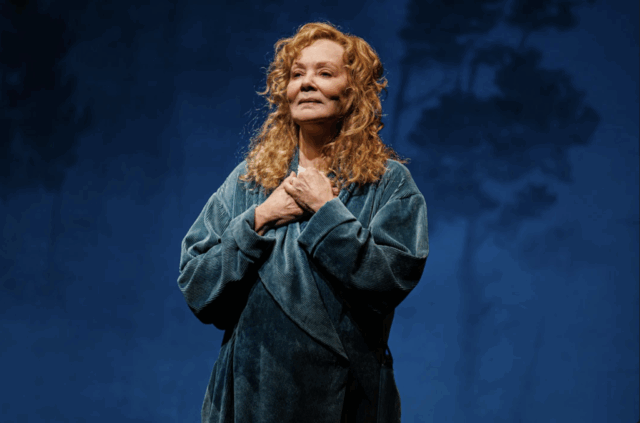
Jean Smart makes a triumphant return to Broadway in Call Me Izzy (photo by Marc J. Franklin)

CALL ME IZZY
Studio 54
254 West 54th St. between Seventh & Eighth Aves.
Tuesday – Sunday through August 17, $69-$399
212-719-1300
callmeizzyplay.com

Baton Rouge native Jamie Wax’s debut play, Call Me Izzy, is a darkly funny and insightful one-person drama, an exploration of an all-too-familiar topic: domestic abuse. Although it borders on clichéd situations and flirts with poverty porn, it never tips over the edge. The stellar production, directed by Sarna Lapine and anchored by an exquisite performance by six-time Emmy winner and Tony and Grammy nominee Jean Smart, makes it much more.

In a triumphant return to Broadway after nearly twenty-five years, Smart portrays Isabelle Scutley, née Fontenot, a woman living with her brutish husband, a pipe fitter named Ferd, in a mobile home in the fictional Louisiana Lady Trailer Park in the real town of Mansfield, Louisiana. Telling her story directly to the audience, Isabelle, who was married at seventeen and got a cemetery plot as a wedding present from her husband, has been trying to establish her own identity since she was a child, but under societal constraints and Ferd’s firm thumb she has rarely had a true sense of self.

Her sadness is immediately invoked as she discusses the blue toilet cleaner she loves using, which Ferd hates. She announces, “Blue . . . Azure . . . Sapphire . . . Swirlin’ cerulean . . . Lapis lazuli . . . Indigo!,” the colors serving as metaphors for the different shades of blue she has experienced in her life. Donald Holder’s lighting shifts accordingly.

Inspired by her fourth-grade performance of Joyce Kilmer’s “Trees” at the Arbor Day Pageant, Izzy decides to become a poet, imbued by an inner strength. Over the years, she compiles dozens and dozens of poetry journals, never showing them to anyone but finding solace in them. At the start of the play, we see her locked in the bathroom, using an eyebrow pencil to scribble on toilet paper.

“If you write something and no one ever reads it, does it even exist?” she asks. “Do I exist? Do you exist?”

Smart is a consummate raconteur, and soon Izzy’s story is revealed, involving a concerned neighbor named Rosalie Chedville, Izzy’s first library card, the free Introduction to Poetry and Creative Writing class taught by Professor Dwight Heckerling at Northwest Louisiana Community College, and Shakespeare’s sonnets; she is soon quoting from Henry VI. (Smart played both Queen Margaret and Lady Elizabeth Grey from Henry VI at the Oregon Shakespeare Festival in 1976–77.) Izzy lets Rosalie read some of her poems and becomes energized, rediscovering her purpose, and she even participates in a poetry contest where the prize is fifteen thousand dollars and a two-month residency in Brewster, Massachusetts. But when she wins the fellowship, Ferd is not exactly jumping for joy. Smart has the audience in the palm of her hand, making us understand the character’s mix of elation, confusion, and dread.

Jean Smart stars as an abused woman living in a trailer park in Call Me Izzy at Studio 54 (photo by Emilio Madrid)

Wax (Evangeline) is a stand-up comedian, actor, and longtime contributing correspondent for CBS News. Call Me Izzy, which he began writing in 1991, was inspired by the real-life story of one of his aunts and interviews he conducted with more than two dozen survivors of domestic abuse, and the play feels more authentic than manipulative or reductive. He fills the narrative with references, both subtle and crystal-clear, to the old-fashioned male-female dynamic that still remains in American culture. Her mother advises her, “The pickins’ in this town are real slim. It’s better to have a broken arm than no arm at all.”

Izzy hides her poetry in a tampon box, where she knows Ferd will not look — repurposing packaging that relates to her premenopausal years of fertility. The name of their town is Mansfield, and she points out that there used to be a Fruit of the Loom factory nearby, a company that, back in the day, primarily made underwear for men. She notes that when she first learned “Trees,” she assumed Joyce Kilmer was a woman, but when she is told he is a man, she thinks, “Well, that figures.”

Mikiko Suzuki MacAdams’s set switches from the cramped trailer park bathroom, with a working toilet, sink, mirror, step stool, and battery-powered radio, to a kitchen table and chairs outside, a black barrier sliding to create doorways and walls. Projections place the action in a forest as the sun rises and sets. Beth Lake’s sound immerses the audience in the melody of nature — and flushing — along with original music by T Bone Burnett and David Mansfield. The costumes, by Tom Broecker, range from a bathrobe to jeans and a flannel shirt.

Lapine (Dracula, Little Women) keeps things moving smoothly through the play’s hundred minutes, but the show belongs to Smart, who has the rapturous audience behind her every step of the way. At the matinee I saw, applause broke out after numerous scenes not just for Smart’s acting talent but for choices Izzy makes.

Smart was nominated for a Tony for her portrayal of Lorraine Sheldon in the 2000 revival of George S. Kaufman and Moss Hart’s The Man Who Came to Dinner and for a Drama Desk Award for her performance in Jane Chambers’s 1980 lesbian drama, Last Summer at Bluefish Cove, but most fans know her from such popular series as Designing Women, Hacks, and Mare of Easttown; she has won Emmys for roles on Frasier, Hacks, and Samantha Who? She is in full command of the stage, and her relationship with the audience is almost conversational, as if we are friends with her. She does not turn Izzy into a heroic figure or melodramatic victim but a woman who wants more, who has been taught that she should remain in her station and exhibit little or no individuality — that maybe she is at least partially responsible for the abuse Ferd heaps on her. But perhaps her time has come to look at herself with newfound respect and admiration.

“I don’t mind being invisible,” she says.

But later, she declares, “I want to blow up this trailer, blow up this whole life.”

Now, that’s something worth applauding.

[Mark Rifkin is a Brooklyn-born, Manhattan-based writer and editor; you can follow him on Substack here.]

THE RED PILL AND THE RABBIT HOLE: JOHN KRASINSKI IN ANGRY ALAN

John Krasinski stars as a man descending into an internet rabbit hole in Angry Alan (photo by Jonny Cournoyer)

ANGRY ALAN
Studio Seaview
305 West 43rd St. between Eighth & Ninth Aves.
Through August 3, $69-$249
studioseaview.com

Angry Alan makes me angry. More on that later.

John Krasinski has made a career of playing likable characters. From Jim Halpert on The Office to Jack Ryan, A Quiet Place, and the web series Some Good News, Krasinski portrays amiable, trustworthy, and sensible men who are easy to identify with and root for.

That’s why he’s such a great choice to star as Roger in Penelope Skinner’s Angry Alan, the inaugural production at Studio Seaview in the former West Forty-Third St. home of Second Stage. Originally performed at the 2018 Edinburgh Fringe by cocreator Donald Sage Mackay as a one-hour solo show, Angry Alan has been expanded to eighty-five minutes and now has a second actor. More on that later.

On social media and various conspiracy sites, the terms “red-pilling” and “blue-pilling,” derived from the 1999 film The Matrix, refer to radicalization as a result of a sudden revelation of a hidden reality that is obscured by various elements of society that seek to repress or hold down humanity. Red pills are associated with conspiracy theorists and men, in particular. In the movie, Morpheus (Laurence Fishburne) offers Neo (Keanu Reeves) a choice: “You take the blue pill . . . the story ends, you wake up in your bed, and believe whatever you want to believe,” he says. “You take the red pill . . . I show you how deep the rabbit hole goes.”

A divorced father who lives with his girlfriend and rarely sees his teenage son, Roger essentially chooses the red pill after he loses his prestigious job at AT&T, becomes the dairy manager in the Walnut Creek Kroger, and goes down the rabbit hole of the internet, becoming obsessed with YouTube posts by a man who goes by the moniker Angry Alan. He tells his story directly to the audience in such a gentle and easygoing manner, it’s not difficult to give him the benefit of the doubt, even as we worry about where this might be heading.

“I’m considering exercising when I fall into your average google vortex: and I’m just about to discover which nut will burn all my belly fat when before I know it I’m watching an uplifting video about great men throughout history, created by a guy who calls himself Angry Alan,” Roger explains from his man cave, a living room with a sofa bed, a reclining chair, a few tables, and a fake backdrop of windows, bookshelves, and doors. (The cozy set is by dots.) “And it feels kinda cool, you know, to be reminded of all the amazing discoveries and achievements we’ve made over the centuries. To hear something positive for a change. And Alan goes on to say that despite what you hear on the news, most men are intrinsically good. So many men are strong, loving fathers, working hard to provide for their families. And I’m watching this thinking, yeah. Wow. Right? So I get to the end and the next video starts playing and this one’s about gender roles and that links me to an article about modern American women and this time instead of forty minutes of pointless swiping I spend five hours reading and watching videos, five hours nonstop reading Alan’s articles and watching Alan’s videos all about how modern men are in crisis.”

He details scenes from his life, talking about his girlfriend, Courtney, who has started taking a community college art class in which she draws from live nude models; his ex-wife, Suzanne; their son, Joe; and his buddy Dave, who got canceled for telling a joke at a Christmas party. The more Roger listens to Alan, the more he gets swept into the men’s rights movement, convinced that cis white males are being mistreated in today’s society — and need to fight back to regain their former power and dominance.

“If you’ve taken the blue pill, then you believe the propaganda as presented to you by our corrupt and biased mainstream media and by the feminist agenda . . . that men run the world and women are the victims of male domination,” he declares. “Once you take the red pill, you realize that in a nutshell: Since feminism was so successful, things have gone too far the other way. We’re living in a ‘Gynocentric Society’ and now, now it’s like Beyoncé says: Who runs the world? Women. Women run the world.”

A “red pill glitch video moment” accompanies certain revelations in mostly one-person show at Studio Seaview (photo by Jonny Cournoyer)

Soon he is reevaluating his past, present, and future through Alan’s lens, and he doesn’t like what he sees. And when Suzanne lets him know that Joe has to speak to him about something, Roger is ready to pass his new world view on to his son as well.

But when Roger goes to Detroit to attend a men’s rights conference sponsored by Alan, the character and the narrative take a severe shift in tone, to the play’s detriment.

Angry Alan works best when it’s just Roger in his man cave, telling us about his life. Lucy MacKinnon’s projections include photographs of some of the people Roger brings up, adding a bit of context. A handful of times, when Roger is energized by an aha! revelation, loud, screeching noise and accompanying red static lights blare out, what Roger ecstatically calls “my red pill moment!”

It’s likely that most audience members have friends or relatives who have gone down similar rabbit holes, and they want them to come back to reality; that’s why we still root for Roger to find his way back — and because Krasinski (Dry Powder) is so charming. He is gently hypnotic in the role, even as Roger descends deeper into the dark side.

But Skinner (Linda, The Village Bike) and Obie- and Tony-winning director Sam Gold (Fun Home, Circle Mirror Transformation) upend the play by first having Roger attend the conference, complete with set change, then having Joe (one of two actors, neither listed in the program but on a board in the lobby) come to stay with Roger for a few days, hence my anger.

The show loses its flow and sophisticated messaging; the situation Joe shares with his father is extremely disappointing and utterly predictable. It might have been far preferable if Roger told us about the conference and his son the way he had described his thoughts and actions the rest of the play, relating it from his room, where his loneliness grows as fast as his plunge into toxic masculinity.

And it has nothing to do with Roger’s no longer being so gracious and affable — there are many Americans who would support his transition and agree with his beliefs. It just feels like a deus ex machina, a lackluster answer leading to a pat conclusion to what had been a gripping story, one that’s still worth seeing, as enough of it is “intrinsically good.” It just could have been so much more.

[Mark Rifkin is a Brooklyn-born, Manhattan-based writer and editor; you can follow him on Substack here.]

MOBILE MUCH ADO: BILINGUAL SHAKESPEARE IN THE PARKS

Public Theater Mobile Unit production of Much Ado About Nothing continues in parks through June 29 (photo by Peter Cooper)

PUBLIC THEATER MOBILE UNIT: MUCH ADO ABOUT NOTHING
Multiple locations in all five boroughs
June 3-29, free (no RSVP necessary)
publictheater.org

Composer and lyricist Julián Mesri and director and choreographer Rebecca Martínez follow up their 2023–24 Public Theater Mobile Unit hit, The Comedy of Errors, with another fun, and free, outdoor treat, a streamlined bilingual adaptation of the Bard favorite Much Ado About Nothing.

The hundred-minute show takes place on a colorfully designed square platform with two ceramic-like chairs with red-flowering cacti on top; the set, by Riw Rakkulchon, evokes the work of Mexican artist Frida Kahlo. The audience sits on three sides of the stage, with the costumes, props, and pianist and guitarist behind the fourth side, where you can see the cast prepare for scenes with the help of very busy stagehands.

The actors make use of the entire space, walking through the aisles and settling under trees, so it’s a hoot watching passersby wonder what’s going on — or pay no attention at all, not letting anything get in the way of where they’re going. (I saw the show when it was performed on the Fortieth St. side of the New York Public Library; it was previously at Astor Plaza and will continue at J. Hood Wright Park, the Cathedral Church of St. John the Divine, Sunset Park, A.R.R.O.W. Field House, and the Queens Night Market through June 29.)

The narrative is not quite as tight as the earlier The Comedy of Errors, so it helps to be familiar with the details of the play; in addition, not all the Spanish is translated into English, and vice versa. Don Pedro of Aragon (Hiram Delgado) returns to Messina after a fierce battle, accompanied by Señor Benedick of Padua (Nathan M. Ramsey) and the right noble Count Claudio (Daniel Bravo Hernández); Governor Leonato (Robert Marcelo Jiménez) readies a welcome celebration for them. While Claudio falls instantly in love with Leonato’s daughter, Hero (usually Mayelah Barrera, but I saw terrific understudy Katherine George), Leonato’s niece, Beatrice (Keren Lugo), has a verbal altercation with Benedick.

Benedick (Nathan M. Ramsey) and Beatrice (Keren Lugo) have a tilted relationship in reimagined Bard tale (photo by Peter Cooper)

Beatrice: I wonder that you will still be talking, Señor Benedick: nobody marks you.
Benedick: What, my dear Lady Disdain! Are you yet living?
Beatrice: Is it possible disdain should die while she hath such meet food to feed it as Señor Benedick?
Benedick: But it is certain I am loved of all ladies, only you excepted: and I would I could find in my heart that I had not a hard heart; for, truly, I love none.
Beatrice: A dear happiness to women: they would else have been troubled with a pernicious suitor. Le doy gracias a Dios y a mi sangre fría — que en eso estamos de acuerdo: I had rather hear my dog bark at a crow than a man swear he loves me.
Benedick: God keep your ladyship still in that mind! So some gentleman or other shall ’scape a predestinate scratched face.
Beatrice: Scratching could not make it worse, an ’twere such a face as yours were.
Benedick: I would my horse had the speed of your tongue. But keep your way, i’ God’s name; yo ya estoy.
Beatrice: Siempre con el mismo numerito — ya te tengo calado.

The bastard Don Juan (Martín Ortiz), jealous of the respect his half brother, Don Pedro, receives, enlists the squire Borachio (usually Carlo Albán, but I saw understudy Jonathan Gabriel Mousset) to throw a wrench into the blooming love between Hero and Claudio, singing, “It’s time to shake off this shame! / To take what’s rightfully mine!” Tricking Margaret (Sara Ornelas), Hero’s lady-in-waiting, Borachio and Conrade (Ortiz) convince the night watch that Hero has been unfaithful prior to her nuptials. On the case is the local constable, Dogberry (Cornelius McMoyler), and his two assistants, Verges (Delgado) and Sexton (Ornelas). Mistaken identity, misunderstandings, a masquerade ball, spying, lying, pratfalls, and private letters all come into play in one of the Bard’s most beloved comedies.

The presentation is delightful from start to finish, even with too much repetition and too many gaps. Shakespeare purists might miss several famous lines, but key ones are still there: “Speak low, if you speak love,” “She speaks daggers, and every word stabs,” “Some Cupid kills with arrows, some with traps.” Mesri’s lovely score features such songs as “I Will Wait for You (Te Esperaré),” “Don Juan the Villain,” “Hey Nonny Nonny,” and “Hay Que Cantar,” although there is less music in the second half; Mousset plays the guitar on- and offstage, with music director Angela Ortiz on piano.

Christopher Vergara dresses some characters in modern-day suits and others in colorful military garb and elegant gowns. The cast, which is having as much fun, if not more, than the audience, is led by charming turns by Lugo, George, Jiménez, and Ornelas, who at times resembles Kahlo. Sound designer Tye Hunt Fitzgerald competes with traffic and wind.

Admission is free, with no advance RSVP necessary. Be sure to arrive early to catch the troupe doing a group sound check and getting into their costumes. Stage manager Ada Zhang and assistant stage manager Bea Perez-Arche keep it all moving with expert precision.

[Mark Rifkin is a Brooklyn-born, Manhattan-based writer and editor; you can follow him on Substack here.]
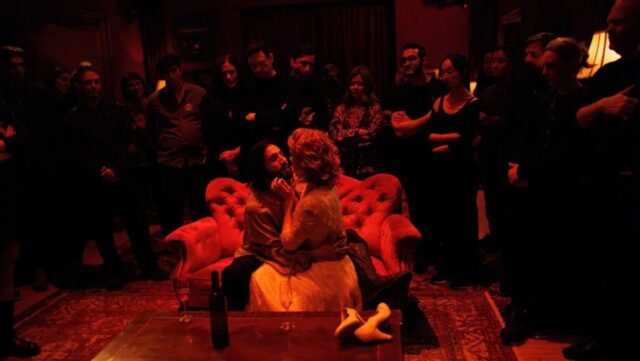
BEWARE THE DARKNESS: THE DEATH OF RASPUTIN ON GOVERNORS ISLAND

Grigory Rasputin (Jake Ryan Lozano) charms Tzarina Alix (Zina Zinchenko) and the audience in immersive show on Governors Island (photo by Maria Baranova)

THE DEATH OF RASPUTIN
Governors Island
The Arts Center at Governors Island (LMCC Building 110)
Thursday – Sunday through June 28, $44-$250
www.deathofrasputin.com

“Hail, all that is light,” Father Grigory Rasputin (Jake Ryan Lozano) says amid all the darkness in The Death of Rasputin.

Theater collective Artemis Is Burning places the audience right in the middle of the mysterious story of the real-life infamous Russian mystic in the immersive experience, running at LMCC’s Arts Center at Governors Island through June 28.

Born a peasant in Siberia in January 1869, Grigory Rasputin became a wandering monk who managed to embed himself with the Romanov royal family for more than a decade, having a major impact on the Russian empire. The seventy-five-minute show is set in 1916 in St. Petersburg, where Rasputin (Jake Ryan Lozano) is treating the young son of Tzar Nicholas II (Audrey Tchoukoua) and his wife, the Tzarina Alix (Zina Zinchenko). While part of Russia considers Rasputin a saint, others believe he is a dangerous heretic.

Audience members, who are strongly encouraged to dress in black to maintain an eerie, dark atmosphere, go from room to room, following either specific characters or plot threads. The narrative unfolds in twenty-one scenes over eleven acts, and it is impossible to see it all; be prepared to be involved in one room while hearing screaming, shouting, singing, and other sounds from other spaces, but that’s fine. As in the immersive-theater standard-bearer, Sleep No More, everyone comes together for the grand finale.

As you go from Rasputin’s apartment, Katya’s Bar, and the palace to a study, a military tent, and a foreboding dungeon, you’ll meet such fictional and real characters as Dread Uncle Duke Nikolai Nikolavich (Louis Butelli), the commander of the Russian military, who is planning on assassinating Rasputin; wealthy heir Felix Yusupov (Adam Griffith), who has returned to Russia after a year away and is immediately repelled by Rasputin while also falling for bar owner Katarina (Ginger Kearns); Olga Lohktina (Manatsu Tanaka), Dread Uncle’s wife who worships Rasputin; palace maid Petra (Lucy York Struever), who is a spy for the revolution, sending secret messages via radio transmission with bartender Fyodor (Cashton Rehklau); and Father Iliodor (Tim Creavin), who quickly realizes it will take more than prayer to bring Rasputin down.

Eulyn Colette Hufkie’s period costumes range from lush and elegant to wild and natty, with moody, often reddish lighting by Devin Cameron and cacophonic sound by Stephen Dobbie. Lili Teplan’s sets are intricately designed, many with chairs and couches; the choreography, which has to work around the unpredictable audience with care, is by James Finnemore.

Creator and coirector Ashley Brett Chipman, creative producer and codirector Hope Youngblood, cowriter and assistant artistic director Julia Sharpe, and cowriter David Campbell always have something going on — be prepared to grab a cord and chant, read through desk diaries (“Whenever I dream there is blood.”), hold Father Iliodor’s hands in solemn prayer, or pour drinks for the Tzar and Tazarina. And don’t pull out your cellphone; there is no photography or video — you’re required to put a privacy sticker over the lens of your phone — and checking messages would affect the ensemble and the audience, since everyone is so close together.

Lozano is ferociously energetic as Rasputin, a role previously portrayed by such actors as John Belushi on Saturday Night Live, Rhys Ifans in The King’s Man, Lionel Barrymore in Rasputin and the Empress, and Christopher Lee in the 1966 Hammer horror film The Mad Monk. Tanaka is hypnotic as Lohktina, and Creavin is steadfast as Father Iliodor.

As with all such immersive shows (Then She Fell, The Grand Paradise, Empire Travel Agency), the more you put into it, the more you’ll get out of it. And, as in real life, be careful where you put your trust and faith.

[Mark Rifkin is a Brooklyn-born, Manhattan-based writer and editor; you can follow him on Substack here.]