live performance

ENCORE ENGAGEMENT: THE MAN WHO SHOT LIBERTY VALANCE

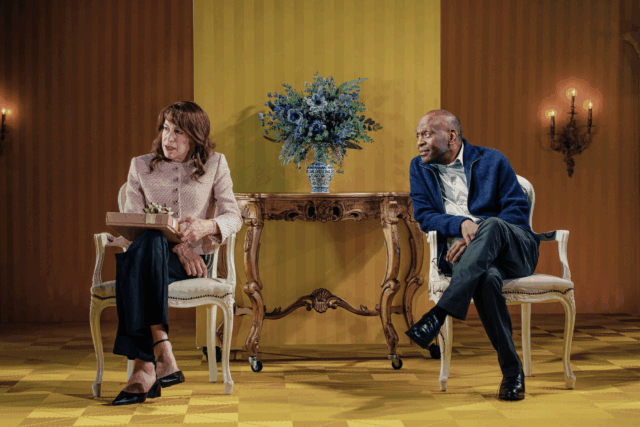
Onomatopoeia’s The Man Who Shot Liberty Valance is back for an encore engagement at the Gene Frankel Theatre (photo by Joshua Eichenbaum)

THE MAN WHO SHOT LIBERTY VALANCE
Gene Frankel Theatre
24 Bond St. at Lafayette St.
Wednesday – Sunday through July 27, $25-$35
www.genefrankeltheatre.com
www.theonomatopoeiatheatrecompany.com

In 2022, the Onomatopoeia Theatre Company presented the New York premiere of Jethro Compton’s The Man Who Shot Liberty Valance. It is now back for a return engagement, through July 27 at the Gene Frankel Theatre. Below is my original review; cast changes include Mari Blake as Hallie Jackson, Dillon Collins as Jake Dowitt, and Ben-David Carlson and Emily Cummings in multiple roles. In addition, no blank guns will be used, only nonfiring replica prop guns and sound effects.

“The hairs on your arm will stand up / At the terror in each sip and in each sup / Will you partake of that last offered cup / Or disappear into the potter’s ground? / When the man comes around,” Johnny Cash warned on the title track of his 2002 American IV album. The song is one of many by the Man in Black that echo in the Gene Frankel Theatre before the start and during intermission of Onomatopoeia Theatre Company’s stirring New York premiere of Jethro Compton’s The Man Who Shot Liberty Valance. In this case, the man coming around is Liberty Valance.

British playwright Compton’s 2014 play is based on the 1953 short story by Dorothy M. Johnson; the twenty-two-page tale was turned into a popular 1962 John Ford film packed with an all-star cast — John Wayne, James Stewart, Vera Miles, Lee Marvin, Edmond O’Brien, Andy Devine, John Carradine, Jeanette Nolan, Woody Strode, Denver Pyle, Strother Martin, Lee Van Cleef — but Compton’s adaptation brings the play into the twenty-first century, twisting many of the movie’s genre clichés inside out as he takes on social and racial injustice while toning down the movie’s political rhetoric, general Hollywood misogyny, and freedom of the press blather.

The two-and-a-half-hour show begins in 1910, as Sen. Ransome Foster (Leighton Samuels) and his wife, Hallie (Stephanie Craven), arrive in Twotrees for the funeral of Bert Barricune (Samuel Shurtleff), who seems to have been an insignificant forgotten man in an insignificant one-horse town. Young reporter Jake Dowitt (Jeff Brackett) wants an exclusive with the senator, leading to a flashback to 1890, when a severely injured Foster is brought into the Prairie Belle Saloon by Barricune. After he is tended to by Jackson and Jim “the Reverend” Mosten (Daniel Kornegay), who works for her, he explains that he was beaten by three men who turn out to be the villainous murderer Liberty Valance (Derek Jack Chariton) and his henchmen.

Foster is a peaceful man from New York, a law scholar traveling not with a gun but with legal texts, Shakespeare sonnets, Greek tragedies, and a Bible. When Marshal Johnson (Scott Zimmerman) refuses to arrest Valance, Foster considers going up against the feared gunslinger himself. “I am no law man, sir,” Foster admits. The marshal responds, “Seems from what I’ve heard you ain’t much good at defending yourself, let alone a town.”

Soon Foster is teaching some residents of Twotrees to read, which angers others, especially since Jackson is a woman and Mosten is the only Black man around; book learning is not for the likes of them. Much of the strength of the play comes from the power Compton invests in the two characters; in the short story and movie, Jackson is a restaurant employee, while Mosten is Barricune’s loyal helper and doesn’t even appear in Johnson’s tale. In the play, Jackson speaks her mind with a razor sharpness, while Mosten is a well-respected man who has the ability to memorize whatever anyone says or reads to him.

Barricune is not happy when he sees Foster and Jackson spending a lot of time together; Bert believes he is destined to marry her. “She’s always been my girl,” Barricune says. “Does she know that?” Foster replies.

After Valance and his two sycophants commit a horrific act, Foster is more intent than ever to face him down and let the chips fall where they may.

Ransome Foster (Leighton Samuels) and Liberty Valance (Derek Jack Chariton) are headed to a final showdown in Onomatopoeia production (photo by Joshua Eichenbaum)

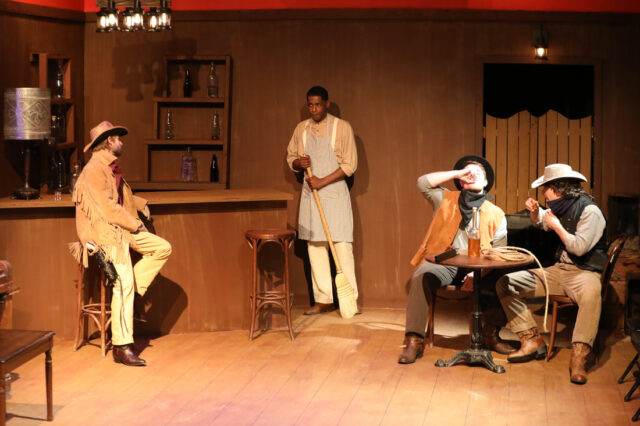
The Man Who Shot Liberty Valance takes place primarily on Nino Amari’s intimate set, a small Western saloon with a bar in the far corner, one table, two windows on either side of a piano, and swinging wooden doors in the back (which audience members must walk through to use the restrooms, but not during the performance). Most of the action occurs at the angled bar, including two sizzling scenes with Valance, the first between him and Mosten, the second him and Foster. Neither scene is in the short story or film, so the suspense is ratcheted up.

In his New York stage debut, Charlton is a magnetic force, his every word and move electrifying. He knows exactly who Valance is and what he wants, a villain who has no veneration for the law or for Blacks. When Foster raises the possibility of his defeating him in a showdown, the cocky Valance says, “Unless the hand of God comes down and strikes me dead there ain’t much chance of that.” Foster, knowing he doesn’t really have a shot, responds, “Or the earth opens up and the Devil takes you under.” Valance retorts, “No. We have an agreement, me and him.” When those words are spoken by Charlton, you don’t doubt it.

The rest of the cast holds up its end of the bargain; Samuels and Craven have a sweet chemistry, Shurtleff portrays Barricune with an inner loneliness, and Zimmerman’s marshal is neither coward nor buffoon. (Assistant director Chandler Robyn ably portrays numerous small roles.)

The play is expertly helmed by Onomatopoeia artistic director Thomas R. Gordon, maintaining a thrilling tension throughout. Susan Yanofsky’s period costumes are effective, while Reid Sullivan’s lighting hints at a danger always lurking, although the changing colors in the two windows are sometimes confusing. The narration occasionally gets in the way of the plot, explaining what we already know or making a point that is better left for the audience to decide for themselves.

Compton has also adapted F. Scott Fitzgerald’s The Curious Case of Benjamin Button into a Celtic musical and Jack London’s White Fang into Wolf’s Blood; his Frontier Trilogy is set in the American West in the mid-nineteenth century, while The Bunker Trilogy delves into Arthurian legend, classical Greek tragedy, and Shakespearean drama. In Liberty Valance he has created a stage Western for our times, cleverly referencing the conflicts of contemporary America, as red states battle blue states over jobs, immigration, and education; rights for women, people of color, and LGBTQIA+ are in serious jeopardy; gun control is being hotly debated; and liberal urban elites and the conservative south and Midwest seem immersed in an endless duel. The arguments the citizens of Twotrees are having are not unlike what we see every day on social media and partisan news outlets.

In the play, Foster teaches his class Shakespeare’s seventy-first sonnet, which reads in part: “No longer mourn for me when I am dead / Than you shall hear the surly sullen bell / Give warning to the world that I am fled / From this vile world with vilest worms to dwell.” Johnny Cash couldn’t have said it any better.

[Mark Rifkin is a Brooklyn-born, Manhattan-based writer and editor; you can follow him on Substack here.]
DOES THE END JUSTIFY THE MEANS? NYCT’S ALL’S WELL EN PLEIN AIR

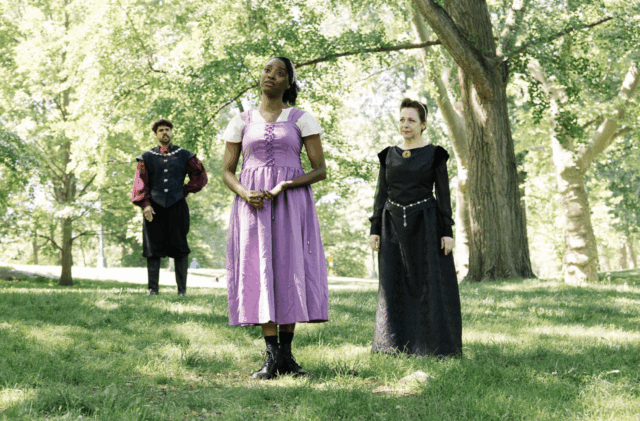
New York Classical Theatre’s All’s Well That Ends Well travels from Central Park to Carl Schurz Park to Battery Park (photo © Da Ping Luo)

ALL’S WELL THAT ENDS WELL
June 3-22: Central Park, Central Park West & 103rd St.
June 24-29: Carl Schurz Park, East 87th St. & East End Ave.
July 1-6: Castle Clinton, Battery Park
nyclassical.org

Every summer, numerous companies deliver free Shakespeare in parks (and even a parking lot) throughout the five boroughs. One of the best, most consistent troupes is New York Classical Theatre (NYCT), which has “staged” more than nine hundred free performances since 2000, including nearly two dozen Bard plays in addition to classics by Oscar Wilde, Anton Chekhov, Molière, Bernard Shaw, Friedrich Schiller, and others. Burdman refers to it as Panoramic Theatre, in which scenes take place in different parts of the parks, the audience moving along with the cast. NYCT has done it again with a splendid revival of All’s Well That Ends Well.

Most everyone knows the phrase “All’s well that ends well,” but few have actually seen what is one of the Bard’s problem plays, and it feels as problematic as ever in the twenty-first century. However, Burdman and NYCT are breathing new life into it this season as it travels from Central Park to Carl Schurz Park to Castle Clinton in Battery Park, continuing the mission they began in 2000: “NY Classical firmly believes that everyone — regardless of economic, social, or educational background — should have the opportunity to enjoy live professional theatre together as a community. Our free, engaging performances interpreted for approachable spaces inspire experienced theatergoers to reconnect with the classics and build new and future audiences.”

All’s Well That Ends Well is a kind of rom-com with an edge, a twist that feels forced, and not just in the current environment. Helena (Anique Clements) has been recently orphaned by the death of her father, Gérard de Narbonne, physician to the ailing king of France (Nick Salamone). She is now a ward of the countess of Roussillon (Carine Montbertrand) and is deeply in love with the countess’s son, Bertram (Paul Deo Jr.), who wants nothing to do with her. Helena travels to the king to offer him one of her father’s remedies; the king is suspect, since so many other doctors have failed him, so Helena offers him a deal: The king will take the prescription and, if it cures him, Helena can choose any man in the kingdom to be her husband, but if he is still sick, he can have Helena executed. The king agrees.

The king’s fistula goes away, and Helena tells him she wishes to marry Bertram, who is strongly against the union but must ultimately fulfill the king’s command. But instead of consummating the marriage, Bertram takes off to fight in Florence, leaving behind a letter in which he sets for his new bride what appear to be impossible tasks: “When thou canst get the ring upon my finger, which never shall come off, and show me a child begotten of thy body that I am father to, then call me husband. But in such a ‘then,’ I write a ‘never.’”

Bertram is accompanied by his untrustworthy friend, Parolles (Karel Heřmánek), a fool and a coward who thinks he’s a fashionista and doesn’t realize when he’s being ridiculed, including by the French courtier Lafeu (Clay Sorseth), who wouldn’t mind if his daughter were to wed Bertram.

A determined Helena disguises herself as a pilgrim and goes to Italy, where she meets old widow Capilet (Montbertrand) and her virgin daughter, Diana (Angelique Archer). The three devise a plan to coerce Bertram into marrying Helena, and it’s a devious one that is at the heart of why the play is so rarely performed.

Anique Clements and Carine Montbertrand stand out in NYCT Shakespeare production in the parks (photo © Da Ping Luo)

Partly inspired by a story from Boccaccio’s Decameron that was adapted by Geoffrey Chaucer in “The Clerk’s Tale,” All’s Well That Ends Well has been performed at the Delacorte in the Public Theater’s Shakespeare in the Park series four times, in 1966, 1978, 1993, and 2011, and has appeared on Broadway only once: Trevor Nunn’s Royal Shakespeare production, which ran for a month at the Martin Beck in 1983. Otherwise, there are small iterations here and there, including TV movies in 1968, 1978, and 1981. So it is exciting that Burdman has brought it back; the company last presented it in 2006.

I saw the show when it was in Central Park by the 103rd St. entrance, winding its way under trees, down paths, and by a pond. (The shows in Carl Schurz Park will be seated in one location, while the scenes will move in Castle Clinton.) Burdman has streamlined it to fit into the company promise of keeping it under two hours, so several characters and some major quotes have been excised (“No legacy is so rich as honesty”; “A young man married is a man that’s marred”), but others are still there (“Love all, trust a few, do wrong to none”; “many a man’s tongue shakes out his master’s undoing”).

The costumes are lovely, the props minimal (blindfolds, a pair of swords, a crown), and the lighting necessary only as the sun sets. (Members of the crew sit in the front with flashlights focused on the speaking actor.) Burdman directs the proceedings with a swift hand, the actors occasionally meandering through the audience. The strong cast is led by superb performances by Clements, who is so appealing as Helena that it’s hard to believe Bertram’s reluctance to wed her, and Montbertrand, who ably shifts between the countess and the widow. Reeves gets well-deserved breakout applause for her singing.

The finale is still troubling, requiring a key suspension of disbelief, but even so, NYCT’s production lives up to the title of the play.

[Mark Rifkin is a Brooklyn-born, Manhattan-based writer and editor; you can follow him on Substack here.]
WORSHIPPING LBJ: XHLOE RICE AND NATASHA ROLAND RETURN TO SOHO PLAYHOUSE WITH REMARKABLE LETTER

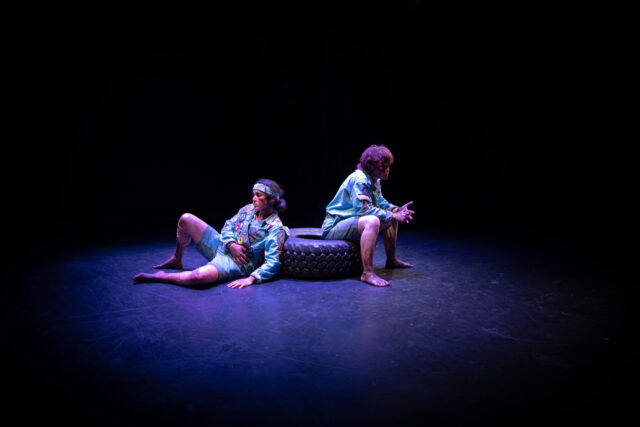
Natasha Roland and Xhloe Rice return to SoHo Playhouse with remarkable award-winning production (photo by Morgan McDowell)

A LETTER TO LYNDON B. JOHNSON OR GOD: WHOEVER READS THIS FIRST
SoHo Playhouse
15 Vandam St. between Varick St. & Sixth Ave.
Wednesday – Sunday through June 29, $45.50
www.sohoplayhouse.com
www.xhloeandnatasha.com

Xhloe Rice and Natasha Roland’s A Letter to Lyndon B. Johnson or God: Whoever Reads This First is back for an encore run at SoHo Playhouse, with good reason: It’s one of the best, most innovative and thoroughly satisfying shows of the year.

Rice and Roland met in high school eleven years ago and have been creating unique and inventive two-character plays and short films ever since, offering funny and poignant views of American history and culture and the elusive American dream.

Developing their own form of absurdist physical clown theater, they’ve portrayed Lewis and Clark in a pair of short films, satirized violence in the thirteen-minute Caramel Apples, and, onstage, played a rodeo clown and his shadow who want to become cowboys in And Then the Rodeo Burned Down and scrutinized the desires of 1950s housewives in What If They Ate the Baby?

They shocked the Edinburgh Fringe by winning the Fringe First award in 2022 for Rodeo, 2023 for Baby, and 2024 for Lyndon B. Johnson, their first three works, a feat never before accomplished.

A Letter to Lyndon B. Johnson or God: Whoever Reads This First packs a lot into its fast-moving sixty-five minutes; in addition to starring in the show, Rice and Roland are responsible for the writing, directing, choreography, costumes, set, and sound design, a legitimate DIY effort. Their regular collaborator Angelo Sagnelli is credited with lighting and technical management.

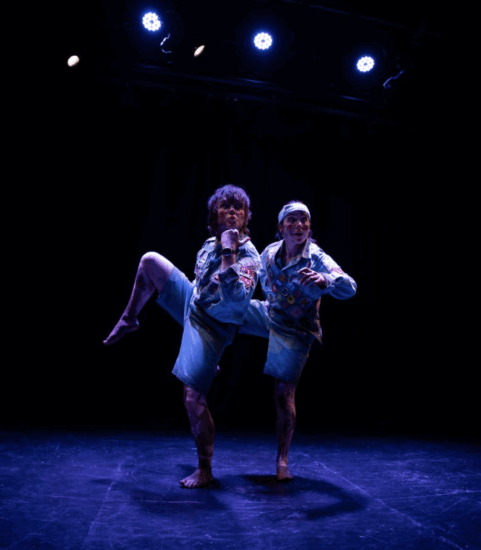
Xhloe Rice and Natasha Roland explore America in A Letter to Lyndon B. Johnson or God: Whoever Reads This First (photo by Morgan McDowell)

Twenty-four audience members sit on the stage in single rows of eight on the two sides and the back; the rest of the audience is in standard seating. The only prop is a large Mudstar radial M/T all-terrain tire with optimized traction; although it was chosen somewhat randomly by Roland’s father, it fits the concept of the show, in which Ace (Roland) and BFF Grasshopper (Rice) share stories of their past in small-town America and their service in Vietnam as they equate President Lyndon B. Johnson with G-d.

Ace is the tough one, from a military family, while Grasshopper is more gentle and vulnerable, raised by his grandmother. They both are barefoot and wearing Boy Scout uniforms, Ace’s covered in many more patches — evoking battle medals — than Grasshopper’s. Their faces, arms, and legs are thick with dirt and grime; Ace also has a bandanna around his head and a bandage on one calf that look like war wounds but, as we learn, aren’t.

“Stay with me,” Grasshopper says at the beginning; we’re not about to go anywhere. Running across the stage, jumping on each other, lying down on the floor, rolling and balancing on the tire, and spit-shaking, Ace and Grasshopper talk about the time Hillbilly had a problem with a high rope swing, relate an evening when their proposed prank of putting snakes in camp counselor Davis’s pillowcase went awry, and prepare for Ace to play the trombone for the president as his train passes through town. Although the trombone scene eerily recalls the 1954 thriller Suddenly, in which Frank Sinatra plays a hit man hired to assassinate the president when his train is scheduled to stop in a small California town, Ace and Grasshopper worship LBJ. They alter the Pledge of Allegiance to include him and offer their own version of the Our Father, as if praying to Johnson and G-d is the same thing; they often swear to Johnson, as if he’s in charge of it all, amid numerous references to religion. Ace has a dream in which his father becomes LBJ.

Throughout the play, Grasshopper tells a multipart fable about “a young boy who lived in a mountain village and . . . wanted nothing more than to be a man.” A witch advises that he must undertake a long, dangerous journey to find a lake filled with leeches that will suck his blood and make him a man; it loosely parallels Ace and Grasshopper’s story as they go from kids to soldiers fighting an ill-defined war in Southeast Asia, one that their hero, LBJ, escalated.

Rice and Roland are utterly charming as Grasshopper and Ace; through direct eye contact with the audience and physically reaching out with various gestures and incorporating the tire, they not only humanize the characters but instantly make them our friends. We all feel a part of the group, enhancing our emotional investment in what happens to them. Their goofing around as kids helps us reminisce about our goofing around as kids:

Ace: I’m what they call “highly decorated.”
Grasshopper: You’re what they call “highly annoying.”
Ace: [puts Grasshopper in a headlock] And what do they call your mom’s brother?
Grasshopper: Uncle! Uncle!

But their faith is tested, as shown in this brief exchange:

Grasshopper: Do you think they’ll let him be president forever?
Ace: They have to.
Grasshopper: He’ll love us.
Ace: He has to.

The immersive sound features nature and music — three Beatles songs play a prominent role, with Rice and Roland performing on that war-movie staple, the harmonica, replacing the words with notes, beginning with “Ob-La-Di, Ob-La-Da,” which contains the refrain “Ob-la-di, ob-la-da, life goes on, brah / La-la, how their life goes on.” The sound and lighting ultimately explode in a gripping, unforgettable finale.

Winner of SoHo Playhouse’s International Fringe Encore Series Overall Excellence award, A Letter to Lyndon B. Johnson or God: Whoever Reads This First captures the America of the late 1960s as well as today, as politics, religion, and the military become intertwined and the everyday struggles of the common people are completely misunderstood or purposely ignored. Rice and Roland remind us who we were, who we are, and who we still can be. I can’t wait to see where they’ll take us next.

[Mark Rifkin is a Brooklyn-born, Manhattan-based writer and editor; you can follow him on Substack here.]
NO HOPE: THE SINS OF CARAVAGGIO

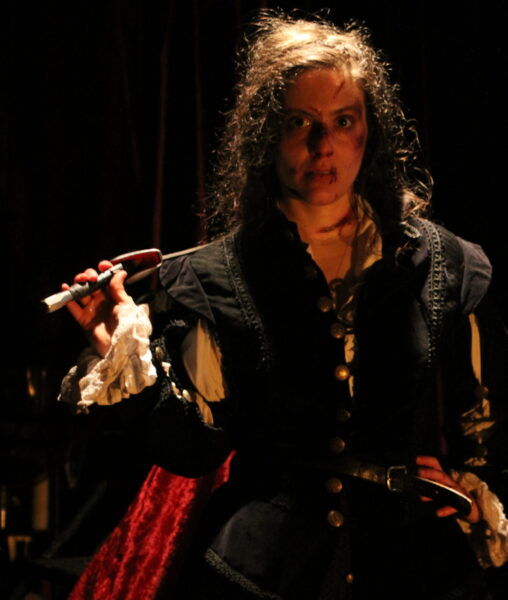
Playwright Sara Fellini stars as Caravaggio in spit&vigor’s Nec Spe (photo by Nick Thomas)

NEC SPE: THE FINAL CONFESSION OF BRUTE PAINTER CARAVAGGIO
The Players Theatre
115 MacDougal St.
Friday, June 20, and Saturday, June 21, $20-$55, 7:30
www.spitnvigor.com

In past productions, the New York City–based spit&vigor has staged works dealing with such real-life figures from centuries ago as Lord Byron, Percy Bysshe Shelley, and Mary Shelley (Mary’s Little Lamb), Irish madam Dorcas Kelly (The Wake of Dorcas Kelly), the Booth brothers (The Brutes), and Hungarian serial killer Elizabeth Báthory (Blood Countess).

The company is now reaching back to its 2019 show, Nec Spe (No Hope), which was initially presented with Nec Metu (No Fear); the former featured Adam Belvo as Italian Baroque painter Michelangelo Merisi da Caravaggio, the latter Sara Fellini as his contemporary, Italian Baroque painter Artemisia Lomi Gentileschi. This time around, troupe cofounding artistic director Fellini, who wrote the plays, will take on the role of Caravaggio, and it will be staged at spit&vigor’s tiny baby blackbox space at the Players Theatre, where I saw the excellent Anonymous in February.

In a January 2022 twi-ny talk with Fellini, she noted, “I’ve always been into history. I have trouble relating to the modern world. . . . So, while a lot of the ideas and prejudices of the past are nonsense and based in ignorance and inexperience, I do think there’s a lot to be learned from people who spent all of their time noticing, negotiating, and navigating other human beings.”

Directed by Megan Medley, the play, which deals with art, gender, politics, and murder both in the past and how it relates to what is happening today, will have two more performances, June 20 and 21, and tickets are almost gone, so act fast to check out this unique exploration of an important and influential artist.

[Mark Rifkin is a Brooklyn-born, Manhattan-based writer and editor; you can follow him on Substack here.]
QUEERING THE MONARCHY: A PRINCELY PLAY AT PLAYWRIGHTS

Royal siblings Charlitte (N’yomi Allure Stewart) and George (John McCrea) toast to their future in Prince Faggot (photo by Marc J. Franklin)

PRINCE FAGGOT
Playwrights Horizons, the Peter Jay Sharp Theater
416 West 42nd St. between Ninth & Tenth Aves.
Tuesday-Sunday through July 27, $68.50 – $103.50
www.playwrightshorizons.org
Studio Seaview
305 West 43rd St. between Eighth & Ninth Aves.
September 11 – December 13, $69-$249
studioseaview.com

The central image accompanying Jordan Tannahill’s new play, Prince Faggot, is Salman Toor’s 2022 ink and gouache Fag Puddle with Crown and Wire, on the program cover and on view in the fourth-floor lobby of Playwrights Horizons, where the show, coproduced with Soho Rep, runs through July 27. [ed note: The production will move to Studio Seaview for an extension September 11 – December 13.] The drawing depicts assorted body parts, a candle, a crown, a wig, and other items, commenting on, among other things, colonialism and queer identity. Toor told the New Yorker, speaking of his artistic approach, “I wanted to have parts of the painting that responded to my need for realism, and other parts that were deliberately sketchlike and a bit irreverent.”

Both descriptions can be applied to Prince Faggot, which feels like two separate plays that don’t quite merge; one is more realistic, and far more engaging; the other irreverent, and far less cohesive.

The play opens with the six actors sharing anecdotes about how their queerness impacted their childhood; five stories include a photo of the performer as a child. The first one, told by Mihir Kumar, and the last, which concludes the show, from N’yomi Allure Stewart, are based on their lives; the other four narratives, related by Rachel Crowl, K. Todd Freeman, David Greenspan, and John McCrea, are fictional creations of the playwright. (The six are listed as Performer #1, Performer #2, etc., in the program, but I will refer to them by their last names here for simplification when not in royal character.)

Prince Faggot feeds off a 2017 photograph of Prince George of Cambridge, the son of William and Kate, the prince and princess of Wales. The picture of the four-year-old in blue shorts, hands on his chin, went viral; Kumar notes, “I remember literally hundreds of people on social media sharing this photo and calling George a ‘gay icon’ for his adorably fey pose.” Freeman takes offense, declaring, “Sexualising a young child like that is disgusting.” But Kumar defends the discussion, peering into the audience and explaining, “Look, the queers in the audience — and I’m assuming that’s most of you, let’s be honest — we know one of our own when we see one because we ourselves were once queer children. We can locate our younger selves in photos of George’s poses and prancing because the world taught us to notice, and isolate, and suppress these affects — or suffer the consequences.”

Kate (Rachel Crowl) and William (K. Todd Freeman) face some trouble at home in Jordan Tannahill play (photo by Marc J. Franklin)

The play soon proceeds into what McCrea calls “an act of queer prognostication”: Tannahill builds a gay fantasia in which Prince George (McCrea), now eighteen, is indeed gay, ready to introduce his boyfriend, Dev Chatterjee (Kumar), to his parents (Freeman and Crowl) at their country estate at Anmer Hall. William and Kate bring in communications director Jaqueline Davies (Greenspan) to train George and Dev — who has been outspoken about what he thinks of the British imperial past — on how to deal with the public furor that will come with the revelation of their relationship. George is close with his sister, Charlotte (Stewart), and also gets personal advice from the gay palace butler, Andrew Farmer (Greenspan), who has a unique bond with him, always ready to cover up for George when drugs, alcohol, and strange men enter the mix.

As the story travels from 2032 to 2044, including the possibility of a gay royal wedding, George continually has trouble navigating a challenging life that requires him to balance what he wants with what the monarchy demands, tropes and themes familiar to any avid romance reader.

Several times, Prince Faggot breaks the fourth wall as performers deliver first-person monologues in what appear to be actual private confessions about their lives or the play itself but are actually fictional tales. Crowl, who is trans, discusses how a specific scene in the play made her angry, giving her an “overwhelming feeling of having been denied the experience of being a trans girl.” McCrea recalls being insulted by a teacher for his effeminacy while rehearsing Henry V in college. Legendary downtown performance artist Greenspan delves into gay history — primarily, fisting during the AIDS crisis.

While each of these sidebars is poignant and moving, the interventions disrupt the play in awkward fashion. Tannahill (Botticelli in the Fire, Is My Microphone On?) is squeezing in too much, generating confusion while exploring and celebrating queer characters and performers. It’s difficult to relate to George; Tannahill might be attempting to make George’s issues with his sexuality representative of many people’s experiences, but not everyone’s parents and grandparents are kings and queens and princes and princesses. However, the play does an excellent job of examining childhood queerness and young adult rebellion — a gay royal bildungsroman.

David Zinn’s set consists of two dressing rooms in the back, a central platform stage, and chairs in the wings where the actors sometimes sit and watch when they are not part of the action; a diagonal curtain is pulled across for set changes. Montana Levi Blanco’s costumes go from contemporary casual and regal finery to comic and, well, nothing during one extremely graphic sex scene. (UnkleDave’s Fight-House is the intimacy coordinator, and they have their hands full.) Obie-winning director Shayok Misha Chowdhury (Public Obscenities, Rheology) can’t quite merge the various elements, which also feature an interminable exchange in the rain and more than a glimpse of some BDSM. (Audience members are required to put their phones in a Yondr pouch so they can’t sneak any photos.)

The ensemble is led by standout performances from two-time Tony nominee Freeman (Downstate, Airline Highway), who imbues William with a gentle understanding, six-time Obie winner Greenspan (The Patsy, I’m Assuming You Know David Greenspan), who is touching as Farmer and hilarious as Davies, and, in his off-Broadway debut, Kumar, who portrays Dev with a deep sense of honesty.

“I was very, very femme growing up, and I often felt intimidated and ostracized,” the Pakistani-born, Brooklyn-based Toor also told the New Yorker. Tannahill probes these feelings in a fresh and unexpected setting in Prince Faggot, with some clever twists, but his romantic fantasy, built around the classic tropes of a shocking love between prince and commoner and the conflict between desire and duty, all too often can’t quite bear the weight of what he seeks to achieve.

[Mark Rifkin is a Brooklyn-born, Manhattan-based writer and editor; you can follow him on Substack here.]

MAGIC TRAIN: PASSENGERS PULLS INTO PAC NYC

The 7 Fingers pull into PAC NYC to take audiences on an unforgettable journey (photo by Matthew Murphy)

PASSENGERS
Perelman Performing Arts Center (PAC NYC)
251 Fulton St.
Tuesday – Saturday through June 29, $43-$117
pacnyc.org
7fingers.com

“There’s something about a train that’s magic,” Richie Havens sang in a series of 1980s Amtrak commercials. The 7 Fingers troupe captures that magic and more in the breathtaking Passengers, continuing at PAC NYC through June 29.

For ninety minutes, the Montreal-based company combines circus acrobatics, gymnastics, song, dance, physical theater, and prose to take audiences on an exhilarating and affecting ride on the rails, By the end, the performers feel like characters in a play more than mere strangers on a train.

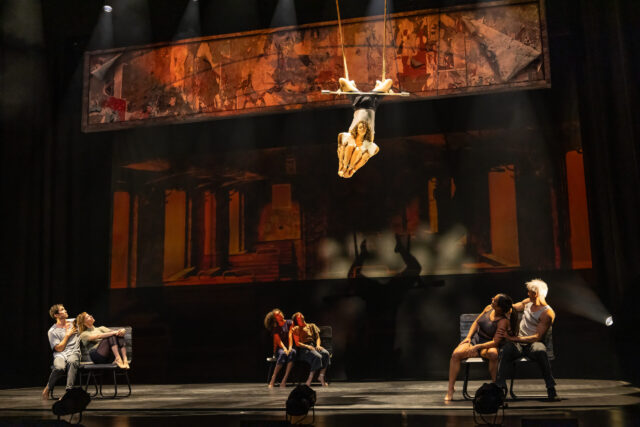
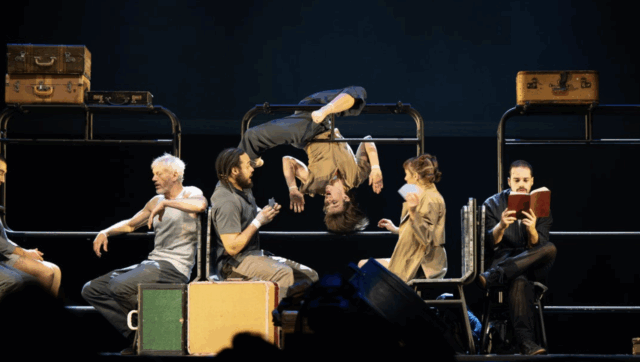
Written, directed, and spectacularly choreographed by Tony nominee Shana Carroll, Passengers begins with Kaisha Dessalines-Wright, Marie-Christine Fournier, Eduardo De Azevedo Grillo, Marco Ingaramo, Anna Kichtchenko, Maude Parent, Michael Patterson, Pablo Pramparo, Méliejade Tremblay-Bouchard, Santiago Rivera Laugerud, Sereno Aguilar Izzo, and Will Underwood bringing out chairs and aligning them as if on a train, destination unknown. Over the course of approximately twenty scenes, each one highlighted by a different discipline, they make their way through tunnels and over bridges as they run, jump, tumble, leap, twirl, and throw one another high in the air, incorporating such props as suitcases, luggage racks, clothing, and the chairs.

Kichtchenko spins multiple hula hoops, holding them out for several of the men to dive through. Contortionist Parent claps her hands to stop and restart time, altering reality in between. Fournier and Grillo perform a romantic hand-to-trap pas de deux in midair on duo trapeze to a rousing version of “Saint Louis Blues.” Dessalines-Wright sings “Train Is Coming” with Grillo on ukulele, advising, “Train is coming, and not that slow / You catch it up or you let it go / Round and round the tracks they go / When you’re back you let me know.” Dessalines-Wright discusses Einstein’s theory of relativity as it applies to speeding trains and time. Grillo pulls himself up on aerial straps, then is joined by Dessalines-Wright on duo straps. Izzo juggles a growing number of white styrofoam balls, some from inside his shirt. Kichtchenko flies with aerial silks. Ingaramo impossibly rises, balances, and slides down a Chinese pole. Three performers build vertical human chains to the song “Call,” which promises, “We will no longer / We will no longer / break apart / We will no further / We will no further / Fall.” Friends and lovers come together and say goodbye.

Suitcases, luggage racks, playing cards, and other props are used alongside hula hoops, aerial straps and silks, duo trapeze, and a Chinese pole in dazzling 7 Fingers show (Renee Choi Photography)

Passengers evokes Cirque du Soleil, Pina Bausch, The Music Man’s opening number, Company XIV, and STREB but is clearly its own phenomenon. Ana Cappelluto’s ever-changing set is supplemented with Johnny Ranger’s videos of passing landscapes and tunnels, some projected on a horizontal bar at the top back of the stage, along with Éric Champoux’s lighting, which creates dazzling shadows and glowing effects. Colin Gagné composed the wide-ranging original music and designed the sound with Jérôme Guilleaume.

The performers, in naturalistic costumes by Camille Thibault-Bédard, are nothing short of spectacular, celebrating remarkable feats that push the limits of what the human body can do. But Carroll (Water for Elephants) manages to make it all relatable, as train travel is still mostly an egalitarian way to get from one place to another.

In “La hora de la hora,” the song accompanying the juggling, lyricist Boogát admits, “Soy un loco más en la locomotora (I’m just another crazy person on the locomotive).”

You’d be crazy not to get on board this magic train.

[Mark Rifkin is a Brooklyn-born, Manhattan-based writer and editor; you can follow him on Substack here.]
EXORCISING DEMONS THROUGH RAP AND SKATING: BOWL EP AT THE VINEYARD

Quentavius da Quitter (Oghenero Gbaje) and Kelly K Klarkson (Essence Lotus) work on their debut rap record in Bowl EP (photo by Carol Rosegg)

BOWL EP
Vineyard Theatre
Gertrude and Irving Dimson Theatre
108 East 15th St. between Union Square East & Irving Pl.
Tuesday – Sunday through June 22, $37.80-$106.92
www.vineyardtheatre.org

Audience members are immersed in the unique, exciting, and at times confounding world of Bowl EP as soon as they enter the Vineyard’s Gertrude and Irving Dimson Theatre, which has been reconfigured as an empty, deep, kidney-shaped swimming pool surrounded by a chain-link fence on all four sides. Thumping songs such as Young Thug’s “Money on the Dresser,” BashfortheWorld’s “50–0,” and Cortisa Star’s “Get It Down” set the mood for the eighty-minute show, which takes place “in the middle of a wasteland at the edge of the galaxy.”

Presented by the Vineyard and the National Black Theatre in association with the New Group, Bowl EP unfolds across twenty-five scenes, conceptualized as a mixtape being made by skateboarders Kelly K Klarkson (Essence Lotus) and Quentavius da Quitter (Oghenero Gbaje). The description of each track is projected into the pool in increasingly offbeat fonts, from “skating n smoking” and “a flirty interlude” to “tasting fingers” and “deepthroating.” Along the way they try to come up with a name for their group while testing out rhymes.

quentavius: “Get high to see far, you don’t know who we are / We’ll nut upon ya face and call it street art”
kelly + quentavius: “Get high to see far, you don’t know who we are / We’ll nut upon ya face and call it street art / Get high to see far, you don’t know who we are / We’ll nut upon ya face and call it street art / Get high to see far, you don’t know who we are / We’ll nut upon ya face and call it street art”
kelly: that sounds like the first track on the tape to me
quentavius: thass wassup

Their attempts at finding a name turn into funny and serious raps as well.

quentavius: the rnb divas
kelly: queens of rnb
quentavius: queens of rap
kelly: queennzzzzzz
quentavius: zthzszthszsthzszsthszsthz
kelly: the lisps
quentavius: the lisps
kelly: (yea) the lisps of pop
quentavius: the speech impediments of pop
kelly: queens of pop
quentavius: kings of pop
kelly: king of pop
quentavius: michael jackson
kelly: michael jackson’s death
quentavius: michael’s jackson doctor
kelly: michael jackson’s catheter
quentavius: michael jackson’s accusers

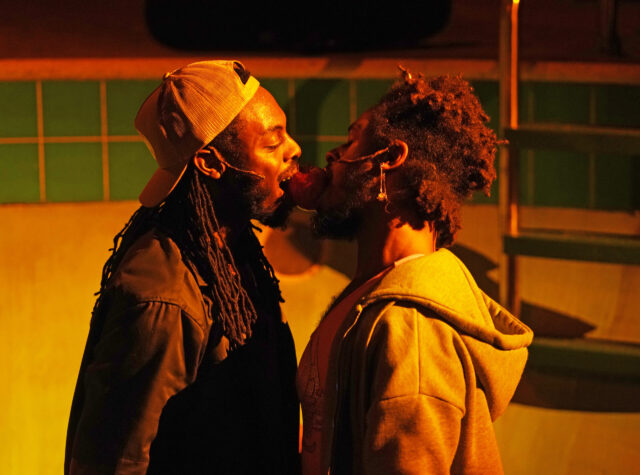
Quentavius (Oghenero Gbaje) and Kelly (Essence Lotus) share an apple and more in hot show at the Vineyard (photo by Carol Rosegg)

Kelly and Quentavius grow closer as they experiment with language and practice their ollies around the periphery of the pool and inside it; Quentavius gives Kelly a banana and Kelly eats it seductively, and later they share an apple that also brings them closer sexually while alluding to the Garden of Eden. They drink, snort Molly, drop acid, bite, slap, and choke each other, the danger growing, then exploding when Quentavius vomits out his personal demon, Lemon Pepper Wings (Felicia Curry), an apparent comic-con escapee with an adorably frightening giant head and cute outfit, described in the script as “a ghetto oreo femme demon clown . . . like the most enthusiastic black anime cosplay girl youve ever met. times 10.”

The arrival of Lemon Pepper Wings pumps up the volume, lifting it all to new levels. “lets get this bitch started,” LPW tells Quentavius, then asks the audience, “is yall ready for a mutha fuckin show?” LPW declares themself to be the burgeoning rap group’s manager, PR, DJ, opening act, and first groupie, igniting a fire in Kelly and Quentavius — and those watching from behind the fence.

The rap duo becomes more socially conscious, dropping heavier rhymes and finding their groove. “this song is especially great when ur insurance lapses and u cant go see ur therapist anymore / or u never had one in the first place,” Quentavius says as they work on the last track, continuing, “or when u realize psychology was a practice created by the government meant to tranquilize the masses and blanch any sense of emotional urgency from a once lively and passionate group of displaced peoples / iCarly qvc and tyler perry were created for this reason as well u might wanna google it anyways / its called word art slash soul extractor.”

Kelly and Quentavius — and the audience — start to question reality following a killer monolog delivered by LPW, a bold and beautiful evaluation of the state of the world and the future of the two rappers, delving into genius and pain, legacy and memory. It’s a glorious several minutes that alters Kelly and Quentavius’s perspective. “its just not the same,” Quentavius says.

The memorable set is by Adam Rigg and Anton Volovsek, with costumes by DeShon Elem, thumping sound by Ryan Gamblin, videos and projections by Zavier Taylor, and fight choreography and intimacy direction by Teniece Divya Johnson, so essential to the relationship between Kelly and Quentavius.

Written and directed by Nazareth Hassan (Security Theater, Slow Mania 009) and featuring music by Free Fool, Bowl EP — which really should be called Bowl LP — is an uneven but ultimately rewarding foray into love and performance, about facing one’s demons. Lotus (soft) and Gbaje (Blood Conscious) are terrific as the wannabe rappers, but Curry (Into the Woods, Until the Flood) runs away with the show as the wildly unpredictable and all-knowing Lemon Pepper Wings, a spectacularly delicious character that I hope we all don’t have lurking deep inside of us.

[Mark Rifkin is a Brooklyn-born, Manhattan-based writer and editor; you can follow him on Substack here.]