live performance

DO YOU BELIEVE IN MAGIC? OPEN OPENS AT WP THEATER

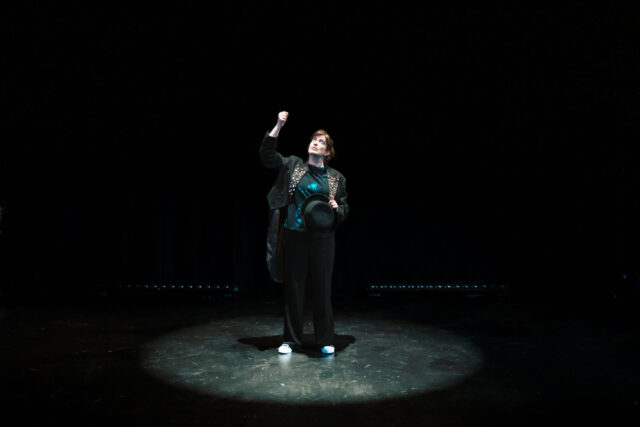
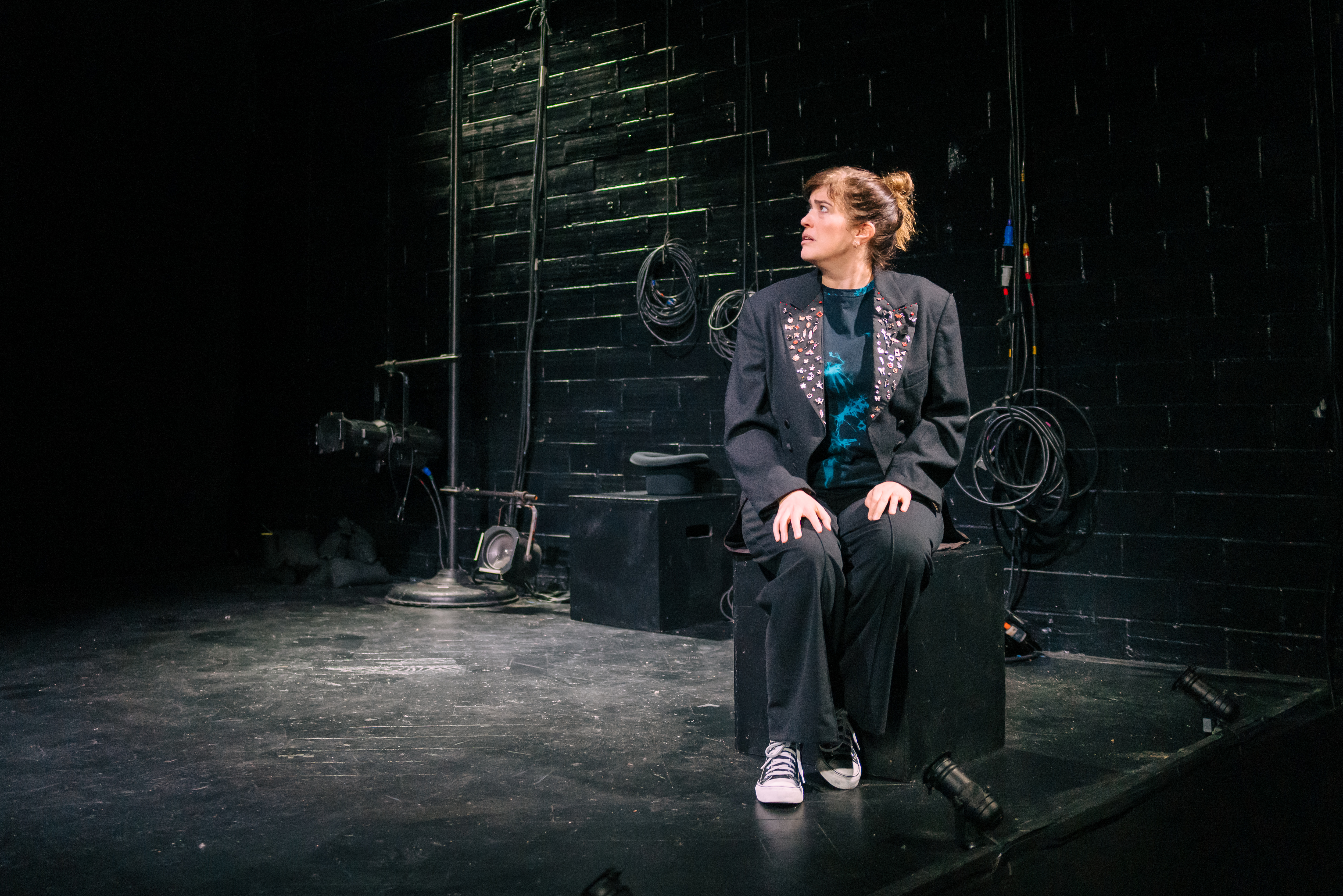
Megan Hill reprises her role as a magician in Crystal Skillman’s Open (photos by Jeremy Varner)

OPEN
WP Theater
2162 Broadway at 76th St.
Tuesday – Sunday through July 27, $65.79
wptheater.org

In the off-Broadway premiere of Crystal Skillman’s 2019 Open, Kristen (Megan Hill), a queer magician and writer, uses her talent as an amateur prestidigitator in telling her heart-wrenching story of true love, relating specific sleight-of-hand acts to events in her life, believing that she might be able to affect the outcome.

In The Year of Magical Thinking, Joan Didion’s memoir of personal tragedy that was adapted into a solo play, the National Book Award winner writes, “I was thinking as small children think, as if my thoughts or wishes had the power to reverse the narrative.”

Psychology Today defines magical thinking as “the need to believe that one’s hopes and desires can have an effect on how the world turns. . . . Spirits, ghosts, patterns, and signs seem to be everywhere, especially if you look for them. People tend to make connections between mystical thinking and real-life events, even when it’s not rational.”

The seventy-five-minute play is divided into three sections and a bonus: “First Love,” “Commitment,” “Sacrifice,” and “Promise.” It takes place on a spare black set designed and lit by Sarah Johnston. Kristen is already onstage as the audience enters, doing a small, slow dance, in her own world. Once everyone is seated, she addresses the audience directly: “I’m here. I’m here. I am here. Your magician,” she begins, as if trying to convince herself. “Here you are. An audience. A kind of audience. Thank you for joining me. It’s incredible. Imagining you here.”

Of course, she is here, and we are here, but Open is about, as Kristen declares, “the power of the imagination!” There are no props; Kristen mimics all the magic — pulling flowers out of a hat, shuffling a deck of cards, levitating, linking metal rings — with just her body, Johnston’s lighting (which casts dramatic shadows), and Emma Wilk’s sound effects, so we can hear the specific tricks if not actually see them happening in front of us. It’s all connected to her relationship with Jenny, a woman she meet-cutes at the Strand, then goes to Marie’s Crisis with on a date.

Kristen pantomimes handing an audience member an egg covered by a red scarf, and the person obliges; she shares the background of the scarf, which had been handed down from her grandmother to her mother to her, and then she gave it to Jenny. The tale delves into love, birth, and homophobia, ending with the squawks of a parrot flying away. The scene prepares us for what is to follow, memories initiated by imaginary magic tricks that drive a nonlinear narrative in which Kristen attempts to come to terms with a tragedy that she considers herself significantly responsible for.

Kristen has written a YA romantasy about two boys who use magic and fall in love. Jenny asks what the first line is, and Kristen tells her: “Magician! Are you a coward? Don’t you want to live?” Fear and apprehension are themes Skillman keeps returning to. For example, when Kristen mimes juggling, she says, “Secrets are the balls we keep in the air. Ours will come crashing down this evening.”

Everything Kristen does is for Jenny; she believes they were destined to be together. She explains, “Well . . . every person who has ever loved — has a magician! King Arthur had Merlin. Roy had Siegfried. Penn has Teller. Jenny has me. So we imagine.” But then she adds, “For I have to confess — this world and I . . . reality . . . we don’t really get along.”
But therein lies the problem with the play: reality and fantasy never quite mesh and too often seem forced. At one point Kristen cuts a rope in two, ties them in a knot, makes the knot disappear, then reveals to us that the rope is in one piece again; it is a too-obvious metaphor for what is happening between her and Jenny, especially when she next compares it to the boys in her novel, explaining, “They would make their own rules. They would take each other apart and put each other back together again. They were . . . safe.

Kristen works at Staples, a company whose motto is “Worklife Solutions for All. We Inspire What Could Be, and Help Make It a Reality,” while Jenny works at an LGBT Community Center, which declares, “They can try to diminish our flame. But our flame is so strong we only grow bigger and burn brighter.”

Aptly directed without flourish by Jessi D. Hill (Surely Goodness and Mercy, Vanishing Point), Open starts slowly and does build energy; Megan Hill (Eddie and Dave, Trade Practices), who originated the role — Skillman (Wild, Geek) wrote the part with her in mind — takes a while to hit her stride. Some vignettes work better than others, and the details of the plot occasionally get confusing. But certain parts hit hard and are deeply affecting; at one shocking moment, a woman sitting behind me let out the loudest, most heartbreaking gasp I have ever heard at a show.

Continuing at the WP Theater on the Upper West Side through July 27, Open also deals with the concepts associated with the title, from being open to new challenges, new loves, and new situations (including watching a show about a magician with no actual magic in it) to being emotionally open and honest with friends and relatives to standing in front of a door and wondering whether to open it to, perhaps most critically, opening one’s eyes to reality. Early on, Kristen tells us, “Magic isn’t denial. . . . When I say ‘abracadabra’ we will accomplish our task! To bring forth the reality of the imagination. Abracadabra, did you know? Means ‘as it is spoken.’ As I have been brought here, so have you.”

Too much of Open feels like it is based on magical thinking, if not ultimately to reverse the narrative or affect the outcome but to convince oneself how to face reality, even in the most dire of circumstances, more like a dramatized therapy session than a play imbued with the intoxicating spirit of magic and imagination.

[Mark Rifkin is a Brooklyn-born, Manhattan-based writer and editor; you can follow him on Substack here.]
LIVING IN A FISHBOWL: BERLINDIA! AT THE TANK

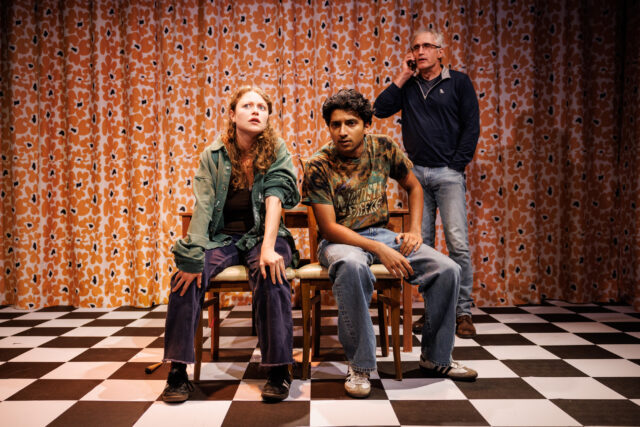
A family undergoes strange, unexpected changes in the unpredictable world of Berlindia! (photo by Maria Baranova)

BERLINDIA!
The Tank
312 West 36th St. between Eighth & Ninth Aves.
Thursday – Monday through July 27, $28-$53
thetanknyc.org

There was an infectious buzz at the Tank on July 7, opening night of the world premiere of Daniel Holzman’s surreal fantasia, Berlindia! It felt like we were all fortunate to have gotten past the velvet ropes and into a hot club, full of lively chatter and bodies moving about as if a techno dance party was about to break out, while overflow audience members sat on cushions up and down the aisle. And indeed, a kind of dance party did break out, for sixty exhilarating, hilarious, and playfully perplexing minutes.

“Do you think it’s cruel to own fish?” nose-picking eight-year-old Burger (Rosalie Neal) asks her mother (Rita Wolf). It’s more than just an innocent question but sets the stage for a wildly unpredictable show about busting out of expectations and challenging the status quo — and in this case, it’s the older generation leading the revolt.

Twenty years later, Mother has suddenly and unexpectedly taken off from their South San Francisco home for a mysterious new land called Berlindia! to immerse herself in the illegal Surf-Sun-Techno-BitchDrop-CoreCow-GrauStraßeM6-Percolan scene, which upsets Burger and her younger brother, Fuck (Arjun Biju), which he changed from the somewhat bulkier Jacob Morowitz Shpeigelman Needlework Groschheimer. “A name should be a symbol of individuality,” he says.

Meanwhile, their father (Pete Simpson) is in New York City to visit holocaust museums. “I love watching blonde women from the South cry,” he explains.

Burger and Fuck decide to track down their mother in Berlindia to find out what’s going on with her. On one of the flights, Burger is sitting behind her elementary school art teacher, Ms. M (Susannah Millonzi), who is also heavy into Surf-Sun-Techno-BitchDrop-CoreCow-GrauStraßeM6-Percolan. Ms. M tells Burger, “They say night and day don’t exist there. They say they don’t believe in it. They say they don’t believe in anything. They say everything there is cheap except water. They say they imported a piece of ozone from Antarctica to be the ceiling, which you can’t even see from the ground. They say the bouncer is half man half dog, like an Egyptian god. They say it’s two hundred degrees in a heating system no one knows the name of. They say there’s a room where you can see Chloë Sevigny fist an entire government. They say that once there was a void, and then there was a light, and then there were the plants and the oceans, and the insects, and then there was Berlindia, and then there was everything else.” That speech just about sums up the play.

Along the way, Burger and Fuck encounter a series of oddball characters, including Sexy Flight Attendant, Seven Foot Tall Swedish Woman, Asymmetrical Haircut Man, a Bouncer, Andre 3000, and a Blonde Woman from the South Named Dolly, and meet their mother’s twin brother, Uncle Mother (Mike Iveson), who is also living and thriving in Berlindia.

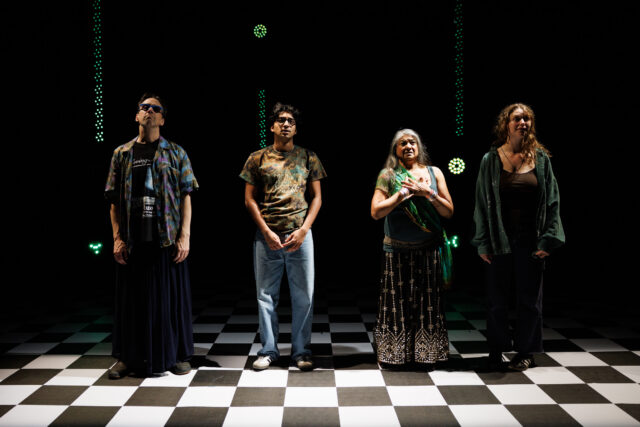
Berlindia! features an excellent ensemble cast at the Tank (photo by Maria Baranova)

On the surface, Berlindia! might seem like a fun but weird expanded episode of the SNL skit “Sprockets,” in which Mike Myers starred as Dieter, host of a West German talk show and dance party. But it’s much more than that; it’s about one’s identity, about what home means, about who our family is. We live in a world that is changing so fast that if you blink, you won’t know what you’ve missed, what has passed you by.

It’s also about different types of connection. Speaking in the third person, which happens often throughout the play, Burger says, “When Burger was ten years old Fuck bit her so hard that a piece of his consciousness was imbedded in her arm. Ever since then, they have been able to communicate telepathically on another plane of existence.” Dad does not resent his wife’s departure; he says to his kids, “I love your mom more than anything in the world. Why wouldn’t I want her to find some strange favorite thing? In some strange city. With some strange name.” Because cities and countries have been inexplicably moving around the globe, it takes six planes for Burger and Fuck to travel from South San Francisco to Berlindia, having to make a series of connections in order to see their mother.

At its heart, the show explores our connection with the past, with how our childhood led to becoming who we are as adults. At one point, Burger is muttering to herself; when Fuck asks what she’s doing, Burger responds, “I’m reassessing the past.” Later, when Burger is worried what will happen if and when they locate their mother, she says to her brother, “I’m scared we’ll find her. And she’ll be different. And it’ll ruin the entire past forever. Forever ever.” Fuck offers, “But what if it’s fun? What if she’s happy? What if it’s right? So don’t be scared. Or do. That’s fine. But don’t only be scared.” Burger also reassesses the past when she is with Ms. M, who is not quite how she remembers her; when they are about to land in Berlindia, Ms. M scoffs at Burger, “Good luck getting in, normie!”

The play is directed with controlled chaos by Noah Latty (Kinderkrankenhaus), where just about anything can happen in its own brand of anarchy, occasionally meandering a bit too much. Colleen Murray’s set morphs from a plain room with a kitchen table, chairs, a black-and-white tiled floor, and a flower curtain to a dark club with flashing, multicolored lights while the sound shifts from morning birds cooing to loud techno. (The lighting is by Marika Kent, with sound design by Chris Darbassie.) Sam DeBell’s costumes match the eccentric narrative. Even the script is a hoot, filled with adorable drawings of planes, soft cheese, chains, and a goldfish.

The ensemble cast looks like it could not be having more fun, featuring an endearing Neal (Holzman’s Adelia, or the Nose Play), a gentle Biju (White Bitches in Delhi), a sweet-natured Wolf (A Delicate Balance, Out of Time), a charming Simpson resembling Chevy Chase (Is This a Room, The Wind and the Rain), and a riotous Millonzi (The Crucible, New York Animals) in multiple roles.

“I started writing Berlindia! in 2019 as a tribute to my family and the way they always figure out how to be fine, no matter how absurd things get,” Holzman (Middle School Play) wrote last year. “Since then, the world has only gotten more and more absurd and we’ve faced more and more things that are so far from fine. But if anything, I think this is a play about the importance of true beautiful ambivalence. Two things can be true at once. The darker things get, the more important it is to hold on to that.”

When deciding whether to find their mother, Fuck tells Burger, “I have absolutely no way of knowing how to feel,” like he’s a fish trapped in a bowl.

As Berlindia! makes clear, it’s all fine in these changing times.

[Mark Rifkin is a Brooklyn-born, Manhattan-based writer and editor; you can follow him on Substack here.]
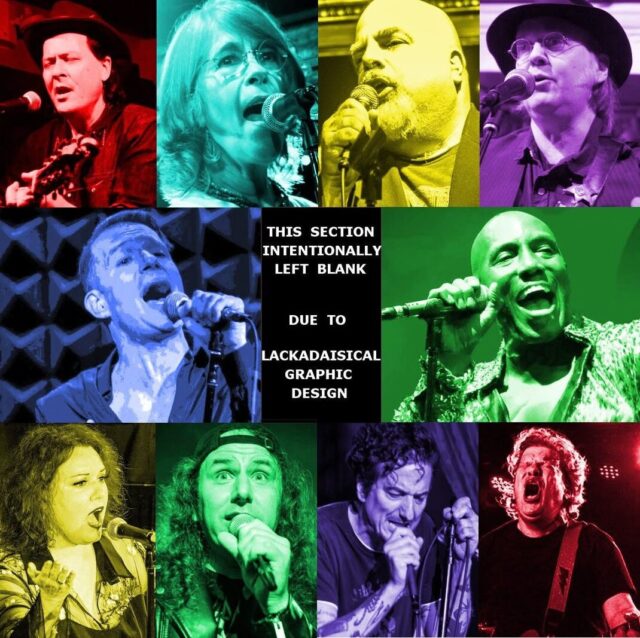
HITS AND MISSES: MIKE FORNATALE’S 1970 BIRTHDAY SHOW AT THE CUTTING ROOM

MURDERERS’ ROW PRESENTS MIKE FORNATALE’S 1970 SHOW
The Cutting Room
44 East 32nd St. between Madison & Fifth Aves.
Thursday, July 10, $27.83, 7:00
212-691-1900
thecuttingroomnyc.com

When he turned sixty-four in 2018, singer, guitarist, and producer Mike Fornatale put together a special show consisting of songs from 1964 — not just famous tracks but deep cuts and B-sides he dug. “I decided a few years ago that, starting with 1964 — the year I started loving music again after walking away from it, while still in kindergarten, during the Fabian/Avalon/Rydell era (something I still haven’t forgiven Philadelphia for) — I was going to assemble a group of stalwart musicians and singers every year and do a show consisting of great songs from the corresponding year,” he said in 2024. “We had a blast with 1964, ’65, ’66, ’67, and ’68. I’m going to do this every year for as long as I can still stand up. Hey! I can still stand up!”

On July 10, Fornatale, who has performed with the Left Banke, the Monks, Moby Grape, the Washington Squares, and Losers’ Lounge, will be at the Cutting Room to celebrate his seventy-first birthday by playing songs from 1970 — they are one year off because of Covid. Among the stalwart musicians and singers joining him, a revolving group he calls Murderers’ Row, are Lauren Agnelli, Russ Alderson, Emilie Bienne, Rembert Block, Tom Clark, Tommy DeVito, Lizzie Edwards, Pam Fleming, Dave Foster, Jeff Hudgins, J. J. Jordan, Stephanie Marie, David Milone, Charly Roth, Tom Shad, Carlton J. Smith, Erica Smith, Peter Stuart Kohman, Tommy Von Voigt, Jahn Xavier, Tony “Z” Zajkowsky, and Jim Allen. Fornatale compiles the setlist and decides who will play what; don’t necessarily expect to hear the biggest songs of the year, like “Bridge Over Troubled Water,” “(They Long to Be) Close to You,” and “American Woman,” but then again, who knows?

Murderers’ Row veteran Jim Allen of the Lazy Lions and the Ramblin’ Kind told twi-ny, “It’s always a blast and an honor to be among such a powerful assemblage of players and singers, reveling in the great anthems and obscurities of the past.”

Fornatale is packing so much in that he will be hosting the second half later this fall. But as he promises, “Hits! Misses! Things you’ve never heard before! And just some other stuff that I really like! How many songs? TONS OF ’EM!! Don’t worry! You’ll be sitting down!”

He also doesn’t refer to these shows as a series; he prefers crusade.

“We’re going to do it every year. I hope I can make it at least as far as, oh, I don’t know, eighty-six? Eighty-seven?” he recently posted on Instagram. “I want to make DeVito play the tympani on ‘Life in a Northern Town.’”

[Mark Rifkin is a Brooklyn-born, Manhattan-based writer and editor; you can follow him on Substack here.]
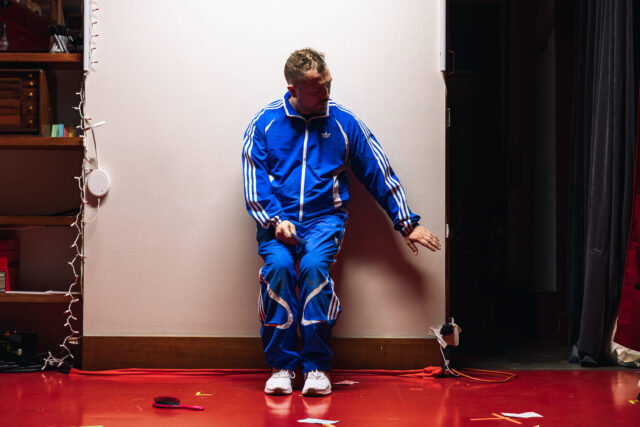
SOMETHING NEW: CARL HOLDER’S OUT OF ORDER IN EAST VILLAGE BASEMENT

Carl Holder shares his hopes and dreams, his successes and failures in Out of Order (photo by Rebecca J Michelson)

OUT OF ORDER
East Village Basement
321 East Ninth St. between First & Second Aves.
Thursday – Tuesday through July 30, $30-$60
www.outofordertheshow.com
www.carlholder.com

“When was the last time you felt something new?” Carl Holder asks in the New York City premiere of his solo participatory Out of Order, which opened tonight for a three-week run at the appropriately named East Village Basement on Ninth St.

I now have the answer: Holder’s frantic and frenetic show.

Despite penning plays for twenty years and winning several awards and grants, upon turning forty the Gainesville-born, Brooklyn-based Holder found himself with a bad case of writer’s block. Worried he had reached the end of the road, he came up with Out of Order, a one-man production that challenges him to perform prompts from three dozen index cards, tossed into a bowl in random order, many involving audience participation. The only element that is the same for each presentation is the first card, which falls from a box on the ceiling and is read by an audience member, laying out the ground rules, including the following: “Everything you are about to see is real. If Carl doesn’t complete every task tonight, he will quit theater forever.” He’s not kidding.

The evening actually begins with the audience gathering downstairs, filling small bags of free popcorn from a cart in the center of the room and purchasing beer, wine, or seltzer from the bar in the far corner, operated by Simon Henriques, who will soon serve as “referee,” running the sound and lighting, strumming a ukulele, and keeping track of the time.

Audience members are encouraged to take and post their own photos at one point of unique solo show at East Village Basement (photo by Rebecca J Michelson)

Wearing a blue track suit and off-white sneakers, Holder races around the room, selecting a card from a big glass bowl in the middle, reading it out loud, and then acting it out, sometimes using a whiteboard, a lone chair, and/or an audience member. On the floor are such words and phrases as “You,” “Me,” “RIP,” and “Climax.” For “Three questions,” he says “How long do I have to wait?” three very different ways, each with its own meaning. For “Show your bank statement,” he does exactly that, projecting his bank statement on a wall and going over it in detail, talking about how much he has in his account, what he has spent money on, and how he might not be able to make his next rent payment by the due date. For “Teach them how to write a play,” he outlines on the board the five key ingredients of a play: Exposition, Inciting Incident, Rising Action, Climax, and Falling Action or Denouement. There are also separate cards for each element, allowing him to give a mini-theater class. Among the other prompts are “How much do you like being in control?,” “Can this be enough?,” and “Be brave.” While not every prompt works, the vast majority do.

There are several cards that relate the complex story of Ass, Chicken, and Peacock on Farmer Farmer’s Farm, involving ego, corporatization, self-awareness, drinking, and dancing; as with “Teach them how to write a play,” the order in which they’re told impacts the narrative, particularly when it comes to how a carrot is used, not just as food, but as creative incentive. For “Try again,” Holder explains, “This whole thing really started because I couldn’t write a play. And I guess I still can’t. But I found I could write down the things I couldn’t stop thinking to myself, the thoughts that were getting in the way of a play. Card by card. And somehow, more than anything I’ve tried to make for the last twenty years, doing this actually feels like being an animal.”

The night I went, the first prompt was about the bank statement, so that led to a focus that might change if, for example, “Mortality” or “Open this later” was selected instead. Thus, we knew from the start what serious financial shape Holder is currently in and how important this play is to his daily existence. It also makes us think about our own fiscal solvency, although so many of the prompts make us look at our unique personal situations.

I was chosen for one of the final cards, “Review the possibilities,” in which I read sixteen statements about how Holder’s life might go, and he decided which might happen and which should be tossed in the trash as a pipe dream. As I announced what was written on each card, I thought about how it related to my own life, and I imagine that must have been the case with just about everyone in the audience. Who hasn’t considered such possibilities as “I will have the money I need to live comfortably” or “I will mend ties with my family”?

Audience interaction is central to Carl Holder’s Out of Order (photo by twi-ny/mdr)

And therein lies why Out of Order, previously staged in living rooms, a theater lobby, a public park, and a bird sanctuary and designed by Adam Wyron and Obie-winning director Skylar Fox, is such a success, whether Holder realizes or not. At each performance, forty or so strangers are brought together in a small room, partake of food and drink, and interact with Holder and other audience members for ninety nearly breathless minutes as Holder shares his hopes and dreams with us, almost painfully realistically, and we do the same with him (if we so desire).

He is eminently likable; we immediately want him to do well. And he is very funny and quick on his feet, with sharp improvisatory skills. I was sitting at the far end of my row and had put my popcorn, wineglass, and phone on the shelf next to me. When Holder ran over there to act out a card, he first took my bag of popcorn and started casually eating from it. It’s important to note that he does not force anyone to do anything, but as one of the prompts announces, “Content warning: audience participation.”

For “The forgotten intro,” Holder even sings, summing up life in a few stanzas: “We are all born once and then we die / along the way we try some things / some are good some are bad some are great / most are forgettable . . . / but every so often a moment comes along / that’s a little bit different than all of the other moments / . . . you get to have this one special moment / and the other special moments where you’re not dead yet / and sometimes people gather around and they want to wish you well / and tell you something special, something very special / and this is one of those moments and that something very special is . . .”

I’m not about to give away what that something very special is here, since, in the show, just like in life, that’s for you to discover. But we should all be thankful that Holder has shared his special moments with us.

[Mark Rifkin is a Brooklyn-born, Manhattan-based writer and editor; you can follow him on Substack here.]

THE GREAT DEBATE: FEMINISM ON TRIAL AT MCC

Emmanuelle Mattana wrote and stars in Trophy Boys at MCC (photo by Valerie Terranova)

TROPHY BOYS
Susan & Ronald Frankel Theater
Robert W. Wilson MCC Theater Space
511 West Fifty-Second St. between Tenth & Eleventh Aves.
Through August 3, $64-$114
mcctheater.org

The Breakfast Club meets John Proctor Is the Villain in the US premiere of Emmanuelle Mattana’s Trophy Boys at MCC.

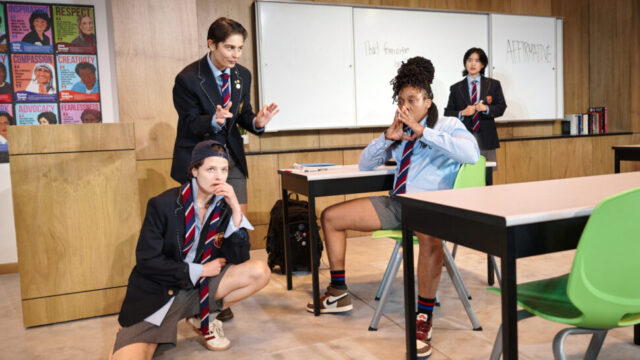
The seventy-minute play takes place in approximate real time as four men from the private boys school Imperium are prepping for a debate against their sister private school, St. Gratia. Owen (Mattana) is a wonk who sees a clear path for himself to become president of the United States. Jared (Louisa Jacobson) is an artist who loves women, and repeatedly reminds everyone of that. Scott (Esco Jouléy) is an athlete who randomly shows off his physical prowess. And David (Terry Hu), the quietest of the team, is determined to become a powerful businessman.

All four roles are portrayed by actors who identify as either female, gender nonconforming, or nonbinary, adding a complicated layer to the argument the high school seniors are given for the debate: “Feminism has failed women — affirmative.”

The humanities classroom is filled with posters depicting famous women, some with one-word descriptions, among them Oprah Winfrey, Amelia Earhart, Ruth Bader Ginsburg, Frida Kahlo, Yoko Ono, Gloria Steinem, Michelle Obama (Empathy), Mother Teresa (Compassion), Katherine Johnson (Hard Work), and Harriet Tubman (Fearlessness). “I am at my most inspired when surrounded by inspiring women,” David says, then calls out excitedly, “Malala!!!” upon seeing a framed picture of Pakistani activist Malala Yousafzai.

The cocky boys, who have had an undefeated season thus far, have one hour to assemble their argument, with Owen putting himself in charge, telling the others, “Trust me. When have I let you down? International politics round you relied on me to know all about the complexities of Pyongyang’s internal power struggle. Technology round I knew all about the ethics of AI in sex dolls. Sports round I knew all the football players with charges of assault. And I don’t even like sports. It’s the same here. I’m on an academic scholarship. I’m smart. Trust me.”

As they proceed, Scott worries about their being accused of mansplaining. Jared doesn’t want to get canceled for accidentally saying something that might be offensive and upset his girlfriend. David complains that he is screwed up because his mother spent more time on the board of eight multinational corporations rather than breast-feeding him. And Owen is not about to let anything get in the way of his political career.

They discuss intersectionalism, pole dancing, the male gaze, the correct word for a woman’s nether region, periods, boobs, women CEOs, the divine feminism, and tradwives, taking potshots at each other’s manhood as if they were in a locker room, complete with a dose of homophobia. Taking notes on the whiteboard, Owen doesn’t realize when he has drawn both a penis and a vagina/vulva.

But when the boys discover that one of them has been accused of sexual assault by a St. Gratia debater, their attitudes about power, gender, and feminism itself begin to morph as they turn on one another, unwilling to jeopardize their futures even as they insist that all women should be believed.

Jared (Louisa Jacobson), Owen (Emmanuelle Mattana), Scott (Esco Jouléy), and David (Terry Hu) have their work cut out for them as final debate nears (photo by Valerie Terranova)

Mattana, who wrote the play when she was twenty-one, quit competitive high school debating “to become an artist and hang out with other queer weirdos who helped me imagine a braver, more radical future.” In the program, she points out, “The very nature of the endeavour — turning argument into sport while believing yourself the smartest in any room — required you fervently argue things you didn’t know enough about or even necessarily believe. Logic was a game, something to be won or lost, and words and arguments were things you could twist at your own whim. If you were articulate and commanding enough you could speak over anyone, or for anyone. It was no wonder this ethos seeped so dangerously into other parts of these boys’ lives. . . . Gender is learnt, which means it is also taught. No more so than to those young men I knew from debate. With this brand of masculinity inhabited onstage by non-cis male bodies, my hope is that it can be revealed for what it truly is — a comical, absurd, and ultimately disturbing performance.”

Trophy Boys is all those things and more. The play is skillfully directed by Danya Taymor, who won a Tony for The Outsiders and was nominated for John Proctor Is the Villain, both of which also deal with toxic masculinity and gender; she and movement director Tilly Evans-Krueger employ full use of Matt Saunders’s realistic set, adroitly lit by Cha See. But Mattana, in their playwriting debut — they have previously appeared in such television series as Mustangs FC and Videoland and cowrote and starred in the feature film Fwends — isn’t about to make anything easy for the audience, providing no simple answers while avoiding genre clichés. In one of the most potent scenes, the four actors strip out of Márion Talán de la Rosa’s school uniform costumes down to their skivvies, a revealing moment that posits that body type does not define gender.

There is plenty of mansplaining, which gets complicated since it’s being delivered by non-cis-male performers, building in an inherent humor and ridiculousness. “Our case has to be more feminist than the pro-feminist side. We believe feminism has failed women from the perspective that we are actually more feminist than the feminists,” Owen declares. David offers, “It’s because they hate us. They hate men. That’s why feminism has really failed. It’s not interested in helping women, it’s interested in denigrating men.” Scott says, “Everyone’s confused about whether Emily Ratajkowski showing her ass on Instagram is feminist or not,” to which Jared, who, as a reminder, really loves women, replies, “Fuck, she’s hot.”

Hu (Never Have I Ever), Jacobson (Lunch Bunch), Jouléy (Merry Me, Wolf Play), and Mattana form a tight-knit, believable quartet of students in a classroom, a setting used for such other recent hard-hitting plays as Donja R. Love’s soft, Sanaz Toossi’s Pulitzer Prize—winning English, and Dave Harris’s Exception to the Rule. They are like a sports team getting ready for the big game, each with their own responsibility, to themselves as well as their team.

Occasionally, the characters, particularly Owen, recognize that the audience is present, making direct gestures at us, but I found those instances perplexing, not sure whether we were supposed to be the crowd watching the eventual debate or the MCC audience, and they seemed to be unnecessary breaks in the fourth wall.

Otherwise, Trophy Boys is a rousing and inventive twenty-first-century battle of the sexes — which is, I imagine, an out-of-date phrase, but please don’t cancel me — that will have you gasping, laughing, and whooping it up, but possibly not always in unison with the rest of the audience.

[Mark Rifkin is a Brooklyn-born, Manhattan-based writer and editor; you can follow him on Substack here.]

WHAT IS THIS? MOZART’S DON GIOVANNI — A ROCK OPERA AT THE CUTTING ROOM

Mozart’s Don Giovanni — A Rock Opera offers a new take on a classic (photo by Ken Howard)

MOZART’S DON GIOVANNI — A ROCK OPERA
The Cutting Room
44 East 32nd St. between Madison & Fifth Aves.
Through July 7, $39-$125, $25 food & beverage minimum per person, 7:00
212-691-1900
thecuttingroomnyc.com
www.dgrocks.com

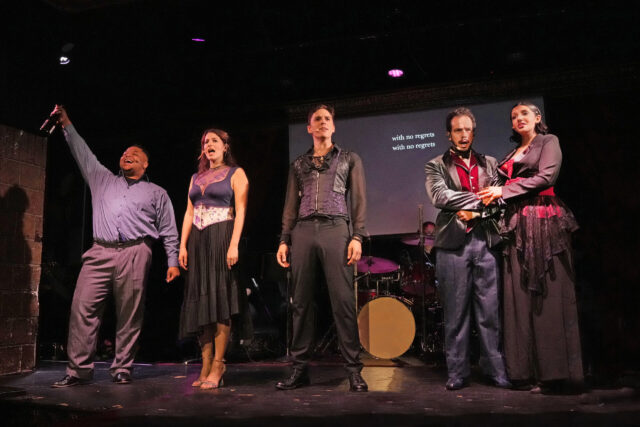
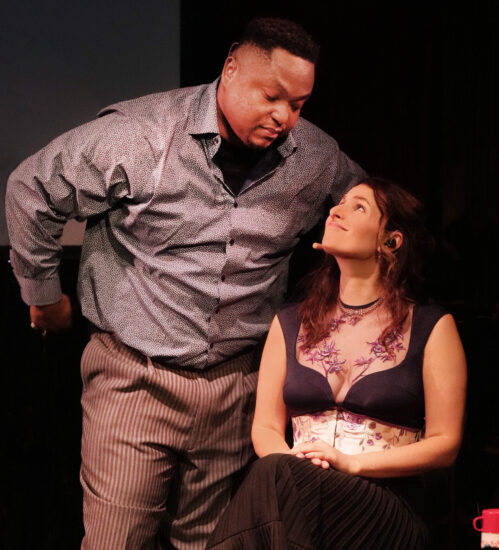
Rachel Zatcoff is superb as Donna Elvira in Adam B. Levowitz’s rock opera adaptation of Mozart’s Don Giovanni at the Cutting Room; if only the rest of the production lived up to her excellence. Mozart’s 1787 tale, with a libretto by Lorenzo DaPonte, is returning to the Met this fall, a two-hundred-minute extravaganza directed by Ivo van Hove and conducted by Yannick Nézet-Séguin and Daniele Rustioni; producer, director, and orchestrator Levowitz’s English-language version has been streamlined to about two hours, primarily by eliminating the subplot involving Zerlina and Mesetto.

The crux of the central story is still intact. After bedding Donna Anna (Anchal Dhir), the dashing Don Giovanni (Ryan Silverman) is challenged to a duel by her father, the Commander (Edwin Jhamaal Davis). Giovanni implores the older man to walk away, but his pride gets the best of him, and Giovanni kills him. Anna then insists that her fiancé, the weak-kneed Don Ottavio (Felipe Bombonato), defend her honor and kill Giovanni, which is not really in his wheelhouse.

Meanwhile, a former lover of Giovanni’s, Elvira, has been searching for “the bastard who left me,” prepared to “take a bow knife and slice his heart from his chest . . . for the maidens he deflowered.” Giovanni and his right-hand man, the clownish Leporello (Richard Coleman), keeper of The Almanac of Fornication, come upon a woman they do not recognize at first, and Giovanni turns to woo her until he sees that it is indeed Elvira, who tells him she wants to castrate him. He runs away.

Levowitz’s plot grows more and more silly as Anna and Ottavio seek revenge, Giovanni keeps trying to increase the number of women he has seduced, Elvira has to decide whether she actually loves or hates Giovanni, and Leporello serves Giovanni through thick and thin, providing comic relief that is mostly thin.

Leporello (Richard Coleman) and Donna Elvira (Rachel Zatcoff) know something is afoot in rock opera (photo by Ken Howard)

Mozart’s Don Giovanni — A Rock Opera is misguided from the start. The conceit is that we are gathered at the Cutting Room at the invitation of Baroness Margarete Voigt on December 5, 1891, the centennial of Mozart’s death at the age of thirty-five. We are told in a letter that we are in for “an evening of elegance, fine food and drink (for a modest indulgence), sensuality, and sublime music,” which sets the bar far too high for what ensues.

For two hours, Leporello makes anachronistic, self-referential jokes that fall flat, like “I won’t block your Dopamine / No, no, no, no, no, no / Cue Giovanni and scene” and “Not my circus, not my monkeys / I’m just here for vegan snacks.” The eight-piece band, consisting of two guitars, two trumpets, three trombones, bass, drums, and piano, often feels out of sync; songs work best when it’s just pianist and conductor Nevada Lozano accompanying the singer. There were significant problems with the surtitles projected onto the back screen, as they got stuck or just vanished; in addition, there were numerous typos (rogue/rouge, savoir/savior), and what was being sung was not always exactly what was on the screen. While the sentences still meant the same thing, the slight differences were distracting. Projections that were supposed to identify locations got lost on the carved facade above the stage. The acting was a mixed bag, ranging from excellent to, well, not so excellent. There were also issues with the microphones, which were so close to the performers’ mouths that the sound squealed through the speakers; only the classically trained soprano Zatcoff (The Phantom of the Opera, Candide) kept her mic at a distance, letting her lovely voice sound more naturally through the space. Debbi Hobson’s costumes make it look like the characters are not always in the same time period.

I’m all for reimagining the classics in any way possible, but this Don Giovanni had me aching for something more traditional.

Early on, Anna asks, “My God, What Is This?” After seeing the show, I have the same question.

[Mark Rifkin is a Brooklyn-born, Manhattan-based writer and editor; you can follow him on Substack here.]
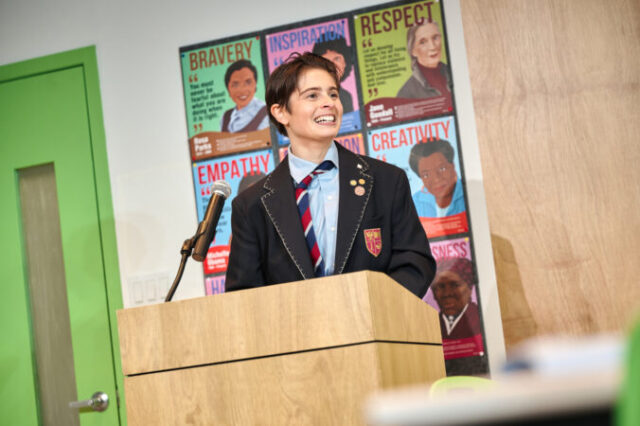
ENCORE ENGAGEMENT: THE MAN WHO SHOT LIBERTY VALANCE

Onomatopoeia’s The Man Who Shot Liberty Valance is back for an encore engagement at the Gene Frankel Theatre (photo by Joshua Eichenbaum)

THE MAN WHO SHOT LIBERTY VALANCE
Gene Frankel Theatre
24 Bond St. at Lafayette St.
Wednesday – Sunday through July 27, $25-$35
www.genefrankeltheatre.com
www.theonomatopoeiatheatrecompany.com

In 2022, the Onomatopoeia Theatre Company presented the New York premiere of Jethro Compton’s The Man Who Shot Liberty Valance. It is now back for a return engagement, through July 27 at the Gene Frankel Theatre. Below is my original review; cast changes include Mari Blake as Hallie Jackson, Dillon Collins as Jake Dowitt, and Ben-David Carlson and Emily Cummings in multiple roles. In addition, no blank guns will be used, only nonfiring replica prop guns and sound effects.

“The hairs on your arm will stand up / At the terror in each sip and in each sup / Will you partake of that last offered cup / Or disappear into the potter’s ground? / When the man comes around,” Johnny Cash warned on the title track of his 2002 American IV album. The song is one of many by the Man in Black that echo in the Gene Frankel Theatre before the start and during intermission of Onomatopoeia Theatre Company’s stirring New York premiere of Jethro Compton’s The Man Who Shot Liberty Valance. In this case, the man coming around is Liberty Valance.

British playwright Compton’s 2014 play is based on the 1953 short story by Dorothy M. Johnson; the twenty-two-page tale was turned into a popular 1962 John Ford film packed with an all-star cast — John Wayne, James Stewart, Vera Miles, Lee Marvin, Edmond O’Brien, Andy Devine, John Carradine, Jeanette Nolan, Woody Strode, Denver Pyle, Strother Martin, Lee Van Cleef — but Compton’s adaptation brings the play into the twenty-first century, twisting many of the movie’s genre clichés inside out as he takes on social and racial injustice while toning down the movie’s political rhetoric, general Hollywood misogyny, and freedom of the press blather.

The two-and-a-half-hour show begins in 1910, as Sen. Ransome Foster (Leighton Samuels) and his wife, Hallie (Stephanie Craven), arrive in Twotrees for the funeral of Bert Barricune (Samuel Shurtleff), who seems to have been an insignificant forgotten man in an insignificant one-horse town. Young reporter Jake Dowitt (Jeff Brackett) wants an exclusive with the senator, leading to a flashback to 1890, when a severely injured Foster is brought into the Prairie Belle Saloon by Barricune. After he is tended to by Jackson and Jim “the Reverend” Mosten (Daniel Kornegay), who works for her, he explains that he was beaten by three men who turn out to be the villainous murderer Liberty Valance (Derek Jack Chariton) and his henchmen.

Foster is a peaceful man from New York, a law scholar traveling not with a gun but with legal texts, Shakespeare sonnets, Greek tragedies, and a Bible. When Marshal Johnson (Scott Zimmerman) refuses to arrest Valance, Foster considers going up against the feared gunslinger himself. “I am no law man, sir,” Foster admits. The marshal responds, “Seems from what I’ve heard you ain’t much good at defending yourself, let alone a town.”

Soon Foster is teaching some residents of Twotrees to read, which angers others, especially since Jackson is a woman and Mosten is the only Black man around; book learning is not for the likes of them. Much of the strength of the play comes from the power Compton invests in the two characters; in the short story and movie, Jackson is a restaurant employee, while Mosten is Barricune’s loyal helper and doesn’t even appear in Johnson’s tale. In the play, Jackson speaks her mind with a razor sharpness, while Mosten is a well-respected man who has the ability to memorize whatever anyone says or reads to him.

Barricune is not happy when he sees Foster and Jackson spending a lot of time together; Bert believes he is destined to marry her. “She’s always been my girl,” Barricune says. “Does she know that?” Foster replies.

After Valance and his two sycophants commit a horrific act, Foster is more intent than ever to face him down and let the chips fall where they may.

Ransome Foster (Leighton Samuels) and Liberty Valance (Derek Jack Chariton) are headed to a final showdown in Onomatopoeia production (photo by Joshua Eichenbaum)

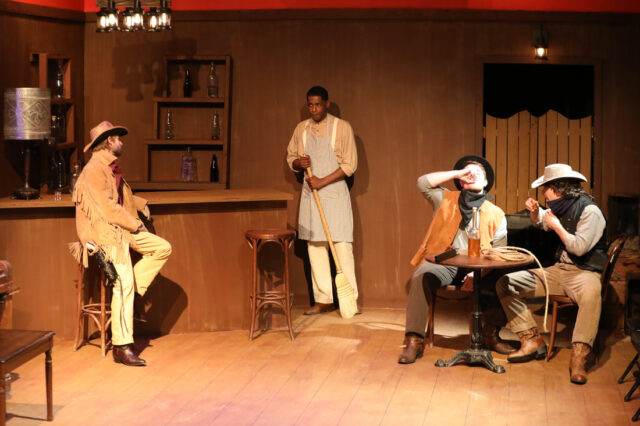
The Man Who Shot Liberty Valance takes place primarily on Nino Amari’s intimate set, a small Western saloon with a bar in the far corner, one table, two windows on either side of a piano, and swinging wooden doors in the back (which audience members must walk through to use the restrooms, but not during the performance). Most of the action occurs at the angled bar, including two sizzling scenes with Valance, the first between him and Mosten, the second him and Foster. Neither scene is in the short story or film, so the suspense is ratcheted up.

In his New York stage debut, Charlton is a magnetic force, his every word and move electrifying. He knows exactly who Valance is and what he wants, a villain who has no veneration for the law or for Blacks. When Foster raises the possibility of his defeating him in a showdown, the cocky Valance says, “Unless the hand of God comes down and strikes me dead there ain’t much chance of that.” Foster, knowing he doesn’t really have a shot, responds, “Or the earth opens up and the Devil takes you under.” Valance retorts, “No. We have an agreement, me and him.” When those words are spoken by Charlton, you don’t doubt it.

The rest of the cast holds up its end of the bargain; Samuels and Craven have a sweet chemistry, Shurtleff portrays Barricune with an inner loneliness, and Zimmerman’s marshal is neither coward nor buffoon. (Assistant director Chandler Robyn ably portrays numerous small roles.)

The play is expertly helmed by Onomatopoeia artistic director Thomas R. Gordon, maintaining a thrilling tension throughout. Susan Yanofsky’s period costumes are effective, while Reid Sullivan’s lighting hints at a danger always lurking, although the changing colors in the two windows are sometimes confusing. The narration occasionally gets in the way of the plot, explaining what we already know or making a point that is better left for the audience to decide for themselves.

Compton has also adapted F. Scott Fitzgerald’s The Curious Case of Benjamin Button into a Celtic musical and Jack London’s White Fang into Wolf’s Blood; his Frontier Trilogy is set in the American West in the mid-nineteenth century, while The Bunker Trilogy delves into Arthurian legend, classical Greek tragedy, and Shakespearean drama. In Liberty Valance he has created a stage Western for our times, cleverly referencing the conflicts of contemporary America, as red states battle blue states over jobs, immigration, and education; rights for women, people of color, and LGBTQIA+ are in serious jeopardy; gun control is being hotly debated; and liberal urban elites and the conservative south and Midwest seem immersed in an endless duel. The arguments the citizens of Twotrees are having are not unlike what we see every day on social media and partisan news outlets.

In the play, Foster teaches his class Shakespeare’s seventy-first sonnet, which reads in part: “No longer mourn for me when I am dead / Than you shall hear the surly sullen bell / Give warning to the world that I am fled / From this vile world with vilest worms to dwell.” Johnny Cash couldn’t have said it any better.

[Mark Rifkin is a Brooklyn-born, Manhattan-based writer and editor; you can follow him on Substack here.]