live performance

FACING ONE’S FEARS: LORD NIL AND THE SEVEN DEADLY SINS

Italian escapologist Lord Nil faces seven of his fears at Stage 42

LORD NIL: SEVEN DEADLY SINS
Stage 42
422 West 42nd St. at Ninth Ave.
Thursday – Tuesday through August 31, $48-$154
www.lordnil.com
shubert.nyc

In the 1966–68 Batman television series, the first of each two-part episode ended with a cliffhanger in which the Caped Crusader and the Boy Wonder were ensnared in a bizarre deathtrap devised by such ruthless cartoon villains as the Joker, the Riddler, Mr. Freeze, the Penguin, and King Tut; Batman and Robin would survive each time with ingenuity and Batman’s utility belt.

Lord Nil: 7 Deadly Sins is set up much like Batman, as a villain, Vice (Steph Payne), challenges illusionist and escapologist Lord Nil to conquer seven death-defying scenarios to preserve his life. However, unlike Batman, Lord Nil’s show appears to be neither camp nor parody but instead more resembles a midbudget magic show in a late-night Atlantic City casino lounge, filtered through a heavy metal video. Which doesn’t necessarily mean it does not have its entertaining moments.

Lord Nil kicks off things by explaining in a filmed voiceover that following a water-tank trick twelve years ago that went awry, landing him in a hospital and suffering from PTSD, “That was the day I became Lord Nil. The first of the forgotten. The Lord of nothing. Just a man who turned pain into strength. Why? To chase an insane dream. I face fear, night after night, because if I can face it, maybe you will too.”

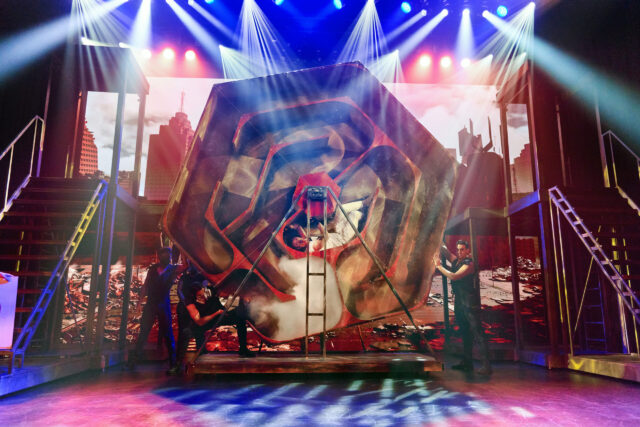
Born in Italy as Simone — his full real name is unknown, and he has done a thorough job of keeping his previous life a secret — Lord Nil made the quarterfinals of the thirteenth season of America’s Got Talent and is now displaying his skills at Stage 42 through August 31. For seventy-five minutes, he battles the four elements — earth, water, fire, and air — via execution machines involving an ax, a circular saw, sizzling bacon, an enclosed maze filled with smoke, a crossbow, and a descending spiked ceiling. Each stunt is linked to one of the seven deadly sins — pride, envy, gluttony, greed, lust, sloth, and wrath — but don’t try too hard to figure out the connection, because most of them are a bit of a stretch.

“Do I scare you? Don’t you recognize me?” Vice purrs at the crowd. “I’m the villain from all your childhood fairy tales, the monster from your nightmares: Call me whatever you wish. Tonight, I am the mirror that reflects all of Lord Nil’s fears back at him.” In between the daring feats, the Lost Souls, consisting of Reba Bartram, Michele Castelli, Christian Hariga, Alina Radu, Derrion Swan, Khy-Felipe Pasamonte Vitug, Kortney Warren, Erika Zilli, Kris Ivy Haynes, and Chance Hoover, slink and slither across the stage, dancing to loud music featuring the Lord of Evil (composer Erik Ventrice) shredding away on electric guitar.

Most of the magic is mediocre, the contraptions can be confusing, and Lord Nil’s celebrations are right out of professional wrestling. There’s not a whole lot of suspense, as evidenced by the less-than-enthusiastic applause after each deed and no unanimous standing ovation at the curtain call. The audience is encouraged to take photos and video; one audience member is chosen to participate in the final caper, which adds a bit of fun to an otherwise silly trick that even Batman might sniff at.
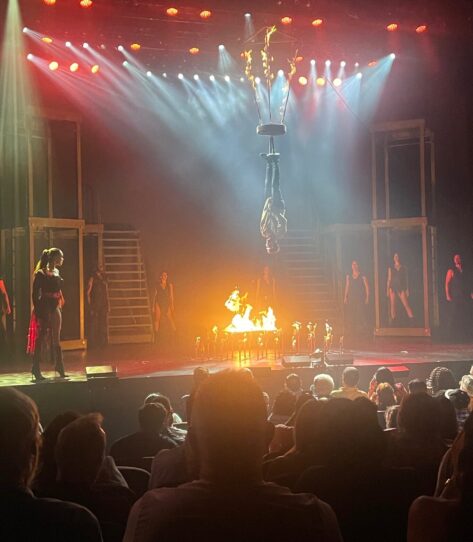
Lord Nil battles the wrath of fire in finale as Vice (Steph Payne) and the Lost Souls watch closely (photo by twi-ny/mdr)

Directed by Alberto Oliva, the dark, splashy production is bumpy and uneven, enlivened with sexy choreography by Stefano Alessandrino, goth costumes by Guiseppe Magistro, flashy lighting by Tudor Micu for the Light Guy and Jamie Roderick, piercing sound by Drew Levy and Kevin Sweetser, and faux-demonic animation and projections by Dan Mitrea for Digital Maverick. Lord Nil himself is a somewhat opaque figure, and there is little chemistry between him and Payne.

You might not call out, “Holy Houdini!” as Robin did at the beginning of the second season of Batman, in the “Shoot a Crooked Arrow” episode, but Lord Nil’s production would not feel out of place on the great vaudeville stages of yore that hosted Houdini and pleased the crowds who could suspend disbelief — and perhaps their better judgment — to enjoy some thrills and chills on a hot summer night.

[Mark Rifkin is a Brooklyn-born, Manhattan-based writer and editor; you can follow him on Substack here.]

HARLEM PRESENTS: OPERA EBONY IN MARCUS GARVEY PARK

Who: Opera Ebony
What: The Harlem Opera Festival
Where: Richard Rodgers Amphitheater, Marcus Garvey Park, Fifth Ave. at 124th St.
When: Saturday, July 26, free (advance RSVP recommended), 7:00
Why: Now in its fifty-first season, the nonprofit Opera Ebony is the longest continually operated Black opera company in the world. Founded in 1973 by bass baritone Benjamin Matthews with mezzo-soprano Sis. Elise Sisson (SBS), music director Wayne Sanders, and conductor Margaret Harris, the troupe has staged works around the globe, from Carmen, Aida, and La Traviata to Porgy & Bess, Faust, and Cosi Fan Tutte in addition to such original pieces as Frederick Douglass, Sojourner Truth, The Meetin’, and O’Freedom.

As part of Harlem Presents, Opera Ebony is holding a pair of concerts prior to the Classical Theatre of Harlem’s production of Will Power and Carl Cofield’s Memnon at the Richard Rodgers Amphitheater in Marcus Garvey Park. The forty-five-minute concerts start at 7:00, the play at 8:30; arriving early to see the music has the added benefit of garnering you an excellent seat for Memnon, as the amphitheater fills up pretty quickly.

On July 19, baritone Shavon Lloyd sang “Silvio’s Aria” from Pagliacci, the spiritual “Ride on King Jesus,” H. Leslie Adams’s “Prayer,” and “Make Them Hear You” from Ragtime, while mezzo soprano Daveda Browne performed “Seguidilla” from Carmen, “Mon Coeur” from Samson and Delilah, “When I Am Laid” from Dido and Æneas, and the spiritual “Wade in the Water.” They were both accompanied by pianist Kyle P. Walker; the program for July 26 will feature soprano Linnesha Crump and tenor David Morgans performing pieces by Wagner, Bizet, Puccini, Cilea, and Gershwin and duetting on William Still’s “Calm as the Bayou Waters.” Be sure to check out the pop-up market with community outreach booths, fashion and beauty boutiques, and food and drink from Creole Soul, Lizzy’s Treats, Kiki’s Cookies, Greensicle, Campbell & Carr, and Bee Favored. (The preshow music and market will be different on July 25 and July 27.) The concert and play are free; advance RSVP is recommended.

[Mark Rifkin is a Brooklyn-born, Manhattan-based writer and editor; you can follow him on Substack here.]
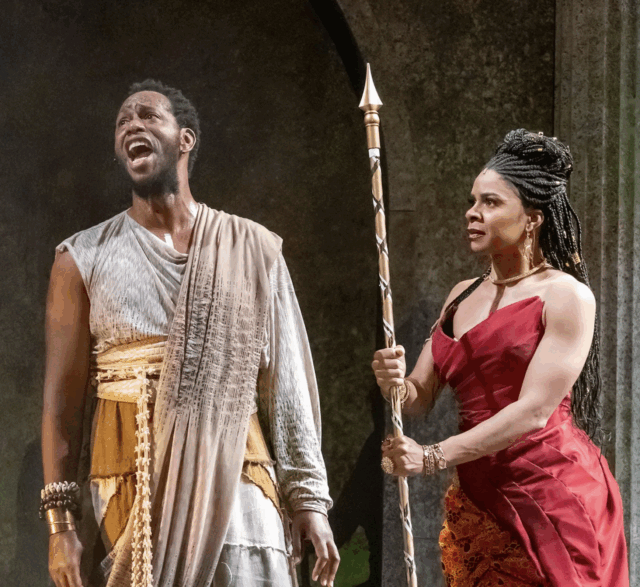
MEMNON: THE MISSING BATTLE OF THE TROJAN WAR

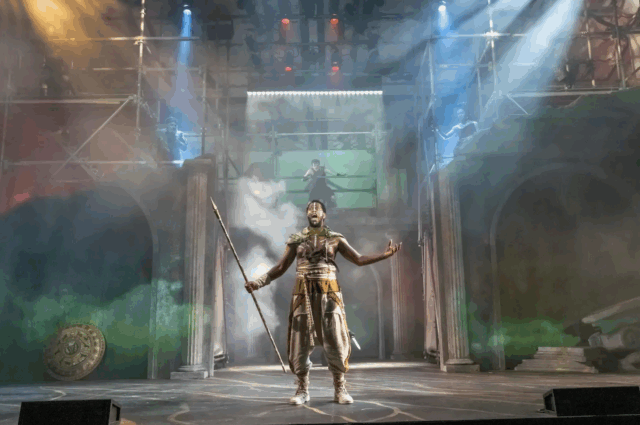
Eric Berryman resurrects a Greek hero in Classical Theatre of Harlem’s Memnon (photo by Richard Termine)

UPTOWN SHAKESPEARE IN THE PARK: MEMNON
Classical Theatre of Harlem
Richard Rodgers Amphitheater, Marcus Garvey Park
18 Mt. Morris Park W.
Tuesday – Sunday through July 27, free (advance RSVP recommended), 8:30
www.cthnyc.org

Writer Will Power and director Carl Cofield follow up their 2021 Richard III reimagination, Seize the King, with Memnon, a bold antiwar missive about a key battle in the legendary fight between the Achaeans and the Trojans about eight hundred years ago.

Presented by the Classical Theatre of Harlem at the Richard Rodgers Amphitheater in Marcus Garvey Park through July 27 at part of its Uptown Shakespeare in the Park series, Memnon zeroes in on the little-known title character, an Ethiopian king, in the mold of Black Panther, who appears in some ancient texts (Virgil’s Aeneid, the extant Aethiopis) and on cups, vases, and mirrors. Priam (Jesse J. Perez), the king of Troy, is mourning the death of his son Hector, a warrior who was killed by Achilles (Jesse Corbin). Priam believes that Hector was “Troy’s last hope,” while Polydamas (David Darrow), Priam’s trusted adviser, declares, “So now without him, our hero gone, our men / Soon slaves to Hades or other men / Our wives violated / And children’s bones crushed by boots.”

But then Polydamas suggests that Priam turn to his nephew, Memnon (Eric Berryman), who self-exiled to Ethiopia many years before under mysterious circumstances. “Never will I call this man of which you speak. Never, I say! / He is us only in lineage, not in spirit / No, his treacherous soul belongs to others / And he has proven that,” Priam argues vociferously. “He is nothing to me!”

Helen (Andrea Patterson), the queen of Troy, entreaties Priam to reconsider; she left her husband in Sparta, abducted or of her free will, as various tales have it, with Paris, Hector’s brother, and the Greek cuckold’s furor led to the Trojan War. “In Troy Helen is Helen at home Helen is hell / In Troy Helen has choice at home no free will / So the place that is home may be truly foreign / And the new place foreign may be true indigen,” Helen says, adding, “Caught up you are in who is foreign / And who is citizen. / Why not who is true and what false?”

Priam eventually relents, and, though hesitant at first, Memnon arrives with his army, although he first speaks of a peaceful resolution to the war. “In Ethiopia, able we are / To speak through disagreements and sidestep bloodshed,” Memnon explains. Priam wants to know how many enemies he has killed, and by what methods, but Memnon tells him, “We didn’t kill we captured to calm them. . . . Once I slaughtered two hundred men myself, in one single battle / Not proud of that.”

Soon Memnon is facing off with Antilochus (David Darrow), son of Nestor (Jesse J. Perez), the king of Pylos. “Your father Nestor, an old man in a young man’s game / He should not be here at war, and neither should you / I see through your brave mirage, men should not slay boys,” Memnon, holding a shield made by the god Hephaestus, warns Antilochus. “Vacate now as I will not attack but, if you should be so bold / To use sword, javelin, and shield against me / Young man, no choice will I have but to end you / Think on this, Antilochus, and think well.”

He doesn’t think well enough.

Next, Nestor appeals to Achilles to fight Memnon, not only to defend the Achaeans, but to seek revenge for his childhood friend Patroclus, who was killed by Hector. Achilles initially does not want to get involved. “To kill again I could easily do, summon the dark and blanket battle fields / With slumbering, lifeless men. But to what end, Nestor?” Achilles asks. “I despise not the Trojans, but gods that play chess with souls of men / These devilish immortals are set on us as their light amusements.” However, Nestor convinces Achilles to take up arms against Memnon, so the two heroic figures, neither of whom wants to shed more blood, are face-to-face in heated battle.

Memnon (Eric Berryman) and Helen (Andrea Patterson) consider their fate as battle awaits (photo by Richard Termine)

Told in iambic hexameter, Memnon is laced with references to immigrants that ring true with what is happening in America today. In response to Helen’s statement about who is foreign and who is citizen, Priam answers, “Is this a man true who loves Troy? That makes the citizen.” Polydamas notes, “Helen became not foreigner but blood to us.” And Memnon, when deciding whether to return to Troy and join his uncle’s cause, considers, “Now times there were when reminded I was / That Troy and I were not the same, that I / Was Troy but not fully Trojan, kin and / Not kin, still would I tuck feelings away. . . . I am of the east and yet / This Troy still calls. I cannot abandon her fully / Though I have tried. / It makes no sense, to fight for that which has proven / Time and time again that you will forever be other.”

Riw Rakkulchon’s set is a multilevel crumbling castle with stairs leading to platforms within scaffolding. Yee Eun Nam’s projections are primarily atmospheric abstractions that morph from black and white into color. Frederick Kennedy’s sound and music has to contend with loud noises in the park but ultimately prevails. Celeste Jennings’s costumes range from regal to battle armor to Memnon’s African-influenced garb, accompanied by white sneakers. The lighting, by Alan C. Edwards, adjusts to the setting sun and the shifts in narrative style, from extended dialogues to rousing dance interludes choreographed by Tiffany Rea-Fisher and performed by Jenna Kulacz, Madelyn LaLonde, Alyssa Manginaro, Caitlyn Morgan, Erik Penrod Osterkil, Tiffany “2Ts” Terry, and Travon M. Williams.

Berryman (Primary Trust, Get Your Ass in the Water and Swim Like Me) is captivating as Memnon, a thoughtful man, strong in mind and body, who favors peace but is thrust into war. His diction is initially heavy with broken English but becomes smoother as he spends more time with Priam and Helen. Perez (Party People, Informed Consent) moves smoothly between Priam and Nestor, both of whom speak loudly, fathers seeking revenge no matter the cost. Patterson (cullud wattah, Confederates) makes the most of her moments as Helen, while Darrow (All Is Calm, the Revival) excels as Polydamas and Antilochus, with several of his longer scenes receiving well-deserved exit applause, and artist, musician, and fitness trainer Corbin (The Lion . . . & the Wardrobe) shows off his muscles as Achilles.

The play unfurls almost too rapidly, with a few plot holes and a lot of exposition that at times makes it feel like something is missing, and some of the contemporary language sticks out like a sore thumb — for example, when Memnon says, “We will always be a nation sliced apart / Haves and have nots, belongs and kind of belongs.” But Power (Flow; Fetch Clay, Make Man) and Cofield (The Bacchae, King Lear) have done Greek tragedy a service by resurrecting a true hero with a unique understanding of glory.

[Mark Rifkin is a Brooklyn-born, Manhattan-based writer and editor; you can follow him on Substack here.]

HIDDEN GEMS: BED-STUY STooPS SUMMER FESTIVAL

STooPS 2025 SUMMER FESTIVAL
Stuyvesant Ave. & Decatur St., Brooklyn
Saturday, July 26, free (advance registration recommended), 1:00 – 7:00
www.stoopsbedstuy.org
www.eventbrite.com

The twelfth annual STooPS Arts Crawl and Block Party takes place on July 26 on Decatur St. between Lewis and Stuyvesant Aves. in Brooklyn, with live music and dance, workshops, and visual art on the stoops and shared spaces of Bedford–Stuyvesant. This year’s theme is “Echoes of Greatness: Celebrating Bed-Stuy’s Hidden Gems,” honoring the lesser-known treasures in the neighborhood. The festivities begin at 1:00 with a block party lasting until 7:00, hosted by Koku with ToniBNYC, a Kiddie Korner by Bridges: A Pan-Afrikan Arts Movement, collaborative visual art by Ovila Lemon/Mut’Sun, and healing workshops by Akika Flower Essences & Apothecary and Essence of Ase. There will be art crawls at 1:30 and 4:00, led by Shanna Sabio of GrowHouse NYC, with Carmen Carriker, Courtney Cook, Ariana Carthan/Wukkout!, Brooklyn Ballet, Qu33n Louise, Nia Blue, and Púyaloahí. Kendra J. Ross Works and Soul Science Lab headline the show. This year’s awardees are Ovila Lemon, Richard Cummings, Valerie Ferguson, Monique Scott, Larry Weekes, and Damon Bolden.

“The summer festival is more than a celebration — it’s a bridge between Bed-Stuy’s past and its future,” STooPS founding director Kendra J. Ross said in a statement. “By bringing art to the stoops, we make space for neighbors to connect across generations and experiences. In a time of change, this is how we honor what’s been while shaping what’s next — together.”

All events are free but advance registration is recommended.

[Mark Rifkin is a Brooklyn-born, Manhattan-based writer and editor; you can follow him on Substack here.]

THE JOY OF RESISTANCE: RACHAEL SAGE, KRISTEN FORD, AND HANNAH JUDSON AT MERCURY LOUNGE

Who: Rachael Sage and the Sequins, Kristen Ford, Hannah Judson
What: Joy = Resistance Tour
Where: Mercury Lounge, 217 East Houston St.
When: Thursday, July 24, $15 in advance, $20 at door, 6:00
Why: The Joy = Resistance Tour pulls into Mercury Lounge on July 24, as Rachael Sage and Kristen Ford are joined by Hannah Judson for what should be a special night of music and inclusivity. MPress Records founder Sage will be performing with her longtime trio, the Sequins: Trina Hamlin on harmonica, Andy Mac on drums, and Kelly Halloran on violin; they will be celebrating the release of Sage’s latest single, “Live It Up,” while highlighting songs from her upcoming album, Canopy, along with old favorites. The L.A.-based Ford will be playing tunes from her debut full-length, Pinto, out August 22 from Righteous Babe; produced by Grammy winners Ani DiFranco and John Driskell Hopkins, it includes such tracks as “Wild Heart,” “Whiplash,” and “White Man’s Dream.” Judson, a Chicago-based French-American singer-songwriter, will be featuring tunes from her latest LP, Satellites Grace the Sky Like Tumbleweeds (Boneyard Records), which boasts such numbers as “Feather,” “Take the Angel Down,” and “Ocean Blue Eyes.”

On the gorgeously poetic “Just Enough” from Canopy, the New York City–based Sage sings, “I feel love in the morning when you wake me up / Love in the middle of the day don’t stop / I feel love in the evening, fills my cup just enough . . . shalalala. . . .” Discussing the tune, she says, “At first listen, [it] seems like a romantic love song and to some degree it started out that way when I was first writing it. But the longer I’ve played it live out on tour the more now it feels like it’s equally a mantra to oneself about being enough as you are: lovable enough, accomplished enough, attractive enough, smart enough . . . all the things that, for instance, a best friend or any loved one might acknowledge in you are truly, unconditionally, and authentically enough.”

There should be plenty of enough at Mercury on July 24 when Sage, Ford, and Judson take the stage on the Lower East Side.

[Mark Rifkin is a Brooklyn-born, Manhattan-based writer and editor; you can follow him on Substack here.]
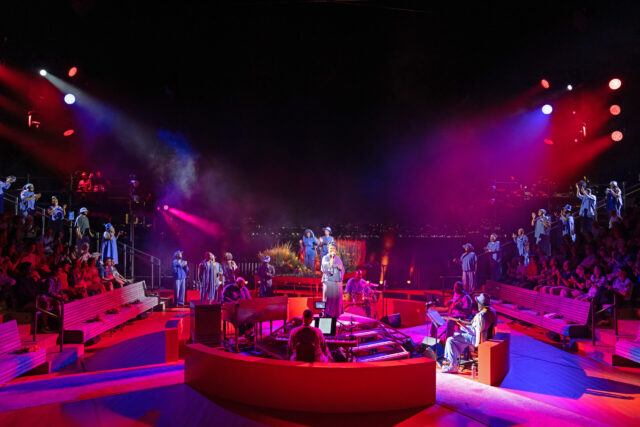
OEDIPUS REIMAGINED: THE GOSPEL AT COLONUS ON LITTLE ISLAND

Revival of The Gospel at Colonus on Little Island tells story of redemption and retribution (photo by Julieta Cervantes)

THE GOSPEL AT COLONUS
The Amph at Little Island
Pier 55, Hudson River Park at West Thirteenth St.
July 8-26, $10 standing room, $25 seats sold out, 8:30
littleisland.org

One of the grandest theatrical events of the summer is taking place on Little Island, Shayok Misha Chowdhury’s rousing, impassioned adaptation of Lee Breuer and Bob Telson’s The Gospel at Colonus, a spirited, spiritual retelling of the Oedipus and Antigone myths.

In 1983, Obie winner and Mabou Mines founding co-artistic director Breuer (Mabou Mines DollHouse, Peter and Wendy) teamed up with composer Telson (Chronicle of a Death Foretold, Bantú) to reimagine Robert Fitzgerald’s version of Sophocles’s Oedipus at Colonus as a Pentecostal revival meeting. The show debuted at BAM’s Next Wave Festival and was mounted on Broadway five years later, with Morgan Freeman as the Messenger; Oedipus was portrayed by Clarence Fountain and the Five Blind Boys of Alabama.

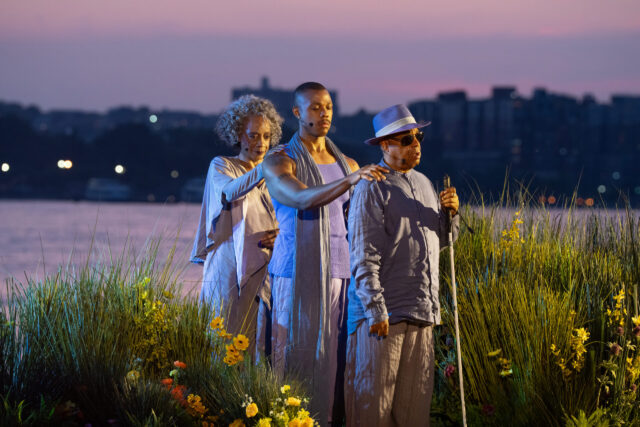
A tale of witness and testimony, of redemption and retribution, The Gospel at Colonus is a revelation at the Amph, where it begins each night amid the glow of sunset over the Hudson. David Zinn’s set is bathed in red; much of the action occurs in a broken circle in the center surrounding a four-step platform, in front of a yellow foot bridge running between high grass. Stacey Derosier’s lighting, switching from red to green to blue, illuminates Montana Levi Blanco’s loose-fitting purple and sackcloth gray costumes, a combination of Greek togas and Sunday finest. Garth MacAleavey’s sound design allows nature to mingle with the crisp, clear music and dialogue.

Stephanie Berry (On Sugarland, Déjà Vu) is sensational as the Preacher, serving as a kind of narrator and oracle. “Think no longer that you are in command here, / But rather think how, when you were, / You served your own destruction / Welcome, brothers and sisters, / I take as my text this evening the Book of Oedipus,” she announces at the start. “Oedipus! Damned in his birth, in his marriage damned, / Damned in the blood he shed with his own hand! / Oedipus! So pitifully ensnared in the net of his own destiny.”

Stephanie Berry, Davóne Tines, and Frank Senior portray different aspects of Oedipus (photo by Julieta Cervantes)

Oedipus — portrayed as a group by blind jazz vocalist Frank Senior, opera bass-baritone Davóne Tines, and Berry — has already blinded himself for having unknowingly killed his father and married his mother, Jocasta, who then hanged herself, and fathered four children with her, two sons, Eteocles and Polyneices, and two daughters, Antigone (Samantha Howard) and Ismene (Ayana George Jackson). Eteocles is a traitor and Polyneices (Jon-Michael Reese) a usurper, taking opposite sides in an upcoming battle, while Antigone and Ismene seek peace.

“Let every man in mankind’s frailty / Consider his last day; and let none / Presume on his good fortune until he find / Life, at his death, a memory without pain. / Amen,” Evangelist Antigone says.

On his journey, Oedipus encounters Jocasta’s brother, Deacon Creon (Dr. Kevin Bond), the former king, who has been tasked with returning Oedipus to Thebes; a friend (falsetto Serpentwithfeet), who welcomes him to Colonus; Pastor Theseus (Kim Burrell), who vows never to drive him away; and the Balladeer (Brandon Michael Nase), who initially refuses Oedipus and Antigone entry into his church and later questions Testifier Polyneices’s attempt to get back in his father’s good graces.

Kim Burrell rips the roof off the joint several times at Little Island (photo by Julieta Cervantes)

Pulitzer finalist Chowdhury (Public Obscenities, Rheology) beautifully flows Breuer’s poetic dialogue (his book earned him a Tony nomination) into Telson’s gospel, blues, and R&B score, featuring Breuer’s potent, emotional lyrics. (Breuer, who died in January 2021 at the age of eighty-three, and Telson, who at seventy-six is still making music, also collaborated on such other projects as Sister Suzie Cinema, The Warrior Ant, and Bagdad Cafe — The Musical.) “Who is this man? What is his name? Where does he come from?” a choragos (Brandon Michael Nase) demands, as if he could be addressing any of us. “Child, I’m so glad you’re here / There’s hope for me / There’s a prophecy . . . I’ve been waiting for a sign / to ease my troubled mind,” Oedipus (Senior and Tines) sings in “Through My Tears.” Oedipus (Tines) later tells Polyneices, “Once you held the power / And when you did you drove me out / Made me a homeless man / You are no son of mine.” But soon Serpentwithfeet is praying, “Let not our friend go down / In grief and weariness / Let some just God spare him / Any more distress” in “Eternal Sleep.”

Burrell tears the roof off the joint — or she would have if the Amph had a roof — in a pair of rip-roaring numbers, “Jubilee (Never Drive You Away)” and “Lift Him Up,” that gets the crowd moving and grooving, hooting and hollering. Among the other notable songs are “Live Where You Can,” “You’d Take Him Away,” and “Evil,” although the finale, “Let the Weeping Cease,” feels unnecessary. Music directors Dionne McClain-Freeney and James Hall lead a terrific band, consisting of McClain-Freeney on piano, Butch Heyward on organ, Bobby Bryan on guitar, Booker King on bass, Jackie Coleman on trumpet, Taja Graves-Parker on trombone, Jason Marshall and Isaiah Johnson on baritone sax, Kevin Walters on alto sax, and Clayton Craddock on drums; the horns perform on high scaffolds at the corners of the stage nearest the river; the superb James Hall Worship & Praise choir includes Pastor Charles, Schanel Crawford, Jaqwanna Crawford, Jacquetta Fayton, Angie Goshea, Robyn McLeod, TJ Reddick, Teddy Reid, Vischon Robinson, Lenny Vancooten, Eugene Marcus Walker, and Darlene Nikki Washington.

In the closing hymn, Serpentwithfeet declares, “There is no end.” That statement is certainly true of the Greek myth of Oedipus; there is no end to the myriad ways this twisted, heart-wrenching can be told, and The Gospel at Colonus on Little Island is among the most inventive, nourishing the soul for ninety glorious minutes.

[Mark Rifkin is a Brooklyn-born, Manhattan-based writer and editor; you can follow him on Substack here.]
SCARY STORIES IN THE DARK: THE WEIR RETURNS TO IRISH REP

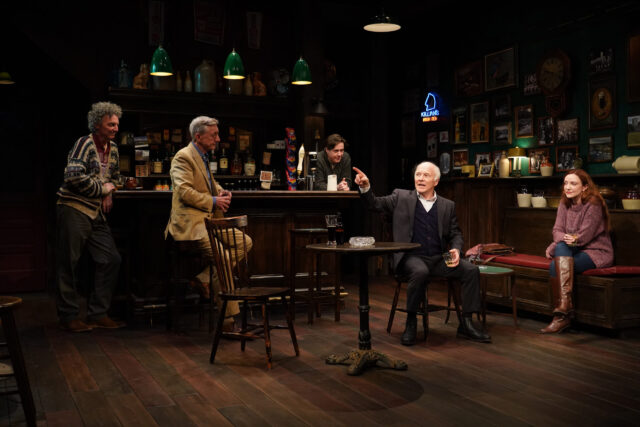
Jack (Dan Butler) shares a ghost story as Jim (John Keating), Finbar (Sean Gormley), Brendan (Johnny Hopkins), and Valerie (Sarah Street) listen intently in The Weir (photo by Carol Rosegg)

THE WEIR
Irish Repertory Theatre, Francis J. Greenburger Mainstage
132 West Twenty-Second St. between Sixth & Seventh Aves.
Wednesday – Sunday through August 31, $60-$125
212-727-2737
irishrep.org

There’s a reason why the Irish Rep keeps returning to Conor McPherson’s The Weir: It’s a marvelous play, and a marvelous adaptation.

The work debuted in England in 1997 and on Broadway two years later; Ciarán O’Reilly first staged it at the Irish Rep in 2013 and again in 2015 by popular demand. The company presented a livestreamed version in July 2020, and now it’s back in person for another engagement through August 31. As in all previous iterations, Sean Gormley is Finbar Mack, John Keating is Jim Curran, and Dan Butler is Jack Mullen; this time around Johnny Hopkins is Brendan Byrne and Sarah Street is Valerie.

The hundred-minute show is set in 1998 in a rustic pub in a rural town near Carrick in the north of Ireland. On a night with a raging wind that sounds like banshees are prowling the weir and pushing against the door, the characters share stories of the supernatural that chill the bone, especially as real life seeps into the tales — part Edgar Allan Poe, part Twilight Zone, part Oscar Wilde.

You know it’s going to be an unusual evening when Jack discovers that the Guinness tap is out of order; he’s not about to have a Harp, the only other draft option. “Well, would you not switch them around and let a man have a pint of stout, no?” Jack asks. Brendan replies, “What about the Harp drinkers?” Jack answers derisively, “‘The Harp drinkers.’” Brendan: “Your man’s coming in to do it in the morning. Have a bottle.” Jack: “I’m having a bottle. I’m not happy about it, now mind, right? But, like.” I understand that exchange all too well.

Finbar is a proudly successful businessman who left for nearby Carrick but is now back for a visit, accompanied by the younger, single Valerie, to whom he has rented an old house once owned by Maura Nealon. Jack is a lifelong bachelor who runs a local garage where Jim occasionally works when not caring for his elderly mother. Brendan has taken over the bar and connected farm from his father and lives upstairs. Jack doesn’t trust the married Finbar, thinking that he has ulterior motives in shepherding around the inquisitive, personable Valerie.

Upon arriving, Finbar orders a Harp, eliciting a chuckle from Jack and Brendan; Valerie asks for white wine, sending Brendan on a hunt to try to find a bottle he received as a Christmas present. What each person drinks — beer, wine, or “small ones,” meaning shots of whiskey — and smokes helps define how they are viewed by the others and lead to playful blarney.

Valerie is interested in the many photos that line one of the walls, and the men start filling her in on the history of the region and the roles their families played in it. Looking at a picture of the weir, Finbar tells her, “Nineteen fifty-one. The weir, the river, the weir, em, is to regulate the water for generating power for the area and for Carrick as well.” A moment later, examining a photo of a scenic field, Finbar asks Jack to tell the story of the fairy road (based on something that actually happened to McPherson’s grandfather). Jack is hesitant, but Finbar insists, even though the events take place in the Nealon house where Valerie is now staying. The ninety-year-old tale involves a widow, a young prankster, and mysterious knocks at the door.

While Finbar dismisses the story as “only old cod,” Valerie notes, “Well. I think there’s probably something in them. No, I do.” Finbar shares a yarn about a spectral figure on the stairs, then Jim relates a frightening event that occurred in a church graveyard. After, the men want to stop telling these tales, but Valerie has one of her own that explains her situation all too well. She says, “No, see, something happened to me. That just hearing you talk about it tonight. It’s important to me. That I’m not . . . bananas.” It’s a devastating narrative, one that the men don’t want to believe is true. The evening concludes with Jack recalling the most critical moment of his life, free of supernatural elements but no less haunting.

The Weir opened at London’s Royal Court Upstairs to an audience of sixty; McPherson (Shining City, Girl from the North Country) wasn’t expecting much from his fourth play, which was directed by Ian Rickson, but it was an instant hit, transferring to the Duke of York’s for a two-year run and earning McPherson an Olivier. It’s been revived around the world over the years, including a new production directed by McPherson this summer and fall in Dublin and London, starring Brendan Gleeson as Jack, a part previously played by Jim Norton, Sean McGinley, Brendan Coyle, and Brian Cox.

The Irish Rep production is exemplary in every way. Charlie Corcoran’s set is wonderfully detailed and inviting, a comforting respite from the threatening winds, expertly captured by Drew Levy’s sound design. Leon Dobkowski’s costumes are naturalistic, from Jack’s black-and-white suit and Jim’s old-fashioned cardigan to Finbar’s persnickety ensemble and Valerie’s purple sweater and knee-high boots; Michael Gottlieb’s lighting keeps it all appropriately shadowy, while Deirdre Brennan’s props add to the believability of the constructed environment.

O’Reilly’s (Molly Sweeney, The Emperor Jones) direction is impeccable, every detail, every movement, every pause accounted for, fully immersing the audience in the play’s magic. At times I felt like bellying up to the bar, grabbing a pint and a small one, and regaling the denizens with one of my own ghost stories, of which I have quite a few.

Butler (Travesties, The Lisbon Traviata), New York City treasure Keating (Autumn Royal, Two by Singe), and Gormley (Jonah and Otto, A Day by the Sea) are such old hands at The Weir that they are like three friends out for yet another evening of drinking, smoking, and talking about life. Hopkins (The Home Place, Rock Doves) fits right in as the publican — the only one who doesn’t impart his own anecdote — while the exquisite Street (Aristocrats, Belfast Girls) has a constant glow around her, giving Valerie a saintlike quality; you want to be in her presence and bask in that radiance.

“There’s no dark like a winter night in the country,” Jack says during his first tale. “And there was a wind like this one tonight, howling and whistling in off the sea. You hear it under the door and it’s like someone singing. Singing in under the door at you. It was this type of night now. Am I setting the scene for you?”

That’s exactly the scene O’Reilly and McPherson set for us with The Weir, which is so much more than a series of eerie saws; it is a play about the stories we tell others, and ourselves, and what we believe and don’t, as we search for our place in an ever-complicated world.

[Mark Rifkin is a Brooklyn-born, Manhattan-based writer and editor; you can follow him on Substack here.]