The Cherry is back with the hybrid What Happens if I Don’t through December 12
AND WHAT HAPPENS IF I DON’T
Cherry Artspace and online
102 Cherry St., Ithaca
December 3-12, $25-$35 in person, $20 livestream www.thecherry.org
The pandemic lockdown might have shuttered venues around the country, but it also offered theater lovers the opportunity to see innovative online productions from companies that are out of one’s geographic range. Since April 2020, I have enjoyed works from Baltimore Center Stage, San Francisco Playhouse, DC’s Studio Theatre and Woolly Mammoth, Steppenwolf in Chicago, Hartford Stage in Connecticut, Boston Court Pasadena and Barrington Stage in Massachusetts, and Chichester Festival Theatre and the Bristol Old Vic in England, among others, all while sitting at my computer.
One of the little gems has been Ithaca’s nonprofit Cherry Artists’ Collective, which has presented Felt Sad, Posted a Frog (and other streams of global quarantine), which interwove six stories dealing with isolation, A Day, a hybrid green-screened show that cleverly revealed its process between scenes, and the two-character onstage Hotel Good Luck, which looked at time, space, and loss in surprising ways.
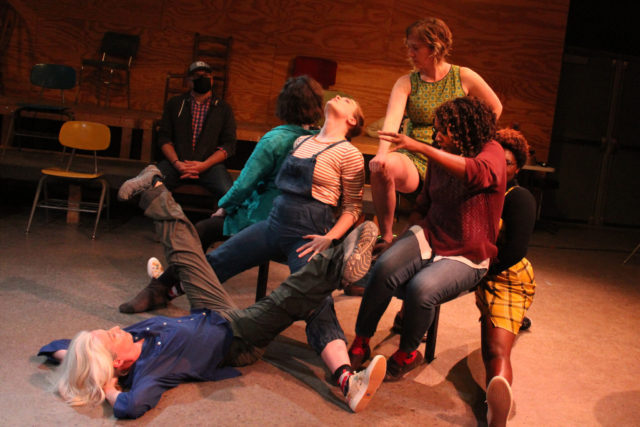
The company’s latest work is its first indoor show in front of an audience since the coronavirus crisis closed everything down. Berlin-based Serbian playwright and screenwriter Iva Brdar’s And What Happens if I Don’t is being performed in the theater and streaming live through December 12 from the Cherry Artspace. I saw one of the streams, filmed with multiple cameras (including one overhead); the play begins with the small audience entering the intimate space, sitting on chairs and risers on three sides of the room, and ends with the crowd leaving, adding to the overall live experience for those at home. The sixty-minute narrative features eight actresses — Adara Alston, Barbara Geary, Naandi Jamison, Elizah Knight, RJ Lavine, Elizabeth Mozer, Jen Schilansky, and Amoreena Wade — portraying thirteen girls and women who, as they grow older, from birth to seventy-eight, share stories about life lessons, both good and bad, they learned from their mothers; each scene also involves a threatening male figure, from a father and a traffic officer to a creepy man at a public pool and a Customs agent.
What Happens if I Don’t explores outdated gender roles in a series of monologues
In “On Ears, age 0,” the only thing a father can say to his newborn daughter (Jamison) is that she has nice ears, which warps her view of the rest of her body. In “On Concrete, age 18,” a teenager (Alston) is told by her mother to avoid sitting on concrete or else she will become a “sterile, hysterical, unfulfilled woman.” In “On Toilet Seats, age 29,” a woman’s (Wade) mother insists she not sit directly on toilet seats unless she wants to get a disease. Other words of advice relate to urinating` in pools, people with dimples, eating fruit, and plucking out gray hairs.
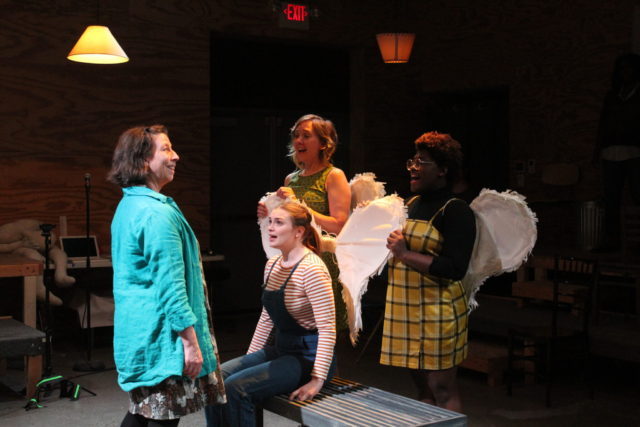
Each scene starts with the character, dressed in modern-day casual clothing, attempting to jump rope held by two of the other actors, a constant reminder of the joys and fun associated with childhood that go away as one ages and discovers more about the not-so-carefree world. Each character is also joined at one point by three angels who remind her that she is “polite, kind, and very well behaved,” understanding what is expected of her as a girl and a woman. Places to sit (a chair, a small bench, a large wooden farm spool) are moved around to sharp sound effects for every vignette, under eighteen lightbulbs in lampshades hanging from the ceiling at different heights. (The sound and music is by Lesley Greene, with lighting by Chris Brusberg, costumes by Iris Estelle and Sasha Oliveau, and livestream design by Greg Levins and Karen Rodriguez.)
Director Susannah Berryman (Holy Ghosts,Daisy Pulls It Off) gives the cast an ample amount of freedom, resulting in a loose, natural feel despite the serious turns; it’s a show by women, about women, but the male need for power and control hovers over all of it as Brdar (Geraniums Can Survive Anything,Rule of Thumb) explores sexism, misogyny, and old-fashioned gender roles. And What Happens if I Don’t also asks the question “Is mother always right?” (The answer is decidedly no.) The show consists of a series of monologues, but the eight cast members stand together throughout, supporting one another as they battle systemic stereotypes that are still all too real in 2021.
Who: Everett Bradley and special guests What:Holidelic funk revue Where: Lucille Lortel Theatre, 121 Christopher St. When: December 9-31, $31-$101 (use code TINSEL50 for half-price tickets) Why: “Holidelic was born out of my obsession with Parliament Funkadelic. I grew up on that music and I love it, and I also like Christmas,” Everett Bradley says in a promotional video about his popular Christmas jam, returning this month to the Lucille Lortel Theatre. “I’m like a Christmas geek.” In his guise as Papadelic, the Father Christmas of Funk, the Grammy-nominated percussionist is joined by special guests, everyone in outrageous holiday finery as they blast through groovy Christmas songs, many from his 2002 album, Toy, which features such tunes as “Christmas Is Kickin’ In,” “Dirty Snow,” “Funky Santa,” “Say Cheese,” and “I’m Coming Home,” and 2017’s Holidelic: Rebooty, which includes “DysFunktional,” “Sugar Rump Fairies,” “Get on Down That Chimney,” “’Twas the Night Before the Funk,” and “Fro Ho Ho.”
Bradley began writing Christmas songs after 9/11 as a way to provide healing to a grieving nation. There will be twelve performances between December 9 and 31, and the Lortel has teamed up with local restaurants Cowgirl, Northfork, and Red Paper Clip for special preshow dinners and happy hours. Holidelic is part of the Lortel’s “Tinsel” global holiday festival, which kicks off December 6 and features such other shows as Jared Grimes’s Christmas in the Lab,Pastorela: A Very Merry Immigrant Christmas,Jaime Lozano & the Familia’s Canciones para Navidad,Ilene Reid’s the Sounds Around the House,Telly Leung’s Tossing Tinsel with Telly, and Latrice Royale’s Why It Gotta Be White Christmas?!
Jamar Roberts will perform new solo on December 9 in final appearance as Ailey dancer (photo by Paul Kolnik)
ALVIN AILEY AMERICAN DANCE THEATER
New York City Center
130 West 56th St. between Sixth & Seventh Aves.
December 1-19, $29-$159
212-581-1212 www.alvinailey.org www.nycitycenter.org
Jamar Roberts has spent nearly half his life with Alvin Ailey. First with Ailey II, then with Alvin Ailey American Dance Theater since 2002, the thirty-nine-year-old Miami-born Bessie Award winner was named the company’s first resident choreographer in 2019; has created such works as 2016’s Gêmeos, 2017’s Members Don’t Get Weary, 2019’s Ode, and 2020’s A Jam Session for Troubling Times, which was filmed on the roof of the troupe’s midtown studio at the Joan Weill Center for Dance.
During the pandemic, Roberts also created two short films for the Guggenheim’s Works & Process series, the fierce and unrelenting solo Cooped and A Chronicle of a Pivot at a Point in Time, a piece for five dancers in the corner of a studio, their shadows echoing hauntingly against one wall; both feature a tense electronic score by David Watson. In addition, Roberts debuted his fifteen-minute solo, Morani/Mungu (Black Warrior/Black God), at City Center’s 2021 digital Fall for Dance program.
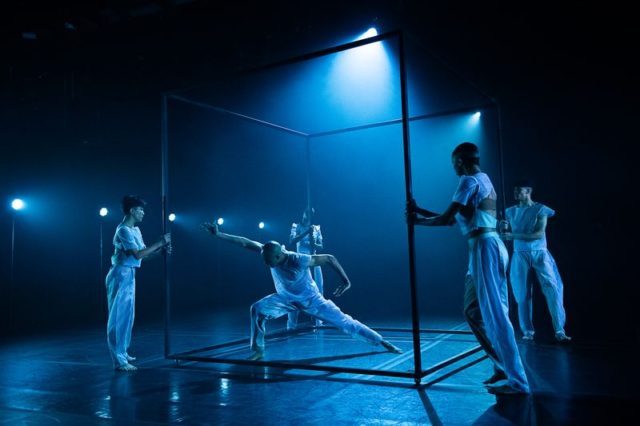
On December 9, as part of AAADT’s annual winter season at City Center, Roberts will perform for the final time; he is retiring from dancing with the six-minute solo You Are the Golden Hour That Would Soon Evanesce, accompanied by pianist and visual artist Jason Moran playing his composition “Only the Shadow Knows (Honey).” On December 3, Ailey premiered Roberts’s mesmerizing Holding Space, which was first seen virtually. The twenty-four-minute piece for thirteen dancers, set to an electronic score by Canadian musician Tim Hecker and featuring scenic design and costumes by Roberts, explores healing and presence and is highlighted by a movable onstage open cube in which dancers perform brief solos. At the debut, I was sitting across the aisle from Roberts, whose eyes were zeroed in on the stage every second.
I spoke with the easily likable Roberts, who smiles and laughs often, over Zoom about his transition from dancer to choreographer, the future of virtual presentations, his newfound love of jazz, and more.
Jamar Roberts discusses the pandemic and his career during Zoom interview (screenshot by twi-ny/mdr)
twi-ny: When you started at Ailey, did you ever anticipate transitioning to choreography? Not all dancers want to become choreographers.
jamar roberts: No, not at all. When I got into the Ailey company, I wanted to be a fashion designer; that was the main thing on my list, and then there were three or four other things. Choreography was, like, number ten.
twi-ny: What were some of the others?
jr: Illustrator, animator, meteorologist, those kinds of things.
twi-ny: So what was your initial feeling when you were named the first resident choreographer in the company’s history?
jr: I was like, cool, only because they had hinted at it before, so I kind of felt it coming, but it didn’t really hit or register until I was well into my second piece.
twi-ny: What’s it like choreographing for your friends and colleagues?
jr: Oh, it’s great. I don’t really like the hierarchy, you know, where it’s like, I am the choreographer, I sit in the chair, you listen to me and you do what I say. I don’t really like that, so I get on the floor and I do the movements too, so for me it’s great because it feels like more of a collaborative effort, that we’re all in it trying to make the same thing. I always tell them I know everything and I know nothing at the same time. I can get the conversation started, but by the end of the day, you’re going to be the ones onstage dancing the work, so your input is essential.
twi-ny: During the pandemic you’ve been incredibly active and prolific. When did you first decide to forge ahead with virtual works?
jr: I didn’t make a decision; I would just get a commission and I would accept it. So I guess the answer to that would be when I got the first commission, which was the Guggenheim Works & Process virtual commission [Cooped.]
twi-ny: For that commission, you’re performer, choreographer, and film director. You really threw yourself right into the whole thing.
jr: Yeah, but if you make something, you’re going to have an opinion about how it should look, what environment it should be in, so the director part for me wasn’t anything more special or significant than the way that you would direct things in the studio, when you make a dance for the theater.
twi-ny: You could have put the iPhone somewhere else and not captured the same claustrophobic effect of confinement.
jr: It’s true. I think that artmaking is part, what, 20% skill, and the rest is taste; the majority of it is taste, and problem solving, and if you’re a person that’s making things and you’re relatively bright and you have a pretty good understanding of what works and what doesn’t — and some of us have that to varying degrees — you just trust your instincts and you go. I am no filmmaker, although I appreciate the sentiment; I’m not a director, but I’m an artist, I’m a person who likes creating, I’m a person who likes to see what I like to see, and if other people like to see what my eye is drawn to, then that’s great. But I’m not really here to put a title on anything. I’m just here to enjoy what it is I’m doing and feel good about it when it’s done.
twi-ny: The reaction to Cooped and so many of your other works has been phenomenal; people do want to see what you want to see. You followed Cooped with Morani/Mungu (Black Warrior/Black God), an intimate solo, and then the exhilarating Jam Session for Troubling Times, which you filmed with a team of dancers outside, although the dancers weren’t allowed to touch each other. What was it like to finally work with dancers, get out in the fresh air, yet still have this barrier, this space between each performer?
jr: When somebody tells you that you have to make a dance but they can’t touch each other, immediately it’s the end of discussion. You just have to deal with the cards you’ve been dealt. I guess at that point I just figured out, well, how am I going to do this. I didn’t really think too much about it because it was what it was.
twi-ny: It was so exciting to watch because just seeing people dance outside in this space was freeing for the viewer too. Your work during the pandemic was very much about space: Cooped is claustrophobic, Jam Session is on the Ailey rooftop, Chronicle has the dancers in a corner, and then with Holding Space you actually have a huge open cage that’s both threatening and liberating. Did these spatial elements progress naturally, or were you looking for confining imagery?
jr: The only one where I specifically looked for confining imagery was for the film Cooped. Everything else happened naturally. I think that because it happened naturally speaks to the kind of person I am. I know some people had a hard time during quarantine, stuck in their apartments, but I actually found it quite . . . great. There’s an aspect of my personality that feels very comfortable at home in confined spaces. I’m also six-four, so I’m always forced into confined spaces, like cars or airplanes. I don’t know, maybe subconsciously there’s a thing there.
twi-ny: Well, I’m much shorter than you and I don’t feel quite as confined, I think, as you do. What part of the city were you quarantining in?
jr: I was in Inwood. We were on tour in Texas in March 2020, and it got shut down. I was at home for about a week and then went to St. Louis to try to ride it out with some friends there. Cooped was made in the basement of their home. So the majority of it was in Missouri, and back and forth to New York.
twi-ny: A lot of your work, prepandemic, pre–George Floyd, and then after, is about the Black body, gun violence, racial injustice, and how Covid-19 disproportionately impacted communities of color while also celebrating, as you’ve said, “strength, beauty, and resilience.” How do you achieve this without expressing these elements explicitly?
jr: I think it’s because I’m a nice guy. [smiles] I mean, when the environment and the things that are going on around you are so heavy, you don’t have to say that much. For me, it really becomes about setting the tone for the moment and then on top of that just doing what dance does, which is inspire. Do you know what I mean? We inspire through images, beautiful images, beautiful movement. The rest is baked into the moment that we’re in.
twi-ny: On December ninth, you’ll be performing for what will be the final time, dancing You Are the Golden Hour That Would Soon Evanesce. Why did you decide now is the right time?
Jamar Roberts’s Holding Space is highlight of Ailey winter season at City Center (photo by Christopher Duggan)
jr: I decided now because my body is at the point where it can no longer keep up with the demands of a full-time professional dance career.
twi-ny: How do you think you’ll feel when it’s over? Are you going to be relieved, excited, sad, or do you have no idea?
jr: I don’t really think it’s the closing of a chapter; I think it’s the opening of a new one. This’ll probably be only the second time that I’ve ever been seen onstage doing my own work. I don’t know, I definitely won’t be crying, and I won’t feel sad at all.
twi-ny: As we come out of the lockdown and theaters are open and dancers can touch each other, do you anticipate making future virtual works or will you be sticking to in-person presentations?
jr: Why not both? I hope in the future they’re not called virtual pieces anymore, that they’ll just be called films. Because the word virtual makes it sound like it’s the B-plan. I think it’s all the same. You can have a virtual piece onstage — just throw a camera on the dancers as they’re dancing and have that be displayed. It’s all tools in the same bag; it doesn’t have to be one or the other. Yeah, I think dance has to think a little big bigger?
twi-ny: When you’re not involved with dance, and it seems like you’re always involved with dance, if you have any free time, what do you do?
jr: I try to connect with my friends and the people I love. I try to be a normal person and go to the clubs. I go to dinner and go and see shows. This past summer — summer in New York is always great because you can go and see so much music, jazz festivals in particular, jazz clubs, seeing live music and other performers. I try to keep my head in what’s going on.
twi-ny: You weren’t always a jazz fan, were you? [Roberts has set pieces to compositions by Moran, John Coltrane, Don Pullen, Nina Simone, Charlie Parker, and Dizzy Gillespie in addition to Fela Kuti and the Last Poets.]
jr: No, I grew up with Brandy, and Britney Spears, and Destiny’s Child, Beyoncé, Alanis Morissette, Björk, and all that music. My family never played jazz in the house; it was probably some gospel music, old sermons from the ’50s, and that’s it. But I had to learn it, I had to teach myself that stuff because I was dancing these works that Alvin Ailey choreographed, and they were all to jazz music. And if I wanted to be able to interpret that work authentically, I had to know what the hell it is I was listening to, where it came from, what was happening at the time in which it was made, just so that I could as a performer come across as authentic, with conviction. I went down the rabbit hole, I guess.
In May 2019, Molière in the Park put on its inaugural event, a staged reading of The Misanthrope by Jean-Baptiste Poquelin, aka Molière, at Lefrak Center at Lakeside in Prospect Park, followed in August by a staged reading of the French playwright’s The School for Wives at the Picnic House in Prospect Park. In 2020, because of the pandemic lockdown, the troupe presented four virtual Zoom readings, The Misanthrope with Heidi Armbruster, Kaliswa Brewster, Chris Henry Coffey, Naomi Lorrain, Jared McNeill, Jennifer Mudge, Postell Pringle, Tamara Sevunts, and Samira Wiley; The School for Wives with Tonya Pinkins, Brewster, Cristina Pitter, Tamara Sevunts, Mirirai Sithole, Carolyn Michelle Smith, and Corey Tazmania; a fun adaptation of Molière’s Tartuffe, with Raúl E. Esparza, Wiley, Brewster, Toccarra Cash, Coffey, Lorrain, McNeill, Chloé Noble, Mudge, Rosemary Prinz, and Carter Redwood; and Christina Anderson’s terrific new play, pen/man/ship, which takes place in 1896 aboard a ship bound for Liberia, featuring Crystal Lucas-Perry, Kevin Mambo, McNeill, and Pringle.
The company returned to in-person outdoor shows this past May with Tartuffe at Lefrak Center, with Andy Grotelueschen, Kate Rigg, Pringle, McNeill, Lizzy Brooks, Mudge, Nicole Ansari, Redwood, Coffey, and Marjan Neshat. Next up is “A Very Modern Classical Evening at the Picnic House,” an exciting pairing on December 9 and 10 at 7:00 of Richard Wilbur’s translation of Molière’s one-act comedy in verse, The Imaginary Cuckold, and Martinique-born Gaël Octavia’s Family — which asks the question “What is the disease that spreads through us and our families when social conventions of any kind force us into hiding?” — translated by Katharine Woff and MIP founding artistic director Lucie Tiberghien, with Wiley, Brewster, Brooks, Alanna Darby, Lisa Gorlitsky, and Nate Miller appearing in both; each work will be followed by a Q&A with members of the cast and crew. Admission is free with advance RSVP.
Laura Peterson’s Interglacial makes its world premiere this week at Dixon Place (photo by Peter Yearsley)
INTERGLACIAL
Dixon Place
161A Chrystie St. between Rivington & Delancey Sts.
December 8-11, $15-$21, 7:30
212-219-0736 dixonplace.org www.openartsstudio.org
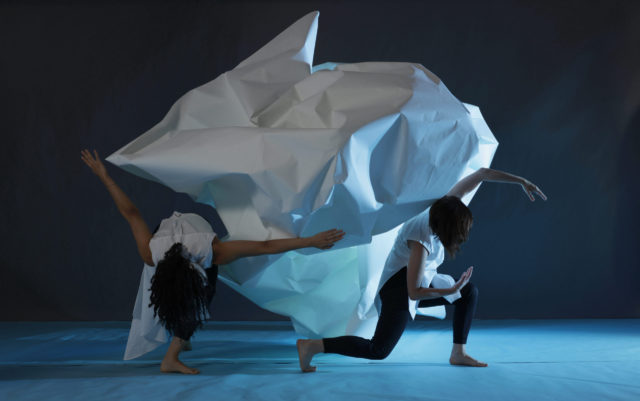
In a 2011 twi-ny talk with Laura Peterson, the New York City–based dancer and choreographer said about Wooden, “I am often influenced by visual art, and I started seriously looking at earthwork and pieces made from natural materials. I found myself thinking that those pieces are meant to change, as they are subject to time and weather.” Climate and land art are also at the center of her latest piece, Interglacial, which is having its world premiere December 8–11 at Dixon Place. Part dance, part installation, the work explores Arctic glacier loss as the performance space transforms over the length of the show.
“In Interglacial, I am trying to understand the devastating effects humans have had on our environment,” Peterson (Failure,SOLO), the artistic director of Open Arts Studio, said in a statement. “I’m exploring the intersection of the human body with landscapes and nonhuman phenomena. This work has a particular focus on the qualities of time, from the hyperspeeds of the digital world to the impossibly slow travels of a glacier across a continent, as it drags rocky material toward the sea.” Interglacial is performed by Peterson, Ching-I Chang, Jennifer Payán, and Darrin Wright, with sound by Omar Zubair, lighting by Amanda K. Ringger, and costumes by Charles Youssef.
COOKING UP (KOSHIRAERU
Japan Society
333 East Forty-Seventh St. at First Ave.
Monday, December 6, $10/$15, 7:30 japansociety.org
Japan Society will present the sixteenth installment of its annual play reading series, “Contemporary Japanese Plays in English Translation,” with Shoko Matsumura’s Cooking Up, directed by Jordana De La Cruz. Originally scheduled for March 2020 and postponed because of the pandemic lockdown, the staged reading will take place December 6 at 7:30. The story, which combines the surreal with naturalism, is set in a restaurant where the pastry chef is missing, the cook is cheating on his wife, and his mistress becomes a housecat. “Every time you think you understand the story line or the plot, something else happens,” the Brooklyn-based De La Cruz (Jack) says in a Japan Society video. “It’s a very intricate play, and it’s powerful, and it talks about isolation and companionship and really makes you think about the people that you have in your corner.”
The Yokohama-born Matsumura (Hanpuku to Junkan ni Fuzui suru Bon’yari no Boken) has acted with Toshiki Okada’s chelfitsch company and founded her own troupe, Momeraths, in 2013. Translated by Amanda Waddell, Cooking Up is part of Japan Society’s fiftieth anniversary celebration honoring New York City woman writers with ties to Japan and will be followed by an audience Q&A with De La Cruz.
Manoel Felciano, Reg Rogers, and Jennifer Sánchez play a trio of swindlers in Red Bull revival of Ben Jonson’s The Alchemist (photo by Carol Rosegg)
THE ALCHEMIST
New World Stages
340 West Fiftieth St. between Ninth & Tenth Aves.
Wednesday – Monday through December 19, $70
Available for streaming January 12-26 www.redbulltheater.com newworldstages.com
Red Bull Theater was one of the most active companies during the pandemic, presenting livestreamed reunion readings of previous productions, the online interview series RemarkaBULL Podversations, and deep explorations into Othello and Pericles. So it’s disappointing that its return to live, in-person theater is an overbaked version of Ben Jonson’s 1610 Jacobean farce, The Alchemist.
Adapted by Jeffrey Hatcher and directed by Jesse Berger — the same team that gave us the superb 2017 revival of Nikolai Gogol’s The Government Inspector — The Alchemist is a hot mess, a frantic, unrelenting satire laden with anachronistic references and modern speech that bury what Samuel Taylor Coleridge famously referred to as one of the “three most perfect plots ever planned.” (The other two, in his opinion, were Sophocles’s Oedipus Rex and Henry Fielding’s Tom Jones.)
The tale is set in 1606 in the Lovewit mansion in London as plague rips through the land; the wealthy master has left for the countryside, reminding us that the rich haven’t changed much, considering their response to the current coronavirus pandemic. A voiceover announces at the start, “Some wear masks, just like you do, that cover the nose and mouth and comply with CDC guidelines at all times, including during the show, except while actively drinking at your seat, so if you’re going to drink, drink actively.”
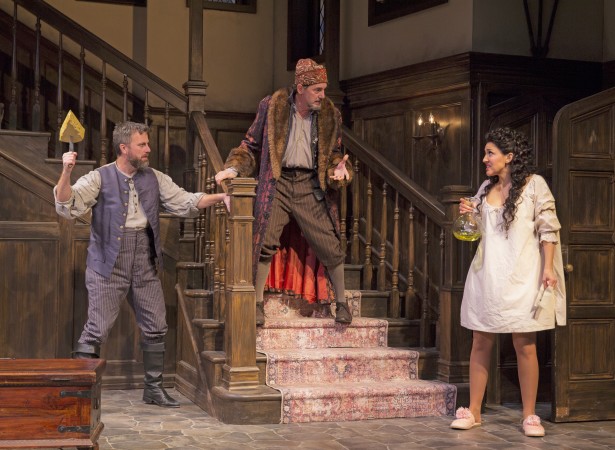
Lovewit’s manservant, the rogue Face (Manoel Felciano), has teamed up with the charlatan alchemist Subtle (Reg Rogers) and their bawdy colleague, Dol Common (Jennifer Sánchez), to con members of the local community out of their money. When the trio learns that Lovewit is unexpectedly returning in two hours, they ramp up their schemes as they attempt to defraud the tobacconist Abel Drugger (Nathan Christopher), the law clerk Dapper (Carson Elrod), the deacon Ananias (Stephen DeRosa), and the knight Sir Epicure Mammon (Jacob Ming-Trent) and his butler from Brooklyn, the surly skeptic known as Surly (Louis Mustillo).
Red Bull returns to in-person theater with The Alchemist at New World Stages (photo by Carol Rosegg)
Subtle might think he is in charge, but Face is quick to remind him, “Recollect, sir: you were not long past known to all the neighborhood as that scurvy beetle who nothing did but loiter at the corner in moldy rags so thin scarce covered they your buttocks. I took pity on you, gave you roof and a bed, replaced your tatters with well-cut cloth, and introduced you to that household item called the bathing tub.” Subtle responds, “Recollect, sir: you were not long past that lowly servant who nothing did but sit your master’s house with no one to converse with save your brooms and dustpans. Twas I took pity on you, raised you up to your potential, taught you to present yourself so convincingly as a captain with a beard so nautical it could fool a blind man who’s never been to sea. Twas I conceived the scheme, tis I should take the largest share!” Meanwhile, Dol points out about their Venture Tripartite, “Well, if we three do not this treasure equal share, you two shall not share mine.”
Despite already having a heavy chest brimming with ill-gotten gains and Lovewit’s arrival fast approaching, Face and Subtle can’t control their greed when they learn of a wealthy widow, Dame Pliant (Teresa Avia Lim), who has come to town with her protective brother, Kastril (Allen Tedder). So they set out to scam her as well, agreeing not to tell Dol. Their nefarious plans play out in real time, a grandfather clock ticking away throughout the nearly two-hour show as things grow more and more frenetic and overwrought.
Red Bull and founding artistic director Berger know their way around classic works, as evidenced by their stellar adaptations of John Ford’s 1630s drama, ‘Tis Pity She’s a Whore, Richard Brinsley Sheridan’s 1777 comedy of manners, The School for Scandal, and Jonson’s 1606 English Renaissance satire, Volpone. But they try too hard to make The Alchemist relevant to this moment in time, sacrificing story for slapstick. Alexis Distler’s two-floor set is filled with doorways, a staircase, and surprise entryways, but the timing of the various door slams is too often slightly off. At one point Rogers ad-libbed about having to run up and down the stairs again, and we feel his pain. As always with Red Bull, the costumes (by Tilly Grimes) are wonderfully extravagant, as is Tommy Kurzman’s wig and makeup design.
Check out our production of Ben Jonson's THE ALCHEMIST, a comedy adapted by Jeffrey Hatcher and directed by Jesse Berger. Off-Broadway NOW for a strictly limited engagement! | Tickets & Information:https://t.co/iXQEaMN3kFpic.twitter.com/kfbnvVDzzP
The show suffers from being in the 199-seat Stage 5 at New World Stages, which is too small and intimate for such a broadly played farce; you’re liable to get whiplash from swiveling your head back and forth and up and down so much, particularly as Subtle changes from “a mystic newly come from Rotterdam” to “a fortune teller late of Portugal” to “a Swedish hypnotist learned in financial planning.” Perhaps it will be easier to take when it is available for streaming January 12-26.
In a program note, Hatcher wryly admits, “Of course, I did screw around with the plot. Ours is a slimmed down version of the play, with fewer characters and one setting instead of four. So, apart from dumbing down the highbrow jokes, ruining the perfect plot, tossing in anachronisms, and adding a song very much like one sung by Shirley Bassey in 1964, the play is pretty much your grandmother’s The Alchemist.” The talented cast, led by Obie winner Rogers, does its best with this dumbing down, seeming to enjoy themselves immensely, as did much of the audience the night I went. I wish I felt the same.