live performance

NOT AS YOU LIKE IT: TWELFTH NIGHT AT THE DELACORTE

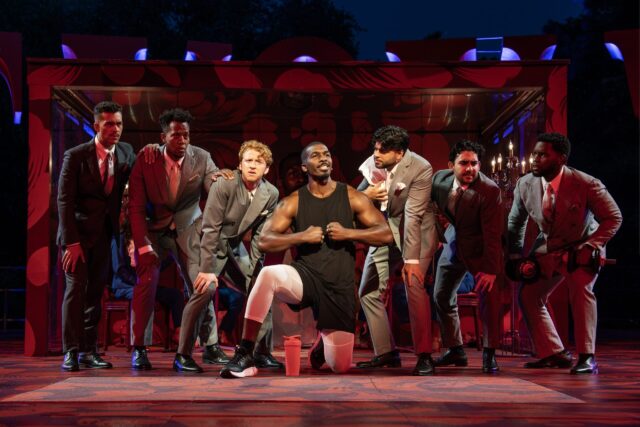
Duke Orsino (Khris Davis) and his minions get ready for action in Twelfth Night (photo by Joan Marcus)

TWELFTH NIGHT
Delacorte Theater, Central Park
Tuesday – Sunday through September 14, free with advance RSVP, 8:00
shakespeareinthepark.org

The confusion begins early in Saheem Ali’s inconsistent adaptation of William Shakespeare’s 1601–02 romantic comedy, Twelfth Night, which opens the newly revitalized Delacorte Theater in Central Park. As the audience enters the space — the majority of the $85 million upgrade went to technical operations, dressing rooms, bathrooms, accessibility, and signage, along with improvements to the facade and seats — a string quartet is playing on a red stage that features swirling patterns and, in giant, bold letters around the back, the subtitle of the play: What You Will. (The renovation did not rid the Delacorte of its famous raccoons, one of which ambled along atop the back wall moments before the play began, eliciting the adoring attention of the crowd.)

Then Ghanaian American singer-songwriter Moses Sumney, portraying the fool, Feste, walks onto the stage with a guitar and sings, “All the world’s a stage, / And all the men and women merely players. / They have their exits and their entrances, / And one man — or woman — in their time plays many parts.”

The line actually comes from the second act of As You Like It and seems like a cliché here taken out of context, even with its addition of “or woman.” Meanwhile, the musical shift from classical to Sumney’s alternative/indie R&B is jarring, and the character feels more like a demonic troubadour than one of Shakespeare’s fools.
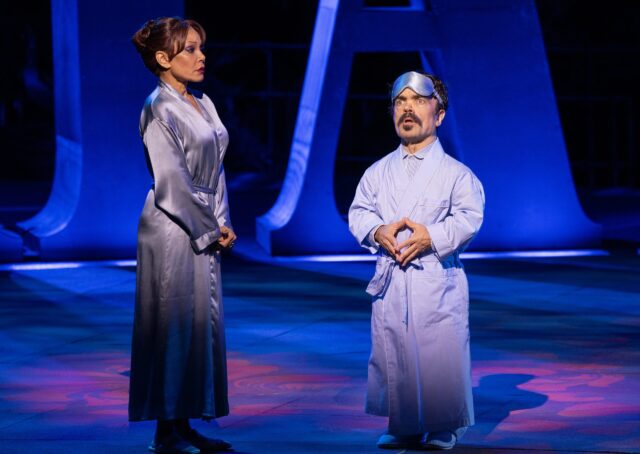
Maria (Daphne Rubin-Vega) offers some intriguing news to Malvolio (Peter Dinklage) in Shakespeare production at revitalized Delacorte (photo by Joan Marcus)

Next, a sea captain (Joe Tapper) and Viola (Lupita Nyong’o) rise in a small boat from one of the Delacorte’s new modular trap doors. Emphasizing that they are strangers to this land, the first words they say to each other are in Swahili, although most of their conversation in in English. (Nyong’o was born in Mexico and raised in Kenya and speaks fluent English, Spanish, Luo, and Swahili.) The explicatory scene lets us know that there has been a shipwreck that has led the captain and Viola to Illyria, which is ruled by the duke Orsino (Khris Davis), who is in love with Olivia (Sandra Oh), a count’s daughter who is mourning the recent deaths of her father and brother and currently uninterested in suitors. Viola’s brother, Sebastian (Junior Nyong’o), was also on the ship, and Viola holds out hope that he has survived as well. She decides to disguise herself as a man named Cesario and serve the duke. (Sebastian has indeed survived and is on the island, with Antonio [b], an enemy of the duke’s, as his servant.) Only then do we meet Orsino as he declares to court gentleman Curio (Ariyan Kassam) and Feste, “If music be the food of love, play on,” which usually starts the play.

Thus, this Twelfth Night has a completely different atmosphere, which is not in itself a bad thing. I am not a Bard purist who insists that Shakespeare plays should not be messed with. Among the endless beauties of his work are the myriad possibilities it offers for reinterpretation. Over the last dozen years, I have seen three memorable productions of Twelfth Night: one on Broadway starring Mark Rylance as an Olivia who is light on her feet and a wickedly funny and towering Stephen Fry as her steward, the much-maligned Malvolio, in a delightful version that harkened back to the seventeenth century in form and style; one off Broadway by Axis that was dark and foreboding and utterly involving; and one at the Delacorte in 2018, an engaging musical comedy by Shaina Taub, who also portrayed Feste. (Twelfth Night is a favorite of the Public Theater’s Shakespeare in the Park presentations, having been staged six times previously, going back to 1969.)

In 2021, I was disappointed in Jocelyn Bioh and Ali’s Merry Wives, which moved the location of the story from Windsor to South Harlem and felt too caught up in shtick, and the same is true here. Scenes move by too quickly as actors enter and leave down the aisles, via the traps, and through the “What You Will” wall like a one-ring circus, not allowing enough time for character development or actor chemistry. Attempts at amusement abound: Olivia’s uncle, the Falstaffian Sir Toby Belch (John Ellison Conlee), and his sidekick, the cheeky Sir Andrew Aguecheek (Jesse Tyler Ferguson), hang out in a hot tub doing lines of coke and whippets when they’re not plotting with Olivia’s chambermaid, Maria (Daphne Rubin-Vega), to publicly embarrass Malvolio (Peter Dinklage) in front of Olivia, whom he secretly pines for. Orsino asserts his strength and power by working out barechested at a gym and ordering his minions to drop and do pushups for punishment. Sir Toby, Sir Andrew, and Fabian (Kapil Talwalkar) hide from Malvolio behind four handheld letters, T, R, E, and E, instead of a tree, which is cute at first but goes on too long. A duel is transformed into a comic boxing match, with Sir Andrew in full boxing regalia.
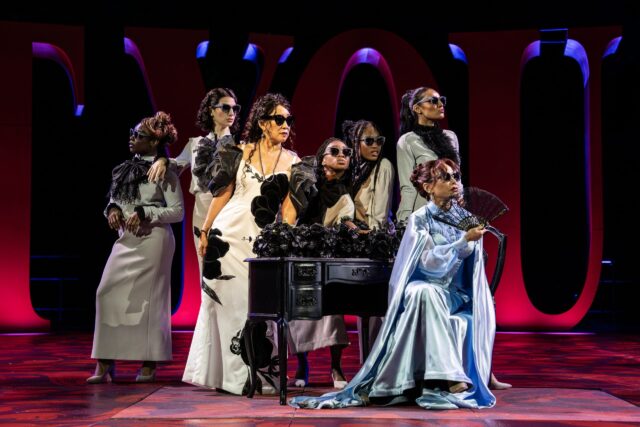
Olivia (Sandra Oh) and her minions get ready for action in Twelfth Night (photo by Joan Marcus)

Real-life siblings Lupita and Junior Nyong’o are dapper in their double-breasted suits. The inspired casting of Dinklage as Malvolio tails off when he is left doing too much voguing, particularly when trying to put a smile on his face. Davis has impressive abs. The actor known as b seems out of place whenever they’re onstage, although the part of Antonio can be a challenge to integrate in even the best of productions. Rubin-Vega looks fabulous, but it’s hard to remember she’s playing a maid. Conlee has fun as Sir Toby, but it’s Oh who steals the show as Olivia, wonderfully balancing comedy and pathos as her lust builds up, subduing her mourning with an elegant wit and grace, best capturing the spirit of Ali’s intentions.

The director has excelled in such non-Shakespeare plays as James Ijames’s Fat Ham, Bioh’s Nollywood Dreams, and Donja R. Love’s Fireflies, but I’ve found both Merry Wives and now Twelfth Night overwrought and scattershot, with too many scenes and characters appearing to come from different plays, lacking continuity despite individual moments that shine. It’s perhaps best exemplified by the Twelfth Night finale, a showcase for costume designer Oana Botez and set designer Maruti Evans; it looks fabulous, but it comes out of nowhere. It elicits wild applause from the audience, but it feels like a preening peacock that has arrived onstage, perhaps watching out for that raccoon.

[Mark Rifkin is a Brooklyn-born, Manhattan-based writer and editor; you can follow him on Substack here.]
LOVE AND JEALOUSY: SEVEN SCENES AT LITTLE ISLAND

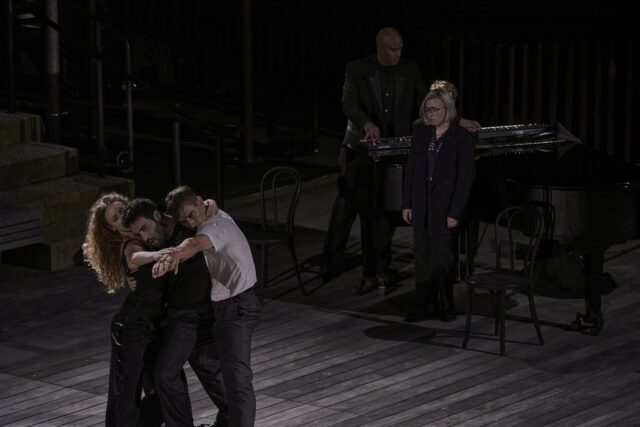
Miriam Gittens, Doug Letheren, and Alexander Bozinoff form a trio as Mikael Darmanie plays the piano and Danni Lee Parpan watches in Seven Scenes at Little Island (photo by Matthew Placek)

SEVEN SCENES
The Amph at Little Island
Pier 55, Hudson River Park at West Thirteenth St.
August 22-28, $10 standing room, $25 seats, 8:30
littleisland.org

A pair of real-life and professional partners bring an infectious passion to Seven Scenes, a lovely hourlong work continuing at the simultaneously spacious yet cozy outdoor Amph at Little Island through August 28.

The dance theater piece was conceived, choreographed, and directed by the Iowa-born Bobbi Jene Smith and Jerusalem native Or Schraiber, who met while dancing for Ohad Naharin’s Batsheva Dance Company, became founding members of the American Modern Opera Company in 2017, got married in 2018, and have a child together. The score, ranging from classical to country, is performed live by the electro-pop duo Ringdown, consisting of real-life couple Caroline Shaw and Danni Lee Parpan on vocals, keys, and synths, accompanied by Mikael Darmanie on keyboards and electronics, Keir GoGwilt on violin, and Coleman Itzkoff on cello. Smith and Schraiber are joined by dancers Alexander Bozinoff, Jonathan Frederickson, Payton Johnson, Doug Letheren, and Ophelia Young.

Seven Scenes comprises a series of interconnected vignettes about love, jealousy, and sexual exploration. Victoria Bek’s costumes feature the men in black or gray dress pants, black or white shirts, and shiny black shoes while the women, each with long hair, wear dark, low-cut outfits. The instruments are at the Hudson River end of the bare wood stage, which remains otherwise empty save for a few moments when the cast brings out a table and chairs. Shaw, Parpan, GoGwilt, and Itzkoff occasionally wander around the dancers, singing and playing their instruments before taking seats in the first row in between audience members. Whenever someone is not performing, they are closely watching what is going on, as if they are voyeurs waiting for their moment to participate.

Payton Johnson, Miriam Gittens, and Bobbi Jean Smith line up in Seven Scenes at Little Island (photo by Matthew Placek)

The evening is highlighted by solos, pas de deux, and trios in which the performers enact primarily romantic scenarios to a score that begins with Jean-Louis Duport’s Étude No.7 and then ranges from Brahms’s Piano Trio No. 2 in C major, op.87: andante con moto, Bach’s Violin Sonata in E minor P. 85: I. Allegro, Schubert’s Piano Trio No. 2 in E-Flat Major, D. 929: II. Andante con moto, and Handel’s Keyboard Suite No. 1 (Set II) in B-Flat Major HWV 434 IV. Minuet to Willie Nelson’s “Crazy” and Ringdown’s “Hocket,” “Fantasia,” and “Thirst,” highlighted by guttural sounds.

Smith and Schraiber’s movement language is inspired by Naharin’s Gaga, focusing on the full body, from fingers to toes, interspersed with just a few runs, jumps, and throws; dancers often remain in place as they interact with one another, but the relationships are always powerfully dynamic. (You can find out more about Smith and Schraiber in the films Bobbi Jene and Aviva.) A man and a woman converge, then are interrupted by a second man, the first man interested in both of them. The three women form a line, moving in unison before breaking free.

Classical ballet and ballroom meld with contemporary dance as the men sit around a table, put on and take off jackets, and one of the men stretches across the table. The men later form a row before sitting in chairs, evoking Naharin’s Minus 16 and Jerome Robbins’s bottle dance from Fiddler on the Roof. Individuals fall to the floor and remain there, as if having been rejected, or exhausted by the chase. Johnson excels in a solo to “Thirst” as Ringdown sings, “Clenched jaw and furrowed brow / If you are the rain, then I am the ground / Don’t know what to do with this thirst for a time and place where I found you first / Where I found you first.”

The men shake hands with audience members. Near the end, Fredrickson thrills with a yearning solo to Darmanie’s gorgeous piano.

There’s a beautiful intimacy to Seven Scenes and how it tells its stories, weaving in sound and motion, dancers and musicians, both physically and emotionally, as bodies come together and are ripped apart, all under a glowing night sky.

Following select performances, the audience is invited to the nearby Glade for a free concert at 10:00, with GoGwilt and pianist Conor Hanick on August 27 and pianist Jeremy Denk on August 28.

[Mark Rifkin is a Brooklyn-born, Manhattan-based writer and editor; you can follow him on Substack here.]
YO-HO-HO! A PYRATE MUSICAL ON A RED HOOK BARGE

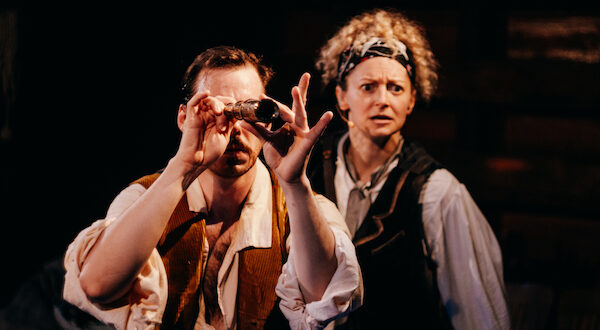
Black Sam Bellamy (Danny Hayward) and Paulsgrave Williams (Lauren Molina) anticipate trouble ahead in The Royal Pyrate (photo by Geve Penaflor)

THE ROYAL PYRATE
Lehigh Valley Railroad Barge No. 79
Waterfront Museum, 290 Conover St., Red Hook
Saturday & Sunday through August 31, $35-$65
www.theroyalpyrate.com

“Ahoy there, maties! I know we all be feelin’ the weight o’ the world crushin’ down on us of late: a system which only seems to serve thems already on top, where ye’re afraid that if ye get hurt, or sick, ye’ll never find o’ way o’ diggin’ yer way outta the grave,” Paulsgrave Williams (Lauren Molina) says at the beginning of The Royal Pyrate. “There always be gold for wars, but never for our strugglin’ families. Life sure is difficult in 1715! But . . . that ain’t no reason we can’t have a bit o’ fun together tonight, eh?”

There’s more than a bit o’ fun to be had aboard Lehigh Valley Railroad Barge No. 79 in Red Hook, where the world premiere musical, featuring music and lyrics by Jason Landon Marcus and a book by Chas LiBretto, continues Saturday and Sunday nights through August 31.

Home to the Waterfront Museum owned and operated by Captain David Sharps, the barge has presented such previous shows as the Drama Desk–nominated The Wind and the Rain: A story about Sunny’s Bar, which related the true tale of the next-door Red Hook institution Sunny’s Bar, and Port Cities NY, which explored the sociocultural and –economic impact of the seventeenth-century Dutch trade routes via a game called “The Settlers of Manahatta.”

The rousing opening number, “Roll the Bones,” sets the tone for the hundred-minute show, which starts out in Wellfleet, Massachusetts, in 1715. Paulsgrave, Tommy Toothacher (accordionist Charley Layton), Ferguson (bassist Charlie Bennett), and Crabby Conrad (guitarist Marcus) are gambling when they are joined by their former colleague, master smuggler Black Sam Bellamy (Danny Hayward). Sam has returned because his girlfriend, Mary Hallet (Maggie Likcani), is pregnant and he needs fast money. Luck is not going his way, so he reveals a treasure map he has obtained that gives the location of where sixteen Spanish trips carrying riches have sunk.

Mary enters, disappointed that instead of getting a real job, Sam has opted to go back to his merry band of pirates, a word that offends Paulsgrave. “Pirates . . . attack ships. Kill the captain. Steal the cargo,” she explains. “Smugglers . . . selflessly distribute that cargo to the poor folks that needs ’em.” Tommy adds, “For a price.”

After Mary delivers the didactic song “New World,” which includes such lyrics as “If you really want a new world / Make sure you’re fighting the right fights. / We need inalienable rights. / Monetary compensation / Breeds corruption in a nation. / Citizens will need to have an independent core / And stop wasting time fighting a rich man’s war,” Simone Van Vorst (flutist Tais Szilagi) announces that Rev. Treat (Korie Lee Blossey) is looking for Sam, claiming he stole a corpse from the harbor; Treat is also upset with Mary because of her determination to change the status quo and expand the rights of the common people.

On their search for the treasure, they are accosted by a pirate ship captained by Edward Teach, better known as Blackbeard (Blossey), an imposing figure who deliciously declares, “Who’s got the beard that be most feared? Who to the mouth of the devil hath steered? . . . Pipe ye down then, shake a leg! / Seek me the captain and roll out a keg / Drop anchor, cut out the sails, I say / Stir not ye rascals or it’s hell ye’ll pay!” In addition, Sam and his ship, the Whydah, have made another enemy in Captain Beer (Layton) and his god-fearing crew, who want to see Sam hanged.

Meanwhile, Treat, Henrietta Hinkley (Marcus), Deidre Dimmock (Layton), Gilda Gilpen (Bennett), and the rest of the villagers in Wellfleet have accused Mary of witchcraft, wanting to see her hanged as well.

Thus, treasure might await some, a noose others.

Blackbeard (Korie Lee Blossey) is not about to back away from sunken treasure in musical aboard Red Hook barge (photo by Geve Penaflor)

The Royal Pyrate is based on the true story of Black Sam Bellamy, Mary “Goody” Hallet, Edward “Blackbeard” Teach, Paulsgrave Williams, the Rev. Samuel Treat, and the sunken Spanish treasure ships. In 1980, lifelong Cape Codder Barry Clifford discovered the Whydah and began salvaging it. However, far more is known about Bellamy, for example, than Hallet, so LiBretto (Melville on the Shore, Cyclops: A Rock Opera) and director Emily Abrams (Eeeeeeeee, Superfeats) try to fill in the gaps, although the pacing can sometimes be as choppy as the water outside. The night I went, it was windy and raining, so the barge occasionally lurched this way and that, which actually enhanced the overall immersive experience.

The audience, some of whom are asked to participate in small ways, is seated in two rows on three sides of the center space, the band occupying the fourth. Among the playful props are barrels, oars, swords, guns, playing cards, a small telescope, doubloons, and skeletons. Juli Abene and Alex Abene’s period costumes depict scalawags, rapscallions, buccaneers, and sea wolves — which are also the four levels of ticket prices — and are highlighted by Hallet’s petticoats, several cool pirate hats, and numerous vests. Marcus’s (Sally May, Cyclops: A Rock Opera) score melds English ballads, Irish folk, sea shanties, and West African and Caribbean melodies, with such standouts as “Roll the Bones,” “The Beard,” belted out by Blossey with operatic grandeur, and the rollicking finale, “Tell No Tales.”

The band crafts a jaunty sound while some members double as minor characters. Molina is an engaging host, and Blossey’s booming baritone and large physical presence can barely be contained by the rocking barge. Likcani is understated as Hallet, complementing the more boisterous Hayward as Bellamy.

And yes, there are plenty of Aaarrrr!s throughout, along with a healthy dose of self-referential humor.

Also, be sure to get there early — taking the ferry is highly recommended — and soak in the barge itself, as Sharps has lovingly preserved it, with fascinating details galore.

[Mark Rifkin is a Brooklyn-born, Manhattan-based writer and editor; you can follow him on Substack here.]
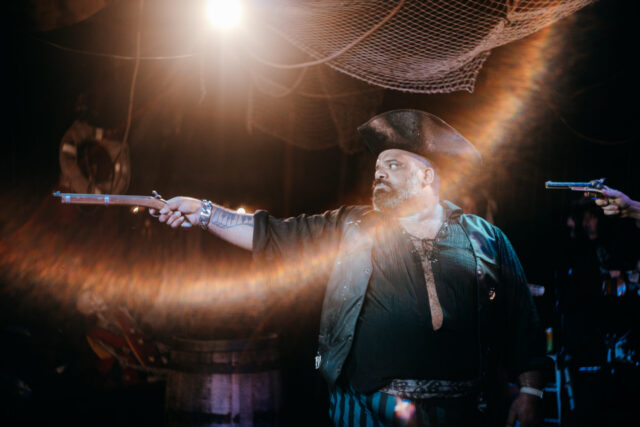
HOLLYWOOD BABBLE-ON: CHANNELING AVA GARDNER, GENE WILDER, AND GILDA RADNER OFF-BROADWAY

Elizabeth McGovern wrote and stars in off-Broadway premiere of Ava: The Secret Conversations (photo by Jeff Lorch)

AVA: THE SECRET CONVERSATIONS
New York City Center Stage I
131 West 55th St. between Sixth & Seventh Aves.
Tuesday – Sunday through September 14, $63-$219
avagardnerplay.com
nycitycenter.org

There are currently two off-Broadway premieres that feature fine performances by actors portraying film and television royalty, but each play struggles to get past frame stories that detract from the overall production.

Oscar-nominated actress Elizabeth McGovern wrote and stars in Ava: The Secret Conversations, a touring show running through September 14 at New York City Center Stage I. It’s based on the 2013 biography Ava: The Secret Conversations by British journalist Peter Evans and Oscar-nominated Hollywood legend Ava Gardner, compiled from interview sessions between the two in Gardner’s lavish London apartment initiated in 1988. Gardner had suffered a stroke in 1986 and had not appeared on camera since.

The play opens with Gardner (McGovern) in silhouette, calling Evans (Aaron Costa Gani) on the phone, talking about possibly ending her life. The narrative then cuts back to the first time they spoke; Gardner had chosen Evans to ghostwrite her memoir for Dick Snyder at Simon and Schuster. Evans, who wants to move away from celebrity gossip and instead work on his novel, thought it was a gag and insults her, but he soon realizes from his agent, Ed Victor (John Tufts), that the project is the real deal. While Evans gets excited about the prospect of exploring the Golden Age of Hollywood, Gardner just wants to barrel through it without making it a kiss-and-tell.

“I gotta write a book, or sell the jewels. I’m kinda sentimental about the jewels,” she admits to him.

He wants to start the memoir with her childhood on a farm in North Carolina, but she wants to talk about her recent stroke. Meanwhile, Victor, in voice-over, advises him, “Dick Snyder says he wants you to ask her about it. Frank’s penis. . . . I can get close to 800K if she talks Sinatra.”

Evans and Gardner quickly get down to business; she reveals the details of meeting and marrying Mickey Rooney, Artie Shaw, and Sinatra and enjoying a lot of sex. They touch on such films as The Killers, Mogambo, The Sun Also Rises, and The Barefoot Contessa and such key figures as Marlon Brando, John Ford, Howard Hughes, and Omar Sharif. Alex Basco Koch’s projections range from archival news footage to clips from Gardner’s films, immersing the audience in her glamorous world.

As she recounts her past relationships, Gani morphs into Rooney, Shaw, and Sinatra, re-creating scenes from Gardner’s past, focusing on her three husbands; none of whom were saints. Evans, who was married with two kids, spends a lot of time with Gardner, who does not hide her flirtatious nature from him. Although she doesn’t have full use of her left arm because of the stroke, she smokes and drinks and curls up seductively on the couch, which initially bothers Evans — until it doesn’t.

Just as Gardner is really opening up, outside forces suddenly stop the interviews and put the kibosh on the book. Gardner went on to publish the 1990 memoir Ava: My Story without Evans’s input; it took more than twenty years for Evans to acquire the rights to the interviews and release them in the 2012 book Ava: The Secret Conversations, which is credited to him and Gardner.

“When you get blown up so big, Peter, you end up paper thin,” she tells him late in the play, summarizing her life as well as her attempts to tell her story her way.

British journalist Peter Evans’s (Aaron Costa Gani) life is turned inside out when he is hired to ghostwrite Ava Gardner’s memoir (photo by Jeff Lorch)

McGovern (Time and the Conways, Downton Abbey) is lovely as Gardner; her accent may waver in and out, but her facial gestures, hair (by Matthew Armentrout), and costumes (by Toni-Leslie James) help her transform into the glamorous silver screen star in a mesmerizing performance. Ganis (Bernhardt/Hamlet, Homos or Everyone in America) does not fare as well, primarily because his characters — Evans, Rooney, Shaw, Sinatra — basically steal time away from Gardner, who merits all the attention.

McGovern the writer and Tony-nominated director Moritz von Stuelpnagel (Hand to God, The Thanksgiving Play) are exploring the creative process, but we learn only so much about Evans and instead want to know everything about Gardner. The pace comes to a screeching halt whenever Peter is not speaking with Ava and is instead talking to Ed or someone else; it’s a shame it couldn’t have been a one-woman show, but that would have been a different play.

In addition, there are bothersome plot holes; for example, Evans has a tiny notebook and only occasionally jots down notes, so it seems impossible for him to have gotten so many direct quotes; in actuality, he used a tape recorder, which would have been useful to point out so we don’t wonder about it.

Ava: The Secret Conversations might not be The Killers, Mogambo, or The Night of the Iguana, but it’s also not Ghosts on the Loose, The Sentinel, or The Naked Maja, falling somewhere in the middle of Gardner’s diverse oeuvre.

The whirlwind romance between Gilda Radner (Jordan Kai Burnett) and Gene Wilder (Jonathan Randell Silver) comes to life in off-Broadway premiere (photo by Carol Rosegg)

GENE & GILDA
59E59 Theaters
59 East 59th St. between Park & Madison Aves.
Tuesday – Sunday through September 7, $66-$86
212-279-4200
www.59e59.org

Cary Gitter’s Gene & Gilda, a Penguin Rep production running through September 7 at 59E59, details the whirlwind romance between Saturday Night Live superstar Gilda Radner (Jordan Kai Burnett) and comedy legend Gene Wilder (Jonathan Randell Silver). The show opens as Wilder is sitting down for his first interview since Radner’s tragic death. He’s hesitant to discuss his personal life with talk show host Dick Cavett, who appears here only in voice-over.

“I thought we agreed we wouldn’t discuss that,” Wilder says, but Cavett pushes him. “I’d rather keep that off limits,” Wilder answers, but is then interrupted by the sudden apparition of Radner, who declares, “Off limits? You wanna keep me off limits? . . . We can tell our story together. The good, the bad, and the ugly. The whole megillah.” The rest of the eighty-five-minute show flashes between the interview and reenacted scenes from Radner and Wilder’s relationship.

The two met on August 13, 1981, on the set of Hanky Panky, a 1982 comic thriller directed by Sidney Poitier that did not fare very well. At the time, Radner, who was born in 1946 in Detroit, was married to future SNL bandleader G. E. Smith, who had worked on her 1979 one-woman Broadway show, Gilda Radner — Live from New York. Wilder, who was born in 1933 in Milwaukee, had been divorced twice and was coming off the huge success of Stir Crazy, the second of his four collaborations with Richard Pryor. Although Radner knew in advance that she was going to fall in love with Wilder, he took a bit of convincing before being swept away by the gale force that was Gilda Radner. “But — but what about my vertigo, and the comfort handkerchief, and the praying?” he says to her, referring to some of his neuroses. She replies, “I love all of it. We complement each other’s craziness. A match made in meshugas.

They both suffer creative crises but find solace in each other and their home away from home, the south of France, where they wed in 1984. At one point, Wilder complains that he is only being offered parts in “Crap! Trash! Garbage!,” telling Radner, “I’m seeing clearly for the first time in years! I wanted to be a thespian. When I was a kid, I saw Death of a Salesman on Broadway, and it changed my life. That was art. I studied at the Actors Studio. I wanted to impact people. And now I’m nothing but a, a cheap Hollywood commodity, making stupid comedies like Hanky Panky! No offense.”

Radner reassures him that making people laugh is his gift. “What do you think people would rather do on a Saturday night — watch me give a speech about the hardships of life, or crack up over Roseanne
Roseannadanna? What we do is a — it’s a public service.”

But their idyllic life is turned upside down when Radner falls ill, experiencing mysterious symptoms that doctors cannot diagnose — until it’s too late.

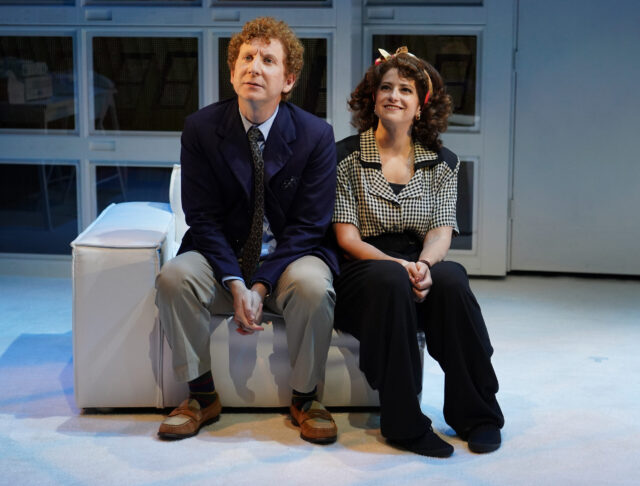
Gene Wilder (Jonathan Randell Silver) looks back at his life with Gilda Radner (Jordan Kai Burnett) in Gene & Gilda (photo by Carol Rosegg)

Christian Fleming’s set features all-white furniture, from a two-section couch and a desk with a typewriter to luggage and a big box (perhaps to make the room seem ghostly or to keep the spotlight more on the couple — except at least twice, the night I went, when the spotlight loses Wilder). Wilder occasionally sits in a black director chair when being interviewed by Cavett; those segments slow down the pace dramatically.

The backdrop is a wall of television monitors where Brian Pacelli’s projections range from hearts and flowers to a shot of the south of France and live video of Wilder answering Cavett’s questions; at the center is a door marked “On the Air,” a constant reminder that we’re watching a TV show. Gregory Gale’s costumes put Wilder in relatively conservative suits and Radner in frumpy yet wacky outfits, while Bobbie Zlotnik’s hair and wigs hit their mark. Sound designer Max Silverman’s treacly score evokes telephone hold music.

In the script, Gitter (The Steel Man, The Sabbath Girl) explains that Gene & Gilda “is a work of fiction, based freely on fact.” Among his sources were Wilder’s 2005 memoir, Kiss Me Like a Stranger, Radner’s posthumous 1989 autobiography, It’s Always Something, and Lisa Dapolito’s 2018 documentary, Love, Gilda, as well as archival footage; although Wilder did sit down with Cavett for an interview in 1991, they did not delve into detail about Radner, instead talking about how ovarian cancer could and should be diagnosed earlier. Director Joe Brancato (The Devil’s Music, The Sabbath Girl) can’t quite find the balance between fact and fiction, fantasy and reality. There is too much telling, describing what happened, and not enough showing.

Burnett (Found, Romy & Michele the Musical), who previously portrayed Radner in a December 2023 workshop reading of Not Ready for Prime Time, a play about SNL’s first five years that is scheduled to debut in New York City in October, is adorable as the determined star, who is not afraid to say what she wants and go after it, although a brief skit in which she channels Roseanne Roseannadanna, Emily Litella, Baba Wawa, Judy Miller, and Candy Slice is a tough challenge.

Silver (Please Continue, Shear Madness!), who portrayed Richard Dreyfuss in regional productions of The Shark Is Broken for the fiftieth anniversary of Jaws, captures the essence of the mild-mannered, tentative Wilder. A scene in which they re-create one of the funniest bits from The Producers — when Max Bialystock (Zero Mostel) attempts to calm down a hysterical Leo Bloom (Wilder) — is another challenge, but there are several lovely moments between them, especially when they dance together.

Gene & Gilda is reminiscent of an episode of Saturday Night Live, with some good sketches, some okay ones, and some, well, not so memorable. It might not be Willy Wonka & the Chocolate Factory, Young Frankenstein, or Silver Streak, but it’s also not Hanky Panky, Haunted Honeymoon, or Rhinoceros. It’s more like The Frisco Kid, The Woman in Red, and Quackser Fortune Has a Cousin in the Bronx. And no need to worry; you won’t need your comfort hankie.

[Mark Rifkin is a Brooklyn-born, Manhattan-based writer and editor; you can follow him on Substack here.]

HEAVY METAL THUNDER: LIGHTNING DOESN’T STRIKE IN VIETNAM WAR JUKEBOX MUSICAL

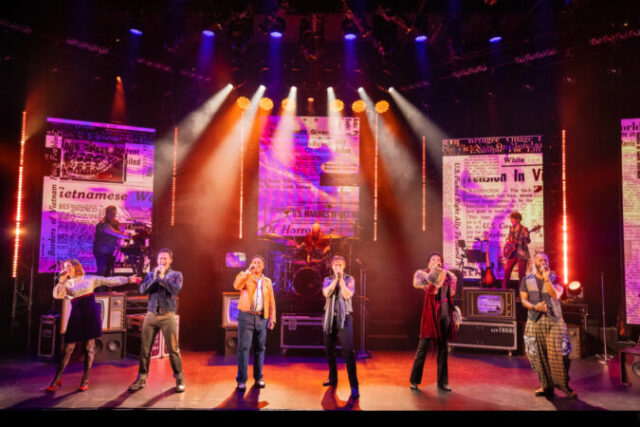
A game cast battles through a perplexing book in Rolling Thunder at New World Stages (photo by Evan Zimmerman for MurphyMade)

ROLLING THUNDER VNM: A ROCK JOURNEY
New World Stages
340 West Fiftieth St. between Ninth & Tenth Aves.
Wednesday – Monday through September 7, $48-$140
rollingthunderus.com
newworldstages.com

In 2008, the jukebox musical Rock of Ages opened at New World Stages on West Fiftieth St., a hugely entertaining fictional story based on classic hits of the 1980s by Journey, Night Ranger, Twisted Sister, Foreigner, Pat Benatar, and others. The production moved to Broadway, was adapted into a 2012 film, and continues to be produced around the world.

This summer, in the same theater, the Australian Rolling Thunder VNM: A Rock Journey is making its US premiere, a by-the-numbers, cliché-ridden story set during the Vietnam War, featuring classic hits of the 1960s and 1970s by Bob Dylan, the Rolling Stones, Curtis Mayfield, the Animals, and others. It’s highly unlikely that it will move to Broadway or be made into a movie.

The two-hour, two-act musical — which has nothing to do with the 1977 film about a soldier returning home from the Vietnam War, the annual motorcycle rally for POWs/MIAs, or Dylan’s 1975–76 Rolling Thunder Revue tour — follows four men who are sent overseas to fight the North Vietnamese. Johnny (Drew Becker) is a Nebraska farm boy who has made his father proud by enlisting, although his mother is unhappy about his decision. “I’ve been thinking about my one big chance for adventure, to see a bit of the world while I could,” he tells the audience. Johnny writes regularly to his high school sweetheart, Linda (Cassadee Pope), and his mother; Linda writes back, bursting with love and affection, but Johnny hears nothing from his mother. Describing his dreams as “Technicolor nightmares,” Johnny admits to Linda, “Your letters keep me sane, amidst the mortar and machine gun fire, when praying you won’t get killed.”

Johnny is in the same unit as his friend Thomas (Justin Matthew Sargent), who convinced him to sign up. After seeing a marine in uniform, Tommy was quick to enlist. “I thought, ‘That’s how I want to look. I’m going to be a marine!’” he says. “I pray I can be a leader among men.” Tommy, who was born into a military family, writes letters to his beloved, Lauren (Courtnee Carter), who, upon going to college, becomes interested in the antiwar movement and one of its school leaders, Jimi (Deon’te Goodman). “The campus in Lincoln is like stepping into a whole new world,” she writes to Tommy.

Andy Johnson (Daniel Yearwood) has been drafted but is clearly not cut out for battle. “I felt sick in the stomach. Go to war or go to prison. What choice did I have?” he opines. Andy gets advice from his buddy from home, Mike (Goodman), who has already been deployed. “Don’t worry, I’m keeping my eye on Andy,” Mike assures Mrs. Johnson.

Meanwhile, Nurse Kelly (Carter), whose two brothers are in Vietnam, keeps the audience informed about the increasing tragedy. “I’ve lost count of the young soldiers in body bags. In this job there’s no time for tears,” she explains.

The characters’ experiences play out in melodramatic, predictable fashion as the war goes bad, protests spread across America, and relationships get complicated.

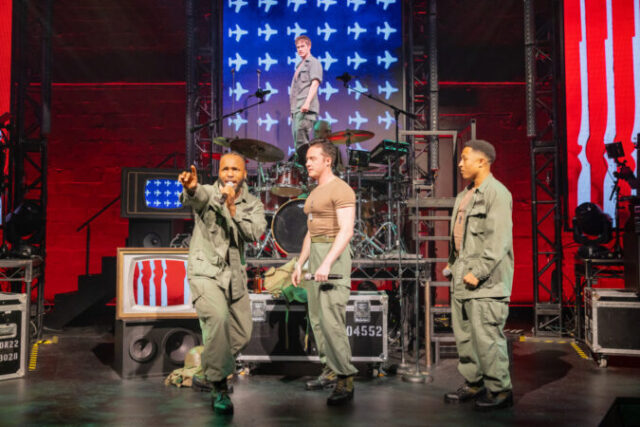
Four soldiers try to survive the Vietnam War in jukebox musical (photo by Evan Zimmerman)

Wilson Chin’s bold set consists of multiple television sets that initially display lighthearted sitcoms (I Love Lucy, My Three Sons), then shift to archival news footage. Conductor and keyboardist Sonny Paladino, guitarists Aurelian Budynek and Sherrod Barnes, bassist Yuko Tadano, and drummer Grant Braddock perform on platforms in front of screens on which Caite Hevner projects news clips, shots of Saigon streets and Vietnamese jungles, whirring helicopters, and groovy color fantasies. (The musicians sometimes appear to morph into the background scenes, which can be disarming.) The standard costumes are by Andrea Lauer — three actors play multiple roles, and it’s not always immediately clear who they are — with flashy lighting by Jake DeGroot and propulsive sound by Mike Tracey.

Director Kenneth Ferrone is limited by Bryce Hallett’s confusing book, which has little sense of time or place, and the musical numbers often feel like way too much of a stretch. For example, the June 1968 assassination of Bobby Kennedy is followed by Walter Cronkite’s February 1968 entreaty for the US to end the war, Dr. Martin Luther King Jr.’s April 1967 “silence is betrayal” speech, and Richard Nixon’s November 1969 “silent majority” declaration.

Several songs fit in well with the narrative — Edwin Starr’s “War,” the Rolling Stones’ “Gimme Shelter,” which was written at least in part about the Vietnam War, Steppenwolf’s “Born to Be Wild” and “Magic Carpet Ride,” which captured the zeitgeist of the era — but too many are forced and dull the proceedings, including Roberta Flack’s “Killing Me Softly with His Song,” Kris Kristofferson’s “Help Me Make it Through the Night,” and, most egregiously, Simon and Garfunkel’s “Bridge over Troubled Water.”

The songs are not in chronological order, adding to the befuddlement, and the script credits one particular version of each song without mentioning the composer or original performer. Thus, “The Letter” is linked to Joe Cocker, not the Box Tops or Wayne Carson, who penned the tune; Jimi Hendrix is listed with “All Along the Watchtower,” not the composer, Dylan; and Santana is credited with “Black Magic Woman,” not the originators, Peter Green and Fleetwood Mac. Even though the soldiers would be more familiar with those versions, credit should be given where due. Alternately, P. F. Sloan is credited with “Eve of Destruction,” which he wrote and recorded, but the song is more closely associated with Barry McGuire, who scored a hit with it.

The ensemble cast is excellent, despite being hamstrung by the material, and the band kicks out the jams, playing Chong Lim and Sonny Paladino’s mostly faithful arrangements and orchestrations. The highlight is Goodman’s spectacular rendition of “Eve of Destruction,” in which he hauntingly sings, “My blood’s so mad feels like coagulatin’ / I’m sittin’ here just contemplatin’ / You can’t twist the truth, it knows no regulation / And a handful of senators don’t pass legislation / Marches alone can’t bring integration / When human respect is disintegratin’ / This whole crazy world is just too frustratin’ / And you tell me / Over and over and over again, my friend / Ah, you don’t believe we’re on the eve of destruction.” [ed. note: I used the actual lyrics as written and sung by Sloan; the script has certain words incorrect that appear to be transcription mistakes, not specifically intended changes.]

Rolling Thunder concludes with a fun encore sing-along, but most of what came before it is not a rock show for the ages.

[Mark Rifkin is a Brooklyn-born, Manhattan-based writer and editor; you can follow him on Substack here.]
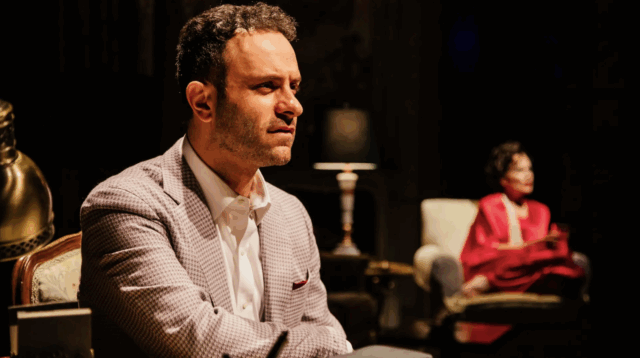
HEROES AND VILLAINS: WELL, I’LL LET YOU GO KEEPS YOU GUESSING

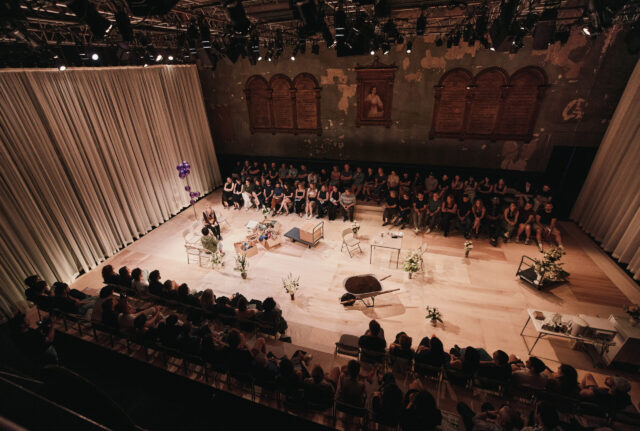
Well, I’ll Let You Go takes place in a reconfigured Space at Irondale (photo by Emilio Madrid)

WELL, I’LL LET YOU GO
The Space at Irondale
85 South Oxford St. between Fulton St. & Lafayette Ave., Brooklyn
Monday to Saturday through September 12, $64 to $141
www.letyougonyc.com

Director Jack Serio turns the vast 6,000-square-foot Space at Irondale, which has 28-foot-high ceilings and can accommodate up to 250 people, into an intimate theatrical venue in his latest sublimely staged drama, Well, I’ll Let You Go, actor Bubba Weiler’s moving playwriting debut about grief and community.

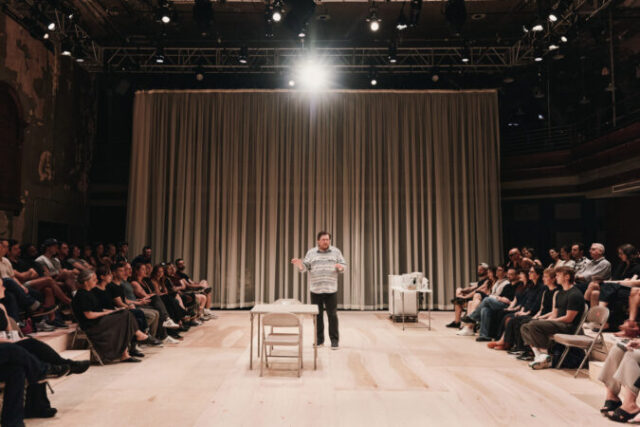
Frank J. Oliva creates a narrow, horizontal set in the large former church nave. An unpainted wooden floor is flanked by the audience of ninety-nine, seated in two rows of folding chairs (the second on risers) on the two long sides. Curtains at either end delineate what we’re told is the family room, which has plain and imaginary furniture that an Our Town–like narrator (Michael Chernus) explains actually consists of a glass-topped circular table, a piano, a television, a fireplace, a big recliner, and an old sectional couch.

The narrator starts things off with a Thornton Wilder–esque introductory monologue.

“The house is in a medium-sized town in the Midwest. Thirty thousand people. One of many towns — nearly identical — that popped up in the early 1800s along the banks of a strong and wide river. Once home to the most fertile farmland in the country, it was slowly and steadily paved
over to become an unremarkable but nice American suburb. Two high schools, a community college. Strip malls, chain restaurants, gravel bike path, riverboat casino. You know the kind of place. Maybe you’re from one. A lot of us are,” he says with great casualness. “The town’s economy — for a long time — was propped up by a factory that manufactured farming equipment and was hit hard when those jobs moved abroad sometime in the early 2000s. Now everyone works at the newly opened Amazon Fulfillment Center. It’s a get-by kind of town and most people do.”

The 1934 farmhouse was purchased in the 1990s by Maggie (Quincy Tyler Bernstine), a teacher, and her husband, Marv, a lawyer who has just died in a tragic situation at a local college. He quickly goes from hero to possible villain as Maggie learns more about what he did in his free time, through a series of one-on-one conversations she has with others who believe they are comforting her.

Michael Chernus serves as a welcoming narrator in Bubba Weiler’s debut play (photo by Emilio Madrid)

Wally (Will Dagger) is a whiny ne’er-do-well with a strange world view who Marv, his cousin, took in when he was down on his luck. “Where would I go anyhow?” he asks at the beginning, having given notice at his Amazon job. When he tells Maggie he is going to sell the car to raise some much-needed cash, she has to remind him that he can’t because it’s actually their car; they just let him use it.

Joanie (Constance Shulman) is a funeral director who needs to plan Marv’s service, presenting Maggie with balloons and samples of carpeting, potpourri, and a photo easel. When Maggie points out that she might not want to have a public funeral, Joanie is flabbergasted. “You can’t just dump the body in the backyard!” she barks. “He’s a figure — now — your husband — a hero. He’s not just, you know, a man — he’s not just yours anymore. He’s yours, of course, but he’s ours.”

Julie (Amelia Workman), Maggie’s sister-in-law — she’s married to Marv’s younger brother, Jeff — shows up with flowers and apologies. The two were best friends growing up but some distance has clearly developed, as Julie discusses Marv’s sacrifice and hints at scandalous gossip surrounding his death.

Jeff (Danny McCarthy), a former navy man, shuffles in next, assuring Maggie that Marv had no secret life and advising that she needs to decide how to proceed. “It’s just there’s a timing to these things,” he says. “The longer we wait the crazier people are gonna get.”

The mysterious Angela (Emily Davis), who has been calling Maggie constantly and not leaving messages, shows up unexpectedly, with yet more shocking news for her. “I don’t know what I’d do,” Angela tells her, if she were in the same situation. That statement is at the heart of Maggie’s dilemma as she gets ready to bury Marv and face life alone.

And then Ashley (Cricket Brown), a waitress at the local club Marv frequented, comes by, wondering what it all means. “Everything we do when a person dies is so weird,” she ponders. “It’s like people have been dying for thousands of years — How have we not figured out how to not be so weird about it always.”

Maggie (Quincy Tyler Bernstine) faces an uncertain future after the tragic death of her husband (photo by Emilio Madrid)

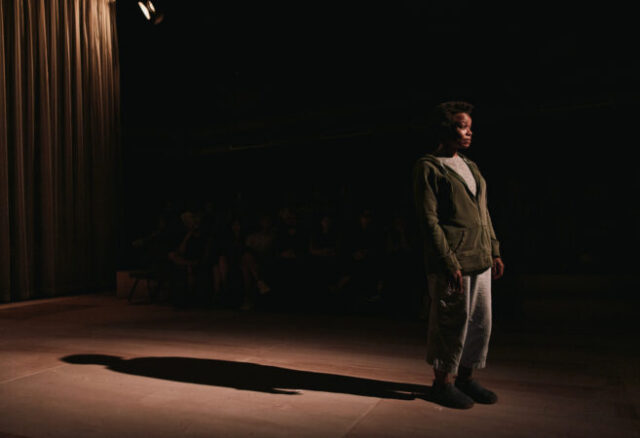
Obie winner Chernus (In the Wake, The Aliens) is warm and inviting as our host, sharing information in a friendly, caring way and watching the action with us, occasionally sitting down in one of two empty chairs in the audience; I could have listened to him all night. Tony nominee Bernstine (Doubt: A Parable, The Amateurs) weaves a complex web as Maggie, who is unpredictable as she contemplates her past, present, and future, searching for her path to grief as others question why she isn’t following societal protocol. In a loose-fitting gray hoodie and baggy pants, Bernstine is onstage the whole hundred minutes, along with Chernus; you can’t take your eyes off either of them. (The costumes are by Avery Reed, with lighting by Stacey Derosier, sound by Brandon Bulls, and original music by Avi Amon).

Serio knows how to put a cast together, and he has another superb ensemble here, even if they are never onstage together, save for a breathtaking surprise as the conclusion approaches. Workman (The Antiquities, Fefu and Her Friends), Dagger (The Antelope Party, Uncle Vanya), Davis (Is This a Room, Singlet), McCarthy (The Minutes, The Antipodes), Shulman (Shhhh, The Best We Could), and Brown (Lobster, This House Is Not a Home) all do their part, eliciting different emotions in every scene.

Drama Desk nominee Weiler, who has also written The Saviors and This Room Is for Everybody and appeared in Harry Potter and the Cursed Child and Swing State, shows a keen ear for dialogue and relationships, keeping the audience guessing as the plot intensifies. Drama Desk and Obie winner Serio (Grangeville, Danger and Opportunity, Uncle Vanya, The Animal Kingdom) expertly builds the pace as revelations emerge, balanced by Chernus’s calm demeanor and Bernstine’s poignant depiction of Maggie’s unease and disbelief. Grief has been a popular theater topic since the pandemic, but Serio and Weiler offer a unique perspective. [ed. note: Marin Ireland replaces Bernstine for the last two weeks of the run, due to a previous commitment.]

At the preview I saw, there was an issue with the sound; we found it difficult to understand what the actors were saying when their backs were to us and they were farther away — we could hear them speaking but not make out the words. Hopefully that has been dealt with. Otherwise, Well, I’ll Let You Go is a sparkling triumph.

[Mark Rifkin is a Brooklyn-born, Manhattan-based writer and editor; you can follow him on Substack here.]
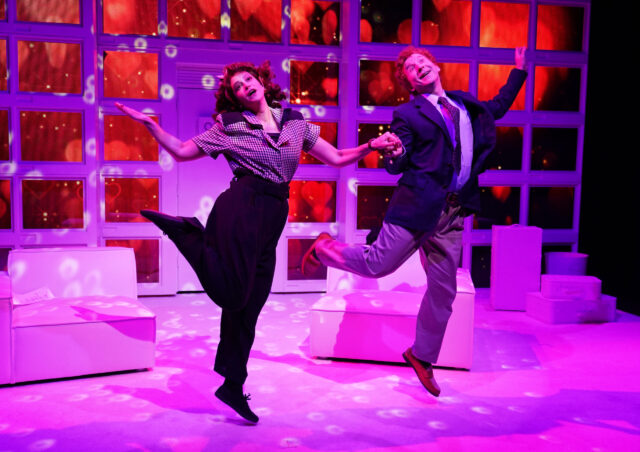
FREEDOM FROM THE YOKE OF LANGUAGE: THE MUSICIANS

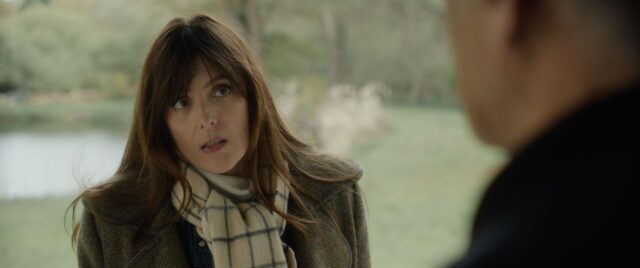
Astrid (Valérie Donzelli) is determined to stage a special one-of-a-kind concert in The Musicians

THE MUSICIANS (LES MUSICIENS) (Grégory Magne, 2024)
Cinema Village
22 East 12th St. between University Pl. & Fifth Ave.
Opens Friday, August 8
212-529-6799
www.cinemavillage.com
www.outsiderpictures.us

“Music is alive. To play it, you need to live it,” composer Charlie Beaumont (Frédéric Pierrot) says in Grégory Magne’s beautiful French comedy-drama The Musicians, a cinematic symphony not just for classical music lovers.

The film opens with a pan of what appears to be a regular-size interior wooden room but turns out to be the inside of a cello, soon confirmed by luthier François (François Ettori) to be the cherished Stradivarius San Domenico, which is up for auction. Determined to carry out her deceased father’s longtime wish, Astrid Carlson (Valérie Donzelli) wants to acquire the instrument to add to the two Stradivarius violins (including the 1713 Wodyka) and viola the family already owns and organize a concert in which four of the best musicians in the world will perform a specially commissioned piece as a kind of one-time-only string quartet supergroup, to be broadcast live around the world from a relatively undistinguished church chosen by her father. Her brother (Nicolas Bridet) is against it from the start, claiming the foundation cannot afford the cello and should instead be selling off the other three instruments, but Astrid won’t take no for an answer.

She pursues violinist George Massaro (Mathieu Spinosi), a lone wolf who plays by his own rules; blind second violinist Peter Nicolescu (Daniel Garlitsky) and cellist Lise Carvalho (Marie Vialle), who have a past that might prevent them from teaming up; and violist Apolline Dessartre (Emma Ravier), a sexy young social media starlet. The four instruments may have been made from the same tree, but that doesn’t mean it will be easy for Astrid to get the musicians on the same page. Things go so poorly at first that she tries to enlist Charlie for help; the reclusive, dour composer is initially not interested but eventually comes around, although he has his doubts from the start that this is a good idea.

A temporary classical supergroup faces professional and personal challenges in symphonic film

Although the four musicians are exceptional, the concert is primarily about the Stradivari. At one point, when the quartet is off to a rehearsal, Charlie is surprised to see a motorcade pulling away. “A car for each musician . . . Quite a heavy carbon footprint,” he says. Astrid responds, “They can’t travel together. Request from the insurance companies.” Charlie ponders, “Just like royalty. Two heirs should never fly on the same flight.” To which Astrid clarifies, “I meant the instruments.”

Over the course of one week before the concert, egos clash and tempers explode, making it seem like this impossible performance might indeed be impossible.

The Musicians features a marvelous original score by Grégoire Hetzel, who has composed music for films by Arnaud Desplechin, Mathieu Amalric, and Kiyoshi Kurosawa, cowrote the opera La Chute de Fukuyama, and penned the novel Le Vert Paradis. The soundtrack is supplemented with pieces by Mozart, Bach, Fauré, and Lead Belly.

French actress, director, and screenwriter Donzelli (Martha . . . Martha, The Queen of Hearts) is tender and vulnerable as Astrid, the emotional center of the narrative; everything is seen through her eyes. But César-nominated French film, television, and theater star Pierrot is sensational as Charlie, a deeply conflicted man who is uncomfortable in his own skin. “I started making music to free myself . . . from the yoke of language,” he says poetically even as he appears trapped. (His character is perhaps named after jazz saxophonist Charlie Beaumont, as Pierrot is a jazz aficionado who plays the clarinet, and there are elements of jazz in the way Charlie approaches his music.)

Moscow-born violinist and pianist Garlitsky (Paul and Paulette Take a Bath, Chez Maupassant), French equestrian, mezzo-soprano, and violinist Ravier (Two Sons, A Private Life), French violinist Spinosi (La Mélodie, Les Souvenirs), and French theater director Vialle (Julie est amoureuse, La parenthèse enchantée) form a wonderful, fully believable foursome, each of them a classically trained musician in real life; the youngest of the group, Ravier, is in fact active on social media, posting photos of herself in a bikini, just like her character does in the movie, upsetting the more private George.

Magne (Vingt-quatre heures par jour de mer, Perfumes) conducts the proceedings with expert precision, using his experience making fiction films and documentaries to give the film a naturalistic air. Lovingly photographed by Pierre Cottereau and intricately edited by Béatrice Herminie with exquisite sound design by Nicolas Cantin, Daniel Sobrino, Fanny Martin, and Olivier Goinard, The Musicians is a mellifluous, affectionate, sweet-natured tale that encourages audiences to free themselves from the ever-present yoke of language.

[Mark Rifkin is a Brooklyn-born, Manhattan-based writer and editor; you can follow him on Substack here.]