Ballet Folklorico Mexicano de Nueva York will perform with Mariachi Real de Mexico at cultural festival at National Arts Club
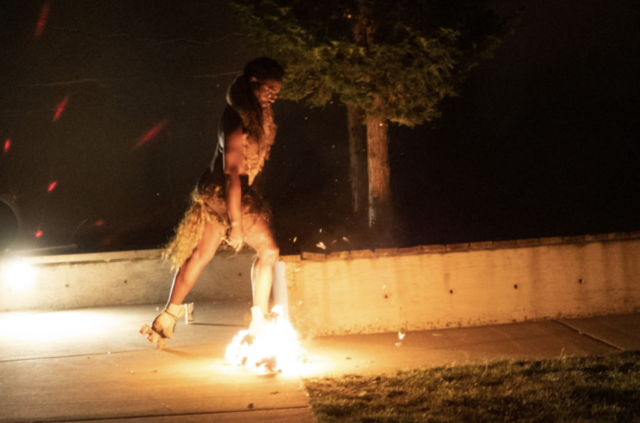
Who:Ballet Folklorico Mexicano de Nueva York,Mariachi Real de Mexico What: Celebration of Mexican culture Where:The National Arts Club, 15 Gramercy Park South When: Saturday, June 18, free with advance RSVP, 1:00 Why: The National Arts Club and the Mexican Cultural Institute are teaming up for “¡Viva México!,” a celebration of Mexican culture, with a special free program on June 18 at 1:00. Part of Festival New York, it begins with Mariachi Real de Mexico playing on the stoop of the club on Gramercy Park South, then heading indoors with dancers from Ballet Folklorico Mexicano de Nueva York, where they will perform traditional works from Veracruz, Jalisco, and the Isthmus of Tehuantepec. In addition, costumes from the eight regions of Oaxaca will be on view. Admission is free with advance registration.
Elevator Repair Service will celebrate the hundredth anniversary of Ulysses at Symphony Space on June 16
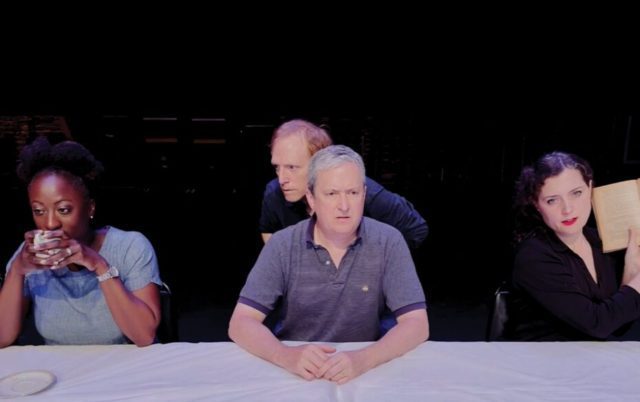
Who:Elevator Repair Service What:Bloomsday on Broadway Where:Symphony Space, Peter Jay Sharp Theatre, 2537 Broadway at Ninety-Fifth St. When: Thursday, June 16, $17-$28, 8:00 Why: Last year, walking on the Lower East Side, I bumped into Scott Shepherd, longtime member of Elevator Repair Service (ERS), which has been presenting unique, experimental theatrical works since 1991. I asked him what he was up to and he said, “Just wait to see what we’re doing for Bloomsday at Symphony Space.” That day has arrived. On June 16, in honor of the centennial of the publication of James Joyce’s masterpiece, Ulysses, ERS will be doing something different at Symphony Space, which has been celebrating the novel for decades by having all-star marathon lineups reading the book on June 16, the day in 1904 in which the story takes place.
Helmed by ERS artistic director John Collins, the two-hour presentation features ERS ensemble members Shepherd, Dee Beasnael, Kate Benson, Maggie Hoffman, Vin Knight, Christopher-Rashee Stevenson, and Stephanie Weeks performing excerpts from each of the book’s eighteen episodes, bringing the tale to life as only ERS can. ERS has previously brought its unpredictable style to F. Scott Fitzgerald’s The Great Gatsby (the eight-hour Gatz), William Faulkner’s The Sound and the Fury, and Ernest Hemingway’s The Sun Also Rises (The Select). The set design is by dots, with costumes by Enver Chakartash, lighting by Mark Barton, sound by Ben Williams, and props by Patricia Marjorie. It all begins with “Stately, plump Buck Mulligan came from the stairhead, bearing a bowl of lather on which a mirror and a razor lay crossed.” For more on the centenary of the novel, be sure to head over to the Morgan Library to see the new exhibit “One Hundred Years of James Joyce’s Ulysses.”
PTDC artistic director Michael Novak is deep in thought during rehearsal for Joyce season (photo by Whitney Browne)
PAUL TAYLOR DANCE COMPANY
Joyce Theater
175 Eighth Ave. at 19th St.
June 14-19, $71-$91 (Curtain Chat follows June 15 show)
212-645-2904 www.joyce.org paultaylordance.org
Growing up in a Chicago suburb, Michael Novak initially tried his hand at sports, but when that didn’t go very well he soon found his muse in musical theater and dance, as both a performer and a disciplined student. Dance became a form of expression that helped him through a severe speech impediment when he was twelve.
He was an artistic associate at the Columbia Ballet Collaborative at Columbia University, where he performed Paul Taylor’s solo from Aureole and graduated magna cum laude and Phi Beta Kappa in 2008. He made his debut with Paul Taylor Dance Company in 2010-11 — Taylor created thirteen roles on him — and, on July 1, 2018, was named the artistic director designate.
At the time, Taylor announced, “I know that Michael is the right person to lead my company in the future. I look forward to working with him to continue my vision.” However, Taylor died that August at the age of eighty-eight, leaving Novak to take on his mentor’s legacy.
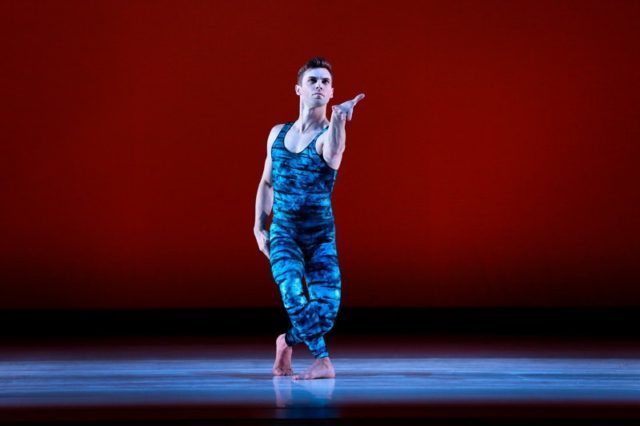
Having guided PTDC through a two-year pandemic lockdown, Novak is now ready to present three special programs at the Joyce, running June 14-19, offering something different from the company’s usual seasons at City Center. The schedule consists of Taylor’s Events II (1957), Images and Reflections (excerpt; 1958), Fibers (1960), Aureole (1962), Tracer (1962), and Profiles (1979), along with a pair of PTDC commissions: the world premiere of Michelle Manzanales’s Hope Is the Thing with Feathers and the New York premiere of Peter Chu’s A Call for Softer Landings.
On the eve of opening night, Novak, who is married to award-winning Broadway choreographer Josh Prince, shared his thoughts on transitioning from dancer to artistic director, navigating through the coronavirus crisis, and planning the future of a beloved, legendary troupe.
twi-ny: You performed with Paul Taylor Dance Company for nine years and were named artistic director designate only a few months before Mr. Taylor’s passing. What were the initial challenges of maintaining his legacy, especially with him no longer there?
michael novak: One of my goals as artistic director is to both preserve Mr. Taylor’s art, legacy, and values while also innovating to push the art form forward driven by my own beliefs and vision. Initially, many of the challenges were centered on how to hold space for the death of a founder and simultaneously move forward, bringing tens upon tens of thousands of people along with us.
But we did it, launching the Celebration Tour in 2019 — a multiyear international retrospective of the most celebrated and captivating dances by Paul Taylor — and creating PTDF Digital, a platform that created a host of unique digital engagements during the pandemic.
twi-ny: How was your transition from dancer to artistic director?
mn: The transition from dancer to artistic director was, overall, smooth. I have always had a passion for arts administration, dance history, and graphic design, so those passions have served me well, as has my education from the Columbia University School of General Studies.
twi-ny: Just as you’re establishing yourself as artistic director, the pandemic hits. What was lockdown like for you, both personally and professionally?
mn: The initial phase of lockdown was extraordinarily unsettling because I was very concerned about our dancers’ safety and company’s sustainability. Simply, we worked nonstop . . . on revamping our educational platforms, rethinking social media strategy, building new ways to engage with patrons and audiences, and, most importantly, getting our dancers back in the studio as soon as possible. We knew that if we wanted to thrive in such a volatile environment, adaptability and sustained momentum were essential.
Michael Novak performs in Paul Taylor’s Concertiana (photo by Paul B. Goode)
twi-ny: In some ways, dance thrived during the coronavirus crisis, unlike other art forms, leading to innovation in online productions. PTDF Digital included the 2021 gala benefit “Modern Is Now: Illumination.” Can you describe that title and what it has been like creating digital works?
mn: I believe modern is a movement, not just a moment. So, “Modern Is Now” is another way of creating an awareness of our present moment to create and experience something new. Being modern has been the foundation of our past and it is what propels us into the future. It has been a very thrilling opportunity to step into the digital world and reach audiences in new ways. At the same time, it has made me realize the poignancy and preciousness of live performances where audiences and artists are in the same space experiencing art together.
twi-ny: In March, PTDC returned to the stage and live audiences at the City Center Dance Festival. What was that experience like?
mn: It was wonderful to be back on the New York stage for our audiences, and at City Center, where so much of our history was made. It was emotional on both sides of the curtain.
twi-ny: The City Center shows saw Michael Apuzzo’s final bow as a dancer, and Jessica Ferretti and Austin Kelly have joined the troupe. What does it take to be a Paul Taylor dancer?
mn: Taylor dancers are known for their athleticism, power, transcendence, and, most importantly, their individuality. They are also known for their emotional range — from the comedic to the horrific, and everything in between.
twi-ny: In preparing for the Joyce season, what Covid-19 protocols were in place, and how did that impact rehearsals?
mn: Covid protocols have changed constantly over the past two years. Our board of directors has been relentless in supporting the company at every stage of this recovery, from daily testing, mask wearing, building upgrades, rehearsal schedule adjustments, etc.
twi-ny: The Joyce season includes the sixtieth anniversary of Aureole, which was a major turning point in Taylor’s career as he reexamined dance as an art form. How do you approach such a piece in 2022? You yourself danced the solo when you were studying at Columbia.
mn: This lyrical, joyful work was a controversial departure from the norm of modern dance in 1962, and it catapulted the then-thirty-two-year-old choreographer to the forefront of the dance world — a position he never relinquished. This is a seminal work that is as impactful now as it was on its premiere. We work diligently with alumni to ensure that its poignancy remains steadfast while also encouraging each artist to find their own voice within the work. It’s balancing both preservation and interpretation.
twi-ny: The three Joyce programs include major works from more than fifty years ago, a New York premiere by Peter Chu, and a world premiere by Michelle Manzanales. What was the impetus behind these specific selections, and how do they differ from the company’s usual Lincoln Center shows?
mn: As artistic director my goal is to curate theatrical experiences that celebrate both our ever-expanding dance repertory and the unique venues we perform in. I have been interested in presenting a series of performances that link early, foundational works from the Taylor canon with new works for a very long time. I am thrilled to present premieres by two of today’s most captivating choreographers, Peter Chu and Michelle Manzanales, at the Joyce.
My vision is to juxtapose the past and future of our company in one of the most intimate dance theaters in our city so audiences will understand — more than ever — how our company sits at a fascinating intersection of radicalism and beauty. These early dances by Paul Taylor were made on small ensembles, and audiences will benefit greatly from their proximity to the stage. It will be up close, visceral, and vibrant.
twi-ny: Four years after taking over as artistic director, what do you see as the next chapters for the company?
mn: The Paul Taylor Dance Company is one of the most innovative, athletic, and expressive dance companies in the world. Our next chapter takes us into celebrating seventy years of bringing the best of modern dance to the broadest possible audience.
We will continue to bring Paul Taylor’s great dances to stages around the world; curate great modern dance from the twentieth and twenty-first centuries; invest heavily in the creation of new work by our resident choreographer, Lauren Lovette, and other compelling choreographers and designers; and expand our educational programming and outreach initiatives.
Modern dance is born out of a desire to innovate, rebel against convention, liberate the human body, and to express the freedom of the emotions of the soul. The need for this never subsides, and our company will never stop innovating and responding to our experiences in the world.
Beth Gill’s Nail Biter is part of twenty-first annual River to River Festival
RIVER TO RIVER FESTIVAL
Multiple locations
June 12-26, free (advance RSVP recommended for some events) lmcc.net/river-to-river-festival
One of New York City’s best and most wide-ranging summer festivals is underway. Sponsored by the Lower Manhattan Cultural Council (LMCC), River to River offers free theater, music, art, dance, and more, from the East River to the Hudson. The twenty-first consecutive iteration begins with Okwui Okpokwasili and Peter Born’s repose without rest without end, a video installation in which the real-life partners (on the way, undone; Poor People’s TV Room) adapt their 2019 interdisciplinary performance piece, Adaku’s Revolt, which investigates ideas of beauty through nature and slavery. The installation is on view at Fosun Concourse Amphitheater at 28 Liberty St. daily through June 26 from 7:00 am to 11:00 pm; in addition, the space will be activated by live performances on June 13 and 20 at 8:00.
On June 17 at 7:00, Jonathan González will be at La Plaza at the Clemente Soto Vélez Cultural & Educational Center at 114 Norfolk St. for the world premiere of Practice, an immersive event focusing on Afro-diasporic idioms featuring Ali Rosa-Salas, Marguerite Angelica Monique Hemmings, Dani Criss, Jordan Lloyd, and Fana Fraser, with music by William “DJ Embe” Catanzaro. On June 18 at 3:00, Amy Khoshbin and Jennifer Khoshbin team up for The Sun Seekers on Governors Island, a participatory induction ceremony in which everyone is encouraged to disconnect from technology and reconnect with the natural world, involving sight, smell, touch, and hearing. On June 18 at 7:00, the opening will be held for Rose DeSiano’s Lenticular Histories: South Street Seaport, an immersive installation on Front St. of large-scale lenticular photographs on sculptural mirrored prisms that will remain on view through June 30.
Skave by keyon gaskin promises to be one of the hottest shows at River to River
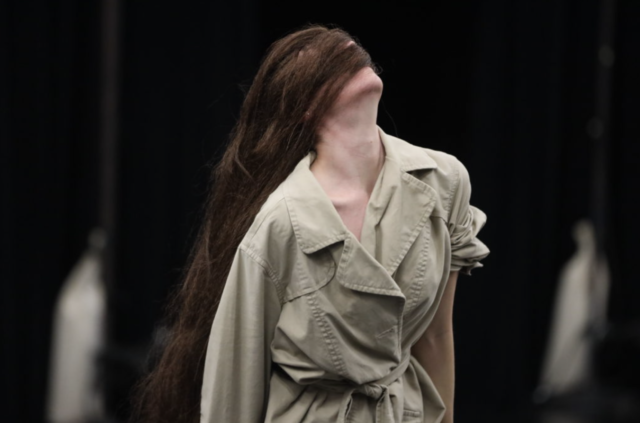
Dancer and choreographer Beth Gill delves into psychodrama and sci-fi in the site-responsive Nail Biter, taking place in Federal Hall on June 22 and 23 at 5:30, with Jordan Demetrius Lloyd, Walter Dundervill, Jennifer Lafferty, Jennifer Nugent, and Marilyn Maywald Yahel moving to a score by Jon Moniaci. On June 23 and 25 at 7:30 at La Plaza, keyon gaskin will present Skave, continuing his journey into oppression, imperialism, colonization, communication, and escape. On June 25 at 4:00, trombonist Craig Harris will lead a large ensemble in Rockefeller Park for Breathe, helping the community fight racial injustice.
Downtown favorite Heather Kravas returns June 25-26 at 8:00 with duet/duet, a piece set at dusk on Governors Island — inside and outside — for opal ingle, Joey Kipp, and Jennifer Kjos, whose movement, to an electroacoustic score by Zeena Parkins, references line drawings and the shapes our bodies can make. The festival was actually supposed to open on June 12 in Teardrop and Rockefeller Parks with Gregory Corbino’s participatory puppet performance Murmurations, but it was canceled because of the weather; watch this space for a rescheduled date. And just a reminder that all events are free, and walk-ups are accepted for sold-out events, as at least a few tickets usually become available around showtime.
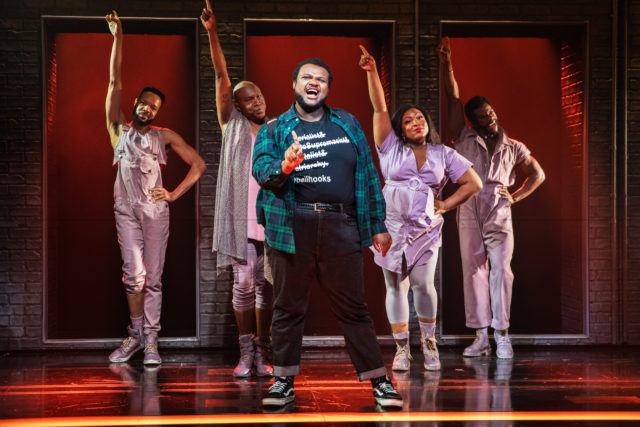
Jaquel Spivey makes his Broadway debut in Pulitzer Prize–winning musical A Strange Loop (photo by Marc J. Franklin)
A STRANGE LOOP
Lyceum Theatre
149 West 45th St. between Sixth & Seventh Aves.
Tuesday – Sunday through January 15, $49 – $225 strangeloopmusical.com
In his 2007 book I Am a Strange Loop, Pulitzer Prize–winning scientist Douglas Hofstadter writes, “In the end, we are self-perceiving, self-inventing, locked-in mirages that are little miracles of self-reference.” In her song “Strange Loop” from her seminal 1993 debut album Exile in Guyville, Liz Phair sings, “The fire you like so much in me / Is the mark of someone adamantly free. . . . I can’t be trusted / They’re saying I can’t be true / But I only wanted more than I knew.”
Hofstadter and Phair are among those who served as major influences on Michael R. Jackson’s dazzling, Pulitzer Prize–winning musical, A Strange Loop, which is bringing down the house at the Lyceum on Broadway following an earlier run at Playwrights Horizons. As the show opens, the protagonist, Usher (Jaquel Spivey), is ushering the audience back to their seats for the second act of The Lion King, adding some unexpected bonus information: “In the background, there will be a young overweight-to-obese homosexual and/or gay and/or queer, cisgender male, able-bodied university-and-graduate-school educated, musical theater writing, Disney ushering, broke-ass middle-class politically homeless normie leftist black American descendant of slaves who thinks he’s probably a vers bottom . . . but not totally certain of that obsessing over the latest draft of his self-referential musical A Strange Loop! And surrounded by his extremely obnoxious Thoughts!” Usher later explains that his self-referential musical is “about a black, gay man writing a musical about a black, gay man who’s writing a musical about a black gay man, who’s writing a musical about a black gay man, etc.”
To bring the loop full circle, Jackson himself is a young overweight homosexual who has been obsessing over his self-referential musical, A Strange Loop, for nearly twenty years; it started off as a monologue in 2003, written when Jackson was working as an usher on Broadway for The Lion King and other Disney extravaganzas and listening to “dat-blasted white girl music” by Phair, Tori Amos, and Joni Mitchell.
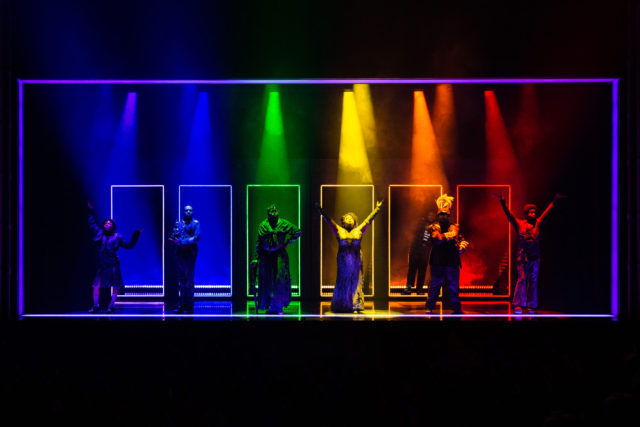
Six thoughts come to colorful life at the Lyceum Theatre (photo by Marc J. Franklin)
Usher’s never-ending fears and worries come to life in the form of six thoughts that roil around in his brain and comment on his decisions like a Greek chorus, including Supervisor of Your Sexual Ambivalence (L. Morgan Lee), Daily Self-Loathing (James Jackson Jr.), Head of Corporate Niggatry (Jason Veasey), and Financial Faggotry (Antwayn Hopper); it’s like a queer Black version of the 1990s cis white sitcom Herman’s Head, in which a young magazine employee’s thoughts of professional and romantic success are debated by four actors playing various parts of his psyche. The actors portraying Usher’s thoughts also take turns as his mother (John-Andrew Morrison), father (Veasey), agent (John-Michael Lyles), and various historical Black figures.
Usher is haunted by his consciousness, especially when he is given the opportunity to ghost write a gospel play for Tyler Perry. Usher feels that writing for Perry would compromise everything he believes in, calling Perry “toxic” and arguing, “The crap he puts on stage, film, and TV makes my bile wanna rise.” However, his thoughts and family want him to do it for the money and because “Tyler Perry writes real life” and “Tyler Perry loves his mama.” The guilt runs deep as Usher pursues both professional and personal opportunities, desperate to make himself seen and heard in a world that too often treats him as if he’s invisible, what he refers to as his “exile in Gayville.” Although not all of the details in the show are autobiographical, Jackson shares a lot in common with Usher, except now everyone knows who Jackson is.
A Strange Loop is stylishly directed by Stephen Brackett (Be More Chill,The Lightning Thief) with a balls-out sense of humor that is furthered by Raja Feather Kelly’s wickedly sly choreography, which has fun with Spivey, who is not your typical Broadway leading man. Arnulfo Maldonado’s set isolates Usher, making his loneliness palpable, while giving each Thought its own doorway, like the different compartments of the brain. Montana Levi Blanco’s costumes are highlighted by Usher’s red usher outfit, which is counteracted by his black T-shirt that includes such crossed-out words as “Imperialist” and “White Supremacist” above the clearly legible “bell hooks,” a tribute to the Black author and activist (Black Is . . . Black Ain’t,I Am a Man: Black Masculinity in America) who passed away in December 2021 at the age of sixty-nine.
The ninety-minute show looks and sounds terrific, with colorful lighting by Jen Schriever, vibrant sound by Drew Levy, music direction by Rona Siddiqui, and wonderful orchestrations by Charlie Rosen, played live by a six-piece band. In his Broadway debut, Spivey, taking over for Larry Owens, who played Usher in the off-Broadway production, is an utter delight. From the opening moments, when he declares, “Everyone, please return to your seats; the second act is about to begin!” to his later acknowledgment that “These are my memories / Sweet sour memories / This is my history / This is my mystery,” he has the audience firmly on his side. You don’t have to be a queer Black man to identify with Usher’s fears and desires, to understand his loneliness. Jackson has done a masterful job of making A Strange Loop an inclusive story while also challenging conceptions of what a Broadway musical can be; this is not The Lion King or Aladdin, and it is most certainly not for kids.
In Gödel, Escher, Bach: An Eternal Golden Braid, Hofstadter writes, “The self comes into being at the moment it has the power to reflect itself.” A Strange Loop works because it reflects on itself, and on all of us, in one way or another.
Myles Frost stars as the King of Pop in MJ the Musical (photo by Matthew Murphy)
MJ THE MUSICAL
Neil Simon Theatre
250 West Fifty-Second St. between Broadway & Eighth Ave.
Tuesday – Sunday through December 30, $84-$299 mjthemusical.com
The most important official line about MJ does not come from two-time Pulitzer Prize winner Lynn Nottage’s book or fifteen-time Grammy winner Michael Jackson’s lyrics; instead, it can be found on the title page of the Playbill: “By special arrangement with the Estate of Michael Jackson.”
The jukebox musical features a star turn by former Voice contestant Myles Frost as the King of Pop. The show opens at his Neverland Ranch as MJ is preparing for a world tour in support of his eighth solo album, 1992’s Dangerous. The extensive, exhausting rehearsals — Jackson is a perfectionist, making demands on the dancers and designers — are being documented by music journalist Rachel (Whitney Bashor) and cameraman Dave (Joey Sorge) for MTV, including occasional access to Jackson himself.
The plot quickly glosses over child abuse allegations — the LAPD would begin investigating Jackson in August 1993 — and has a brief scene dealing with his addiction to painkillers. (Jackson’s death in June 2009 at the age of fifty was attributed in large part to his overdependence on prescription medication.)
The main conflict, and it’s a big stretch, is whether Jackson is willing to put Neverland up for collateral in exchange for a loan that will pay for his spectacular entrance sequence at the start of his concerts. It’s a paper-thin narrative even as we root for Jackson not to lose his beloved home, where many of the alleged abuses purportedly took place. More time is given to talk of his Heal the World Foundation, a charity to help disadvantaged children, than to any accusations. Although one certainly gets invested in seeing just how close the company comes to re-creating Jackson’s songs and movement, that can’t sustain a 150-minute show (with intermission).
Director-choreographer Christopher Wheeldon cuts between rehearsals and key scenes from Jackson’s childhood in the Jackson Five, with the young Michael (Walter Russell III, Christian Wilson, Tavon Olds-Sample) joined by his brothers Marlon (Devin Trey Campbell, Zelig Williams), Jermaine (Lamont Walker II), Tito (Apollo Levine), Randy (Raymond Baynard), and Jackie (John Edwards) as they are discovered and nurtured by Motown founder Berry Gordy (Antoine L. Smith) and producer Quincy Jones (Levine) as parents Katherine (Ayana George) and, especially, the controlling Joe (Quentin Earl Darrington) carefully watch their career.
The songs are terrifically orchestrated and arranged by musical supervisor David Holcenberg and musical director Jason Michael Webb, regularly igniting the crowd. And what a setlist it is: “ABC,” “Bad,” “Beat It,” “Billie Jean,” “Black or White,” “Dancing Machine,” “Man in the Mirror,” “Smooth Criminal,” “Thriller,” and “Wanna Be Startin’ Somethin’,” among others. The show is a tech success, with sets by Derek McLane, lighting by Natasha Katz, costumes by Paul Tazwell, sound by Gareth Owen, and projections by Peter Nigrini; Charles Lapointe does a great job with hair and wigs.
Darrington (Once on This Island,Ragtime) stands out doing double duty as tour manager Rob and Joe Jackson, as Nottage (Sweat,Ruined) and Tony winner Wheeldon (An American in Paris,Cinderella) make direct comparisons to the two men’s influences on Michael’s personal and professional lives and how they protect him. But it’s not enough to offset everything that is left out of the story, which looms over the production like a dark cloud.
In the song “Keep the Faith” from the Dangerous album, Jackson sings, “If you call out loud / Will it get inside / Through the heart of your surrender / To your alibis / And you can say the words / Like you understand / But the power’s in believing / So give yourself / A chance.” MJ the Musical feels like a chance for the Michael Jackson Estate to exploit those alibis without really looking at the man in the mirror.
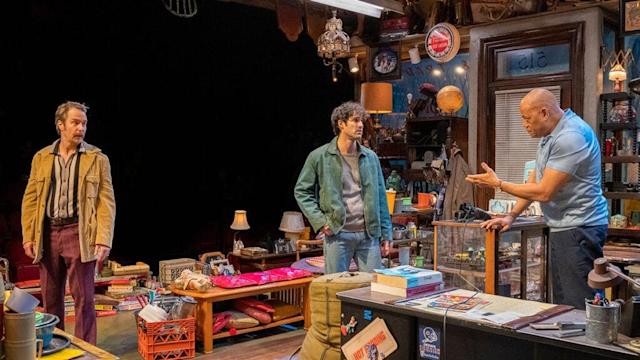
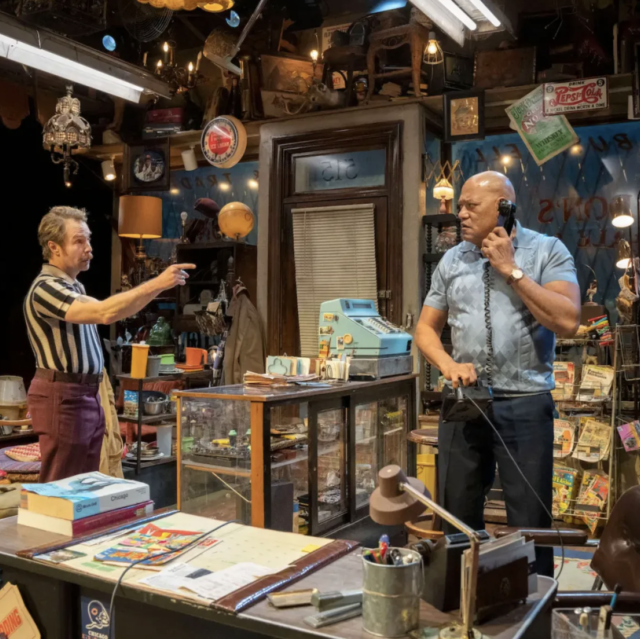
Sam Rockwell, Darren Criss, and Laurence Fishburne star in latest Broadway revival of David Mamet’s American Buffalo (photo by Richard Termine)
AMERICAN BUFFALO
Circle in the Square Theatre
1633 Broadway at 50th St.
Tuesday – Sunday through July 10, $79.50 – $299.50 americanbuffalonyc.com
In 1981, at the downtown Circle in the Square on Bleecker St., a high school classmate of mine named Rich and I saw David Mamet’s American Buffalo, a searing three-character drama starring Al Pacino, Clifton James, and Thomas G. Waites as a trio of luckless losers in a Chicago junk shop plotting a low-level heist. Last month, Rich and I saw the third Broadway revival of the play, at Circle in the Square in the Theater District, a still-sizzling play with another all-star cast: Sam Rockwell, Laurence Fishburne, and Darren Criss.
A lot has changed over the last forty-one years. Rich and I both moved out of Long Island; he is a married insurance defense lawyer in Queens with two kids, while I’m a married culture writer and managing editor in Manhattan. Mamet, for decades celebrated as one of the country’s most important and talented playwrights and filmmakers — he’s been nominated for two Oscars, three Emmys, and two Tonys and won the Pulitzer Prize for 1983’s Glengarry Glen Ross — has now been turned into a pariah by the left because of his Trumpist political views and condemnation of liberalism, which dates back to around 2011, along with the toxic masculinity and misogyny that appear throughout his work.
The last decade has witnessed a quartet of disasters by Mamet — the oh-so-brief Broadway debuts of The Anarchist and China Doll, an ill-fated revival of Glengarry Glen Ross, and the world premiere of the disappointing The Penitent — but all of that has little to do with Neil Pepe’s powerful new staging of American Buffalo; my only quibble is that the intermission gets in the way of the flow of the drama, which is only eighty-five minutes without the break. (Most of Mamet’s works are between sixty and one hundred minutes, so he certainly has a way of getting right to the point.)
Donny (Laurence Fishburne) gets an earful from Teach (Sam Rockwell) in American Buffalo (photo by Richard Termine)
American Buffalo takes place in an impossibly crowded downstairs junk shop. It’s a Friday morning, and middle-aged store owner Donny Dubrow (Laurence Fishburne) is talking with Bobby (Darren Criss), a young simpleton who helps him out on occasion. In this case, Donny has asked Bobby to keep watch on a guy who had come into the store and purchased a buffalo nickel from him for ninety bucks. Donny compares the stranger to their friend Fletcher, who just won a stash playing cards.
“You take him and you put him down in some strange town with just a nickel in his pocket, and by nightfall he’ll have that town by the balls,” Donny says. “This is not talk, Bob, this is action. . . . Skill. Skill and talent and the balls to arrive at your own conclusions.”
While Donny goes out of his way to teach Bobby about life, their friend Walter Cole (Sam Rockwell), better known as Teach, isn’t seeking out any teaching moments. He whirls into the shop, complaining about this and that, finding offense in minor incidents, lashing out with a slew of curses as he recounts supposed wrongs done to him. “Someone is against me, that’s their problem,” he barks. “I can look out for myself, and I don’t got to fuck around behind somebody’s back, I don’t like the way they’re treating me. Or pray some brick safe falls and hits them on the head, they’re walking down the street. But to have that shithead turn, in one breath, every fucking sweetroll that I ever ate with them into GROUND GLASS — I’m wondering were they eating it and thinking ‘This guy’s an idiot to blow a fucking quarter on his friends‘’ . . . this hurts me, Don. This hurts me in a way I don’t know what the fuck to do.” When Donny tries to calm him down, the bloviator says, “The only way to teach these people is to kill them.”
Amid a series of Pinteresque discussions, each more absurd than the last as they talk about English muffins, bacon, the weather, coffee, cheating at cards, pigirons, and loyalty, they plot a heist, deciding to rid the buffalo nickel customer of all of his coins later that night. What could possibly go wrong?
American Buffalo is a character-driven masterpiece about low-level dreams gone awry, about people who started with nothing and have no idea how to get their piece of the pie, or at least not legally. It’s field day for three actors; past productions have featured such trios as Robert Duvall, Kenneth McMillan, and John Savage; William H. Macy, Philip Baker Hall, and Mark Webber; John Leguizamo, Cedric the Entertainer, and Haley Joel Osment; and Damian Lewis, John Goodman, and Tom Sturridge.
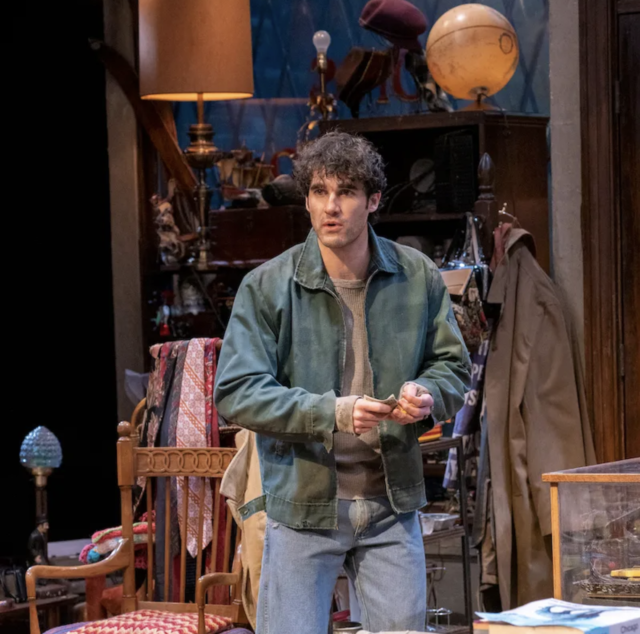
Daren Criss holds his own with big-timers Sam Rockwell and Laurence Fishburne in Mamet revival (photo by Richard Termine)
The current Broadway revival, staunchly directed by Neil Pepe (Hands on a Hardbody,Dying for It), who has helmed many of Mamet’s works — including the 2000 revival at the Donmar Warehouse and the Atlantic Theater, which was cofounded by Mamet and Macy and where Pepe has been artistic director for thirty years — is another acting tour de force, with Criss (How to Succeed in Business without Really Trying,Hedwig and the Angry Inch) sublime as the gentle Bobby, Fishburne (Two Trains Running,Riff Raff) steadfast as the straightforward Donny, and a mustachioed Rockwell (A Behanding in Spokane,Fool for Love) right on target as the unsettling, unpredictable Teach, his polyester slacks practically a character unto themselves. (The costumes are by Dede Ayite.)
Scott Pask’s set is like a character unto itself as well, consisting of hundreds of items cluttering the floor and filling the ceiling over the men’s heads; these pieces of junk are like parts of their brain, all the thoughts and desires swimming around their skulls, likely to never come to fruition, just taking up space in these ne’er-do-wells who can’t see clearly ahead of themselves.
Right before the show started, Rich reminded me that when he had taken a stab at acting and stand-up comedy after college, his go-to audition speech was from American Buffalo, Teach’s first words: “Fuckin’ Ruthie, fuckin’ Ruthie, fuckin’ Ruthie, fuckin’ Ruthie, fuckin’ Ruthie.” After experiencing the play with him again after four decades, that choice made perfect sense to me.