live performance

THE QUEENS OF QUEENS: IN SEARCH OF THE AMERICAN DREAM

Polish immigrant Renia (Marin Ireland) dreams of a better life in Martyna Majok’s reimagined Queens (photo by Valerie Terranova)

QUEENS
MTC at New York City Center – Stage I
131 West Fifty-Fifth St. between Sixth & Seventh Aves.
Tuesday – Sunday through December 7, $109-$139
www.manhattantheatreclub.com
www.nycitycenter.org

Polish-born American playwright Martyna Majok tells stories that challenge the audience, taking risks as she explores the lives of the disenfranchised, the disabled, the underrepresented, and undocumented immigrants in search of the unreachable American dream. In Cost of Living, which earned her the Pulitzer Prize, it all came together without compromise; I wrote of the Broadway version, “The separate storylines merge at the end in an uneasy finale that acknowledges that we all encounter tremendously painful issues in life, regardless of our physical or psychological situations, which is further established during the curtain call.”

Her three other plays were not quite as successful despite intriguing setups and intricate narratives. About Ironbound, I noted, “The rest of the cast play their roles well, but their characters and tales are nowhere near as interesting and compelling as Darja’s, and they become somewhat quaint and repetitive as the show goes on and overdoes the obvious distinctions between rich and poor.” And I wrote that Sanctuary City “takes a head-scratching turn as the ending approaches, detracting from everything that came before it, which was powerful and moving.”

Queens, which originally ran at LCT3 in 2018 and is now at MTC’s New York City Center – Stage I through December 7 in a newly reimagined version, displays too many of the same issues; the play features characters and situations that you want to embrace and understand, but Martok and director Trip Cullman (Cult of Love, Six Degrees of Separation) are unable to weave their way through a web of fascinating ideas that don’t quite mesh. As with Ironbound and Sanctuary City, there’s a strong play in there that refuses to emerge.

A group of women seek common ground in MTC production at City Center Stage I (photo by Valerie Terranova)

Over the course of sixteen years, seven immigrant women move in and out of a crowded basement apartment in Queens, desperate to find a better life in America: the Belarusian Pelagiya (Brooke Bloom), the Polish Agata (Anna Chlumsky), the Polish Renia (Marin Ireland), the Ukrainian Inna (Julia Lester), the Afghan Aamani (Nadine Malouf), the Ukrainian Lera (Andrea Syglowski), and the Honduran Isabela (Nicole Villamil).

“Any regrets? In your life? In this building?” Inna asks Renia. Although she doesn’t want to admit it, Renia has plenty, having made choices that did not necessarily work out the way she expected. Inna punches her in the face before going inside and renting a room.

The basement is cluttered with clothing, a guitar, and other objects that are memories of those who came before, haunting Renia. (The effective set is by Marsha Ginsberg.) “What is your reason?” the memory of Pelagiya asks her. Aamani adds, “The reason you are here. Looking to live someplace away from the rest of your kind of people. What happened.”

The narrative then shifts to December 2001, when Renia has arrived in New York with little money in her pocket. Pelagiya wants to know what brought her there. “It’s no story,” Renia says. “It’s always story,” Pelagiya insists. Renia responds, “I need place I can stay. I come here. End of story.” Of course, it’s only the beginning of what turns out to be a dark, painful story. Even a somewhat pathetic party the women hold is tinged with fear and sadness. The appearance of the Honduran American Glenys (Sharlene Cruz) injects a burst of youthful energy, but it’s not enough to sustain the play’s 135 minutes (with intermission).

Queens does serve as a fascinating counterpoint to Bess Wohl’s dazzling Liberation, the current Broadway transfer about six diverse women who meet regularly in a rec center basement in Ohio in the 1970s to discuss the role of women in society, how it impacts their lives individually and what they can do to help change the status quo publicly; both shows delve into the relationships among women as well as mothers and daughters. The Queens women, however, have a different kind of baggage — obviously, they lack the relative privilege of the characters in Liberation, and face colossal odds stacked against them, coming from countries where women are still in search of freedom, fifty years after the Liberation women began changing America. Still, women’s search for the most basic of freedoms is the motor that drives Queens, even if the ride is bumpy and the destination uncertain.

[Mark Rifkin is a Brooklyn-born, Manhattan-based writer and editor; you can follow him on Substack here.]

SEEING HELENE SCHJERFBECK: PANEL DISCUSSION AT SCANDINAVIA HOUSE

Helene Schjerfbeck, Self-Portrait, oil on canvas, 1912 (Finnish National Gallery Collection / Ateneum Art Museum; photo courtesy Finnish National Gallery / Yehia Eweis)

Who: Dr. Anna Maria von Bonsdorff, Dita Amory, Patricia Berman
What: Panel discussion on the life and career of Helene Schjerfbeck
Where: Scandinavia House, 58 Park Ave. between Thirty-Seventh & Thirty-Eighth Sts.
When: Wednesday, December 3, free with advance RSVP, 5:00
Why: On December 5, the Metropolitan Museum of Art is opening “Seeing Silence: The Paintings of Helene Schjerfbeck,” an exhibition featuring nearly sixty works by Finnish modernist painter Helene Schjerfbeck (1862–1946), from landscapes and portraits to still-lifes and self-portraits. You can get a behind-the-scenes preview of the show on December 3 at 5:00 when Scandinavia House hosts a panel discussion with Ateneum Art Museum Finnish National Gallery director Dr. Anna Maria von Bonsdorff, Met Museum Robert Lehman Collection curator in charge Dita Amory, and Wellesley College art professor Patricia Berman. The event, which is part of Scandinavia House’s twenty-fifth anniversary celebration, is free with advance RSVP.

Be sure to arrive early to check out the institution’s current exhibit, “A Time for Everything: 25 Years of Contemporary Art at Scandinavia House,” comprising works by such artists as Jesper Just, Louisa Matthíasdóttir, Shoplifter / Hrafnhildur Arnasdóttir, Pekka & Teija Isorättyä, Jeppe Hein, Olav Christopher Jenssen, Outi Pieski, and Olof Marsja.

[Mark Rifkin is a Brooklyn-born, Manhattan-based writer and editor; you can follow him on Substack here.]
BY THE SKIN OF OUR TEETH: THE SEAT OF OUR PANTS SETS WILDER TO MUSIC

The Antrobus family faces the weight of the world in The Seat of Our Pants at the Public (photo by Joan Marcus)

THE SEAT OF OUR PANTS
Newman Theater, the Public Theater
425 Lafayette St. at Astor Pl.
Tuesday – Sunday through December 7, $125
publictheater.org

Just because The Skin of Our Teeth won Wisconsin native Thornton Wilder his third Pulitzer Prize doesn’t mean the 1942 work isn’t a slog, dense with metaphor, festooned with oddball characters and bizarre scenarios, and obsessed with strange time-shifting interventions. I’ve seen two recent productions, an overstuffed mess at Lincoln Center in 2022 and an exemplary revival from TFANA in 2017, but even the latter required significant attention from the audience to sift through Wilder’s complex storytelling as he essentially shares a tale that is nothing less than an encapsulation of the survival of living creatures on this planet.

The quartet of Leonard Bernstein, Jerome Robbins, Betty Comden, and Adolph Green attempted to turn The Skin of Our Teeth into a musical but eventually abandoned the project, as did the trio of John Kander, Fred Ebb, and Joseph Stein. But now Obie-winning composer, bandleader, playwright, and librettist Ethan Lipton has taken on the challenge and delivered an exciting and fun, if still problematic, musical adaptation called The Seat of Our Pants, continuing at the Public’s Newman Theater through December 7.

The 160-minute show (with intermission) is divided into The Skin of Our Teeth’s usual three acts, the first during the Ice Age in Excelsior, New Jersey, complete with dinosaurs and humans getting along well; the second on the boardwalk in Atlantic City at a convention of the Ancient and Honorable Order of Mammals, Subdivision Humans; and the third back in Excelsior following a devastating war. Each act is introduced by an announcer (Andy Grotelueschen), singing with a mic stand and asking the audience to join in. He advises at the very beginning, “I want to tell you that the news is good / I want to shout it out in every neighborhood / But I can’t lie to you — although I had assumed I would / The world is ending, the world is ending.”

At the center of everything is the Antrobus family: the father (Shuler Hensley), a successful and important businessman; his wife (Ruthie Ann Miles), a kind and practical woman; and their two children, the promising Gladys (Amina Faye) and the less-than-promising Henry (Damon Daunno). Holding it all together is their maid, Lily Sabina (Micaela Diamond), who often addresses the stage manager and the audience directly, complaining about the play itself. When someone apparently misses a cue, Sabina repeats a key line, “Don’t forget — we made it through the recession-pandemic-wildfire-oligarchy by the seat of our pants. One more crisis like that and then where will we be?” Fitz, the stage manager, tells her to stretch it out because of technical issues, but Sabina is having none of it.

“I will not invent words for this show,” she argues. “I hate this show and every line in it. I don’t understand a word of it anyway — all about the troubles of the human race? Now there’s a subject for you. Besides, the author hasn’t decided whether it’s set back in the caves or in New Jersey today. And now some other guy’s added songs. Songs! Because that’s what it was missing.”

Humans and animals interact in New Jersey in inventive musical based on Thornton Wilder play (photo by Joan Marcus)

But it turns out that many of the songs, including “The World Is Ending,” “Sabina’s Suite,” “Stuff It Down Inside,” and “Ordinary Girl,” inject life into the narrative, accompanied by clever staging by director Leigh Silverman (Yellow Face, Grand Horizons), boisterous choreography by Sunny Min-Sook Hitt, witty orchestrations and arrangements by Daniel Kluger, Lee Jellinek’s gleeful, open set with the audience on two sides facing each other and the band on the other two sides, and costumes (by Kaye Voyce) that range from suburban casual to convention uniforms to a talking mammoth (Geena Quintos) and turkey (Bill Buell) duo to band outfits that match the flowery yellow wallpaper. The attention to detail in the costumes and the set changes are hilarious.

But, as Sabina repeated, “Don’t forget —” that this is based on The Skin of Our Teeth, so not everything makes sense, scenes go on too long, and there are too many songs. But watching the cast, led by wonderful performances by Grotelueschen (Into the Woods, Pericles) and Diamond (Parade, The Cher Show), having so much fun — even band member Allison Ann Kelly gets in on the action — is infectious.

I’m thinking that The Skin of Our Teeth is back in favor because of the current state of the country and the world amid wars, the immigration crisis, economic instability, political dysfunction, climate change, polarization, and general havoc and maelstrom. So why not turn it into a charming musical? Obie winner and Guggenheim fellow Lipton (We Are Your Robots, The Outer Space) has done just that.

“I am skin and bones, and I have escaped only by the skin of my teeth,” Job says in the Old Testament. With The Seat of Our Pants, we escape with much more.

[Mark Rifkin is a Brooklyn-born, Manhattan-based writer and editor; you can follow him on Substack here.]
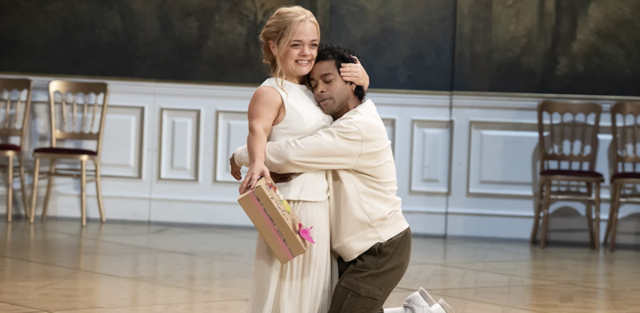
TAKING THE INTITIATIVE: A MORE-THAN-WORTHWHILE FIVE-HOUR THEATRICAL EXPERIENCE

Else Went’s Initiative unfolds over more than five hours at the Public Theater (photo by Joan Marcus)

INITIATIVE
LuEsther Hall, the Public Theater
425 Lafayette St. at Astor Pl.
Tuesday – Sunday through December 7, $109
publictheater.org

“Do you think we’ll do anything worthwhile with our lives? Is it even possible?” Clara (Olivia Rose Barresi) asks Riley (Greg Cuellar) about halfway through Else Went’s Initiative.

Experiencing the play is worthwhile, whether it’s the five-plus-hour performance, with three ninety-minute acts and two intermissions, or the six-and-a-half-hour one, with an added dinner break.

The show is set in “Coastal Podunk, California,” where a group of high school classmates explore first love, traumatic loss, and just about everything in between at the dawn of the new millennium as they begin to try to seek their place in an ever-more complex universe. In the early aughts, just after Y2K has not destroyed society, seven teenagers navigate adolescence, essentially without adults, on their own; we occasionally hear the garbled offstage shouting of two brothers’ unbalanced mother and the disembodied voices of Mr. Stone, a somewhat comforting English teacher, and Ms. May, a sensitive guidance counselor (both voiced by Brandon Burk). The tech age is upon the teens as they obsess over Super Nintendo and instant messaging on the internet — but only when they’re home at their computers. “The world is . . . tumultuous right now, and taking in too much information . . . can actually be dangerous,” Ms. May tells Clara, who responds, “It’s just that this is, like, the world, right? That I’m gonna inherit. Everyone’s always like ‘you’re the leaders of tomorrow,’ that sort of thing, but at the same time nobody wants to explain yesterday.”

Clara has returned to the classroom after several years of home-schooling by her religious parents. She is in love with Riley (Greg Cuellar), who admits to her he is gay but wants to remain her best friend. Clara seeks solace in Lo (Carson Higgins), a selfish, callous kid who is a star pitcher hiding something that happened between him and Riley at summer camp. Lo’s younger brother, Em (Christopher Dylan White), is a loner addicted to video games and unsure of how to return the affections of the sexy Kendall (Andrea Lopez Alvarez), the most progressive of the gang. Tony (Jamie Sanders), the least refined of them, has a crush on Kendall but becomes more of a bully after she doesn’t go for him and she becomes good friends with a shy, reserved new student, Ty (Harrison Densmore).

Over the course of four years, the teens discover things about themselves and each other as college approaches. Oh, and they spend a whole lotta time playing Dungeons and Dragons. Really. And it’s a blast to watch.

A continuing game of Dungeons and Dragons provides an exhilarating break during five-hour play (photo by Joan Marcus)

Initiative shouldn’t be compared to such other time behemoths as The Iceman Cometh, Strange Interlude, and the grandmaster of them all, Gatz. Written by Else Went and directed by Emma Rosa Went, who are married millennials who met in high school, the play, loosely inspired by their real lives, is performed by actors who are also millennials, which lends them an understanding of what their characters are going through; they might not look fourteen or fifteen, but they act it in a very empathetic, understanding way. In addition, several of them have been with the project since its start nearly ten years ago, giving them the opportunity to develop their portrayals.

Mikiko Suzuki MacAdams’s large, open set features a row of lockers, two swings, a glowing abstract orb that represents a popular local tree (as well as the end of innocence), a bridge in the back, and a series of arches that evoke Greek drama; desks, beds, chairs, tables, benches, and other furniture are wheeled on- and offstage, and a hot tub emerges from beneath. S. Katy Tucker’s projections focus on stars, the galaxy of opportunities awaiting the teenagers — as well as the challenges they will face. Noticing shooting stars out the window, Lo says to Riley early on, “You ever think about dying?”

The cast is extraordinary, holding our attention for five hours, making us care what happens to each character, even during the D&D scenes, which allow them, and the audience, to temporarily break free of their inner turmoil. Christopher Akerlind’s lighting and Angela Baughman’s sound further engage us in the proceedings, along with Kindall Almond’s period costumes.

The play is about fifteen minutes too long, and the Wents seem unsure how to end it; I noticed three times I thought it should conclude and was sorry to see it continue, and there’s a coda that feels unnecessary, explaining elements we are already aware of that were better left unsaid. But it all flows with a tender naturalism before that — and is sure to make you remember moments from your own high school years, the good ones and the bad.

Initiative is a warm and engaging coming-of-age epic filled with universal truths about then and now. In a script note, Else Went writes, “This play is the letter to my younger self that I cannot receive. . . . It is apology and forgiveness, to myself, to my first friends, my first loves.”

It’s a letter that the audience is happy she sent.

[Mark Rifkin is a Brooklyn-born, Manhattan-based writer and editor; you can follow him on Substack here.]
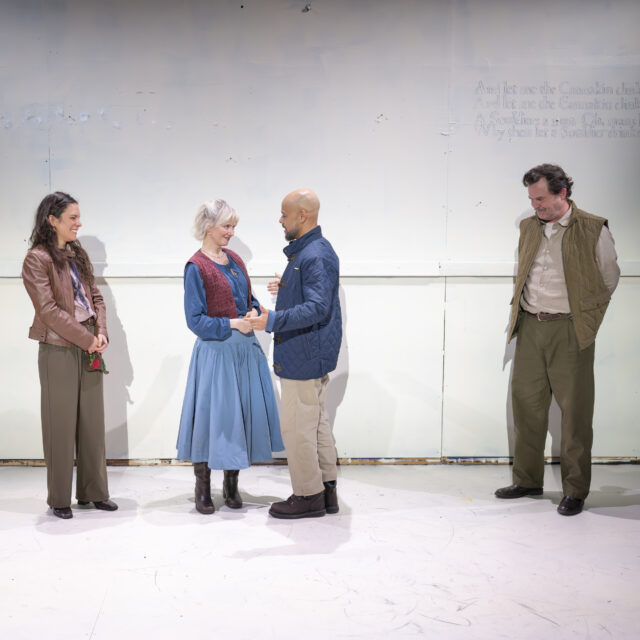
LAST CHANCE: KYOTO AT LINCOLN CENTER

Stephen Kunken stars as conniving lawyer Donald Pearlman in Kyoto (photo © Emilio Madrid)

KYOTO
Lincoln Center Theater at the Mitzi E. Newhouse
150 West 65th St. between Broadway & Amsterdam Ave.
Tuesday – Sunday through November 30, $140.50-$242.50
www.lct.org

If the prospect of sitting through Kyoto, a 160-minute play at Lincoln Center’s Mitzi E. Newhouse Theater, set at a series of 1989–97 climate change conferences, doesn’t fill you with anticipation, consider Oslo, a nearly three-hour drama about the 1993 Oslo accords that began at the Newhouse in 2016, moved to the Vivian Beaumont, and deservedly won the Tony for Best Play. Kyoto is a worthy successor in the arena of political theater, a gripping behind-the-scenes thriller that commands our attention even as we are aware of the general outcome; decades later, there is still a battle over global warming, whether it’s man-made and a legitimate threat to the immediate future of the Earth.

Stephen Kunken is sensational as conniving American lawyer and lobbyist Don Pearlman, who serves as participant and narrator, speaking from beyond the grave; he died in 2005 at the age of sixty-nine, having built a controversial legacy. The play begins with him directly addressing the audience, explaining, “I think we can all agree on one thing: the times you live in are fucking awful. Everywhere you look there’s some kind of disagreement, something angry, something vicious, something acutely historic. There’s some maladjusted kid who takes a gun into his school. Countless limbless civilians blown up daily on your newsfeed. A CEO leaking blood on the sidewalk, dying, shrieking, shot. There’s food shortages, global pandemics, runaway inflation, culture wars, trade wars, real wars, possible third world wars, the death of democracy, collapse of the rules-based order and, on top of all of that, a planet that is literally burning down. And if you’re a guy like me looking at a time like now, the main thing you think is: man . . . the 1990s were freakin’ glorious.

The show takes place on a circular stage that morphs from a scientists meeting in England in May 1990 to an IPCC Plenary Session in Sweden in August, the World Climate Conference in Geneva in November, talks in Virginia and the United Nations in 1991–92, Berlin in 1995, and ultimately the Kyoto International Conference Centre in December 1997 for COP3 (Conference of the Parties). Projections on a rear screen feature live video feeds and archival footage (of George W. Bush, Al Gore, and other players, designed by Akhila Krishnan).

Along the way, Pearlman butts heads with and attempts to manipulate an international collection of experts, based on real people, who have differing views on how to proceed, including Argentinian lawyer and conference leader Raul Estrada-Oyuela (Jorge Bosch), Austrian-born American Global Climate Coalition atmospheric physicist Fred Singer (Peter Bradbury), Swedish meteorologist and Intergovernmental Panel on Climate Change founder Bert Bolin (Daniel Jenkins), American climate scientist Ben Santer (Jenkins), Saudi oil economist Mohammed Al Sabban (Dariush Kashani), Chinese professor Shukong Zhong (Feodor Chin), a Kiribati AOSIS spokesperson (Taiana Tully), German president Angela Merkel (Erin Darke), UK deputy prime minister John Prescott (Ferdy Roberts), Japanese environment minister Hiroshi Ohki (Rob Narita), British physicist John Houghton (Roberts), Tanzania professor Mark Mwandosya (Roslyn Ruff), the head of the US delegation (Kate Burton), and a UN Secretariat (Imani Jade Powers). While some fall in line, others are ready to fight, especially over the specific language in their assessments reports and draft protocols, arguing about such single words as appreciable.

Don is approached by the Seven Sisters, representatives of the world’s biggest oil companies, who want Don’s support — and get it through not-so-subtle threats. “We feel that without proper oversight, words like targets and timetables will be used to harm us,” one advises Don. Another adds, “To harm America, Don.” Don cancels his long-promised vacation with his wife, Shirley (Natalie Gold), and sets out to do the bidding of the Seven Sisters, breaking rules, undermining the conferences’ goals, and seeming to enjoy throwing wrench after wrench into the machinery.

“I know what people like you think of lawyers like me. You theater, artsy, liberal types who pay your bills in empathy,” he tells the audience. “But none of your concerns interest me. I’m the only one who can tell this story. Because I’m the only one who was there. Start to finish, I saw it all. Did it all. Fought for it all. And you may not like it all, but if you want to know it all, you can’t have it all your own way.”

Gripping fact-based play revisits a decade of climate-change conferences (photo © Emilio Madrid)

Writers Joe Murphy and Joe Robertson (The Walk with Little Amal) and directors Stephen Daldry (Skylight, Billy Elliot: The Musical) and Justin Martin (Prima Facie, Inter Alia) previously collaborated on the breathtaking, immersive hit The Jungle, which transformed St. Ann’s Warehouse into a Calais refugee camp. As in that production, in Kyoto they avoid preaching to the choir or making pronouncements on climate change, instead letting the action unfold while keeping the audience on the edge of their seats. In fact, some audience members have special chairs next to the characters around the circular stage and occasionally are engaged in conversation with them. (The set is by Miriam Buether, with business-style costumes by Natalie Pryce, lighting by Aideen Malone, crisp sound by Christopher Reid, and original music by Paul Englishby.)

There’s a lot of talk and scientific jargon, but it never gets boring. Tony nominee Kunken (Nikolai and the Others, Enron), who has been with the show through its original run at Stratford-upon-Avon and its subsequent move to the West End, is fully in charge of the proceedings, imbuing Pearlman with a balance between true believer, evil mastermind, and expert controller; you might not like or trust Pearlman, but you can’t take your eyes off him, as he in so many ways represents what is wrong with how important decisions that affect the entire world are made, then and now. Olivier nominee Bosch (Invencible, Speaking in Tongues) provides solid support as Pearlman’s archnemesis.

Nominated for an Olivier Award for Best New Play, Kyoto is an engrossing and riveting story, a cautionary tale that says much about why we are in the mess we are today, with no clear way out.

[Mark Rifkin is a Brooklyn-born, Manhattan-based writer and editor; you can follow him on Substack here.]
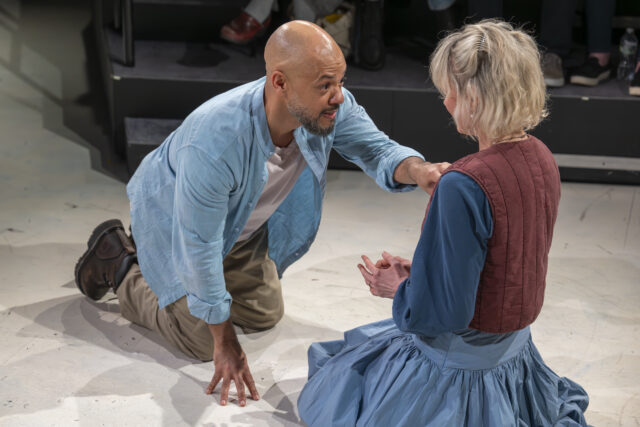
BEARING HEAVY WOUNDS: GRUESOME PLAYGROUND INJURIES AT THE LUCILLE LORTEL

Rajiv Joseph’s Gruesome Playground Injuries traces the friendship between Kayleen (Kara Young) and Doug (Nicholas Braun) (photo by Emilio Madrid)

GRUESOME PLAYGROUND INJURIES
Lucille Lortel Theatre
121 Christopher St. between Bleecker & Hudson Sts.
Tuesday – Sunday through December 28, $42-$225
gruesomeplaygroundinjuries.com
lortel.org

The title of Pulitzer Prize finalist Rajiv Joseph’s Gruesome Playground Injuries, at the Lucille Lortel Theatre through December 28, is a bit misleading. One might assume that it has something to do with the bad cuts and bruises kids get while playing outside, but it goes well beyond that; instead, it is a distinctively adult look at the physical, psychological, and emotional damage we suffer throughout life, bearing heavy wounds that are not always easily healed. It’s about real pain, the kind that digs deep under your skin, into your heart and soul, affecting the way you see and react to everyday existence. It’s also extremely funny.

The ninety-minute play unfolds in eight segments that follow the friendship between Kayleen (Kara Young) and Doug (Nicholas Braun) over the course of thirty years, from age eight to thirty-eight. However, they are not told in chronological order but in jumps of fifteen years going forward and ten years going backward; for example, the first three scenes take the characters from eight (“Face Split Open”) to twenty-three (“Eye Blown Out by Firework”) to thirteen (“The Limbo”).

In between scenes, the actors change costumes onstage, usually next to translucent screens on either side, and rearrange two hospital-like beds; they also apply their own makeup, which can involve blood, bandages, and eye patches. In addition, interstitial music ranges from Cracker’s powerful “Low” to Sleeping at Last’s moving acoustic cover of Men without Hats’ “The Safety Dance” to Gary Jules’s evocative “Little Greenie,” in which he sings, “You know / That in spite of all the things that you show / You’re fucking around with something / You cannot control / If it scares you so / Then make it go away.”

The rhythmic dialogue merges humor with details of horrific wounds; an early exchange when Kayleen and Doug are eight sets the tempo:

Kayleen: One time, I threw up because I had a stomach ache and I threw up so bad that my one eye started to have blood in it.
Doug: Why.
Kayleen: Because I threw up so hard and so there was blood in my eye.
Doug: Did it hurt?
Kayleen: No. But it was red. I have a sensitive stomach. The doctor told me. There’s an angel on the roof.
Doug: No there’s not.
Kayleen: Yes there is. It’s a statue. Are you going to go to the doctors?
Doug: To get stitches. I like to get stitches.
Kayleen: Why.
Doug: It makes your skin feel tight.
Kayleen: Does it hurt?
Doug: Yeah.
Kayleen: This room is like a dungeon.
Doug: What’s a dungeon?
Kayleen: It’s a room in a castle. It’s where people languish.
Doug: Oh.
Kayleen: The rest of the castle is loud and has bright lights and flags and hot oil because of wars. But the dungeon is where people can go to languish and get some peace and quiet.
Doug: OW!
Kayleen: What?
Doug: My face hurts. I broke it.
Kayleen: You did not. It’s just cut. Can I see it?
Doug: What?
Kayleen: Can I see the cut on your face?
Doug: Why.
Kayleen: Can I? . . . Does it hurt?
Doug: A little.
Doug: What happened to the blood in your eye?
Kayleen: It went back into my head. . . . Can I touch it?
Doug: Why.
Kayleen: Can I?
Doug: Okay.

As the story goes back and forth in time, we learn about Kayleen’s and Doug’s families, their careers, their relationships, and their fears, but their desires are often thwarted. They love and need each other — Doug believes that Kaylee’s touch can heal him — even when years pass without contact. (The play takes place in a time before cellphones.) While Doug’s injuries occur because he tends to do impractical things and take irresponsible chances, Kaylee’s trauma is more self-inflicted. He is a kind of hopeless dreamer who can’t get out of his own way, while she is far more introspective and deliberate.

“I’m accident prone. That’s what my mom says I am,” thirteen-year-old Doug tells Kayleen, who replies, “If you’re riding on the handlebars of a bike going down a hill, you’re not accident prone, you’re retarded.” Doug: “You shouldn’t say ‘retarded.’ That’s real rude to retarded people.” Kayleen: “Sorry I offended you.” Doug: “No, it’s cool.”

Kayleen keeps calling him “stupid,” but she understands that she has also made bad decisions. “I know I know I know . . . I’m so stupid. I’m always . . . I’m just fucked up, you know that. And so I need you to stick it out, Dougie,” the twenty-eight-year-old Kayleen admits. “I really need you right now. I really need you to come over and show me some stupid shit again, tell me some stupid joke like you always do.”

It’s a difficult show to watch — there’s a reason why the word “gruesome” is in the title — but it also a profoundly rewarding and, yes, immensely entertaining experience.

Doug (Nicholas Braun) and Kayleen (Kara Young) share their unique life experiences in Rajiv Joseph revival (photo by Emilio Madrid)

As he has demonstrated in such previous works as Describe the Night, Dakar 2000, and King James, Joseph writes complex narratives, and director Neil Pepe (American Buffalo, On the Shore of the Wide World) does a superb job maneuvering through Gruesome Playground Injuries, which premiered in 2009 at the Alley Theatre in Houston, with Selma Blair and Brad Fleischer in the lead roles. Arnulfo Maldonado’s set is spare but efficacious, with contemplative lighting by Japhy Weideman, creating shadowy effects with the screens. (David Van Tieghem composed the original music and designed the sound.)

Three-time Emmy nominee Braun and two-time Tony winner Young might not at first seem to be the perfect fit; best known for playing Cousin Greg in Succession, Braun is making his off-Broadway debut, while Young has proved herself to be one of New York’s most talented and engaging actors, having dazzled in such diverse productions as Clyde’s, Purlie Victorious: A Non-Confederate Romp Through the Cotton Patch, Table 17, Cost of Living, and Halfway Bitches Go Straight to Heaven. They also have a rather noticeable height discrepancy; Braun is six-foot-seven, whereas Young is about five-foot-two.

But they shine from the start. Whether they’re portraying silly eight-year-olds hopping and flopping around or serious thirty-three-year-olds examining their futures, Braun, tall and gangly, Young, taut and energetic, both with impressive bodies, have a stirring chemistry. When they are changing outfits and putting on their makeup, using sinks at opposite sides of the stage, it’s like watching a tennis match; you don’t want to miss a thing as your head darts back and forth to catch their every move. And in this case, they both emerge as champions.

[Mark Rifkin is a Brooklyn-born, Manhattan-based writer and editor; you can follow him on Substack here.]

A HELLUVA TOWN: TWO STRANGERS MEET CUTE IN NEW YORK CITY

Robin Rainey (Christiani Pitts) and Dougal Todd (Sam Tutty) are about to have a time to remember in Two Strangers (Carry a Cake Across New York) (photo by Matthew Murphy)

TWO STRANGERS (CARRY A CAKE ACROSS NEW YORK)
Longacre Theatre
220 West 48th St. between Broadway & Eighth Aves.
Tuesday – Sunday through July 5, $69-$299
twostrangersmusical.com

Broadway shows set in New York City have a difficult task getting things right, needing to satisfy tourists as well as native New Yorkers, who will immediately criticize any geographic or sociocultural mistakes while tiring of genre clichés about the City That Never Sleeps. For every Hell’s Kitchen, there’s a New York, New York.

Happily, the charming new Broadway musical Two Strangers (Carry a Cake Across New York) gets things right.

It begins with Dougal Todd’s (Sam Tutty) arrival in New York City from London, with a childlike gleam in his eye and a bounce in his step, a wide-eyed ingénue deliriously excited to see as much as he possibly can during his short visit, his first ever overseas. “New York is kind of my second home,” he tells Robin Rainey (Christiani Pitts), who has picked him up at the airport. “The Empire State, the White House, the Golden Gate Bridge.” After a wild and woolly two days — in which, among other things, he stood outside the Freedom Tower, Katz’s Deli, and the Tenement Museum because he couldn’t afford to go inside — he still has that gleam and bounce, a sweetly infectious and innocent worldview that rubs off on both Robin and the audience.

Dougal lives at home with his mother, “big Polly,” and works in a local movie theater. His only ambition seems to be to keep marveling at life. He’s in New York to attend the wedding of his father, Mark, who deserted them before Dougal’s birth. “Technically he didn’t leave me because I wasn’t actually born yet,” he explains to Robin.

Raised by her grandmother in Brooklyn, Robin toils at Bump ‘n’ Grind Coffee in the East Village and just tries to survive day to day, hiding away any dreams she might have of finding the right career or the right partner. Robin’s older sister, Melissa, who is thirty, is marrying Mark, an extremely successful fifty-seven-year-old businessman. Robin disapproves of her sister’s choice and is irritated when Dougal starts playfully referring to her as Auntie Robin, since they are both in their midtwenties.

“My town: / where everyone has an apartment to spare with a skyline view, / where even improbable dreams come true. / Where everything comes with a smile, a high five, and a side of cheese; / I’m down on my knees,” Robin sings sarcastically. Dougal responds enthusiastically, “She’s called the Big Apple / No one knows why / But she’s my kind of town and I’m her kind of street-smart guy. / I’ll stroll up the Broadway / I’ll order a beer / I’ll scream at the Statue of Liberty / ‘Hey lady! I’m walkin’ here!’”

Melissa has given Robin two important responsibilities: picking up the wedding cake and bridal stockings. When Dougal insists on going with her to the bakery, they head off on a whirlwind adventure that takes them from the lowest of the low to the highest of the high.

Robin Rainey (Christiani Pitts) and Dougal Todd (Sam Tutty) reach highs and lows in delightful new musical from England (photo by Matthew Murphy)

Two Strangers might refer to itself as a musical comedy, but it is closer to a play with music. Composers and lyricists Jim Barne and Kit Buchan (Catastrophe Bay, Mona Loser) have written a terrific book that firmly establishes the two characters and their individual and mutual quests. Nearly all the songs feel organic to the story, further defining Dougal and Robin on the outside and the inside. Dougal expresses his longing for his father in “Dad,” singing “‘Dad,’ Is that a word that I can use for you? / It’s been a while since we had news from you / Since your picture left the frame.” In “What’ll It Be,” Robin confesses, “And I stare / through the windows at the world / — this bit of world / that I can see — / and I try / not to think about that girl / who looked like me . . . / . . . who laughed, / and danced, / and knew what she was facing; / who believed / the world / was hers to find a place in; / and I tell myself / this year could be the right year / but we both know / this time tomorrow I’ll be right here. . . .”

Two numbers do fall flat, “On the App,” in which Dougal encourages Robin to swipe through Tinder while on the subway, and “Under the Mistletoe,” a Christmas fantasy they sing in the back of an Uber; it would also trim the show to a more streamlined 110 minutes or so without an intermission. Otherwise, the songs glitter under Tim Jackson’s inventive direction and choreography, Tony Gayle’s sound design that takes us from the airport to the subway to a nightclub, and Lux Pyramid’s lovely orchestrations, performed by an onstage orchestra consisting of conductor Ted Arthur on keys, Kevin Ramessar on guitar, Lee Nadel on bass, Rocky Bryant on drums, and Jessie Linden on percussion. Soutra Gilmour’s rotating set features a collection of monochromatic luggage that open up to reveal a minibar, a bed, and other elements, cleverly lit by Jack Knowles with LED strips and spots. Gilmour also designed the costumes, which offer a late surprise.

Tutty (Dear Evan Hansen) is adorable in his Broadway debut; you just want to run up and hug him (but please don’t). Dougal looks at the city in the way not only tourists but longtime denizens should, with wonder and happiness and promise. Pitts, who has appeared in such other New York City shows as A Bronx Tale and King Kong, is heart-wrenching as Robin, who believes she has hit a dead end and needs to be reenergized. Their chemistry is evident from their first meet-cute bump.

Two Strangers opens with suitcases becoming radios that broadcast sports, weather, and news alternately from America and England until they meld together. It’s a delightful metaphor for what follows, an award-winning show about a British man and an American woman that has successfully journeyed across the pond and is now selling out at the Longacre Theatre, where, afterward, you will experience New York City with a gleam in your eye and bounce in your step.

[Mark Rifkin is a Brooklyn-born, Manhattan-based writer and editor; you can follow him on Substack here.]