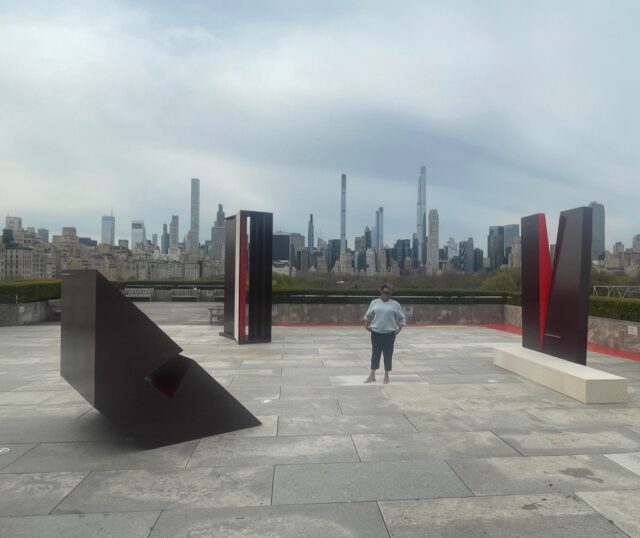
Jennie C. Jones celebrates the opening of Ensemble on Met roof (photo by twi-ny/mdr)
Who:International Contemporary Ensemble,Jennie C. Jones, George Lewis What:Live performance and discussion Where: The Grace Rainey Rogers Auditorium, the Met Fifth Ave., 1000 Fifth Ave. at Eighty-Second St. When: Sunday, October 5, $35-$70 (use discount code ENSEMBLE20 to save 20%), 2:00 Why: “What I hope for this work is that it ignites the sonic imagination. The pieces are not always singing, they’re not always performing, they’re not always activated. I think for me that’s also a tremendous part of the work, the way to hold space, and nuance, not always full of an outward expression but to hold a rich, interior imagination, and to hold a rich sonic imagination,” Jennie C. Jones said at the opening of Ensemble, her stunning installation on the Met’s Iris and B. Gerald Cantor Roof Garden. On view through October 19, Ensemble consists of three large-scale pieces inspired by a few of Jones’s previous works, the extraordinary skyline of the buildings surrounding the roof, and the Met’s musical instruments collection and use of travertine; one recalls a zither, another an Aeolian harp, and the third a one-string, in addition to a red path that expands in one corner.
The Roof Garden Commission rewards the viewer’s attention through close contemplation and intimate enjoyment; if you’re lucky, you might even hear the wind gently playing the strings.
On October 5 at 2:00, you’ll be able to hear the International Contemporary Ensemble (ICE) play their strings in the Met’s Grace Rainey Rogers Auditorium, as the Brooklyn-based collective performs Jones’s 2022 Oxide Score and 2024 Met Color Study, featuring Emmalie Tello on clarinet, Mike Lormand on trombone, Nuiko Wadden on harp, Clara Warnaar on percussion, Modney on violin, Kyle Armbrust on viola, and Brandon Lopez on bass. The Cincinnati-born, Hudson-based Jones will be on hand for a discussion with ICE artistic director George Lewis.
“This is one of Jennie’s things, right? The sculpture changes the sound. See, you stick your head in here, it kind of echoes,” composer, musicologist, and trombonist Lewis says in a video of him walking around Ensemble. “My first encounter with Jennie’s work was probably around 2015. She was finding all these incredible parallels between visual art and music. Jennie taught me a lot about graphic scores. You could say they’re open-ended, but she is definitely weighing in on what she feels could be a perspective. . . How do we transmit these energies to everyone around us, and how do we make these scores part of a larger listening and visual environment? Jennie engages sound as a medium and as a subject. . . . One of the great parts about this work is that it’s not telling you what or how to think or how to hear or how to feel or any of that. You have a lot of agency to decide that for yourself. And once you do, there’s discovery there.”
There’s lots to discover with Ensemble, but you’ll need to get to the Met fast, before the installation closes and the museum begins a five-year renovation of the roof.
[Mark Rifkin is a Brooklyn-born, Manhattan-based writer and editor; you can follow him on Substack here.]
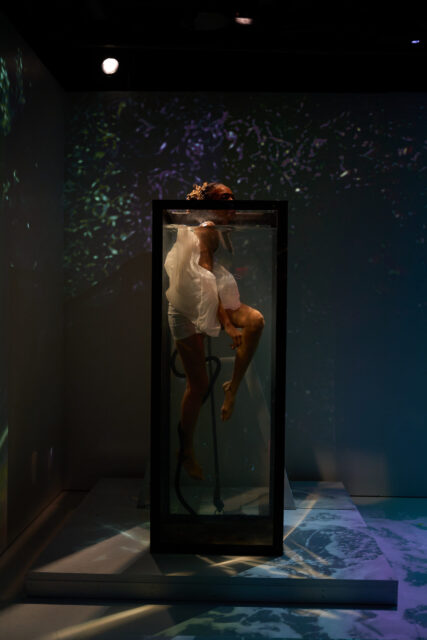
Eisa Davis immerses herself in a water tank in The Essentialisn’t (photo by Daniel J. Vasquez)
THE ESSENTIALISN’T
HERE Arts Center
145 Sixth Ave.
Tuesday – Sunday through September 28, $10-$120 here.org
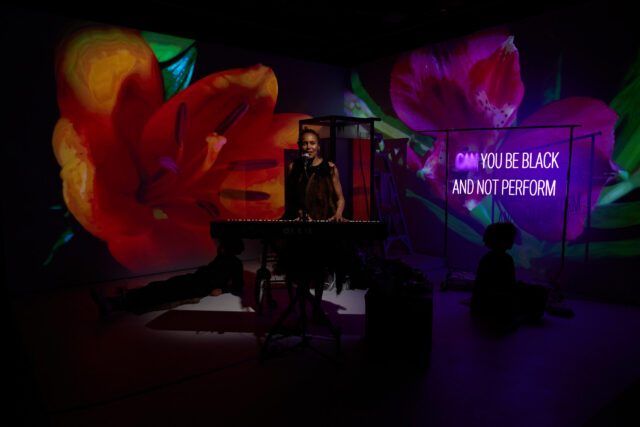
“Can you be Black and not perform?” is the critical question at the center of Eisa Davis’s intimate and rewarding — and brilliantly titled — The Essentialisn’t.
During the pandemic, I saw Davis in Lynn Nottage’s What Are the Things I Need to Remember, a virtual microplay that was part of Theatre for One’s Here We Are, brief shows presented live for one person at a time, sitting at home in front of their computer, in which not only did the actors have their video and audio turned on but so did the audience member, allowing the performer to gauge the viewer’s reaction in real time — and in some cases even engage in very brief conversation. I wrote that What Are the Things I Need to Remember was “superbly directed by Tiffany Nichole Greene despite the clear limitations of physical space, in which Eisa Davis portrays a woman who brings up an old memory that still haunts her.”
I have the same feeling about The Essentialisn’t, which continues at HERE Arts Center through September 28.
In the lobby is a wall projection of black-and-white clips of legendary Black performers, including actress Dorothy Dandridge, dancer Jeni Legon, and jazz great Hazel Scott playing two pianos, one black, one white, simultaneously. To these, Davis intercuts footage of herself in a black skirt and high heels in a large vertical water tank.
The audience enters the theater itself and is greeted by an interactive art installation consisting of such books as Fred Moten’s Black and Blur, Saidiya Hartman’s Lose Your Mother: A Journey Along the Atlantic Slave Route, and Douglas Kearney’s Mess and Mess and as well as a pair of black Capezio tap-dancing shoes. In the far corner is a box of tags in a half-basketball filled with black dirt; audience members are asked to “write in your vote on essences of Black women” and put them in a clear acrylic box on a stool. The night I went, I saw such handwritten words as helper and light. There is plenty of time for everyone to interact with the books and tags while audio of Daniel Alexander Jones as W. E. B. Du Bois is piped in through a speaker.
After several minutes, the audience is led through a Mylar curtain to a small space with a few rows of seating perpendicular to the stage, which features a standing keyboard with a microphone, a water tank with a ladder, and two hair comforters on the floor. Davis is in the tank, barefoot, in a white dress. Her head emerges from the water and she begins singing over a Mende funeral dirge as video of the ocean and extreme close-ups of a Black woman’s hair, recalling Lorraine O’Grady’s Landscape (Western Hemisphere), are projected on two walls.
“I’m crossin, I’m crossin, I’m crossin the water / Darkness be my friend,” Davis begins. After she leaves the tank, two Sovereigns, Jamella Cross and Princess Jacob, dry her off, then wheel over a coat rack that has LED letters on it spelling out “Can you be Black and not perform?” Davis sings, “No, no, no, no.”
The Essentialisn’t is a magical multimedia mixtape at HERE (photo by Daniel J. Vasquez)
For more than an hour, Davis and the Sovereigns sing and talk about the slave narrative, logic, gender, ritual, Cat on a Hot Tin Roof, technologies of liberation, objectification, Afrofuturism, consent, and emancipation in such songs as “No Music,” “Tripping,” “Magical Negro,” and “Black Girl Bullet.” Davis explores Black diasporic culture and the Black feminine, making powerful pronouncements while placing white paper over a few of the words in the LED sign.
“Can you make sense of this nonsense? No,” she says. The Sovereigns declare, “This is not a performance. This is a performance.” Davis explains, “So I’m a act like I know. Even though . . . Let me be clear, performance isn’t the same as being enslaved. There’s just . . . a connection. I can perform, but when it’s forced? When it’s an obligation that can cost livelihood, life if you do or don’t do it? If you do or don’t do it well? When performance equals the illusion of success, an American dream I never even believed in because I knew it was a trick bag?”
The Essentialisn’t is a multimedia mixtape filled with both clear and subtle messages, which makes sense, as Davis, whose given first name is Angela, is the daughter of civil rights lawyer and social justice activist Fania Davis and the niece of educator and activist Angela Davis. Davis, who wrote and directed the piece, builds a genuine connection with the audience, encouraging participation and revealing the artistry, laying it all out in the open.
Her terrific team includes sound designer and live sound mixer Chris Payne, video designer Skye Mahaffie, lighting designer Cha See, soundscape artist Rucyl Mills, costumes by James Gibbel, movement consultant Okwui Okpokwasili, and scenic and costume consultant Peter Born, who add a magical feel to the show, incorporating Houdini-like elements. Cross and Jacob contribute humor and energy to the proceedings.
The Brooklyn-based Davis (The History of Light,The Secret Life of Bees), who won Obies for Passing Strange in 2006 and for Sustained Excellence in 2009 and was nominated for a Pulitzer Prize for Bulrusher in 2007, is a fearless multi-hyphenate, and much of that is on view in The Essentialisn’t, a provocative and affecting work that is as challenging as it is engaging.
The night I went, the audience was mostly white; that fact did not appear lost on Davis. In the scene “What Are You Working On?,” Davis’s grad school acting teacher (the Sovereigns) tells her, “Remember. We can’t train you in Blackness. We’re white. You’ll have to do that for yourself. . . . You’re gifted. You’ll work. But will you do the work?” Davis then covers the word “can” on the LED sign.
“Can you be Black — and not perform?” she says.
It’s not a rhetorical question. Here we are, indeed.
[Mark Rifkin is a Brooklyn-born, Manhattan-based writer and editor; you can follow him on Substack here.]
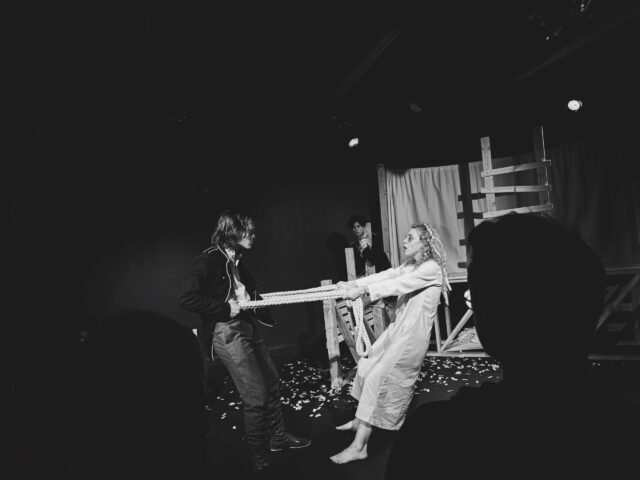
Kolya Krasotkin (Benjamin Nowak) and Zhutchka the dog (Alina Mihailevschi) fight for survival in The Mutt
THE MUTT
IATI Theater
64 East Fourth St. between Second & Third Aves.
Through September 21, $54.65 themuttplay.com
As the audience enters the tiny, downstairs black box space of the IATI Theater on East Fourth St. to see Anoushka Nesterova’s The Mutt, there is already a character there, a woman on all fours, panting lightly but desperately. Ticket holders fill in two perpendicular rows on two sides, looking through the program, talking to their friends, or taking photos of the human-dog, behind whom is an unpainted wooden construction that is part of a barn loft. The play begins with a video, projected on a horizontal white cloth in the loft, of snow and train tracks. In voiceover, a man says, “Once upon a time there was a woman, and she was wicked as wicked could be, and she died. And not one good deed was left behind her. The devils took her and threw her into the lake of fire. So her guardian angel stood and wondered what good deed of hers he could remember to tell to God.” The parable, which also refers to Paradise, ends, “And the woman fell into the lake and she is burning there to this day. So the angel wept and went away.”
The Mutt is an intimate retelling of “The Boys,” Book X of Fedor Dostoevsky’s 1880 Russian epic The Brothers Karamazov, a sprawling philosophical novel about faith, morality, and the human condition. It follows the exceedingly bright and cynical thirteen-year-old Kolya Krasotkin (Benjamin Nowak); his younger apostle, Smurov (Tommy Dougherty); the older, aristocratic Alyosha Karamazov (Fabio Bernardis), also known as Alexei, named after Dostoevsky’s son, who died at the age of three of epilepsy in 1878; and Zhutchka (Alina Mihailevschi or Nesterova), the dog, who is supposed to be dead, brutally killed by the ailing schoolboy Ilyusha Snegirev (Jaden Cavalleri) and renamed Perezvon. Ilyusha’s father, Captain Snegirev (Marcus Troy or Sasha Litovchenko), has been recently humiliated by one of Alyosha’s brothers and wants to leave town with his son, but they can’t afford to go.
An early exchange establishes some of the background, although many of the plot details are kept purposely vague and indeterminate:
Krasotkin: They won’t whip you for being with me? Smurow: Lord, no, they never whip me! And you’ve got Perezvon with you? Krasotkin: Yes, Perezvon. Smurow: You’re taking her, too? Krasotkin: Yes, him too. Smurow: Ah! if it were only Zhutchka! Krasotkin: Impossible. Zhutchka does not exist. Zhutchka has vanished in the darkness of the unknown. Smurow: Ah! couldn’t we do this? You see, Ilusha says that Zhutchka was a shaggy, grayish, smoky-looking dog like Perezvon. Couldn’t you tell him this is Zhutchka, and he might believe you? Krasotkin: Boy, shun a lie, that’s one thing; even for a good cause — that’s another. Above all, I hope you’ve not told them anything about my coming. Smurow: Heaven forbid! I know what I am about. But you won’t comfort him with Perezvon. You know his father, the captain, told us that he was going to bring him a mastiff pup today. A real one, with a black nose. He thinks that would comfort Ilyusha, but I doubt it. Krasotkin: And how is Ilyusha? Smurow: Ah, he is bad, very bad! He is quite conscious, but his breathing! His breathing’s gone wrong. The other day he asked to be walked around the room, they put his boots on, he tried to walk, but he couldn’t stand. “Ah, I told you before, Papa,” he said, “that those boots were no good. I could never walk properly in them.” He fancied it was his boots that made him stagger. He won’t live another week. The doctor will come to them. Krasotkin: Swindlers. Smurow: Who are swindlers? Krasotkin: Doctors, and all medical scum, generally speaking, and, naturally, in particular as well. I reject medicine. A useless institution. I mean to go into all that. But what’s that sentimentality you’ve got up there? The whole class seems to be there every day. Smurow: Not the whole class. There’s nothing in that. Krasotkin: What I don’t understand in all this is the part that Alexei Karamazov is taking in it. He has too much time to spend on sentimentality with boys. Smurow: There’s no sentimentality about it. You are going yourself now to make it up with Ilyusha. Krasotkin: Make it up with him? What an absurd expression! But I allow no one to analyze my actions. Smurow: And how pleased Ilyusha will be to see you! He has no idea that you are coming. Why was it, why was it you wouldn’t come all this time? Krasotkin: My dear boy, that’s my business, not yours. I am going of myself because I choose to, but you’ve all been hauled there by Karamazov — there’s a difference, you know. And how do you know? I may not be going to make it up at all. It’s a stupid expression.
Motives are questioned, the existence of a Supreme Being is debated, money is literally thrown around, socialism is defined, and a puppet show reaches to the heart of things as the characters get caught up in intellectual battles and physical altercations.
“What good is faith by force?” Zhutchka asks Krasotkin, who replies, “Never for one minute have I taken you for reality. You are a lie, you are my illness, you are a phantom.”
Presented by Streetcar Productions and Art Against Humanity, The Mutt is a kind of mutt itself, a mixed-breed of dance, theater, performance art, and music, poetically integrated by directors Nesterova and Elena Che and choreographer Gisela Quinteros, incorporating experimental movement with white ropes that bind and release the guilty and the innocent on Alyona Sotnikova’s minimalist set as the Jazz Pilgrim’s ominous score drones in the background. The video projections of a cold, lonely Russian winter are by Anastasia Slepchenkova, a blast of light in the dark.
The strong cast gives depth to the characters and add a modern feel to the proceedings, with Zhutchka nearly always front and center, stuck between fantasy and reality, life and death, being and nothingness.
“There was an old sinner in the eighteenth century who stated that, if there were no God, he would have to be invented. And man has, indeed, invented God. And the strange thing, the wonder would not be that God really exists, the wonder is that such an idea, the idea of the necessity of God, could enter the head of such a savage, vicious beast as man,” the narrator says over a second-act video. “As for me, I long ago decided not to think about whether man created God or God created man. And I won’t go through all the axioms laid down by Russian boys on that subject, and not only with the boys but with their professors too, since Russian professors today are quite often the same Russian boys. Yet, what must be noted above all else in relation to God is this: Does He exist, or does He not?”
That question has been asked through the ages, but don’t expect to find the answer in The Mutt, or in the eight-hundred-page novel, the four-hour 1969 Russian film, the seven-hour 2009 miniseries, or the forty-two-hour audiobook.
[Mark Rifkin is a Brooklyn-born, Manhattan-based writer and editor; you can follow him on Substack here.]
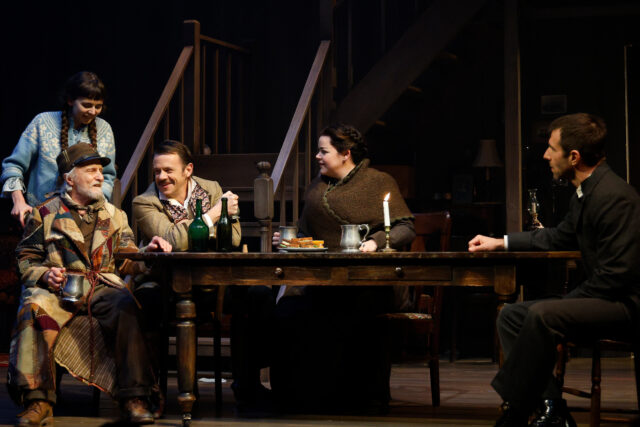
A family faces some hard truths in stellar revival of Henrik Ibsen’s The Wild Duck (photo by Gerry Goodstein)
THE WILD DUCK
Theatre for a New Audience, Polonsky Shakespeare Center
262 Ashland Pl. between Lafayette Ave. & Fulton St.
Tuesday – Sunday through September 28, $102-$132 www.tfana.org
“Men are the most peculiar creatures,” Gina (Melanie Field) says near the middle of Simon Godwin’s adaptation of David Eldridge’s 2005 translation of Henrik Ibsen’s The Wild Duck at the Polonsky Shakespeare Center.
That’s not the half of it.
Over the last fourteen years, Henrik Ibsen’s plays have been experiencing a renaissance, with productions of Ghosts at Lincoln Center, An Enemy of the People on Broadway and at Park Ave. Armory,The Master Builder and John Gabriel Borkman at BAM, and A Doll’s House and Lucas Hnath’s A Doll’s House, Part 2 on Broadway, along with Charles Busch’s Ibsen’s Ghost in midtown and Will Eno’s Peer Gynt reimagining, Gnit, at the Polonsky. It’s been a while since New York City has seen a major revival of Hedda Gabler and even longer of The Wild Duck, which is at last back in this exquisite rendering.
A dual presentation from Theatre for a New Audience and Shakespeare Theatre Company (STC), The Wild Duck is a complex tale of parents and children, money and power, truth-telling, and the ability to see what’s happening right in front of you. The story takes place in 1880s Norway, where wealthy mill owner Håkon Werle (Robert Stanton) is having a dinner party in honor of his son, Gregers (Alexander Hurt), who apparently would rather be anywhere else. Gregers has invited his old friend Hjalmar Ekdal (Nick Westrate), whom he has not seen in sixteen years; Hjalmar, who is not in the same class as the other guests, has reluctantly shown up and is embarrassed when his bedraggled father, Old Ekdal (David Patrick Kelly), a onetime war hero and partner of Håkon’s who spent several years in prison, walks through the party, muttering to himself, and accepts a bottle from Miss Pettersen (Katie Broad), the housekeeper.
Gregers and Hjalmar have a long conversation that leads to Gregers confronting his father, accusing Håkon of having had an affair and an ulterior motive in helping Hjalmar and his family. Håkon asks Gregers to become his partner, explaining, “I’m not as fit for work as I used to be. My eyes aren’t as good.” Gregers thinks his father, who is preparing to marry his current housekeeper, Mrs. Sørby (Mahira Kakkar), is up to something. “I know how you’re using me,” Gregers says. An angry Håkon replies, “I don’t think there’s a man in this world you could detest as much as you detest me.” A frightfully earnest Gregers retorts, “I’ve observed you too closely and for too long, Father.”
The narrative then switches to the Ekdals’ dusty, rustic studio, where Hjalmar and his wife, Gina, live with their bright, inquisitive fifteen-year-old daughter, Hedvig (Maaike Laanstra-Corn), and her grandfather, Old Ekdal, who was a well-regarded hunter. The old man now resigns himself to shooting animals in their loft, which is populated by birds, rabbits, chickens, and a wild duck that was winged by Håkon, was rescued in the sea by Håkon’s dog, and is now cared for by Hedvig, an avid reader who is losing her eyesight. (The impressive sets are by Andrew Boyce.) Hjalmar believes he will be able to lift up his family with an invention he is working on that will make them rich. For additional income, they have two boarders, Dr. Relling (Matthew Saldívar) and the unseen theologian Mr. Molvik. Gregers arrives to inquire if he can rent a vacant room; despite Gina’s misgivings, he moves in and almost immediately inserts himself into situations that drive wedges between just about everyone. Oh, and then there’s the Chekhovian gun. . . .
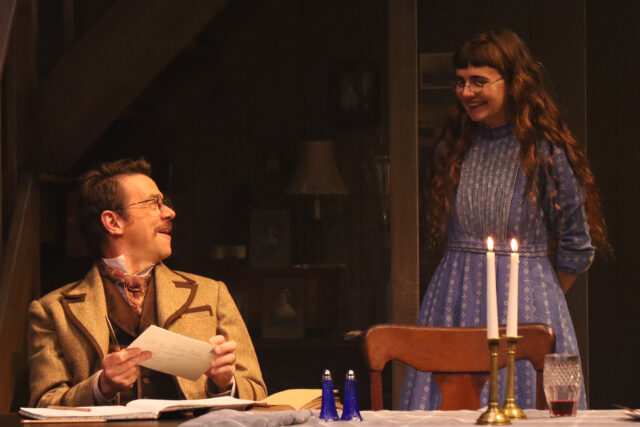
Hjalmar Ekdal (Nick Westrate) and his daughter, Hedvig (Maaike Laanstra-Corn), share a happy moment in The Wild Duck at TFANA’s Polonsky Shakespeare Center (photo by Gerry Goodstein)
The Wild Duck centers on the relationships between fathers and children: Håkon and Gregers, Old Ekdal and Hjalmar, and Hjalmar and Hedvig. Håkon blames Gregers’s distaste for him on his late wife; Hjalmar tells Gregers that he wants to save his aging, ailing father. And Hjalmar reevaluates his love for Hedvig after a secret is revealed.
It’s also focused on the concept of truth, particularly as it applies to Gregers, who believes in getting everything out into the open, no matter how much it might harm certain people. But he is not a master manipulator or self-righteous believer as much as he might be mad. “Damn it, can’t you see the man’s insane — He’s disturbed!” Dr. Relling shouts at one point. In addition, sight plays a major role, literally and figuratively, as some characters are losing their eyesight and others refuse to see the truth that’s staring them in the face.
Eldridge (Festen,Under the Blue Sky) and STC artistic director Godwin (Timon of Athens,Man and Superman) get right to the heart of Ibsen’s play with an exquisite rendering that grabs you and never lets go. It’s so on target, so alive and bursting with energy and intrigue, that you’ll wonder why you’ve never seen it before.
Westrate (Bernhardt/Hamlet,Casa Valentina) is a powder keg as Hjalmar, a tortured soul with pipe dreams who loves his family but seems powerless to take action; as a photographer, he takes pictures of others but never looks at himself. Field (The Phantom of the Opera,Uncle Vanya) is touching as Gina, a woman who is determined to move forward, intent on keeping the past behind her. Rising star Laanstra-Corn (Grief Camp,Homofermenters) steals every scene she’s in as Hedvig, an inelegant teenager who worships her father. Kelly (An Enemy of the People,Into the Woods) is affecting as Old Ekdal, a once proud man who has long lost his grip on reality. (He also wears a dazzling multi-patched coat; the fine period costumes are by Heather Freedman.) And Stanton (The Killer,Ink) is steely as the unyielding Håkon, who is unable to connect with his son.
Hurt (Continuity,Love, Love, Love) is an enigma as Gregers, a complex character whose motives are not always clear. The night I went, it was difficult to hear him; none of the actors use microphones, which is a special treat, but Hurt delivered his lines at a significantly lower decibel level. His body movement was also rather stiff and his eyes often distant, reminiscent of Jeremy Strong’s performance as Dr. Stockmann in Amy Herzog and Sam Gold’s recent adaptation of An Enemy of the People. Although the interpretation was generally successful, it called too much attention to itself in an otherwise stellar and memorable production.
And as far as the duck goes, it’s an extraordinarily salient metaphor not just for all the characters in the play but for the audience as well, a potent reminder of who we are, what we’ve done, and where we’re going.
[Mark Rifkin is a Brooklyn-born, Manhattan-based writer and editor; you can follow him on Substack here.]
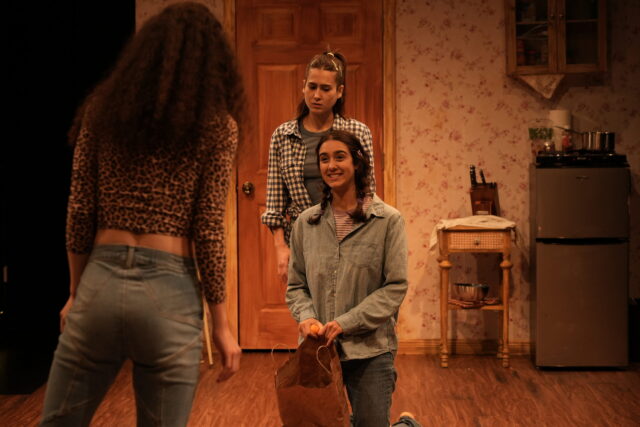
Three teenage girls face threats of violence in Abigail Duclos’s Blood Orange (photo by Gabriela Amerth)
BLOOD ORANGE
The Jeffrey & Paula Gural Theatre, A.R.T./New York
502 West 53rd St. between Tenth & Eleventh Aves.
Thursday – Monday through September 27, $33.85-$60.54 www.etaliatheater.com www.art-newyork.org
Abigail Duclos’s Blood Orange is a creepy foray into grief and loneliness in a world devoid of caring adults, where teenage girls turn to roadkill for solace and escape as they face the trials and tribulations of adolescence.
Presented at the Jeffrey & Paula Gural Theatre at A.R.T./New York by the all-female Et Alia company, the show takes place in the mid-2000s in a small town outside of Asheville, North Carolina. Faye’s (Luísa Galatti or Maria Müller) father has just died a bloody death, and her stepmother, Mariah (Doreen Oliver), spends almost all her time in bed, leaving Faye to fend for herself.
Faye is regularly visited by her longtime bestie, Georgia (Müller or Giorgia Valenti), and her new friend, Eden (Ana Moioli); Faye and Georgia are sixteen, Eden fifteen. Sex and violence are on the girls’ minds as they navigate through trauma and tragedy and the normal fears and desires of high school. Faye asks Eden and Georgia to punch her over and over again in order to cause bruises and to make her throw up so maybe her stepmother will notice her and help her through the loss of her father; Eden reluctantly obliges, but Georgia refuses.
Faye has recently found a dead animal in the road and keeps it in a paper bag in the refrigerator; she names it Agnivis and starts to build a ritualistic religion around it. Eden feels that same power emanating from the creature, but Georgia is disgusted by it, seeing it only as a rotting corpse and wondering whether Faye is okay.
When Georgia is not there, Faye and Eden pray to Agnavis — the name appears to be made up, but there is a Pinterest page called “Agnavis Inspiration” that consists of about a dozen images of strange rabbits, deer, and lambs. Faye wants Agnavis to bring her father back from the dead, while Eden asks Agnavis to get rid of her dad so he can stop hurting her and her mother.
As Faye and Eden grow closer, Georgia becomes jealous, asserting that she is having sex with her older boyfriend while obsessing over whether Eden wants to sleep with Faye.
When Faye shows up unexpectedly at Eden’s house, she notices that Eden has a stuffed animal on her bed and grabs it; observing how limp it is, she asks Eden what happened to it. “My dad got. Angry. At me. He said I was being too childish. Um. And yeah,” she says. “I was always kinda worried that he’d do the same to me.”
As the three girls learn more about one another, things come to a head in a shocking finale.
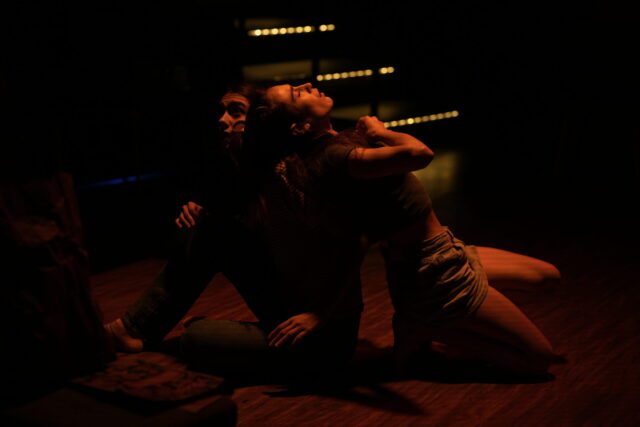
Intimate moments add to the dark mystery behind Et Alia Theater world premiere (photo by Gabriela Amerth)
The threat of violence underlies much of Blood Orange. At various times, Faye tells Eden that she will kill her with a kitchen knife or strangle her, then says Eden should shoot her abusive father. Georgia asks Faye if she has “murder-suicided” her stepmother yet. When Eden is late one day, Georgia surmises that “maybe she got hit by a car. Or kidnapped by some weirdo and stored in his apocalypse bunker.”
The number twenty-one, associated with the age of adulthood in many countries, is prevalent throughout the play. The opening scene takes place on the twenty-first day after Faye found Agnavis, it’s been twenty-one days since Mariah has come downstairs, and Georgia’s boyfriend is twenty-one.
Blood is central to the narrative, from specks of her father’s blood that Faye thinks she can still see on the floor and Faye going to third base with Devin Davis while she was on her period to the “sticky sweet” blood that was on Agavnis when Faye first found her and the tomato soup Faye heats up for Mariah.
In addition, orange is a leitmotif, from the fruit that Agnavis magically delivers out of thin air to the flavor of soda Devin prefers to a reference to Wendy Cope’s poem “The Orange,” which concludes with the line “I love you. I’m glad I exist.” Oranges are also associated with queer culture; for example, many Jewish households now add an orange on their seder plate during Passover in recognition of gays and lesbians.
The audience sits on opposite sides of Ningning Yang’s narrow, horizontal set, which has a futon and ottoman at one end and a door and tiny kitchen at the other, with a small refrigerator and a hotplate. The casual costumes are by Whitney Fabre; the characters are often barefoot, which make for intimate moments like when Faye and Georgia intermingle their feet on the ottoman. Laura Pereira’s sound is highlighted by offstage creaking signaling that Mariah — or someone/something else — might be moving around, and Hayley Garcia Parnell’s lighting features a ceiling light that flickers whenever the girls take out Agnavis.
Director Vernice Miller maintains an eerie pace — aside from one awkward scene involving Mariah and the overuse of the word “beautiful,” which is said more than a dozen times — where just about anything can happen, while associate director Amelia Estrada adds ghostly choreography. At the matinee I saw, Galatti was a superb Faye, a teenager searching for answers but getting lost in obsession; Müller was dangerously sexy as Georgia, while Moioli mixed a wide-eyed innocence with more than a tinge of mystery as Eden — whose name, of course, evokes the biblical garden where Eve took a bite of an apple, which altered the fate of humankind, and particularly women.
The mission of Et Alia, which has previously staged such works as Hasnain Shaikh’s Running in Place at Dixon Place, Müller’s On How to Be a Monster at Casa Italiana Zerilli Marimò and the Tank, None of the Above at Rattlestick’s Global Forms Theater Festival, and This Is Me Eating___ at the Alchemical Studios, is to “create art for the other, by the other, and about the other.” The dark, supernatural Blood Orange fits that bill.
In a program note, Duclos writes, “Tonight, I hope that you can think about loved ones you’ve lost. Maybe the next time they appear in the corner of your eye, you can give them a small smile or do a little dance.”
Maybe.
Or maybe not.
[Mark Rifkin is a Brooklyn-born, Manhattan-based writer and editor; you can follow him on Substack here.]
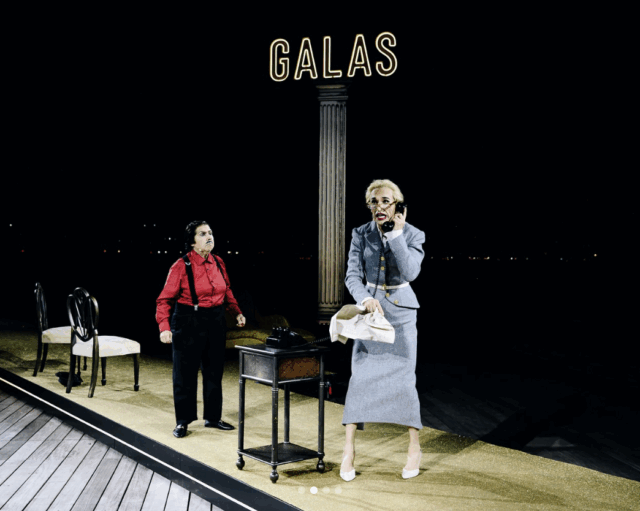
Anthony Roth Costanzo is sensational as a fictionalized version of Maria Callas in Galas at Little Island
GALAS: A MODERN TRAGEDY
The Amph at Little Island
Pier 55, Hudson River Park at West Thirteenth St.
September 6-28, $10 standing room, $25 seats, 8:30 littleisland.org
The first half of Eric Ting’s exciting version of Charles Ludlam’s rarely revived 1983 downtown hit, Galas: A Modern Tragedy, is everything you want it to be: hilariously campy, with fabulous singing, outrageous staging, and delicious costumes. The second half veers far off course until righting itself for a thrilling finale.
Ludlam, who founded the highly influential Ridiculous Theater Company in 1967, wrote, directed, and starred in the original, portraying the title character, Maria Magdalena Galas, an opera diva based on American-born Greek soprano Maria Callas. Today, the use of the word “tragedy” in the subtitle is twofold: the revered Callas died in 1977 at the age of fifty-three, while the beloved Ludlam passed away in 1987 when he was just forty-four, of AIDS.
Despite the inspired lunacy of the acting and plot, Galas is surprisingly faithful to Callas’s life and career. The show begins at the Verona train station, where successful brick industrialist Giovanni Baptista Mercanteggini (Carmelita Tropicana) is waiting to pick up Galas (Anthony Roth Costanzo), who is scheduled to perform the lead role in Amilcare Ponchielli’s La Gioconda at the Arena di Verona. They meet at a café, where they have a delightful and meaningful exchange.
Galas: You are an opera lover? Mercanteggini: Yes, I’m a real aficionado. Now there’s something we have in common, eh? Galas: What’s that? Mercanteggini: We are both music lovers. Galas: I am not a music lover. I am a musician. Mercanteggini: But surely you love music. Galas: I am a musician. And because I am a singer I am a musical instrument. A music lover, no. I am music. Mercanteggini: But you don’t love it? Not even a little bit? Galas: I wouldn’t dare. Art is so great it frightens me sometimes.
Carmelita Tropicana and Anthony Roth Costanzo make a fine comic duo in Galas
Mercanteggini offers her a deal: He will serve as her manager and benefactor for one year; she agrees, moving into his home, where she encounters his brusque housekeeper, Bruna Lina Rasta (Mary Testa), a former soprano based on Lina Bruna Rasa, who had a meltdown onstage and, because of mental illness, stopped singing.
Soon Galas and Mercanteggini are married, and she experiences success on tour but it’s not enough; she desperately wants to become a company member of La Scala. Fritalini (Samora la Perdida) and Ghingheri (Austin Durant) of La Scala offer her a onetime slot as a guest-artist replacement for the ill Baldini to sing La Gioconda, which she reluctantly does after some fabulous prima donna fits of pique. Later, after a tough negotiation, Galas does become a company member, agreeing to appear in I Vespri Siciliani,Norma, and Don Carlo on the condition that she sing La Traviata as well, an occasion for even more entertaining diva displays.
While the feverish Italian press offers ever-more outré explanations for her significant weight loss, which made her a svelte femme fatale, Galas has a contentious audience with Pope Sixtus VII (la Perdida), with whom she argues about the value of Wagner’s operas, and later has to cut short her performance of Norma at La Scala because she has lost control of her voice.
Giving up singing, she heads out with Mercanteggini and Bruna on a yacht owned by wealthy womanizer Aristotle Plato Socrates Odysseus (Caleb Eberhardt), who is traveling with his wife, Athina (Erin Markey); his former mistress, Hüre von Hoyden (Patricia Black); and gossip columnist Ilka Winterhalter (la Perdida); and takes an instant liking to Galas, not hiding his desire. (After ten years of marriage, Callas left Mercanteggini for Aristotle Onassis.) A final conversation between Galas and Bruna reveals a desperate Maria trying to hold on to something, anything.
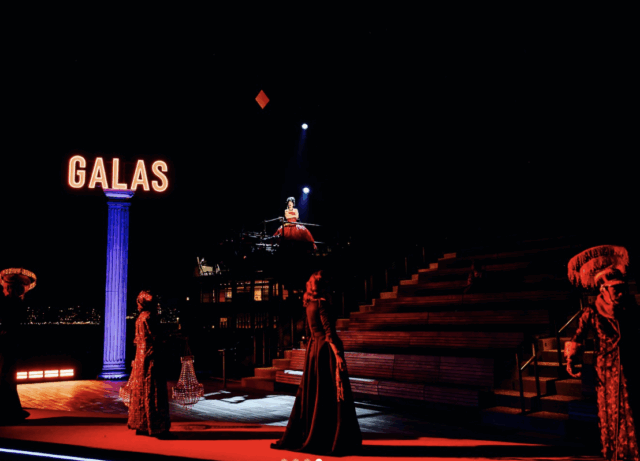
Tony and Obie winner Mimi Lien’s set features a long, movable catwalk, some furniture, and a tall Greek column with the word Galas at the top in neon lights that change color. Jackson Wiederhoeft’s costumes for Galas are spectacular, from an elegant red gown to a tight-fitting business dress. The other costumes, by Hahnji Jang, are fun and frolicsome, especially the getups for the pope. Jiyoun Chang’s lighting and Tei Blow’s sound work well in the outdoor setting. Raja Feather Kelly’s choreography is way too over the top during the yacht scene.
Rare revival of Charles Ludlam’s Galas continues through September 28
Countertenor Costanzo, who has appeared in lead roles for the Metropolitan Opera, the English National Opera, the Teatro Real Madrid, and other international companies and is the general director and president of the innovative Opera Philadelphia, has become Little Island’s breakout star; last year he performed all the live singing parts in an almost-solo version of Mozart’s The Marriage of Figaro, and he is outstanding here as Galas, wearing fanciful outfits, dishing dirt, and luxuriating in the high life but understanding that it could all go away in the blink of an eye. The role was originally played by Ludlam, then by the late Ludlam’s longtime partner, Everett Quinton, in the first-ever revival in 2019. (Quinton designed the costumes and played Bruna in the 1983 staging.)
Obie winner Testa (On the Town,Oklahoma!) serves as the anchor for the show, balancing pathos with physical comedy and her lovely singing voice. Tropicana (With What Ass Does the Cockroach Sit?/Con Que Culo Se Sienta la Cucaracha,Memorias de la Revolucion) is a hoot as the short and stout Mercanteggini, and la Perdida sparkles as the nonbinary pontiff.
Obie-winning director Ting (The Comeuppance,Between Two Knees), who helmed Alina Troyano and Branden Jacobs-Jenkins’s Give Me Carmelita Tropicana!, guides numerous delightful moments in the first half, particularly with his interpretation of a train arriving at a station and his later use of chandeliers, but the yacht scenes drag on, feeling like a Fellini movie that was never released. And the way the characters say “La Scala” with their tongues sticking out is humorous at first but eventually dries up.
Galas is at its best when Costanzo is singing, whether an aria from Carmen, “Casta Diva” from Norma, or additional selections he made. But even with its troubled center section, it’s a triumphant tribute to a downtown theater legend, an eternal opera diva, and the cost of living for art.
[Mark Rifkin is a Brooklyn-born, Manhattan-based writer and editor; you can follow him on Substack here.]
Oshoosi (Alani iLongwe) shares his dreams with his brother, Ogun (André Holland), in sizzling drama at the Shed (photo by Marc J. Franklin)
THE BROTHERS SIZE
The Shed’s Griffin Theater
545 West 30th St. at Eleventh Ave.
Tuesday – Sunday through September 28, $25-$129
646-455-3494 theshed.org
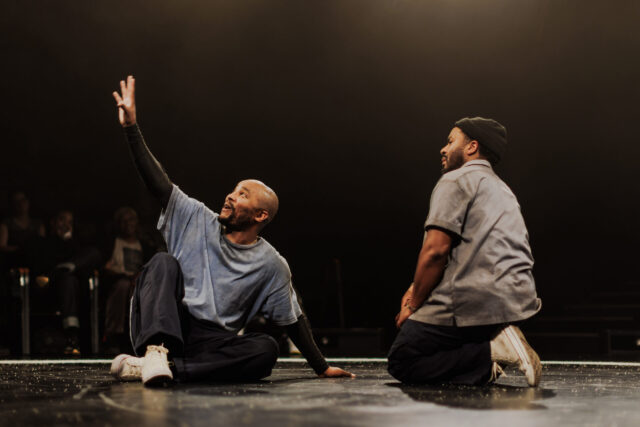
Halfway through the scintillating revival of Tarell Alvin McCraney’s The Brothers Size at the Shed, Ogun Size (André Holland) says to his younger brother, Oshoosi (Alani iLongwe), “He call me Size,” referring to the local sheriff. Oshoosi replies, “Call me Size, too.” Ogun adds, “Like we twins.” Oshoosi responds, “Or the same person.”
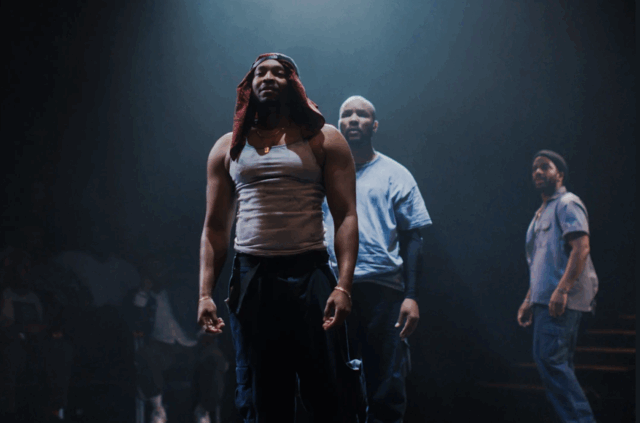
Based on Yoruba myth, the play is set in San Pere, Louisiana, near the Bayou, in the distant present, about a pair of very different siblings who deeply care for each other but are on decidedly separate paths: Ogun, named after the god of metal and fire, is a practical, hardworking man who owns an auto repair shop, specializing in bringing damaged cars back to life. Oshoosi, the divine spirit of hunting and contemplation, is a dreamer who just finished a two-year prison stint and is hanging around with his fellow parolee, Elegba (Malcolm Mays), the divine messenger and guardian. “We was like brothers,” Elegba says to Oshoosi, referring to how close they grew while behind bars, adding, “Brothers in need.”
Performed in the round, the story begins with Elegba slowly walking the staging area, pouring out white sand in a large, sacred circle that serves as a kind of spiritual and physical boundary; in Yoruba lore, a magic circle could represent healing, communication with the deities, or ritual sacrifice. The three characters sing a Gospel song, “This road is rough . . . / This road is rough and hard —” Accompanying them is percussionist Munir Zakee, who contributes rhythms that date back to the thirteenth-century diaspora.
Ogun, Oshoosi, and Elegba often stand outside the circle when they’re not part of the action, watching the others, then announcing their entrance; in fact, much of the text is told in the third person, switching from dialogue to stage directions without a blink.
Ogun: Ogun Size Enters / Osi! / Calling for his brother / Osi . . . / Oshoosi! Oshoosi: Waking from his dream! / What man, what? Ogun: Get up. Oshoosi: Comin’ in here turning on lights! Ogun: That’s the sun. Oshoosi: Kissing his teeth Ogun: Oshoosi! Oshoosi: Don’t you get tired of going through this? / Every morning we go through this. Ogun: Get yo ass up! Oshoosi: This hard? / Early in the morning you gotta be this hard? Ogun: Man don’t bring me that!
After two years in prison, Oshoosi resents being told what to do by his brother. Although Ogun has provided him with a job and a place to live, Oshoosi seems ungrateful, more interested in spending his time with Elegba, finding a woman, and getting a car so he can experience more freedom. Ogun doesn’t trust Elegba, who works at a funeral parlor and who has again attracted the attention of the racist sheriff, who is just waiting for Elegba and Oshoosi to make a mistake.
Ogun has good reason to worry.
Elegba (Malcolm Mays), Oshoosi (Alani iLongwe), and Ogun (André Holland) explore family and responsibility in The Brothers Size (photo by Marc J. Franklin)
The Brothers Size debuted in 2005, when McCraney was still in graduate school. The first of his “Brother/Sister Plays,” which continued with 2008’s In the Red and Brown Water and 2015’s Marcus; or the Secret of Sweet, this revival, a coproduction between the Shed and the Geffen Playhouse, is a searing exploration of male friendship and family responsibility viewed through the lens of racial injustice and rehabilitation. Without becoming preachy, it unfolds at a beautifully rhythmic and poetic pace, with nary a word out of place, highlighted by several stunning dream/nightmare monologues.
There are no props, no furniture on Suzu Sakai’s bold set; the actors never change out of their gray shirts, dark pants, and white sneakers, evoking prison uniforms; Ogun also wears a black knit hat and Elegba a durag-like bandanna. The stark costumes are by Tony winner Dede Ayite, with sharp sound and interstitial music by Stan Mathabane, softly dramatic lighting by Spencer Doughtie, and occasional choreography by Juel D. Lane inspired by Alvin Ailey.
For the first time, McCraney, who shared an Oscar with director Barry Jenkins for Best Adapted Screenplay for the 2016 film Moonlight, is codirecting the play, with Bijan Sheibani (Barber Shop Chronicles,Till the Stars Come Down), and the minimalist production sizzles through all ninety minutes. There’s an excitement each time one of the performers steps over the circle and the plot progresses with a fierce yet touching intimacy.
Mays, a musician, filmmaker, and actor best known for the television series Power Book III: Raising Kanan and Snowfall, imbues Elegba with just the right hint of potential trouble as he inserts himself between the two brothers. iLongwe (Paradise Blue,Antebellum) is gentle and touching as Oshoosi, a young man who wants to turn around his life but has difficulty seeing things through and understanding potential consequences. And Holland (Jitney,Othello), who portrayed Elegba twenty years ago and played the adult Kevin in Moonlight, is electric as Ogun, a proud man who has sacrificed his personal life to help his brother, but while he can fix any car, he’s running out of options with Oshoosi.
The Brothers Size is worthy of an esteemed place in the pantheon of such classic plays about siblings as Suzan-Lori Parks’s Topdog/Underdog, Sam Shepard’s True West, and August Wilson’s The Piano Lesson, a powerful, gripping, timeless tale of freedom and brotherhood.
[Mark Rifkin is a Brooklyn-born, Manhattan-based writer and editor; you can follow him on Substack here.]