live performance

I’M REVOLTING

Patients and family members await serious news in Gracie Gardner’s I’m Revolting (photo by Ahron R. Foster)

I’M REVOLTING
Atlantic Theater Company
Linda Gross Theater
336 West 20th St. between Eighth & Ninth Aves.
Tuesday – Sunday through October 16, $77-$97
866-811-4111
atlantictheater.org

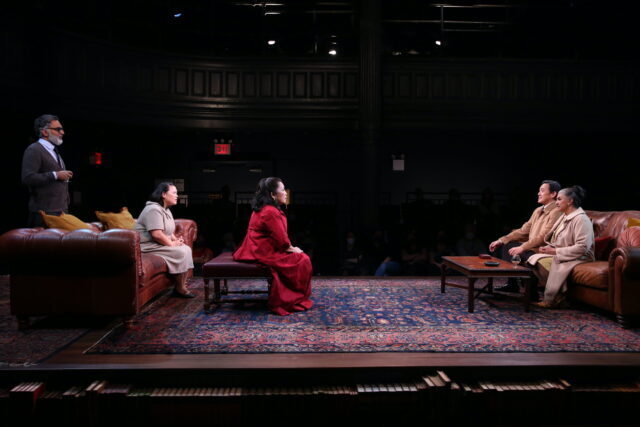
Theater is all about making magic, and that’s exactly what happened at last Sunday’s matinee of Gracie Gardner’s I’m Revolting at the Atlantic. The play takes place in the waiting room of a New York City skin cancer clinic, where four characters are arriving for further tests or surgeries. There’s no curtain, so Marsha Ginsberg’s attractive set is visible as the audience enters: six chairs lined in a row at the center, a watercooler stage right, some plants stage left, a vending machine behind the patients, low overhead fluorescent lighting (by Kate McGee) and a striking wall of mirrors across the back that allows the audience to see itself in the reflection, as if we are all in the waiting room together. The effect is all the more effective since masks are required at the Atlantic and we are about to see a show in which several characters must deal with possible facial disfigurements that would leave them trying to avoid mirrors.

But before the play started, director Knud Adams, taking off his mask, announced that one of the actors, the wonderful Peter Gerety, had come down with Covid-19 and was being replaced by the wonderful Peter Maloney, an Atlantic regular who had been asked the day before to step in for Gerety. Adams explained that Maloney would be playing the part with script in hand, since he had had less than twenty-four-hour notice. Understudies have performed their own kind of magic during the coronavirus crisis, keeping Broadway and off Broadway going amid variant outbreaks, but none are listed in the Playbill for I’m Revolting, so without Maloney, the last week of the show’s run might have had to be canceled.

Doctors Denise (Patrice Johnson Chevannes) and Jonathan (Bartley Booz) are in for a long day at skin cancer clinic (photo by Ahron R. Foster)

Maloney does a remarkable job as Clyde, an older man who has been to the clinic many times for multiple procedures; he is either a wise sage or a nosey neighbor to the others: nineteen-year-old Reggie (Alicia Pilgrim), who is terrified of being left with ugly facial scars; Reggie’s older sister, Anna (Gabby Beans), a demanding financier who seems to have better things to do than wait with her nervous sibling; Toby (Patrick Vaill) a former lifeguard who blames his nipple melanoma on himself for not using proper protection and hides under his coat instead of interacting with anyone; Paula (Laura Esterman), Toby’s New Age mother, who believes healing comes from within (with the help of holistic rituals); Liane (Emily Cass McDonnell), the saddest of them all, who has the most extreme case; and Jordan (Glenn Fitzgerald), her husband, who is in complete denial as to her wife’s situation.

The clinic is run by Denise (Patrice Johnson Chevannes), a calm, welcoming doctor, and Jonathan (Bartley Booz), a younger physician learning the ropes from her. Every time Denise or Jonathan call in a patient to go through the door in the back, the other people in the waiting room engage in a range of conversations, openly sharing their personal information with one another.

The cast is uniformly superb, keeping it real even when their characters go a little overboard. Pilgrim (Cullud Wattah) portrays Reggie in a way that she could be any of us, while Chevannes (Halfway Bitches Go Straight to Heaven, runboyrun) makes Denise the doctor you’d want to have for whatever ails you.

Jordan (Glenn Fitzgerald) and Jonathan (Bartley Booz) face off in I’m Revolting at the Atlantic (photo by Ahron R. Foster)

Clyde is the central guiding force, and Maloney (Outside Mullingar, Glengarry Glen Ross) nailed him; while he occasionally looked at the script (usually surreptitiously), he was mostly off book, getting his line readings just right with all the necessary ebbs and flows. It was inspiring to watch him pull this off, to both the audience and his fellow actors, a reminder for how real illness can be and as a model for how humans deal with it (although the general public cannot call in a replacement at the last minute).

Adams (English, Paris) directs the play with surgical precision, although things get bumpy when Gardner (Panopticon, Pussy Sludge) tries to conclude each patient’s story arc. The finale, though, is a sharp jab to the head and stomach. It’s not an easy ninety minutes, but Adams and Gardner do a terrific job of keeping you involved in a work that unfolds in one of the last places you’d ever want to be.

BAM NEXT WAVE / FIAF CROSSING THE LINE: CROWD

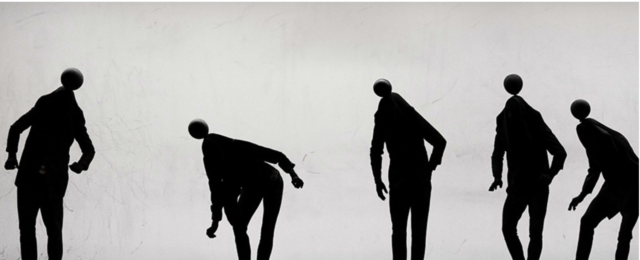
Fifteen characters share their stories during a rave in CROWD (photo © Estelle_Hanania)

CROWD
Brooklyn Academy of Music
BAM Howard Gilman Opera House
30 Lafayette Ave. between Ashland Pl. & St. Felix St.
October 13-15, $34-$85, 7:30
718-636-4100
www.bam.org/crowd
www.g-v.fr/en/shows/crowd

Franco-Austrian choreographer, filmmaker, photographer, and installation artist Gisèle Vienne’s propulsive, euphoric CROWD makes its US premiere at BAM from October 13 to 15, with three highly anticipated performances in the Howard Gilman Opera House. A joint presentation of BAM’s Next Wave and FIAF’s Crossing the Line Festivals, the ninety-minute 2017 work, which has traveled from Tokyo, Rome, and Dublin to Stockholm, Singapore, and Sao Paulo, features fifteen performers whose dialogue-free stories emerge amid a time-jumping 1990s-style Detroit rave. Lucas Bassereau, Philip Berlin, Marine Chesnais, Sylvain Decloitre, Sophie Demeyer, Vincent Dupuy, Massimo Fusco, Rehin Hollant, Georges Labbat, Oskar Landström, Theo Livesey, Louise Perming, Katia Petrowick, Linn Ragnarsson, Jonathan Schatz, Henrietta Wallberg, and Tyra Wigg move around a filthy floor littered with dirt and detritus to music by Underground Resistance, KTL, Vapour Space, DJ Rolando, Drexciya, the Martian, and others; the sound design, edits, and playlist are by Peter Rehberg, with Stephen O’Malley the sound diffusion supervisor and lighting by Patrick Riou.

Inspired by her time dancing in clubs in early 1990s Berlin, creator, choreographer, and scenic designer Vienne (I Apologize, Kindertotenlieder, Jerk) developed the characters and narrative with longtime collaborator Dennis Cooper, the American poet and novelist who has written such books as the George Miles Cycle and was the founder and editor of the 1970s–’80s punk zine Little Caesar. “If you see CROWD live, audiences have said they feel a little bit different afterwards than before they came into the theatre, a slightly altered way of being,” Vienne told the UK Guardian in September 2019. “I think there is this double feeling of being very sharp — because it has slowed down, you can see detail in a sharper way than usual — and then a little bit of this stoned feeling.”

american (tele)visions

Victor I. Cazares’s american (tele)visions takes place in a Wal-Mart that represents the United States (photo by Joan Marcus)

american (tele)visions
New York Theatre Workshop
79 East Fourth St. between Second & Third Aves.
Tuesday – Sunday through October 16, $65-$75
www.nytw.org

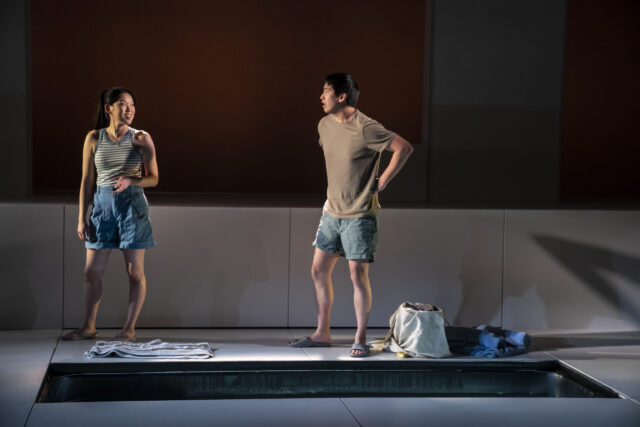
Sitting at home watching television, you can always change the channel if you’re not enjoying a program; the same is not true when sitting in a dark theater experiencing a live play. I would have liked having a remote during Victor I. Cazares’s american (tele)visions, making its world premiere at New York Theatre Workshop through October 16.

The hundred-minute nonlinear play explores a family of illegal Mexican immigrants unable to attain the American dream. Their home base is Wal-Mart, where they are tempted by the ogre of “perpetual consumption.” When young daughter Erica (Bianca “b” Norwood), who is awaiting the rapture, admits, “I want to not want . . . to not want. I want. I don’t want to want,” it is like blasphemy.

Erica’s mother, Maria Ximena (Elia Monte-Brown), who ran away with a trucker named Stanley, explains, “We don’t watch television together anymore. And we stopped shopping together even when we were together. Yes, we would all be in the same store . . . but in different aisles, worlds apart.”

Maria’s husband, Octavio (Raúl Castillo), arrived in America first, working hard to save money to bring over the rest of his family, but he is not on a path to success. When his dead son, Alejandro (Clew), begins filming him and asks him how work is, Octavio plainly replies, “It’s fine.” Alejandro says, “Dad, that isn’t good television, you have to tell me more — something juicy.” Ocatavio offers, “I cut my hand at work today. I’m severely depressed. And I can’t stop watching television. And I think about your mom, with that fucking truck driver. And I keep thinking about you. And how I miss you.”

Projections about in world premiere at New York Theatre Workshop (photo by Joan Marcus)

Erica’s best friend and next-door neighbor is Jeremy (Ryan J. Haddad), a young gay man who spends a lot of time choosing which Barbie doll to add to his collection. Erica has promised to get him one, but she can’t afford it, so it is languishing in “Layaway Land.” Jeremy complains, “That’s no way to treat a goddess.”

Meanwhile, it is becoming apparent that Alejandro and his best friend, Jesse (Clew), were closer than just buddies, as evidenced by a VHS tape they made of themselves — a tape that Octavio wanted to destroy but the eject button on the VCR was broken and the remote control was out of batteries, overt metaphors for the father’s deteriorating life.

Directed by Rubén Polendo (remnant), american (tele)visions features a complex set by Bretta Gerecke that features two large rusted boxes on top of one another on either side of the stage, evoking the sculpture of Richard Serra. The boxes, on which live and prerecorded video is sometimes projected, are occasionally opened by various characters to reveal Octavio’s man cave, the Barbie section of Wal-Mart, the front of Stanley’s truck, and [.] The two angled side walls also serve as screens, showing a barrage of consumer items or the characters making confessions, which also happens in the back.

The initial wonder of the set fades, especially if you’re not near the center of the audience; various projected images and the interiors of the boxes are not fully visible to much of the audience, which was annoying. In addition, the use of the projections and boxes, as well as the dialogue and plot, grow repetitive and disappointing, as it seems like they could have done so much more with them. (The technology design is by Theater Mitu, a copresenter of the production.)

Cazares (Pinching Pennies with Penny Marshall, Ramses contra los monstruos) throws in a kitchen sink’s worth of issues, from illegal immigration, religious faith, and capitalism to queer culture, disabilities, infidelity, depression, and workplace safety, but it’s too much all at once. We watch television series because of the characters; every week the plots change, but it’s the regulars who keep us coming back, season after season. In american (tele)visions, the characters are just not compelling enough; I found myself wanting to appreciate and care about them, but they remain stagnant. And the vast array of plot points were dizzying.

By the time Maria emerged in a bizarre costume (by Mondo Guerra) as Wal-Martina, I had had enough. “Look, if they don’t like it, they can change the channel,” Maria had said earlier. But that choice was not open to me.

BALDWIN AND BUCKLEY AT CAMBRIDGE

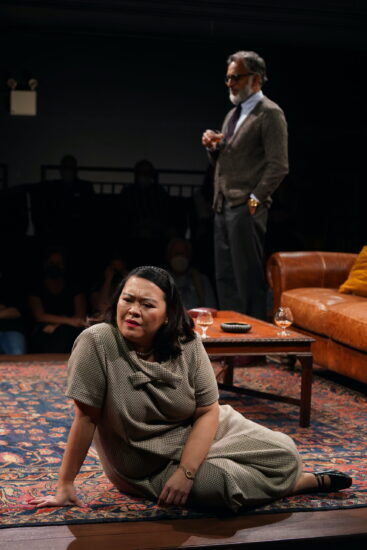
James Baldwin (Greig Sargeant) and William F. Buckley (Ben Jalosa Williams) face off about the American dream at the Public (photo by Joan Marcus)

BALDWIN AND BUCKLEY AT CAMBRIDGE
Anspacher Theater, the Public Theater
425 Lafayette St. at Astor Pl.
Tuesday through Sunday through October 23, $60-$70
212-539-8500
publictheater.org

During the pandemic lockdown, I watched the american vicarious’s virtual Debate: Baldwin vs Buckley, a sharp re-creation of the famous debate between liberal Black author James Baldwin and conservative white author William F. Buckley that was held at the University of Cambridge in England on February 18, 1965, addressing the question “Has the American Dream been achieved at the expense of the American Negro?” Presented in collaboration with BRIC, the show premiered in person at the Great Room at A.R.T./New York in March 2022 and continues its five-borough tour October 10 at the Old Stone House and November 11 at the Queens Theater. The online performances took place on a dark, spare stage with Baldwin (Teagle F. Bougere) and Buckley (Eric T. Miller) on either side of a small table; the in-person play moved the proceedings to a wood-paneled conference room with a black-and-white television occasionally showing clips of the original debate.

I also watched that original debate, which can be found on YouTube. It is a thrilling event, as mostly white male students in suits and ties pack the Cambridge Union; there’s barely room for the two main competitors to walk to their places at their opposing lecterns. The multiple cameras cut between the crowd and close-ups of Baldwin, in a narrow tie, and Buckley, in a bowtie, as they state their cases and react to each other’s points.

When I heard that Elevator Repair Service, one of the city’s most adventurous and daring companies for more than thirty years, was doing its own version, titled Baldwin and Buckley at Cambridge, at the Public’s Anspacher Theater, I was excited by the possibilities; ERS has previously staged unique interpretations of such classics as The Sound and the Fury, The Seagull, Ulysses, Measure for Measure, and The Great Gatsby (the eight-hour Gatz). Alas, perhaps I was expecting too much.

James Baldwin (Greig Sargeant) and Lorraine Hansberry (Daphne Gaines) have a drink while discussing racism in Baldwin and Buckley at Cambridge (photo by Joan Marcus)

Directed by ERS founding artistic director John Collins, Baldwin and Buckley at Cambridge turns out to be, more or less, a straightforward adaptation of the debate, with small little touches. The introductions by Cambridge students David Heycock (Gavin Price) and Jeremy Burford (Christopher-Rashee Stevenson) are delivered in contemporary dress (the costumes are by Jessica Jahn) and include a land acknowledgment and references to the Public, which opened on Lafayette St. in 1967. Heycock quotes Martin Luther King Jr. and shares frightening numbers about voting and prison that immediately bring to mind current attempts at voter suppression and the Black Lives Matter movement. Burford argues that “the American dream has been very important indeed in furthering civil rights and in furthering freedom for the American Negro,” a controversial statement, especially as delivered by Stevenson, who is Black. (Price is white.)

The bulk of the show are the two long monologues by Baldwin and Buckley, portrayed by Greig Sargeant and Ben Jalosa Williams, respectively; neither actor tries to fully embody their character, although Williams throws in a few lines doing a mock impression of the erudite Buckley’s upper-class accent. Although the words resonate with what is happening today, I wasn’t grabbed by the proceedings. Perhaps it was because I was too familiar with it all, having so recently seen the american vicarious version and the original. It also felt distant; the 1965 debate was filled to the gills with students, shoulder to shoulder in chairs and on the floor, while at the Anspacher we were sitting quietly in our seats, experiencing a fictionalized play, not actual history.

The play did not end with the conclusion of the debate; ERS adds a coda that initially stirred me but eventually left me confused. The brief scene takes place in a living room (the sets are by dots), where Baldwin is joined by his good friend, playwright Lorraine Hansberry (Daphne Gaines), as they discuss four hundred years of racism and the need for societal change. “We’ve got to sit down and rebuild this house,” Baldwin says. “The charge of impatience is simply unbearable,” Hansberry explains.

Mixing past and present, they then turn into Sargeant (who conceived the project) and Gaines, the actors, who recall working together at the Public in ERS’s The Sound and the Fury and discuss white and Black casting. While they make interesting points, reminding us how far we still have to go, it felt tacked on to score sociopolitical points; it also made me think about how Hansberry’s A Raisin in the Sun, which deals with a Black family in 1959 trying to find the American dream, is playing now in the Public’s Newman Theater.

“HELLZAPOPPIN’: WHAT ABOUT THE BEES?”

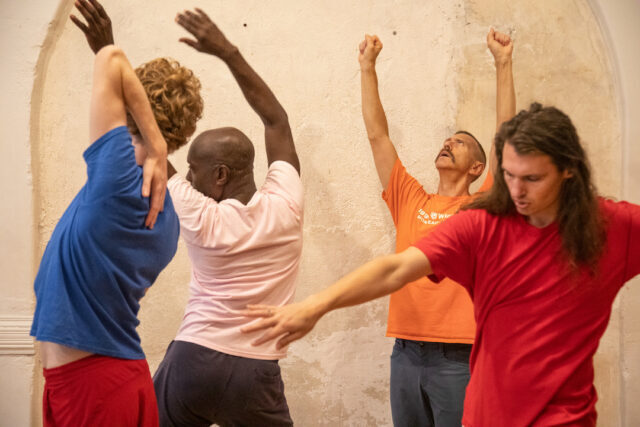
Yvonne Rainer’s “last dance” includes a pillow fight at New York Live Arts

Who: Emily Coates, Brittany Bailey, Brittany Engel-Adams, Patricia Hoffbauer, Vincent McCloskey, Emmanuèle Phuon, David Thomson, Timothy Ward, Kathleen Chalfant
What: World premiere
Where: New York Live Arts Theater, 219 West Nineteenth St. between Seventh & Eighth Aves.
When: October 5-8, $15-$85
Why: Legendary dancer, choreographer, filmmaker, author, and activist Yvonne Rainer asks, “What about the bees?” in what she has announced will be her “last dance.” Premiering October 5-8 at New York Live Arts, “HELLZAPOPPIN’: What about the bees?” takes on systemic racism through text, movement, and live projections, including excerpts from the 1941 Hollywood musical Hellzapoppin’, a reality-busting movie melding film and theater starring Ole Olsen and Chic Johnson, Martha Raye, Mischa Auer, Shemp Howard, Slim and Slam, and Whitey’s Lindy Hoppers, and Jean Vigo’s highly influential 1933 antiestablishment film about boarding school, Zero for Conduct. The evening begins with a screening of Rainer’s 2002 half-hour film After Many a Summer Dies the Swan: Hybrid, which expands on a piece she choreographed for Mikhail Baryshnikov’s White Oak Dance Project incorporating texts by Oscar Kokoschka, Adolf Loos, Arnold Schoenberg, and Ludwig Wittgenstein and rehearsal footage shot by Charles Atlas and Natsuko Inue.

“HELLZAPOPPIN’: What about the bees?” runs October 5-8 at NYLA

A coproduction of NYLA and Performa, “HELLZAPOPPIN’: What about the bees?” will be performed by a mix of dancers and actors, featuring Emily Coates, Brittany Bailey, Brittany Engel-Adams, Patricia Hoffbauer, Vincent McCloskey, Emmanuèle Phuon, David Thomson, Timothy Ward, and Kathleen Chalfant. Rainer also harkens back to her fictional character Apollo Musagetes, leader of the muses, who in 2020 presented “Revisions: A Truncated History of the Universe for Dummies: A Rant Dance, Lecture, and Letter to Humanity.” “I’m going to be veering back and forth between various topics: my aging self-pity, my ‘permanently recovering racism,’ my sometimes evasive appropriation of the notion that not all white people, and not all white women, are racists, and various historical and cultural reflections,” Rainer, who is now eighty-seven, said in a statement. Rainer will participate in a Stay Late conversation with Bill T. Jones following the October 6 show.

THEATER TALKS — DEATH OF A SALESMAN: A CONVERSATION WITH WENDELL PIERCE, SHARON D. CLARKE, ANDRÉ DE SHIELDS, AND MIRANDA CROMWELL

Who: Wendell Pierce, Sharon D. Clarke, André De Shields, Miranda Cromwell, Salamishah Tillet
What: Panel discussion on new Death of a Salesman revival
Where: Schomburg Center for Research in Black Culture (NYPL), 515 Malcolm X Blvd., and online
When: Monday, October 3, free with RSVP, 7:00
Why: Lee J. Cobb, George C. Scott, Dustin Hoffman, Brian Dennehy, and Philip Seymour Hoffman have all starred as Willy Loman in Broadway productions of Arthur Miller’s Pulitzer Prize–winning 1949 American classic, Death of a Salesman. You can now add to that prestigious list Wendell Pierce, in the latest Broadway revival, now in previews for an October 9 opening at the Hudson Theatre. The cast features Pierce and Sharon D. Clarke as Willy’s wife, Linda — both won Oliviers for their performances in the West End production — along with André De Shields as Ben, Khris Davis as Biff, and McKinley Belcher III as Happy, the first all-Black Loman family on the Great White Way.

On October 3 at 7:00, Pierce (The Wire, The Piano Lesson), Clarke (Holby City, Caroline, or Change), and Tony and Emmy winner De Shields (Hadestown, The Full Monty) will be joined by director Miranda Cromwell (Magic Elves, Pigeon English) and moderator and Pulitzer Prize winner Salamishah Tillet for a discussion at the NYPL’s Schomburg Center for Research in Black Culture; presented in conjunction with the 92nd St. Y’s Unterberg Poetry Center, the free event is being held in person and online, and advance registration is required. “So many of the elements of the play are fundamentally questioning of the American dream, and when you put that through the perspective of the Black experience, that enriches it,” Cromwell said in a statement. “The obstacles are harder, the stakes become higher.”

LUNDAHL & SEITL: SYMPHONY OF A MISSING ROOM PERFORMANCE AND DISCUSSION

Lundahl & Seitl, Symphony — Tunnel Vision, performed in 2015 at Momentum 8 (photo courtesy of the artists)

Who: Lundahl & Seitl, Barbara London
What: Performance and discussion
Where: Scandinavia House, 58 Park Ave. at 38th St.
When: Sunday, October 2, free with advance RSVP, performances 11:30 am – 1:30 pm and 4:00 – 5:30, discussion at 1:30
Why: “In times of challenge, how to find a good balance between resilience and resistance when adapting to a changing environment? How can we stay sensible for subtle yet powerful shifts in our being together? What is an acceptable level of reality, and for who/what do we make the sacrifice?” So ask immersive art duo Lundahl & Seitl in regard to their 2009 piece, Symphony of a Missing Room, which they reimagined as an app during the pandemic. On Sunday, October 2, Christer Lundahl and Martina Seitl will be at Scandinavia House to perform the work, in half-hour increments between 11:30 and 1:30 and 4:00 to 5:30; in addition, there will be a discussion at 1:30 moderated by curator and writer Barbara London, host of the Barbara London Calling podcast.

The free event is being held in partnership with the Consulate General of Sweden in New York; Lundahl & Seitl have previously performed Symphony of a Missing Room at the Swedish National Museum in Stockholm, the Akropolis Museum in Greece, the Kochi-Muziris Biennale in India, and the Temple of Alternative Histories at Staatstheater Kassel in Germany, among other venues. The ever-evolving work involves white goggles as participants must reconsider their inner and outer relationships with the environment and the space they are in. Admission is free with advance RSVP.