live performance

DOWNSTAIRS AT BOND 45: THE ELI “DR. E” YAMIN QUARTET

Who: The Eli “Dr. E” Yamin Quartet
What: Live Music Downstairs
Where: Bond 45, 221 West Forty-Sixth St. between Seventh Ave. & Broadway, 212-689-4545
When: Sunday, October 23, no cover ($25 minimum), 7:30
Why: Broadway might be mostly dark on Sunday nights, but that doesn’t mean the Theater District isn’t hopping with some of the hottest shows at that time. In recent months, such bands as Vince Giordano and the Nighthawks, the Stan Harrison Quartet, and the Mark Kostabi Trio have performed Sunday nights Downstairs at Bond 45, the popular Italian restaurant that is now located on West Forty-Sixth St. On October 23 at 7:30, the Eli “Dr. E” Yamin Quartet will take the stage for its second weekend, consisting of Eli Yamin (aka “Dr. E”) on piano and vocals, Zaid Nasser on alto sax, Elias Bailey on bass, and David F. Gibson on drums. A native of East Patchogue, Long Island, Yamin recently earned his doctorate in musical arts, specializing in jazz piano, from Stony Brook; he also cofounded and serves as managing and artistic director of Jazz Power Initiative, a nonprofit organization whose mission is “to ignite the power of jazz music education and transform lives by fostering creative self-expression, community, teamwork, and diversity,” and was the founding director of Jazz at Lincoln Center’s Middle School Jazz Academy.

Yamin, who has a wide range of influences, from Pete Seeger and Arlo Guthrie to Bach and Mozart, from Sinatra and B. B. King to Jimi Hendrix and Taj Majal, has released such albums as Louie’s Dream, I Feel So Glad, You Can’t Buy Swing, and Pushin’ 30. The good doctor will kick off his Sunday at 2:00 cohosting the free Intergenerational Jazz Power Jam: Brass Extravaganza at the National Jazz Museum of Harlem before heading down to Bond 45. He’s also a bit of a philosopher, offering these words of wisdom on his website: “You can do it if you set your mind to it. Whatever your long term goal is, whether academic, artistic, spiritual. The main thing is just like Duke Ellington said and I’ll say it again. NEVER GIVE UP.”

COST OF LIVING

Eddie (David Zayas) and Ani (Katy Sullivan) face adversity in Cost of Living (photo © Jeremy Daniel)

COST OF LIVING
Samuel J. Friedman Theatre
261 West Forty-Seventh St. between Broadway & Eighth Ave.
Tuesday – Sunday through November 6, $74-$298
www.manhattantheatreclub.com

When I saw Manhattan Theatre Club’s production of Martyna Majok’s Cost of Living at New York City Center’s Stage I five and a half years ago, I did not anticipate that it would win the Pulitzer Prize for Drama. I also never imagined that the show, which I called “a tender, emotional play about four lonely people seeking connections,” would eventually transfer to Broadway. But Cost of Living has made a terrific transition to MTC’s Samuel J. Friedman Theatre, with all its tenderness, emotion — and sense of humor — fully intact. In fact, it is now even better.

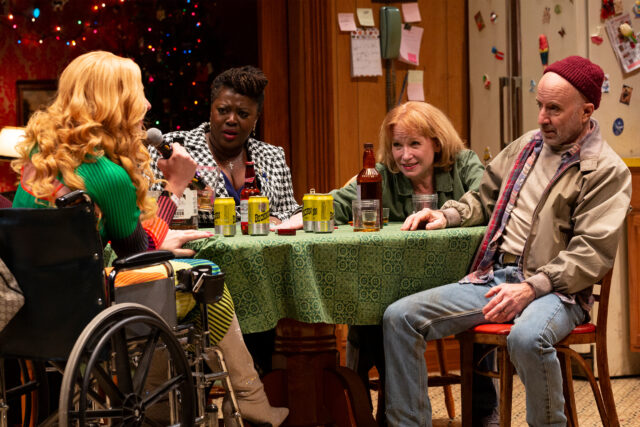
The play is once again directed by Obie winner Jo Bonney on Wilson Chin’s set, which rotates between the homes of John (Gregg Mozgala), a Harvard grad working on his PhD at Princeton and confined to a wheelchair with cerebral palsy, and Ani (Katy Sullivan), a quadriplegic also in a wheelchair.

While John is looking for a caregiver and interviews and hires Jess (Kara Young), a Princeton grad scrambling to make a living by working multiple jobs and who assures John that despite her slight build she can handle his needs, Ani initially refuses help from her ex-husband, Eddie (David Zayas), a former truck driver with a new girlfriend.

The play opens with Eddie sitting at a bar, talking to an unseen person in what is essentially a long, compelling monologue delivered directly to the audience. “The shit that happens is not to be understood. That’s from the Bible,” he says. “That life is good for people. I was thankful for every day they ain’t invented yet the trucker-robots. That life is good. The road. Sky. The scenery. Except the loneliness. Except in the case of all the, y’know, loneliness. This was what my wife was good for. Not that this was the only thing.”

John (Gregg Mozgala) and Jess (Kara Young) come to an agreement in Cost of Living (photo © Jeremy Daniel)

The loneliness and vulnerability experienced by all four characters is palpable, expressed most effectively in scenes of back-to-back caretaking. In the first, Jess washes John in the shower, moving him out of his chair and then back into it, followed by Eddie giving Ani a bath.

Describing his sensations, John tells Jess that his body feels as if he’s constantly under attack. “That’s what it’s like. Under my skin. From underneath my skin. Like people hitting me from beneath my skin. And that’s what you’ll be working with. Every morning. Is touching, shaving, undressing, washing, and clothing — that. That’s what I’m like.”

Meanwhile, Eddie visits Ani on a day her nurse hasn’t shown up, so Eddie asks Ani to hire him instead. “What do you think’s gonna happen you come take care of me a few hours a day? Huh?” she spurts out. “You brush my teeth a couple mornings, dump my bedpan a few times, and BOOM, conscience — fuck-shit, clap yer hands when I say Boom. . . . Yer not doin’ penance on me.”

The separate storylines merge at the end in an uneasy finale that acknowledges that we all encounter tremendously painful issues in life, regardless of our physical or psychological situations, which is further established during the curtain call.

Both Mozgala (Teenage Dick, Diagnosis of a Faun), who has cerebral palsy, and Sullivan (The Long Red Road, Finish Line), who was born without lower legs, return from the original cast, and both give intense, superb performances again, neither one pulling any punches. Young (Clyde’s, Halfway Bitches Go to Heaven) displays a tenacious fragility as Jess, who might be getting in over her head, while Zayas (Dexter, Anna in the Tropics) proves once more that he is one of New York City’s finest actors, balancing toughness with a sweet gentleness that shines through. Jeff Croiter’s lighting and Rob Kaplowitz’s sound capture the pervasive loneliness playing out onstage.

“Self-pity has little currency in these characters’ worlds. Humor, however, has much,” Majok (Ironbound, Sanctuary City) explains in a script note. Her and Bonney’s (Father Comes Home from the Wars, Fucking A) approach feels honest and unambiguous, as summarized in this exchange between Jess and John:

Jess: Sorry, I never worked with the, differently-abled —
John: Don’t do that.
Jess: What?
John: Don’t call it that.
Jess: Why, I —
John: Don’t call it differently-abled.
Jess: Shit, is that not the right term?
John: It’s fucking retarded. . . .
Jess: So what do I, how do I, refer to you?
John: Are you planning on talking about me?
Jess: No.
John: Why not? I’m very interesting.

The Broadway debut of Cost of Living, which was expanded from Majok’s 2015 short play John, Who’s Here from Cambridge, is a lot more than interesting, and you’ll be sure to be talking about it long after seeing it.

NIGHTMARE: GOTHIC

Nightmare: Gothic offers Victorian scares on the Lower East Side (photo by Joshua Hoffine)

NIGHTMARE: GOTHIC
Teatro SEA @ the Clemente
107 Suffolk St. between Rivington & Delancey Sts.
October 17-31, $30 GA, $45 VIP, 6:00 – 11:00 pm
nightmarenyc.com

Nobody loves Halloween scares quite as much as the folks at Psycho Clan do. For twenty years, cofounders Timothy Haskell and Paul Smithyman have been presenting varieties of immersive haunted house experiences as well as other holiday-themed (mis)adventures, including Nightmare Haunted House, This Is Real, Full Bunny Contact, and SANTASTICAL. Their latest horror presentation is Nightmare: Gothic, a half-hour immersion set amid Victoriana macabre, running October 17-31 at Teatro SEA @ the Clemente on the Lower East Side. The hunt is on to locate a missing child, but there are frightening barriers every step of the way.

“People have a very specific idea when they think ‘Goth’ and it is mostly of the romantic goth genre,” Haskell said in a statement. “We are, however, inspired by the Victorian Goth era. Think mid to late nineteenth century. Think Mary Shelley, Bram Stoker, The Picture of Dorian Gray, Kafka, the contemporary work of Edward Gorey, corsets, dark purples and black, hoop skirts, parasols . . . you get the idea.”

Advance tickets for Nightmare: Gothic are $30 for general admission and $45 for skip-the-line, arrive-any-time VIP access; groups of up to five people are welcome, but no one under twelve will be admitted, and those between thirteen and sixteen require a guardian. The event was conceived by cowriter and director Haskell (The Rise and Fall, Then Brief and Modest Rise Followed by a Relative Fall of . . . Jean Claude Van Damme as Gleaned by a Single Reading of His Wikipedia Page Months Earlier) and cowriter and production designer Smithyman, with sound by James Lo and lighting by Yang Yu.

Psycho Clan’s goal is “to haunt you well beyond the ephemeral,” so be ready for anything.

LAZARUS 1972–2022

Christopher Caines stars as the title character in Ping Chong’s mesmerizing update of Lazarus

LAZARUS 1972–2022
La MaMa Downstairs Theater
66 East Fourth St. between Second & Third Aves.
Thursday – Sunday through October 16, $25-$30
www.lamama.org
www.pingchong.org

For his final work as artistic director for his troupe, Ping Chong revisits his past while looking to the future in Lazarus 1972–2022, a contemporary reimagining of his first independent piece. In 1972, Ping presented Lazarus at Meredith Monk’s loft studio; as part of Ping Chong and Company’s fiftieth anniversary, the thrilling update is running at La MaMa, just a few blocks from that studio, through October 16.

The evening begins with a film of the stars in the galaxy, followed by a video countdown of the Toronto-born Ping’s previous works. Then Watoko Ueno’s delicate, enchanting set is intricately put together by two women (Chaesong Kim and Nancy McArthur) dressed all in black who bring in a white glass table and a white chair and place dining items on them — a coffee cup and saucer, salt and pepper shakers, a serving tray, silverware in a napkin — arranging and rearranging them with great delicacy, each making a loud noise as they are put on the table. Behind the table is a backdrop with alternating vertical panels. A hanging lamp is occasionally set in motion, moving back and forth like a pendulum clock running out of time as it slows down. (The haunting lighting, which turns from white to red to blue to pitch-black, is by Hao Bai, with expert sound design by Ernesto Valenzuela.)

Eventually, Lazarus (Christopher Caines) enters the room; he is wearing black pants, a white button-down shirt, and black shoes, his face covered in white bandages except for his eyes and mouth. He evokes both Claude Rains in The Invisible Man and Edith Scob in Eyes without a Face, another character whose true self goes unseen by the world. In this case, Lazarus has risen to life in 2022 New York City and feels alienated from a society not so quick to welcome strangers, echoing Ping’s experience when he moved out of Chinatown, where he was raised. Lazarus deliberately repositions the items on the table and prepares to eat, but he is soon distracted.

Over the course of about an hour, Lazarus meets a mysterious lady in red (Jeannie Hutchins) and another young woman in black (Tiffany Tan), becomes a puppet, encounters a strange truck, and considers what is next for him in this unyielding city, which at one point flies past him on multiple screens. (The projections are by Kate Freer, with costumes by Stefani Mar.) The only words are spoken in voiceover by Louise Smith or Ping (“There is a room; there is nothing in the room.”); there is no dialogue, only sound, light, and movement in a mesmerizingly beautiful piece.

The Canadian-born Caines, who runs his own dance company, has performed previously with Ping and is hypnotic as Lazarus; you can feel his alienation and suspicion as his eyes and body shift to surprise noises or he just stands tall and still, waiting for something to happen to break him out of his loneliness. But don’t let me mislead you; the show is also very funny.

“Time passes, and with time passing the poignancy of loss multiplies, which is to say Lazarus has lived the fullness of life through time,” Ping writes in a program note. “By now, it must be obvious that I am Lazarus and Lazarus is me. The theme of Lazarus, the theme of Otherness, runs through all my work. Who could be more Other than Lazarus. . . . I have chosen to complete my life as an artist with this work that started it all. Coming full circle seemed appropriate.”

Lazarus 1972–2022 is a fitting finale for Ping, a longtime leader in the avant-garde theater that rose up in downtown New York City in the 1970s and who is now saying farewell having come full circle, for all our benefit.

LMCC TAKE CARE SERIES: SUN SEEKERS INDUCTION CEREMONY

“Sun Seekers Induction Ceremony” will take place in the Oculus on October 15 (photo courtesy LMCC)

Who: Amy Khoshbin, Jennifer Khoshbin, Merced Searer, Ching-I Chang, Malcom McMichael, Alex Koi, Jon Panikkar
What: LMCC Take Care Series
Where: The Oculus, Westfield World Trade Center, 185 Greenwich St.
When: Saturday, October 15, free with RSVP, 3:00
Why: Continuing through October 30 on Governors Island, Iranian-American sisters Amy and Jennifer Khoshbin’s “Sun Seekers” is an interactive sci-fi installation in which visitors are encouraged to remove their shoes and put away their cellphones, leaving behind the Wreck-tangle, and immerse themselves in the healing aspects of the natural world. The exhibition consists of four portals that incorporate sound, movement, touch, and smell. “Enter the sun portal, the source of all life,” one portal offers. “Close your eyes, breathe, and listen. Be reborn as a Sun Seeker.” As you walk among the works, encountering spinning seats, a musical chair, futuristic clothing, and a central portal you can enter, you discover “The Great Forgetting” and “The Great Remembering. ”

On October 15 at 3:00, Amy Khoshbin will host an hourlong “Sun Seekers Induction Ceremony” at the Oculus at the Westfield World Trade Center; part of the Lower Manhattan Cultural Council’s Take Care Series, the event, cowritten with Yuliya Tsukerman, features performers Merced Searer, Ching-I Chang, and Malcom McMichael and musicians Alex Koi and Jon Panikkar and gives the audience the opportunity to connect with the sun, the environment, and their bodies in a group healing ritual. Admission is free with advance RSVP.

BEING FUTURE BEING: LAND/CELESTIAL and INSIDE/OUTWARDS

Emily Johnson’s Being Future Being comes to New York Live Arts October 20-22

Who: Emily Johnson/Catalyst
What: Being Future Being
Where: New York Live Arts, 219 West 19th St., 212-727-7476
When: Land/Celestial: October 15, $10-$30, 3:00 & 5:00; Inside/Outwards: October 20-23, $15-$40, 7:30
Why: In a July 2021 illustrated lecture to students at the Bates Dance Festival in Maine, where she was presenting the outdoor section of her work in progress Being Future Being, maker, gatherer, and protector Emily Johnson (Yup’ik) said, “We spent a lot of time in class earlier today thinking of the ground lifting up with us and also thinking about how we are always in relationship to the ground and thinking about ways in which we might be in better ongoing relationship with ground, with land, with water, with air, with relations. And from that I want to say that one day, the civil rights and sovereignty of Indigenous peoples will be recognized in relation to land, and that power imbalance and extraction will not be the default relationship in our working lives, and that theft of and abuses on and lack of recognition of Indigenous land and water and peoples will not be tolerated. And that’s the kind of future I look forward to making with all of you; that’s the kind of future I enjoy being in already with all of you.”

In such participatory works as Then a Cunning Voice and a Night We Spend Gazing at Stars, Shore, and The Ways We Love and the Ways We Love Better — Monumental Movement Toward Being Future Being(s) in addition to her Kinstillatory Mappings series outside Abrons Arts Center, Johnson, a Bessie Award-winning dancer, choreographer, curator, writer, and social justice activist, brings people together with the land and its history, taking on power imbalance and extraction by forming communities organized around the local environment.

Emily Johnson gathers people together for The Ways We Love and the Ways We Love Better — Monumental Movement Toward Being Future Being(s) in September 2020 (photo by twi-ny/mdr)

Johnson’s Being Future Being: Inside/Outwards will hold its Lenapehoking premiere October 20-22 at New York Live Arts, featuring a commissioned score by composer Raven Chacon (Navajo), sound by Chloe Alexandra Thompson (Cree), visual design by Holly Mititquq Nordlum (Iñupiaq), masks and wearables by IV Castellanos (mx Indige Quechua/Guaraní), Quilt-Beings by Korina Emmerich (Coast Salish Territory, Puyallup tribe), quilts by Maggie Thompson (Fond du Lac Ojibwe), costumes by Raphael Regan (Sisseton-Wahpeton Eastern Band of Cherokee and Diné), scenic fabrication by Joseph Silovsky, and lighting by Itohan Edoloyi. The piece will be performed by Ashley Pierre-Louis, Jasmine Shorty (Diné), Stacy Lynn Smith, and Sugar Vendil.

In addition, on October 15 there will be a special offsite performance, Land/Celestial, in Lower Manhattan; ticket holders will be advised of the specific location that day. As a whole, the creation of Being Future Being has involved four groups of collaborators, which Johnson refers to as the Branch of Knowledge, the Branch of Scholarship, the Branch of Making, and the Branch of Action. Johnson will be joined by individuals from the four branches at a Stay Late discussion following the October 21 show.

“The work asks audiences to join in community processes that move from each presentation out into the world in what I call the Speculative Architecture of the Overflow, with actions that directly support local rematriative, protection, and Land Back efforts,” Johnson explains on her website. “The Overflow is resonance, moving in the in-between, in-the-collective, in-the-invitation to GATHER HERE. Can the Overflow become supported, beyond the moment of the performance gathering, a speculative architecture resisting BUILD, but living, ongoing in an otherwise?” Johnson always asks intriguing, important questions, but the ultimate answers will have to come from each one of us.

I’M REVOLTING

Patients and family members await serious news in Gracie Gardner’s I’m Revolting (photo by Ahron R. Foster)

I’M REVOLTING
Atlantic Theater Company
Linda Gross Theater
336 West 20th St. between Eighth & Ninth Aves.
Tuesday – Sunday through October 16, $77-$97
866-811-4111
atlantictheater.org

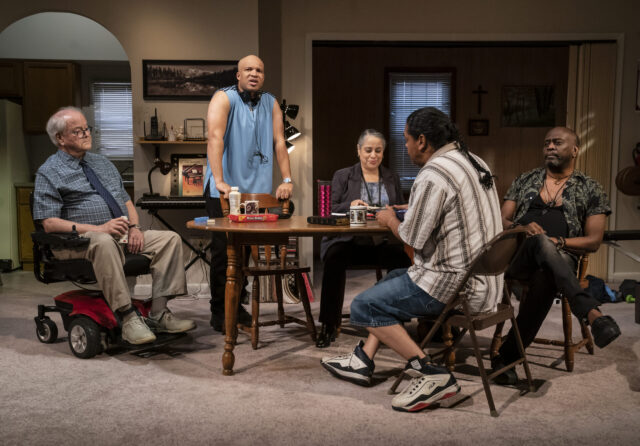
Theater is all about making magic, and that’s exactly what happened at last Sunday’s matinee of Gracie Gardner’s I’m Revolting at the Atlantic. The play takes place in the waiting room of a New York City skin cancer clinic, where four characters are arriving for further tests or surgeries. There’s no curtain, so Marsha Ginsberg’s attractive set is visible as the audience enters: six chairs lined in a row at the center, a watercooler stage right, some plants stage left, a vending machine behind the patients, low overhead fluorescent lighting (by Kate McGee) and a striking wall of mirrors across the back that allows the audience to see itself in the reflection, as if we are all in the waiting room together. The effect is all the more effective since masks are required at the Atlantic and we are about to see a show in which several characters must deal with possible facial disfigurements that would leave them trying to avoid mirrors.

But before the play started, director Knud Adams, taking off his mask, announced that one of the actors, the wonderful Peter Gerety, had come down with Covid-19 and was being replaced by the wonderful Peter Maloney, an Atlantic regular who had been asked the day before to step in for Gerety. Adams explained that Maloney would be playing the part with script in hand, since he had had less than twenty-four-hour notice. Understudies have performed their own kind of magic during the coronavirus crisis, keeping Broadway and off Broadway going amid variant outbreaks, but none are listed in the Playbill for I’m Revolting, so without Maloney, the last week of the show’s run might have had to be canceled.

Doctors Denise (Patrice Johnson Chevannes) and Jonathan (Bartley Booz) are in for a long day at skin cancer clinic (photo by Ahron R. Foster)

Maloney does a remarkable job as Clyde, an older man who has been to the clinic many times for multiple procedures; he is either a wise sage or a nosey neighbor to the others: nineteen-year-old Reggie (Alicia Pilgrim), who is terrified of being left with ugly facial scars; Reggie’s older sister, Anna (Gabby Beans), a demanding financier who seems to have better things to do than wait with her nervous sibling; Toby (Patrick Vaill) a former lifeguard who blames his nipple melanoma on himself for not using proper protection and hides under his coat instead of interacting with anyone; Paula (Laura Esterman), Toby’s New Age mother, who believes healing comes from within (with the help of holistic rituals); Liane (Emily Cass McDonnell), the saddest of them all, who has the most extreme case; and Jordan (Glenn Fitzgerald), her husband, who is in complete denial as to her wife’s situation.

The clinic is run by Denise (Patrice Johnson Chevannes), a calm, welcoming doctor, and Jonathan (Bartley Booz), a younger physician learning the ropes from her. Every time Denise or Jonathan call in a patient to go through the door in the back, the other people in the waiting room engage in a range of conversations, openly sharing their personal information with one another.

The cast is uniformly superb, keeping it real even when their characters go a little overboard. Pilgrim (Cullud Wattah) portrays Reggie in a way that she could be any of us, while Chevannes (Halfway Bitches Go Straight to Heaven, runboyrun) makes Denise the doctor you’d want to have for whatever ails you.

Jordan (Glenn Fitzgerald) and Jonathan (Bartley Booz) face off in I’m Revolting at the Atlantic (photo by Ahron R. Foster)

Clyde is the central guiding force, and Maloney (Outside Mullingar, Glengarry Glen Ross) nailed him; while he occasionally looked at the script (usually surreptitiously), he was mostly off book, getting his line readings just right with all the necessary ebbs and flows. It was inspiring to watch him pull this off, to both the audience and his fellow actors, a reminder for how real illness can be and as a model for how humans deal with it (although the general public cannot call in a replacement at the last minute).

Adams (English, Paris) directs the play with surgical precision, although things get bumpy when Gardner (Panopticon, Pussy Sludge) tries to conclude each patient’s story arc. The finale, though, is a sharp jab to the head and stomach. It’s not an easy ninety minutes, but Adams and Gardner do a terrific job of keeping you involved in a work that unfolds in one of the last places you’d ever want to be.