this week in literature

FREE SECOND SUNDAYS: WHITNEY BIENNIAL

Isaac Julien, detail, Once Again . . . (Statues Never Die), 2022 (photo by Ashley Reese), a highlight of the 2024 Whitney Biennial

WHITNEY BIENNIAL: EVEN BETTER THAN THE REAL THING
Whitney Museum of American Art
99 Gansevoort St.
Sunday, August 11, free with timed tickets, 10:30 am – 6:00 pm
212-570-3600
whitney.org

According to Ligia Lewis, the eighty-first Whitney Biennial is “a dissonant chorus”; that’s an apt description of the exhibition, which features more than seventy artists contributing painting, sculpture, video, live performances, and sound and visual installations. Organized by Chrissie Iles and Meg Onli with Min Sun Jeon and Beatriz Cifuentes, this edition is themed “Even Better Than the Real Thing,” with works that delve into the sociopolitical aspects of AI, personal identity, and marginalization.

The biennial comes to a close on August 11 with a free day of special programming as part of the Second Sundays initiative, including tours, workshops, and storytelling. Navigating the biennial can be a daunting task; below are ten recommended highlights, followed by the scheduled programs.

Nikita Gale, Tempo Rubato (Stolen Time): The keys of a seemingly haunted player piano are not connected to wires, so the sound made is just that of the pressing of the wood. Lights dim as the visitor contemplates whether what they are hearing is music and what constitutes an original composition.

Isaac Julien, Iolaus/In the Life (Once Again . . . Statues Never Die): British filmmaker Isaac Julien invites museumgoers to wander around multiple screens hung at different angles and sculptures by African American artists Richmond Barthé and Matthew Angelo Harrison as a film depicts conversations with Alain Locke (André Holland), the influential Harlem Renaissance writer, philosopher, educator, and first Black Rhodes scholar, and white chemist and art collector Albert C. Barnes (Danny Huston).

Seba Calfuqueo, Tray Tray Ko: Chilean artist Seba Calfuqueo makes her way through the sacred landscape where the Mapuche people live, walking amid trees, rocks, and a river, draping herself in a long train of electric blue fabric.

Carolyn Lazard, Toilette: A mazelike conglomeration of mirrored medicine cabinets filled with Vaseline, a by-product of oil and gas production, brings up thoughts of the price of self-care and caregiving as the corporatization of the health-care industry and the decimation of the rainforest get stronger.

Julia Phillips, Mediator: Hamburg-born, Chicago-based Julia Phillips examines pregnancy and motherhood in a piece composed of two chest casts with partial faces separated by a microphone, evoking a spinning game one might find in a public playground.

P. Staff, Afferent Nerves and A Travers Le Mal: A long room bathed in an ominous yellow contains an abstract self-portrait of the UK-born, LA-based artist, with a live electrical net hovering overhead, inviting visitors into what P. Staff calls “a particular trans mode of being that exists in the tension between dissociation and hypervigilance.”

Kiyan Williams, Ruins of Empire II or The Earth Swallows the Master’s House: A reflective aluminum statue of Black trans activist Marsha P. Johnson, holding a sign that declares, “Power to the People,” watches as the north facade of the White House, topped with an upside-down American flag, sinks into the earth in this outdoor installation. Viewers are encouraged to walk through and look closely at the impending death of a once-powerful building constructed by enslaved laborers.

Constantina Zavitsanos, All the time and Call to Post (Violet): Take a seat on the carpeted ramp and get lost in the blue-violet light as captions projected on the wall share such thoughts as “The universe is made of abundance” as you feel the infrasonics of modulated speech reverberating underneath you.

Holland Andrews, Air I Breathe: Radio / Hyperacusis Version 1: Sleeping Bag: Brooklyn-based composer and performer Holland Andrews has created two pieces for the biennial, Air I Breathe: Radio in the stairwell and Hyperacusis Version 1: Sleeping Bag, located in the elevator, works that incorporate music and found sound — in the latter, some made by the elevator itself — that offer a respite from visual overload.

Sunday, August 11
15-Minute Tours: Highlights of the Exhibition, multiple times

Artmaking: Magnetic Mosaic, 11:00 am – 3:00 pm

Artmaking with Eamon Ore-Giron, 11:00 am – 4:00 pm

Story Time with NYPL in the Gallery, 11:00 am, 1:00 pm, 3:00 pm

Double Take: Guided Close-Looking through Intergenerational Dialogue, for teens, 1:00

Recorridos Familiares, 2:30

Recorridos de 15 minutos, 3:00

[Mark Rifkin is a Brooklyn-born, Manhattan-based writer and editor; you can follow him on Substack here.]
HARLEM WEEK 50: CELEBRATE THE JOURNEY

HARLEM WEEK
Multiple locations in Harlem
August 7-18, free
harlemweek.com

Fifty years ago, actor and activist Ossie Davis cut a ribbon at 138th St. and the newly renamed Adam Clayton Powell Jr. Blvd. (formerly Seventh Ave.), opening what was supposed to be a one-day, one-time-only event known as Harlem Day; Davis called it “the beginning of the second Harlem Renaissance.” Among the cofounders were Davis, his wife, Ruby Dee, Maya Angelou, James Baldwin, Harry Belafonte, Ornette Coleman, Lloyd E. Dickens, David Dinkins, Basil Paterson, Tito Puente, Charles Rangel, Max Roach, Vivian Robinson, “Sugar Ray” Robinson, Hope R. Stevens, Bill Tatum, Barbara Ann Teer, and Rev. Wyatt T. Walker.

The festival has blossomed over the last half century into the annual favorite Harlem Week, a summer gathering packed full of live performances, film screenings, local vendors, panel discussions, a job fair, fashion shows, health screenings, exhibits, and more. This year’s theme is “Celebrate the Journey”; among the highlights are the Uptown Night Market, the Percy Sutton Harlem 5K Run & Health Walk, Great Jazz on the Great Hill, Harlem on My Mind Conversations, a Jobs & Career Fair, the Children’s Festival, the Concert Under the Stars, and the centerpiece, “A Great Day in Harlem.” Below is the full schedule; everything is free.

Wednesday, August 7
Climate Change Conference, Adam Clayton Powell Jr. State Office Building, West 125th St., 6:00

Thursday, August 8
Uptown Night Market, 133rd St. & 12th Ave., 4:00 – 10:00

Harlem Summerstage, Adam Clayton Powell Jr. State Office Building, 5:30

HW 50 Indoor/Outdoor Film Festival, 7:00

Friday, August 9
Senior Citizens Day, with health demonstrations and testing, live performances, exhibits, panel discussions, the Senior Hat Fashion Show, and more, Adam Clayton Powell Jr. State Office Building, 10:00 am – 3:00 pm

Saturday, August 10
NYC Summer Streets Celebrating Harlem Week’s 50th Anniversary, 7:00 am – 3:00 pm

The Percy Sutton Harlem 5K Run & Health Walk, West 135th St., 8:00 am

Choose Healthy Life Service of Renewal and Healing, noon

Great Jazz on the Great Hill, Central Park Great Hill, 4:00

Harlem Week/Imagenation Outdoor Film Festival: Black Nativity (Kasi Lemmons, 2013), 7:00

Sunday, August 11
A Great Day in Harlem, with Artz, Rootz & Rhythm, the Gospel Caravan, AFRIBEMBE, and Concert Under the Stars featuring the Harlem Music Festival All-Star Band, music director to the stars Ray Chew, and special guests, General Grant National Memorial, Riverside Dr., noon – 7:00

Monday, August 12
Youth Conference & Hackathon, 10:00 am – 3:00 pm

Children’s Corner — Books on the Move: “Mommy Moment,” 10:00 am

Tuesday, August 13
Economic Development Day, noon – 3:00

Arts & Culture/Broadway Summit, 3:00

Harlem on My Mind Conversations, 7:30

Wednesday, August 14
NYC Jobs & Career Fair, CCNY, 160 Convent Ave., 10:00 am – 4:00 pm

Harlem on My Mind Conversations, 7:00

Thursday, August 15
Black Health Matters/HARLEM WEEK Summer Health Summit & Expo, with free health screenings, prizes, breakfast, and lunch, the Alhambra Ballroom, 2116 Adam Clayton Powell Jr. Blvd., 9:00 am – 3:00 pm

Harlem Summerstage, Adam Clayton Powell Jr. State Office Building Plaza, 5:00

Banking & Finance for Small Business & Entrepreneurs, Chase Community Banking Center, 55 West 125th St., 6:00 – 9:45

Harlem on My Mind Conversations, 8:45

Saturday, August 17
NYC Summer Streets Celebrating HARLEM WEEK’s 50th Anniversary, 109th St. & Park Ave. – 125th St. & Adam Clayton Powell Jr. Blvd., 7:00 am – 3:00 pm

NYC Children’s Festival, with storytelling, live performances, dance, hip hop, theater, poetry, arts & crafts, double dutch competitions, face painting, technology information, health services, and more, Howard Bennett Playground, West 135th St., noon – 5:00

Summer in the City, with live performances, fashion shows, and more, West 135th St., 1:00 – 6:00

Alex Trebek Harlem Children’s Spelling Bee, Schomburg Center for Research in Black Culture, 515 Malcolm X Blvd., 2:00

Harlem Week/Imagenation Outdoor Film Festival, Great Lawn at St. Nicholas Park, West 135th St. 6:00

Sunday, August 18
NYC Health Fair, West 135th St., noon – 5:00

NYC Children’s Festival, with storytelling, live performances, dance, hip hop, theater, poetry, arts & crafts, double dutch competitions, face painting, technology information, health services, and more, Howard Bennett Playground, West 135th St., noon – 5:00

Harlem Day, with live performances, food vendors, arts & crafts, jewelry, hats, sculptors, corporate exhibitors, games, a tribute to Harry Belafonte, and more, West 135th St., 1:00 – 7:00

[Mark Rifkin is a Brooklyn-born, Manhattan-based writer and editor; you can follow him on Substack here.]
BROOKLYN MUSEUM FIRST SATURDAY: SOL/SOLEY/SOLO

Takashi Murakami adds unique characters to many of his Hiroshige re-creations in Brooklyn Museum exhibit (photo by twi-ny/mdr)

SOL/SOLEY/SOLO
Brooklyn Museum
200 Eastern Parkway at Washington St.
Saturday, August 3, free, 5:00 – 10:00
212-864-5400
www.brooklynmuseum.org

The Brooklyn Museum honors Caribbean culture with its free August First Saturday program, “Sol/Soley/Solo,” featuring live performances by Metro Steel Orchestra, RAGGA NYC DJs Oscar Nñ and Byrell the Great, Dada Cozmic, and Lulada Club; storytelling with Janet Morrison and Deborah C. Mortimer; a pop-up Caribbean market; pop-up poetry with Roberto Carlos Garcia, Omotara James, Anesia Alfred, and Christina Olivares; a hands-on art workshop in which participants will make Caribbean-inspired fans; and screenings of Ben DiGiacomo and Dutty Vannier’s 2023 documentary Bad Like Brooklyn Dancehall, followed by a talkback with Pat McKay, Screechy Dan, and Red Fox, moderated by Lauren Zelaya, and Eché Janga’s 2020 drama, Buladó. In addition, the galleries will be open late so you can check out “Nico Williams: Aaniin, I See Your Light,” “Paul McCartney Photographs 1963–64: Eyes of the Storm,” “Brooklyn Abstraction: Four Artists, Four Walls,” “The Brooklyn Della Robbia,” “The Dinner Party by Judy Chicago,” and more.

Paul McCartney, Self-portrait, London, 1963, large graphic reproduction (courtesy MPL Communications Ltd.)

It’s also your last chance to catch the must-see exhibition “Hiroshige’s 100 Famous Views of Edo (feat. Takashi Murakami),” which closes August 4. For the first time in more than two decades, the Brooklyn Museum is displaying its rare complete set of Utagawa Hiroshige’s “100 Famous Views of Edo,” an 1856–58 collection of woodblock prints of Edo, later to become Tokyo. Hiroshige, who died in 1858 at the age of sixty-one, captured everyday life in the gorgeous works, from flora and fauna to stunning landscapes to fish, cats, people, and weather patterns, including Nihonbashi, Clearing After Snow; Ryogoku Ekoin and Moto-Yanagibashi Bridge; Cotton-Goods Lane, Odenma-cho; Yatsukoji, Inside Sujikai Gate; Shitaya Hirokoji; Night View of the Matsuchiyama and Sam’ya Canal; View of Nihonbashi Tori-itchome; Sudden Shower over Shin-Ohashi Bridge and Atake; and Bamboo Yards, Kyobashi Bridge.

The show is supplemented with related objects, contemporary photographs of the locations by Álex Falcón Bueno, and, most spectacularly, Takashi Murakami’s re-creations of each view of Edo, many with gold or platinum leafing. Dozens of smaller 14 1/2 × 9 7/16 inch acrylics on canvas are arranged in three rows on the walls, as well as 39 3/8 × 25 9/16 inch works in two rows, but it’s the large-scale 137 13/16 × 89 9/16 inch pieces that demand intense scrutiny, as Murakami has added classic miniature characters from his oeuvre, hiding them in trees, behind bushes, on rooftops, and in other hard-to-find locations, in the same gallery space where “© Murakami” dazzled visitors in 2008.

[Mark Rifkin is a Brooklyn-born, Manhattan-based writer and editor; you can follow him on Substack here.]
OPEN CALL 2024: NEW ART FOR NEW YORK

Asia Stewart, work-in-progress showing of Fabric Softener, presented by Amanda + James, Coffey Street Studio, Red Hook, Brooklyn, June 11, 2022 (photo by Elyse Mertz / courtesy the artist)

OPEN CALL
The Shed
545 West 30th St. at Eleventh Ave.
Thursday – Saturday through August 17, free with advance RSVP
646-455-3494
theshed.org

The Shed’s free summer performance series, Open Call, kicked off in June with Yaa Samar! Dance Theatre’s Gathering: New York City and has included such other presentations as Cain Coleman’s New Information, Kyle Dacuyan’s Dad Rock, and Garrett Zuercher’s Inside/Look. It continues July 25–27 with Asia Stewart’s Fabric Softener, a ritualistic response to Toni Morrison’s 1977 novel, Song of Solomon, that introduces the audience to the Laundress (Stewart), the Celebrant (Dominica Greene), and the Witness (Candice Hoyes), joined by the Narrator (Shala Miller) and violinist and composer Yaz Lancaster.

The next weekend, NIC Kay’s must have character features a mascot and a drag performer (Kay and Gabriele Christian) wandering through the Shed and the surrounding area from noon to 8:00 on August 1 and 1:00 to 3:00 on August 2, followed by the public program “Building Characters Through Theater and Photography” on August 3 at 1:00. On August 9 and 10 at 7:30 in the Griffin Theater, Nile Harris investigates jazz cornetist Buddy Bolden, mental illness, containment, and black box theaters in a workshop production of minor b, starring Harris, Jim Fletcher, Tony Jenkins, Ley(sis), and Jonah Rollins. Open Call concludes August 15–17 with Kayla Hamilton’s immersive dance performance How to Bend Down/How to Pick It Up, which honors lineages of Black disabled imagination.

Although many of the performances are sold out, these are free events, so there are always no-shows; in-person waitlists will be available fifteen minutes before curtain.

[Mark Rifkin is a Brooklyn-born, Manhattan-based writer and editor; you can follow him on Substack here.]

LEGENDS & LEGACIES: ELEVENTH ANNUAL STooPS BED-STUY ART CRAWL AND BLOCK PARTY

STooPS 2024 SUMMER FESTIVAL
Stuyvesant Ave. & Decatur St., Brooklyn
Saturday, July 27, free (advance registration recommended), 1:00 – 7:00
www.stoopsbedstuy.org
www.eventbrite.com

The eleventh annual STooPS Arts Crawl and Block Party takes place July 27 from 1:00 to 7:00, with live music and dance, spoken word, workshops, theater, and visual art on the stoops and shared spaces of Bedford–Stuyvesant. This year’s theme is “Legends & Legacies,” honoring the history of the community. Among the legacies participants are textile artist Aaliyah Maya, singer-songwriters Amma Whatt and YahZarah, poets Carmin Wong, Kai Diata Giovanni, and Keys Will, storyteller Christine Sloan Stoddard, musicians BSTFRND, DJ Toni B, and Zardon Za’, dancer-choreographer Kendra J. Bostock, healer Renee Kimberly Smith, and artists Ladie Ovila Lemon (Mūt’ Sun) and Shanna Sabio. Representing the legends are Black Girl Magic Row; Monique Greenwood of Akwaaba Mansion; Sincerely, Tommy founders Kai Avent-deLeon, Mama Jelani deLeon, and Ms. Doreen deLeon; Chief Baba Neil Clarke; Ms. Cathy Suarez of the Decatur St. Block Association; and organizer and educator Lumumba Akinwole-Bandele of the East.

“STooPS is a living legacy — the bridge that connects the artists, movements, organizations, and neighbors who transformed Bed-Stuy into a Black Cultural Hub with the new artists, residents, and visitors in order to forge the future of this neighborhood and Black culture,” STooPS founding director Bostock said in a statement. “For our 2024 annual summer festival we honor the national and hyperlocal hero/sheros and imagine and inspire their posterity with our theme, Bed-Stuy: Legends and Legacies.“

The festivities begin at 1:00 with a block party lasting all afternoon, including a Kiddie Korner; there will be art crawls at 1:30 and 4:30, led by playwright and poet Wong. All events are free but advance registration is recommended.

[Mark Rifkin is a Brooklyn-born, Manhattan-based writer and editor; you can follow him on Substack here.]
THE JOURNALS OF ADAM AND EVE: THE WORLD’S FIRST LOVE STORY

Hal Linden and Marilu Henner play Adam and Eve in new play at Sheen Center (photo by Paul Aphisit)

THE JOURNALS OF ADAM AND EVE
Loreto Theater, the Sheen Center for Thought & Culture
18 Bleecker St. at Elizabeth St.
Wednesday – Sunday through July 28, $39-$99
212-925-2812
www.sheencenter.org

In September 2022, nine-time Emmy-winning writer and producer Ed. Weinberger presented Two Jews, Talking at the Theatre at St. Clement’s, a two-character play in which television icons Hal Linden and Bernie Kopell played a pair of old Jewish men, first in the desert escaping slavery in Egypt, then sitting on a park bench, complaining about the state of the modern world.

Weinberger has followed that up with The Journals of Adam and Eve at the Sheen Center, a two-character play in which television icons Linden and Marilu Henner portray the planet’s first couple. The ninety-minute show is an adaptation of two short stories written by Mark Twain late in his career, 1904’s “Extracts from Adam’s Diary” and 1906’s “Eve’s Diary,” hilariously retold in the style of Borscht Belt comedians (and with a nod to John Milton’s Paradise Lost).

Although it is a staged reading with the actors at music stands, they know most of the lines, allowing them to gesticulate, whether speaking to the audience or to each other. They do regularly refer to the script, but only to pick up a word or phrase. Behind them, a projection of the sky turns from blue skies to clouds to the sun and the moon.

“Much to my amazement, I was born a full-grown man. How old exactly I never knew,” Adam says at the beginning. “But I was made on the sixth day after G-d created everything else in the world. I like to think of myself as G-d’s ‘big finish.’ After me, He rested.”

Discussing being the only man on Earth, Adam explains, “My first day was one damn thing after another. Figuring out what was edible and what was not. Which fruit to eat as is and which fruit I had to open or peel took serious concentration. My first banana almost choked me to death.” He discovers a pleasing herb that gives him the munchies, realizes that the figure looking back at him in a brook is himself, and wonders what the two dangling objects between his legs are for.

He is tasked with naming everything, but he fails miserably. He asks for an assistant, and G-d gives him Eve. “Now, there have been those — poets mostly — who have described our first meeting as ‘love at first sight.’ Nothing could be further from the truth,” he says. Eve responds, “You can say that again.” The gender wars have begun.

Eve is not so willing to accept G-d’s word as sacrosanct; she doesn’t believe that she was made from Adam’s rib, and she refuses to be Adam’s inferior. She declares, “Well, it just so happens that this living thing that ‘moveth’ is not one of your birds, fishes, or any other animal you have dominion over. So maybe you and this G-d ought to have another little talk about who is whoest and what is whateth.”

Eve shows an immediate talent for doling out names, starting with herself, as she recognizes the beauty of the Garden of Eden, but she also wonders what those two dangling objects between Adam’s legs are for. When Adam takes her to the brook, she sees her reflection and opines, “I must do something about my hair,” then asks Adam, “You think this makes me look fat?” In the skillful hands of Linden and Henner, these old jokes still elicit laughter. (Oddly, the joke that fell the flattest is a retread from Two Jews, Talking, where it fell flat as well.)

Weinberger details their initial sexual encounter, which is both romantic and humorous as it explores classic tropes. “Was it as good for you as it was for me?” Adam asks. Eve replies, “Better,” then tells the audience, “I lied.”

But their idyllic existence is turned upside down after Eve is lured by a snake to take a bite of an apple from the Tree of Knowledge, leading to Adam and Eve’s exile from the Garden of Eden. They must make a new life for themselves, experiencing guilt and shame, fighting like husbands and wives do, raising two boys, Cain and Abel, and learning to fear death. But amid it all, Adam tells the world’s first joke.

Director Amy Anders Corcoran (Christmas in Connecticut, Unexpected Joy) gives plenty of space for Bronx-born ninety-three-year-old Tony and Emmy winner Linden (Barney Miller, The Rothschilds) and Chicago-born seventy-two-year-old Henner (Taxi, Madwomen of the West, Gettin’ the Band Back Together) to strut their stuff, delighting in the words of Philly-born seventy-eight-year-old Weinberger (The Mary Tyler Moore Show, Taxi, The Cosby Show).

Linden, in casual gray slacks and a brown shirt that probably came from his closet, and Henner, in dazzling form-fitting black spandex, have a lovely camaraderie. (In the Los Angeles version of the play earlier this year, two-time Emmy winner Sally Struthers was Eve.) You can feel their warmth as Adam and Eve poke fun at each other, argue, and make love. Their relationship echoes a battle of the sexes that has been going on since, well, creation, especially as depicted in television sitcoms, from Ralph and Alice and Lucy and Ricky to Sam and Diane and Homer and Marge.

Even though the play is at the Sheen Center, a venue “where art and spirituality meet” — the program features a welcome that includes Bible verses — it does not proselytize. Instead, it is a very funny comic look at the ups and downs of life on Earth between men and women, asking eternal questions while (barely) skirting clichés and, most important, making us all laugh, at Adam and Eve and ourselves.

[Mark Rifkin is a Brooklyn-born, Manhattan-based writer and editor; you can follow him on Substack here.]

OPEN THROAT

Chris Perfetti is one of three actors who portray a queer mountain lion in Open Throat on Little Island (photo by Julieta Cervantes)

OPEN THROAT
The Amph at Little Island
Pier 55, Hudson River Park at West Thirteenth St.
July 10-14, $25, 8:30
littleisland.org

In the theater, an actor is said to be “on book” if they are using the script onstage. Most often this occurs in previews because they are still working on their lines. A performer can also be on book if they are a last-minute replacement or, as in the case of the protagonist in Marin Ireland’s current Pre-Existing Condition, as a directorial choice relating to the character’s state of mind.

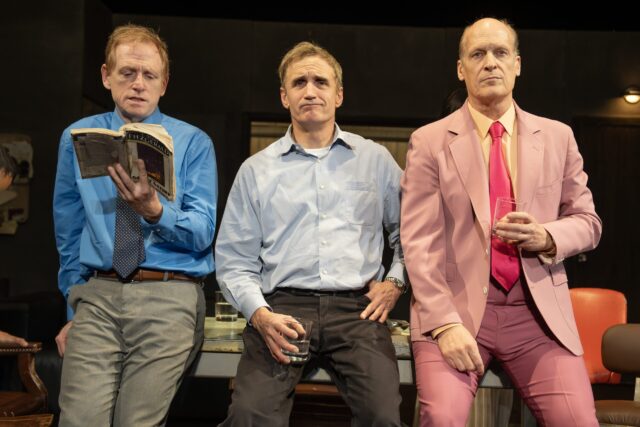
The full cast is on book — literally — in Henry Hoke’s expert adaptation of his highly acclaimed 2023 novel, Open Throat. Throughout the eighty-minute play, the actors read from either the hardcover or paperback edition as they walk across the spare set at the Amph on Little Island, the 687-seat open-air theater that borders the Hudson River. Because of rights issues, and probably also because there are only five performances of the piece, which was commissioned for the space, it had to be a staged reading with scripts in hand, but director Caitlin Ryan O’Connell uses that to her advantage, as the play becomes a celebration of the written word as well as clever stagecraft.

The story is narrated by a queer mountain lion (portrayed first by Chris Perfetti, then Calvin Leon Smith and Jo Lampert) living under the Hollywood sign in the Los Angeles hills, avoiding confrontations with humans, unwilling to be the hunter or the hunted, instead surviving on bats and small animals. “I’ve never eaten a person but today I might,” the lion says early on. The lion, who was inspired by P-22, a puma who lived for ten years in Griffith Park in LA, has no name; a young man in a homeless tent city calls the lion “fucker cat,” “shitfuck cat,” or “goddamn fuck cat.” His mother gave him a name he cannot share and people would be unable to pronounce, while his father gave him a name he won’t repeat. It’s all part of his search for his identity and his place in a foreign world he is trying to understand.

As the lion ventures closer to humans and vice versa, impeding on each other’s territory, the lion encounters a scary man who cracks a whip, a gay couple having sex in a cave, a woman yapping away on a phone, and various hikers and tourists. The lion listens as the people discuss capitalism, therapy, veganism, and dating. But the lion’s life changes dramatically when taken in by a young woman named slaughter who has domestication on her mind.

Henry Hoke’s Open Throat begins just as the sun sets over the Hudson River (photo by Julieta Cervantes)

Open Throat is a beguiling parable about personal identity, family, language, and being part of a community. It feels right at home in the Amph, surrounded by grassy hills, wind whipping through trees, and, on the west side, a beckoning river. At one point, just when the lion is describing how a young man in town refers to machines flying in the sky as “fucking helicopters,” a helicopter actually flew over the water. Unfortunately, many more did, creating loud distractions. The lion often refers to the “long death,” which is a busy street where many animals have met their end, being hit by cars; it’s hard not to compare that to the West Side Highway, which must be crossed in order to enter Little Island. And there are numerous mentions of “a deep forest on the edge of the water,” which is an apt description of the environment encircling the Amph.

Noah Mease’s set features a large, octagonal “O” on the floor; the missing center is represented twice as an object on which Steven Wendt makes shadow puppets with his hands, depicting moments from the lion’s past with his parents, including a poignant kill. Wendt also makes ingenious analog sound effects from atop a scaffold balcony. Perfetti, Smith, and Lampert each brings a different flavor to the lion, involving gender, color, and sexuality, as if any one of us could be the crafty animal. The rest of the characters are played by Marinda Anderson, Alex Hernandez, Layla Khoshnoudi, Ryan King, and Susannah Perkins, moving from the wings to the aisle steps to a balcony; rising star Perkins — she’s excelled in such plays as Grief Hotel, The Welkin, The Wolves, The Low Road, and The Good John Proctor — is particularly effective as the young slaughter, adding depth and nuance while having clearly memorized many of her lines.

Mease also designed the props and masks — each lion portrayer has a small costume element that identifies them as a cat — although they are kept to a minimum. Most of the props are imaginary, and cast members’ appearances do not change in order to match the text. The superb lighting, which emerges as the sun sets, is by 2024 special Drama Desk Award winner Isabella Byrd, with playful choreography by Lisa Fagan and immersive sound and music by Michael Costagliola. O’Connell (King Philip’s Head Is Still on That Pike Just Down the Road, Twin Size Beds) directs with a sure hand, whether depicting a tragic fire, an animal fight, an earthquake, or a road trip; a Disney dream sequence is the only scene that felt out of place. Even the actors using the script becomes organic to the tale.

Not only is the Amph itself a kind of character in the narrative but so is New York City. “they talk about new york a lot in ellay / in new york you don’t need a car,” the lion says. (The book contains no punctuation, and only the pronoun “I” is capitalized, furthering the idea of establishing one’s identity.)

“is new york where I have to go,” the lion asks. The answer is a resounding yes, as Open Throat could not have happened quite like this anywhere else.

[Mark Rifkin is a Brooklyn-born, Manhattan-based writer and editor; you can follow him on Substack here.]