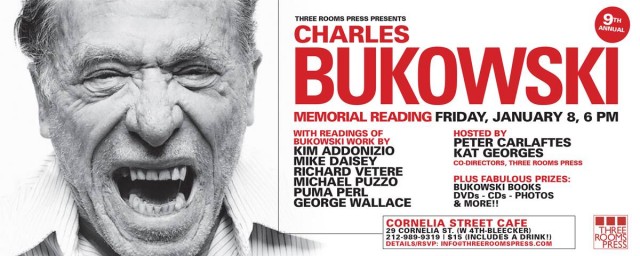
Who:Three Rooms Press Presents the Monthly @ Cornelia Street Cafe What:Ninth Annual Charles Bukowski Memorial Reading Where:Cornelia Street Cafe, 29 Cornelia St., 212-989-9319 When: Friday, January 8, $15 (includes one drink), 6:00 pm Why: “What sort of cultural hangover keeps Charles Bukowski in print and popular more than twenty years after his death?” S. A. Griffin asks in the new Three Rooms Press essay “Charles Bukowski: Dean of Another Academy.” “In light of the fact that a good portion of what has been published since his passing in 1994 may not be the man’s best work, along with some heavy editing at times, why does Charles Bukowski remain relevant well into the 21st century?” The ninth annual Charles Bukowski Memorial Reading at Cornelia Street Cafe will explore what Bukowski would think about today’s society, with tribute readings by Kim Addonizio, Mike Daisey, Richard Vetere, Puma Perl, Michael Puzzo, George Wallace, and anyone else who signs up before 6:00, hosted by Kat Georges and Peter Carlaftes and featuring rare photos and videos, oral history, prizes, and more.
Erica Hunt and Marty Ehrlich will be back at the Poetry Project for annual January 1 marathon benefit
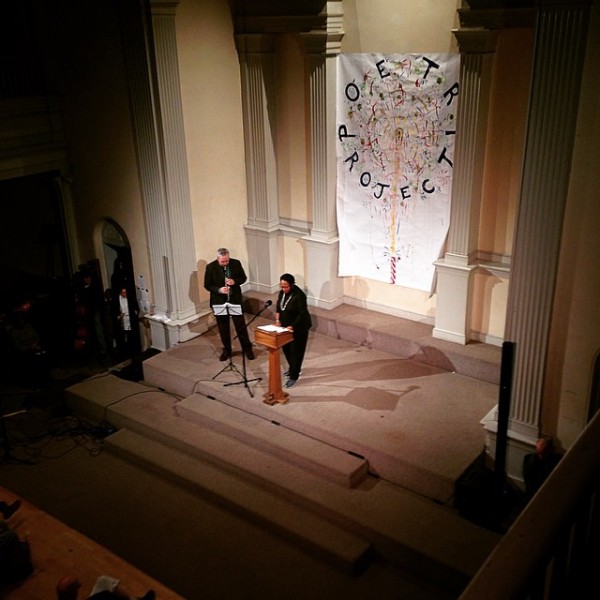
Who:The Poetry Project What: Forty-second Annual New Year’s Day Marathon Benefit Reading Where: The Poetry Project at St. Mark’s Church-in-the-Bowery, 131 East Tenth St., 212-674-0910 When: Friday, January 1, $20 in advance, $25 at the door, 2:00 pm – 12 midnight Why: Some 150 poets will take the podium in this annual Poetry Project benefit, including Penny Arcade, Anselm Berrigan, Edmund Berrigan, Jennifer Blowdryer, Stephen Boyer, Steve Cannon, Yoshiko Chuma, CA Conrad, Maggie Dubris, Douglas Dunn, John Giorno, Philip Glass, John S. Hall, Jonas Mekas, Jennifer Miller, Jennifer Monson, Carley Moore, Thurston Moore, Eileen Myles, Elinor Nauen, Dael Orlandersmith, Church of Betty, Reno, Bob Rosenthal, Emily Skillings, Jesse Smith, Edwin Torres with David Brown, Anne Waldman with Fast Speaking Music, Ken Walker, Martha Wilson, Jenny Zhang, and more to be announced.
Who:The Klezmer All-Stars with Frank London and Eleanor Reissa What:Annual Hanukkah concert Where:Center for Jewish History, 15 West 16th St. between Fifth & Sixth Aves., 212-294-8301 When: Sunday, December 13, $18, 3:00 Why: The American Jewish Historical Society and the American Society for Jewish Music are teaming up for their annual musical and literary celebration of the Festival of Lights with its annual Hanukkah party at the Center for Jewish History. The Sunday matinee features Frank London’s Klezmer Brass All-Stars — consisting of London on trumpet, Michael Winograd on clarinet, Brian Drye on trombone, Aaron Alexander on drums, Patrick Farrell on accordion, and Ron Caswell on tuba — with Tony-nominated director, singer, writer, and actor Eleanor Reissa, who performs in both English and Yiddish. The show is a follow-up to last Sunday’s On Stage at Kingsborough “Oy Chanukah!” show. The afternoon will include holiday songs, storytelling, a menorah lighting, refreshments, and more.
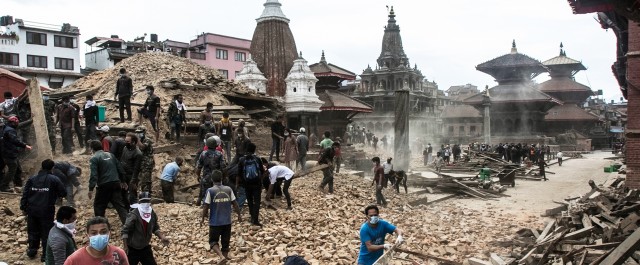
Thomas L. Kelly and Claire Burkert explore ways to rebuild post-earthquake Nepal in discussion at Rubin Museum (photo by Thomas L. Kelly)
Who: Claire Burkert and Thomas L. Kelly What: Himalayan Style: How to Rebuild Nepal Where:Rubin Museum of Art, 150 West 17th St. at Seventh Ave., 212-620-5000 When: Wednesday, December 9, $20, 7:00 Why: Earlier this week, we returned from a seventeen-day visit to Kathmandu, where we saw firsthand the destruction wrought by the April and May 2015 earthquakes as well as the intoxicating resiliency of the Nepalese people, who are also currently in the midst of a significant fuel blockade imposed by India, with far-reaching effects. Among the most impressive things we witnessed during our travels was a stop in Bungamati, where an international group of architecture students are working hand-in-hand with local residents to help the community get itself back on its feet. On one wall in an old temple, Bungamati residents can indicate whether they will “clean up,” “reuse materials,” “rebuild,” “repair,” or “do nothing.” On December 9, a similar conversation will take place at the Rubin Museum of Art, when Janakpur Women’s Development Center founder Claire Burkert and photo-activist Thomas L. Kelly will discuss “Himalayan Style: How to Rebuild Nepal,” inspired by their book Himalayan Style (Roli, March 2015, $49.95), which came out shortly before the earthquake hit. Burkert, a crafts expert with Nepal’s Poverty Alleviation Fund, and Kelly, who runs Wild Earth Journeys with his wife, Carroll Dunham, will sign copies of the book after their illustrated lecture, which will include photographs Kelly has taken following the earthquakes, many of which you can see here. You can contact twi-ny directly if you are interested in seeing some of the photos we took in Nepal as well.
Adrian Tomine is the special guest at the fourth annual Brooklyn Holiday Book Fair
The Old Stone House
336 Third St. between Fourth & Fifth Aves.
Saturday, December 5, free, 11:00 am – 5:00 pm
718-768-3195 theoldstonehouse.org
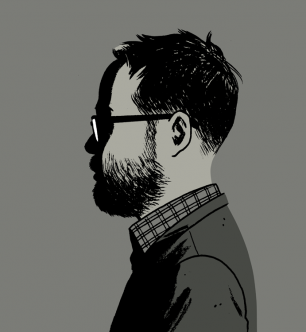
The historic Old Stone House will be hosting the fourth annual Brooklyn Holiday Book Fair on December 5, chock-full of rare, vintage, and out-of-print literary tomes offered by independent bookshops and antiquarian booksellers from Williamsburg, Greenpoint, Cobble Hill, Sheepshead Bay, Midwood, and other locations in the world’s greatest borough. The participating shops are Antifurniture, Archestratus Books, Arthur Fournier Fine & Rare, Brooklyn Books, Enchanted Books, Freebird Books, Honey & Wax Booksellers, Joe Maynard, Terrace Books, Tom Davidson, and Faenwyl Bindery. This year’s special guest is Sacramento-born Brooklynite Adrian Tomine (Shortcomings, New York Drawings), who will be signing copies of Killing and Dying (Drawn & Quarterly, October 2015, $22.95) from 12 noon to 1:00. This is a great place to do some holiday shopping; of course, any way you can avoid buying books through Amazon is always strongly encouraged.
Brooklyn Museum
200 Eastern Parkway at Washington St.
Saturday, December 5, free, 5:00 – 11:00
212-864-5400 www.brooklynmuseum.org
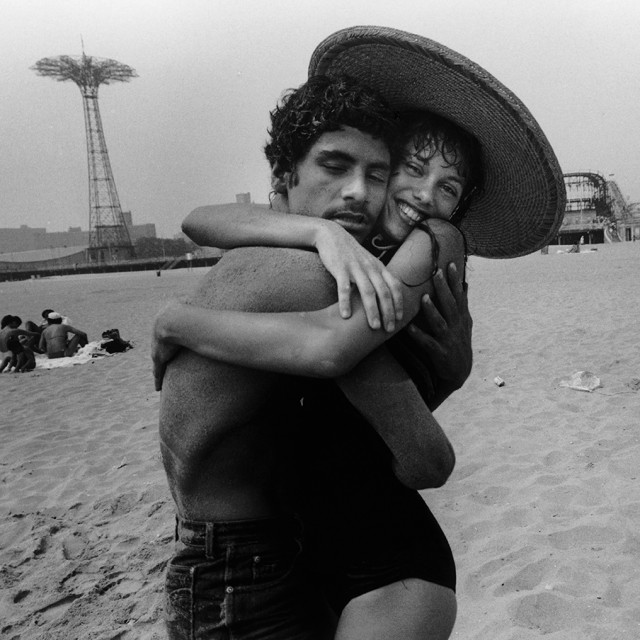
The Brooklyn Museum is honoring the most dramatic, historic, and entertaining part of the world’s greatest borough for the December edition of its monthly free First Saturday program. On the always eclectic bill are live music by Fright Barker and Sons and Raya Brass Band, a theatrical drawing performance by Amour Obscur, sideshow acts curated by Adam Rinn, the issues-oriented BodySpeak by Brown Girls Burlesque, a curator talk and Q&A about the new exhibition “Coney Island: Visions of an American Dreamland, 1861–2008” with Robin Jaffee Frank, a wire workshop where you can make your own Coney Island ride, a book club discussion with Harvey Stein about his photography book Coney Island: 40 Years, 1970–2010, a screening of Sidney Lumet’s The Wiz, and a Visual AIDS screening of Radiant Presence, followed by a discussion with Ted Kerr, Shawn Torres, Rusti Miller-Hill, and Jawanza Williams held in conjunction with World AIDS Day/Day With(out) Art. In addition, the galleries are open late so you can check out such other exhibitions as “Stephen Powers: Coney Island Is Still Dreamland (To a Seagull),” “Forever Coney: Photographs from the Brooklyn Museum Collection,” “Impressionism and the Caribbean: Francisco Oller and His Transatlantic World,” and “KAWS: ALONG THE WAY.”
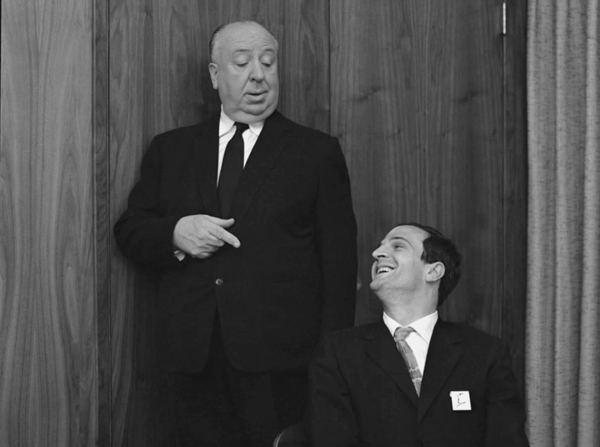
“In 1962, while in New York to present Jules and Jim, I noticed that every journalist asked me the same question: ‘Why do the critics of Cahiers du Cinéma take Hitchcock so seriously? He’s rich and successful, but his movies have no substance,’” French Nouvelle Vague auteur François Truffaut wrote in the preface to the second edition of what he called “the hitchbook,” the seminal film bible Truffaut/Hitchcock. “In the course of an interview during which I praised Rear Window to the skies, an American critic surprised me by commenting, ‘You love Rear Window because, as a stranger to New York, you know nothing about Greenwich Village.’ To this absurd statement, I replied, ‘Rear Window is not about Greenwich Village, it is a film about cinema, and I do know cinema.’” Truffaut was determined to change the prevailing belief that British director Alfred Hitchcock was a maker of studio fluff. “In examining his films,” Truffaut continued, “it was obvious that he had given more thought to the potential of his art than any of his colleagues. It occurred to me that if he would, for the first time, agree to respond seriously to a systematic questionnaire, the resulting document might modify the American critics’ approach to Hitchcock. That is what this book is all about.” The tome compiled a weeklong series of conversations between the thirty-year-old Truffaut and the sixty-three-year-old Hitchcock — the talks began on Hitch’s birthday — in the latter’s Hollywood studio office, with Helen Scott serving as translator. Although the interviews were recorded for audio, no film was shot; instead, Philippe Halsman took still photos. The story of the unique relationship between Truffaut, who as of 1962 had made only The 400 Blows and Shoot the Piano Player (he was in the midst of finalizing Jules and Jim), and Hitchcock, who was preparing his forty-eighth film, The Birds, is told in the splendid documentary Hitchcock/Truffaut, which cleverly reverses the order of their names from the book it’s based on. Writer-director Kent Jones (head of the New York Film Festival), cowriter Serge Toubiana (former editor in chief of Cahiers du Cinéma) and editor Rachel Reichman lovingly combine Halsman’s pictures, audio clips from the original sessions, scenes from many of Hitchcock’s films (and a few of Truffaut’s), close-ups of dozens of pages from the book, rare archival footage, and new interviews with ten directors from around the world who weigh in on what makes Hitchcock’s work so special, so illuminating, so influential.
Sharing their praise are Martin Scorsese, Wes Anderson, David Fincher, Olivier Assayas, Peter Bogdanovich, Arnaud Desplechin, James Gray, Kiyoshi Kurosawa, Richard Linklater, and Paul Schrader, as they shed light on such classic films as Vertigo, Psycho, I Confess, The Wrong Man, Sabotage, Marnie, Rear Window, and others, with detailed shot-by-shot analysis while also praising the importance of “the hitchbook” itself. It all makes for an eye-opening crash course in cinema, and it’s likely to change the way you look and think about motion pictures. “It was a window into the world of cinema that I hadn’t had before, because it was a director simultaneously talking about his own work but doing so in a way that was utterly unpretentious and had no pomposity,” Gray (Little Odessa, Two Lovers) says about the book. “There was starting to be these kind of erudite conversations about the art form, but Truffaut was the first one where you really felt that they were talking about the craft of it,” Schrader (American Gigolo, Mishima) points out. “It’s not just that Truffaut wrote a book about Hitchcock. The book is an essential part of his body of work,” Olivier Assayas (Clouds of Sils Maria, Carlos) explains. “I think it conclusively changed people’s opinions about Hitchcock, and so Hitchcock began to be taken much more seriously,” Bogdanovich (The Last Picture Show, Paper Moon) asserts. And Scorsese (Taxi Driver, Raging Bull) sums up, “It was almost as if somebody had taken a weight off our shoulders and said yes, we can embrace this, we could go.” Of course, the book not only created a critical reassessment of Hitchcock but also helped Truffaut’s budding career. Narrated by Bob Balaban, the film places the work of the two men, who remained good friends until Hitchcock’s death in 1980 at the age of eighty (sadly, Truffaut died four years later at the age of fifty-two), in context of the history of cinema. “Why do these Hitchcock films stand up well? Well, I don’t know the answer,” Hitchcock is heard saying at the beginning of the documentary. By the end of the documentary, you will surely know the answer. Following its recent screening at DOC NYC with Jones and Scorsese present, Hitchcock/Truffaut will be playing at Film Forum December 2-17.
 “In 1962, while in New York to present Jules and Jim, I noticed that every journalist asked me the same question: ‘Why do the critics of Cahiers du Cinéma take Hitchcock so seriously? He’s rich and successful, but his movies have no substance,’” French Nouvelle Vague auteur François Truffaut wrote in the preface to the second edition of what he called “the hitchbook,” the seminal film bible Truffaut/Hitchcock. “In the course of an interview during which I praised Rear Window to the skies, an American critic surprised me by commenting, ‘You love Rear Window because, as a stranger to New York, you know nothing about Greenwich Village.’ To this absurd statement, I replied, ‘Rear Window is not about Greenwich Village, it is a film about cinema, and I do know cinema.’” Truffaut was determined to change the prevailing belief that British director Alfred Hitchcock was a maker of studio fluff. “In examining his films,” Truffaut continued, “it was obvious that he had given more thought to the potential of his art than any of his colleagues. It occurred to me that if he would, for the first time, agree to respond seriously to a systematic questionnaire, the resulting document might modify the American critics’ approach to Hitchcock. That is what this book is all about.” The tome compiled a weeklong series of conversations between the thirty-year-old Truffaut and the sixty-three-year-old Hitchcock — the talks began on Hitch’s birthday — in the latter’s Hollywood studio office, with Helen Scott serving as translator. Although the interviews were recorded for audio, no film was shot; instead, Philippe Halsman took still photos. The story of the unique relationship between Truffaut, who as of 1962 had made only The 400 Blows and Shoot the Piano Player (he was in the midst of finalizing Jules and Jim), and Hitchcock, who was preparing his forty-eighth film, The Birds, is told in the splendid documentary Hitchcock/Truffaut, which cleverly reverses the order of their names from the book it’s based on. Writer-director Kent Jones (head of the New York Film Festival), cowriter Serge Toubiana (former editor in chief of Cahiers du Cinéma) and editor Rachel Reichman lovingly combine Halsman’s pictures, audio clips from the original sessions, scenes from many of Hitchcock’s films (and a few of Truffaut’s), close-ups of dozens of pages from the book, rare archival footage, and new interviews with ten directors from around the world who weigh in on what makes Hitchcock’s work so special, so illuminating, so influential.