this week in literature

TWI-NY TALK: EIKO / PLATFORM 2016

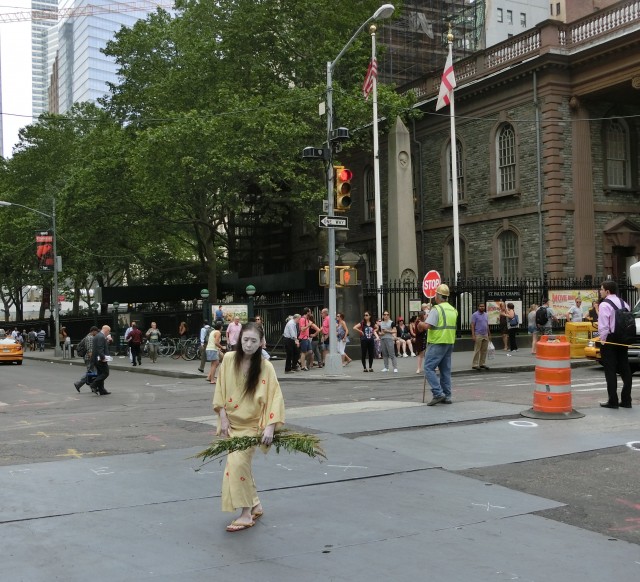
Eiko makes her way to the Fulton Center subway hub in June 2015 (photo by twi-ny/mdr)

Eiko makes her way to the Fulton Center subway hub in June 2015 for “A Body in a Station” (photo by twi-ny/mdr)

PLATFORM 2016: A BODY IN PLACES
Danspace Project
St. Mark’s Church in-the-Bowery
131 East Tenth St. between Second & Third Aves.
February 17 – March 23, free – $20
866-811-4111
www.danspaceproject.org
www.eikoandkoma.org

Based in New York City since 1976, Eiko Otake and Takashi Koma have been creating uniquely fragile and evocative dances and “living installations” for forty years, taking place on proscenium stages as well as site-specific indoor and outdoor locations around the world. Here in New York City, they’ve performed Grain in an East Village loft, Event Fission on the Hudson River landfill near the World Trade Center, Water in Lincoln Center’s reflecting pool on Hearst Plaza, and Offering, Tree Song, and Cambodian Stories Revisited in the graveyard of St. Mark’s Church-in-the-Bowery. In 2014, Eiko began her solo project, A Body in Places, consisting of free, site-specific works in nontraditional venues, including the new Fulton Center subway hub.

The Tokyo-born Eiko is returning to St. Mark’s as the focal point of Danspace Project’s 2016 Platform series, consisting of live performances, discussions, art, movie screenings (at Anthology Film Archives), special duets, and more, curated by Judy Hussie-Taylor and Lydia Bell. This tenth Platform festival runs February 17 to March 23 and will include “Talking Duets” with such artists as Ishmael Houston-Jones, John Kelly, and Elizabeth Streb; “Precarious” guest solos by Eiko, Beth Gill, Donna Uchizono, Koma, and more; Delicious Movement Workshops for participants as well as observers; a book club examining works by such writers as Kenzaburō Ōe, Tamiki Hara, and C. D. Wright; an art installation and readings with writer Claudia La Rocco, visual artist Paul Chan, painter and rapper DonChristian Jones, and others; a twenty-four-hour remembrance on the fifth anniversary of the Fukushima disaster; and weekday solos by Eiko in unannounced locations around St. Mark’s Church. Eiko recently discussed Platform with twi-ny as she prepared for this exciting month-long multidisciplinary program.

twi-ny: How did the idea of your being the centerpiece of Platform come about? It’s quite a major undertaking.

Eiko: A year ago, when Danspace’s executive director, Judy-Hussie Taylor, invited me to “the third Platform focused on a single choreographer,” I was surprised. First, I hardly consider myself as a choreographer and more a performer with a multidisciplinary practice. We had previously talked about Danspace possibly sponsoring a long and intimate run of my solo performance (and this does happen as a part of Platform). However, her proposal of the shift to a multifaceted project was unexpected. “Platform is all about relationships,” says Judy. But, while I have choreographer/dancer friends, I do not have the kind of dense relationship with the dance community that other choreographers have. While many choreographers work with dancers and each other and they frequent the same studios and classes, I have, for decades, worked with only Koma without a dance studio or classes.

But through many long and dense dialogues with the patient and persuasive Judy, as well as Lydia Bell, Danspace Project’s program director, who was Eiko & Koma’s Retrospective Project coordinator from 2009 to 2011, the Platform programs have evolved! Some were my ideas and some were Judy’s and/or Lydia’s. Together, the programs are now very expansive in scope, with many activities and participants. I am endlessly thankful and in awe of Judy, Lydia, the rest of the Danspace staff, and the participating artists.
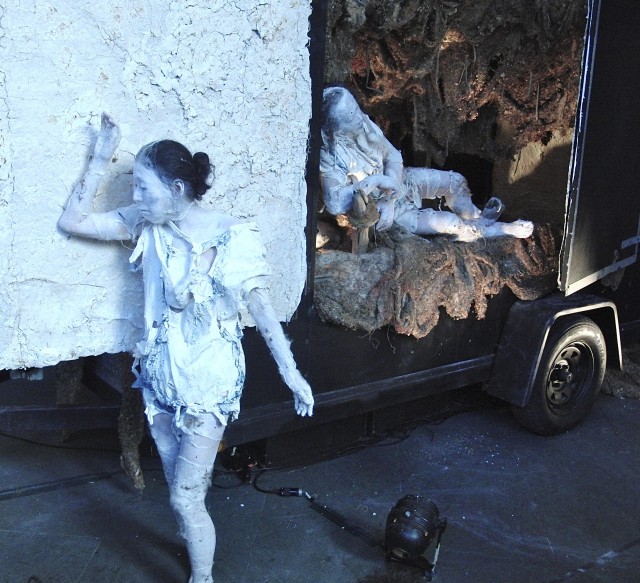
Eiko & Koma perform at MoMA in 2011 (photo by twi-ny/mdr)

Eiko & Koma perform “The Caravan Project” at MoMA in 2011 (photo by twi-ny/mdr)

twi-ny: As you noted, the Platform series will focus on your recent solo work; what made you decide to do the solo project in the first place, and how did Koma take it when you first told him about it?

Eiko: After working as Eiko & Koma since 1972, we had four very intense years creating and touring the Retrospective Project, followed by the Archive Project. That made me see and remember so many works Eiko & Koma had created. So while I felt proud, I also started to look for ways that I can work differently. Teaching also encouraged me to think independently. I wanted to find ways to work outside of theaters. Koma happened to have suffered a series of injuries that required care, so it actually made sense that I work alone. He is now feeling better and working on his own solo project.

twi-ny: How did you go about choosing which dancers and choreographers you wanted to participate in “Precarious: Solos,” which was inspired by a quote Hussie-Taylor selected from Judith Butler’s Precarious Life: The Powers of Mourning and Violence?

Eiko: “Precarious: Solos” was more or less Judy’s idea and it is a continuation of what she has done under the same title. My contribution was to encourage all artists to present not group works but solos with low tech.

twi-ny: What was it about the quote [“When we lose certain people, or when we are dispossessed from a place, or a community, we may simply feel that we are undergoing something temporary, that mourning will be over and some restoration of prior order will be achieved. But maybe when we undergo what we do, something about who we are is revealed, something that delineates the ties we have to others, that shows us that these ties constitute what we are, ties or bonds that compose us. . . .”] that made you and Judy want that to be the inspiration behind the solos?

Eiko: The Butler quote also came from Judy, and she thinks my work with Fukushima resonates with her thoughts.

twi-ny: What are some of the unique characteristics of St. Mark’s Church and the surrounding neighborhood that have gotten you excited about performing there again?

Eiko: St. Mark’s Church is a uniquely familiar and austere space with a rich history. I love to go there and I love to perform there. Because the church is open to so many activities, it is not easy to present heavy set pieces there, but that limitation served well with many choreographers. The East Village is also where we have hung around with friends. I love that diversity, and I owe to the memories. There have been many, many artists and activists in the area, some dead. And I had many, many nights of seeing and talking.

twi-ny: You’ve taken A Body in Places to Fukushima, Philadelphia, New York City, Hong Kong, and Chile. How did your performance change with each location? With the exception of Fukushima, where you had only one “witness,” did people react the same way to you, or does the response differ from city to city?

Eiko: You forgot Middletown, Connecticut! I teach one course a year at Wesleyan University, and its Center for the Arts has supported my experimentation since 2006. Wesleyan has been an incubator of many of the things Eiko & Koma and I have created. So for the Body in Places project, it helped me to create a photo exhibition, “A Body in Fukushima,” and it also presented my project at four different locations: a school library, a town library, an observatory, and an un-lived-in old house with a gallery. In general, I would say individual differences in response to my work are always bigger than city, country, and race differences. But performing in Middletown means I have young students as viewers who are invested in and interested in what I do. To perform there is a challenging practice, and I deliberately planned multiple performances in possible locations so as to train myself toward this platform through real performance practices.

In Hong Kong, I performed at the site where people who participated in the 2014 Umbrella Revolution had camped out for three months, stopping a major highway. Everyone who saw me perform there knew and remembered the place as a site with such important public memory. In Chile, my friends Forrest Gander and C. D. Wright came and invited Chilean poets to see me perform. [Ed. note: Wright, who was married to Gander, passed away last month at the age of sixty-seven.] Two poets recited poems each night as part of my performances. These and many more memories make each place I danced a very unique place for me and for viewers.

Eiko performs A Body in Fukushima in 2014 (photo by William Johnston)

Eiko performs “A Body in Fukushima” in 2014 (photo by William Johnston)

twi-ny: You and Koma have lived in New York City for nearly forty years now. What is your impression of how the city has changed since 1976? How different might your edition of Platform have been if this were 1976, 1986, 1996, or 2006?

Eiko: Of course, the city is sooooo different. It is so much more expensive to live here, and because of that the city is bigger as friends now live in far places. But I love New York for its intensity. I would not be able to do this Platform any earlier than now.

twi-ny: Without giving away some of the locations where you will be performing your daily solos, what are some of your favorite public spots in New York City?

Eiko: I like many places I performed in this project and as Eiko & Koma. To name a few: St Mark’s Church graveyard, Bryant Park, community gardens, the Whitney Museum, the Fulton Center, Governors Island, etc., etc. But these are very different places from where I will perform for this Platform. It is winter and I need to be indoors and in intimate places.

twi-ny: You have written, “I fight without any potential to win but I fight because they should not stand unopposed.” Do you really see no way to win this fight?

Eiko: I meant I do not know really how to win, as I am not a political activist. But I think it is important for artists to know what you are against, whether you have a prospect to win or not.

twi-ny: Which battles are most important to you right now?

Eiko: I am against corporate greed and human arrogance.

twi-ny: Your movement is intensely slow, often set to silence or natural, environmental sounds. When you’re not performing in front of a crowd, do you ever just blast music and dance like crazy?

Eiko: No. I do not have the desire to do that now. But when I am really down I can listen to some special song, like Nina Simone’s “Everyone’s Gone to the Moon.”
DAVE STEWART IN CONVERSATION WITH MICK ROCK

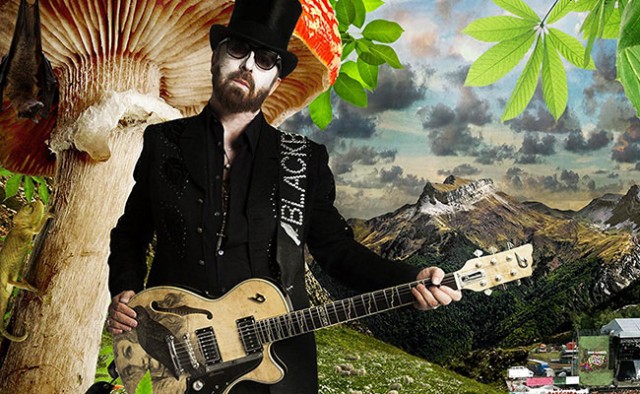
Dave Stewart will discuss his new memoir at B&N on February 10 with Mick Rock

Dave Stewart will discuss his new memoir at B&N on February 10 with Mick Rock

Who: Dave Stewart and Mick Rock
What: Conversation about new book
Where: Barnes & Noble, 150 East 86th St. at Lexington Ave., 212-369-2180
When: Wednesday February 10, free, 7:00
Why: “I love Dave’s constant creative search and his passion for making music; I love the fact that he’s constantly pushing the boundaries of what we think is possible,” Mick Jagger writes in the foreword to Dave Stewart’s memoir, Sweet Dreams Are Made of This: A Life in Music (New American Library, February 9, $27.95). “He creates a fertile environment in which it’s almost impossible not to be creative and innovative. This environment includes a compulsory martini at seven thirty in the evening, although by ten thirty, no one has gone home and everyone in the control room is dancing.” British songwriter, musician, and producer Stewart will be at the 86th St. B&N on February 10 to discuss his brand-new book, which details his life and times from a small child through his glory years with Annie Lennox in the Eurythmics to his collaborations with such superstars as Bob Dylan, Aretha Franklin, George Harrison, Stevie Nicks, Tom Petty, Jagger, and so many others. “I’ve had the chance to experience this wonderful state of being in the moment with some of the greatest artists on the planet,” Stewart, who also delves into his battle with pheochromocytoma, explains in the introduction. Legendary photographer Mick Rock, who has shot such musicians as Syd Barrett, Joan Jett, David Bowie, Alicia Keys, Lou Reed, Iggy Pop, Queen, Ellie Goulding, the Sex Pistols, Snoop Dogg, the Killers, Michael Buble, and Daft Punk, will host the conversation. Preferred seating is available for this wristband event with the purchase of the book at the store; no word yet on whether martinis will be served.

LUNAR NEW YEAR FESTIVAL: YEAR OF THE MONKEY

Year of the Monkey

The Met will celebrate the Year of the Monkey with a full slate of programs on February 6

The Metropolitan Museum of Art
1000 Fifth Ave. at 82nd St.
Saturday, February 6, free with recommended museum admission ($12-$25), 11:00 a.m.–6:00 p.m.
www.metmuseum.org

It will soon be 4713 on the Chinese calendar, the Year of the Monkey, a positive yang fire year that celebrates the monkey’s clever wit and inventive, playful nature. On February 6, the Metropolitan Museum of Art will host its annual Lunar New Year festival, with special events going on all day long honoring both China and Tibet. There will be live performances by Sesame Street puppeteers, students from the Music from China Youth Orchestra using traditional instruments, and Lotus Music & Dance in addition to a parade led by the Chinese Center on Long Island Lion Troupe. Art workshops include paper cutting with Master Lu, Monkey King mask making with the Children’s Museum of Manhattan, iPad calligraphy with the China Institute, a hand-pulled noodle demonstration by Chef Zheng of Noodle Q, a martial arts demonstration by the New York Chinese Cultural Center, Chinese tea ceremonies with Ten Ren Tea & Ginseng Co., a participatory installation by artist Wu Jian’an, a reading by picture book author and illustrator Yangsook Choi, bilingual storytime, drawing stations, and more. There will also be an interactive digital fireworks display in the Great Hall by CHiKA and Calli Higgins. The museum is currently showing several exhibitions related to China and Tibet, including “Monkey Business: Celebrating the Year of the Monkey,” “The Arts of Nepal and Tibet: Recent Gifts,” “Chinese Textiles: Ten Centuries of Masterpieces from the Met Collection,” “Chinese Lacquer: Treasures from the Irving Collection, 12th-18th Century,” and “Masterpieces of Chinese Painting from the Metropolitan Collection.”

FIRST SATURDAY: RADICAL BLACK HISTORY

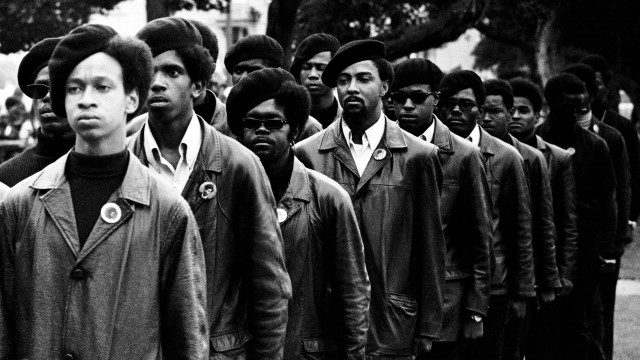
Stanley Nelson will be at the Brooklyn Museum to screen and discuss his 2015 documentary, THE BLACK PANTHERS: VANGUARD OF THE REVOLUTION

Stanley Nelson will be at the Brooklyn Museum to screen and discuss his 2015 documentary, THE BLACK PANTHERS: VANGUARD OF THE REVOLUTION, as part of free Black History Month program

Brooklyn Museum
200 Eastern Parkway at Washington St.
Saturday, February 6, free, 5:00 – 11:00
212-864-5400
www.brooklynmuseum.org

The Brooklyn Museum turns its attention to Black History Month for its February edition of its free First Saturday program. There will be live performances by Dasan Ahanu and Tai Allen (“The Originals,” a live mix-tape honoring Gil Scott-Heron and Oscar Brown Jr.), the New Black Fest (“HANDS UP 7: Testaments,” monologues followed by a Q&A), L.A. Lytes (Latasha Alcindor, DJ Afro Panther, and NonVisuals), and Charles Perry; art chats with experts using the ASK app; interactive activities with the Museum of Impact, the Very Black Project, and #TeamMelanin; an art workshop inspired by Romare Bearden’s collage portraits; an art workshop about Black Lives Matter and gender justice led by activist Joshua Allen; book-club discussions of Joshua Bloom and Waldo E. Martin’s Black Against Empire: The History and Politics of the Black Panther Party and Bob Avakian’s From Ike to Mao and Beyond: My Journey from Mainstream America to Revolutionary Communist, led by Andy Zee; and a screening of Stanley Nelson’s 2015 documentary, The Black Panthers: Vanguard of the Revolution, followed by a conversation with Nelson and Elizabeth Sackler. In addition, the galleries are open late so you can check out such exhibitions as “Coney Island: Visions of an American Dreamland, 1861–2008,” “Stephen Powers: Coney Island Is Still Dreamland (to a Seagull),’” “KAWS: ALONG THE WAY,” “Forever Coney: Photographs from the Brooklyn Museum Collection,” and “Agitprop!”

NY COMICS & PICTURE-STORY SYMPOSIUM: KIM DEITCH

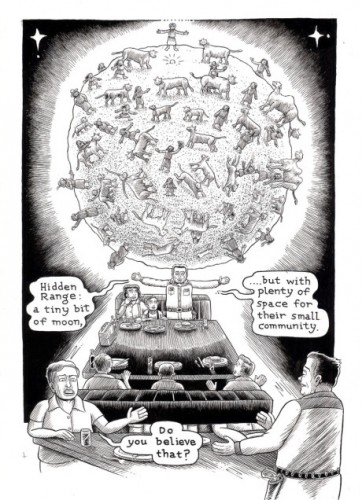
Legendary cartoonist Kim Deitch will discuss his current work-in-progress at NYC symposium

Legendary cartoonist Kim Deitch will discuss his current work-in-progress at NYC symposium

Who: Kim Deitch
What: NY Comics & Picture-story Symposium
Where: The New School, the Klein Conference Room (A510), 66 West Twelfth St. between Fifth & Sixth Aves.
When: Tuesday, January 26, free, 7:00
Why: L.A.-born, New York-based cartoonist Kim Deitch, the Eisner Award-winning author and illustrator of such works as The Boulevard of Broken Dreams, A Shroud for Waldo, Shadowland, and The Amazing, Enlightening, and Absolutely True Adventures of Katherine Whaley, is the special guest at the 141st meeting of the NY Comics & Picture-story Symposium, being held at the New School on January 26 at 7:00. The underground legend, aka Fowlton Means, will present an illustrated lecture on his latest project, a semiautobiographical tale of reincarnation in which virtually nothing is true. The 139th meeting, held December 15, featured a panel on Hugo Pratt, while the 140th meeting, held December 21, consisted of an illustrated talk by Peter Blegvad. The spring season continues through May 10 with such other cartoonists as Monroe Price, Archie Rand, Paula McDowell, Sara Lipton, Sam Gross, and Kristen McKinney. As always, admission is free and open to the public.

SPINE OUT WINTER 2016

dixon place

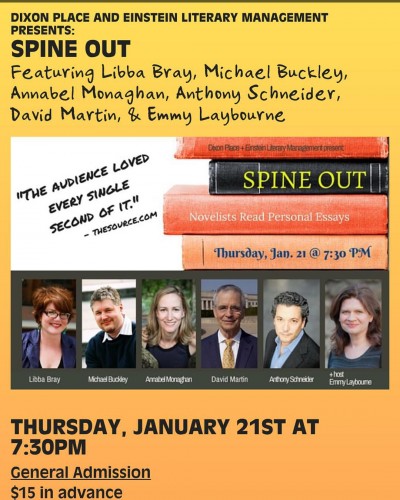
Who: Libba Bray, Michael Buckley, Annabel Monaghan, Anthony Schneider, David C. Martin, and Emmy Laybourne
What: “Spine Out: Novelists Read Personal Essays”
Where: Dixon Place, 161A Chrystie St., 212 219-0736
When: Thursday, January 21, $15-$18, 7:30
Why: Dixon Place’s quarterly literary series, “Spine Out,” returns on January 21 with a fab lineup of YA authors and others reading intimate personal essays: Libba Bray (the Gemma Doyle trilogy), Michael Buckley (the Undertow trilogy), Annabel Monaghan (the Digit series), Anthony Schneider (Repercussions), and television news journalist David C. Martin (Best Laid Plans: The Inside Story of America’s War Against Terrorism), hosted by Emmy Laybourne (the Monument 14 series).

MLK DAY 2016

mlk day of service

Multiple venues
Monday, January 18
www.mlkday.gov

In 1983, the third Monday in January was officially recognized as Martin Luther King, Jr. Day, honoring the birthday of the civil rights leader who was assassinated in Memphis on April 4, 1968. Dr. King would have turned eighty-seven this month, and you can celebrate his legacy on Monday by participating in a Martin Luther King, Jr. Day of Service project or attending one of numerous special events taking place around the city. BAM’s thirtieth annual free Brooklyn Tribute to Dr. Martin Luther King, Jr. includes a keynote address and book signing by Michael Eric Dyson, live performances by the Brooklyn Interdenominational Choir and Kimberly Nichole, the NYCHA Atlantic Terminal Community Center student exhibit “Picture the Dream,” master of ceremonies Eric L. Adams, and a special film screening. The JCC in Manhattan will host “Artists Celebrate Martin Luther King, Jr.,” with a screening of Aviva Kempner’s documentary Rosenwald at 5:00, followed by a Q&A with the director, and “Idealism and Activism: A Conversation with Bill T. Jones” at 7:30 ($5, benefiting Saturday Morning Community Partners).

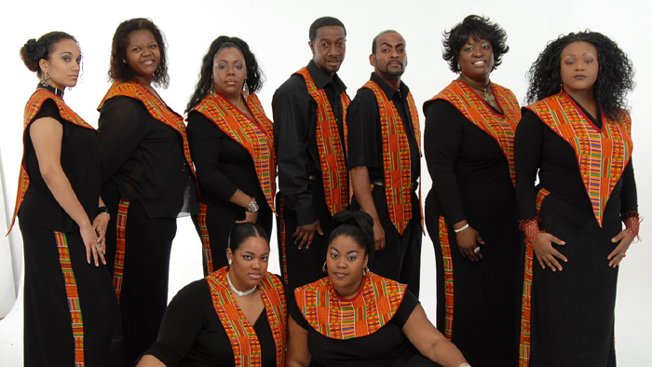
The Harlem Gospel Choir will play a special matinee at B.B. King’s on MLK Day

The Harlem Gospel Choir will play special matinees at B.B. King’s and the Children’s Museum of Manhattan on MLK Day

The Children’s Museum of Manhattan will teach kids about King’s legacy with the “Heroic Heroines: Coretta Scott King” book talk at 10:00 and 2:00 and the World Famous Harlem Gospel Choir at 3:00 and 4:00, while the Brooklyn Children’s Museum hosts the special hands-on crafts workshops “The Art of Protest” and “Protest Prints,” a noon screening of Rob Smiley and Vincenzo Trippetti’s 1999 animated film Our Friend, Martin, and the toddlers program “Storytime & Civil Movements.” The Museum at Eldridge Street will be hosting a free reading of Kobi Yamada and Mae Besom’s picture book What Do You Do with an Idea? along with a mural workshop. The Harlem Gospel Choir will also give a special MLK Day matinee at 12:30 ($22-$26) at B.B. King’s in Times Square, while Big Daddy Kane will take the mic with a live band at 9:00 ($15-$30).