this week in literature

BROOKLYN MUSEUM FIRST SATURDAY: NEW YEAR, NEW FUTURES

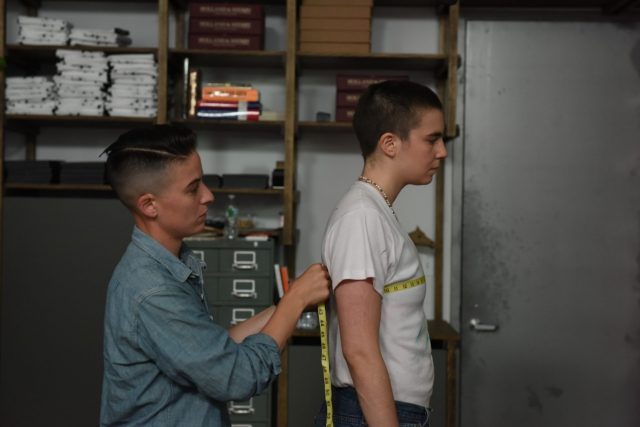
Jason Benjamin’s SUITED will be shown at the Brooklyn Museum on Saturday night, followed by the discussion “Queer Style as Resistance in Post-Trump Activism”

Jason Benjamin’s SUITED will be shown at the Brooklyn Museum on Saturday night, followed by the discussion “Queer Style as Resistance in Post-Trump Activism”

Brooklyn Museum
200 Eastern Parkway at Washington St.
Saturday, January 7, free, 5:00 – 11:00
212-864-5400
www.brooklynmuseum.org

A lot of Americans were glad to bid good riddance to 2016, although there’s plenty of fear for what can happen in 2017. The Brooklyn Museum explores some of those very legitimate concerns in its free First Saturday program on January 7. There will be live performances by Tank and the Bangas, Discwoman (DJs BEARCAT and SHYBOI) and Cakes Da Killa; a Brooklyn Dance Festival workshop; a book club reading, discussion, and signing with Daniel José Older for his latest Bone Street Rumba novel, Battle Hill Bolero; a hands-on art workshop in which participants can make masks inspired by “A Woman’s Afterlife: Gender Transformation in Ancient Egypt”; a screening of Jason Benjamin’s Suited, followed by a “Queer Style as Resistance in Post-Trump Activism” talkback with Benjamin, dapperQ, Anita Dolce Vita, Daniel Friedman, Debbie-Jean Lemonte, and Rae Tutera; a curator tour of “A Woman’s Afterlife” with Edward Bleiberg; pop-up gallery talks on “Marilyn Minter: Pretty/Dirty”; a community resource fair with Active Citizen Project/Project EATS, Caribbean Leadership Empowerment Foundation, Historic Districts Council, Spaceworks, Carroll Gardens Association, and Pioneer Works; Kids Corner storytelling (“Virtuous Journeys”) with Rezz and Mando; and pop-up publishing with DIY feminist publishers Pilot Press, led by Jen Kennedy and Liz Linden. In addition, you can check out such exhibits as “Iggy Pop Life Class by Jeremy Deller,” “Beverly Buchanan — Ruins and Rituals,” “The Dinner Party by Judy Chicago,” “Life, Death, and Transformation in the Americas,” “Marilyn Minter: Pretty/Dirty,” and “Infinite Blue”; admission to “Who Shot Sports: A Photographic History, 1843 to the Present,” which closes January 8, requires a discounted admission fee of $10.

NEVER BEFORE, NEVER AGAIN

never-before-never-again

Triskelion Arts
Muriel Schulman Theater
106 Calyer St. (enter on Banker St.)
January 5-8, $16-$20
www.triskelionarts.org

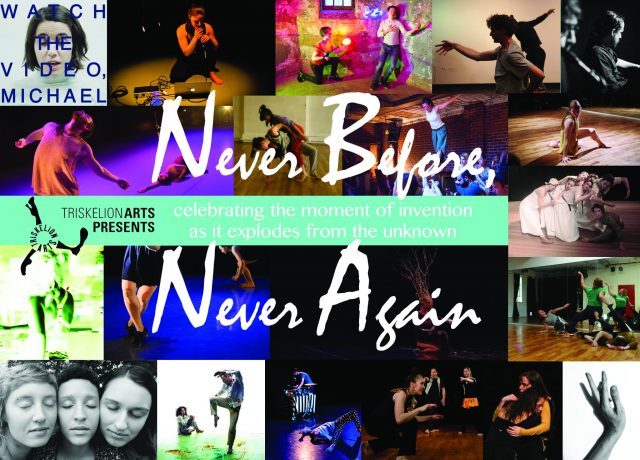
Most of the winter performance festivals, such as Under the Radar, COIL, Prototype, and American Realness, consist of experimental works that have either already been performed elsewhere or will afterward. However, the nonprofit Triskelion Arts, which was founded in Brooklyn in 2000 to “foster the development and presentation of the performing arts,” has something very different in mind with its “Never Before, Never Again” festival, which consists of dance, music, comedy, theater, poetry, and other disciplines in improvisational performances that have never been presented before and never will again quite like they will be during the third annual event, running January 5-8. The improv celebration begins January 5 with the Lovelies; Alyssa Gersony; Judah Levenson, Hank Mason, and Shane Gertner; kamrDANCE; NOW ACCEPTING ALL OFFERS MADE; and Katelyn Halpern & Dancers. On January 6, the lineup features Schmidt / Keenoy Movement / Sound Lab; slowdanger; Jog Films; Debbie Z & Friends; and the Lovelies. Saturday’s roster boasts Mauri Connors and Mindy Toro; TanzKlub; the Shelburne Trio (bassist Kevin Farrell, dancer Rachel Mckinstry, and poet Josh Adler); stb x at; Sarah Foster / MoveWorks; and Boom Bat Gesture Performance Group. The festival concludes January 8 with Ali Perkins; Kirsten Schnittker; Jason Mears / Quentin Tolimieri; There’s No Law (Rachel Cohen, Michael Henry, Irene Siegel); and Lokasparsa Dance Projects / clyde forth. Tickets are $16 in advance, $20 at the door to check out these now-you-see-it, now-you-don’t performances.

AGNES MARTIN

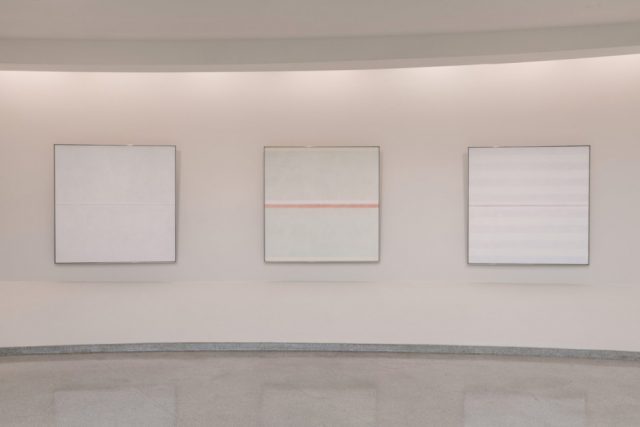
Agnes Martin’s work feels right at home in major retrospective at the Guggenheim (photo by David Heald, courtesy Solomon R. Guggenheim Museum)

Agnes Martin’s work feels right at home in major retrospective at the Guggenheim (photo by David Heald, courtesy Solomon R. Guggenheim Museum)

Solomon R. Guggenheim Museum
1071 Fifth Ave. at 89th St.
Friday – Wednesday through January 11, $18 – $25 (pay-what-you-wish Saturday, 5:45-7:45)
212-423-3587
www.guggenheim.org

“To be an artist,” Agnes Martin once explained, “you look, you perceive, you recognize what is going through your mind, and it is not ideas. Everything you feel, and everything you see — your whole life goes through your mind, you know. I have to recognize it and go with it.” The same can be said for visitors who attend the absolutely lovely, simply titled retrospective “Agnes Martin,” continuing at the Guggenheim through January 11. As you spiral your way up the chronological exhibit, you are not only connecting with Martin’s life but your own as well, giving you a newfound appreciation of your very existence. Born in March 1912 in Saskatchewan, Canada, Martin lived in New York City and New Mexico during her most productive years, working daily up to her death in 2004 at the age of ninety-two. A former teacher (and onetime driver for John Huston), she never married and never had children; she was diagnosed with schizophrenia, living alone her entire adult life. Her paintings defy categorization, which was fine with her; her canvases incorporated Minimalism and Abstract Expressionism but were much more than that. “I would like [my pictures] to represent beauty, innocence, and happiness,” she proclaimed. “I would like them all to represent that. Exaltation.” And it is indeed exalting walking through the exhibition, which includes more than one hundred works that reveal Martin’s expert control of line, geometric form, grids, and color, delivered in spare, understated style.
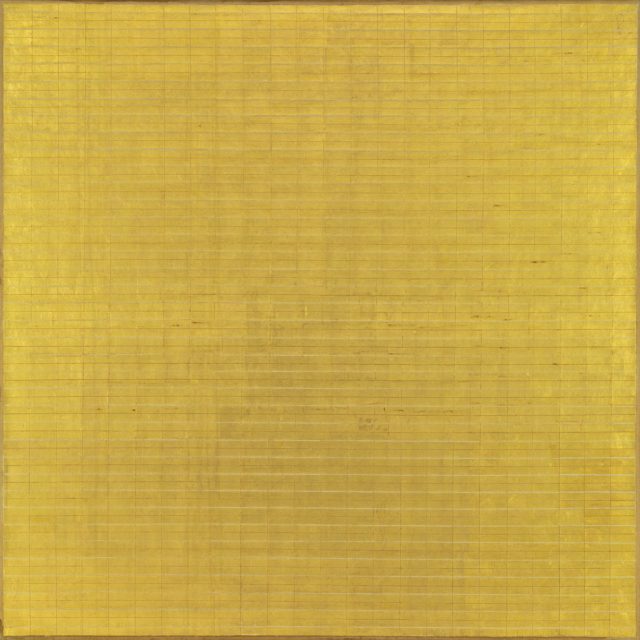
Agnes Martin, “Friendship,” incised gold leaf and gesso on canvas, 1963 (© 2015 Agnes Martin /Artists Rights Society, New York)

Agnes Martin, “Friendship,” incised gold leaf and gesso on canvas, 1963 (© 2015 Agnes Martin /Artists Rights Society, New York)

The paintings feel at home in the Guggenheim bays, complemented by the white walls, lighting fixtures, and horizontal vents, which sometimes appear to have been created just for this show, earning bonus kudos to senior curator Tracey Bashkoff and guest curator Tiffany Bell. The first gallery actually begins with the midcareer suite “The Islands,” a group of nearly identical monochromatic paintings that set the tone for the rest of the show. “You see one canvas after another, and they’re similar until you look at them up close and you see how the artist’s hand has moved through the canvas and the marks that she has made,” notes Bashkoff, referring to Martin’s general oeuvre. “It’s by slowing down and looking at Martin’s canvases individually, taking in all of the details — it’s at those moments that you get close to this thoughtfulness and deliberateness.” Other paintings that reward extra attention are “This Rain,” two rectangles reminiscent of Mark Rothko; the kinetic sculpture “The Wave”; “White Flower,” a white grid on a dark canvas that has ghostly images floating in the background; “Little Sister,” composed of rows of dots; “Friendship,” a mesmerizing canvas of sparkling gold; “Happy Holiday,” boasting alternate stripes of white and peach pastel; “Heather,” consisting of rare vertical rectangles; and “Homage to Life,” from 2003, a floating black trapezoid in the center of a gray ground.
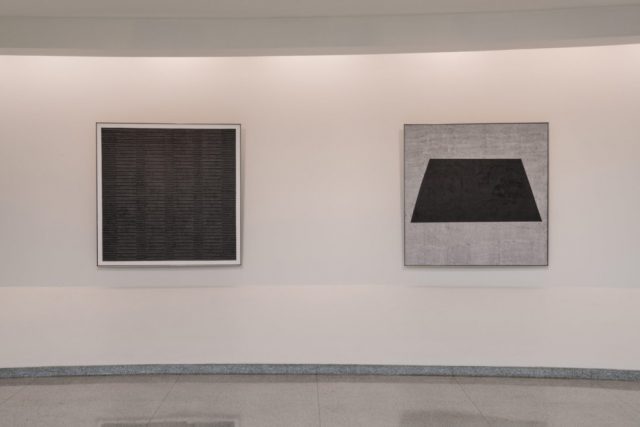
Agnes Martin’s work feels right at home in major retrospective at the Guggenheim (photo by David Heald, courtesy Solomon R. Guggenheim Museum)

Agnes Martin show at the Guggenheim features beautiful works filled with glorious line, color, and form (photo by David Heald, courtesy Solomon R. Guggenheim Museum)

“I believe in living above the line,” Martin said. “Above the line is happiness and love, you know. Below the line is all sadness and destruction and unhappiness. And I don’t go down below the line for anything.” Those are words to live by, from an artist who approached the world in a unique way, beautifully memorialized in one of the best shows of the year. On January 10 at 6:30 ($15), Quiet: A Poetry Reading for Agnes Martin will feature recitations by poets Ari Banias, Mei-mei Berssenbrugge, and Souvankham Thammavongsa, a reception, and an exhibition viewing, an evening curated by artist Jen Bervin. Martin fans should also make their way to Dia:Beacon, where several rooms of her work are on long-term display.
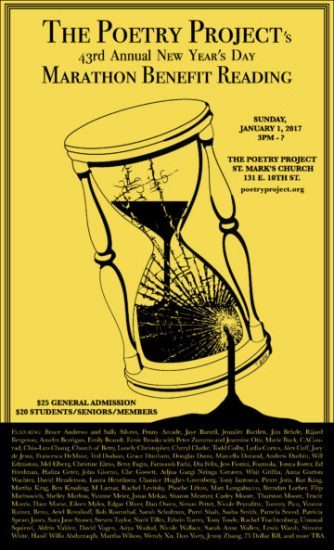
NEW YEAR’S DAY MARATHON BENEFIT READING

poetry-project-marathon-benefit

Who: The Poetry Project
What: Forty-third Annual New Year’s Day Marathon Benefit Reading
Where: The Poetry Project at St. Mark’s Church-in-the-Bowery, 131 East Tenth St., 212-674-0910
When: Sunday, January 1, $20 in advance, $25 at the door, 3:00 pm – 2:00 am
Why: More than 150 writers, musicians, actors, dancers, and other artists will take the podium in this annual Poetry Project benefit, this year celebrating the fiftieth anniversary of the Poetry Project, which “promotes, fosters, and inspires the reading and writing of contemporary poetry by (a) presenting contemporary poetry to diverse audiences, (b) increasing public recognition, awareness, and appreciation of poetry and other arts, (c) providing a community setting in which poets and artists can exchange ideas and information, and (d) encouraging the participation and development of new poets from a broad range of styles.” This year’s forty-third annual marathon boasts another stellar lineup, including Penny Arcade, Jennifer Bartlett, Anselm Berrigan, Edmund Berrigan, Justin Vivian Bond, Steve Cannon, Yoshiko Chuma, Andrei Codrescu, Grace Dunham, Steve Earle, John Giorno, Nick Hallett, Yvonne Meier, Jonas Mekas, Thurston Moore, Eileen Myles, Yvonne Rainer, Lee Ranaldo, Will Rawls, Bob Rosenthal, Sarah Schulman, Elliott Sharp, Tammy Faye Starlight, ynne Tillman, Edwin Torres, Rachel Trachtenburg, Martha Wilson, Anne Waldman and Fast Speaking Music, CAConrad, and Church of Betty, among many others.

ELEMENTS OF OZ

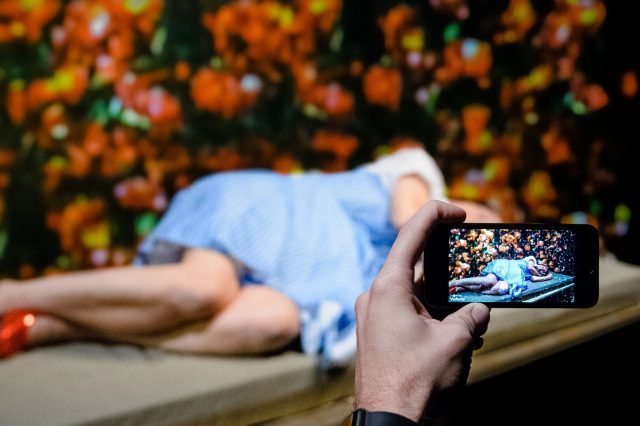
(photo by Gennadi  Novash, courtesy of Peak Performances @Montclair State University)

Unique app is key part of ELEMENTS OF OZ (photo by Gennadi Novash, courtesy of Peak Performances @Montclair State University)

3LD Art and Technology Center
80 Greenwich St. at Rector St.
Tuesday – Sunday through December 18, $25
866-811-4111
www.3ldnyc.org
www.thebuildersassociation.org

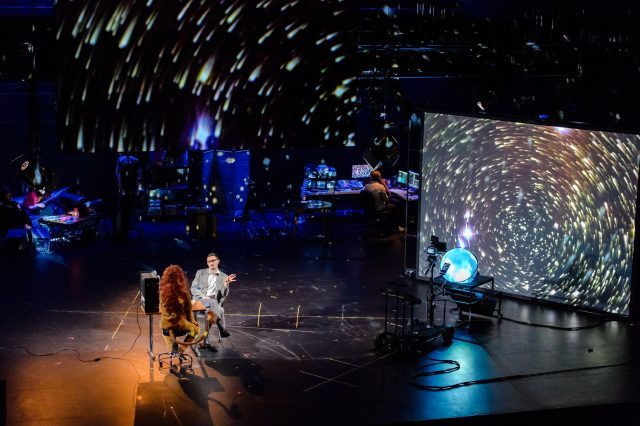
The Builders Association (Sontag:Reborn, Invisible Cities) takes audiences on a wild trip down the yellow brick road as it deconstructs and reconstructs The Wizard of Oz in its fun and innovative multimedia experimental production Elements of Oz. Conceived by Marianne Weems, Moe Angelos, and James Gibbs, directed by Weems, and cowritten by Gibbs and Angelos, Elements of Oz delves into the legend and legacy of the classic 1939 film, sharing little-known stories, reenacting key scenes, and examining its online presence, including theories about how the book and movie are metaphors for the U.S. monetary system and gold standard. Continuing at the 3LD Art and Technology Center through December 18, the show presents a small corp of actors who reenact and reshoot key scenes, creating a new version via multiple monitors that project what is happening onstage and freeze-frames taken from previous scenes. The piece is performed by Angelos, Sean Donovan, and Hannah Heller, who each portray several characters — all three play Dorothy Gale at various points. They not only switch roles, they also shift from commenting on the film to acting in its re-creation, and from past to present, telling tales of 1939 moviemaking and its ongoing reverberations in popular culture. Following a YouTube overture, Angelos delivers the first of many “talking points,” giving inside information to the audience. “It’s a masterpiece,” she says about the film, “but all we see is the magic. We don’t see all the brutal work and failure.” Elements of Oz reveals how much of that magic was made as stage manager April Sigler, associate lighting designer Elliott Jenetopulos, video designer Austin Switser, production manager Brendan Regimbal, and technical director Carl Whipple set up and break down Neal Wilkinson’s sets, filming short scenes that are then edited live to mimic the original, shot by shot, and played back on a large onstage screen as well as the monitors that fill the theater. Meanwhile, Moe relates stories about Margaret Hamilton and her double, Betty Denko, suffering major injuries; how “Somewhere Over the Rainbow” was almost left on the cutting-room floor; that some of the munchkins were repurposed as flying monkeys; and what really happened when the film went from black-and-white to color.

(photo by Gennadi  Novash, courtesy of Peak Performances @Montclair State University)

Hannah Heller and Sean Donovan play multiple characters in experimental exploration of the making of THE WIZARD OF OZ (photo by Gennadi Novash, courtesy of Peak Performances @Montclair State University)

Just as The Wizard of Oz made use of cutting-edge technology, so does Elements of Oz, which has a unique innovation of its own. During the show, which is based on both the film and the book by L. Frank Baum, there are moments that are best viewed through your smart phone or tablet via a free augmented reality app, designed by John Cleater, that enhances what you’re watching by adding visual and aural effects, from snow to giggling munchkins to other cool surprises. Angelos (the Five Lesbian Brothers), Donovan (Thank You for Coming: Play), and Heller (The World Is Round) are hysterical as they change from role to role, with Angelos as Dorothy and Glinda, the mustachioed Donovan as Dorothy, Uncle Henry, Mike Wallace, the Scarecrow, the Tin Man, Salman Rushdie, and the Wizard, and Heller as Dorothy, Aunt Em, the Wicked Witch, the Scarecrow, Judy Garland, and Ayn Rand. (The costumes are by Andreea Mincic, with lighting by Jennifer Tipton, sound design and original music by Dan Dobson, and interactive design and programming by Jesse Garrison.) Originally presented by Peak Performances @ Montclair State University, the goofy and charming Elements of Oz is probably about twenty minutes too long, as things get a little repetitive, and as fun as the app is, you’ll find yourself at times looking at your phone, waiting for the next bit of AR to take place, instead of watching what is happening onstage. But like the original book and film, Elements of Oz is an enjoyable mind-expanding journey; and be sure to keep that app on as you exit 3LD and head down Greenwich St.

ICONS & INNOVATORS: NORMAN LEAR

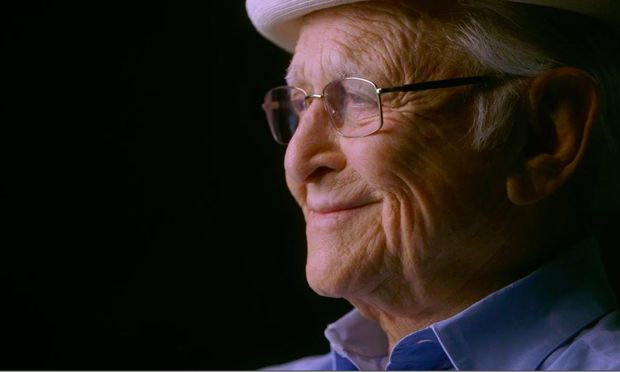
Norman Lear, seen above in documentary NORMAN LEAR: ANOTHER VERSION OF YOU, will be at the Greene Space to discuss his life and career

Norman Lear, seen above in documentary NORMAN LEAR: ANOTHER VERSION OF YOU, will be at the Greene Space on December 17 to discuss his life and career

Who: Norman Lear, Susan Fales-Hill, Heidi Ewing, Rachel Grady
What: Conversation with Norman Lear
When: Saturday, December 17, $25, 6:00
Where: The Greene Space at WNYC, 44 Charlton St. at Varick St.
Why: “In my ninety-plus years I’ve lived a multitude of lives,” Norman Lear writes in his new memoir, Even This I Get to Experience. “I had a front-row seat at the birth of television; wrote, produced, created, or developed more than a hundred shows; had nine on the air at the same time; finished one season with three of the top four and another with five of the top nine; hosted Saturday Night Live; wrote, directed, produced, executive-produced, or financed more than a dozen major films; before normalization, led an entourage of Hollywood writers and producers on a three-week tour of China; founded several cause-oriented national organizations, including the 300,000-member liberal advocacy group People for the American Way; was told by the New York Times that I changed the face of television; was labeled the ‘No. 1 enemy of the American family’ by Jerry Falwell; was warned by Pat Robertson that my arms were ‘too short to box with God’; made it onto Richard Nixon’s ‘Enemies List’; was presented with the National Medal of the Arts by President Clinton; purchased an original copy of the Declaration of Independence and toured it for ten years in all fifty states; was ranked by Entertainment Weekly fortieth among the ‘100 Greatest Entertainers of the Century’ (twenty-nine places ahead of the Sex Pistols); ran the Olympic torch in the 2002 Winter Olympics; blew a fortune in a series of bad investments in failing businesses; and reached a point where I was informed we might even have to sell our home.” That’s quite a legacy for the ninety-four-year-old New Haven native, built around such innovative television programs as All in the Family, Good Times, The Jeffersons, Sanford and Son, Maude, Fernwood 2Night, One Day at a Time, and Marry Hartman, Mary Hartman but one that goes much further than that. On December 17, Lear will sit down with author and television writer Susan Fales-Hill (Always Wear Joy, A Different World) for the next installment of her “Icons & Innovators” series at the Greene Space for a conversation exploring Lear’s extensive life and career. They will be joined by filmmakers Heidi Ewing and Rachel Grady (Jesus Camp, 12th & Delaware), directors of the recently released documentary Norman Lear: Another Version of You, which opened the 2016 Sundance Film Festival. It should be a fascinating, wide-ranging talk, especially given the political situation in the country today.

AUTHOR EVENT — KATHRYN CALLEY GALITZ, “THE METROPOLITAN MUSEUM OF ART: MASTERPIECE PAINTINGS”

met-masterpieces

Barnes & Noble
150 East 86th St. at Lexington Ave.
Tuesday, December 13, free, 7:00
212-369-2180
www.rizzoliusa.com
stores.barnesandnoble.com

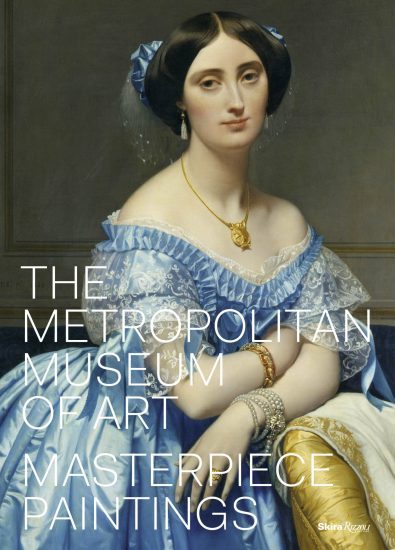
On December 13, the Met moves slightly northeast as museum curator and educator Kathryn Calley Galitz discusses her new book, The Metropolitan Museum of Art: Masterpiece Paintings (Skira Rizzoli, September 2016, $75), at the Barnes & Noble on Eighty-Sixth St. and Lexington Ave. The deluxe book examines five hundred classic works, divided into four chronological sections, “Before 1450,” “1450-1750,” “1750-1900,” and “After 1900,” from the ca. 3800-3700 BCE Central Iran “Storage Jar with Mountain Goats” to Kerry James Marshall’s 2014 “Untitled (Studio).” In addition to full-color photos of each piece, the book includes a bibliography and artist-based index. “Every painting has a story to tell. It should come as no surprise, then, that The Metropolitan Museum of Art: Masterpiece Paintings reveals so many intriguing stories,” Met director Thomas P. Campbell writes in the foreword, opposite Georges Braque’s “Still Life with Metronome (Still Life with Mandola and Metronome).” In her essay “Painting through the Ages,” Galitz explains, “As for the qualifier ‘masterpiece,’ it is indeed a loaded term whose inherent subjectivity goes without saying. We each have our own idea of what constitutes greatness, just as, over time, the canon of acknowledged masterpieces has been subject to the vagaries of taste — both scholarly and popular. . . . That a painting completed in 2015 is included in the same volume as works that have enjoyed masterpiece status for centuries may come as a surprise, but its presence forces us to question the imposition of an arbitrary time frame on the notion of a masterpiece.” Many of the reproductions are full pages, allowing readers to delve into the details of some of what makes these works so special. (Getting the prestigious front cover, by the way, is Jean Auguste Dominique Ingres’s “Joséphine-Éléonore-Marie-Pauline de Galard de Brassac de Béarn, Princesse de Broglie,” while Ogata Kōrin’s “Irises at Yatsuhashi [Eight Bridges]” occupies the back.) I started to list some of my personal favorites here, but that would have just gone on . . . and on . . . and on. The Metropolitan Museum of Art: Masterpiece Paintings is a beautifully designed book that will make you gasp again and again, much like a trip through the Met’s spectacular galleries does.