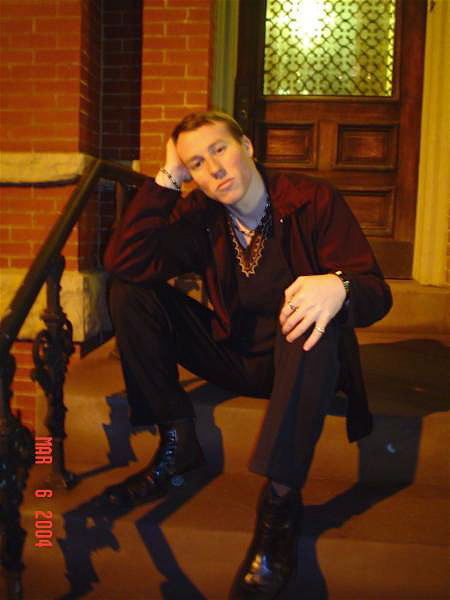
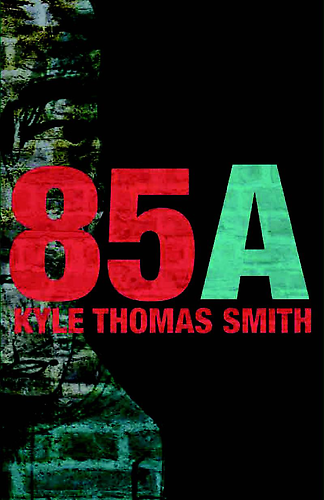
Kyle Thomas Smith will read from his well-received debut novel, 85A, on Wednesday night at Cake Shop
Cake Shop
152 Ludlow St. between Stanton & Rivington Sts.
Wednesday, February 16, free, 7:00
212-253-0036
www.85anovel.com
www.cake-shop.com
“Every detention, every chip of glass piercing my forearm from the inside, every minute the 85A is late drives me that much closer to London.” So begins Kyle Thomas Smith’s harrowing debut novel, 85A (Bascom Hill, August 2010, $14.95), the brutally honest story of Chicago teenager Seamus O’Grady, who is desperate to get out of a city, school, and family that relentlessly beats him down both mentally and physically. Although the plot of the book is not based on Smith’s real life — he was born and raised in Chicago and moved to Brooklyn in 2003, where he currently lives with his partner and cats — the setting is, and he does a marvelous job capturing the heart and soul of the dark underbelly of his hometown over the course of one long day in January 1989. Smith, a passionate, engaging young man with an infectious joie de vivre, has written for websites and magazines including Sentient City: The Art of Urban Dharma, Boston’s Edge, and The Brooklyn Rail, is an ardent Buddhist practitioner and meditator, and is a multidimensional, enthusiastic individual who feels right at home whether at a punk-rock show or a classical music concert, at experimental theater or an opera at the Met. Smith will be participating in the latest free monthly Mixer event at Cake Shop on February 16 hosted by Melissa Febos and Rebecca Keith, with fellow writers Jami Attenberg (The Melting Season), Deenah Vollmer (The New Yorker, The Rumpus), and Rohin Guha (Relief Work) and a live performance by the Scamps. Smith discussed his first New York City reading of 85A and more in our latest twi-ny talk.
twi-ny: Seamus is a fascinating character who doesn’t quite understand that with actions come consequences, at least not always the desired kind. How much did you play with Seamus’s lack of/dawning self-awareness?
Kyle Thomas Smith: I was always careful to keep Seamus’s naïveté front-and-center. On the one hand, he’s a city kid who coolly assesses every environment he enters. On the other hand, he’s a misfit and a dreamer. He’s in a bad situation at home, he doesn’t have many friends, he’s not learning in school, so he copes by escaping into fantasy. He projects these fantasies on to the wrong people and builds all sorts of castles in the air. I have always been preoccupied with the notion that there are different types of intelligence. Seamus is hopeless when it comes to academics but his imaginative capacities are off the charts. Yet it’s his imaginative intelligence that could also plunge him headlong into an abyss. In order to illustrate that conflict, I had to constantly ground Seamus’s character in “ungroundedness.”
twi-ny: Music plays a key role in 85A, but you have said that the music that inspires Seamus is not the music that inspires you. What music inspired you when you were Seamus’s age, and what music inspires you today?
KTS: Well, when I was Seamus’s age, the music I listened to and the music that inspired me were two different things. In early high school, I let the scene dictate my tastes. So I listened to a lot of Skinny Puppy and Ministry and a lot of their industrial-goth side projects, but inside I was much more drawn to Bauhaus and Joy Division and even softer stuff like the Smiths, Cocteau Twins, and Robyn Hitchcock. But things changed for me when the Pixies’ Surfer Rosa and Jane’s Addiction’s Nothing’s Shocking surfaced. That was incredible shit and it inspired me to abandon what I was supposed to be listening to and go straight for what I wanted. I went way, way, way back to basics at that point and steeped myself in the Stones (pardon my orgasm), Bowie, Lou Reed, John Cale, and Dylan (especially) — my soul was much more in alignment with all of them. I still love them and I still love the Pixies, but I’m more hooked on Miles Davis and Nina Simone these days. My partner is an opera and classical music aficionado, so my ear has become trained on the Brahms and Chopin that he’s always playing. I keep going back in time. I’m afraid I don’t know much about what’s going on in music anymore, though I do like Gnarls Barkley and Danger Mouse a lot. That’s some deep, inventive stuff right there.
twi-ny: You’ve had readings in your native Chicago, where the book is set, and now will be having your first major event in New York City, your adopted hometown. Has reaction to the book been different in each city? Based on your personal experience, what are some of the major differences between the two cities?
KTS: 85A has been well received in New York. Maybe it’s because there’s been too much written about New York already and New Yorkers are sick of always reading about themselves; they want to read about another dynamic American city for a change. And a lot of nostalgic, homesick Chicago transplants in New York tell me how much the book brings them back.
As for Chicago itself, I can’t tell you how over the moon I was when the Chicago Tribune gave 85A a great review. It was one of those hometown-boy-makes-good experiences. But Chicago is another kettle of fish. It’s an extremely proud city, and people in its music, lit, and art scenes can be incredibly territorial. I recently saw a spot-on documentary about Chicago’s 80s punk scene called You Weren’t There. The title perfectly sums up that chest-thumping, I-was-there-you-weren’t attitude that some people still cop to this day. And that attitude was on flagrant display on this one major Chicago website that posted a poorly written review of 85A that bashes Seamus and completely misrepresents the book. It set off a shit-storm of parochial, internecine comments from people who admitted that they’d never even read 85A. The day it was posted, I had just come to town and was supposed to do a reading at Quimby’s Books the following night. I had no idea how I was going to get through it. But when I got up in front of the audience, a more confident spirit overtook me and people couldn’t have been more receptive to what I was reading. So . . . Chicago can be a tough crowd but it can give a lot of love too.
The difference between the two cities — that’s a damned good question. Chicago winters are never easy, but I never knew why they got such a bad rap until I first moved to New York and then went home for a visit. Holy witch’s tit in a steel bra! How I got through daily life for so many years in that town I have no idea. I like Chicago’s modern architecture better, but New York and Chicago are both world-class cities with some of the best cultural offerings on the planet. Many New Yorkers who have moved to Chicago say they don’t miss New York at all. They say they have just as good a time in Chicago and it’s much cheaper and more manageable. I would probably see Chicago the same way if I wasn’t from there, but there just seems to be more here and you never know what you’re going to stumble upon next when you explore New York neighborhoods, no matter how long you’ve lived in its boroughs.




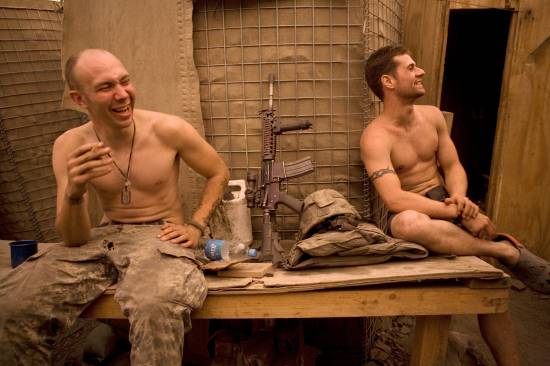
 From June 2007 to July 2008, journalists Sebastian Junger (THE PERFECT STORM) and Tim Hetherington (LIBERIA: AN UNCIVIL WAR) made a total of ten trips to the dangerous Korengal Valley in Afghanistan, documenting the full deployment of Battle Company of the 173rd Airborne Brigade. With snipers hidden all around them, the fifteen soldiers of Second Platoon built a remote, strategic outpost they named Restrepo after PFC Juan Restrepo, the well-liked company medic who was killed early on. Junger and Hetherington film such men as Captain Dan Kearney, Staff Sergeant Kevin Rice, and Sergeant Brendan C. O’Byrne as they go about their daily duties, joking around, playing the guitar, meeting with Afghan locals to get information about the Taliban, and digging trenches while prepared to be shot at at any moment. The journalists took more than 150 hours of footage, supplemented with interviews with several of the soldiers after they were safely back at home base in Italy, talking about what they went through. There is nothing political about RESTREPO, nor does it pull at the heartstrings with melodramatic, overemotional scenes; instead, it depicts the harsh realities of battle, including the long stretches of boredom punctuated by sudden life-or-death situations. There is no narration, no one discusses the possible merits of the war, and no generals or politicians are on hand to defend America’s involvement in the region. There’s no ethnocentric yahooism, nor is there racist treatment of the mostly unseen enemy. It’s just war, pure and simple, seen from the perspective of men who chose to join the army and risk their lives for their country. The film won the documentary Grand Jury Prize at last year’s Sundance Festival and also screened at the Human Rights Watch Film Festival at Lincoln Center. Nominated for an Oscar for Best Documentary, RESTREPO is having a special presentation February 10 at the Paley Center, followed by a panel discussion with Junger, Hetherington, and THE WRONG WAR author Bing West, moderated by Foreign Affairs’ Gideon Rose.