featured

THE WILD PARROTS OF TELEGRAPH HILL 4K RESTORATION

Mark Bittner feeds several cherry-headed conures in The Wild Parrots of Telegraph Hill

THE WILD PARROTS OF TELEGRAPH HILL (Judy Irving, 2003)
New Plaza Cinema @Macaulay Honors College
35 West Sixty-Seventh St. between Central Park West & Columbus Ave.
Opens Friday, November 17
newplazacinema.org
pelicanmedia.org

Judy Irving begins her 2003 documentary, The Wild Parrots of Telegraph Hill, with a shot of a skeptical passerby who has stopped to watch Mark Bittner as he cares for a flock of forty-five cherry-headed conures, also known as red-masked parakeets, living in the trees outside his apartment.

“They’re not really wild if you have names for them, if you don’t mind my saying,” the man claims. “You feed them out of your hands, you have names for them, and they come up to you like they’re your pets. . . . Well, whatever.” He then shrugs and walks away.

The exchange doesn’t bother Bittner at all; he gleefully answers the suspicious man’s doubts and just continues doing what he’s doing, a big smile on his face.

It’s an extremely clever way to start the film, which opens November 17 in a brand-new 4K twentieth anniversary digital restoration at New Plaza Cinema. With the question of Bittner’s relationship with the birds resolved right up front, Irving, who served as director, producer, editor, and cinematographer, is free to now follow Bittner’s odd life choice.

Born in Vancouver, Washington, in 1951, Bittner moved from Seattle to Berkeley when he was twenty and then to San Francisco with the goal of making it as a rock-and-roll musician, in search of a “real transformation.” In 1993, he became infatuated with the conures, some of whom had previously been pets and others that had been born in the wild. Over the course of several years, he devoted his life to them, giving them names, caring for them when they were ill, watching out for predatory hawks, and keeping a somewhat scientific journal of their comings and goings and their individual personalities.

As if he’s sharing the plot of a soap opera, he talks about Scrapper and Scraperella’s breakup; discusses the pairing of Picasso and Sophie; introduces us to Fanny, Gibson, Flap, Pushkin, and Olive; sings to Mingus to get him dancing; vacuums up the mess the birds make in his apartment; nurses Tupelo; and bonds deeply with Connor, the only blue-crowned conure in the flock, an older bird who cannot find a mate or best friend. Connor is not unlike Bittner, a single man with thick glasses, a bushy beard and mustache, and a long ponytail who apparently has no close friends either.

“I don’t think of myself as an eccentric,” he says in his calm, relaxing voice.

Inspired by such Beat writers as Gary Snyder and Jack Kerouac, Bittner is a kind of throwback, an easygoing Bohemian going with the flow, living for free without a paying job. “It wasn’t a plan; it just happened,” he says about his caring for the birds. “It was what I was doing while I was trying to figure out what that thing would be, my idea of where I was going to go in my life. But it became the thing that I’m doing. It’s magic that way.”

But that magic threatens to disappear when he is forced to leave his apartment and has to figure out what will happen to the birds.

Irving, who appears in the film, originally intended the project to be a short but ended up compiling thirty hours of 16mm footage over a few years on a shoestring budget. “When I first met him, I thought Mark was an inarticulate hippy recluse and he thought I was an ecofeminist lesbian,” she writes in a new article for Talkhouse. That changed as filming continued.

A companion piece to Bittner’s 2004 memoir of the same name (the book has the added subtitle A Love Story . . . with Wings), The Wild Parrots of Telegraph Hill is a tender and touching — and colorful — look at not just one man’s dedication to conures but the connection between humanity and nature, as well as the need for people to be a part of something, like a bird in a flock. We are not built for solitude. And that comes to fruition in a sweet shocker of a finale involving Irving (Pelican Dreams, Dark Circle), who will be at New Plaza Cinema for Q&As following the 6:10 screening on November 17 and the 2:40 shows on November 18 and 19.

Meanwhile, Bittner is working on his next book, Street Song, which will be accompanied by an album featuring such originals as “Poppa John,” “The Arrow You Want,” and “You’re So Peaceful” and covers of tunes by Van Morrison, Bob Dylan, and the Beatles.

[Mark Rifkin is a Brooklyn-born, Manhattan-based writer and editor; you can follow him on Substack here.]
REVERSE SHOT AT 20: SELECTIONS FROM A CENTURY: MANAKAMANA

MANAKAMANA

A mother and daughter eat ice cream in experimental documentary Manakamana

MANAKAMANA (Stephanie Spray & Pacho Velez, 2013)
Museum of the Moving Image
35th Ave. at 36th St., Astoria
Saturday, November 18, 12:30, & Sunday, November 19, 3:30
Festival continues through November 26
www.manakamanafilm.com
movingimage.us

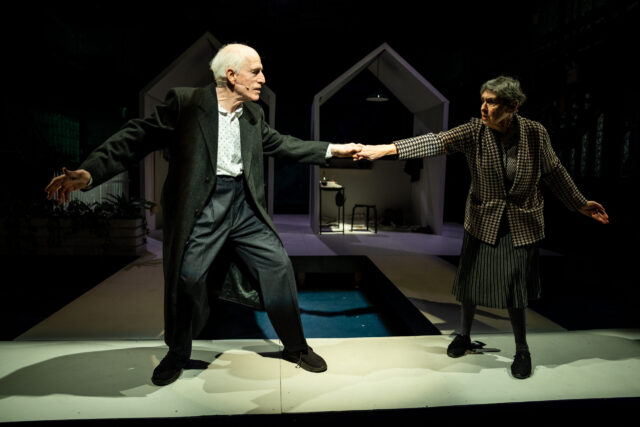
If you’re an adventurous filmgoer who likes to be challenged and surprised, the less you know about Pacho Velez and Stephanie Spray’s Manakamana, the better. But if you want to know more, here goes: Evoking such experimental films as Michael Snow’s Wavelength, Hollis Frampton’s Zorns Lemma, and Andy Warhol’s Screen Tests as well as the more narrative works of such unique auteurs as Jim Jarmusch and Abbas Kiarostami, Manakamana is a beautiful, meditative journey that is sure to try your patience at first. The two-hour film, which requires a substantial investment on the part of the audience, takes place in a five-foot-by-five-foot cable car in Nepal that shuttles men, women, and children to and from the historic Manakamana temple, on a pilgrimage to worship a wish-fulfilling Hindu goddess. With Velez operating the stationary Aaton 7 LTR camera — the same one used by Robert Gardner for his 1986 documentary Forest of Bliss — and Spray recording the sound, the film follows a series of individuals and small groups as they either go to or return from the temple, traveling high over the lush green landscape that used to have to be traversed on foot before the cable car was built. A man and his son barely acknowledge each other; a woman carries a basket of flowers on her lap; an elderly mother and her middle-age daughter try to eat melting ice-cream bars; a pair of musicians play their instruments to pass the time.

A heavy metal band takes a picture of themselves in meditative documentary

A heavy metal band takes a picture of themselves in meditative documentary

Each trip has its own narrative, which must be partly filled in by the viewer as he or she studies the people in the cable car and the surroundings, getting continually jolted as the car glides over the joins. The film is a fascinating look into human nature and technological advances in this era of surveillance as the subjects attempt to act as normal as possible even though a camera and a microphone are practically in their faces. Produced at the Sensory Ethnography Laboratory at Harvard, Manakamana consists of eleven uncut shots of ten-to-eleven minutes filmed in 16mm, using rolls whose length roughly equals that of each one-way trip, creating a kind of organic symbiosis between the making and projecting of the work while adding a time-sensitive expectation on the part of the viewer.

A film well worth sticking around for till the very end — and one that grows less and less claustrophobic with each scene — Manakamana is screening November 18 and 19 as part of the Museum of the Moving Image series “Reverse Shot at 20: Selections from a Century,” honoring the twentieth anniversary of the film publication Reverse Shot, which has been its in-house journal since 2014; the two-month retrospective highlights twenty-first-century works touted by what was originally a stapled zine. Velez will be present at the November 19 show to discuss the film; both screenings will be preceded by the 2014 video Reverse Shot Talkie: Stephanie Spray & Pacho Velez. “Spray and Velez’s film calls attention to attention, the ways our thoughts and perceptions slowly drift and return during long durations spent looking at certain subjects or familiar scenarios,” Leo Goldsmith wrote in Reverse Shot.

DOWN IN DALLAS TOWN: FROM JFK TO K2

Alan Govenar returns to Dealey Plaza in Down in Dallas Town: From JFK to K2

Who: Film director Alan Govenar
What: New York City theatrical premiere of Down in Dallas Town From JFK to K2, with 7:00 screenings opening weekend followed by director Q&As
Where: Cinema Village, 22 East 12th St. between University Pl. & Fifth Ave.
When: November 17-23
Why: In conjunction with the sixtieth anniversary of the assassination of President John F. Kennedy at the age of forty-six on November 22, 1963, poet, writer, folklorist, photographer, and filmmaker Alan Govenar travels back to Dealey Plaza to take another look at that fateful day and how it has impacted contemporary society in the documentary Down in Dallas Town: From JFK to K2, opening November 17 at Cinema Village. Govenar mixes archival audio and television footage with new interviews of eyewitnesses, Kennedy experts, tourists, musicians, and more, including the first-ever interview of Mary Ann Moorman, who talks about her iconic Polaroid snapshot of the event. The film also explores many of the songs written about JFK and the murder, by such groups as the Dixie Nightingales, Los Conquistadores, the Southern Bell Singers, Freddy King, and the Sensational Six. Along the way, Govenar wonders whether JFK’s policies could have prevented the rampant homelessness, designer drug epidemic, and gun violence so prevalent in America today.

In previous films, Govenar examined tattoo legends (Tattoo Uprising), the NEA’s National Heritage Fellowships (Extraordinary Ordinary People), multidisciplinary artist Sidiki Conde, who has lost the use of his lower body (You Don’t Need Feet to Dance), and a nameless hotel that became a gathering place for Allen Ginsberg, Peter Orlovsky, Gregory Corso, William S. Burroughs, and others (The Beat Hotel). Here he turns his attention to a moment in American history that caused a paradigm shift that is still felt today. “Kennedy was the best president we had. I wish we still had him,” Robert from Maine tells Govenar. Down in Dallas Town is more than just another movie about JFK, and Govenar will be at Cinema Village for Q&As following the 7:00 screenings opening weekend to take it even further.

MERRY ME

An Angel (Shaunette Renée Wilson), Lt. Shane Horne (Esco Jouléy), and Dr. Jess O’Nope (Marinda Anderson) seek out latest merryment from Hansol Jung (photo by Joan Marcus)

MERRY ME
New York Theatre Workshop
79 East Fourth St. between Second & Third Aves.
Tuesday – Sunday through November 19, $65-$75
www.nytw.org

Rising star Hansol Jung finishes a busy 2023 with her third production, Merry Me, continuing at New York Theatre Workshop through November 19. The year began with the exhilarating and unpredictable Wolf Play at MCC, followed by the confusing and overly self-referential Romeo and Juliet. Merry Me falls somewhere in between, but it is certainly worth catching before it closes.

As the audience enters the theater, songs are blasting through the speakers, by Melissa Etheridge, Peaches, and Tegan & Sara, all longtime lesbian faves. “Do you like my playlist? You’re welcome,” says our host and narrator, the Angel (Shaunette Renée Wilson) from Angels in America, to open the show.

Merry Me mixes Tony Kushner, Greek tragedy (Aeschylus’s Oresteia, Homer’s Odyssey), William Wycherly’s seventeenth-century Restoration comedy The Country Wife, and Shakespeare into a frenetic tale about sex as power. It takes place on a naval base camp on a “Naval basecamp of A Nation’s most prestigious navy on an Island not far from Another Nation’s most vulnerable coast cities,” wonderfully depicted by set designer Rachel Hauck as a wall of tents as if seen from high above. A small door sits at stage right, a military foot locker stage left. Above are two white clouds amid a blue sky.

There’s a bit of a furor at the encampment, where an electric blackout is hampering the navy’s ability to defend itself. Curiously, the only devices that work are vibrators. Lt. Shane Horne (Esco Jouléy), known as “God’s gift to lady parts of all shapes, colors, and vintages,” is just out of the brig, having served time for bedding Gen. Aga Memnon’s (David Ryan Smith) wife, Clytemnestra (Cindy Cheung). The androgynous Horne, inspired by The Country Wife womanizer Harry Horner, looks fabulous in a camouflage tank top that reveals bulging muscles and tattoos. Horne and their therapist, Dr. Jess O’Nope (Marinda Anderson), who has trouble making decisions — her name is a riff on “yes or no” — concoct a plan in which the doctor will falsely report that “Lieutenant Shane Horne has been zapped, nuked, and lobotomized and returned to the world as Straight as a Road through Nevada!” Thus “converted,” Horne will be able to pursue, unabated, their “merries,” referring to orgasms.

Meanwhile, the general’s son, Pvt. Willy Iphigenia Memnon (Ryan Spahn), is trying to assert his military acumen with his father and his sexual prowess with his wife, Mrs. Sapph Memnon (Nicole Villamil). “I’m a woke white man,” he tells Dr. O’Nope. “I can come to pretend to understand extremities I do not fully comprehend by mansplaining and then apologizing. . . . What if I have been conditioned all my life to believe I am excellent above all other types of humans while not really being trained to work as hard? What if I am actually quite medium in talent, tenacity, and general interestingness and I know I have not developed a mental capacity to bridge the discrepancy between the genius I self-identify to be and the mediocre lump of ego that I actually am?”

As the apt-named Willy struggles with his conscience, Horne keeps up their search for pleasure, demanding, “I want my orgasm.”

Mrs. Sapph Memnon (Nicole Villamil) and Pvt. Willy Memnon (Ryan Spahn) are joined by a surprise guest (Shaunette Renée Wilson) in Merry Me (photo by Joan Marcus)

“The principal concern for women is not having an orgasm. But a woman has to take responsibility for her own orgasms,” Dr. Ruth said in 2010. Merry Me is, well, like an orgasm. Sometimes it explodes, sometimes it disappointingly falls flat, and other times it teases, tickles, and titillates.

The ninety-minute show can’t quite find its center, although it does occasionally locate its G-spot; Jung and director Leigh Silverman (Grand Horizons, On the Exhale), her regular collaborator, along with the cast, are having an absolute blast, which is infectious up to a point. Aficionados of Greek drama may enjoy the Homeric references sprinkled liberally throughout, but the narrative can get overwhelmed by repeated jokes, too many pop-culture references, and a nearly endless stream of double entendres — “It’s my fault, General. I have distracted your dear wife. I asked her to come,” Horne explains — while also having a lot to say about gender, sexuality, war, and the theater itself. Sometimes less is more, as with the navy’s small insignia, a slingshot, comparing sexual freedom to David’s battle with Goliath.

Lt. Shane Horne (Esco Jouléy) makes her case in wild and woolly Merry Me (photo by Joan Marcus)

Alejo Vietti’s costumes counter military fatigues with the blue-and-white outfit worn by Clytemnestra and the red dress adorning Sapph, a sly tip of the cap to America, along with the Angel’s fab getup, which is dazzling. Barbara Samuels’s lighting and Caroline Eng and Kate Marvin’s sound are bold and brash.

The excellent cast is led by Shaunette Renée Wilson (La Race, The Resident), who makes a spectacular appearance as the Angel, and Jouléy (Wolf Play), who is likely to turn you on as Horne no matter your orientation. Anderson (You Will Get Sick, Sandblasted), Cheung (Catch as Catch Can, Golden Child), Smith (Arden of Faversham, The Death of the Last Black Man in the Whole Entire World AKA the Negro Book of the Dead), Spahn (Moscow Moscow Moscow Moscow Moscow Moscow; Jane Anger, or . . .), and Villamil (Wolf Play, Lessons in Survival) provide solid support, at the ready for whatever is to come.

Merry Me makes for some fine merriment, even if the ending is a bit, er, anticlimactic.

[Mark Rifkin is a Brooklyn-born, Manhattan-based writer and editor; you can follow him on Substack here.]
JAJA’S AFRICAN HAIR BRAIDING

Marie (Dominique Thorne, right) receives an unexpected visitor in Jaja’s African Hair Braiding (photo © Matthew Murphy, 2023)

JAJA’S AFRICAN HAIR BRAIDING
Samuel J. Friedman Theatre
261 West Forty-Seventh St. between Broadway & Eighth Ave.
Tuesday – Sunday through November 19, $74-$205.50
www.manhattantheatreclub.com

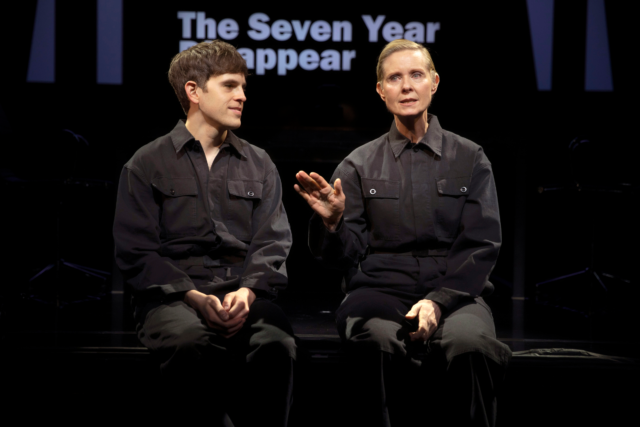
“I feel like I moved in for the day,” Jennifer (Rachel Christopher) says in Jocelyn Bioh’s Broadway debut, Jaja’s African Hair Braiding. An aspiring journalist, Jennifer is a kind of doppelganger for the audience; she arrived just as Jaja’s hair salon on the corner of 125th St. and St. Nicholas Ave. in Harlem opened, asked for long micro braids, and has spent the entire morning and afternoon with Miriam (Brittany Adebumola), an optimistic stylist from Sierra Leone. It’s Jennifer’s first time in the shop, and she carefully watches from her chair to the side as people come and go and the stylists laugh, argue, gossip, and wonder what’s next for them. Just as Jennifer starts to feel part of this tight-knit community, so does the audience.

It’s an auspicious, and very hot, July day in 2019, and Senegalese owner Jaja (Somi Kakoma) is getting married that night. Her eighteen-year-old daughter, wannabe writer Marie (Dominique Thorne), is managing the shop and the stylists, who can be a handful: the Ghanaian Sista Bea (Zenzi Williams), a busybody who thinks she’s better than the others and is hoping to open her own salon; the Senegalese Aminata (Nana Mensah), who loves hanging around the shop, especially while she’s having issues with her husband; Miriam, a patient and agreeable young woman with a surprise secret; and the Nigerian Ndidi (Maechi Aharanwa), a fast, talented, fun-loving braider who the older Bea is jealous of.

Over the course of the day, a variety of customers come and go. The nasty and rude Vanessa (Lakisha May) complains about nearly everything, from the way the others look at her to the chair. Chrissy (Kalyne Coleman) is a cheerful young woman who wants to look like Beyoncé. Sheila (May) is a businesswoman who can’t stop talking on her phone. Laniece (Coleman) is a local DJ. And Michelle (Coleman) is a nervous mother who has made an appointment with Ndidi instead of her usual stylist, Bea, who is furious and feels betrayed.

Also stopping by are a series of men, including Franklin the Sock Man, Olu the Jewelry Man, and Eric the DVD Man, selling their wares, in addition to Aminata’s husband, James (all portrayed by Michael Oloyede).

Shortly after Jaja (Somi Kakoma) arrives, the narrative takes a sharp, unexpected turn, forcing everyone to face a hard dose of contemporary reality.

Jocelyn Bioh’s Jaja’s African Hair Braiding takes place in a Harlem salon (photo © Matthew Murphy, 2023)

In School Girls; Or, The African Mean Girls Play, Bioh, who has appeared in such plays as Suzan-Lori Parks’s In the Blood, Branden Jacobs-Jenkins’s Everybody and An Octoroon, and Jaclyn Backhaus’s Men on Boats, follows a group of young Ghanaian students seeking to be selected as a contestant for Miss Ghana, raising issues of jealousy, fairness, and colorism.

She expands on the concept of Black style in Jaja’s African Hair Braiding, celebrating individuality and woman entrepreneurship while also exploring immigration and the African diaspora in America. In a program note, Bioh explains, “To many people, they are just ‘hair braiding ladies,’ random women people pass by on the street, but to me, they are heroes, craftswomen and artists with beautiful, gifted and skilled hands.” Each character has her hopes and dreams, her fears and desires, that feel real, not cartoonish or pedagogic.

At the center is Marie, who, despite being the youngest, is both friend and mother to the other stylists while figuring out how she can afford to go to college and start up her own life. “You know, I really don’t wanna talk about ANY of this anymore, okay?! I don’t want to talk about school or my mother or her ‘connections’ or whatever you saw on the news!” she blurts out, succumbing to the pressure. “Trust me — this is already all I think about every single day. Every single second! For once, can I just have a day where I come here, do my work — in peace — and go home? Is that okay?!”

The show is lovingly directed by Obie winner Whitney White (soft, On Sugarland), balancing uproarious comedy and wit with sincerity and grace. The ensemble cast is outstanding, led by Thorne as Marie, who imbues her with an inner strength that is wise beyond her years yet existing on a knife’s edge. Adebumola is engaging as the warm and caring Miriam, Mensah is hilarious as Aminata, and Oloyede pulls off quite a feat in portraying all four male characters.

Dede Ayite nails the costumes, giving identity, dignity, and humor to each of the women. The effective lighting is by Jiyoun Chang, with lively sound and original music by Justin Ellington. David Zinn’s phenomenal set, a remarkably detailed salon that essentially puts the audience right in Jaja’s shop (and receives its own well-deserved applause), and Nikiya Mathis, who is responsible for the spectacular hair and wigs, are stars in themselves.

You won’t mind spending a lot more time in Jaja’s, moving in for a day or more.

[Mark Rifkin is a Brooklyn-born, Manhattan-based writer and editor; you can follow him on Substack here.]
WAITING FOR GODOT

Close friends Michael Shannon and Paul Sparks star in TFANA adaptation of Waiting for Godot (photo by Hollis King)

WAITING FOR GODOT
Theatre for a New Audience, Polonsky Shakespeare Center
262 Ashland Pl. between Lafayette Ave. & Fulton St.
Tuesday – Sunday through December 23, $97-$132
866-811-4111
www.tfana.org

On the 1985 Talking Heads song “Road to Nowhere,” David Byrne sings, “Well, we know where we’re goin’ / But we don’t know where we’ve been / And we know what we’re knowin’ / But we can’t say what we’ve seen / And we’re not little children / And we know what we want / And the future is certain / Give us time to work it out.”

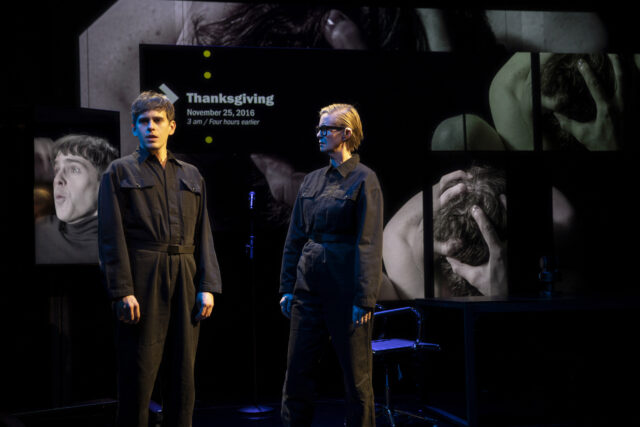
I was thinking about that song while watching Arin Arbus’s spirited adaptation of Samuel Beckett’s absurdist Waiting for Godot at Theatre for a New Audience’s Polonsky Shakespeare Center in Brooklyn. Riccardo Hernandez’s set is a long, narrow, dusty platform that bisects the seating from the back of the theater all the way to where the proscenium stage would have been, which now leads into a dark void. Two yellow traffic lines run down the middle, making the set a postapocalyptic road to nowhere.

The orchestra features three rows of seats on either side of the abandoned thoroughfare, while the mezzanine and balcony have chairs on three sides. As the crowd enters, Estragon, aka Gogo (Michael Shannon), is sitting on a rock, deep in thought, or as deep in thought as he can get. Opposite him is a bare tree. After several minutes, he tries to take off one of his boots, with no success. “Nothing to be done,” he says as Vladimir, aka Didi (Paul Sparks), joins him.

Through nearly the entire 145-minute show (including intermission), Didi doesn’t step on the yellow lines, nimbly leaping over them or walking or standing right next to them. Sparks is a marvel to watch as he avoids the lines often without looking down at them, as if via muscle memory or like they are emitting some kind of negative energy. Meanwhile, Gogo doesn’t even seem to notice the lines, dragging his feet, either bare or in wretched shoes (go-go boots?), striding on them as if they’re not there.

The yellow lines, and the two protagonists’ different interaction with them, amplify the duality inherent in the play in a way that I have to admit has never stood out to me before, offering fascinating nuance to a work I have now experienced five times in the last nine years, on and off Broadway and online, by Irish, English, American, and Yiddish companies.

Two yellow lines run down the center of the stage at TFANA’s Polonsky Shakespeare Center (photo by Hollis King)

Waiting for Godot unfurls in an unidentified time and place. A pair of disheveled men discuss food, feet, and suicide while waiting for a mysterious figure they’ve never met to arrive, as if he will bring meaning to their lives. “Time has stopped,” Didi says when Pozzo listens to his pocket watch. Pontificating on their situation, Didi says, “We wait. We are bored. [He throws up his hand.] No, don’t protest, we are bored to death, there’s no denying it. Good. A diversion comes along and what do we do? We let it go to waste. Come, let’s go to work! In an instant all will vanish and we’ll be alone once more, in the midst of nothingness!”

In each act a carnivalesque man named Pozzo (Ajay Naidu) and his servant, Lucky (Jeff Biehl), pass through, the former snapping his whip, the latter carrying a suitcase and a picnic basket and tied to a rope like a horse. In addition, a young boy (Toussaint Francois Battiste) shows up with important information at the end of each act.

There are two of nearly everything in the play: Vladimir’s and Estragon’s nicknames are doubled: Didi and Gogo. There are two yellow lines down the road, dividing it into two geographic sections. There are two acts over two days, with no past and no future. Didi and Gogo are two friends who seem to be unable to exist without each other, no matter how hard they might try. Pozzo and Lucky are physically connected by the rope. Lighting his second pipe, Pozzo enthuses, “The second is never so sweet . . . as the first I mean. But it’s sweet just the same.”

There are only two props, the rock and the tree. After intermission, there are two green leaves on the tree. The boy, who is solo, speaks of his abused brother, as if his sibling might be a doppelganger.

Even actors Shannon and Sparks are like their own duo; they are close personal friends who brought the show to TFANA as a unit. They have previously performed together onstage — including in The Killer at the Polonsky — and in movies and on television.

Didi (Paul Sparks) and Gogo (Michael Shannon) juggle hats in Waiting for Godot (photo by Hollis King)

Fortunately, Arbus (Des Moines and Frankie and Johnny in the Clair de Lune, both with Shannon) does not get bogged down by the doubling. This Godot (accent on the first syllable) is loud and aggressive, with less of the kind of vaudeville shtick that many productions revel in. The characters don’t wear the traditional bowlers; when Didi and Gogo swap their hats and Lucky’s, it is not merely a funny skit but refers to the interchangeability of people, as Didi suggests that he can take over for Pozzo and Gogo can be Lucky. In addition, just as the boy does not get beaten but his brother does, Gogo gets roughed up every night but Didi wakes up unharmed.

The dichotomy also relates to the two thieves who are crucified with Jesus; Didi points out how only one of the four evangelists wrote that one thief was saved, evoking Didi and Gogo’s potential fate while they wait for Godot. Perhaps the double yellow lines are a kind of cross, which could explain in part why Didi avoids touching it out of fear of damnation.

“The road is free to all,” Pozzo says. Didi responds, “That’s how we looked at it,” to which Pozzo replies, “It’s a disgrace. But there you are.” Gogo concludes, “Nothing we can do about it.”

Shannon’s (Grace, Long Day’s Journey into Night) Gogo is bleak and downtrodden, shoulders hunched, while Sparks’s (Grey House, Edward Albee’s At Home at the Zoo) Didi is mischievous and hopeful. Whenever Didi is asked what they’re doing, Sparks spits out “Waiting for Godot” like the words don’t matter. At one point they even sit together in the audience, fully enjoying themselves.

Naidu (The Master and Margarita, The Kid Stays in the Picture) is boisterous as Pozzo, while Biehl (The Merchant of Venice, Life Sucks.) beautifully morphs from his stiff, silent servant to deliver Lucky’s long, complex monologue about tennis, quaquaquaqua, the divine, and nothingness. Battiste (A Raisin in the Sun) does a fine job as the boy, who offers a promise that might never come to fruition.

Susan Hilferty’s costumes turn the raggedy Didi and Gogo into hobos, although there is no boxcar to come and whisk them away. Chris Akerlind’s lighting takes the scenes from night to day with a nearly blinding, heavenly blast, while Palmer Hefferan’s sound maintains the feeling of being lost. The choreography, primarily Lucky’s dance, is by Byron Easley. Beckett expert Bill Irwin, who has portrayed Didi and Lucky, serves as creative consultant.

“That passed the time,” Didi says at one point. Gogo quickly replies, “It would have passed in any case.” Didi responds, “Yes, but not so rapidly.”

And so goes another Godot, a lovely way to pass the time while asking, but never answering, two of life’s biggest questions: Who are we, and what are we waiting for?

[Mark Rifkin is a Brooklyn-born, Manhattan-based writer and editor; you can follow him on Substack here.]
KING OF THE JEWS

Volksdeutscher F. X. Wohltat (Daniel Oreskes) has strong words for Dr. I. C. Gotterman (Richard Topol) in King of the Jews (photo by Russ Rowland)

KING OF THE JEWS
HERE Arts Center
145 Sixth Ave.
Tuesday – Sunday through November 18, $99
here.org

Leslie Epstein’s theatrical adaptation of his controversial 1979 novel, King of the Jews, arrives at a perilous moment in Jewish history, as Israel responds to the horrific October 7 Hamas attack that killed at least 1,200 people and took more than 200 hostages. The current rise in antisemitism, specifically related to Israel’s bombing of Gaza and preparation for a ground incursion to destroy the terrorist organization, is palpable throughout the show, which takes place in occupied Poland in 1939. Director Alexandra Aron’s immersive staging is powerful and hard-hitting, but, alas, the narrative, despite a strong start, can’t quite live up to its promise.

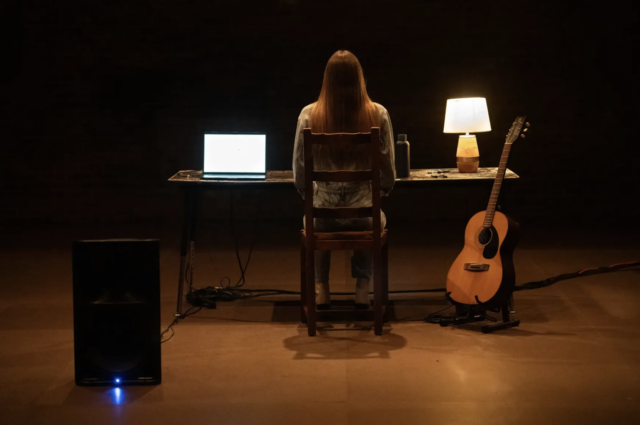
Set designer Lauren Helpern has transformed HERE’s upstairs theater into the Astoria Café, the only Jewish nightclub allowed to remain open in pre-WWII Lodz, Poland. The audience sits at small tables and on benches, surrounded by a mirrored bar. On stage is music and comedy; several tables are reserved for the characters, who eat, drink, debate issues, and watch the entertainment.

When you first walk into the space, clarinetist and saxophonist Matt Darriau of the Klezmatics and pianist Raphael D’Lugoff are playing jazz tunes. (They start thirty minutes before showtime, so it’s worth coming early.) You can take a walk around the room and check out the stocked bar, a classic old telephone, and a Polish menu.

The Astoria is owned by the sycophantic Fried Rievesaltes (Dave Shalansky); his wife, vocalist Phelia Lubliver (Rachel Botchan), is the star attraction. The staff includes waiter Ferdinand Philosoff (John Little), who is not the best of philosophers; cook Herman Gutfreind (JP Sarro), who plays the trumpet and euphonium and spouts Marxism any chance he gets; and cellist and violinist Dorka Kleinweiss (Erica Spyres). The café regulars are Rabbi Martini (Allen Lewis Rickman) and Rabbi Verble (Robert Zukerman), who enjoy arguing and complaining; Schotter (David Deblinger), who tells awful jokes about the Jews and “Hamilton,” not wanting to say the name of the German führer; Hungarian amateur pianist M. M. Schpitalnik (Jonathan Spivey); and Dr. I. C. Gotterman (Richard Topol), who is infatuated with Phelia.

One evening, a young boy (Wesley Tiso) dives in through the window. It’s right around curfew, when the Death’s Headers of the SS patrol the streets. Volksdeutscher F. X. Wohltat (Daniel Oreskes) arrives, looking for the boy, but the people in the café have hidden him (rather poorly). A big bear of a man, Wohltat proclaims he is there to help the Jews.

“You see, I know our Jews! And perhaps some of you know me? I was brought up here, in these streets, the same as you,” he boasts. “I am not ashamed to say that even though the blood of the Reich flows in my veins, I played boyish games and swam in the blue Dolna with members of your community. This is my beloved city, too. I am your neighbor, your friend.”

Pretending not to see the boy, Wohltat orders the Jews to form a Judenrat, “a council of ministers to rule Jewish life. . . . Of course, during wartime, we might have to ask them to carry out this task or that task. Like turning over someone who runs away, or anyone who tries to hide him. But you must agree: better for you Jews to do things yourselves than have others — like our friend the Obersturmfuhrer — do them for you.”

The Jews in the café discuss whether they should give up the boy or agree to the Judenrat, a council of elders that would make them collaborators with the enemy, who they refer to as the Blond Ones. They ultimately decide to keep the boy, so soon they are choosing their officers and a president. The doctor is ultimately put in charge. Infighting, backstabbing, and doubt ensue as Wohltat asks them to pick a hundred Jews to be sent to work while promising that they will all eventually have a new homeland in Madagascar.
The nature of their bargain is clear: “If a Jew puts his head into the mouth of a leopard, is the leopard liable because it is his nature to chew?” Rabbi Martini asks.

Rabbi Martini (Allen Lewis Rickman) doesn’t like what he sees in King of the Jews (photo by Russ Rowland)

Epstein, who comes from an eminent family — his father, Philip G. Epstein, and uncle, Julius J. Epstein, cowrote such films as The Man Who Came to Dinner, Casablanca (with Howard Koch), and Arsenic and Old Lace, and his son, Theo, was the GM who helped guide the Boston Red Sox to their first World Series championship in more than eighty years in 2004 — does not make things easy for the audience. The title character, inspired by the real-life council elder Chaim Mordechaj Rumkowski, is a deeply conflicted man and complicated figure; he brazenly and embarrassingly lusts after Phelia and is distressed that he appears to have lost his magic touch as a doctor. He is ably portrayed by Topol, who has become a go-to actor in Jewish dramas, playing Jewish men in Paula Vogel’s Indecent, Clifford Odets’s Awake & Sing!, and Joshua Harmon’s Prayer for the French Republic, with Tadeusz Slobodzianek’s Our Class opening at BAM in January, about a 1941 Polish pogrom.

The rest of the cast is solid, with fine turns by Botchan (Indecent, The Sorceress) and Spyres (Once, Into the Woods), who must consider sacrifices only women can make, and the always excellent Oreskes (Oslo, The Seagull / Woodstock, NY), who lets Wohltat’s evil build scene by scene.

Aron (A Night in the Old Marketplace, Naked Old Man) puts the audience right in the midst of it all, making the air of antisemitism stifling. Zach Blane’s lighting, Jane Shaw’s sound, and Oana Botez’s costumes — complete with big yellow Stars of David on the Jews’ clothing — add to the overall feeling of impending doom. The café denizens are faced with a nearly impossible situation, but their individual concerns, worries, fears, and hopes lack consistency; the characters are not quite fully drawn. In the second act — the audience has to exit the house after the first act, returning to a slightly changed layout — the characters’ reactions to Wohltat’s orders seem more random, not as believable, perhaps in part because Epstein had to trim the novel’s plot considerably for the play.

King of the Jews does raise critical issues, especially in light of what is happening in Israel right now and the response around the world, but it falls short of being the important play it could have been. Nevertheless, certain lines resonate deeply.

“Be brave, stand up, Jews,” the doctor says. “Who can say what a Jew is?” Philosoff asks. And Rabbi Verble sums it all up when he declares, “We two rabbis herby forbid the King of Heaven from punishing his people any longer. It’s enough! . . . We demand that the suffering stop!”

[Mark Rifkin is a Brooklyn-born, Manhattan-based writer and editor; you can follow him on Substack here.]