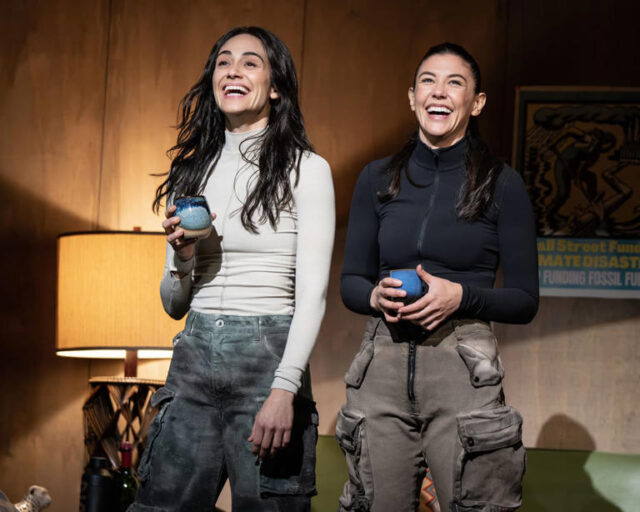
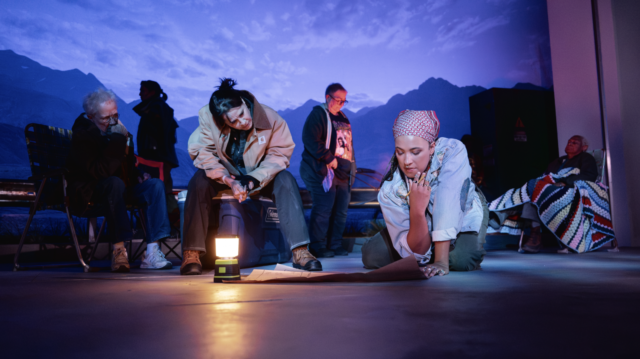
Richard Move / MoveOpolis!’s Devrai (Sacred Grove) is part of “Prelude in the Parks” festival (photo by Ben Parker / courtesy of the Segal Theatre Center of the Graduate Center CUNY)
PRELUDE IN THE PARKS: PERFORMANCES FOR THE PLANET
Multiple locations in all five boroughs
June 7-9, free www.thesegalcenter.org
Musicians, poets, dancers, storytellers, actors, and other creators and performers will spread across all five boroughs June 7-9 for “Prelude in the Parks: Performances for the Planet.” Curated by Mov!ngCulture Projects founding director and creative producer Robin Schatell and Segal Center executive director Dr. Frank Hentschker, the special event, an initiative of CUNY’s Segal Theatre Center, features free site-specific shows in parks and gardens exploring climate change, environmental issues, and the future of the Earth, with presentations by Richard Move / MoveOpolis!, Kinesis Project Dance Theatre, Dennis RedMoon Darkeem, Keith Josef Adkins, Anh Vo, and others.
The pieces, which will use no electricity, run between twenty-five and sixty minutes each, in such locations as Barretto Point Park, Fort Greene Park, the Eastside Outside Community Garden, Tappen Park, and Inwood Hill Park; several are interactive, including nature walks. Below is the full schedule.
Friday, June 7, 6:00
Strike Anywhere Performance Ensemble: Pliable Futures, Fort Greene Park, Fort Greene
Richard Move / MoveOpolis!: Devrai (Sacred Grove), with Aristotle Luna, Riverside Park, Manhattan, 6:00 & 6:30
Kinesis Project Dance Theatre: Bridge Matter/The Reach (excerpt), with live music by Johnny Butler, Inwood Hill Park, Gaelic Field, Manhattan
Sidiki Conde and His Tokounou Ensemble: Guinean Environmental Stewardship Traditions, Hunters Point South Park, Long Island City
Anh Vo will perform Weather in Brower Park on June 9 (photo by Evelyn Efreja / courtesy of the Segal Theatre Center of the Graduate Center CUNY)
Saturday, June 8, 3:00
Community Poetry and Tea, with tea ceremony, arts, and culture, Eastside Outside Community Garden, Manhattan, 2:00 – 4:00
Artichoke Dance Company: Water Rises, Newtown Creek Nature Walk, Kingsland Ave., Greenpoint
Dennis RedMoon Darkeem: Land Connections: Reflections with Dennis, Bronx River Community Garden
Pajarillo Pinta’o: Dance in Connection, Barretto Point Park, Bronx
Keith Josef Adkins: The Heat Will Kill Everything (excerpts), with Francois Battiste, directed by Russell G. Jones, Riverside Park, Manhattan
Manners and Respect, Thomas Fucaloro, and Cynthia Rodriguez: Mixed Use, Tappen Park, Staten Island
Sunday June 9, 3:00
Monica Dudárov Hunken and Leah Bachar: Brooklyn Is Not a Sacrifice Zone, Newtown Creek Nature Walk, Greenpoint
Anh Vo: Weather, Brower Park, Brooklyn
Rafael de Balanzo Joue and Daniel Pravit Fethke: Resilience Thinking Walkscape, Prospect Park, Brooklyn
The thirty-eighth annual Performance Mix Festival, hosted by New Dance Alliance at Abrons Arts Center, features live and recorded works from thirty-five experimental dance and film artists, including pieces from NDA’s Black Artists Space to Create residency and LiftOff residency. Running June 6-9, the festival features such creators as Mickey Davidson, Carole Arcega, Arantxa Araujo, j. bouey, Beatriz Castro Mauri, Jordan Deal, Tal Halevi, Yolette Yellow-Duke, and Aya Shabu, exploring such issues and subjects as ghost porn, climate change, queer platonic intimacy, Michael Jackson, masculinity, gun violence, gender markers, effeminacy and androgyny, and landscapes of memory. The 2024 event is curated by NDA founder and executive director Karen Bernard and an artist panel comprising Rafael Cañals, Maxi Hawkeye Canion, Jil Guyon, Rebecca Patek, and Stacy Lynn Smith, with films selected in collaboration with Ciné-Corps.
Tickets are $18.50; below is the complete schedule.
Thursday, June 6
j. bouey: A Message from Mx. Black Copper, Shua Group: Over, Frédéric Nauczyciel: A Baroque Ball (Shade), Bob Eisen, 7:00
Nina Laisné and François Chaignaud: Mourn, O Nature!, Flamenco Rosado, ankita sharma: jagaana/Awaken/, Isa Spector: A Larger Body, 8:30
Friday, June 7
Breakfast Mix: virtual dance experience organized by Agora de la danse/Koros, New Dance Alliance Studio, 182 Duane St., free with advance RSVP, 10:00
Panel discussion with Karen Bernard, L’Annexe-A, Virginie Combet, and Vanessa Bousquet of Koros, including two VR dance pieces by Hélène Blackburn and Andrea Peña, 10:30
Thomas Choinacky: Home Is the Body, Smaïl Kanouté: Never Twenty One, Company [REDACTED]: My Apocalypse, Shua Group: Over, 7:00
Saturday, June 8
Audrée Juteau, Zoey Gauld, Catherine Lavoie-Marcus, and Ellen Furey | Mystic-Informatic, followed by a reception, 7:00
Sunday, June 9
Carole Arcega: Hymen, Beatriz Castro Mauri: girl crush, Chloë Engel: Rubber, Johanna Meyer: Suit Hang, noon
Mickey D. & Friends: Visiting the Past to See the Future, Jordan Deal: capeforce, Lo Fi Dance Theory: Move Freely, Aya Shabu: LandED (excerpt), 1:30
Tal Halevi: Hidden in a Closet My Mother Imagined Being Wrapped in Her Father’s Shawl, Mohamad Moe Sabbah and Khansa: Khayef, Yolette Yellow-Duke, 3:00
Arantxa Araujo in collaboration with Mariana Uribe: Breathsculpt: Transformations Unveiled, Lena Engelstein: Stage Direction, Viktor Horváth, 4:30
[Mark Rifkin is a Brooklyn-born, Manhattan-based writer and editor; you can follow him on Substack here.]
Jamar Roberts’s Ode is a meditation on gun violence (photo by Paul Kolnik)
ALVIN AILEY AMERICAN DANCE THEATER
BAM Howard Gilman Opera House
30 Lafayette Ave. between Ashland Pl. & St. Felix St.
June 4-9, $37-$105
718-636-4100 www.bam.org
If you missed Alvin Ailey American Dance Theater’s annual monthlong visit to City Center this past November/December, you can still catch two programs from their sixty-fifth anniversary season, taking place at BAM’s Howard Gilman Opera House June 4-9. Alvin Ailey had close ties to BAM, dancing there in 1956 and starting a company residency in 1969.
“Contemporary Visions” consists of new productions of Jamar Roberts’s 2019 Ode, Hans van Manen’s 1997 Solo, and Alonzo King’s 2000 Following the Subtle Current Upstream. Set to Don Pullen’s “Suite (Sweet) Malcolm (Part 1 Memories and Gunshots),” Ode is a seventeen-minute meditation on gun violence, restaged by Ghrai Devore-Stokes. Solo, originally performed by the company in 2005 and restaged by Clifton Brown and Rachel Beaujean, is seven minutes of playful one-upmanship as three male dancers strut their stuff in a kind of dance-off, their costumes (by Keso Dekker) differentiated by yellow, orange, and red; as each finishes a solo, they make gestures and eye movements inviting the next dancer to top what they have just done. But this is no mere rap battle; instead, it’s set to Sigiswald Kuijken’s versions of Johann Sebastian Bach’s “Partita for Solo Violin No. 1 in B minor, BWV 1002 — Double: Presto” and “Partita for Solo Violin No. 1 in B minor, BWV 1002 — Double: Corrente.”
Alonzo King’s Following the Subtle Current Upstream is part of “Contemporary Visions” Ailey program at BAM (photo by Paul Kolnik)
And Following the Subtle Current Upstream, which King calls “a piece about how to return to joy,” is a twenty-two-minute work that unfolds in a series of vignettes with nine dancers performing to silence, a storm, chiming bells, and other sounds by Indian percussionist Zakir Hussain, American electronics composer Miguel Frasconi, and the late South African singer and activist Miriam Makeba. At one point a dancer is alone onstage, like a music box ballerina, two horizontal beams of smoky light overhead; the lighting is by Al Crawford based on Axel Morgenthaler’s original design, with tight-fitting, short costumes by Robert Rosenwasser, the men in all black, the women in black and/or yellow.
“All Ailey” is a treat for company aficionados, with presentations of the Ailey classics Memoria (1979), A Song for You (1972), Cry (1971), and Revelations (1960). Memoria, which will be performed with members of Ailey II and students from the Ailey School, was inspired by the death of Ailey’s friend and colleague Joyce Trisler; it is set to music by Keith Jarrett. A Song for You, an excerpt from Love Songs, features Donny Hathaway’s version of Leon Russell’s title track. Ailey choreographed the seventeen-minute Cry as a birthday gift for his mother. And Revelations is, well Revelations, one of the most famous and important dance works of all time.
[Mark Rifkin is a Brooklyn-born, Manhattan-based writer and editor; you can follow him on Substack here.]
HERE THERE ARE BLUEBERRIES
New York Theatre Workshop
79 East Fourth St. between Second & Third Aves.
Tuesday – Sunday through June 30, $105-$125 www.nytw.org
When you enter New York Theatre Workshop to see Here There Are Blueberries, there’s a projection of the Leica logo on a translucent curtain behind an actual camera on a stand on the stage. “In the 1930s, the development of compact, portable cameras like this one changed everything,” an actor says in a prologue, explaining that as Germany emerged from a national depression, citizens started taking photos as an affordable hobby in the pursuit of happiness. “Each pose, each press of a button, each frozen moment tells the world: This is our shared history, and this is what it means to us. Viewed in this way, the apparent ordinariness of these images does not detract from their political relevance. On the contrary: Asserting ordinariness in the face of the extraordinary is, in itself, an immensely political act.”
According to the September 2020 U.S. Millennial Holocaust Knowledge and Awareness Survey, the first national poll ever taken of millennials and Gen Z about the Holocaust, sixty-three percent of respondents did not know that six million Jews were killed by the Nazis, forty-eight percent could not name a single concentration camp or European ghetto, and twenty percent believed that the Jews caused the Holocaust. As more survivors and witnesses pass away and antisemitism grows around the world, those numbers are only likely to increase, which is why a play such as the exquisitely rendered Here There Are Blueberries is so timely and necessary.
Running at New York Theatre Workshop through June 30, the gripping hundred-minute drama from the Tectonic Theater Project pores over the contents of a book of photos delivered to the U.S. Holocaust Memorial Museum in 2007 by an eighty-seven-year-old retired U.S. lieutenant colonel (Grant James Varjas); he had been holding on to them since he discovered them in an abandoned Frankfurt apartment in 1946. There was something unique and unexpected — and terrifying — about the pictures: They did not contain a single image of a victim or prisoner.
With limited information, the archival team, led by Dr. Rebecca Erbelding (Elizabeth Stahlmann) and Judy Cohen (Kathleen Chalfant), begin a detailed forensic investigation that yields a surprising result: The photos are of Nazi officers and Helferinnen, a communication corps of young women, enjoying themselves at Auschwitz, exploring the facilities, laughing and singing, and relaxing at the previously unknown chalet known as Solahütte, where weekends were awarded to hard workers, a bonus for a job well done — asserting ordinariness in the face of the extraordinary, examples of what Jewish historian and philosopher Hannah Arendt, who fled Germany with her family in 1933, referred to as “the banality of evil.”
As the museum archive team starts identifying the men in the photos — among those seen in large projections on the back wall are Dr. Josef Mengele, Commandant SS Major Richard Baer, chief SS doctor Eduard Wirths, Auschwitz builder Rudolph Höss, and his right-hand man, former bank clerk SS Obersturmführer Karl Höcker (Scott Barrow), who owned the album — it reaches out to descendants of the subjects, some of whom are shocked to find out what their fathers and grandfathers were up to. One, Tilman Taube (Jonathan Raviv), decides to help the museum track down more relatives in order to gather further information. “Those who say nothing . . . they transfer this trauma to the next generation,” he bravely argues.
Meanwhile, Dr. Erbelding, Cohen, and museum director Sara Bloomfield (Erika Rose) debate whether the photographs should be put on display. “Here we find our first obstacle. There’s a sense at our museum that we should focus on the victims, not on the perpetrators,” Cohen says. Bloomfield replies, “In the creation of the permanent exhibition of the United States Holocaust Memorial Museum, special effort has been made to avoid undue attention to the perpetrators and to humanize and honor the victims.” Shortly after a survivor declares that the museum should let the public see the pictures for themselves, Bloomfield says, “We don’t want to elevate Nazis, to give them any kind of platform.”
The photographs that give the play its name are a series of shots of Höcker with a group of Helferinnen in skirts sitting on a fence on the Solahütte deck, eating blueberries, all smiles as they pose for the camera; one of the young women pretends to cry because her bowl is empty. “People called us and said — these people look normal, the girls look like teenage girls. Because they were. And that was surprising, that they look like us!” Dr. Erbelding explains. The caller continued, “‘I know I never could’ve been a Mengele. I know I never could’ve been a Höcker. But could I have been a Helferin?’”
And therein lies the dilemma at the heart of the play: What would any of us have done in that situation — and what would we do today?
Using their Moment Work method of collaboration, Tectonic Theater Project and founding artistic director Moisés Kaufman have created such fact-based narrative plays as The Laramie Project,33 Variations,I Am My Own Wife, and Gross Indecency: The Three Trials of Oscar Wilde. Conceived and directed by Tony and Emmy nominee Kaufman — inspired by the 2007 New York Times article “In the Shadow of Horror, SS Guardians Frolic” — and cowritten by Kaufman and Emmy nominee Amanda Gronich, Here There Are Blueberries takes the audience inside the tense research and analysis as the museum realizes how important the evidence is.
The album served as visual reference for the Oscar-nominated film The Zone of Interest, a fictionalized version of the everyday life of Höss and his family, who lived next door to Auschwitz. It also has much in common with Bianca Stigter’s astounding 2021 documentary, Three Minutes — A Lengthening, which follows the U.S. Holocaust Memorial Museum as it tries to uncover the details about a mysterious 180-second home-movie clip from Poland in 1938, searching for the exact location, who is in the footage, and what happened to the citizens of this community.
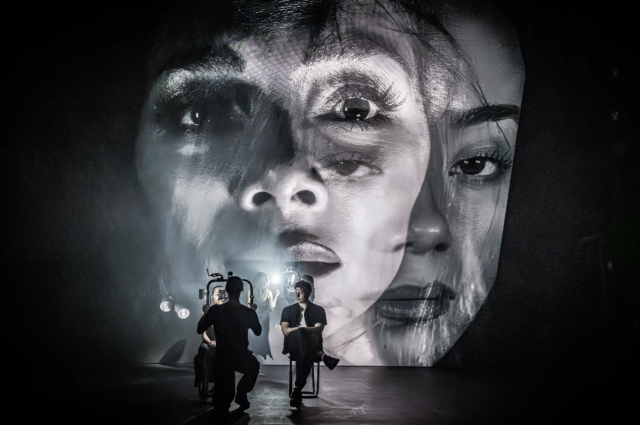
Derek McLane’s set is a research room containing several standing desks where characters in Dede Ayite’s everyday costumes conduct their analyses; David Lander’s clear-cut lighting includes overhead industrial fluorescents and illuminates individual speakers, while Bobby McElver’s sound ranges from the accordion and a storm to chirping birds, a flowing river, and marching feet. David Bengali’s bold projections of the photos, news reports, related documents, and maps makes the audience feel like they are part of the research team, especially with close-ups and when a particular figure in a photo is lit up or silhouetted. A few instances of live video are distracting and unnecessary, but they are kept to a minimum.
Stahlmann (Slave Play,Pushkin “Eugene Onegin” in our own words) and Tony nominee Chalfant (Angels in America,Novenas for a Lost Hospital) lead a strong ensemble cast (which also includes Noah Keyishian, Anna Shafer, and Charlie Thurston) that smoothly handles multiple roles. The material is treated with a gentle sensitivity that makes the various revelations all the more powerful.
Early on, Dr. Erbelding concludes, “This album is something [Höcker] treasured. There are no ink blots, he doesn’t misspell anything, he made sure the lettering was right. Everything is glued perfectly. This was meant to last.” After the show, as the audience exits, facsimiles of many of the photos are on display in the lobby, a potent reminder that the story that has just been told is true and that the snapshots are real.
I know that for me, one thing that is going to last from this play: I will never be able to look at blueberries the same way again.
[The June 4 and 12 performances will be followed by discussions with the Fellowships at Auschwitz for the Study of Professional Ethics. Mark Rifkin is a Brooklyn-born, Manhattan-based writer and editor; you can follow him on Substack here.]
“Because we used to be cattle ranchers, we are the bridge, and we have to be able to have our feet in both worlds to be able to be a funnel and channel for the light to save not just cows, which I adore and love, but the planet, all species,” Renee King-Sonnen says in Rowdy Girl. “If we are not here to do that, then what are we doing?”
Jason Goldman’s debut feature-length documentary introduces audiences to King-Sonnen and her husband, Tommy Sonnen, who run Rowdy Girl Veganic Farm and Rowdy Girl Sanctuary, a nonprofit charity that rescues farm animals that had been raised for meat and incorporates them into their vegan lifestyle. Through their Rancher Advocacy Program, they help others convert their farms to grow crops veganically.
Goldman and cinematographers Bridget McQuillan, Dmitri Borysevicz, and Caleb Kuntz follow King-Sonnen as she speaks to and nurtures Sealy the turkey, Lulu and Penny the pigs, Tom Tom the goat, Trixie and Dixie the donkeys, Lemuria the horse, and Rowdy Girl the cow. A Texas rancher nearly breaks down in tears when he watches King-Sonnen welcome newborn calf Buster, who he helped deliver and then witnessed the animal’s mother reject and leave him to die.
King-Sonnen is a fierce activist for humane treatment of all animals; every shirt and hat she wears boasts anti-factory-farming and pro-vegan slogans, much like the farm’s social media presence. “There’s a door inside our consciousness that we dare not go through, because if we do, we will see that all these animals are just like us,” she tells the Texas rancher.
She meets with Valerie Peña and Jose Bustos about their pig, sixth-generation cattle ranchers Cindy and Richard Traylor about converting their farm, and Jennifer and Rodney Barrett about transforming their chicken ranch into “the first exotic automated mushroom farm in America.” In addition, King-Sonnen hosts a small gathering where she talks about how she is a product of rape, that her father horribly abused her mother, and that she is in recovery; her sobriety happened around the same time she went vegan, fighting against violence and the mistreatment of animals.
Just as King-Sonnen does, the film itself has a clear message. “I was originally drawn to Renee’s story when I learned that she was not only rescuing animals but rescuing ranchers,” Goldman notes in his director’s statement. “That idea crystalized in my mind, that her method of activism was disarming, displayed vulnerability, and was authentically holistic. I could see how she embodies the core philosophy of animal liberation: that animals are sentient beings who have their own interests, desires, and complex emotional lives. My intent with this film was to showcase the deep compassion, understanding, and unusual methods that are required of activists to help people open their hearts and minds to the cruel nature of animal agriculture.”
Rowdy Girl, which was executive produced by New York City native and longtime vegan Moby, opens May 31 at DCTV Firehouse Cinema; Goldman and King-Sonnen will be on hand for Q&As following the 7:00 show on Friday, the 7:30 screening ons Saturday, and the 4:30 show on Sunday.
[Mark Rifkin is a Brooklyn-born, Manhattan-based writer and editor; you can follow him on Substack here.]
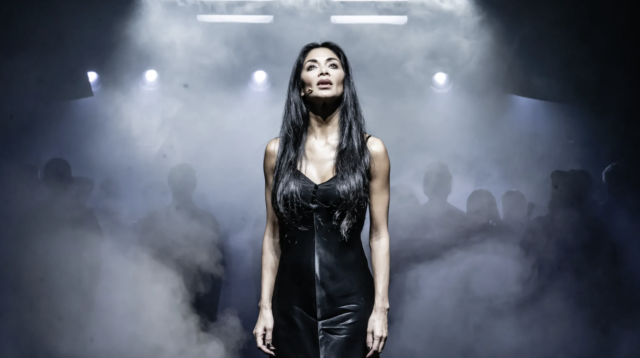
Harriet Stubbs will perform at Joe’s Pub on June 2 (Drew Bordeaux Photography)
HARRIET STUBBS
Joe’s Pub
425 Lafayette St. by Astor Pl.
Sunday, June 2, $32.50 (plus two drink or one food item minimum), 6:00
212-539-8778 www.joespub.com www.harrietstubbs.com
“If you feel safe in the area that you’re working in, you’re not working in the right area,” David Bowie said in a 1990s video interview. “Always go a little further into the water than you feel you’re capable of being in. Go a little bit out of your depth, and when you don’t feel that your feet are quite touching the bottom, you’re just about in the right place to do something exciting.”
British classical pianist, William Blake scholar, and Bowie aficionado Harriet Stubbs has built her career on such advice, as evidenced by her latest album, the exciting Living on Mars; the record is the follow-up to 2018’s Heaven and Hell: The Doors of Perception, a title inspired by Aldous Huxley’s autobiographical 1954 book The Doors of Perception and 1956 essay Heaven and Hell and Blake’s 1793 tome The Marriage of Heaven and Hell.
Now based in London, Los Angeles, and the East Village, the British-born Stubbs took to the keys when she was three and has performed at such prestigious venues as Carnegie Hall, Le Poisson Rouge, St Martin-in-the-Fields, the Cutting Room, Tibet House, and the Los Angeles County Museum of Art. On June 2, she will play Living on Mars in its entirety at her Joe’s Pub debut; be sure to get a good look at her shoes, which are always spectacular.
The eclectic record features Stubbs’s unique solo adaptations of the Thin White Duke’s “Space Oddity” and “Life on Mars” as well as Nick Cave’s “Push the Sky Away,” Paul McCartney’s “Blackbird,” and Beethoven’s “Pathétique” in addition to homages to the duos of J. S. Bach/Glenn Gould and Frédéric Chopin/Leopold Godowsky.
My wife and I first became interested in Stubbs when Cave gave her a shout-out at an October 2023 show at the Beacon; earlier this month my wife saw Stubbs perform a private Coffee House Club concert at the Salmagundi Club on Fifth Ave., and then we bumped into her on the street by Sheridan Square. Clearly, our paths were destined to cross.
In this exclusive interview, Stubbs talks about Blake and Bowie, the pandemic, swimming with Cave, and playing in New York City.
twi-ny: You started your career early, first performing publicly as a pianist at the age of four and performing piano concertos as soloist at the age of nine. Growing up immersed in classical music performance, when did you become interested in contemporary pop music?
harriet stubbs: My love of music outside of classical really developed as a teenager and as I was transitioning from a career as a child prodigy to that of an adult artist: what I wanted to do with classical music, how I wanted to remain in it, why, and how these were going to come together to inform my professional adult life. A moment that I remember in particular was hearing the Verve live at Glastonbury in 2008 and realizing that it would always be music that I wanted to dedicate my life to. The thrill of a shared moment in music where everyone has been moved by the same thing is simply extraordinary.
twi-ny: That thrill was changed when the pandemic hit. During the Covid-19 crisis, you played live daily, from your London flat — 250 twenty-minute concerts. Do you have any favorite memories from that rather dark time? How did it feel to get back in front of larger audiences in person again after the lockdown ended?
hs: I think that period was so bleak that every concert in its own way was a deeply moving experience, whether it was two people in the pouring rain or two hundred. Pre-vaccine it was outside of a small window, attached to an amp attached to an upright at a busy intersection of traffic, with people very distanced and masked — who I waved at through the window.
At the time there was no end in sight, so just to have a shared experience in that way — however tentative — was needed more than ever. The two hundredth concert was in December of 2020 and the last at that address and under those circumstances in the dark and the rain. When the spring came, people were starting to be vaccinated, and as they were, I was able to offer them drinks outside; the weather was beautiful (mostly), there was a grand piano, a bay window, and a quiet, residential street where people could hear properly. Being awarded a British Empire Medal [in 2022] by the late Her Majesty Queen Elizabeth II was very special, as was Nick Cave showing up to hear “Push the Sky Away”! Those concerts were made by the regulars who came right up until the border opened back up for me to return to New York.
twi-ny: Speaking of Nick Cave, we recently saw him play the Beacon, and he raved about you. Your cover of “Push the Sky Away” is on your new album, Living on Mars. How did the Nick Cave connection come about?
hs: Nick and I met in a park in London a few years ago and became fast friends and swimming partners, and eventually Nick became an integral part of how the album came to be. We swam in a lake together every day and would talk about everything from philosophy to music, politics, literature, and what we were working on as the seasons changed around us.
These are some of my happiest memories. If Nick hadn’t insisted under the moon on a dark New Year’s Day swim that I “get on with” the new album — just as he was starting his [Wild God will be released August 30] — I would never have been on a plane to LA three weeks later to record it. Mike Garson wrote the arrangement of Nick’s “Push the Sky Away” as a thank-you to Nick, and it became the centerpiece.
twi-ny: I’m glad you brought that up. How does a classical pianist end up recording one album with Russ Titelman, who has worked with Randy Newman, Rickie Lee Jones, James Taylor, the Monkees, and Eric Clapton, and then Garson, who’s produced and played with the Smashing Pumpkins, Nine Inch Nails, and, primarily, David Bowie?
hs: I have been in New York for fifteen years now and over that time have had so many adventures, many of which were not directly related to classical music. Russ and I met at Barney Greengrass on the Upper West Side through our mutual friend, author Julian Tepper. Russ wrote his number on a Barney receipt and we would meet for milkshakes. Two years later we were on a train to Pleasantville to “try out” recording together, which then turned into Heaven and Hell: The Doors of Perception, recorded at Samurai NYC.
·
Russ invited Marianne Faithfull because of my love of William Blake — I recently wrote the lead editorial article for The Journal of the Blake Society,“Invisible Women in Blakean Mythology” — and really the point of the record was just that, to bring together the worlds of rock and roll, literature, classical, and popular music, to see all of them in each other and to have as Blake would have referred to it an “illuminated” experience. Living on Mars continues this threading of the worlds together, just a little more literally.
[ed. note: Stubbs also participated in a January 2022 panel discussion at the Global Blake conference that you can watch here. Faithfull narrates Blake text over John Adams’s “Phrygian Gates” to open Heaven and Hell: The Doors of Perception.]
twi-ny: There are Blakean influences throughout Bowie’s work, particularly in the 1970s. What makes his music so translatable to classical?
hs: I have always been a Bowie fan, and over the years there have been many ways in which our worlds seemed to collide serendipitously. I loved Bowie as a teenager and through my friendship with May Pang became friends with [producer] Tony Visconti and later Mike Garson, who produced and arranged Living on Mars. Before the Bell Canyon wildfires I went to Mike’s home there and played for him, and we started to conceive of the album. We finally got to record it in 2023 in LA, entirely live, which was a thrilling experience.
twi-ny: Who are your favorite classical composers?
hs: It depends who I am at any given time of the day but usually somewhere between late Beethoven’s final piano sonatas living on the border between life and death or dancing through some gothic Prokofiev.
twi-ny: Besides Bowie and Cave, what other contemporary performers or songwriters do you listen to? Who’s doing things that you find musically intriguing?
hs: I have recently started listening to the Last Dinner Party. My rotation at the moment seems to be some [Krystian] Zimerman Brahms B flat piano concerto, the Magnetic Fields, [Marc-André] Hamelin’s late Busoni, Rob Zombie, Judas Priest, Alter Bridge, and the National, but that’s just this week. Always a mix!
twi-ny: Yes, that is quite a mix. Having performed on both sides of the Atlantic for years, do you notice any difference between American and British or European concertgoers, especially over time, pre- and postpandemic?
hs: I think that location is becoming less relevant to those that consume their music entirely through platforms such as TikTok. I think that the US has been more open to contemporary reimagining of classical music than other locations around the world, but social media has changed that concentration, as has the growing need for audience development. Anywhere that there is a live, enthusiastic audience is the same thrill, but there’s nothing like playing to my adopted hometown of New York; it’s electrifying.
twi-ny: You’ll be in New York on June 2 at Joe’s Pub. Have you ever been there before?
hs: I am so excited to perform at Joe’s. This will be my first show there and I can’t wait!
[Mark Rifkin is a Brooklyn-born, Manhattan-based writer and editor; you can follow him on Substack here.]
“Our goal is dialogue, not divisiveness,” Art at a Time Like This (ATLT) cofounders Anne Verhallen and Barbara Pollack say about their latest event, a two-day summit featuring panel discussions, live performances, illustrated lectures, and more.
“Dangerous Art/Endangered Artists” takes place June 7–8 at BRIC in Brooklyn, hosted by ATLT and Artists at Risk Connection (ARC). ATLT started on March 17, 2020, as an online community focusing on art as a direct response to what was happening in the world, from the pandemic lockdown to racial injustice. ARC began in 2017, helping international artists and cultural professionals of all disciplines connect to such resources as emergency funds, legal assistance, temporary relocation programs, and fellowships.
Among the summit participants are Iranian artist Shirin Neshat, American journalist and author Nikole Hannah-Jones, Cuban American interdisciplinary artist, writer, and curator Coco Fusco, Kenyan rapper Henry Ohanga aka Octopizzo, Native American artist and activist Demian DinéYazhi’, Pakistani American artist Shahzia Sikander, and Vietnamese singer and sound artist Mai Khôi. “I was born in Vietnam, where freedom of expression and artistic freedom have always been suppressed,” Mai Khôi, who recently performed her autobiographical show Bad Activist at Joe’s Pub, said in a statement. “I have had to become an activist to protect my right to be an artist because the artist inside me doesn’t want to be killed by the censorship system.”
TICKET GIVEAWAY: “Dangerous Art / Endangered Artists” takes place June 7-8 at BRIC in Brooklyn; tickets are $30 for one day and $50 for both, but twi-ny has two pairs to give away for free. Just send your name and favorite sociopolitical artist to contest@twi-ny.com by Monday, June 3, at 3:00 pm to be eligible. All entrants must be twenty-one years of age or older, and all information will be kept confidential; two winners will be selected at random.
Here is the full schedule (times and participants subject to change):
Summit Day 1: Challenges Facing Artists in Authoritarian Regimes
Opening Remarks, with Anne Verhallen, cofounder and codirector, ATLT, 5:00
Keynote Speaker: Shirin Neshat in conversation with ARC artistic director Julie Trebault, 5:05
Performance: Henry Ohanga aka Octopizzo, 6:00
Artists at the Forefront of Social Movements, with Dread Scott and Samia Halaby, moderated by ATLT cofounder and codirector Barbara Pollack, 6:15
Resiliency in Exile: Rania Mamoun and Mai Khôi, moderated by Ethiopian American writer Dinaw Mengestu, 7:15
Closing Remarks: ARC artistic director Julie Trebault, 7:50
Reception, 8:15
Summit Day 2
Registration + Coffee, 10:30
Here and Now: Censorship as a Political Tool in the United States, with Nikole Hannah-Jones and Aruna D’Souza, 11:00
Global Censorship: What It Looks Like, Who Does It, How to Combat It, with Coco Fusco, Omaid Sharifi, Khaled Jarrar, and Henry Ohanga AKA Octopizzio, moderated by Mari Spirito, 12:15
Is Censorship Discriminatory?, with Lorena Wolffer, Demian Diné Yazhi, and Shahzia Sikander, moderated by Jasmine Wahi, 3:30