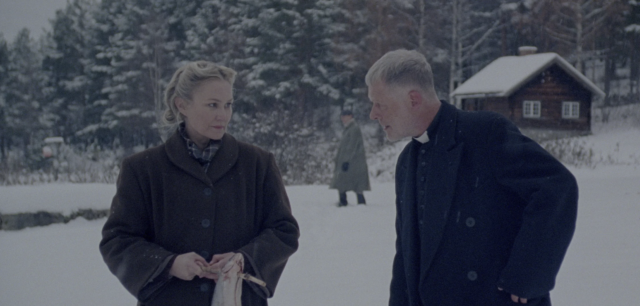
Anna Kristiansen (Ellen Dorrit Petersen) and Adam Honderich (Andreas Lust) are caught up in WWII intrigue in Rob Tregenza’s The Fishing Place (courtesy Cinema Parallel)
THE FISHING PLACE (Rob Tregenza, 2024)
MoMA, the Museum of Modern Art
The Debra and Leon Black Family Film Center
11 West Fifty-Third St. between Fifth & Sixth Aves.
February 6-12 www.moma.org
Rob Tregenza’s The Fishing Place is a tour de force of filmmaking, and the writer-director isn’t shy about making sure the audience knows it. The movie, divided into three sections that Tregenza refers to as “flows,” opens with a shot of a boat out at sea, shown in the negative, a ghostly white in a gray, gloomy seascape that slowly reverses into color over Earecka Tregenza and Jason Moody’s melancholic score. We are then introduced to the three protagonists via superimpositions and fades that point toward memory, as well as through mysterious, virtually impossible camera movements forward.
It’s 1945 in a small Norwegian town, and Anna Kristiansen (Ellen Dorrit Petersen) is a Nazi prisoner working as a housekeeper for Klaus (Eindride Eidsvold), a wealthy collaborator. Adam Honderich (Andreas Lust) is a newly arrived German Lutheran priest. Nazi officer Aksel Hansen (Frode Winther) orders Anna to work for Honderich for three days and spy on him, as it’s suspected that the priest is part of the resistance.
Anna becomes the focus in a stunning six-and-a-half-minute scene at a small party being thrown by Klaus for Aksel; Anna works with the cook (Lena Barth-Aarstad) and a maid (Ingvild Holthe Bygdnes), serving Klaus and Aksel in addition to Willie (Peder Herlofsen), a young man who would rather be reading his book; a man (Jonas Strand Gravli) trying to convince Klaus to invest in his electronic gadgets; the elegant, wheelchair-bound Margit (Gjertrud L. Jynge) and her doctor (Ola Otnes); among others. It’s intense and almost interminably slow-paced; every sound — a footstep, a glass being put on a tray, background music — feels as if we’re on a precipice, every element desperate to break free. The stunning sound design, also highlighted by boots in the snow, a crackling fire, and gunshots, is by Øyvind Rydland.
Soon after the party, Anna finds a frightened child named Ada (Ella Maren Alfsvåg Jørgensen) hiding out in a shack on Honderich’s property. Later, a local man visits Honderich, bringing him a fish that seems to be more of a threat than a gift, and comments on his priestly dress. Honderich says, “Unfortunately, I didn’t have much choice.” The man responds in an ominous tone, “We all have a choice, don’t we?”
Margit makes a surprising confession to the priest. The doctor takes Anna for a ride in his automobile and shares his suspicions of who she is and what she is doing there. In his church, which bursts with colors that stand out in the otherwise bleak but beautiful snowy winter landscape, Honderich suddenly is filled with fire and brimstone. As the camera circles an old fishing boat where Honderich and Aksel have cast out their lines, the colors morph into a hellish red. “Are you happy with yourself?” the priest asks. The Nazi officer replies, “No. And you know it.”
In another dazzling sequence, the camera goes down a horizontal row of characters who one at a time share brief thoughts and then appear again at the other end, with no cuts. “Don’t look back,” the priest prophetically warns us.
Later, after a fadeout, we can hear talking behind-the-scenes as a scene is readied; a man claps the slate and we see the cast and crew in action in a virtuosic twenty-minute crane shot that starts with indoor close-ups before heading outside and almost flying away. Tregenza is the cinematographer, but camera operators Pål Bugge Haagenrud and Art Eng deserve huge kudos, as does editor Elise Olavsen.
Kansas native Tregenza (Talking to Strangers,Gavagai) mixes in a little Ingmar Bergman and Jean-Luc Godard in The Fishing Place, which was partly inspired by the work of philosophers Henri Bergson and Gilles Deleuze. “The self is only a threshold, a door, a becoming between two multiplicities,” the latter wrote in A Thousand Plateaus: Capitalism and Schizophrenia, as well as “Bring something incomprehensible into the world!”
The Fishing Place is making its North American theatrical premiere February 6–12 at MoMA; Tregenza will be at the museum for a Q&A following the 6:30 show on opening night.
[Mark Rifkin is a Brooklyn-born, Manhattan-based writer and editor; you can follow him on Substack here.]
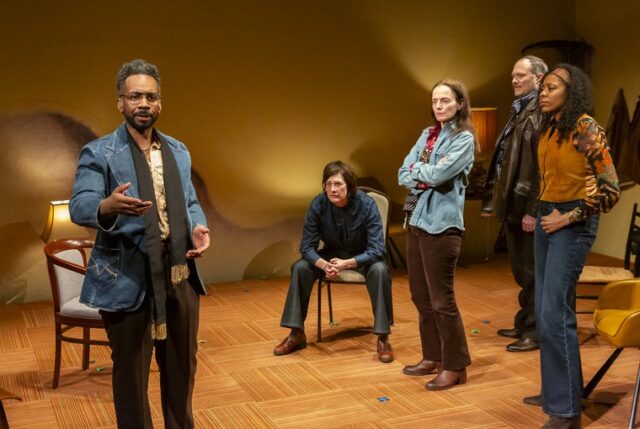
Five actors re-create 1970s WNYC programs in documentary play (photo by Hunter Canning)
RADIO DOWNTOWN: RADICAL ’70s ARTISTS LIVE ON AIR
59E59 Theaters
59 East 59th St. between Park & Madison Aves.
Tuesday – Sunday through February 9, $44
212-279-4200 www.59e59.org
The Civilians’ Radio Downtown: Radical ’70s Artists Live on Air is an odd documentary play that is difficult to decipher. Conceived and directed by Steve Cosson and written by Cosson and Jocelyn Clarke, it consists of five actors re-creating segments from three 1970s programs on WNYC: Arts Forum,Artists in the City, and Poetry of the Avant-Garde.
The conceit is that, as the audience is told at the start, “The actors do not know their lines. This is made from archival recordings. The actual words, pauses, and sounds from back then will be fed into the actor’s ears.” I’m not quite sure why Cosson decided to present the dialogue that way; it makes for an uneasy experience, as I found myself on edge every time an actor paused, wondering whether the hesitation was in the original interview, there was a technical glitch, or the performer lost their place. In addition, these are professional actors, and one would think that, especially after several weeks of performance, they would know their lines, complete with pauses and hesitations.
Robert M. Johanson, Jennifer Morris, Joshua David Robinson, Maya Sharpe, and Colleen Werthmann portray a who’s who of the avant-garde scene: film theorist and historian P. Adams Sitney, experimental choreographer, dancer, and visual artist Yvonne Rainer, filmmakers George Kuchar and Kenneth Anger, poets Leroi Jones and Lorenzo Thomas, critic and academic Annette Michelson, polymath Harry Smith, and actress, dancer, and singer Kimako Baraka, among others. The seventy-minute production takes place in a room with numerous chairs, lamps on the floor (did they run out of tables, or was this how it was at WNYC?), and a back wall featuring a large image of part of a naked human body with a fly on its mouth.
The actors switch between characters by making small clothing adjustments, selecting jackets, vests, and other apparel hanging from hooks on each side of Andrew Boyce’s set. (The costumes are by Emily Rebholz.) Attilio Rigotti’s projections identify the speakers and include newspaper headlines, snippets from a Rainer dance rehearsal, and clips from Anger’s 1967 Lucifer Rising, which starred Bobby Beausoleil, who committed murder the next year as an associate of the Manson family and is still serving life in prison.
The highlight of the show is Anger discussing fellow filmmaker Maya Deren’s apparent disgust of his work. Deren had sent a letter to Anger explaining why she chose not to award a film of his a prize at a festival; in response, Anger describes, “I wrote her back and I said, ‘The whole thing was a joke.’ And she wrote me back and said, uh, she said, ‘You are guilty of confounding the public, and you are also guilty of pulling my leg, [laughter] and I will never forgive you.’ And I said, well, if she has — if she has such a lack of a sense of humor. . . .”
As far as a sense of humor goes, I was questioning mine throughout Radio Downtown, particularly when Werthmann, as Rainer, mimicked some of the choreographer’s slow, angular movement. While my theater companion found it hilarious in a good way, I was perplexed, uncertain whether it was a pretentious tribute or a playful parody of Rainer and the whole underground scene.
That was essentially my takeaway from the show, a constant level of confusion. Later, I checked out The NYPR Archive Collections, where you can listen to the original recordings and read the transcripts.
When I heard Rainer talk to Michelson about “kinesthetic empathy,” I knew just what she meant.
[Mark Rifkin is a Brooklyn-born, Manhattan-based writer and editor; you can follow him on Substack here.]
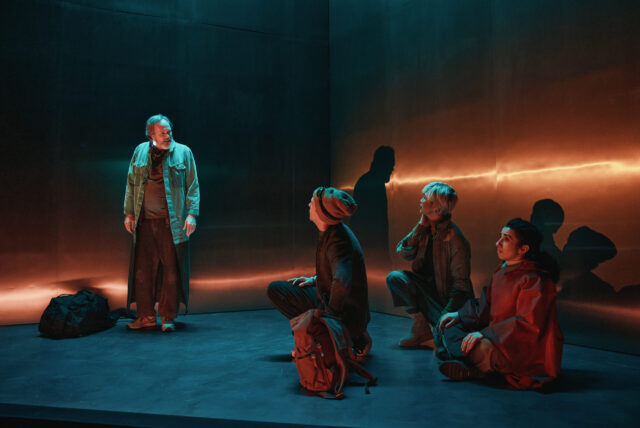
Two ancient women introduce the audience to Jordan Harrison’s The Antiquities at Playwrights Horizons (photo by Emilio Madrid)
A TOUR OF THE PERMANENT COLLECTION IN THE MUSEUM OF LATE HUMAN ANTIQUITIES or, just THE ANTIQUITIES
Playwrights Horizons, the Judy Theater
416 West 42nd St. between Ninth & Tenth Aves.
Tuesday – Sunday through March 2, $62.50 – $102.50 www.playwrightshorizons.org
“It’s alive, it’s alive!” a mad scientist cries out in the 1931 sci-fi classic Frankenstein, as he watches electricity breathe life into a creature made of stitched-together body parts from corpses. People have been searching for the fountain of youth essentially since the beginning of time, on an endless quest to defeat death and live forever.
Pulitzer Prize finalist Jordan Harrison traces that journey, focusing on our role in our own destruction, in A Tour of the Permanent Collection in the Museum of Late Human Antiquities or, just The Antiquities, an intensely clever and prescient warning shot that opened tonight at Playwrights Horizons, in a coproduction with the Vineyard and the Goodman.
Harrison (Marjorie Prime,The Amateurs) and codirectors David Cromer (A Case for the Existence of God,Tribes) and Caitlin Sullivan (Find Me Here,The Good John Proctor) lead the audience between 1816, when Mary Wollstonecraft Godwin shares a ghost story that would become her Gothic novel Frankenstein; or, The Modern Prometheus, and 2076, when AI has taken over in the postapocalyptic nightmare we all fear is coming.
The hundred-minute play begins with two women from the Museum of Late Human Antiquities surveying the audience, as if we are objects in a gallery.
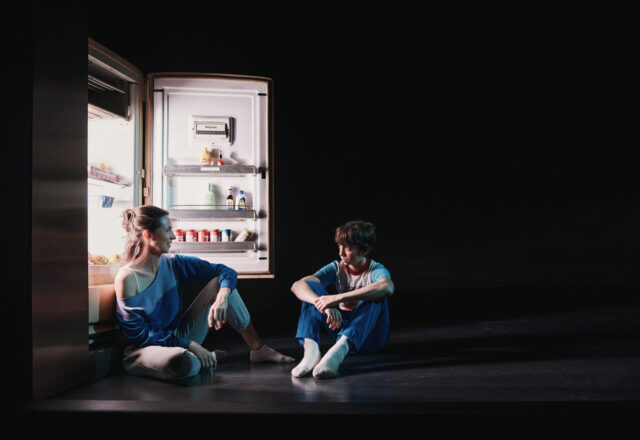
A mother and son contemplate death in Jordan Harrison’s The Antiquities (photo by Emilio Madrid)
Woman 1: “Thank you for coming.” That’s what we’d say, if we were them. Thank you for coming. It’s good to see your faces. Fasten your seatbelts. Look alive. Woman 2: “Look alive.” W1: That’s one of my favorites. As if it were necessary to pretend. W2:[To the audience, trying it out.] Look alive. W1:[Regarding us.] They do, don’t they. You all look perfect. It’s like we’re really here. [A beat. She takes in the room.] Imagine we’re actually here in these seats in this room in the Late Human age. Imagine you have a body. Imagine that’s your body.
Cindy Cheung, Marchánt Davis, Layan Elwazani, Andrew Garman, Aria Shahghasemi, Kristen Sieh, Ryan Spahn, Julius Rinzel, and Amelia Workman portray multiple characters throughout the centuries, with quick costume and set changes; the effective period dress is by Brenda Abbandandolo, while Paul Steinberg’s cold, metallic set shifts for every scene as props are added and subtracted, from a bar and a kitchen refrigerator to an early home computer and a conference room. In 1816, Mary, Percy Bysshe Shelley, Claire Clairmont, Dr. Thomas Briggs, and Lord Byron gather around a campfire and try to scare one another. Early on, Mary offers, “What if I could bring back the dead.” Mary’s mother died ten days after her daughter was born, and Mary suffered several miscarriages and lost three children after birth, so her desire to bring back the dead was deeply personal.
In 1910, a father drops off his ten-year-old son to work in a factory where he might lose a finger or two if he’s not careful. In 1978, Stuart has built a robot that can learn, on its way to being sentient. “It’s life. I created life,” he boasts to a bartender. In 1994, a family of three bask in the glow of their new computer and prepare to connect to the internet for the very first time, via a loud dial-up modem. “Did you ever think you’d live in the future?” the mother asks. In 2008, a young woman teaches her grandfather how to use his iPhone to access the World Wide Web. In 2023, a woman is offered a big payout if she agrees to an NDA to silence her complaints about out-of-hand technology at her firm. She argues, “Doesn’t anybody get it? I’m telling you I made this thing, I helped make this thing, and now . . . We’re the dinosaurs. We’re the dinosaurs and this is the meteor.”
And then, in 2076 . . .
Humankind finds itself at a precipie in prescient new play (photo by Emilio Madrid)
Among the outdated items accumulated at the Museum of Late Human Antiquities are a pen, a rotary phone, a Betamax videocassette, a musical instrument, and a butter churn, pieces of a past that is now long gone. There’s also a ghostlight, a bulb that is placed on stages overnight to ward off troublesome spirits and/or provide light to the theater ghosts who inhabit the space, as if acknowledging that even if humans come to an end, their spirits might still remain. Woman 2 discloses, “So much has been lost, but we have recovered fragments. Scraps of language, abandoned devices. We have endeavored to fill in the gaps; to bring them to life again.”
Filling in some of the gaps, Harrison regularly reminds us that humanity’s time on earth has been squandered by our desperate fear of death, of what might be next, including nothing — and we only have ourselves to blame.
Stuart’s sister confesses to her son, “Everybody dies, baby,” referring to each person. But when Woman 1 promises, “One day you Began, and one day you will End,” she’s talking about the human species as a whole. Our addiction to technology in the pursuit of longevity might very well be our doom, as is already being predicted by many people involved in AI.
But perhaps there’s a glimmer of hope. In the future, a man named Len wonders, “All the while we’ll be getting stronger. We’ll remember the things people used to know, a thousand years ago. The plow. The candle. Probably people will become religious again. They’ll look up in the sky and want to explain a storm. Our kids will grow strong, out in the weather. And all the while, we’ll teach them to hate the inorganics. And eventually, though maybe not in our lifetimes, eventually human beings will rise again. We made the computers and we’ll destroy them.”
Famous last words?
[Mark Rifkin is a Brooklyn-born, Manhattan-based writer and editor; you can follow him on Substack here.]
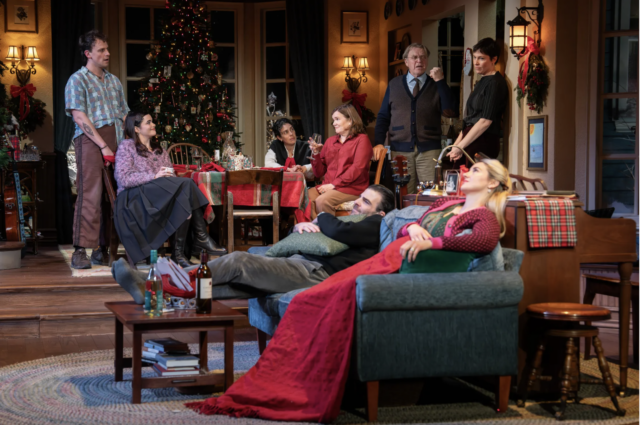
The Dahls have a Christmas to remember — or forget — in Cult of Love (photo by Joan Marcus)
CULT OF LOVE
Hayes Theater
240 West 44th St. between Broadway & Eighth Ave.
Through February 2 2st.com
I started to call Leslye Headland’s hilarious, on-target Broadway debut, Cult of Love, the story of a dysfunctional family at Christmas, but I stopped myself because it sounded redundant; has there ever been a holiday-themed play about a functional family?
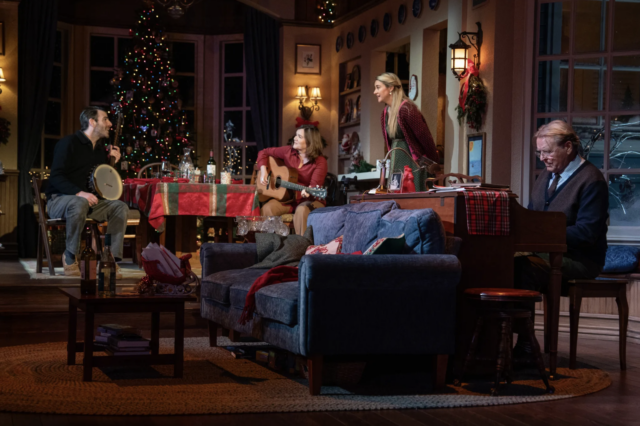
Directed with plenty of pizzazz and panache by Obie winner and two-time Tony nominee Trip Cullman, the hundred-minute satire introduces us to the musical Dahl family, who come together on Christmas Eve at their farmhouse in Connecticut to sing songs and do battle. Patriarch Bill (David Rasche) is a piano-playing Pollyanna and a hugger who prefers to avoid arguments; his children think he might be suffering from dementia, because how else can he be so positive? Matriarch Ginny (Mare Winningham) strums the guitar, sings songs about Jesus, and plays favorites with her children, even though she fails to see it.
The Dahls’ eldest progeny, Mark (Zachary Quinto), is a law clerk in DC, almost became a priest before abandoning Christianity, and is having marital problems with his wife, Rachel (Molly Bernard), who converted from Judaism and drinks too much at family events.
Older daughter Evie (Rebecca Henderson) recently got back from her Italian honeymoon with her new spouse, Pippa Ferguson (Roberta Colindrez); both have successful careers in brand management.
Third child Johnny (Christopher Sears) is the ever-late prodigal son who has been in and out of rehab for years; everyone is excited when they learn he is bringing a mystery guest, Loren Montgomery (Barbie Ferreira).
The baby of the group, twentysomething Diana Dahl Bennett (Shailene Woodley), is a Bible thumper with a six-month old son with her husband, Episcopal priest James Bennett (Christopher Lowell), and she is pregnant again.
Music is the only thing a Connecticut family can agree on in hilarious Broadway satire (photo by Joan Marcus)
Over the course of a fretful, highly volatile evening, the Dahls and their significant others discuss racism, homophobia, smoking, molestation, mental health, the Mexican wedding cookies known as polvorones, and tolerance in between picking up instruments (guitars, banjo, ukulele, melodica, washboard, sleigh bells, maracas) and breaking into traditional religious songs as well as tunes by Radiohead, the Fleet Foxes, and Sufjan Stevens, displaying gorgeous harmonies and pure joy that, momentarily, put aside their seemingly endless issues with one another.
“Evie! Are you picking a fight during Christmas carols?” Mark cries out. Evie responds, “I’m questioning the problematic lyrics, Mark!” Diana concludes, “You ruin it when you do that.”
When Evie wants to talk about Bill’s health, Mark argues, “Is Christmas really the best time for that?” Evie explains, “Christmas is exactly the time to talk about the things we never talk about.”
John Lee Beatty’s cluttered Christmas-themed set feels homey and lived in, with windows and glass doors that offer peaks at what is going on in the outside world, where perhaps sanity is possible. Jacinth Greywoode’s expert musical direction will make you wonder if there will be a cast album. The ensemble is terrific as Cullman guides them through an ever-more-claustrophobic situation.
“You must be having a wonderful time,” Bill says to Loren, who answers for her and the audience when she replies, “Oh, sure. I love the singing, the lesbian drama. It’s all great.”
[Mark Rifkin is a Brooklyn-born, Manhattan-based writer and editor; you can follow him on Substack here.]
Marlon Brando (Brandon Flynn) has an unusual audition with Tennessee Williams (Robin Lord Taylor) in Kowalski (photo by Russ Rowland)
KOWALSKI
The Duke on 42nd Street
New 42 Studios
229 West Forty-Second St. between Seventh & Eighth Aves.
Tuesday – Sunday through February 23, $40-$140 www.kowalskionstage.com
In 1947, still basking in the glow of the breakout success of his semiautobiographical play The Glass Menagerie three years earlier, Thomas Lanier “Tennessee” Williams III was preparing to take the oddly titled A Streetcar Named Desire to Broadway. Although he wanted thirty-four-year-old Oscar nominee John Garfield to star as the protagonist, Stanley Kowalski — the name of a Polish American soldier Williams met at the International Shoe Company — hot director Elia Kazan, affectionately known as Gadge, insisted he audition a little-known twenty-three-year-old actor named Marlon Brando from Omaha, Nebraska. Brando had appeared in a handful of stage productions, including I Remember Mama at the Music Box; Maxwell Anderson’s Truckline Cafe, which lasted only ten performances at the Belasco; and Jean Cocteau’s Eagle Rampant, in which he played Stanislas opposite Tallulah Bankhead, but he was fired before it came to New York, where it flopped. He wouldn’t make his film debut until getting the lead role in Fred Zinnemann’s 1950 military drama, The Men.
Gregg Ostrin re-creates what that initial meeting could have been like in the somewhat superficial yet satisfying Kowalski, running at the Duke through February 23.
Originally produced in Los Angeles in 2011, the show has been significantly revised and updated for its New York premiere. The main narrative is framed by a 1977 interview with Williams (Robin Lord Taylor), who wants to discuss his latest work but instead is steered into going behind the scenes of Streetcar yet again.
“Do we need to talk about it? I’m here to talk about my latest one. I think it’s my best. What is it called? It’s called, well, I can’t remember that, baby. No, of course I know the name. Tiger Tail, yes. I think it’s my best play since . . . my last play,” he tells an unseen journalist, who wants to hear about Brando. “Who? No, I’m just joking. Of course I know to whom you are referring. I just don’t want to talk about him. Does he need more publicity? He is certainly capable of generating more than enough on his own. Of course I remember the first time I met Marlon. No, it was not in a theater.”
The narrative goes back thirty years, when Williams, known to his friends as Tom, is living in his Provincetown beach house with his muse and partner, Pancho Rodriguez y Gonzalez (Sebastian Treviño), a rugged young Mexican American who loves to drink and have sex. Hanging around is Margo Jones (Alison Cimmet), a Texan who had directed Williams’s previous two plays, You Touched Me and The Glass Menagerie, and is not happy when she learns that her supposed close friend has chosen to go with Kazan for Streetcar. “You want my assessment? The play is genius and so are you,” she tells Tom, adding, “You’re also a callous little shit who can rot in hell.”
Williams seems to enjoy manipulating people, pulling their strings until they bite back and then hitting even harder. He regularly belittles Pancho, and his lover is getting tired of it; when Pancho complains about having to use the outhouse because the inside toilet is broken, demanding, “When are we gonna get the plumbing fixed?,” Williams replies, “As soon as you decide to fix it.” The angry Pancho responds, “I’m not your fucking plumber.” When Pancho calls Williams “a pathetic old drunken queen,” Williams declares, “I am thirty-six, which makes me neither pathetic, nor old. Drunken and a queen, well, I suppose that’s a different story.”
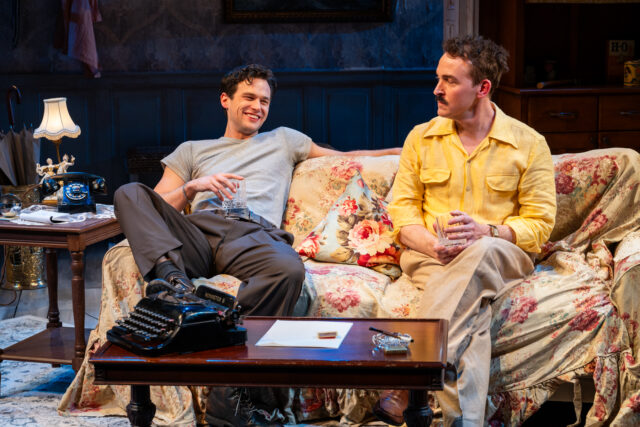
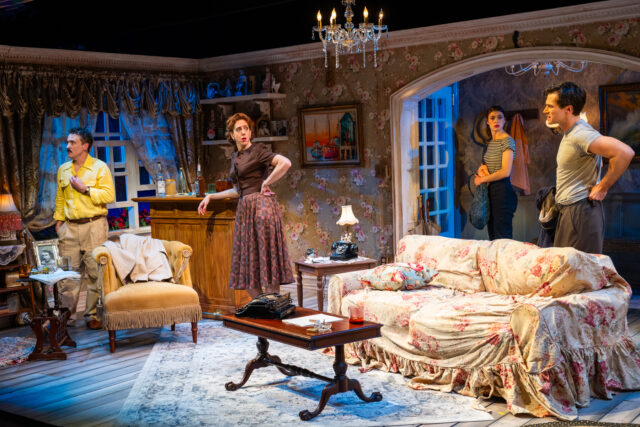
Kowalski reimagines a day with Tennessee Williams (Robin Lord Taylor), Margo Jones (Alison Cimmet), Jo (Ellie Ricker), Marlon Brando (Brandon Flynn), and (Pancho Rodriguez (Sebastian Treviño, not in photo) (photo by Russ Rowland)
After Pancho and Margo head out to a nightclub and Williams goes into the bedroom, Brando (Brandon Flynn) enters the empty living room, three days late. Bold and brawny in a tight white T-shirt, leather jacket, jeans, and boots, he is cool, calm, and collected, especially when Williams comes upon him and assumes he is either a thief or is there for Pancho. Brando takes his time, enjoying Williams flirting with him, before letting the playwright know he is there to audition for the role of Stanley. They instantly engage in a verbal boxing match, throwing around subtle and overt insults at each other as Brando fixes the toilet and the fusebox and they both keep drinking and smoking while sharing private tales, Brando about losing his virginity, Williams about his beloved sister, Rose.
They are soon joined by Brando’s twenty-year-old traveling companion, Jo (Ellie Ricker), who had no idea they had an appointment with Williams. She is overwhelmed, having seen Menagerie five times, and Williams capitalizes on her fandom, cozying up to her in order to make Brando jealous. “Darling girl, let’s not stand on ceremony. Call me Tom. All my closest friends do,” Williams says to Jo, then turns to Brando and orders, “You may call me Tennessee.” The jabs keep coming fast and furious as Brando essentially auditions without using the script.
David Gallo’s set is a welcoming, cozy living room with a bar on one side and a small kitchen on the other. Lisa Zinni’s apt costumes help define the characters instantly. Taylor (Neighborhood 3: Requisition of Doom,The Shooting Stage) is masterful as Williams, balancing the playwright’s vulnerabilities and insecurities with his giant ego and need to intimidate others. Flynn (Kid Victory,Much Ado About Nothing) has raw energy as Brando, who is on the cusp of becoming one of the biggest stars in the world; while Taylor inhabits Williams, it’s hard not to keep judging how good a job Flynn is doing as Brando, even though he is not mimicking him exactly, which would be an impossible task. In one of the most resonant moments of the play, Williams watches with quiet disgust as Brando, who has already helped himself to cookies and food in the fridge, fishes through a dish of candy, touching every one before deciding not to have a piece, knowing how much it would annoy the playwright. It sums up their relationship without a word said about it.
In his off-Broadway debut, Treviño (On Your Feet,The Jury) is striking as the underwritten Pancho, clearly the model for Stanley in Streetcar; Ricker is charming as Jo, an aspiring actress who is pulled between her affection for both Williams and Brando; and Cimmet (Party Face,someone spectacular) is effective as Williams’s abused sounding board.
Did it all happen this way? It might not perfectly match the accounts of the afternoon published in such books as Brando: Songs My Mother Taught Me and John Lahr’s Tennessee Williams: Mad Pilgrimage of the Flesh, but it entertainingly captures the essence of a meeting that changed the future of Broadway and Hollywood.
[Mark Rifkin is a Brooklyn-born, Manhattan-based writer and editor; you can follow him on Substack here.]
DANCE REFLECTIONS: WHAT THE DAY OWES TO THE NIGHT
Joyce Theater
175 Eighth Ave. at 19th St.
January 28 – February 2, $12-$82
212-645-2904 www.joyce.org www.cie-koubi.fr
Last January, French choreographer Hervé Koubi brought down the house at the Joyce with his troupe’s stirring 2023 production, Sol Invictus, so it’s no surprise that Compagnie Hervé KOUBI sold out in advance its encore engagement of 2013’s What the Day Owes to the Night. A later production dazzled Joyce audiences in 2018, and it’s back to once again push the limits of what the human body can do.
In a program note, Koubi, who discovered his family’s Algerian roots when he was twenty-five, explains, “This project is at the crossroads of two preoccupations: my taste for the construction and the danced composition and a deep need to bring me closer to my origins in the land of Algeria. Links to be found, others to be renewed, and still others to be built.” Upon learning of his heritage, he spent four years in Algeria and came back with a movement language that incorporates hip-hop, the Afro-Brazilian martial art of capoeira, break-dancing, gymnastics, ballet, and contemporary dance, performed by an all-male North African ensemble.
The sixty-five-minute presentation is named after the 2008 novel by Yasmina Khadra, the pseudonym of Algerian author Mohammed Moulessehoul; the show does not follow the plot of the romantic drama as much as the feel and setting, structured around the midcentury battle of Mers El-Kebir, the Algerian War for Independence, and the hours in a day.
The insanely talented dancers — Badr Benr Guibi, Giacomo Buffoni, Mohammed Elhilali, Vladimir Gruev, Youssef El Kanfoudi, Abdelghani Ferradji, Oualid Guennoun, Bendehiba Maamar, Nadjib Meherhera, Houssni Mijem, Ismail Oubbajaddi, Matteo Ruiz, and El Houssaini Zahid — are dressed in white cotton pants with panels that swirl and shirts that eventually come off, revealing duly impressive torsos. The flowing costumes are by assistant choreographer Guillaume Gabriel, who also arranged the score, which features Johann Sebastian Bach, Sufi music, and the Kronos Quartet performing songs by Egyptian Nubian musician Hamza El Din, in addition to moments of poetic silence.
The dancers begin in a pile in a far corner, then stir in a hazy, smokey dawn. Over time, as Lionel Buzonie’s lighting gets sharper and brighter, resulting in different shades of shadows on the white floor and, for one section, two dozen golden circles, the men do jaw-dropping head spins; shoot our their arms as if defending themselves; lift up one man high into the sky; and form two groups that each toss a dancer up and others catch him.
They swirl like whirling dervishes, writhe on the floor, and arch and angle their bodies in unison. They run forward and backward, perform cartwheels and diving somersaults, and hold hands in a circle. At one point, twelve men line up on one side and all watch a dazzling solo. At another, they come together and do simultaneous handstands, their bare feet dangling in the air like roots growing out of the earth. They occasionally slow down, most likely to gather their breath before the next action-packed moments.
Part of the Dance Reflections by Van Cleef & Arpels initiative, What the Day Owes to the Night does become a bit repetitive — is it possible for remarkable head spins to become de rigeur? — but it is also utterly thrilling, a unified piece that immerses you in Koubi’s world, radically changed by his discovery of his secret family identity. It will likely make you think about your own ancestors and wonder what beauty might be hidden there.
[Mark Rifkin is a Brooklyn-born, Manhattan-based writer and editor; you can follow him on Substack here.]
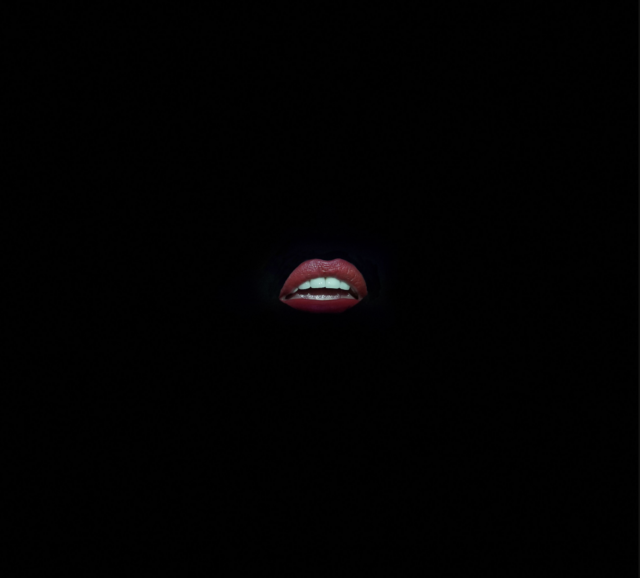
Sarah Street’s mouth is the star of the first of three short Beckett plays at Irish Rep (photo by Carol Rosegg)
BECKETT BRIEFS: FROM THE CRADLE TO THE GRAVE
Irish Repertory Theatre, Francis J. Greenburger Mainstage
132 West Twenty-Second St. between Sixth & Seventh Aves.
Wednesday – Sunday through March 9, $60-$125
212-727-2737 irishrep.org
Why is the Irish Rep presenting Beckett Briefs: From the Cradle to the Grave, three short works by Samuel Beckett, now? “Because he’s Irish, and he knows things,” Irish Rep artistic director Charlotte Moore and producing director Ciarán O’Reilly explain in a program note.
The Dublin-born playwright died in Paris in 1989 at the age of eighty-three, during the Irish Rep’s second season, in which they staged Chris O’Neill and Vincent O’Neill’s one-man Endworks, based on more than a dozen Beckett plays. The company has since performed Beckett’s Krapp’s Last Tape in 1998, Endgame in 2005 and 2023, A Mind-Bending Evening of Beckett in 2013 featuring Act without Words,Play, and Breath, and Bill Irwin’s solo show On Beckett in 2018, 2020, and 2024.
In his unique, existential writings, Beckett displayed a flair for knowing things, although it is usually not easy to parse out exactly what he means, a significant part of the joy of experiencing his plays, which also include the full-length All That Fall,Happy Days, and Waiting for Godot. Theater itself is a regular subject; his scripts have extremely detailed instructions of nearly every movement, costume, and prop, and the narratives are often about the art of storytelling.
Such is the case with Beckett Briefs, a trio of tales about life, death, and the afterlife in which the narrative style drives the work.
First up is Not I, Beckett’s 1972 monologue that has been performed by Beckett muse Billie Whitelaw, Jessica Tandy, Julianne Moore, Lisa Dwan, and British comedian Jess Thom, who incorporated her copralalia (cursing) form of Tourette’s syndrome into her delivery of the nonstop barrage of text. The play generally runs between nine and fifteen minutes; it is not a race, but the actor is expected to go through the 2,268 words as fast as possible. “I am not unduly concerned with intelligibility. I hope the piece may work on the nerves of the audience, not its intellect,” Beckett wrote in a 1972 letter to Tandy prior to the play’s world premiere at Lincoln Center.
A hole has been cut in a black curtain more than eight feet above the stage, so the only thing we can see is a mouth peeking through, in this case belonging to Irish Rep regular Sarah Street. Her teeth are sparkling white and her red lipstick thick and emotive — resembling the famous movie poster for The Rocky Horror Picture Show — as she speeds through Beckett’s wildly unpredictable verbiage, barely stopping to breathe. Known as Mouth, the character has been mostly speechless since her parents died when she was an infant, but now, at the age of seventy, words start pouring out of her.
The audience is not meant to understand every plot detail as she relates stories involving shopping in a supermarket, going to court, sitting on a mound in Croker’s Acres, and searching for cowslips in a field, bringing up such concepts as shame, torment, sin, pleasure, and guilt. The protagonist has suffered an unnamed trauma that has led to her becoming an outcast from society and virtually unable to communicate with others. In many ways, she is as surprised at what she’s saying as we are at what we are hearing. For example:
“imagine! . . . whole body like gone . . . just the mouth . . . lips . . . cheeks . . . jaws . . . never . . . what? . . . tongue? . . . yes . . . lips . . . cheeks . . . jaws . . . tongue . . . never still a second . . . mouth on fire . . . stream of words . . . in her ear . . . practically in her ear . . . not catching the half . . . not the quarter . . . no idea what she’s saying . . . imagine! . . no idea what she’s saying! . . and can’t stop . . . no stopping it . . . she who but a moment before . . . but a moment! . . could not make a sound . . . no sound of any kind . . . now can’t stop . . . imagine! . . can’t stop the stream . . . and the whole brain begging . . . something begging in the brain . . . begging the mouth to stop . . . pause a moment . . . if only for a moment . . . and no response . . . as if it hadn’t heard . . . or couldn’t . . . couldn’t pause a second . . . like maddened . . . all that together . . . straining to hear . . . piece it together . . . and the brain . . . raving away on its own . . . trying to make sense of it . . . or make it stop . . .”
O’Reilly, the director of all three parts of Beckett Briefs, has excised the second character, known as the Auditor, who in some renderings stands off to the side of the stage, hidden in the shadows. (In Thom’s case, the Auditor served as ASL translator.) So the focus is completely on the mouth in a dazzling performance by Street, a celebration of language and a potent reminder that life is to be lived, not merely watched or listened to, that there is more to our existence, even beyond theater.
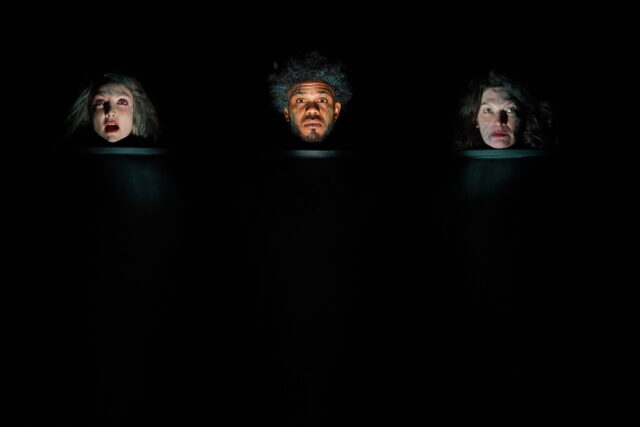
Sarah Street, Roger Dominic Casey, and Kate Forbes examine their love triangle in Beckett’s Play (photo by Carol Rosegg)
In Endgame, a married couple named Nell and Nagg live in garbage cans. In Play, the middle section of Beckett Briefs, three people find themselves in urns in the afterlife, only their heads and the outlines of the vessels visible. A man (Roger Dominic Casey) appears to be doomed for eternity to be trapped between his wife (Kate Forbes) and his mistress (Street). They look straight ahead “undeviatingly,” the script says, and speak only when a spotlight shines on them.
Their initial exchange sets the stage of this forever love triangle.
W1: I said to him, Give her up. I swore by all I held most sacred — W2: One morning as I was sitting stitching by the open window she burst in and flew at me. Give him up, she screamed, he’s mine. Her photographs were kind to her. Seeing her now for the first time full length in the flesh I understood why he preferred me. M: We were not long together when she smelled the rat. Give up that whore, she said, or I’ll cut my throat — [Hiccup.] pardon — so help me God. I knew she could have no proof. So I told her I did not know what she was talking about. W2: What are you talking about? I said, stitching away. Someone yours? Give up whom? I smell you off him, she screamed, he stinks of bitch. W1: Though I had him dogged for months by a first-rate man, no shadow of proof was forthcoming. And there was no denying that he continued as . . . assiduous as ever. This, and his horror of the merely Platonic thing, made me sometimes wonder if I were not accusing him unjustly. Yes. M: What have you to complain of? I said. Have I been neglecting you? How could we be together in the way we are if there were someone else? Loving her as I did, with all my heart, I could not but feel sorry for her.
It’s a tour de force for Casey (Aristocrats,CasablancaBox), Forbes (A Touch of the Poet,Rubicon), and Street (Molly Sweeney,Belfast Girls) as well as lighting designer Michael Gottlieb and sound designers M. Florian Staab and Ryan Rumery, who must be in perfect sync and not miss a beat as the spotlight switches from face to face in the snap of a finger, sometimes illuminating all three characters at the same time. Occasionally the light grows dim, signaling the actors to slow down. As with Not I, it is not a race, but it leaves the audience breathless, as if we had just finished running laps.
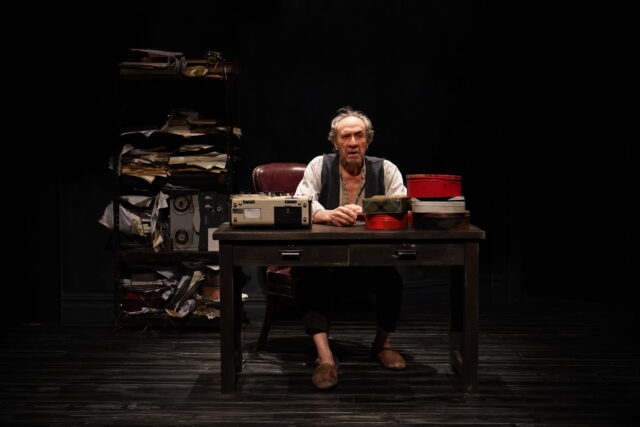
Everything slows down in the finale, Krapp’s Last Tape, but that doesn’t mean it is any easier to decipher. The set, by Irish Rep genius Charlie Corcoran, is a dark, messy room with overstuffed shelves, a desk with an old-fashioned reel-to-reel tape player and several canisters on it, and a light fixture with a single bulb dangling overhead. The unkempt, disheveled Krapp (F. Murray Abraham) shuffles around the floor, struggles to open one of the drawers in the front, and takes out a banana, which he fondles before eating it, tossing the peel to his right. Beckett, a vaudeville fan, does indeed have Krapp slip on it. Krapp, occasionally letting out tired grunts of woe, then opens the second drawer, takes out another banana, peels it, and puts it in his mouth, being more careful this time with the peel. However, he decides not to eat the banana, instead putting it in his pocket.
An aging man (F. Murray Abraham) looks back at his younger self in Krapp’s Last Tape (photo by Carol Rosegg)
He goes in the back and returns with a large ledger that he looks through, reading out loud, “Box . . . thrree . . spool five. Spool! Spooool!” He finds the box he needs, starts playing the recording, then sweeps everything else off the desk and onto the floor. He has chosen to listen to a memory of his thirty-ninth birthday, his young self explaining, “Thirty-nine today, sound as a bell, apart from my old weakness, and intellectually I have now every reason to suspect at the . . . crest of the wave — or thereabouts. Celebrated the awful occasion, as in recent years, quietly at the Winehouse. Not a soul. Sat before the fire with closed eyes, separating the grain from the husks. Jotted down a few notes, on the back of an envelope. Good to be back in my den, in my old rags. Have just eaten I regret to say three bananas and only with difficulty refrained from a fourth. Fatal things for a man with my condition. Cut’em out! The new light above my table is a great improvement. With all this darkness round me I feel less alone. In a way. I love to get up and move about in it, then back here to . . . me. Krapp.”
It doesn’t appear that much has changed over the last three decades, Krapp still alone, still eating bananas, still surrounded by darkness. As the tape continues, Krapp scampers off to take a few gulps from a bottle of liquor, looks up the meaning of “viduity,” sings, and recalls a romantic evening on a lake. But the tape does not provide him with happiness; he barks out, “Just been listening to that stupid bastard I took myself for thirty years ago, hard to believe I was ever as bad as that. Thank God that’s all done with anyway.”
The autobiographical, poetic Krapp’s Last Tape was written in 1958 for Patrick Magee and has also been performed by Harold Pinter, Brian Dennehy, Michael Gambon, and, primarily, John Hurt, who brought it to the 2011 BAM Next Wave Festival. Oscar and Obie winner and Emmy and Grammy nominee Abraham (Good for Otto,It’s Only a Play), who is eighty-five, fully inhabits the role of a man long past the crest of the wave. The desk is near the front of the stage, so close to the audience that you can practically reach out and touch him, although you’re probably inclined to stay away from such a dour, sad, disheveled person.
All three plays, which total about seventy-five minutes, deal with time, memory, and the futility of language, as each character faces issues with communication yet delivers masterful articulation. Expertly directed by O’Reilly (Endgame,The Emperor Jones), Beckett Briefs is a vastly entertaining evening that immerses you in the unique, engaging, complex, and minimalistic worlds the playwright is renowned for, enigmatic works that are worth revisiting over and over again, offering new and fascinating insights as viewers age and understand them in ever-changing, profound ways.
[Mark Rifkin is a Brooklyn-born, Manhattan-based writer and editor; you can follow him on Substack here.]