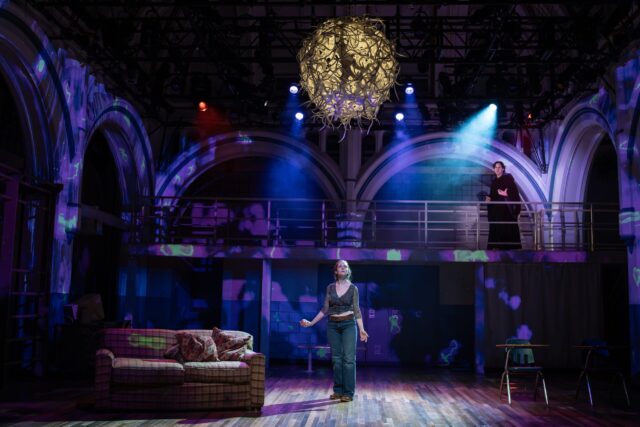
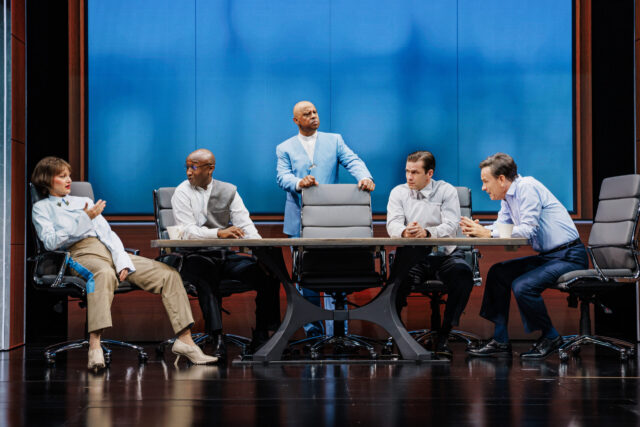
Else Went’s Initiative unfolds over more than five hours at the Public Theater (photo by Joan Marcus)
INITIATIVE
LuEsther Hall, the Public Theater
425 Lafayette St. at Astor Pl.
Tuesday – Sunday through December 7, $109 publictheater.org
“Do you think we’ll do anything worthwhile with our lives? Is it even possible?” Clara (Olivia Rose Barresi) asks Riley (Greg Cuellar) about halfway through Else Went’s Initiative.
Experiencing the play is worthwhile, whether it’s the five-plus-hour performance, with three ninety-minute acts and two intermissions, or the six-and-a-half-hour one, with an added dinner break.
The show is set in “Coastal Podunk, California,” where a group of high school classmates explore first love, traumatic loss, and just about everything in between at the dawn of the new millennium as they begin to try to seek their place in an ever-more complex universe. In the early aughts, just after Y2K has not destroyed society, seven teenagers navigate adolescence, essentially without adults, on their own; we occasionally hear the garbled offstage shouting of two brothers’ unbalanced mother and the disembodied voices of Mr. Stone, a somewhat comforting English teacher, and Ms. May, a sensitive guidance counselor (both voiced by Brandon Burk). The tech age is upon the teens as they obsess over Super Nintendo and instant messaging on the internet — but only when they’re home at their computers. “The world is . . . tumultuous right now, and taking in too much information . . . can actually be dangerous,” Ms. May tells Clara, who responds, “It’s just that this is, like, the world, right? That I’m gonna inherit. Everyone’s always like ‘you’re the leaders of tomorrow,’ that sort of thing, but at the same time nobody wants to explain yesterday.”
Clara has returned to the classroom after several years of home-schooling by her religious parents. She is in love with Riley (Greg Cuellar), who admits to her he is gay but wants to remain her best friend. Clara seeks solace in Lo (Carson Higgins), a selfish, callous kid who is a star pitcher hiding something that happened between him and Riley at summer camp. Lo’s younger brother, Em (Christopher Dylan White), is a loner addicted to video games and unsure of how to return the affections of the sexy Kendall (Andrea Lopez Alvarez), the most progressive of the gang. Tony (Jamie Sanders), the least refined of them, has a crush on Kendall but becomes more of a bully after she doesn’t go for him and she becomes good friends with a shy, reserved new student, Ty (Harrison Densmore).
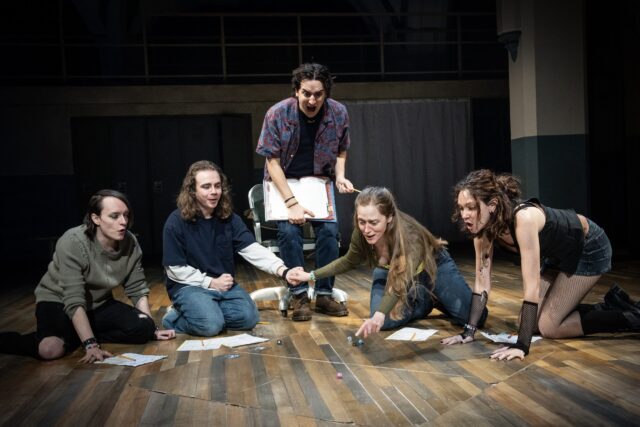
Over the course of four years, the teens discover things about themselves and each other as college approaches. Oh, and they spend a whole lotta time playing Dungeons and Dragons. Really. And it’s a blast to watch.
A continuing game of Dungeons and Dragons provides an exhilarating break during five-hour play (photo by Joan Marcus)
Initiative shouldn’t be compared to such other time behemoths as The Iceman Cometh,Strange Interlude, and the grandmaster of them all, Gatz. Written by Else Went and directed by Emma Rosa Went, who are married millennials who met in high school, the play, loosely inspired by their real lives, is performed by actors who are also millennials, which lends them an understanding of what their characters are going through; they might not look fourteen or fifteen, but they act it in a very empathetic, understanding way. In addition, several of them have been with the project since its start nearly ten years ago, giving them the opportunity to develop their portrayals.
Mikiko Suzuki MacAdams’s large, open set features a row of lockers, two swings, a glowing abstract orb that represents a popular local tree (as well as the end of innocence), a bridge in the back, and a series of arches that evoke Greek drama; desks, beds, chairs, tables, benches, and other furniture are wheeled on- and offstage, and a hot tub emerges from beneath. S. Katy Tucker’s projections focus on stars, the galaxy of opportunities awaiting the teenagers — as well as the challenges they will face. Noticing shooting stars out the window, Lo says to Riley early on, “You ever think about dying?”
The cast is extraordinary, holding our attention for five hours, making us care what happens to each character, even during the D&D scenes, which allow them, and the audience, to temporarily break free of their inner turmoil. Christopher Akerlind’s lighting and Angela Baughman’s sound further engage us in the proceedings, along with Kindall Almond’s period costumes.
The play is about fifteen minutes too long, and the Wents seem unsure how to end it; I noticed three times I thought it should conclude and was sorry to see it continue, and there’s a coda that feels unnecessary, explaining elements we are already aware of that were better left unsaid. But it all flows with a tender naturalism before that — and is sure to make you remember moments from your own high school years, the good ones and the bad.
Initiative is a warm and engaging coming-of-age epic filled with universal truths about then and now. In a script note, Else Went writes, “This play is the letter to my younger self that I cannot receive. . . . It is apology and forgiveness, to myself, to my first friends, my first loves.”
It’s a letter that the audience is happy she sent.
[Mark Rifkin is a Brooklyn-born, Manhattan-based writer and editor; you can follow him on Substack here.]
Award-winning filmmaker Alan Berliner explores the life and career of Benita Raphan in new documentary
BENITA (Alan Berliner, 2025)
DCTV Firehouse Cinema
87 Lafayette St.
November 28 – December 4 www.dctvny.org alanberliner.com
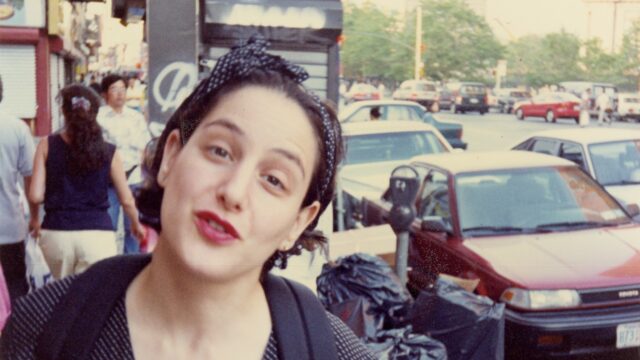
Shortly after learning of his friend and longtime collaborator Benita Raphan’s suicide on June 10, 2021, documentarian Alan Berliner was asked by her family if he would complete the film she was working on when she died, at the age of fifty-eight. They gave him full access to her extensive archives, comprising notebooks, outtakes, drawings, photographs, and other ephemera. Berliner spent a year doing research and ultimately decided instead to make a film about her, in an attempt to better understand Betina as a person and filmmaker and, perhaps, why she hanged herself.
“Think of this film as an experiment in collaboration,” Berliner says at the start of the aptly titled Benita. “Benita left behind thousands of pieces; my job was to splice them together, to make a mash-up of our different filmmaking styles, to do whatever it takes to bring Benita’s creative spirit to life. But as much as anything, I also just wanted the joy of being able to work with Benita, one final time.”
Berliner conducted new interviews with more than a dozen people from Betina’s private life and professional career, including her mother, Roslyn Raphan; her friends Lucy Eldridge, Shari Spiegel, Miriam Kuznets, and Eric Latzky; her former boyfriend Eric Hoffert of the Speedies; composers Hayes Greenfield and Robert Miller, and SVA chair Richard Wilde. Together they paint a portrait of an eclectic, unusual, and caring avant-garde artist who was able to charm people into participating in the creation of her films — for free. Among the numerous words they use to describe her are “complex,” “serious,” “charismatic,” “a singular soul,” “a nonconformist,” “unpredictable,” “an irregular verb,” “nervous,” “anxious,” “intense,” “incredibly humble,” “fragile,” “vulnerable,” and “a scientist in an artist’s body.”
“I want to work on fun stuff, and her stuff is fun,” sound designer Marshall Grupp says.
“I wanted to help her, I wanted her to succeed,” notes postproduction facilitator Rosemary Quigley.
Producer, director, writer, editor, and narrator Berliner incorporates scenes from about half of Benita’s thirteen short films, focusing on ones that explore creativity, intelligence, and mental illness: 2002’s 2+2 (mathematician John Nash), 2004’s The Critical Path (architect Buckminster Fuller), 2008’s Great Genius and Profound Stupidity (author Helen Keller), and 2018’s Up to Astonishment (poet Emily Dickinson).
“Benita’s films aren’t really meant to be understood,” Berliner (First Cousin Once Removed,Intimate Stranger) explains. “She’s more interested in helping you make connections and stirring up feelings about her subjects using abstraction, layering, and rapid editing, sometimes all at once, to express things that can’t always be put into words, things like dreams, stream of consciousness, or visual metaphors. When Benita takes us inside the complicated minds of her subjects, she’s also trying to show us what it’s like inside her own.”
The film excerpts reminded me of the work of experimentalists Hollis Frampton, Stan Brakhage, and Maya Deren and such surrealists as Luis Buñuel and Salvador Dalí yet wholly original. Clips in which Benita is filming her shadow as she walks down the sidewalk or crunching on ice are poetically beautiful and memorable.
A 2019 Guggenheim fellow, Benita wrote down such thoughts as “Don’t be afraid to have bad ideas,” “Mistakes are an opportunity to start again & do it right,” and “Celebrate the confusion.” However, her more recent words ranged from “afraid” and “lost” to “I’m not myself” and “falling apart.”
She spent more time by herself near the end, dedicating many of her days to her dogs, including one who had severe psychological issues and another she named Rothko, after abstract painter Mark Rothko, who committed suicide in 1970 at the age of sixty-six. “Dogs don’t repeat any of your secrets,” she wrote.
Berliner captures Benita’s inner strength and unique style, but it’s not always possible to figure out why someone chooses death over life; mental illness is too often too difficult to diagnose, especially among friends and relatives.
Benita, which had its world premiere at the recent DOC NYC festival, is screening November 28 to December 4 at DCTV Firehouse Cinema, with Berliner, the recipient of last year’s DOC NYC Lifetime Achievement Award, on hand for Q&As following one showing each night, with such guests as Firehouse Cinema’s Dara Messinger and filmmakers Deborah Shaffer, Doug Block, and Caveh Zahedi in addition to several special short films on December 1, 3, and 4.
[Mark Rifkin is a Brooklyn-born, Manhattan-based writer and editor; you can follow him on Substack here.]
KYOTO
Lincoln Center Theater at the Mitzi E. Newhouse
150 West 65th St. between Broadway & Amsterdam Ave.
Tuesday – Sunday through November 30, $140.50-$242.50 www.lct.org
If the prospect of sitting through Kyoto, a 160-minute play at Lincoln Center’s Mitzi E. Newhouse Theater, set at a series of 1989–97 climate change conferences, doesn’t fill you with anticipation, consider Oslo, a nearly three-hour drama about the 1993 Oslo accords that began at the Newhouse in 2016, moved to the Vivian Beaumont, and deservedly won the Tony for Best Play. Kyoto is a worthy successor in the arena of political theater, a gripping behind-the-scenes thriller that commands our attention even as we are aware of the general outcome; decades later, there is still a battle over global warming, whether it’s man-made and a legitimate threat to the immediate future of the Earth.
Stephen Kunken is sensational as conniving American lawyer and lobbyist Don Pearlman, who serves as participant and narrator, speaking from beyond the grave; he died in 2005 at the age of sixty-nine, having built a controversial legacy. The play begins with him directly addressing the audience, explaining, “I think we can all agree on one thing: the times you live in are fucking awful. Everywhere you look there’s some kind of disagreement, something angry, something vicious, something acutely historic. There’s some maladjusted kid who takes a gun into his school. Countless limbless civilians blown up daily on your newsfeed. A CEO leaking blood on the sidewalk, dying, shrieking, shot. There’s food shortages, global pandemics, runaway inflation, culture wars, trade wars, real wars, possible third world wars, the death of democracy, collapse of the rules-based order and, on top of all of that, a planet that is literally burning down. And if you’re a guy like me looking at a time like now, the main thing you think is: man . . . the 1990s were freakin’ glorious.”
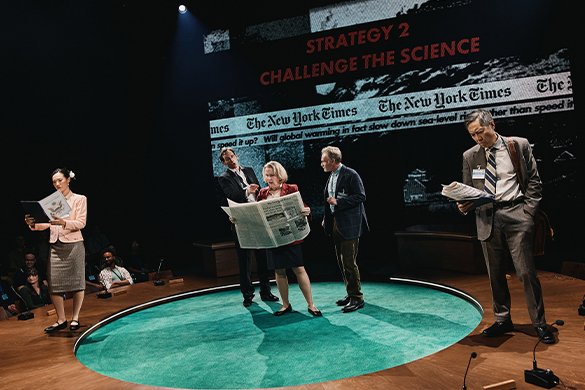
The show takes place on a circular stage that morphs from a scientists meeting in England in May 1990 to an IPCC Plenary Session in Sweden in August, the World Climate Conference in Geneva in November, talks in Virginia and the United Nations in 1991–92, Berlin in 1995, and ultimately the Kyoto International Conference Centre in December 1997 for COP3 (Conference of the Parties). Projections on a rear screen feature live video feeds and archival footage (of George W. Bush, Al Gore, and other players, designed by Akhila Krishnan).
Along the way, Pearlman butts heads with and attempts to manipulate an international collection of experts, based on real people, who have differing views on how to proceed, including Argentinian lawyer and conference leader Raul Estrada-Oyuela (Jorge Bosch), Austrian-born American Global Climate Coalition atmospheric physicist Fred Singer (Peter Bradbury), Swedish meteorologist and Intergovernmental Panel on Climate Change founder Bert Bolin (Daniel Jenkins), American climate scientist Ben Santer (Jenkins), Saudi oil economist Mohammed Al Sabban (Dariush Kashani), Chinese professor Shukong Zhong (Feodor Chin), a Kiribati AOSIS spokesperson (Taiana Tully), German president Angela Merkel (Erin Darke), UK deputy prime minister John Prescott (Ferdy Roberts), Japanese environment minister Hiroshi Ohki (Rob Narita), British physicist John Houghton (Roberts), Tanzania professor Mark Mwandosya (Roslyn Ruff), the head of the US delegation (Kate Burton), and a UN Secretariat (Imani Jade Powers). While some fall in line, others are ready to fight, especially over the specific language in their assessments reports and draft protocols, arguing about such single words as appreciable.
Don is approached by the Seven Sisters, representatives of the world’s biggest oil companies, who want Don’s support — and get it through not-so-subtle threats. “We feel that without proper oversight, words like targets and timetables will be used to harm us,” one advises Don. Another adds, “To harm America, Don.” Don cancels his long-promised vacation with his wife, Shirley (Natalie Gold), and sets out to do the bidding of the Seven Sisters, breaking rules, undermining the conferences’ goals, and seeming to enjoy throwing wrench after wrench into the machinery.
“I know what people like you think of lawyers like me. You theater, artsy, liberal types who pay your bills in empathy,” he tells the audience. “But none of your concerns interest me. I’m the only one who can tell this story. Because I’m the only one who was there. Start to finish, I saw it all. Did it all. Fought for it all. And you may not like it all, but if you want to know it all, you can’t have it all your own way.”
Writers Joe Murphy and Joe Robertson (The Walk with Little Amal) and directors Stephen Daldry (Skylight,Billy Elliot: The Musical) and Justin Martin (Prima Facie,Inter Alia) previously collaborated on the breathtaking, immersive hit The Jungle, which transformed St. Ann’s Warehouse into a Calais refugee camp. As in that production, in Kyoto they avoid preaching to the choir or making pronouncements on climate change, instead letting the action unfold while keeping the audience on the edge of their seats. In fact, some audience members have special chairs next to the characters around the circular stage and occasionally are engaged in conversation with them. (The set is by Miriam Buether, with business-style costumes by Natalie Pryce, lighting by Aideen Malone, crisp sound by Christopher Reid, and original music by Paul Englishby.)
There’s a lot of talk and scientific jargon, but it never gets boring. Tony nominee Kunken (Nikolai and the Others,Enron), who has been with the show through its original run at Stratford-upon-Avon and its subsequent move to the West End, is fully in charge of the proceedings, imbuing Pearlman with a balance between true believer, evil mastermind, and expert controller; you might not like or trust Pearlman, but you can’t take your eyes off him, as he in so many ways represents what is wrong with how important decisions that affect the entire world are made, then and now. Olivier nominee Bosch (Invencible,Speaking in Tongues) provides solid support as Pearlman’s archnemesis.
Nominated for an Olivier Award for Best New Play, Kyoto is an engrossing and riveting story, a cautionary tale that says much about why we are in the mess we are today, with no clear way out.
[Mark Rifkin is a Brooklyn-born, Manhattan-based writer and editor; you can follow him on Substack here.]
Rajiv Joseph’s Gruesome Playground Injuries traces the friendship between Kayleen (Kara Young) and Doug (Nicholas Braun) (photo by Emilio Madrid)
GRUESOME PLAYGROUND INJURIES
Lucille Lortel Theatre
121 Christopher St. between Bleecker & Hudson Sts.
Tuesday – Sunday through December 28, $42-$225 gruesomeplaygroundinjuries.com lortel.org
The title of Pulitzer Prize finalist Rajiv Joseph’s Gruesome Playground Injuries, at the Lucille Lortel Theatre through December 28, is a bit misleading. One might assume that it has something to do with the bad cuts and bruises kids get while playing outside, but it goes well beyond that; instead, it is a distinctively adult look at the physical, psychological, and emotional damage we suffer throughout life, bearing heavy wounds that are not always easily healed. It’s about real pain, the kind that digs deep under your skin, into your heart and soul, affecting the way you see and react to everyday existence. It’s also extremely funny.
The ninety-minute play unfolds in eight segments that follow the friendship between Kayleen (Kara Young) and Doug (Nicholas Braun) over the course of thirty years, from age eight to thirty-eight. However, they are not told in chronological order but in jumps of fifteen years going forward and ten years going backward; for example, the first three scenes take the characters from eight (“Face Split Open”) to twenty-three (“Eye Blown Out by Firework”) to thirteen (“The Limbo”).
In between scenes, the actors change costumes onstage, usually next to translucent screens on either side, and rearrange two hospital-like beds; they also apply their own makeup, which can involve blood, bandages, and eye patches. In addition, interstitial music ranges from Cracker’s powerful “Low” to Sleeping at Last’s moving acoustic cover of Men without Hats’ “The Safety Dance” to Gary Jules’s evocative “Little Greenie,” in which he sings, “You know / That in spite of all the things that you show / You’re fucking around with something / You cannot control / If it scares you so / Then make it go away.”
The rhythmic dialogue merges humor with details of horrific wounds; an early exchange when Kayleen and Doug are eight sets the tempo:
Kayleen: One time, I threw up because I had a stomach ache and I threw up so bad that my one eye started to have blood in it. Doug: Why. Kayleen: Because I threw up so hard and so there was blood in my eye. Doug: Did it hurt? Kayleen: No. But it was red. I have a sensitive stomach. The doctor told me. There’s an angel on the roof. Doug: No there’s not. Kayleen: Yes there is. It’s a statue. Are you going to go to the doctors? Doug: To get stitches. I like to get stitches. Kayleen: Why. Doug: It makes your skin feel tight. Kayleen: Does it hurt? Doug: Yeah. Kayleen: This room is like a dungeon. Doug: What’s a dungeon? Kayleen: It’s a room in a castle. It’s where people languish. Doug: Oh. Kayleen: The rest of the castle is loud and has bright lights and flags and hot oil because of wars. But the dungeon is where people can go to languish and get some peace and quiet. Doug: OW! Kayleen: What? Doug: My face hurts. I broke it. Kayleen: You did not. It’s just cut. Can I see it? Doug: What? Kayleen: Can I see the cut on your face? Doug: Why. Kayleen: Can I? . . . Does it hurt? Doug: A little. Doug: What happened to the blood in your eye? Kayleen: It went back into my head. . . . Can I touch it? Doug: Why. Kayleen: Can I? Doug: Okay.
As the story goes back and forth in time, we learn about Kayleen’s and Doug’s families, their careers, their relationships, and their fears, but their desires are often thwarted. They love and need each other — Doug believes that Kaylee’s touch can heal him — even when years pass without contact. (The play takes place in a time before cellphones.) While Doug’s injuries occur because he tends to do impractical things and take irresponsible chances, Kaylee’s trauma is more self-inflicted. He is a kind of hopeless dreamer who can’t get out of his own way, while she is far more introspective and deliberate.
“I’m accident prone. That’s what my mom says I am,” thirteen-year-old Doug tells Kayleen, who replies, “If you’re riding on the handlebars of a bike going down a hill, you’re not accident prone, you’re retarded.” Doug: “You shouldn’t say ‘retarded.’ That’s real rude to retarded people.” Kayleen: “Sorry I offended you.” Doug: “No, it’s cool.”
Kayleen keeps calling him “stupid,” but she understands that she has also made bad decisions. “I know I know I know . . . I’m so stupid. I’m always . . . I’m just fucked up, you know that. And so I need you to stick it out, Dougie,” the twenty-eight-year-old Kayleen admits. “I really need you right now. I really need you to come over and show me some stupid shit again, tell me some stupid joke like you always do.”
It’s a difficult show to watch — there’s a reason why the word “gruesome” is in the title — but it also a profoundly rewarding and, yes, immensely entertaining experience.
Doug (Nicholas Braun) and Kayleen (Kara Young) share their unique life experiences in Rajiv Joseph revival (photo by Emilio Madrid)
As he has demonstrated in such previous works as Describe the Night,Dakar 2000, and King James, Joseph writes complex narratives, and director Neil Pepe (American Buffalo,On the Shore of the Wide World) does a superb job maneuvering through Gruesome Playground Injuries, which premiered in 2009 at the Alley Theatre in Houston, with Selma Blair and Brad Fleischer in the lead roles. Arnulfo Maldonado’s set is spare but efficacious, with contemplative lighting by Japhy Weideman, creating shadowy effects with the screens. (David Van Tieghem composed the original music and designed the sound.)
Three-time Emmy nominee Braun and two-time Tony winner Young might not at first seem to be the perfect fit; best known for playing Cousin Greg in Succession, Braun is making his off-Broadway debut, while Young has proved herself to be one of New York’s most talented and engaging actors, having dazzled in such diverse productions as Clyde’s,Purlie Victorious: A Non-Confederate Romp Through the Cotton Patch,Table 17,Cost of Living, and Halfway Bitches Go Straight to Heaven. They also have a rather noticeable height discrepancy; Braun is six-foot-seven, whereas Young is about five-foot-two.
But they shine from the start. Whether they’re portraying silly eight-year-olds hopping and flopping around or serious thirty-three-year-olds examining their futures, Braun, tall and gangly, Young, taut and energetic, both with impressive bodies, have a stirring chemistry. When they are changing outfits and putting on their makeup, using sinks at opposite sides of the stage, it’s like watching a tennis match; you don’t want to miss a thing as your head darts back and forth to catch their every move. And in this case, they both emerge as champions.
[Mark Rifkin is a Brooklyn-born, Manhattan-based writer and editor; you can follow him on Substack here.]
Robin Rainey (Christiani Pitts) and Dougal Todd (Sam Tutty) are about to have a time to remember in Two Strangers (Carry a Cake Across New York) (photo by Matthew Murphy)
TWO STRANGERS (CARRY A CAKE ACROSS NEW YORK)
Longacre Theatre
220 West 48th St. between Broadway & Eighth Aves.
Tuesday – Sunday through November 22, $69-$299 twostrangersmusical.com
Broadway shows set in New York City have a difficult task getting things right, needing to satisfy tourists as well as native New Yorkers, who will immediately criticize any geographic or sociocultural mistakes while tiring of genre clichés about the City That Never Sleeps. For every Hell’s Kitchen, there’s a New York, New York.
Happily, the charming new Broadway musical Two Strangers (Carry a Cake Across New York) gets things right.
It begins with Dougal Todd’s (Sam Tutty) arrival in New York City from London, with a childlike gleam in his eye and a bounce in his step, a wide-eyed ingénue deliriously excited to see as much as he possibly can during his short visit, his first ever overseas. “New York is kind of my second home,” he tells Robin Rainey (Christiani Pitts), who has picked him up at the airport. “The Empire State, the White House, the Golden Gate Bridge.” After a wild and woolly two days — in which, among other things, he stood outside the Freedom Tower, Katz’s Deli, and the Tenement Museum because he couldn’t afford to go inside — he still has that gleam and bounce, a sweetly infectious and innocent worldview that rubs off on both Robin and the audience.
Dougal lives at home with his mother, “big Polly,” and works in a local movie theater. His only ambition seems to be to keep marveling at life. He’s in New York to attend the wedding of his father, Mark, who deserted them before Dougal’s birth. “Technically he didn’t leave me because I wasn’t actually born yet,” he explains to Robin.
Raised by her grandmother in Brooklyn, Robin toils at Bump ‘n’ Grind Coffee in the East Village and just tries to survive day to day, hiding away any dreams she might have of finding the right career or the right partner. Robin’s older sister, Melissa, who is thirty, is marrying Mark, an extremely successful fifty-seven-year-old businessman. Robin disapproves of her sister’s choice and is irritated when Dougal starts playfully referring to her as Auntie Robin, since they are both in their midtwenties.
“My town: / where everyone has an apartment to spare with a skyline view, / where even improbable dreams come true. / Where everything comes with a smile, a high five, and a side of cheese; / I’m down on my knees,” Robin sings sarcastically. Dougal responds enthusiastically, “She’s called the Big Apple / No one knows why / But she’s my kind of town and I’m her kind of street-smart guy. / I’ll stroll up the Broadway / I’ll order a beer / I’ll scream at the Statue of Liberty / ‘Hey lady! I’m walkin’ here!’”
Melissa has given Robin two important responsibilities: picking up the wedding cake and bridal stockings. When Dougal insists on going with her to the bakery, they head off on a whirlwind adventure that takes them from the lowest of the low to the highest of the high.
Robin Rainey (Christiani Pitts) and Dougal Todd (Sam Tutty) reach highs and lows in delightful new musical from England (photo by Matthew Murphy)
Two Strangers might refer to itself as a musical comedy, but it is closer to a play with music. Composers and lyricists Jim Barne and Kit Buchan (Catastrophe Bay,Mona Loser) have written a terrific book that firmly establishes the two characters and their individual and mutual quests. Nearly all the songs feel organic to the story, further defining Dougal and Robin on the outside and the inside. Dougal expresses his longing for his father in “Dad,” singing “‘Dad,’ Is that a word that I can use for you? / It’s been a while since we had news from you / Since your picture left the frame.” In “What’ll It Be,” Robin confesses, “And I stare / through the windows at the world / — this bit of world / that I can see — / and I try / not to think about that girl / who looked like me . . . / . . . who laughed, / and danced, / and knew what she was facing; / who believed / the world / was hers to find a place in; / and I tell myself / this year could be the right year / but we both know / this time tomorrow I’ll be right here. . . .”
Two numbers do fall flat, “On the App,” in which Dougal encourages Robin to swipe through Tinder while on the subway, and “Under the Mistletoe,” a Christmas fantasy they sing in the back of an Uber; it would also trim the show to a more streamlined 110 minutes or so without an intermission. Otherwise, the songs glitter under Tim Jackson’s inventive direction and choreography, Tony Gayle’s sound design that takes us from the airport to the subway to a nightclub, and Lux Pyramid’s lovely orchestrations, performed by an onstage orchestra consisting of conductor Ted Arthur on keys, Kevin Ramessar on guitar, Lee Nadel on bass, Rocky Bryant on drums, and Jessie Linden on percussion. Soutra Gilmour’s rotating set features a collection of monochromatic luggage that open up to reveal a minibar, a bed, and other elements, cleverly lit by Jack Knowles with LED strips and spots. Gilmour also designed the costumes, which offer a late surprise.
Tutty (Dear Evan Hansen) is adorable in his Broadway debut; you just want to run up and hug him (but please don’t). Dougal looks at the city in the way not only tourists but longtime denizens should, with wonder and happiness and promise. Pitts, who has appeared in such other New York City shows as A Bronx Tale and King Kong, is heart-wrenching as Robin, who believes she has hit a dead end and needs to be reenergized. Their chemistry is evident from their first meet-cute bump.
Two Strangers opens with suitcases becoming radios that broadcast sports, weather, and news alternately from America and England until they meld together. It’s a delightful metaphor for what follows, an award-winning show about a British man and an American woman that has successfully journeyed across the pond and is now selling out at the Longacre Theatre, where, afterward, you will experience New York City with a gleam in your eye and bounce in your step.
[Mark Rifkin is a Brooklyn-born, Manhattan-based writer and editor; you can follow him on Substack here.]
Jack Ferver reimagines Our Town through a deeply personal queer lens in My Town (photo by Jeremy Jacob)
MY TOWN
NYU Skirball Center for the Performing Arts
566 La Guardia Pl.
November 21-22, $42-$57, 7:30 nyuskirball.org jackferver.com
“Oh, earth, you’re too wonderful for anybody to realize you,” Emily Webb says in Thornton Wilder’s Our Town. “Do any human beings ever realize life while they live it? — every, every minute?”
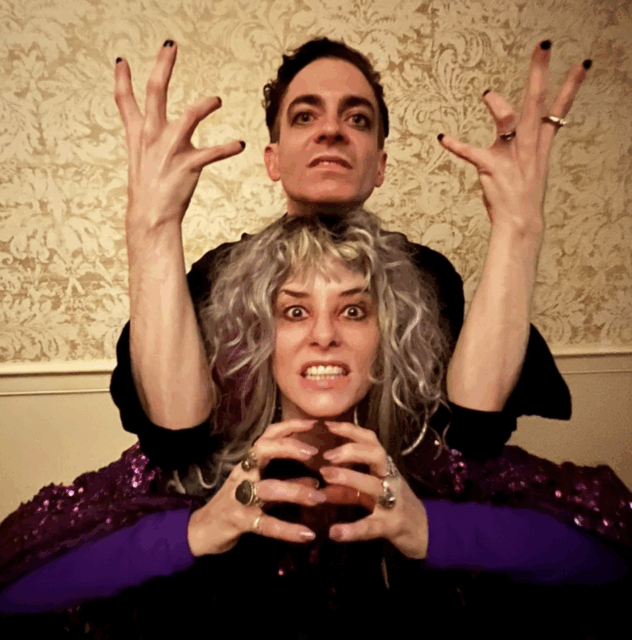
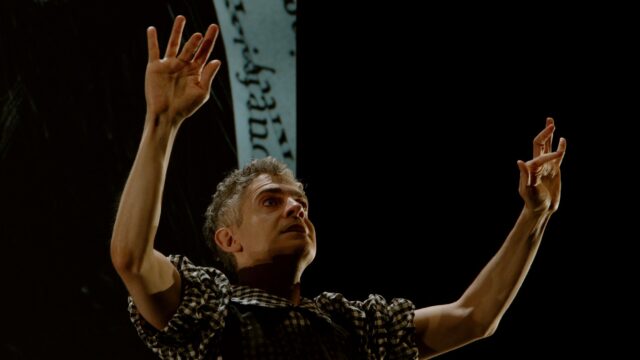
Dancer, actor, choreographer, and professor Jack Ferver has been sharing their unique and impassioned realizations about life in deeply personal and intensely funny and frightening shows since 2007; their works are complex, intoxicating fusions of pop culture, Hollywood glitz and glamour, childhood trauma, and loneliness, filtered through a distinctively queer sensibility. Their latest piece, My Town, running November 21 and 22 at the NYU Skirball Center, incorporates Emily, a romantic idealist who serves as the heart and soul of Wilder’s 1938 Pulitzer Prize–winning drama about the fictional early-twentieth-century American community of Grover’s Corners.
In a 2010 review of Rumble Ghost, an intimate story about the search for a missing child inspired by the 1982 film Poltergeist, I noted that Ferver “once again makes viewers squirm for a whole range of reasons.” For more than fifteen years, they have both challenged and delighted audiences with such obsessive yet relatable pieces as All of a Sudden, a reimagination of Tennessee Williams’s 1959 melodrama Suddenly, Last Summer; Night Light Bright Light, an examination of the 1964 suicide of dancer, actor, and choreographer Fred Herko; and Everything Is Imaginable, in which Ferver is like a devilish cherub paying tribute to Judy Garland and Martha Graham while asking us all to take stock of our lives.
“Artists are the stomachs of society. We digest the indigestible,” they told me in a 2012 interview focusing on Two Alike. “That means we explore all terrains. Gender and sexuality roles are assigned or taken in hopes of a sense of self, as a branch of the ego. And the ego begins with ‘Me, not me.’ As an artist I make my work so that people donʼt feel as lonely as I have felt. Therefore my work expands into something more akin to ‘I am you.’”
It’s been six years since Ferver presented a major work, yet they’ve been extraordinarily busy, teaching, choreographing for other creators, curating an upcoming Graham exhibition at Bard, making the film Nowhere Apparent with their partner, Jeremy Jacob, and revisiting the Little Lad, the bizarrely affecting character they played in a 2007 Starburst commercial for its new berries and cream flavor that went viral during the pandemic.
I recently met with Ferver over Zoom, discussing the creative process, Wilder and Williams, the Little Lad, growing up in Wisconsin, pets, and more.
Jack Ferver introduces Nomi to Tuki over Zoom (screenshot by twi-ny/mdr)
twi-ny: Oh, who’s that?
jack ferver: Here’s Nomi. She is a Parson Terrier and we got her in February of ’21 from a really great rescue org, Korean K9. Who’s that baby?
twi-ny: This is Tuki. She’s Maine Coon and Siberian, with a little Ragdoll. And she’s just adorable and cute and fluffy. This is all fur. She’s not very heavy. It’s just fur, and look at that tail!
jf: She’s so sweet. I know that we’re very blessed with our animal angels.
jf: Nomi was four. We had been looking for a dog for a while and she looked so sad. She had come from breeding and also a meat market. My partner said, “This looks like the saddest dog I’ve ever seen.” And I said, “Let’s go get her.” And then we got her and she’s just completely changed my life. We have both changed. They said, I don’t think she’ll ever play. Our trainer wasn’t sure if she ever would. And she plays every morning. I mean, I’ve really moved upstate, for two reasons. One was because of Bard, where I’m a professor. The other was that she was just so happy up here. But in just a moment, she will need to go back to the city.
twi-ny: Since I last saw you, you became a TikTok sensation with the Little Lad, garnering two million followers. How did that come to be?
jf: Well, someone had posted the commercial during the lockdown and told people to do things with it. I wasn’t on TikTok. Friends of mine were and started messaging me, saying there’s all these people impersonating that character and using the advertisement.
It was the fall of 2021, so we’re still kind of in the lockdown. Like, how are we returning? There’s just this day where I said, I’m not going to do anything. I don’t have the capacity or the bandwidth. And then there was this day where I said, Just go to Fourteenth Street and get a wig and do it. And I did; I did one post and overnight it had hundreds of thousands of followers.
And then within a few months it was a million and then it went up to two million. And my partner, Jeremy Jacob, who’s a visual artist and a filmmaker and made the video and music for My Town, we made one film together where the Little Lad is trying to track down their mom, who is supposedly Anna Wintour. We did that. I did some other long-format YouTubes and a bunch of TikToks and people really loved it. I haven’t opened TikTok in so long. The Little Lad hasn’t shown themselves since, wow, July 2023, which was pretty much when I started working on this show. I loved doing it.
I think a benefit that I hadn’t foreseen with it was I was really curious how my work would get to places in America where it’s simply not going to tour. There are curators in cities in America who wouldn’t feel comfortable with my work, with its queerness and its femmeness and its examination of trauma, and also use the use of humor.
I started to receive all of these emails from young people who had found the Little Lad and then found my website; there were some incredibly touching emails. Years ago, when I started making my work, I saw how broke I was going to be. I said, Well, you better have a good sentence, like one that you can remember, because this is going to be so hard. It certainly has been.
What I always loved from art was that it made me feel less alone. So that was my sentence, that I’d make work for people to feel less alone. And so to receive emails from people who were able to then get this material that I saw no way of ever getting to them. . . . Also, in the lockdown, I opened up almost all of the works of mine that I have documentation for, which aren’t all of them, but for all the ones I do, I opened them for free on my website so that people would have access to that. And I’ve kept it open because it’s my way of dealing with what we have culturally and what we don’t — or rather don’t have in terms of support culturally.
twi-ny: That also relates to the audience, which wants to know Jack Ferver. So much of your work is about queer isolation; it really all comes together with Little Lad and the two million followers —
jf: Little Lad was such a place of just complete play. In a lot of my pieces, there has been playfulness. There’s also been, and I think probably always will be, a lot of darkness, a lot of dealing with really difficult material. So to have this other [creation] that’s not close to me, I think that was also the thing that was so fun, that it was so far from me.
Someone who was so important to me when I was growing up was Paul Reubens. I was eight when Pee-Wee was coming out. And so to be a lonely, queer, bullied kid who saw this queer-in-every-which-way character taking up space, having a lot of fun. . . . I don’t think the Little Lad would have ever existed if it hadn’t been for Paul Reubens. Pee-wee was so informative for the Little Lad. I certainly didn’t think about it when I did the commercial.
I was paid very little for it, because this was before YouTube was monetized. And it was like the Twin Peaks of commercials. It was so strange, so desired that it instantly went to YouTube and was being watched there. It stopped running on the networks, so that stopped the paychecks.
twi-ny: I was looking back at the last time I saw one of your live shows, and it’s been a while.
jf: It’s been a long time.
twi-ny: Over the last six years, you played Arkadina in The Seagull: The Rehearsal, you did It’s Veronique at Hesse-Flatow, you worked with Parker Posey on Abracadabra. Oh, you were talking before about having fun; I had a blast at The Last Bimbo of the Apocalypse, which you choreographed. So much fun, and very serious elements too. You also did Is Global Warming Camp? at MASS MoCA. And now you’re curating a Martha Graham exhibition, one of your heroes, at the New York Public Library. I kind of know why you haven’t been around for six years.
Jack Ferver and Parker Posey collaborated on Abracadabra (Instagram photo courtesy Jack Ferver)
jf: The last show in New York was Everything Is Imaginable; we did it in 2018 and it came back in 2019. And then that year, I was also the AIDS Oral History fellow with Jeremy at the New York Public Library of the Performing Arts, the Jerome Robbins Dance Division. So that year of 2019 through 2020 was spent with that archive.
We did a lecture performance in January of 2020. Working with that archive answered so many questions for me, or I would say really reified answers I had about where people were who would be mentors for me and what had happened with funding. It was an incredible and devastating event. It was an audience that was filled with a lot of women who afterwards said, “Thank you for saying my friend’s name, which I haven’t heard in years.” And then in rolled this pandemic and the lockdown and I left and went and lived at Parker’s and taught and wrote and really had time to reassess and have space and to think about what it was that I wanted to do artistically, in many aspects of life, and then because art is the big forerunner of what I do in my life, what I wanted to do. So much of the lockdown was spent writing and then the MASS MoCA show came up, which I started working on in 2021 and it went up in 2022. Then Jeremy and I made [Nowhere Apparent] through All Arts. It’s still streaming on the All Arts platform.
With MASS MoCA, it was this question, I’ve created this show, am I gonna try and get these presenters from NYC or from wherever to come to North Adams in the early fall? I really had met full burnout with trying to do that with presenters.
So at that time, Garen Scribner, who was in Everything Is Unimaginable, was changing paths to being a manager and said, I would love to be your manager. And I said, Great. So then Jay Wegman, who used to be the artistic director of Abrons, had given me free space for ten years when he was there. That’s how I made most of my work. And so Garen said, Let’s have a conversation with Jay, who was now at Skirball.
twi-ny: That’s the connection.
jf: I’ve been working on [My Town] since the summer of 2023. I’ve never worked harder on a piece. A lot of the things that are, I would say, more familiar if I look back at some of the formal things in my work, such as the use of film, that isn’t there. It begins sheerly by fiction of a story that’s not me, that’s about a schoolteacher and her student in 1911 in this town that I live in now, and then through trauma time starts to collapse.
A lot of characters emerge through this show, which is also something very different. And there’s a different approach to the solo format, which I might be doing for quite a while, I think, inside of my work. Through this work, I’m literally having more time alone. That Joan Didion quote: “Do not complain. Work harder. Spend more time alone.” And so my writing practice and my movement practice have just had so much more space.
I love teaching at Bard. I feel so grateful that I love to teach so much, and I feel so grateful I’m at Bard, which makes total sense for the way I work. It’s so interdisciplinary, and I work with professors from different parts of the college.
twi-ny: Are you hopeful for our next generation of writers and performance artists?
jf: That really solidified for me too during the AIDS Oral History Project, that I’m one of the bridge makers. We’ll never fix that gap, and we’ll never heal that canyon. But some of us will work to help build the bridge and those students, our students, will continue to be that bridge.
This piece has just been — oh, Mark, if I performed it a thousand times, I would never perform it for as many hours as I’ve rehearsed it.
twi-ny: It’s a solo piece.
jf: It is.
twi-ny: You’re very influenced by previous media: plays, movies, television, like Black Swan,Poltergeist,Suddenly, Last Summer,The Maids. So you’ve chosen in this case to take on Our Town, which is maybe the most famous play for its numerous characters.
jf: Yes.
twi-ny: And you’ve turned it into this one-person show. Why Our Town?
jf: A lot of the work had already been made. And then there was this moment where the character of Emily Webb emerged for me. And it emerged at a point in the process when, in the way I was talking and describing things, I was reminded of the stage manager. Then Emily Webb arrived and also Simon Stimson, the “queer-coded” chorus leader who hangs himself. I talked about both of them in Is Global Warming Camp? I talked about their deaths in that piece. And I was curious about why this woman meets her death in childbirth and then the queer-coded one hangs himself.
So I became really interested in tapping into, perhaps, could Emily get revenge with the stage manager before going back to the cemetery? It’s a very brief moment in the show. I was contacted by the Wilder estate; I felt very happy to be contacted by them. There’s nothing really of Our Town in there. There’s a part where it’s my fantasy if Emily got to confront the stage manager. But I think where I see the haunting of Our Town in it is that there’s someone describing things that aren’t there, that aren’t onstage. So many of my works don’t have a set. They generally have taken place in an “empty space,” to quote Peter Brook. It’s this thing of me using the power of my imagination to evoke the audience’s power of imagination. So much of that for me came from dance, but I also really see where that also comes from this experiment that Wilder did for America.
As Wilder’s essay that he put out to the American theatergoers says, you were just here for the soporific and for the baubles and for being entertained and you are asleep at the wheel. And so I’m gonna strip everything down. I connected very much in that way with Wilder. I will use language to evoke where we are. So that is where Our Town happens from. And I’d also say, yes, that I’m so many characters through this work. I’m very rarely me. And if I am, it’s some aspect of self. What I see from my work is that the stage is the psyche. It’s the psychic space.
I think this has been true of all of my work. And now it’s very clear to me that I am playing all of the aspects of self that get shattered in trauma and then jockey for attention. So when I’ve worked with a cast, they have also been aspects of self or aspects of whether they’re coming to it from a more narcissistic position or from a more victimized position.
They are all the shattered aspects that happen from trauma, and they will look to jockey and fight and spar to get the audience’s attention, to get the attention of the witnessers.
twi-ny: I wonder if that’s why you often don’t have a lot of set design. You were talking about this black space inside yourself or inside your mind, and right now you’ve chosen to be on Zoom in a dark corner.
jf: [laughs] Yes, this is where I do take my calls.
twi-ny: Last night I saw The Seat of Our Pants at the Public Theater, a musical adaptation of Wilder’s The Skin of Our Teeth. So clearly his estate is having fun with people taking Thornton to other levels.
jf: Well, I think of Wilder and I think of Williams; I would love to, if I ever have it in me, to write a more narrative play — I’ve always been so curious of what it would be like for the two of them at a bar. They were obviously so creative, so utterly American, and very angry, incredibly angry artists, and a lot of their work comes from revenge. It’s clear on the page. Our Town is a deeply vengeful play. It is so much of an agony of how people are not waking up and are not being awake to the present moment.
I wish that we had more of that content of trying to wake us up. I mean, we’re so polarized; I’m the billionth person to say that. That’s not new news of how polarized we are, so inside of our own vectors, and so unwilling to see the other person.
twi-ny: It’s very scary. So Emily Webb took what you were already working on in this other direction, gave another part to it. What was the initial genesis before Our Town was even on the page?
jf: First it was Wisconsin Death Trip, the book by Michael Lesy, which has those photos and police records from the late 1800s into the early 1900s.
twi-ny: That’s where you grew up, in Wisconsin.
jf: I did. I grew up relatively close to where a lot of that material for that book takes place. So first there was that, and then, as I went on, that began to fall away. And because I was researching where I grew up, what was it like as the town was forming, and what was it like where I am now? Because they look very similar. Where I have landed looks very similar to where I grew up, which is a big shock because I was very, “I’m getting out of this town.” That real queer kid adventure of “I’m going to move to New York City and . . .”
twi-ny: Be a star!
jf: Yeah. Where I grew up was on the Wisconsin River, on the train tracks facing the Wisconsin Ferry Bluffs. And now I live on Amtrak. Just down the street are the train tracks, the Hudson River, and the Catskills. So I thought, Okay, let me do research between these two towns. Then that began to fall away. I don’t know where this story came from of this schoolteacher and her student in 1911 in a town that is maybe this town that I live in now. And I wrote this really long, incredibly detailed, graphic, honestly . . . novella. I started to read it to a friend of mine and I said, This is going to be my next piece. And he said, Well, it can’t be because you’ve written a novella and no one will sit through this. You could do this as a book on tape. I think I was at page twenty and still reading what was going on for them. And he said, You can’t. What’s the show? It’s a show. We’re not going to sit through . . .
twi-ny: Five hours of . . .
jf: Yeah, five hours of reading a story. That was what began. I think part of where that came from was really this interest in what happens to this schoolteacher, who’s marked as a woman in my script but she might possibly be a trans man, though she doesn’t have language for that at that time.
I won’t say more than that of what happens to her and the student. But I decided to have there be a traumatic event that rips through time. And that will tie this town back to Wisconsin, and I thought about portals and trauma and how we have memories of places that perhaps we’ve been or haven’t been. I thought about amnesis, this recollection of something that we haven’t experienced but feels very familiar, a knowledge of something that we haven’t directly experienced. What is that? There’s so much that opened, I believe, inside of the collective consciousness during the lockdown, and I’m so curious about what it will be to keep those psychic doors open, art’s ability to keep those psychic doors open. I started going through those doors: I’ll take a long walk to the cemetery, I’ll take a run through the woods. I don’t think if I was spending so much time alone and in nature . . . I don’t know if these doors would have opened that way.
twi-ny: That’s fascinating. Speaking of opening doors, My Town is going to be at Skirball. I’m thinking of the shows that I’ve seen of yours, they take place mostly in great spaces but small ones; this one is huge. How did Skirball and its size figure into the work?
jf: Immediately I knew that Jeremy was gonna have to make a video. It’s too big of a space. At one point it was a duet and then I cut that part. [laughs] There was another section that happened in this show that is another show. It’s just another show, and maybe I will make that other show.
But that duet needed to just go away. There were actual scenic pieces that were going to be constructed. And as it went on, I just thought the way that my experience of going to Skirball has been . . . they do screenings of films there. I’ve never seen a film screened there, but there’s times where it reminds me that I could be coming here to see the first screening of The Phantom of the Opera. It has this very grand theater feeling to it. So I wanted Jeremy to make a video that wouldn’t be illustrative to what I was saying but that would provide another element of projection, which I mean both literally and metaphorically, so that there would also be this projective element that’s happening while I am working through all of these projections and the audience is projecting onto me, onto the roles I’m playing, and then also dealing with their projections of this projection. So that was where the screen came from. There’s a large screen that’s behind me that I wouldn’t say I interact with as much as it is functioning as another part of the mind. And in the ways that, as Freud said, we’re always doing at least two things. And formally, I thought there needs to be something more here for the audience.
Jack Ferver plays multiple aspects of their self in My Town (photo by Jeremy Jacob)
And then Jeremy went further and said, I also think the whole piece has to be underscored, and so wrote an entire score — pending on how I do it. Every show is slightly different every time. This show has very specific reasons why it’s different every time that I won’t say; I’ll just leave that a secret. So it rides somewhere between sixty and sixty-five minutes, and the score has cues in it that’s from my text. I foresee our collaboration continuing on in that way. I always knew it was going to be me; at one point I thought it might be two people. Then I was like, Nope, it’s just me. Me and this video. I was also really interested in the size of it, and one person out there trying to work through something really difficult, because that is also what I experience people to be like right now. They have community and they have friends, but a lot of the people I see or what I see reflected back are a lot of people feeling very isolated in a very huge space.
twi-ny: Well, I’ve seen several solo shows at Skirball; it is a huge space. I’m not trying to scare you —
jf: Fortunately, I first got to do this piece at EMPAC in Troy, New York. We had a technical residency there, and I had it set up so it would feel the same as Skirball. So I’ve already tested it out.
For me, it’s the hardest performance I’ve ever done. It’s a gauntlet. I pretty much don’t stop moving through the majority of it. The text is so incredibly dense, and because I’m dealing with temporal disorder it has tricky syntax shifts that are . . .
twi-ny: But that’s your own fault. You gave it to you.
jf: I run best on a muddy track. I really wanted to let go of a lot of things and go through these doors that were opening and really listen to this writing that was coming through. In the lockdown, I wrote at least sixty pages of poetry that maybe no one will ever see. There are two poems that made it into this piece, modified. And there are reasons that they’re in the work, which I won’t say. I think it gets explained as the piece goes on. My desire for pushing my writing and pushing the psychological iconographies of my choreography has always continued to grow. So I wanted to push myself to do the hardest thing I had done so far.
twi-ny: Judging by what I’ve seen of your work previously, I know how hard you push yourself and how much you open up and reveal of yourself. I can’t wait to see this one.
jf: Yes. I’m terrified. It’s a piece that is so terrifying and so freeing all at once. But I don’t think the piece works as well if that’s not the state that I’m in. I’ve made it so that there’s no way to do it not terrified. Formally it’s just so hard, and again it has a psychological reason in it, which is when we hunt for memories and when we try to understand and make sense of extreme trauma and the way that the massive crush of heterogeneous voices falling upon us while we ask for something good to be done creates such a hardship of not becoming bitter, not shutting down, not coldly and decisively picking a lane and sticking to it.
Allowing oneself to remain open is something that I also wanted this work to encourage people to do and really to do through also what I don’t see much of right now, which is mystery and humor, and not easy humor — I mean, I’m great at that, but the humor that comes from recognition.
[There will be a talkback with Ferver following each performance. Mark Rifkin is a Brooklyn-born, Manhattan-based writer and editor; you can follow him on Substack here.]
Bert Allenberry (Tom Hanks) meets Virginia (Kayli Carter) and Carmen (Kelli O’Hara) at the 1939–40 World’s Fair in This World of Tomorrow (photo by Marc J. Franklin)
THIS WORLD OF TOMORROW
The Shed’s Griffin Theater
545 West 30th St. at Eleventh Ave.
Tuesday – Sunday through December 21, $169-$299 theshed.org
The 1939–40 World’s Fair was an extraordinary moment in New York City history, as people from around the globe descended on Flushing Meadows to see such attractions as the Trylon and Perisphere, Elektro the Moto Man, the Fountains of Light at the Lagoon of Nations, General Motors’ Futurama, the Life Savers Parachute Jump, the Helicline, the Aquacade, and a Rembrandt self-portrait. It’s been memorialized in books, movies, and museum exhibits, and now it’s the setting of a new play cowritten by and starring Tom Hanks, running at the Shed through December 21.
This World of Tomorrow gets off to a rousing start, with jazzy entrance music by Louis Armstrong, the Dorsey Brothers, Lionel Hampton, Benny Goodman — and Nina Simone, who is from the next generation. In the opening scene, two people from the future, Bert Allenberry (Hanks) and Cyndee (Kerry Bishé), have traveled back in time to the World’s Fair, to June 8, 1939; while Bert is fascinated by everything he is experiencing, Cyndee is less enthusiastic. When looking at four sculptures by Leo Friedlander, Bert reverentially reads to Cyndee, “All citizens of the world are entitled to these four Freedoms: Of Religion, Speech, Assembly, and that one there. The Press. . . . Never has the world held a brighter promise of things to come. The Present is but an instant between an Infinite Past and a Hurrying Future.”
They then meet Carmen Perry (Kelli O’Hara) and her teenage niece, Virginia (Kayli Carter), who are playing hooky from work and school, respectively. Bert is instantly smitten with Carmen as much as he is excited by the fair. When he offers them his VIP pass and pin that says, “I have seen the future,” Virginia turns him down, explaining that she is learning to approach life with patience and so will wait in line like most everyone else. “Enjoy the anticipation,” Bert says, surprised.
Bert and Cyndee return to 2089, where they work at SKAEL, the Salina Kansas Alternating Enterprise Lab, which he runs with M-Dash (Ruben Santiago-Hudson). While Bert gleefully talks about hot dogs, cake, and coffee, which apparently aren’t available in 2089, M-Dash wonders why he didn’t kill Adolf Hitler and reminds him about the racism that was prevalent 150 years before, two classic time-traveling genre tropes. (Other tropes, like how Bert has to avoid changing anything that could impact the space-time continuum, are either ignored or given short shrift.) Bert and M-Dash get caught up in a discussion filled with techno-jargon — Finite Atomic Structure, DODEKA, VOX-PAC, Impulse coding, Inner-Structurals — and seek answers from ELMA (Jamie Ann Romero), an External Learning Machine Associate, a sort of AI robot who speaks without emotion.
The narrative shifts back to the morning of June 8, 1939, as Carmen, a divorced bookkeeper, gets ready to take Virginia to the fair. Carmen lives in the Bronx with her brother, Max (Jay O. Sanders), Max’s wife, Sylvia (Romero), and Virginia in a cramped apartment. Max is a tough-talking butcher, and Sylvia is a nurse who works the late shift at Bellevue. Max plays pinochle with his buddies. Carmen has lunch every day at a Greek diner off Sheridan Square owned by an immigrant named Costas (Sanders), a larger-than-life figure who promises his food is “number one the best.”
After several trips to the past, Bert is warned by Honoria (Michelle Wilson) and Dr. Tanner (Paul Murphy) of Chronometric Adventures that his portal-related Trillic Acid numbers are at dangerous levels and that he should not go on another journey, but his fondness for Carmen makes him consider risking it all.
This World of Tomorrow is like an hourlong episode of The New Twilight Zone (without commercials), except it’s two hours and fifteen minutes (with intermission), along with a dash of the 1980 romantasy Somewhere in Time, more than a hint of Back to the Future, and a touch of the 1985 anthology series Amazing Stories thrown in. (In fact, the 1939 New York World’s Fair is a key plot point in the time-traveling TZ episode “The Odyssey of Flight 33.”) There’s a lot of repetition and explication; it could benefit from being trimmed down to a leaner ninety minutes or so.
The Salina Kansas Alternating Enterprise Lab has an important meeting in 2089 (photo by Marc J. Franklin)
The play is based on two short stories from Hanks’s 2017 collection Uncommon Type, “The Past Is Important to Us” and “Go See Costas,” but Tony-winning director Kenny Leon (Topdog/Underdog,Home) can’t quite merge them on Derek McLane’s ever-shifting set, which switches from a Bronx kitchen and a Greek diner to a conference room and the fair and features archival projections on more than two dozen pillars. Dede Ayite’s costumes help differentiate the various time periods, but it still feels like multiple stories unsuccessfully merged into one.
Oscar and Emmy winner and Tony nominee Hanks is most well known as a television and film star, but he cut his teeth with the Riverside Shakespeare Company in New York and the Great Lakes Shakespeare Festival in Cleveland in the late 1970s; he made his Broadway debut in Lucky Guy in 2013, and he played Falstaff in the Shakespeare Center of Los Angeles’ Henry IV in 2018. Clearly comfortable on the stage, he is as appealing as ever as Bert, an eminently likable man who doesn’t have a bad thing to say about anyone. He has instant chemistry with Tony winner and Emmy and Grammy nominee O’Hara (The Light in the Piazza,The King and I), who mostly appears in musicals but is at home here, lending a working-class elegance to Carmen. You desperately want them to fall in love and be together, but not all the obstacles they face make sense.
The rest of the cast is trapped in thankless roles that only get in the way of the central story. And the dialogue is overladen with scientific concepts that weigh down the narrative with confusing verbiage — it lacks the fun charm of, say, Star Trek’s invented technological language — and Hanks and cowriter James Glossman preach too much about peace and love.
“Let’s leave tomorrow to tomorrow,” Carmen suggests. That’s not necessarily a bad idea.
And as Lee (Lee Aaron Rosen), one of Bert’s colleagues at SKAEL, emphasizes, “Learning that ‘The Past Is Important to Us’ don’t come cheap.”
Neither does learning about the future.
[Mark Rifkin is a Brooklyn-born, Manhattan-based writer and editor; you can follow him on Substack here.]