featured

FRAGMENTED BODY PERCEPTIONS AS HIGHER VIBRATION FREQUENCIES TO GOD

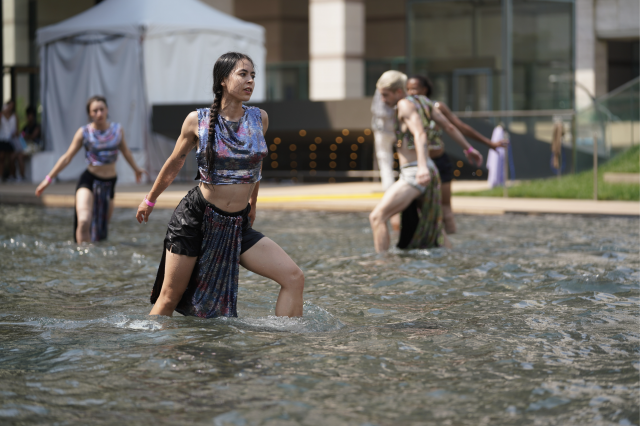
A stream winds through the center of naturalistic indoor environment at Performance Space New York (photo by twi-ny/mdr)

Performance Space New York
150 First Ave., fourth floor
Wednesday-Sunday through May 9, free with RSVP, noon – 6:00
performancespacenewyork.org
online slideshow

As the pandemic lockdown in New York City begins to ease up and arts institutions slowly open, Precious Okoyomon has brought the outside inside in the beautifully meditative and welcoming Fragmented Body Perceptions as Higher Vibration Frequencies to God. The installation, in the Keith Haring Theatre on the fourth floor of Performance Space New York, offers a naturalistic ecosystem where one can grieve and reflect on the events of the past year, during which the country has been immersed in overlapping crises, from the coronavirus to police injustice to growing income inequality, all of which disproportionately affects Black men, women, and children. Continuing through May 9, Fragmented Body consists of gravel, small Delaware River rocks, boulders, soil, insects, anoles, and wildflowers, with an algae-laden stream running down the middle and kudzu ash, sourced from Okoyomon’s recent Earthseed exhibit in Germany, falling from the ceiling in a kind of wake, a ritual burning of the invasive Japanese vine that was used to prevent soil erosion in the cotton-growing south and became a metaphor for the suppression of Blacks after slavery ended.

Boulders piled like cairns evoke rituals as well as spirits in immersive exhibition (photo by twi-ny/mdr)

“The creation of Earthseed started this ever-flourishing garden of kudzu, which was allowed to evolve and escape and be truly wild,” Okoyomon explains in a statement. “At the end, it had to be killed: It couldn’t be transplanted to a new environment because it’s a monster. And the way I had to burn it all and the way that ash gets to have a new life here, it seemed the only reconcilable wake we could do for it, and one that would reflect the timeline of death we’ve been in. 2020 was the reckoning of death, and we’re still living in it. We have to face it and live in it and allow it to change us and be changed by it.”

Timed, limited fifteen-minute admission is free with advance RSVP; we were fortunate to go on a rainy afternoon and spend more than a half hour by ourselves in the space, sitting by the trickling stream, following the paths laid out on the gravel, and gently touching the hollow boulders, piled like cairns, in order to feel the vibration of the soundtrack, which features such found noises as construction. The haunting sound design is by Dion McKenzie, with lighting by Jørgen Skjaervold.

Precious Okoyomon’s installation offers visitors an opportunity to reflect, grieve, and revive (photo by twi-ny/mdr)

The work also features a poem, “Weather report,” by the Brooklyn-based Okoyomon (Ajebota, But Did U Die?) that begins, “Today i wake up still the assemblage associated distortions bewilder me / IN THIS WORLD I AM A SHAPESHIFTER / FRAGMENTED BODY PERCEPTIONS AS HIGHER VIBRATION FREQUENCIES TO GOD / In the supernatural sky / I was restful as I had reached my place of salvation / The surface as a material structure neither heaven nor solace / Only the wind / Only quenched light / Lulled into covering until everything was the same / soul object well formed / the irreducible always already truth / Hidden in the trees / It is nothing i am here i am still here.” Visitors are encouraged to leave a little token behind as part of a community garden of objects, a reminder of solace and salvation.

REP ON-AIR: THE WAVES IN QUARANTINE

The cast of The Waves in Quarantine comes together over Zoom in Berkeley Rep live discussion on May 6

Who: Raúl Esparza, Alice Ripley, Nikki Renée Daniels, Carmen Cusack, Darius de Haas, Adam Gwon, Manu Narayan, Johanna Pfaelzer
What: Live discussion about six-part The Waves in Quarantine
Where: Berkeley Rep Zoom
When: Thursday, May 6, free with RSVP, 8:30 (presentation available on demand through May 28)
Why: In 1990, New York Theatre Workshop presented The Waves, a musical adaptation by director Lisa Peterson and composer and lyricist David Bucknam of the 1931 novel by Virginia Woolf about six friends, portrayed by Catherine Cox, Diane Fratantoni, Aloyisius Gigl, John Jellison, Sarah Rice, and John Sloman. During the pandemic lockdown, Berkeley Rep has taken a deep dive into the novel and adaptation, exploring the characters, the settings, Woolf’s life, and the making of the musical. Conceived by Esparza and Peterson and directed by Peterson, The Waves in Quarantine: A Theatrical Experiment in 6 Movements is streaming for free through May 28, with songs, reflections, recitations, and memories shared by actors Raúl Esparza, Alice Ripley, Nikki Renée Daniels, Carmen Cusack, Darius de Haas, and Manu Narayan in addition to Adam Gwon, who wrote additional music and lyrics for the show. The actors film themselves at home and outside and meet over Zoom over the course of ninety minutes, covering “Memory,” “Those We Love,” “The Female Gaze,” “Absence,” “The Sun Cycle,” and “Reunion,” paying special tribute to Bucknam, who passed away in 2001 at the age of thirty-two. On May 6 at 8:30 EST, members of the cast will reunite over Zoom for a live discussion about The Waves in Quarantine, moderated by Berkeley Rep artistic director Johanna Pfaelzer. Admission is free with RSVP.

SIGNATURE THEATRE 30th ANNIVERSARY GALA: THREE DECADES TOGETHER, ONE FUTURE FOR US ALL

Who: Anna Deavere Smith, Katori Hall, Samuel D. Hunter, Dominique Morisseau, Lynn Nottage, Dave Malloy, Abraham Kim, Jane Lui, Joe Ngo, Courtney Reed, more
What: Gala celebration and fundraiser
Where: Signature Theatre YouTube
When: Thursday, May 6, free with RSVP, 7:00
Why: One of the theaters I have missed the most during the pandemic lockdown has been the Signature, home to four unique spaces in addition to a bar with live music on far west Forty-Second St. Founded in 1991 by James Houghton, the Signature is a playwright-driven company, having dedicated seasons to a wide range of established and emerging writers, from Edward Albee, Horton Foote, Arthur Miller, Sam Shepard, August Wilson, and A. R. Gurney to Paula Vogel, Branden Jacobs-Jenkins, Suzan-Lori Parks, Will Eno, María Irene Fornés, and Annie Baker. During the pandemic, Signature has been posting live discussions, behind-the-scenes videos, and clowning challenges by Bill Irwin. On May 6, the theater will host its thirtieth anniversary gala, paying tribute to resident playwright Anna Deavere Smith, who was in the midst of a season that included revivals of Fires in the Mirror and Twilight: Los Angeles, 1992 when the coronavirus crisis shut down the city. Among those making appearances at the free event, titled “Three Decades Together, One Future for Us All” and directed by Lila Neugebauer, are resident playwrights Katori Hall, Samuel D. Hunter, Sarah Ruhl, and Lynn Nottage, with performances by Dave Malloy and members of the cast of Lauren Yee’s Cambodian Rock Band (Abraham Kim, Jane Lui, Joe Ngo, and Courtney Reed).

THE LAST FIVE YEARS

THE LAST FIVE YEARS
Extended through May 9
Tickets: $32.50 for time-specific single stream, $47.50 for forty-eight-hour on-demand viewing with behind-the-scenes featurette
www.ootbtheatrics.com/l5y

“I think you’re really gonna like this show / I’m pretty sure it doesn’t suck / See, you’re laughing, and I’m smiling,” Cathy Hiatt (Nasia Thomas) sings early in Jason Michael Webb’s exhilarating, intimate, and emotional adaptation of Jason Robert Brown’s 2001 two-character sung-through musical, The Last Five Years. Produced by Out of the Box Theatrics, Holmdel Theatre Company, and Blair Russell, this online version, streaming through May 9, was rehearsed remotely and filmed in a cramped New York City apartment, with director of photography and videographer Brian Bon using a handheld camera, lending an immediacy and urgency to the proceedings, as well as an overwhelming feeling of claustrophobia as Jewish writer Jamie Wellerstein (Nicholas Edwards) and actress Cathy journey across the beginning, middle, and end of a relationship, told backward by Cathy but chronologically by Jamie. When career success seems imminent for one but not the other, jealousy and envy threaten their love, made all the more intense by the close quarters necessitated by Covid-19 restrictions.

As Cathy and Jamie make their way through the apartment, they encounter keyboardist and associate music director Cynthia Meng, cellist Sterling Elliott, violist Orlando Wells, guitarist Jonathan Linden, bassist Chelton Grey, and drummer Brandon Brooks sitting in corners, relaxing on the bed, or suddenly appearing in the living room or kitchen, performing poignant orchestrations of such songs as “Still Hurting,” “The Schmuel Song,” “The Next Ten Minutes,” and “A Miracle Would Happen / When You Come Home to Me.” Casting two people of color and not changing the script — the original production in Skokie starred Lauren Kennedy (replaced by Sherie Rene Scott) and Norbert Leo Butz — lead to scenes both moving and, at times, humorous, as when Jamie considers his potential romantic partners in “Shiksa Goddess,” explaining, “I’ve been waiting through Danica Schwartz and Erica Weiss / And the Handelman twins / I’ve been waiting through Heather Greenblatt, Annie Mincus, Karen Pincus, and Lisa Katz / And Stacy Rosen, Ellen Kaplan, Julie Silber, and Janie Stein / I’ve had Shabbos dinners on Friday nights / With every Shapiro in Washington Heights” as photos of the women are projected on the wall behind him. But at the heart of the story is a universality that transcends race, religion, or ethnicity as two people try to build a life together.

Cathy (Nasia Thomas) and Jamie (Nicholas Edwards) tell their story in opposite directions in The Last Five Years (photo © Gerald Malaval)

Thomas (Ain’t Too Proud: The Life and Times of the Temptations, Beautiful: The Carole King Musical) and Edwards (Godspell, Frozen) are utterly engaging as Cathy and Jamie; you are instantly drawn into their orbit, rooting for them even when you know what’s going to happen from the very first song. Thomas is particularly captivating as Cathy digs deep into who she is and what she desires. Tony winner Webb (The Color Purple, Choir Boy) shoots some of the scenes without cuts as the camera winds through multiple rooms, making the most of the surroundings, which feature a fun production design by Adam Honoré that includes lots of books, theatrical posters, and Playbills; the costumes are by Siene Zoë Allen, with sound by Nicole Maupin and Carin M. Ford. Brown (13, The Bridges of Madison County) won Drama Desk Awards for Best Music and Best Lyrics back in 2002; two decades later, The Last Five Years is as fresh and alive as ever. It definitely doesn’t suck.

STUDIO THEATRE: UNTIL THE FLOOD

Until the Flood features three women playing multiple roles in dazzling production

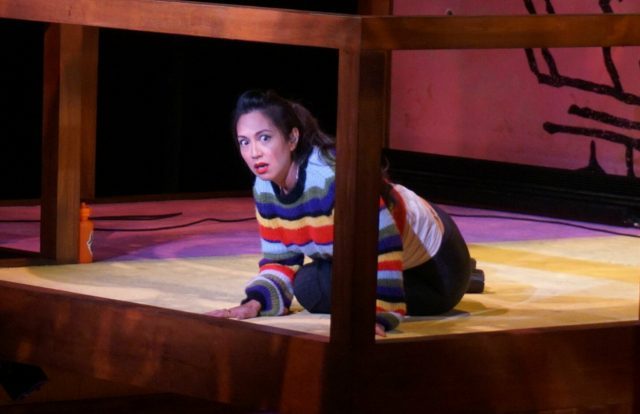
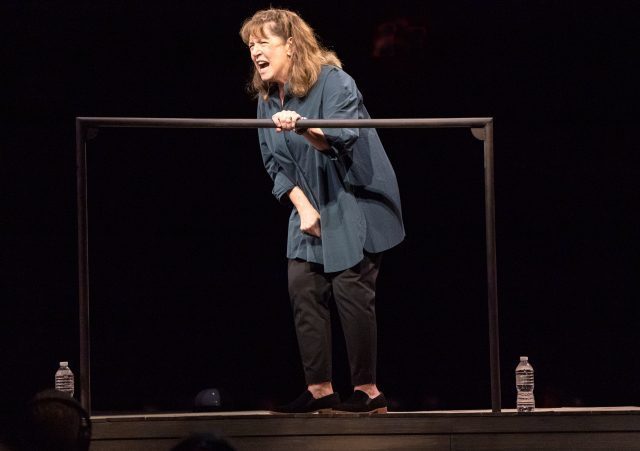
Studio Theatre associate artistic director Reginald L. Douglas takes Dael Orlandersmith’s one-woman show, Until the Flood, to a whole new level in a stirring, deeply affecting online version, streaming through May 9. In January 2018, Pulitzer Prize finalist Orlandersmith presented Until the Flood at Rattlestick Playwrights Theater. In the play, which was originally commissioned by the Repertory Theatre of St. Louis, Orlandersmith portrays eight composite characters in relating the tragic story of the killing of Michael Brown at the hands of police officer Darren Wilson in Ferguson, Missouri, on August 9, 2014; Orlandersmith traveled to Ferguson and interviewed dozens of people to understand the incident from every possible angle. (A recording of the Rattlestick show can be viewed for free here.)

Douglas has transformed the work by having a trio of stunning Black women of different ages, Felicia Curry, Ora Jones, and Billie Krishawn, perform the roles of Black retired schoolteacher Louisa Hemphill (70s), white retired policeman Rusty Harden (75), Black teen Hassan (17), white high school teacher Connie Hamm (35), Black barber Reuben Little (late 60s/early 70s), white landowner and electrician Dougray Smith (late 30s/early 40s), Black high school student Paul (17), and Black Unitarian minister Edna Lewis (late 50s/early 60s), who share their thoughts on racism, anger, violence, poverty, fear, bigotry, liberalism, homosexuality, protest, privilege, education, and other social issues. There is almost too much pain to bear, but keep watching.

“It wasn’t until I reached my mid- to late-30s and moved back to St. Louis, and when both parents died, I realized, saw; and I remember my father saying how racism causes self-hate,” Hemphill (Jones) recalls. “Legacy is the word that comes to mind. Legacy. The legacy of self-hate. The legacy of keeping your place. The legacy of grinning and bowing. The legacy of seeing yourself as a n****r, being taught to see yourself as a n****r. My God, how I hate that word. How I hate when anybody, white or Black, uses it. That young man, Michael Brown, his death, he was made to see himself that way — as a n****r. As someone who was nondeserving. He was set up, and he set himself up to fail.”

Filmed using several cameras that follow the characters on Studio Theatre’s DC stage and in the empty seats, moving from close-ups to longer shots that remind us of the loneliness and isolation of the pandemic lockdown, the eighty-minute production might be specifically about Brown and Ferguson, but now, in 2021, it also evokes George Floyd and Minneapolis, Adam Toledo and Chicago, Breonna Taylor and Louisville, Daunte Wright and Brooklyn Center, Rayshard Brooks and Atlanta, Elijah McClain and Aurora, Philando Castile and Falcon Heights, Alton Sterling and Baton Rouge, Sandra Bland and Hempstead, Freddie Gray and Baltimore, Tamir Rice and Cleveland, and so many other men, women, and children of color killed by police around the country since Brown’s murder.

Dael Orlandersmith’s Until the Flood explores the Michael Brown shooting and more in blazing Studio Theatre adaptation

“There is a part of me that wants to go, get out. There’s a part that wants to stand before a gun, right in front of some redneck, hungry motherfucker who don’t know my name, who don’t care what my name is, but I know this motherfucker would aim to shoot and not miss,” Hassan (Krishawn), wearing a hoodie, shouts. “I’m seventeen, man. Sometimes I feel seven, sometimes I feel seventy, and I want out. Spill my blood, man, spill it. I just want out! Do it!”

Each scene seamlessly transitions to the next with the actresses, sometimes with script in hand, slightly overlapping in a kind of nonphysical handoff, acknowledging one another as one takes center stage and the other sits down, melding audience, performer, and character. (The expert lighting and sound are by Jesse Belsky and Elisheba Ittoop, respectively.) Douglas and video director Wes Culwell occasionally cut to the reactions of the other two while the third is delivering a monologue; in addition, the two seated actresses perform dialogue within the third’s speech when a character other than the one they are playing speaks.

Curry (Collective Rage: A Play in Five Boops, Bloody Bloody Andrew Jackson), Jones (Curve of Departure, The Children), and Krishawn (Blood at the Root, Ohio State Murders) are extraordinary, gaining power and passion as Orlandersmith, whose other works include Forever, Yellowman, Monster, and The Gimmick, digs deeper into the many aspects of racial injustice, as seen from multiple sides.

“I’m not gonna live in fear. I won’t give in to it,” Paul (Curry at her fiercest) declares before walking over to a concrete pillar, softly looking at it and touching it, then admitting, “I live in the Canfield apartments just like Michael Brown did. You know, if you look at a housing project or low-income apartments like Canfield, if you really look at it, it looks just like a prison. I mean, it really does look just like a prison. Sometimes it feels like that too. Feels just like a prison. There’s something that’s just, I don’t know, defeated there. It feels defeated.”

The finale is not about defeat, nearly exploding off the screen as Curry, Jones, and Krishawn unite, three generations coming together onstage while pointing to the future. Throughout the play, it becomes more and more apparent via costume changes that Krishawn is pregnant, and by the end, she is rubbing and holding her belly, hoping and praying, along with us, that her baby won’t become the next Michael Brown.

NEW CAMERATA OPERA: THE BROOKLYN JOB

New Camerata Opera attempts to pull off an interactive, immersive virtual art heist in The Brooklyn Job

Who: New Camerata Opera
What: Virtual world premiere
Where: New Camerata Opera Zoom
When: Thursday, May 6, and Saturday, May 8, $40-$160, 8:00
Why: On March 18, 1990, thieves broke into the Isabella Stewart Gardner Museum in Boston and got away with thirteen masterpieces worth half a billion dollars; you can learn more about the still-unsolved crime in the new Netflix documentary This Is a Robbery: The World’s Biggest Art Heist. Immersive specialists New Camerata Opera will be pulling off its own interactive, virtual museum heist this week with the premiere of The Brooklyn Job. Written and directed by Sarah Morgan Ashey, the piece, debuting May 6 and 8 at 8:00 over Zoom as part of the sixth annual New York Opera Fest, mixes prerecorded elements filmed and edited by Erik Bagger with live performance, featuring sopranos Samina Aslam and Barbara Porto, mezzo-sopranos Eva Parr, Julia Tang, and Anna Tonna, tenors Victor Khodadad and Bagger, baritones Stan Lacy and Scott Lindroth, and bass Kofi Hayford. Dan Franklin Smith is the music director. New Camerata Opera has presented such online works as Julie, the nine-episode Ives Project, and The Prince von Pappenschmear, a Prequel during the pandemic lockdown; The Brooklyn Job is a participatory opera that invites viewers to take polls and, for an additional fee, order a cocktail box (by May 3) that comes with a Woman in Gray, Sunlight Effect, or Rhubarb Spritz, spiced caramel popcorn, and an art-focused interactive program guide.

SIXTH ANNUAL NEW YORK OPERA FEST

New Camerata Opera’s The Brooklyn Job is one of numerous cutting-edge productions in New York Opera Fest

The New York Opera Alliance
May 1 – June 30, free – $60
newyorkoperafest.org

I have a confession to make: Everything I know about opera I learned from Warner Bros. cartoons: The Rabbit of Seville, Long-Haired Hare, What’s Opera Doc? In my nearly twenty years of covering New York City events, I’ve been to only a handful of performances at the Metropolitan Opera, and mostly because of my interest in multidisciplinary artist William Kentridge.

But during the pandemic, I discovered that there’s a vibrant, experimental side to the four-hundred-year-old classical art form. Since April 2020, I have watched several dozen operas made for Zoom, filmed onstage and in the nooks and crannies of theaters, outdoors, in virtual cities, and in a trailer by a forest. Opera Philadelphia’s Soldier Songs followed a military man with PTSD. White Snake Projects’ Alice in the Pandemic employed cutting-edge technology to send Alice into a dark, virtual wonderland. On Site Opera’s audio-only To My Distant Love presented a Beethoven song cycle over the telephone. Boston Lyric Opera’s The Fall of the House of Usher reimagined Philip Glass’s work using puppets and stop-motion animation. City Lyric Opera’s adaptation of Brecht and Weill’s The Threepenny Opera featured audience participation. And HERE Arts Center’s all decisions will be made by consensus was the first Zoom opera, with performers in boxes.

So there is much to look forward to in the New York Opera Alliance’s sixth annual New York Opera Fest, which takes place online and in person through June 30, consisting of more than two dozen events that stretch the bounds of what opera can be. “This year’s festival transformed its lineup entirely due to performative restrictions,” NYOF chairwoman Megan Gillis said in a statement. “Having to reinvent itself as a virtual festival, the range of work being presented is astounding. We are pleasantly surprised to learn of so many innovative productions on tap this year, as well as the essential courage, energy, and hard work required from their respective staff members and artists. We are honored to provide this unique platform at a time when both artists and audiences are starving for live performance.”

Among the highlights of the 2021 festival, which honors bass-baritone Antoine Hodge, who died from Covid-19 on February 22 at the age of thirty-eight, are encores of Prototype’s self-guided Modulation and Times3 (Times x Times x Times), the latter a collaboration by Pamela Z and Geoff Sobelle best experienced in Times Square; On Site Opera’s The Road We Came, an immersive musical walking tour through local Black history; Heartbeat Opera’s workshop production of the Brooklyn-set futuristic dark comedy The Extinctionist; New Camerata Opera’s The Brooklyn Job, an interactive virtual museum heist in which the audience can order at-home cocktail kits and party favors; the return of HERE’s fun live serial space opera Only You Will Recognize the Signal; and Divaria Productions’ Rival Queens, about Mary Queen of Scots and Queen Elizabeth I.

Below is the full schedule in chronological order; all presentations are available through June 30 unless otherwise noted:

dell’Arte Opera Ensemble, “Songs from Hibernation,” winter and spring recital series on YouTube led by artistic director Chris Fecteau, through August 31, free

Divaria Productions, Rival Queens, biopic about Mary Queen of Scots and Queen Elizabeth I, directed by Antón Armendariz, cinematography by Fabián Jiménez Asis, and music direction by pianist Sergio Martínez Zangróniz from Donizetti’s Maria Stuarda, with Ashley Bell as Mary, Anna Tonna as Elizabeth, and Michal Gizinski as the narrator, $20

Experiments in Opera, Aqua Net & Funyuns, podcast operas with music by Tariq Al-Sabir, Jason Cady, Kamala Sankaram, Aaron Siegel, and Michi Wiancko and librettos by Cady, Cara Ehlenfeldt, Annie-Sage Whitehurst, and Daniel Shepard, free

HERE Arts Center, Only You Will Recognize the Signal, serial space opera composed by Kamala Sankaram, directed by Kristin Marting, with libretto by Rob Handel, and performed by Paul An, Christopher Burchett, Hai-Ting Chinn, Adrienne Danrich, Joy Jan Jones, Joan La Barbara, and Jorell Williams, $5-$50

Hunter Opera Theater, the Richard Burke Pocket Opera at Hunter College, featuring The Taxi Driver (libretto and music by Joe Young), The Blue Bird Opera: The Pursuit of Happiness (libretto and music by Alyssa Regent), Panic Room (libretto and music by Deshawn Withers), and Prince Danila Govorila (music by Matthew Sandahl, libretto by Alkiviades Meimaris), free

Lighthouse Opera, Mozart’s Die Zauberfloete (“A Distant Flute”), conducted by Stephen Francis Vasta and directed by John Tedeschi, and excerpts from Verdi’s La Traviata, free

No Dominion Theater Company, Hindsight: Behind the Lens, exploration of true crime opera based on the Leopold and Loeb case, libretto by Bea Goodwin, music by Felix Jarrar, with singers Gabriel Hernandez and Joseph Beutel, free

On Site Opera, The Road We Came, three self-guided tours of the Black history of New York City featuring works by Black composers, multimedia collaboration between On Site Opera, Ryan & Tonya McKinny’s Keep the Music Going Productions, and Harlem historian Eric K. Washington, through July 31, $60 – $165

Prototype, Modulation, multimedia self-guided exploration of isolation, identity, fear, and connection, available for download, free

Prototype, Times3 (Times x Times x Times), site-specific sonic journey through Times Square by composer Pamela Z and theatre artist Geoff Sobelle, $5 and up

Regina Opera Company, “2021 Spring Concert,” with soprano Lisa Bryce, mezzo-soprano Galina Ivannikova, tenors Lindell Carter and Hyunho Cho, and pianist Dmitry Glivinskiy, filmed in the company’s Sunset Park theater, free

New Camerata Opera, The Brooklyn Job, written and directed by Sarah Morgan Ashey, with music direction by Dan Franklin Smith, and featuring sopranos Samina Aslam and Barbara Porto, mezzo-sopranos Eva Parr, Julia Tang, and Anna Tonna, tenors Erik Bagger and Victor Khodadad, baritones Stan Lacy and Scott Lindroth, and bass Kofi Hayford, May 6 & 8, 8:00, $40-$160

Fab Fulton/ART360° and the American Opera Project, Brooklyn Cultural Tours Kick-off, self-guided audiovisual tour led by Ron Janoff, with songs by contralto Nicole Mitchell, May 8, 11:00 am, Betty Carter Park, free

Bronx Opera, Mozart’s Impresario, Zoom broadcast on YouTube, directed by Benjamin Spierman, conducted by Michael Spierman, with pianist Eric Kramer and singers Blake Friedman, Halley Gilbert, Ben Spierman, Hannah Spierman, and Jack Anderson White, May 8-9, free

The American Opera Project and the Center for Fiction, “Note/Books: The Night Falls,” libretto reading with musical excerpts, book and lyrics by Karen Russell, music and lyrics by Ellis Ludwig-Leone, choreographed and directed by Troy Schumacher, and moderated by Joseph V. Melillo, May 13, 7:30, free

Brooklyn College Conservatory, Bizet’s Carmen, directed by Isabel Milenski, with music preparation by Dmitry Glivinskiy, performed by the Brooklyn College Opera Theatre on Facebook, May 14, 7:00, and May 18, 12:30, free

Bronx Opera and Bronxnet Community Cable, “Sunday Night at the Opera,” Sundays at 7:00 beginning May 16, free

Heartbeat Opera’s The Extinctionist takes place in person and online

Victor Herbert Renaissance Project, Heart O’Mine, including the Irish drinking song “Cruiskeen Lawn,” with music by Victor Herbert and his grandfather Samuel Lover, May 16-23, $20

Beth Morrison Projects, Next Generation concert featuring rising composers, singers, and artists, streamed digitally from National Sawdust in Brooklyn, May 27, 7:00, free

AS/COA, Ebbó, opera-oratorio by composer Louis Aguirre and librettist Rafael Almanza, online production commissioned by Americas Society from Dominican artist Yelaine Rodríguez, with solo soprano Estelí Gómez, Ahmed Gómez as the narrator, Jeremy Antonio Caro as Bird and Orula, Rayser Rafelina Campusano Rosario as Queen Apetebí, Michelle Wong on oboe, David Byrd-Marrow on horns, Pala Garcia on violin, Stephanie Griffin on viola, Jacob Greenberg on piano, and Haruka Fujii and Booby Sanabria on percussion, May 28, 7:00, free

Heartbeat Opera, The Extinctionist, music by Daniel Schlosberg, libretto by Amanda Quaid, directed, conceived, and developed by Louisa Proske, semistaged sneak peek at show about a potential Brooklyn apocalypse, with four singers and four multi-instrumentalists, performed live with a socially distanced audience and streamed online from PS21 in Chatham, New York, May 29, 7:30, and May 30, 3:00, $5

Little Opera Theater of NY, “Monteverdi & Other Treasures from the Seicento,” featuring Il combattimento di Tancredi e Clorinda, composed by Claudio Monteverdi, and music of the era by Barbara Strozzi and Dario Costello, with tenor Raúl Melo as the Narrator, music director Elliot Figg on harpsichord, violinists Manami Mizumoto and Rebecca Nelson, violist Majka Demcak, theorbist and guitarist Paul Morton, and viol de gamba and bassist Doug Balliett, livestreamed from St. John’s in the Village, June 4, 7:30, $5-$50

SAS Performing Arts Company and Studios, “A Night at the Opera,” music by Mozart, Rossini, Bellini, Donizetti, Verdi, Puccini, and Strauss, performed by members of SAS Performing Arts Concert Opera, June 5-12, 7:30, $15

Professional Women Singers Association, songs dealing with the current crisis, June 6-30, free

The American Opera Project, “Sing Together, Children!,” created and hosted by soprano Adrienne Danrich, with the Music as the Message (MaM) choir and Q&A, June 13, 4:00, free