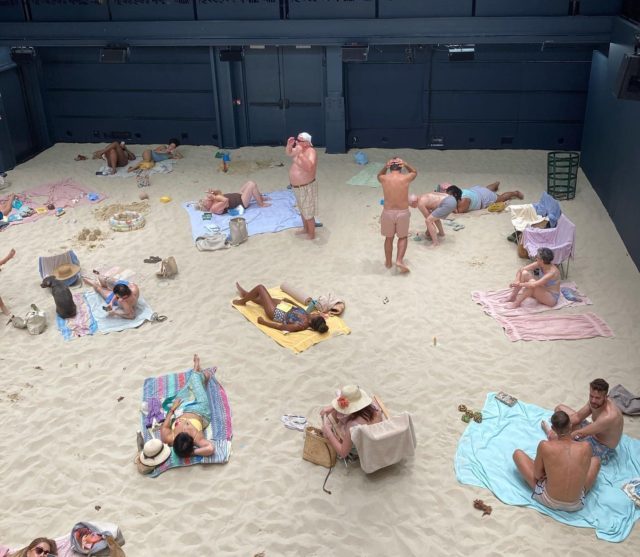
featured

INAUGURAL DRAMA BOOK SHOP IN-PERSON SIGNING — IN THE HEIGHTS: FINDING HOME

Who: Lin-Manuel Miranda, Quiara Alegría Hudes, Jeremy McCarter
What: Book signing
Where: The Drama Book Shop, 266 West Thirty-Ninth St. between Seventh & Eighth Aves.
When: Wednesday, July 21, 2:00 (tickets on sale Friday, July 16, 10:00 am)
Why: In 2002, a theater group started rehearsing a new musical in the tiny Arthur Seelen Theatre in the basement of the Drama Book Shop, which was founded in 1917 by the Drama League and was bought by Arthur and Rozanne Seelen in 1958. With the future of the beloved store in jeopardy, it was purchased in January 2019 by two of the primaries involved with that rehearsal, director Thomas Kail and writer Lin-Manuel Miranda, along with producer Jeffrey Seller and theater impresario James L. Nederlander. The production was In the Heights, cowritten by Quiara Alegría Hudes, the Broadway smash that was nominated for thirteen Tonys and won four, including Best Musical. Delayed by the pandemic lockdown, the new store, designed by David Korins, opened June 10 on West Thirty-Ninth St., and it is celebrating with its first in-store book signing, a rather big one.

On July 21 at 2:00, composer-lyricist-star Miranda, librettist Hudes, and theater writer Jeremy McCarter will be signing copies of their new tome, In the Heights: Finding Home (Penguin Random House, June 2021, $40), following up on the virtual launch that took place last month. The book opens with an introduction by McCarter that begins, “The actors took their bows, the crowd finished cheering, and everybody headed for the doors. Spotting a friend, I cut across the lobby. I asked, Did you just see what I just saw? Or words to that effect. It’s been fourteen years, so I can’t remember exactly what I said that night. But I do remember exactly how In the Heights made me feel.” The show was turned into a major motion picture that was released on June 10, in theaters and on HBO Max, to wide acclaim and a casting controversy. Limited tickets for the bookstore event, in which the authors will not sign anything other than the books and no photos with them are allowed, go on sale July 16 at 10:00 am, and they’re likely to go fast, so don’t hesitate if you want to keep sharing that feeling.

CAN YOU BRING IT: BILL T. JONES AND D-MAN IN THE WATERS

Documentary explores the creation and legacy of Bill T. Jones/Arnie Zane Company’s D-Man in the Waters (photo courtesy Rosalynde LeBlanc)

CAN YOU BRING IT: BILL T. JONES AND D-MAN IN THE WATERS (Rosalynde LeBlanc & Tom Hurwitz, 2020)
Film Forum
209 West Houston St.
Opens Friday, July 16
212-727-8110
www.d-mandocumentary.com
filmforum.org

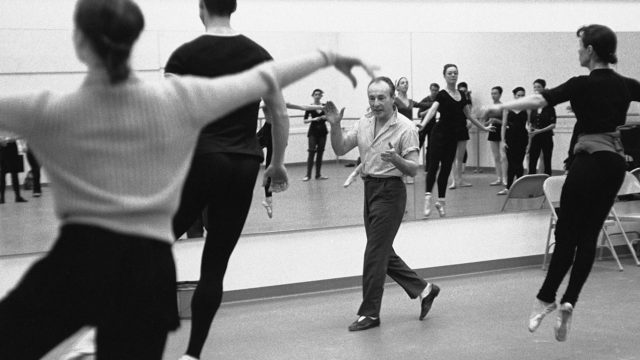
In 1989, the Bill T. Jones/Arnie Zane Company presented the world premiere of D-Man in the Waters at the prestigious Joyce Theater in New York City, a physically demanding, emotional work born out of the AIDS crisis, dealing with tragedy and loss in the wake of the death of Zane, Jones’s personal and professional partner, at the age of thirty-nine in 1988. Directors Rosalynde LeBlanc and Tom Hurwitz take a deep dive into the history of the dance and its lasting impact more than thirty years later in the captivating documentary Can You Bring It: Bill T. Jones and D-Man in the Waters, opening July 16 at Film Forum.

“What is D-Man? Is it alive now? Is it a cautionary tale? Is it one of inspiration?” Jones tells fifteen Loyola Marymount dancers who are staging the piece under the direction of LeBlanc, a former company member who runs the Jones/Zane Educational Partnership at the school, where she is an associate professor in the Department of Dance. Jones continues, “Makes you want to get all your shit together, your community together, take responsibility, be beautiful, be fierce — is that what it is? I don’t know what it is. . . . What do they share that is so big, so tragic that you need a piece like this to move it and give it body?”

LeBlanc, who also produced the film, and two-time Emmy-winning cinematographer Hurwitz, the son of longtime Martha Graham dancer, choreographer, and teacher Jane Dudley, talk to most of the original cast of D-Man, many of whom have gone on to form their own companies: Arthur Avilés, Seán Curran, Lawrence Goldhuber, Gregg Hubbard, Heidi Latsky, Janet Lilly, and Betsy McCracken, who, along with Jones and his sister Johari Briggs, share intimate stories of working with Jones and Zane and the importance of the piece as the arts community was being ravaged by AIDS. Sometimes holding back tears, they speak lovingly of Zane and Demian Acquavella, nicknamed “D-Man,” who died at the age of thirty-two in 1990. “He was always a boy, but always a bit of a devilish boy, and the dancing was also that way,” Jones remembers.

Through new and old interviews, home video and archival photographs, and exciting footage from the dance’s original rehearsals and Joyce premiere, LeBlanc, Hurwitz, and editor Ann Collins choreograph a gracefully flowing, compelling narrative as the documentary participants discuss specific movements — Latsky’s attempts at a jump and Curran’s memories of a duet with Acquavella in which their foreheads have to keep touching are wonderful — and LeBlanc tries to reach inside the Loyola Marymount performers to motivate them. They might have the movement down, but D-Man requires more than that to be successful. “Do you dare to let the stakes really be high?” she asks as they search for contemporary issues that impact them similarly to how AIDS affected the creation of the work, which is set to Felix Mendelssohn’s 1825 Octet for Strings, which the German composer wrote at the age of sixteen. “There was some healing, cathartic ritual in the making and the doing of this dance that sustained us,” Curran says, a feeling LeBlanc wants to instill in the college students.

“This work is not about anybody’s epidemic,” Jones, a Kennedy Center Honoree, MacArthur Grant awardee, and Tony winner who is the artistic director of New York Live Arts, said in a statement about the film. “It is about the dark spirit of what is happening in the world and how you push back against it.” Can You Bring It: Bill T. Jones and D-Man in the Waters gets to the heart of that spirit by revealing the legacy, and the future, of a seminal dance piece that continues to find its place on an ever-evolving planet.

LeBlanc and Hurwitz will be at Film Forum to discuss the film at the 7:00 shows on July 16 and 17 and will participate in a live, virtual Q&A with Jones at 8:00 on July 21. Jones, whose riveting Afterwardsness at Park Avenue Armory in May explored the Covid-19 pandemic, isolation, and racial injustice, will return to the space this fall with Deep Blue Sea, a monumental work for more than one hundred community members and dancers that begins with a solo by Jones and incorporates texts by Martin Luther King Jr. and Herman Melville, with water again playing a critical role.

ICE FACTORY 2021

ICE FACTORY
New Ohio Theatre
154 Christopher St.
Through August 14, $18-$29
newohiotheatre.org

New Ohio Theatre’s twenty-eighth-annual Ice Factory Festival got under way June 30 – July 3 with The Extremely Grey Line from 23.5°, which could be experienced on bikes, as a walking tour, or in the theater, followed July 7-10 by Lisa Helmi Johanson and Kimberly Immanuel’s Kim Loo Gets a Redo, inspired by the real-life jazz quartet the Kim Loo Sisters. You might have missed those two, but there is plenty more to see; the Obie-winning festival runs through August 14. Al Límite Collective’s Liminal Archive (July 14-17) is a forty-five-minute multimedia immersive journey that takes you back to the beginnings of the pandemic, featuring works by such artists as Cypress Atlas, Arthur Ban, Toney Brown, Katya Chizhayeva, Caio D’aguilar, Jessica Daugherty, and Sissy Doutsiou, from across the United States as well as Greece, Brazil, Mexico, Colombia, and other countries.

Dow-Dance explores radical Black love and Sundown Towns in As the Sun Sets (July 21-24), performed by Imani Gaudin-County, Andy Guzmán, Jai Perez, and company founder and choreographer Caleb Dowden. Teatro Dallas’s A Grave Is Given Supper (July 28-31) is a one-person Narco-Acid Western set in a US-Mexico border town, written by Mike Soto, directed by Claudia Acosta, and performed by Elena Hurst. An inheritance brings together a pair of strangers (Laura Butler-Levitt and Heather Hollingsworth) in In Tandem Lab’s Herstory (August 4-7). Daniel Irizarry directs and stars in My Onliness (August 11-14) from One-Eighth Theatre, with text by Robert Lyons and music by Kamala Sankaram. Over the course of the festival, the solo interactive sound installation Endless Loop of Gratitude, created by Broken Chord, Steph Ferreira, Jackson Gay, Steven Padla, Riw Rakkulchon, and Ashley M. Thomas, invites visitors up to a microphone to answer the question: “What are you really grateful for?” We’re really grateful for the return of indoor theater and affordable summer festivals such as Ice Factory. (To enter the New Ohio, you have to show proof of vaccination or a negative Covid test from the past seventy-two hours, and the audience must wear masks.)

ACROSS THE MacDOWELL DINNER TABLE: EXCELLENCE, AESTHETICS, AND VALUE

Who: Nell Painter, Linda Harrison, Joyce Kozloff, Garth Greenan
What: Livestreamed discussion
Where: 92Y online
When: Thursday, July 15, free with advance RSVP, 7:00
Why: For more than a century, artists of all disciplines have come to MacDowell to create works in residency in a welcoming New Hampshire community. (It was previously known as the MacDowell Colony, but the name was changed in 2020 because of the its oppressive overtones.) MacDowell Fellows have included James Baldwin, Meredith Monk, Thornton Wilder, Leonard Bernstein, Suzan-Lori Parks, Studs Terkel, Ruth Reichl, and Jonathan Franzen. On July 15 at 7:00, the 92nd St. Y is hosting the free virtual discussion “Across the MacDowell Dinner Table: Excellence, Aesthetics, and Value,” with Newark Museum director and CEO Linda Harrison, visual artist Joyce Kozloff, and gallerist Garth Greenan, moderated by artist, author, and board chair Nell Painter. They will consider the past, present, and future of MacDowell and its place in a quickly changing art world. The Garth Greenan Gallery is currently showing “Alexis Smith: Not in Utopia” through July 30; the Newark Museum has on view “Anual de Artes de Nueva Jersey 2021: ReVisión y Respuesta,” “Four Quiltmakers, Four American Stories,” and “Wolfgang Gil: Sonic Geometries”; and Kozloff’s “Uncivil Wars,” in which she repurposes Civil War battle maps by incorporating images of viruses, runs through August 13 at DC Moore. Kozloff will be at the gallery to talk about the exhibition on July 21 at 6:00 as part of the free ADAA Chelsea Gallery Walk.

SHAKESPEARE IN THE PARKING LOT: TWO NOBLE KINSMEN

The Drilling Company will be back in the Clemente parking lot and Bryant Park with free presentation of Two Noble Kinsmen (photo by Hamilton Clancy)

Who: The Drilling Company
What: Free summer Shakespeare
Where: Parking lot of the Clemente, 107 Suffolk St., and Bryant Park
When: July 15-30, free, 7:00 or 7:30
Why: Indoor theater is back after the pandemic lockdown, and so is outdoor theater, including free summer Shakespeare, a birthright of New Yorkers. Among the many entries this season is the beloved Shakespeare in the Parking Lot, which has been presented by the Drilling Company since 1995. This year the troupe is staging the rarely performed Two Noble Kinsmen, what might be William Shakespeare’s final work, a collaboration with John Fletcher based on Geoffrey Chaucer’s “The Knight’s Tale” from The Canterbury Tales. Founding artistic director Hamilton Clancy has reimagined the play, which is set in the aftermath of a war between Athens and Thebes, as a contemporary drama involving Russian spies, Interpol, and corporate espionage. The two-hour show, which stars Brad Frost as Palemon, Jane Bradley as the Jailer’s Daughter, John Caliendo as Arsite, and Liz Livingston as Emilia, with Lucas Rafael, Mary Linehan, Jaqwan Turner, and Remy Souchon, will take place July 15-17 and 28-30 in the Clemente parking lot and July 19-21 in Bryant Park, with admission first come, first served.

STOP AAPI HATE: A GENTLEMAN’S GUIDE TO LOVE AND MURDER

Abridged online version of A Gentleman’s Guide to Love and Murder benefits Stop AAPI Hate

Who: Lea Salonga, Ali Ewoldt, Diana Phelan, Thom Sesma, Cindy Cheung, Karl Josef Co
What: All-Asian-American abridged online version of A Gentleman’s Guide to Love and Murder
Where: Broadway on Demand
When: July 15-22, pay-what-you-wish (suggested donation $20.14 – $1,000)
Why: On May 19, the National Asian American Theatre Company held a one-time-only virtual benefit reading of Thornton Wilder’s Our Town, featuring an all-Asian-American cast. Now CollaborAzian and Broadway on Demand are teaming up for an online version of Robert L. Freedman and Steven Lutvak’s A Gentleman’s Guide to Love and Murder that will benefit Stop AAPI Hate, which “tracks and responds to incidents of hate, violence, harassment, discrimination, shunning, and child bullying against Asian Americans and Pacific Islanders in the United States.” An abridged adaptation of the Broadway musical that was nominated for ten Tonys, winning three (Best Musical, Best Book of a Musical, and Best Direction of a Musical), the show will be available July 15-22. The story, based on the 1907 novel Israel Rank: The Autobiography of a Criminal by Roy Horniman and the 1949 British film Kind Hearts and Coronets, follows the exploits of a man ninth in the line of succession to his family’s dukedom who decides to get rid of the eight people above him and grab the crown for himself as revenge for how his mother was treated by them. Thom Sesma plays the endangered members of the D’Ysquith clan, with Cindy Cheung as Ms. Shingle and others, Ali Ewoldt as Phoebe D’Ysquith, producer Karl Josef Co as Monty Navarro, and producer Diane Phelan as Sibella Hallward; hosted by Tony winner Lea Salonga, the presentation is directed by Alan Muraoka, who has played Alan, the owner of Hooper’s Store on Sesame Street, for more than two decades, with music direction by Steven Cuevas, costumes by Carla Posada, props by Alesha Borbo Kilayko, and audio engineering by Jonathan Cuevas.

“Historically, Asian American artists have been marginalized in media and on stage, and productions like this help to spotlight the tremendous talent that has been overlooked. We’re here to show the world that we are here, and we are fantastic,” Salonga said in a statement. The event is being held in conjunction with the Coalition of Asian Pacifics in Entertainment, the Broadway Diversity Project, Unapologetically Asian, Leviathan Labs, Chinosity, and Tremendous Communications.

THE GARDEN

Caroline Stefanie Clay and Charlayne Woodard play a mother and daughter reconnecting in The Garden (photo by J Fannon)

THE GARDEN
Baltimore Center Stage
Through July 18, $15-$40
www.centerstage.org

This past April, Manhattan Theatre Club presented a virtual version of Charlayne Woodard’s solo play Neat as part of its Curtain Call series; the autobiographical work, written and performed by Woodard, had debuted on MTC’s stage in 1997. Recorded from her home for the online version, Neat tells the story of Woodard’s coming-of-age in Albany in the 1970s, when she was a teenager and her disabled aunt, Neat, came to live with her family. Woodard has also delved into her past and present in Flight, In Real Life, and Pretty Fire, while The Night Watcher was based on actual slave narratives.

Woodard returns to the stage in The Garden, a La Jolla Playhouse commission filmed live at Baltimore Center Stage and streaming through July 18. Woodard stars as Cassandra, a middle-aged woman who is visiting her mother, Claire Rose (Caroline Stefanie Clay), for the first time in three years. They are so estranged that Cassandra uses her mother’s given name, refusing to call her “mother” or any other similar appellation. Sneaking up on her as the play starts, Cassandra says, “Claire Rose, Claire Rose, Claire Rose, Claire Rose! I’m sorry! Oh my God! I didn’t mean to frighten you! I’m sorry! Please? It’s just me. Claire Rose, Claire Rose, please!!!” Her mother replies, “I was beginning to think I might never see you again.”

Over the course of seventy-five minutes, mother and daughter bring up past wrongs, explore what tore them apart, and reveal deeply emotional secrets that might bring them back together. The show takes place in a large garden created by Tony-winning set designer Rachel Hauck, featuring pinkeye purple hull peas, crookneck squash, Swiss chard, mustard greens, and turnip greens in numerous floor boxes and a small greenhouse. Claire Rose might live by herself, but she does not consider herself lonely. Answering her phone, Claire Rose says to the person on the other end of the line, “I am not at all alone. I’m in my garden.” Later, she tells Cassandra, “All I can say is this particular morning, I need the peace my garden brings me.”

The garden is an apt metaphor for the lives Claire Rose and Cassandra are living and the concepts of “home” and being “uprooted,” representing elements they personally chose to grow as well as those that were forced upon them, out of their control, especially when it comes to race. “This day . . . I believe this day is different from all the rest,” Cassandra says. Claire Rose responds, “Different from all the rest. . . . I don’t know. But I turned on CNN, the BBC. I turned on Fox News, only to find out things are far worse today than they were yesterday! My big question is why are we going backwards in this country. Pretty soon Black folk will be back at the voting booth, guessing how many jelly beans are in the jar —” Cassandra cuts her off, declaring, “— Very true. These are frightening times. But I didn’t come three thousand miles to discuss . . . voter suppression. I suggest you stay away from the twenty-four-hour news cycle, anyway—” This time Claire Rose cuts her daughter off, proclaiming, “—Oh, no. We can’t afford to live in a bubble. They are coming for us, Cassandra! It’s time to be vigilant. You don’t want to find yourself living like Negroes had to live back in the ’40s and ’50s. This country was a misery back then. . . . Oh, yes. Good ole’ racism. It is and always has been alive and kicking.”

Charlayne Woodard wrote and stars in Baltimore Center Stage streaming production of The Garden (photo by J Fannon)

Claire Rose and Cassandra each share horrifying, tragic stories from their past, which get to the heart of their fractured relationship, in need of serious tending. Cassandra is defiant in explaining that she felt her mother cared more for the garden than for her children, imploring, “Claire Rose . . . you are so generous, so nurturing every step of the way with this garden. April to October. Whether there’s too much rain or freezing temperatures. This garden never gets on your nerves. Me, Rachel, Isaiah, even Pop-Pop — we’ve all been competing with this garden. I have always done the best I could to be a good daughter. But you left me out of it. My shrink says —” An adamant Claire Rose defends herself: “This garden is between me and my God. Competing with my garden? That’s as silly as me competing with your career. Who does that? If you choose to be jealous of some beets and some eggplant and my heirloom tomatoes, maybe that’s a topic to bring up with your shrink.” It all leads to a haunting, unforgettable finale.

Filmed by David Lee Roberts Jr. with camera operators Darius Moore and Taja Copeland, The Garden is directed with a compelling green thumb by Patricia McGregor (Hamlet, Hurt Village), who allows the actors, who occasionally break the fourth wall, time and room to grow as the narrative unfolds. Two-time Obie winner and Tony nominee Woodard (Jeremy O. Harris’s “Daddy,” Lynn Nottage’s Fabulation, or The Re-Education of Undine) and Clay (Lillian Hellman’s The Little Foxes, Adrienne Kennedy’s Etta and Ella on the Upper West Side) cultivate a potent and powerful chemistry as a daughter and mother who have never quite understood each other but are more alike than they realize.

It’s a gripping story that blossoms at just the right moment in time, tackling issues of loss and isolation as we emerge from the pandemic lockdown and family and friends meet up in person for the first time in more than a year in a country dangerously polarized by social injustice, police brutality, and health and economic crises that disproportionately affect people of color. In her 1983 book In Search of Our Mothers’ Gardens, Pulitzer Prize winner Alice Walker wrote, “Guided by my heritage of a love of beauty and a respect for strength — in search of my mother’s garden, I found my own.” Those words ring as true as ever in 2021, embodied in Woodard’s moving, heartrending play.