featured

2021 CAT FILM FESTIVAL

2021 CAT FILM FESTIVAL
Village East by Angelika
181-189 2nd Ave. at Twelfth St.
Saturday, October 16, $20, noon
www.angelikafilmcenter.com/villageeast
catfilmfestival.com

During times of strife, especially amid the tumult of social media, many of us seek solace in cat videos. There’s just something about the tricky little devils riding Roombas, squeezing into ridiculously tight spaces, sneaking up on us like ninjas, and jumping and climbing everywhere that soothes our souls. “There are two means of refuge from the miseries of life: music and cats,” polymath Albert Schweitzer said. Cat fanciers — and dog lovers too — can find refuge from the maelstrom on October 16 when the Cat Film Festival purrs up to Village East for its 2021 iteration on Global Cat Day, October 16. Screening at noon, the ninety-minute program features twenty-one shorts, not random cat videos but stories with narrative arcs, from the United States, Australia, Turkey, and Canada.

Among the entries in the fourth annual festival are Bob Finkelstein’s Zack the Movie, about a neglected house cat dreaming of so much more; Susku Ekim Kaya’s Will You Be My Quarantine?; Andrew Graham’s documentary Winston the Cat Who Couldn’t Pee, about a kitty with a bladder problem; Nevada Caldwell’s hard-boiled Feline Noir; MK Ghonima’s Nauticats, which takes place aboard a ship at sea; Priscilla Dean’s meow-Western Catfight at the Okay Corral; Kim Best’s The Great Escape, in which a cat is suffering from cabin fever; Andrew Volpe’s Cat Scratch Fever, in which a cat becomes a DJ; and Asali Echols’s House Cats, about a cat who is not necessarily thrilled that the human he rules is suddenly always around. As French writer Champfleury duly summed up, “A kitten is the delight of a household. All day long a comedy is played out by an incomparable actor.”

MoMA SCULPTURE GARDEN: AUTOMANIA

Four classy cars will be parked in MoMA’s sculpture garden through October 15 as part of “Automania” (photo by twi-ny/mdr)

AUTOMANIA
Museum of Modern Art
The Abby Aldrich Rockefeller Sculpture Garden
West 54th St. between Fifth & Sixth Aves.
Through October 15
www.moma.org
online slideshow

You better rev it up and go if you want to catch the part of MoMA’s current “Automania” exhibition that is parked in the Abby Aldrich Rockefeller Sculpture Garden, as it will be pulling out at the end of the week.

In 1998, the Guggenheim presented “The Art of the Motorcycle,” a survey of the history of two-wheeled motorized transport, a show that was greeted with a significant amount of disdain for elevating a vehicle into the realm of fine art. On July 4, MoMA opened “Automania,” which includes nine cars and an Airstream in addition to lithographs, posters, photographs, signs, books, paintings, short films, and other ephemera. Four of the cars are on view through October 15 in the sculpture garden, alongside Henri Matisse’s The Back I-IV, Aristide Maillol’s The River, Alexander Calder’s Man-Eater with Pennants, and Isa Genzken’s Rose II.

“Automania” features such colorful vehicles as a 2002 Smart Car Coupé (photo by twi-ny/mdr)

Joining those familiar works are a 2002 Smart Car Coupé, a 1973 Citroën DS 23 Sedan, a 1953 Jeep M-38A1 Utility Truck, a 1965 Porsche 911 Coupé, and a 1968 Fiat 500f City Car. Just outside the entrance to the garden is a 1990 Ferrari Formula 1 Racing Car. Each vehicle is accompanied by a label and audio guide entry detailing its creation and use. “Commonly referred to as the Cincquecento, the Nuova 500 is a compact, rear-engine city car that helped make automobile ownership attainable for an Italian public recovering from the economic devastation of World War II,” the text for the Fiat explains. On the third floor you’ll find a 1963 Airstream Bambi Travel Trailer, a 1946 Cisitalia 202 GT Car, a 1963 E-Type Roadster, and a 1959 Volkswagen Type 1 Sedan.

While making your way through the exhibit, you can listen to “I’m in Love with My Car: An Automania Driving Mix” a playlist that includes songs by Grace Jones, Yo La Tengo, Chuck Berry, War, the Beach Boys, Tracy Chapman, Prince, Buzzcocks, the Beatles, Public Enemy, Bruce Springsteen, the Rolling Stones, and others.

CHICKEN & BISCUITS

A family gathers to say farewell to its patriarch in madcap Chicken & Biscuits (photo © Emilio Madrid)

Circle in the Square Theatre
1633 Broadway at 50th St.
Through January 2, $69.50
chickenandbiscuitsbway.com

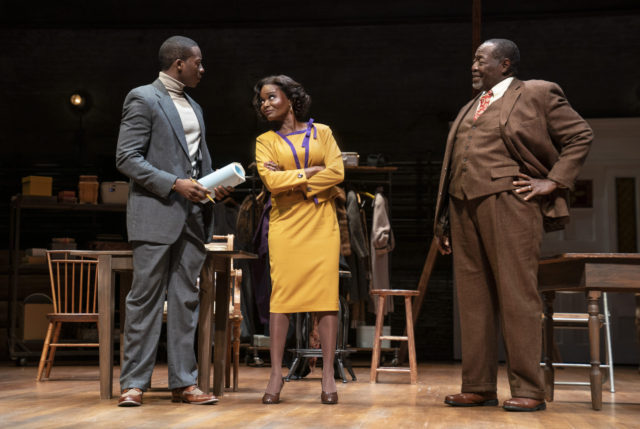
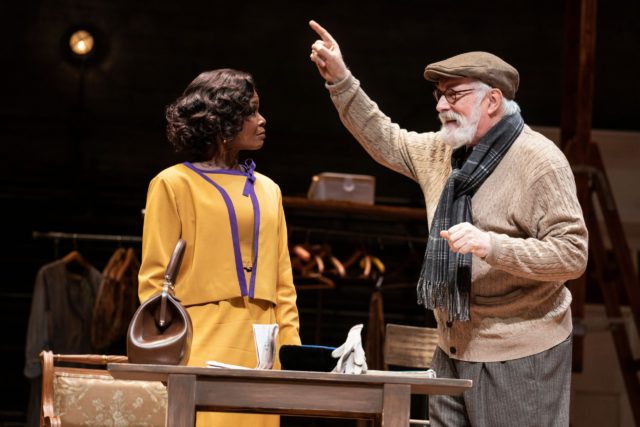
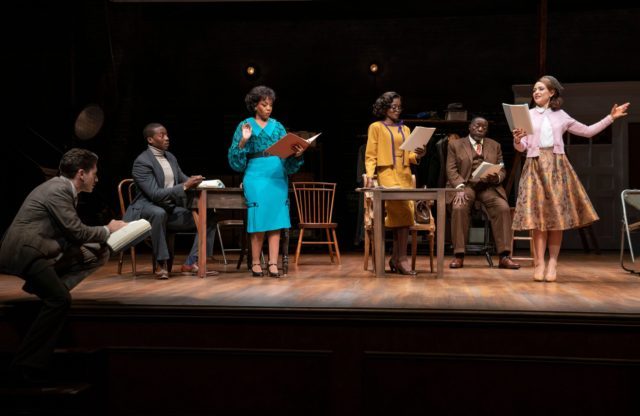
I was in serious need of some unabashed laughter when I entered Circle in the Square last week, and that’s precisely what writer Douglas Lyons, director Zhailon Levingston, and a fab cast of eight delivered with the madcap comedy Chicken & Biscuits. It’s a divine stew of familiar plot points stirred together in an appealing way, set in a vibrant Black church community, a throwback to the popular crowd pleasers of the 1930s to 1960s that have been popularized more recently by Tyler Perry onstage and onscreen.

Much of the cast and crew are making their Broadway debuts, so the play gets a bit ragged and repetitive at times and is too long at more than two hours, but it’s a ton of fun nonetheless. Set designer Lawrence E. Moten III has transformed the intimate space into St. Luke’s Church in New Haven, with four mobile pews, stained-glass windows, and a pair of kitschy religious portraits. The patriarch of the Jenkins family, Father Bernard, has passed on, and his relatives are gathering to send him off to his beloved late wife in style. Well, kind of.

New pastor Reginald Mabry (Norm Lewis), the husband of Bernard’s oldest daughter, the God-fearing Baneatta (Cleo King), is worried about the eulogy he is preparing, while Baneatta is not looking forward to seeing her sister, the hard-partying, loud, and demonstrative Beverly (Ebony Marshall-Oliver), who arrives with her soon-to-be-sixteen-year-old, glued-to-her-smartphone daughter, the sarcastic La’Trice Franklin (Aigner Mizzelle).

Baneatta is none-too-happy that her son, Kenny (Devere Isaac Rogers), has brought his boyfriend, the white, Jewish nerd Logan (Michael Urie), who has no idea what he’s gotten himself into. Kenny’s older sister, Simone (Alana Raquel Bowers), shows up solo.

“Lord . . . please give me your strength on today,” Baneatta says at the beginning. “Bless me with your patience to deal with my family, for they know not what they do. Lord, help me keep my eyeballs rolled forward, as they have a tendency to roll backwards around foolishness. And Lord, keep me from strangling my baby sister, no matter how much she tests me. For you and I both know . . . she’ll try it. Keep all things unlike you at bay.”

Circle in the Square is transformed into a church in Chicken & Biscuits (photo © Emilio Madrid)

A hilarious farce ensues, as the funeral attendees cut one another down and their private aspirations pop out all over. Wearing a glittering, tight outfit more appropriate for a sleazy nightclub, Beverly tells La’Trice, “They say the best place to find a husband is inside God’s house, and that’s exactly what Beverly will be doing. ’Cause your triflin’ daddy ain’t good for nothing but his child support check, so every new day is an opportunitay.” La’Trice asks, “Even at Grandpa’s funeral?” Beverly responds, “It ain’t a funeral, it’s a celebration! That’s the problem with Black folk, our mindset, always stuck in tradition. Why we gotta wear black, huh? We already Black! We should be honoring my daddy in style, color! Hell, canary yellow was his favorite, and he wore it like a pimp. Shit, he taught me good fashion!”

Logan, a kind of onstage representative of the white theatergoing audience that suddenly finds themselves inside a Black church, says to Kenny, “I’m penetrating a private cultural tradition.” Kenny asks, “Why penetrating?” Logan answers, “It’s like a reverse Get Out, and we all know how that ended.”

The plot thickens when a mysterious woman (NaTasha Yvette Williams) steps up to the pulpit to share her thoughts about Bernard, and all hell breaks loose.

Dede Ayite’s ebullient costumes and Nikiya Mathis’s spectacular wig, hair, and makeup design are key ingredients in Chicken & Biscuits, adding plenty of sweetness and spice. The cast, led by Lewis (Porgy and Bess, The Phantom of the Opera) in his first Broadway nonmusical and King (Jelly’s Last Jam, Beau) in her Great White Way bow, is clearly having a ball, keeping the audience howling with laughter and breaking into spontaneous applause — as well as shouts as if we were all at Sunday service. “Why is everyone screaming at him?” Logan asks Kenny during a call-and-response part of Reginald’s sermon. Sure, it can get too sitcomy, but so what? Not all of the courses are delicious, but there are more than enough savory moments to make the show worthy of a very favorable Yelp review.

The last time I was at Circle in the Square was for Daniel Fish’s controversial Oklahoma!, which included free chili for everyone at intermission. Alas, there are no chicken and biscuits for the audience in Chicken & Biscuits, but there are plenty of tasty treats to satisfy the soul.

TODD HAYNES: THE VELVET UNDERGROUND

Todd Haynes tells the true story of the Velvet Underground in new documentary opening at Film Forum

THE VELVET UNDERGROUND (Todd Haynes, 2021)
Film Forum
209 West Houston St.
Opens Wednesday, October 13
212-727-8110
filmforum.org

The Velvet Underground was more than just a music group; they electrified a generation, and continue to do so today, half a century later. Todd Haynes, whose 1998 Velvet Goldmine was set in the world of glam rock and whose 2007 I’m Not There explored the career of Bob Dylan through six characters and a nonlinear narrative, now turns his attention to the true story behind the Velvets. Haynes details the history of the band by delving into leaders John Cale and Lou Reed’s initial meeting, the formation of the Primitives with conceptual artists Tony Conrad and Walter DeMaria, and the transformation into the seminal VU lineup at the Factory under Pop icon Andy Warhol’s guidance: singer-songwriter-guitarist Reed, Welsh experimental composer and multi-instrumentalist Cale, guitarist Sterling Morrison, drummer Maureen Tucker, and German vocalist Nico. Much of Haynes’s documentary focuses on Warhol’s position in helping develop and promote the Velvets. “Andy was extraordinary, and I honestly don’t think these things could have occurred without Andy,” Reed, who died in 2013, says. “I don’t know if we would have gotten the contract if he hadn’t said he’d do the cover or if Nico wasn’t so beautiful.”

Haynes and editors Affonso Gonçalves and Adam Kurnitz pace the film like VU’s songs and overall career, as they cut between new and old interviews and dazzling archival photographs and video, frantic and chaotic at first, then slowing down as things change drastically for the band They employ split screens, usually two but up to twelve boxes at a time, to deluge the viewer with a barrage of sound and image. Among the talking heads in the film are composer and Dream Syndicate founder La Monte Young, actress and film critic Amy Taubin, actress and author Mary Woronov, Reed’s sister Merrill Reed-Weiner, early Reed bandmates and school friends Allan Hyman and Richard Mishkin, filmmaker and author John Waters, manager and publicist Danny Fields, composer and philosopher Henry Flynt, and avant-garde filmmaker and poet Jonas Mekas. “We are not part really of the subculture or counterculture. We are the culture!” Mekas, who passed away in 2019 at the age of ninety-six, declares.

Haynes also talks extensively with Cale and Tucker, who hold nothing back, in addition to Morrison’s widow, Martha Morrison; singer-songwriter Jackson Browne, who opened up for the Velvets back in their heyday; and big-time fan Jonathan Richman (of Modern Lovers fame). While everyone shares their thoughts about Warhol, the Factory, the Exploding Plastic Inevitable shows, and the eventual dissolution of the band, Haynes bombards us with clips from Warhol’s Sleep, Kiss, Empire, and Screen Tests (many opposite the people who appear in the film) as well as works by such artists as Maya Deren, Jack Smith, Kenneth Anger, Barbara Rubin, Tony Oursler, Stan Brakhage, and Mekas and paintings by Warhol, Jasper Johns, Robert Rauschenberg, and Mark Rothko. It’s a dizzying array that aligns with such VU classics as “I’ll Be Your Mirror,” “I’m Waiting for the Man,” “Heroin,” “White Light / White Heat,” “Sister Ray,” “Pale Blue Eyes,” and “Sweet Jane.”

Several speakers disparage the Flower Power era, Bill Graham, and Frank Zappa and the Mothers of Invention, with Tucker admitting, “This love-peace crap, we hated that. Get real.” They’re also honest about the group’s own success, or lack thereof. Tucker remembers at their first shows, “We used to joke around and say, ‘Well, how many people left?’ ‘About half.’ ‘Oh, we must have been good tonight.’” And there is no love lost for Reed, who was not the warmest and most considerate of colleagues.

The Velvets still maintain a remarkable influence on music and art today despite having recorded only two albums with Cale (The Velvet Underground and Nico and White Light / White Heat) and two with Doug Yule replacing Cale (The Velvet Underground and Loaded) in a span of only three years. (For example, the tribute album I’ll Be Your Mirror was released in September, featuring VU covers by Michael Stipe, Matt Berninger, Andrew Bird & Lucius, Kurt Vile, St. Vincent & Thomas Bartlett, Thurston Moore & Bobby Gillespie, Courtney Barnett, Iggy Pop & Matt Sweeney, and others.) Haynes (Far from Heaven, Safe) sucks us right into their extraordinary orbit and keeps us swirling in it for two glorious hours of music, gossip, art, celebrity, and backstabbing. The documentary, which premiered earlier this month at the New York Film Festival, opens at Film Forum on October 13 and begins streaming on Apple+ two days later. If you end up watching the film at home, turn it up loud. No, louder than that. Even louder. . . .

[Film Forum will be hosting Q&As with Gonçalves and Kurnitz on October 14 and 16 following the 7:50 shows, and Taubin will introduce the 7:50 screening on October 15. In addition, Haynes will join Gonçalves and Kurnitz at Film Forum for the 7:50 screening on November 12.]

POLYLOGUES

Xandra Nur Clark wrote and stars in one-person show about ethical nonmonogamy (photo by Ashley Garrett)

HERE Arts Center
145 Sixth Ave.
In person through October 9, $40
On-demand streaming through October 13, $20-$25
here.org/shows
www.polyloguesplay.com

A few years ago, a friend of mine told me that his girlfriend had just explained to him that she was polyamorous. I had not heard that term before, and he wasn’t quite sure what it meant either, but it wasn’t merely that his partner wanted an open relationship so she could see other people. It went well beyond that.

Writer and performer Xandra Nur Clark explores the reality of polyamory in the insightful one-person show, Polylogues. The seventy-five-minute piece of documentary theater has just finished its run at HERE Arts Center and is available on demand through October 13. Clark, a queer Indian American community builder who studied with Anna Deavere Smith, interviewed more than fifty people over three years about ethical nonmonogamy, ranging in age from five to seventy-five, from eleven different countries and numerous races, religions, socioeconomic backgrounds, and political perspectives. Clark wears earphones during the Colt Coeur production, listening to the actual words spoken by the subjects and enacting them for the audience, which sits on three sides of Clark, who doesn’t do a deep dive into each character but embodies them with small differences in tonality and gestures. The characters are either the one who initiated the idea of nonmonogamy in the relationship, the one who was asked to consider it, or had nonmonogamous parents. In some cases they are happy with their decision to participate, but in others it either goes awry or they appear to be trying too hard to defend and rationalize their choices.

Ryan points out, “I’m not behaving like a quote unquote normal person would behave in this situation.” Shamma offers, “When you spend your whole life as a cheater, right? You’re doing it to fulfill a certain insecurity that you have in the, you know, a gap that you have in the relationship?
So you go to the next person to fill that gap. . . . Why can’t this be a new form of family?!” Trudy refers to the additional person as a “love friend.”

Casius says, “Most people think polyamory is just like about having orgies! . . . It’s like being willing to do anything for another person no matter what!” Jackson declares, “You know, I’m not a fucking toy! You know, like, I’m a person. And it’s not that we couldn’t have made a very casual arrangement, but, like, I need to have some autonomy in that decision!

K, a Muslim from Malaysia, where men can have multiple wives, asserts, “Nonmonogamy interacting with male privilege, or interacting with capitalism, can, like, produce some really, like, frightening dynamics. . . . And finding ways to self-limit that in my nonmonogamy practice is . . .
important to me. To ensure I’m not trying to . . . I don’t know, like, build a . . . mmm, I don’t know . . . build a harem or something.”

Xandra Nur Clark embodies multiple characters involved in polyamorous relationships (photo by Ashley Garrett)

The issue of jealousy comes up numerous times. Alex admits, “I’m not okay with him with another girl other than his wife, but I’m okay with him with his w-wife. I want it — this one, this one guy love me with his full heart, everything. But meanwhile, I still got freedom to choose someone else!” And CJ concedes, “I’m fine with being with one person. But I always want to make sure that the other person doesn’t feel an obligation to me. I don’t want you to feel like you’re stuck with me.” She later adds, “It’s just like,
well, I’ll just — if this is just a little piece of it, I can get through nonmonogamy, I’ll take this little piece. Or like, if we’re ‘n a . . . nonmonogamous relationship, you can’t break my heart. But, maybe I just equate breaking my heart with cheating on me.”

Directed by Molly Clifford (Karaoke, Soldier), who introduces the piece in a clever way that prepares everyone for what is to follow, Polylogues begins with a stream of questions and statements on the wall behind Clark, including the key one: “How do you experience love in your life?” Clark (Everything You’re Told, Separated) is charming as she embodies the diverse characters, displaying a relaxing demeanor that brings ease and comfort to an audience that most likely doesn’t understand the complexities of modern-day ethical nonmonogamy, a term I had not encountered until seeing this show. You’re likely to be enticed by the play, if not polyamory itself, although I’m not sure my friend is ready to hear more about it just yet.

TWI-NY TALK: ANTHONY BARILE / 1-2-3 MANHUNT

Anthony Barile with Ilene Kristen in Tony DiMurro’s 1-2-3 Manhunt, opening October 10 at Theater for the New City

1-2-3 MANHUNT
Theater for the New City
155 First Ave. between Ninth & Tenth Sts.
Thursday – Sunday through October 24, $15-$18
theaterforthenewcity.net
www.123manhunt.com

“I really thought I had a place in telling stories in film or theater,” actor, restaurateur, Realtor, and kung fu instructor Anthony Barile says to me over Zoom. “People like me are needed. I feel I have a story to tell; I can portray a person like me who has a story to tell.”

I’ve known Barile since high school on Long Island, where he lettered in football and basketball; I never expected that all these years later, I’d be interviewing him about his performance in a play, Tony DiMurro’s 1-2-3 Manhunt, which opens October 10 at Theater for the New City. The show is set on a Lower East Side tenement roof and deals with Alex (Santo Fazio), an old school Italian American man returning to the neighborhood, and Alec (Chris Paul Morales), a Chinese American teenager dreaming of a career as a professional baseball player. Barile portrays Alex’s best friend, Frankie, which came relatively easy; in real life he’s best friends with Fazio, who he met in 1985. They last appeared onstage together in a 1994 revival of Michael Gazzo’s Hatful of Rain at the Actors Studio, helmed by original director Frank Corsaro, that attracted such luminaries as Norman Mailer and Shelley Winters.

Barile’s path to becoming an actor was a circuitous one.

“It was completely by accident,” the Brooklyn-born Barile explains. “I was going through a lot of changes at this particular point of my life. It was around 1990. I was in a long-term relationship that had ended, and, with that kind of life jolt, I decided to take the time for myself to explore things.”

He quit college the day Led Zeppelin drummer John Bonham died, drove a bread truck, then moved to Manhattan in the mid-’80s and started snapping a lot of pictures around the city. He took a photography class at SVA, a martial arts class — “I thought, I kinda like to fight, so this would be good” — and studied film production at NYU, a connection that led him to acting.

“A lot of friends I met, through my roommate at the time, were actors,” he remembers. “I was invited to a barbecue on the Fourth of July, and one of his friends was studying with Sandra Seacat. She was at this barbecue and got to speaking with me and invited me to her acting class. It was unrelated to acting — she wasn’t that kind of person. She’s a wonderful human being, a phenomenal acting coach; she was just interested by me. I don’t know, she embraced me. She was thinking, ‘This guy’s been through some stuff, he’s leaving his twenties — he should come to my class.’

“Because that’s what her classes were about, finding out who you are, in a healing way. I’m like, I don’t think so; it’s not really my thing. But then I’m thinking that if I want to work with actors in film, maybe it’s a good idea I understand how they think, how they operate, what the process is. So I go.

Former Three of Cups co-owners Anthony Barile and Santo Fazio reunite onstage for the first time in twenty-five years

“I still have my notes, my journal from that day — it was mandatory that you take notes. I read it every once in a while, and I was writing, ‘These people are nuts. They’re super self-indulgent and just out of their minds. This is an insane way to spend a day.’ But I continued in her class because I was fascinated. I’d go to her special workshops, where there would be people who would come from all over the country, some big names. I was never really starstruck; being a New Yorker and living in New York City, especially in the ’80s and then the ’90s, you see famous people all the time. But now I’m watching their process. It was amazing. And now she wants me involved, she wants me acting; she snuck it in on me.”

Barile, wearing a Mets hat and Pretenders T-shirt, shakes his head and laughs as he recalls what happened next.

“We’re doing all kinds of Chekhov pieces. Now, I’m going to be honest with you; I’d never read Chekhov. I don’t know who Chekhov is. This is not my world. Okay, I’ll read it. So I read it and I’m like, ‘Well, this is pretty crazy stuff. Do I understand this even? And then she gives me a scene partner, a name actor, and another friend of mine. We’re doing a scene from Kafka’s The Trial. Again, this is so foreign to me.

“The name actor is getting ready to audition for a major motion picture, so he’s there to get his chops together. So I go up to Sandra and I say, ‘Sandra, you think I should tell him that I’ve never acted before?’”

He laughs again. “And she’s like, ‘Oh, no. Oh, no no no no no. What’s acting? You’ll only make him nervous. There’s no reason for that. Just go, go live, go do the work I’m telling you to do, and go live this scene.’ So I did, and it was kind of phenomenal. So that was the beginning of the bug.”

Barile learned a lot more than acting from the workshops.

“As a human being, it was like an exorcism of my soul. We did dreamwork and numerology and method sensory work, we studied Indian philosophers and poets, Jungian psychology. It made me look at my life and go, ‘What has been going on?’”

Anthony Barile and Santo Fazio share a moment while appearing together in Hatful of Rain at the Actors Studio

His next teacher literally threw the book at him.

“I went on to study with Susan Batson — that was another insane experience where I wasn’t fully prepared for what I was walking into at all. The first time she saw me, she said to the other students, ‘Who’s the Anthony Quinn–looking motherfucker?’ It was an audition class; I didn’t know that. She would have us dance in a circle, speak our thoughts, and then she would write a monologue every day and have you perform it in front of a director and casting agent. Your job was to get the job.

“But she was so brutally tough. She threw things at me at times. She would sit in her apartment with her back against a bookcase. This one time, I remember, my character was supposed to cry in this emotional moment. And my crying was so phony that she just reached back, grabbed a book off the shelf, and flung it at me. I didn’t see it coming, so I got hit in the head by it. She’s like, ‘What the fuck is that? Don’t ever fucking do that in my fucking class again. Get the fuck out of here. If you really gotta cry, pull a hair out of your nose, but don’t do that shit.’

“I didn’t go back for weeks after that, but then I went back, and she tells me, ‘You’re either very brave or very stupid.” Barile also studied with such other prestigious teachers as Marcia Haufrecht and Sheila Gray.

In December 1992, Barile, Fazio, and a third partner had opened the Three of Cups, a Southern Italian restaurant on First Ave. Three of Cups cook Anthony Alessandro was an Actors Studio member, and when one of the supporting actors in Hatful of Rain wasn’t working out, Alessandro asked Barile to take over the role of Chuch, a junkie who was played by Harry Guardino in the 1956 original Broadway production.

“I was scared shitless. What an amazing experience. But I was terrified,” Barile readily admits. “I had gone knee deep into studying; I was entrenched. But all of that work went out the window because I was so fucking scared. Fortunately, the actors in this play were so good that all I really had to do was listen — listen backstage, listen onstage, and I was in it. I just opened my heart and listened, learning to just really be free.”

His next show changed his life. His friend Mark Nassar, a Three of Cups regular, had originated the role of Tony in the hit immersive play Tony n’ Tina’s Wedding. Nassar suggested that Barile join the cast in 1995, portraying the groom’s best friend. At the end of his one-year run, Barile started dating Justine Rossi, who played Tina. The two later married; they now live in Bayside and have two kids in college.

“What a great gift it’s been,” Barile says of Tony n’ Tina. Before the pandemic, he was asked to come back as the priest, Father Mark, and has performed the role in New York as well as in Oklahoma, North Dakota, South Dakota, Ohio, Pennsylvania, Florida, and New Orleans. He’ll be playing Tony’s father in Chicago in November, and recently his daughter appeared in the show, which includes a heavy amount of improv.

“Owning Three of Cups was very helpful in that. What they call it in Tony n’ Tina’s Wedding is table work, because it’s a wedding, you’re dealing with dinner guests. So my interaction with my customer base at Three of Cups got me ready for that. By nature, I’m a ballbreaker. I like comedy; I’m not afraid to break horns or just tell you what I think. So all of those things helped each other. And that training makes me a stronger actor for sure.” He would later appear in plays by David Mamet and John Patrick Shanley in black box theaters, including inhabiting a half dozen characters in Mamet’s Edmond. Three of Cups, where Justine had also worked before they were married and which hosted live music and comedy in its downstairs space, closed in April 2018.

Anthony Barile stands outside his beloved Lower East Side restaurant, Three of Cups

In 1998, Barile played the brutally violent Sally Hipps in DiMurro’s fabulously titled Moe Green Gets It in the Eye at La Tea Theater at the Clemente Soto Velez Arts Center on the Lower East Side.

“I connect to Tony’s writing,” Barile says. “He’s very New York, writing about the Italian American experience. I’m very familiar with that because a lot of the characters he writes about I know very well, whether they be family members, acquaintances, friends, people I’ve worked with. I like his language, and he’s a super guy as well.”

In 1-2-3 Manhunt, which is directed by William Roudebush with set design by Julie DiMurro, Tony’s wife, Barile plays another tough guy, Frankie. They were supposed to begin rehearsals in March 2020, but the pandemic canceled that. Since then, DiMurro has made small changes to incorporate the coronavirus crisis and other current events. They chose not to rehearse or do any readings over Zoom, getting together instead for the first time about a month ago.

“My favorite thing about my character is his enjoyment of a good laugh,” Barile explains. “He loves a good laugh, and he’s a ballbreaker. Listen, the writer knows me. Tony put things in the piece that are straight references right out of Three of Cups, because he used to visit me there all the time.”

Barile is also thrilled to be working with Fazio again.

“It’s like, wow. He’s my best friend in the show,” he tells me. “I’ve known Santo since 1985. It’s fun telling him stories onstage in character, because he’s my best audience. He can recognize when I’m in truth.”

A huge Mets fan — he was at Shea Stadium and Citi Field for the deciding World Series games in 1986, 2000, and 2015 — he is not thrilled with where the club is after a disastrous year.

“It will be a blow-up off-season, from top to bottom, starting with the front office,” he says. “They suck. It’s a curse. I was miserable. I can’t even believe my investment emotionally.”

I ask him what it’s like wearing a Yankees hat in the show.

“Frankie is definitely a baseball fan, and I figured that him being from Staten Island, he’s a Yankees fan. It also was a way for me to know I was playing someone else, not myself, because I’m most comfortable and successful in characters that aren’t too far removed from who I am.
In my approach to a character I like to have at least one part of my costume/wardrobe anchor me to him. In this case it’s the Yankees hat, for sure. As the great Lee Marvin once said, ‘Show up on time, know your lines, and let the clothes do the acting.’”

Barile and his wife also starred together as a couple preparing to go out for the first time since the pandemic took hold in Kevin Alexander Leonidas’s short film You Can’t Fix Stupid, and Barile, aka Mummy, appeared in David Shapiro’s seven-part documentary series Untitled Pizza Movie, about famed pie man Andrew Bellucci.

“I enjoy a good story,” Barile says. “You just want to be natural about it. Just tell the story.”

MATRIARCH: SHE’S WIDE AWAKE SHINING LIGHT . . .

Morgan Danielle Day delivers one of six monologues about motherhood in Matriarch

Who: The Roots and Wings Project
What: Livestream of six monologues
Where: Houston Coalition Against Hate online
When: Friday, October 8, free (donations accepted), 7:00 (available on demand through October 30)
Why: The Roots and Wings Project and the Houston Coalition Against Hate have teamed up to present Matriarch, a collection of six monologues and a song exploring the complex relationship between mothers and children in a patriarchal society. Filmed in front of a live, masked audience in the small backyard of the MKM Cultural Arts Center in Los Angeles, the show begins with Lioness, in which writer and Roots and Wings co-executive producer Jesse Bliss rails at an unseen man chastising her for breastfeeding in her parked car. “Fuck that,” she argues. “I’ll feed my baby wherever we need to handle it and it should elicit no kind of reaction and cause no kind of problem. . . . I birthed her, care for her, feed her. I could scream loud as fuck right now and it won’t bother her because we are a team. She wants me to chew your ass out. . . . . You’re trying to make shame out of something beautiful,” immediately establishing motherhood as a nurturing necessity and connection.

In The Truth about Perfecta, written by Obie winner Diane Rodriguez, who died of lung cancer in April 2020, Cristina Frias plays a mother defending herself against racist stereotypes. “I bet when you people look at me, you make assumptions about who I am, where I come from, who I belong to, who I love, how I love, where I live, how I live, who my friends are, how I manage my life, how much money I make, how I treat my kids. Well, don’t do that; you don’t know who I am, and you don’t know how I was raised.”

Some Things You Should Know about My Mom is a eulogy written by Gabriel Diamond and Tamar Halpern and performed by Diamond in front of a music stand. “You’ve been talking about Sandy the friend, the playwright, the sister, the calligrapher, the painter, the poet, all these things,” he says. ”I’m gonna talk about her as the mommy,” proceeding to tell stories about her decision to be a single mother and detailing her death.

Morgan Danielle Day is explosive as a young woman fighting the system in Taylor Lytle’s The Formula. Wearing a durag and face tattoos, Day fiercely proclaims, “I was criminalized long before I was ever incarcerated. I remember it like it was yesterday.” She recounts how her drug-addicted, sexually abused mother sent her off to foster care. “Now, it may be to you all a surprise that I was actually happy to get a foster home. Now, don’t get the wrong idea. I had a beautiful mother. I admire this woman for her strength. She was loving and caring and did what she could with what she had, period. . . . But there wasn’t a lot of room in this world for a single mother of twelve on welfare.”

Bahni Turpin sits down for Sigrid Gilmer’s Remember This . . . in which she portrays Margaret, a mother who is preparing her daughter for her impending death. “Oh, Angela. Please, dear,” she pleads. “Please, don’t. No tears, my darling. Stop it. I’m not going to discuss it. It is just dying. . . . I will not suffer any more than I have to. I will not waste away. You know, you don’t have to be here when I go.” She also admits, “I should have never had children.”

The evening concludes with Roger Q. Mason’s Age Sex Location, in which a fab Ramy El-Etreby dances onstage in glittery drag and proclaims, “Fat bitch / Black queen / Mixed breed mishap / Round nosed fag hoe / That’s what you think of me / As I walk down the street / My wide hips waddling / My fleshy neck obscuring a too-soft jawline.” He goes on to tell how he was rejected by his mother, father, and doctor, none of whom even tried to understand who he was, who he needed to be. The show also features a song by Sheila Govindarajan in which she sings, “Let me go / set me free,” along with snippets from Lizzo, Talking Heads, Nina Simone, Bob Dylan, Ella Fitzgerald, and Roberta Flack.

Created and directed by Bliss and photographed by Ivan Cordeiro, Matriarch debuts online October 8 at 7:00, followed by a panel discussion with several of the performers and Houston-area domestic violence prevention advocates, including Dr. Nusrat Ameen of Daya and Barbie Brashear of the Harris County Domestic Violence Coordinating Council, moderated by HCAH executive director Marjorie Joseph, and will be available on demand on YouTube and Facebook through October 30.