featured

LIFE IS NO PICNIC: YOU GOT OLDER AT THE CHERRY LANE

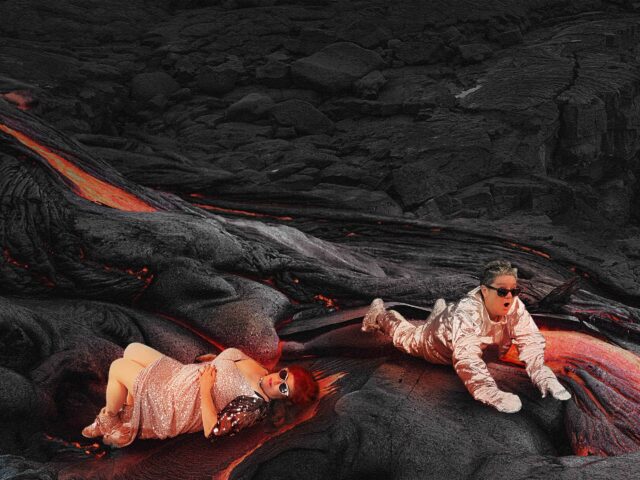
Alia Shawkat and Peter Friedman star as a daughter and father who reconnect in Clare Barron’s You Got Older (photo by Marc J. Franklin)

YOU GOT OLDER
Cherry Lane Theatre
38 Commerce St.
Tuesday – Sunday through May 3, $89-$189
www.cherrylanetheatre.org

Alia Shawkat makes an exciting theatrical stage debut as a single woman having “like the second worst moment of my life so far” in the stirring revival of Clare Barron’s You Got Older at the Cherry Lane.

After losing her job and her boyfriend at the same time — she was sleeping with her boss — the thirty-two-year-old Mae, a Minneapolis lawyer, has returned to the family home in a small agricultural town in eastern Washington State. Not only does she need a respite, but her father (Peter Friedman) has cancer of the larynx, so she can help out at least for a while.

Nearly everyone in their circle seems to be having issues with physical bodies. In addition to their father’s illness, Mae, who no longer has health insurance, has a lump in her throat and a large, ugly rash that requires special ointment; her sister Jenny (Nina White) has a pericardial cyst and can’t eat meat or gluten; her sister Hannah’s (Nadine Malouf) ex-boyfriend died of a rare blood cancer, and she thinks she may be passing bad skin, cancer, Alzheimer’s, Parkinson’s, and male pattern baldness to her son; her brother, Matthew (Misha Brooks), might have a weird penis; her old schoolmate Mac (Caleb Joshua Eberhardt) admits to liking pus, scabs, and flaky skin; Mae’s fantasy lover, Luke the Canadian Cowboy (Paul Cooper), has weeping lesions from his neck to his groin; and the entire Hardy family suffers from acidic mouths and body odor.

Mae wants to move forward but inner and outer forces seem hell-bent on preventing that. In addition to having to move back to the house where she grew up, she has been told by her dentist that she should use a child-size toothbrush, she’s horny like she way when she was in high school, and she sneaks Mac into her bedroom to hide him from her father. She also has a cat named, appropriately enough, Murphy, hinting that everything that could go wrong just might.

Mae (Alia Shawkat) and Mac (Caleb Joshua Eberhardt) share their likes and dislikes in revival at the Cherry Lane (photo by Marc J. Franklin)

“I hate it when I feel helpless,” she tells her father, who doesn’t mind occasionally not being in control. “I love it when you just get to lie back and let people take care of you,” he says to Mae, who can’t understand that.

When the whole family is finally together, Jenny proclaims, “It’s like we’re on a picnic.”

Not quite.

Barron (Shhhh, Dance Nation), who won an Obie for the play, wrote You Got Older after her father was diagnosed with cancer and she went through a breakup. In a program note, she writes, “This play was written and finished in the middle of a personal crisis — before anything was resolved. And so, for me it remains a kind of play without perspective. The characters are so far inside of something that they don’t know how to explain what’s happening to them. The result is a lot of avoidance.”

While there is plenty of psychological avoidance — most of the characters exist in their own private space — the act of physically touching occurs over and over again, whether it is the application of ointment, hugging a stranger who may be crying, or having sex. The father is the only one who likes to get his hands dirty, as evidenced by the garden he has started where he grows peppers and other plants.

Anne Kaufman (Mary Jane, The Nether) helmed the 2014 premiere, which included Obie winners Brooke Bloom and William Jackson Harper and Tony winners Reed Birney and Miriam Silverman, and she directs the revival as well, keeping things dark and mysterious, alternating between fantasy and reality as Mae tries to find her way in a world that’s letting her down but she can’t get back on track. The transitions between scenes on Arnulfo Maldonado’s ever-morphing set can be as bumpy as some of the subplots, but the challenging narrative makes it all worthwhile.

Shawkat (Arrested Development, Search Party) is alluring as a woman who is as unpredictable as she is appealing. Friedman (Job, The Nether) once again is masterful as a sweet man who remains upbeat as he faces the end, exemplified by the theme song he has chosen for himself, Regina Spektor’s “Firewood,” in which she sings, “Rise from your cold hospital bed / I’ll tell you, you’re not dying / Everyone knows you’re going to live / So you might as well start trying.”

Even as we get older, it’s never time to stop trying.

[Mark Rifkin is a Brooklyn-born, Manhattan-based writer; you can follow him on Substack here.]
HERE’S TO THE EXTRAS: WHAT HAPPENED WAS . . . AT AUDIBLE’S MINETTA LANE

Michael (Corey Stoll) and Jackie (Cecily Strong) are on a first date in revival of Tom Noonan play (photo by Evan Zimmerman for MurphyMade)

WHAT HAPPENED WAS . . .
Audible’s Minetta Lane Theatre
18 Minetta Lane between Sixth Ave. and MacDougal St.
Through May 28, $55-$236.50
www.audible.com

“It’s weird . . . sometimes when I’m on the subway and people are whirring by me — lots of them — or on a bus looking out at the crowded sidewalks — it’s hard to believe that I have a life like all those people — that I am going through all this stuff, you know — that we’re all just not like extras,” Jackie says in Tom Noonan’s What Happened Was . . . “You mean like on a movie?” Michael responds. Jackie answers, “Yeah, it’s like we’re not here — that we don’t really have lives.”

It’s a feeling most everyone has had at one time or another, especially in New York, where both Jackie and Michael, two unusual, lonely people, work at the same law firm, she an executive assistant, he a paralegal. Of course, they don’t really have lives; they’re characters that first appeared in a 1992 play that debuted in the round at the Paradise Theater, which Noonan founded, on East Fourth St., followed by a highly influential 1994 indie film that gained great acclaim. Both were written and directed by Noonan, who also starred as Michael opposite Karen Sillas as Jackie onstage and on the big screen.

Those roles are now being performed by Corey Stoll and Cecily Strong, respectively, in a sparkling revival at Audible’s Minetta Lane Theatre, part of the company’s collaboration with Hugh Jackman and Sonia Friedman’s Together, which began last year with Ella Hickson’s Sexual Misconduct of the Middle Classes and August Strindberg’s Creditors in repertory. This spring, What Happened Was . . . is running in repertory with Sexual Misconduct through April 30, then with Hickson’s New Born, featuring Jackman, Marianna Gailus, and Sepideh Moafi. All are directed by Ian Rickson.

What Happened Was . . . takes place in real time on one night. Jackie has invited Michael over to her apartment for dinner, a first date, although Michael seems a bit clueless initially. They gossip about people at work, discuss music, and talk about their apartments — Jackie’s studio has a great view on the west side, while Michael lives in a one-bedroom on the east side. She comes from a big family on Long Island, while he was raised in Westchester.

He is tightly wound, moving stiffly, complaining about words that bother him (ritzy, seafood), explaining how birds are dinosaurs, and grimacing when Jackie announces they’ll be eating frozen scallops she’s heating up in the microwave, leading him to describe just how the appliance works. He keeps his briefcase nearby and doesn’t seem to be comfortable in his own skin.

Corey Stoll and Cecily Strong are terrific in Audible/Together production of What Happened Was . . . (photo by Evan Zimmerman for MurphyMade)

Walking around barefoot, she is a freer spirit who shares what’s on her mind without a filter, although she wants everything to go right with Michael. She comments on how the suits he wears at the office make him look like a partner; meanwhile, in the corner opposite the kitchen are several racks of clothes, as if Jackie’s wardrobe is a theatrical costume room. (Brett J. Banakis and Christine Jones’s cozy set also features a pull-out sofa, a record player, wooden floors, small tables with lamps, a black chest, and a New York City Ballet Academy poster.)

As Jackie keeps pouring more wine, the two lost souls connect and disconnect as Michael goes into detail about the novel he is writing and Jackie is tempted to read her latest children’s story, which turns out to be utterly unforgettable. Having worked in children’s publishing for more than twenty-five years, I can say that I’ve never heard anything like it before.

Deftly directed by Rickson, What Happened Was . . . is a compelling adult tale boasting two outstanding performances; Stoll (Plenty, Othello), who chose not to watch the film version before doing the play, and Strong (Brooklyn Laundry, The Search for Signs of Intelligent Life in the Universe) once again prove that they are among our finest actors, each adding small touches of nuance and detail that give depth to their characters. You have to watch them every second to catch it all.

It’s a shame that Noonan, who also made such films as The Wife and The Shape of Something Squashed and had recurring roles on such series as The Beat, Damages, and 12 Monkeys, will be unable to see the production; he passed away on Valentine’s Day at the age of seventy-four.

In the early scene cited above, Michael continues, “I would have thought you’d feel real and that everyone else was an extra.” Jackie responds, “Yeah, I guess, but not really.” A moment later Michael makes a toast: “Here’s to the extras.”

Amen to that.

[Mark Rifkin is a Brooklyn-born, Manhattan-based writer; you can follow him on Substack here.]
NO NAPOLEON COMPLEX HERE: 96 POUNDS OF DYNAMITE

Chad “Shorty” McDaniel displays his lust for life — and pool — in ReelAbilities documentary

Who: Chad “Shorty” McDaniel, Loren Goldfarb
What: East Coast premiere of 96 Pounds of Dynamite at 2026 ReelAbilities Film Festival
Where: Fashion Institute of Technology, Pomerantz Center, 300 Seventh Ave. at West Twenty-Seventh St., room D207, and Marlene Meyerson Jewish Community Center Manhattan, 334 Amsterdam Ave.
When: Wednesday, April 28, free with advance RSVP, 6:30, and Thursday, April 29, $19.95, 5:30
Why: “I really want to get the message out there that regardless of the circumstances, you can do it in life. You can succeed in life, you can make something of yourself,” Chad “Shorty” McDaniel says at the beginning of 96 Pounds of Dynamite. “But I don’t think any human should have to put up with what I put up with.”

Making its East Coast premiere at the ReelAbilities Film Festival, Loren Goldfarb’s documentary follows McDaniel’s inspiring story. He first met McDaniel in a Florida pool hall, where he plays in a motorized wheelchair because of Osteogenesis Imperfecta, a genetic brittle bone disease that has resulted in his having extremely short arms and legs. But that hasn’t stopped him from becoming an amateur champion — or to enjoy every part of life he possibly can.

“People, they naturally go, ‘Oh the poor little handicap guy,’ you know what I mean?” he says. “Once I open my mouth, I shut that shit down quick. Mm, no. No Napoleon complex here,” he says wryly.

Goldfarb speaks with McDaniel’s friends and relatives, doctors, fellow pool players, his wife, Allison, and others with his disease. Through it all, McDaniel is upbeat and ready to take on anything, determined to win an upcoming tournament.

“I love when people underestimate me. I will eat them alive,” he declares defiantly.

Codirected by Ed Coughlin and featuring pool champion Jeanette “the Black Widow” Lee as one of the executive producers, 96 Pounds of Dynamite is screening April 28 at 6:30 at FIT and April 29 at 5:30 at the Marlene Meyerson JCC; both showings will be followed by a Q&A with McDaniel and Goldfarb. You can also stream the film through May 3 here.

ReelAbilites continues through April 30 with such other screenings as Heavy Healing at Nitehawk, No One Cares About Crazy People at the Joan and Alan Bernikow JCC Staten Island, and Espina at the JCC Manhattan.

EVERY GRAIN OF SAND: A MOTHER AND SON EXPLORE THE PHYSICS OF DEATH

Physicist and professor Bulbul Chakraborty won an Obie for her performance in Rheology (photo by Maria Baranova)

RHEOLOGY
Playwrights Horizons, Peter Jay Sharp Theater
416 West 42nd St. between Ninth & Tenth Aves.
Through May 16, $53.50-$93.50
www.playwrightshorizons.org

When is a physics lecture not a physics lecture? When it’s also a genius theatrical meditation on family and death.

First presented last spring at the Bushwick Starr in association with HERE Arts Center and Ma-Yi Theater Company, Rheology is back for an encore run at Playwrights Horizons, where it is beguiling audiences with its intoxicating mix of science and multimedia art. Written and directed by Obie winner and Pulitzer finalist Shayok Misha Chowdhury, the ninety-minute play was created in collaboration with his mother, renowned theoretical physicist and professor Bulbul Chakraborty, who specializes in condensed matter and how nonthermal systems, particularly sand, respond to external stresses.

When the doors open, Chakraborty is already onstage, writing down formulas and equations across a long digital blackboard relating to field theory, Gauss’s Law, Faraday’s Law, and the rheology of fragile matter. In this case, the fragile matter is Chowdhury, who is seen in a photo as a child with his mother projected above the blackboard; the screen is also used to share scientific photographic and video information. In addition, a camera zooms in on an hourglass on her table, projecting it onto a side monitor, and a child’s sandbox beckons. (The video design is by Kameron Neal, Chowdhury’s partner, with set by Krit Robinson and live music by cellist George Crotty.)

As Chakraborty performs an experiment describing how the solid sand can behave like a liquid, she starts choking, bending over in distress. Several people in the audience began calling out to her, asking if they should contact 911; a woman sitting behind me was practically freaking out. I didn’t want to ruin the experience for her, but I felt I had to tell her that it was part of the show, that Chakraborty wasn’t dying right in front of us as we did nothing.

She suddenly stops, and a man in the audience asks her why. She explains that she usually pretends to choke longer but she could feel the energy in the room shift to genuine concern. The man then identifies himself as Chowdhury, and he describes what it was like growing up the only child of two physicists; as a bonus, his father, Partha Chowdhury, a graduate professor who specializes in gamma-ray spectroscopy and nuclear structure, was in the audience that night. Chowdhury talks about his nightmares about his mother’s eventual death — she is not ill, but we all die eventually — and so dreamed up this play to savor more experiences with her.

“The time we have left together is finite,” Chowdhury posits. “And it’s almost this . . . pressure I’ve been feeling, like I can’t be . . . in the moment when we’re together because I’m aware that each moment is a moment I’m supposed to be making the most of. Um . . . so . . . what I have done is forced her to . . . be in a show with me . . . so we can spend more time together . . . because as long as we’re doing this show she is literally . . . contractually obligated to be alive. . . . So what we’re doing here is a kind of exposure therapy for me. . . . Whenever I’ve expressed to her that I could not in fact survive her death, my mom is like: But how do you know that, that’s not a statement of fact, that’s a hypothesis, where’s the evidence? You need to gather evidence to support your hypothesis. And I was like: How do I do that? And she was like: I thought you did experimental theater? Why don’t you design an experiment to test your hypothesis? And I was like: You mean, kill you? And she was like: Could you do a simulation?”

And so they do an extremely realistic simulation in a way that regularly circles back to Chakraborty’s studies of the properties of sand, investigating them as both individual grains and how they react with other grains en masse, like a human being relating to other human beings, or to one specifically — for example, a loved one.

Misha Chowdhury faces his fears about his mother’s eventual death in deeply personal play (photo by Maria Baranova)

Not surprisingly, while Chakraborty accepts the facts that she, and the rest of us, are going to die, Chowdhury is far more emotional and dramatic about it, which results in a compelling dynamic between mother and son, scientist and theater maker. Beautifully presented, the show is likely to have each audience member considering their own relationship with death, be it theirs or someone close to them. For me, it instantly brought back memories of the deaths of my mother (at seventy-six) and father (at forty-seven) as well as that of my mother-in-law, who passed last October at the age of eighty-nine. In addition, it was fascinating to look over at Partha Chowdhury every once in a while and wonder what was going through his mind as he watched his wife “die” onstage and his son proclaim that he cannot go on without her.

Chakraborty, who won an Obie for her performance, is utterly charming and engaging playing herself; she appears to be a terrific teacher and a wonderful mother — and an expert improviser. Chowdhury (Public Obscenities, Prince Faggot) holds nothing back as he willingly, and entertainingly, shares his deepest, darkest fears with a combination of sadness and humor, emphasizing his fragility. It all comes together when he goes into the sandbox and attempts to build a castle, a powerful metaphor for everything that has come before it. Kudos should also go out to dramaturg Sarah Lunnie for the tight structure.

In his 1981 song “Every Grain of Sand,” which closes every concert on his neverending tour, Bob Dylan sings, “I hear the ancient footsteps like the motion of the sea / Sometimes I turn, there’s someone there, other times it’s only me / I am hanging in the balance of the reality of man / Like every sparrow falling, like every grain of sand.”

Rheology also concludes with poetry, by Indian polymath Rabindranath Tagore, followed by a moving hypothesis that goes far beyond scientific theory and a lecture on physics.

[Mark Rifkin is a Brooklyn-born, Manhattan-based writer; you can follow him on Substack here.]
ADDING IT UP: AN EXPERIMENTAL REVIVAL FROM THE NEW GROUP

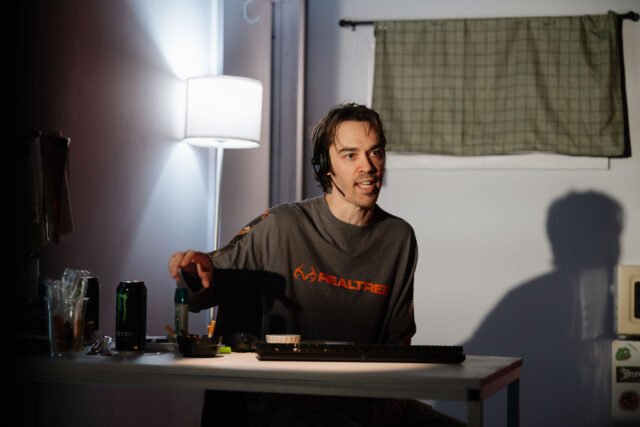
Mrs. Zero (Jennifer Tilly) has a lot to say to Mr. Zero (Daphne Rubin-Vega) in New Group experimental revival (photo by Monique Carboni)

THE ADDING MACHINE
Theatre at St. Clement’s
423 West 46th St. between Ninth & Tenth Aves.
Tuesday – Sunday through May 17, $39-$135; livestream May 7, $39.99, 7:00
thenewgroup.org

At the heart of the New Group’s revival of Elmer L. Rice’s 1923 satire, The Adding Machine, extended at the Theatre at St. Clement’s through May 17, is humanity’s fear of displacement and extinction — not by another species but by our own creations.

Ten years ago, Israeli theoretical computer scientist Moshe Vardi said, “We are approaching a time when machines will be able to outperform humans at almost any task. I believe that society needs to confront this question before it is upon us: If machines are capable of doing almost any work humans can do, what will humans do?”

Technological unemployment has been on the minds of humans since ancient times; warnings about robots and machinery taking over have been posited by Aristotle, John Maynard Keynes, Isaac Asimov, Rod Serling, Philip K. Dick, and Stanley Kubrick.

Pulitzer Prize winner Rice’s (Street Scene) prescient work now features “experimental” revisions by Thomas Bradshaw that make it relevant to the current day, as AI threatens not only the future of a wide range of workers but of humanity itself.

As the audience enters the theater, a light shines down on an adding machine that boldly sits center stage; a sign of progress, it may not appear threatening, but to many it can be seen as a villain whose presence, in this case, will lead to violence and a journey into the afterlife.

Among the most important changes Bradshaw has made is the addition of a friendly narrator (Michael Cyril Creighton) who announces at the beginning, “You are about to witness a heart-warming tale about modern life crushing the human spirit. This isn’t a place where life is ‘lived,’ but rather ‘endured.’ A world of worn-out routines, frayed tempers, and dreams so thoroughly flattened that no one even remembers having them. . . . Listen, I know this all might sound depressing and why the hell would you even want to endure this, let alone pay for it, but fear not! I promise there’s plenty of humor in watching humans try to navigate a society that keeps nudging them toward becoming polite and obedient. You may even recognize a few things from your own life. If so, I apologize in advance.”

That opening is followed by a long, biting monologue in which Mrs. Zero (Jennifer Tilly), in bed with her husband, Mr. Zero (Daphne Rubin-Vega), lets loose a verbose diatribe about going to the pictures, getting older, and their failed marriage, exacerbated by Mr. Zero’s attraction to a young woman who lives in their complex, his inability to get promoted at his accounting job, and how “Captain Standish doesn’t stand at attention for me anymore.” Tucked under the covers, Mr. Zero barely moves, as if he’s dead, ignoring his wife, who is tired of playing second fiddle.

“What about me? Where do I come in?” she argues. “You think I don’t know what it’s like — going to that office every day, adding numbers till you feel like one. But I do. My office is this house, these same four walls. And I been adding, too. Adding the days, my gray hairs, and the silences you could bury a life inside. Adding and adding until the total’s too much to bear.”

Humans performing office work are doomed in The Adding Machine (photo by Monique Carboni)

The next day, Mr. Zero believes he is going to be celebrated at work for his twenty-fifth anniversary. He earns his salary writing down numbers that his longtime colleague, the efficient Daisy Diana Dorothea Devore (Sarita Choudhury), reads aloud from receipts. He talks down to her, making her angry.

“You make me sick,” he says. She opines, “I wish I was dead.” They bicker like an old couple. He admits that maybe he would marry her, while she notes that it might be too late for them to have kids. He cuts her off, declaring, “Can’t you slow up? What do you think I am — a machine?”

When the cold-hearted boss (Creighton) tells Mr. Zero that he’s being replaced by an adding machine, the disgruntled employee murders him. At a dinner party that night, during which the host Zeros discuss sports, health, voting, immigrants, and other topics with the Ones, Twos, Threes, Fours, Fives, and Sixes (all played by Creighton), Mr. Zero is arrested, unapologetic for what he has done. At his trial, he delivers a numbers-laden, racist, misogynistic tirade about the societal ills that led him to kill his boss. Soon he finds himself in the Elysian Fields, where he is met by a series of surprises.

In The Adding Machine, life is a boring numbers game that can’t be won. As Lt. Charles (Creighton) explains to Mr. Zero, “Before there were numbers, there was counting. Before there was meaning, there was routine.”

There is little that is routine about the play, directed by New Group founding artistic director Scott Elliott, who has previously collaborated with Bradshaw on Intimacy, Burning, and The Seagull/Woodstock; they are not afraid to take chances and challenge the audience. Although not everything works — several of the afterlife scenes are awkward — what does succeed takes things from the sublime to the ridiculous, or, perhaps, the ridiculous to the more ridiculous.

It begins with casting. In the long-forgotten, misguided 1969 film, Milo O’Shea played Mr. Zero, Phyllis Diller was Mrs. Zero, and Billie Whitelaw portrayed Daisy Devore. In the play, Tilly (Don’t Dress for Dinner, The Women) is like a one-woman band as Mrs. Zero, her alternately squeaky, gravelly voice littered with musical grunts and sighs. Choudhury (the New Group’s Roar, The Flatted Fifth, and Rafta, Rafta . . .) is elegant and alluring as Daisy, an excellent foil to Mr. Zero, portrayed as a short, squat, angry man by two-time Tony nominee Rubin-Vega (Rent, the New Group’s Everything’s Turning into Beautiful) in a bulky suit and mustache. Creighton (The Amateurs, Stage Kiss) is warm and welcoming as the narrator, a tour guide, a man who has committed matricide, the boss, the lieutenant, Judy O’Grady, and other characters.

Derek McLane’s set consists of file cabinets that turn into other pieces of furniture, a back wall with dozens of lamps and fans in their own cubbies, and an electric chair that takes the place of the adding machine. The costumes are by Catherine Zuber, with stark lighting by Jeff Croiter and sharp sound by Stan Mathabane.

There is plenty of debate on how AI will affect people’s jobs. According to Authentic Ventures partner Robin Bordoli, “I think what makes AI different from other technologies is that it’s going to bring humans and machines closer together. AI is sometimes incorrectly framed as machines replacing humans. It’s not about machines replacing humans but machines augmenting humans.”

Journalist Kevin Drum counters, “Sometime in the next forty years, robots are going to take your job. I don’t care what your job is. If you dig ditches, a robot will dig them better. If you’re a magazine writer, a robot will write your articles better. If you’re a doctor, IBM’s Watson will no longer ‘assist’ you in finding the right diagnosis from its database of millions of case studies and journal articles. It will just be a better doctor than you.”

In the play, the fixer (Creighton) from the claims department tells Mr. Zero, “The machine is quicker, it never makes a mistake, it’s always on time. It presents no problems of housing, traffic congestion, water supply, sanitation.”

That’s something that is going to keep being heard as long as humans are on this earth.

[Mark Rifkin is a Brooklyn-born, Manhattan-based writer; you can follow him on Substack here.]
BALANCING THE BALUSTRADE: A BRILLIANT NEW BROADWAY COMEDY

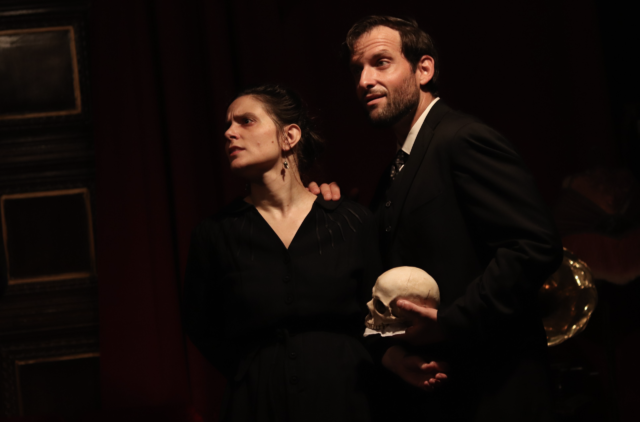
A series of meetings of the Vernon Point Neighborhood Association opens up old and new wounds in The Balusters (photo by Jeremy Daniel)

THE BALUSTERS
Samuel J. Friedman Theatre
261 West Forty-Seventh St. between Broadway & Eighth Ave.
Tuesday – Sunday through May 24, $58-$347
www.manhattantheatreclub.com

Yesterday afternoon I bumped into Richard Thomas on the Upper East Side. I told him how fabulous I thought The Balusters, the new Broadway play he’s starring in, is and what a great cast he’s working with. But as much fun as I had at the show, it appears that he is having even more, if that’s possible, gushing about David Lindsay-Abaire’s script and the entire ensemble. His smile was even bigger than mine.

Making its world premiere at MTC’s Samuel J. Friedman Theatre, The Balusters takes on a kitchen sink of contemporary issues, from homophobia, racism, classism, and corruption to toxic masculinity, privilege, bigotry, and furniture. And it does so in hilarious ways; I can’t remember the last time I laughed so long and hard during a play or clapped so often after side-splitting, sparkling lines of dialogue.

The hundred-minute comedy is set at several meetings of the Vernon Point Neighborhood Association, where a group of nine people regularly gather to discuss the state of their beloved community, a peaceful, old-fashioned enclave steeped in history, boasting well-manicured lawns, comfortable, attractive porches, and an overall flavor of Victorian elegance. The host is the newest member, Kyra Marshall (Anika Noni Rose), who has recently moved from Baltimore with her husband and their twin daughters. She lives in a beautifully designed home with fashionable chairs and couches, fancy china, and paintings of and by distinguished Blacks on the walls, as if overseeing the coming shenanigans, including, in the foyer, a print of George DeBaptiste’s 1978 portrait of Toussaint L’Ouverture, who was born a slave and went on to be a leader of the Haitian Revolution, and, above the fireplace, a flower-laden portrait of a Black feminist that evokes the work of contemporary Black American artists Harmonia Rosales and Kehinde Wiley. (The elegant set is by two-time Tony and two-time Emmy winner Derek McLane.)

The gavel-wielding president of the association is Elliot Emerson (Thomas), a fuddy-duddy real-estate broker intent on protecting the legacy of Vernon Point. The other members are Latino contractor Isaac Rosario (Ricardo Chavira); the acerbic, antagonistic Jewish treasurer, Ruth Ackerman (Margaret Colin); Willow Gibbons (Kayli Carter), a young, white vegan who sees microaggressions everywhere; Brooks Duncan (Carl Clemons-Hopkins), a gay Black travel writer who is married and has a son; the somewhat hapless Alan Kirby (Michael Esper), a white man in his fifties who considers himself an ally and doesn’t understand why he is so often ignored; Melissa Han (Jeena Yi), an ambitious Asian American lesbian and lawyer who is the vice president; and Penny Buell (Marylouise Burke), the elderly white secretary who used to work for Elliot and is not nearly as doddering as she might let on, surprising everyone with sharply focused acerbic quips. Also present is Luz Baccay (Maria-Christina Oliveras), Kyra’s ultra-efficient Filipino housekeeper who left the Emersons’ employ for unstated reasons.

New resident Kyra Marshall (Anika Noni Rose) has no idea what she’s in for after joining group (photo by Jeremy Daniel)

Among the topics of discussion are expanding the hours of the safety van to catch porch pirates, how to handle kids who don’t live in Vernon Point but hang out there, and the plain, ahistorical balusters the Crawfords may be installing, which insult Elliot and lead to the following exchange, which helps define the characters while establishing the play’s central metaphor.

Elliot: Farmhouse balusters aren’t true to the period or style of the original railing. They’d look ridiculous on that Queen Anne.
Melissa: But we don’t police our neighbors.
Elliot: It’s not policing. If you live here, you’ve agreed to certain guidelines.
Kyra: I hate to ask, but what exactly are balusters?
Elliot: I’m sorry, Kyra. We should’ve started with that.
Isaac: They’re the posts that support a railing. They’re like spindles but with footings.
Kyra: Okay, I’m gonna nod and pretend I know what that means.
Melissa: You’re gonna learn so much useless information here.
Elliot: It’s not useless. The balusters are important. They hold everything up. A porch’ll fall to pieces without the right support.
Ruth: As riveting as this is, may we move on?

When Kyra suggests that the group request stop signs for a corner where numerous accidents have occurred, heated arguments ensue, eventually becoming personal over the course of several meetings and leaving no one unscathed, their biases revealed via revenge, gossip, and carelessness.

Penny Buell (Marylouise Burke) is deceptively clever and prescient in brilliant new Broadway comedy (photo by Jeremy Daniel)

The Balusters is brilliantly written by Tony and Pulitzer winner Lindsay-Abaire (Rabbit Hole, Kimberly Akimbo) and expertly directed with a wry sense of humor by Tony winner Kenny Leon (Purlie Victorious: A Non-Confederate Romp Through the Cotton Patch, Home). It is reminiscent of both Bruce Norris’s Tony- and Pulitzer-winning Clybourne Park and Jonathan Spector’s Tony-winning Eureka Day, two plays that explore what can go wrong when small groups of people think they can decide what’s right and wrong for others. It will also likely remind New Yorkers of why they don’t want to be on their coop board.

Five-time Tony nominee Emilio Sosa’s costumes are impeccable, and four-time Tony nominee Allen Lee Hughes’s lighting and six-time Tony nominee Dan Moses Schreier’s sound — he also composed the excellent interstitial music, which features a rap bent — are in sync throughout, especially when thunder and lightning strike at just the right instances.

The terrific ensemble forms an outrageously funny extended family, led by Emmy winner Thomas (Our Town, The Little Foxes) as an older man seeing his carefully curated life slip away and Tony winner Rose (Caroline, or Change, A Raisin in the Sun) as a younger woman who is not afraid to get in Elliot’s way, but theater treasure Burke (Ripcord, Infinite Life), in her seventh collaboration with Lindsay-Abaire, steals the show as Penny, who always knows just what to say.

“I’d just like to remind us that everyone in this room is a decent person,” Penny interjects at one point when things are threatening to get out of hand. “We wouldn’t be here if we didn’t care about our neighbors. At the same time, no one is perfect, and sometimes people make mistakes.”

Now, where’s my gavel?

[Mark Rifkin is a Brooklyn-born, Manhattan-based writer; you can follow him on Substack here.]
IRISH COLD CASE: SCORCHED EARTH AT ST. ANN’S

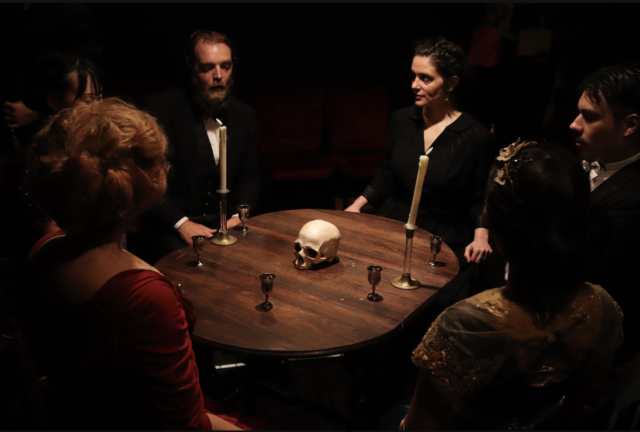
Suspect John McKay (Luke Murphy) is interrogated by Detective Alison Kerr (Sarah Dowling) in Scorched Earth (photo by Teddy Wolff)

SCORCHED EARTH
St. Ann’s Warehouse
45 Water St.
Through April 19, $74
stannswarehouse.org
www.atticprojects.com

Writer, director, choreographer, dancer, and actor Luke Murphy returns to St. Ann’s Warehouse, following 2024’s sci-fi gem Volcano, with the searing Scorched Earth.

I called the nearly four-hour Volcano “an eruption of ingenuity, a multimedia, multidisciplinary melding of past, present, and future bathed in mystery.” The same can be said of the ninety-minute Scorched Earth.

“What does it take to be from somewhere?” Detective Alison Kerr (Sarah Dowling) asks while discussing a questionable case, setting the stage for a play steeped in humans’ relationship with one another and the land.

The show takes place in a small, tight-knit, unnamed Irish town where the body of a wealthy man, William Dean (Will Thompson), was found on a ten-acre plot of land he had just won at auction, outbidding John McKay (Murphy), a tenant farmer who had worked on the property for eight years. Ten years after the death, Kerr has reopened the case. She brings in McKay for twenty-four hours of interrogation, a digital clock on the wall counting down the time.

The fractured narrative shifts kaleidoscopically in time and space, between the interrogation, re-creations of past events, and a radio talk show where host Leanne Meany (Tyler Carney-Faleatua) speaks with Dean, both before and after his death. Alyson Cummins’s stark set is a bleak, gray, angled room in which the cast of five moves around tables and chairs, an open door morphs into a telephone booth where Sergeant Leahy (Ryan O’Neill) calls Kerr, and a rectangular section of the back wall slides open to reveal other elements. Patricio Cassinoni’s slide projections depict crime-scene photos, pages from official reports, and aerial views of the contested land while putting the murder in context of other similar disputes through Irish history.

Much of the story is told through captivating movement that takes the story in fascinating directions, brilliantly expanding the tense atmosphere as the police procedural unfolds. McKay dances with a grass body (Carney-Faleatua) that is less a green monster than a piece of the land. The deceased Dean writhes around on the floor, his body like a limp, boneless creature. There’s even a country line dance where, as Leahy announces, “no one has to touch each other,” a sly reference to the previously accepted claim that Dean died because of a fall, not at the hands of a murderer.

Meanwhile, the townsfolk seem far more concerned about John O’Donnell’s missing donkey than what happened to Dean, which they seek to remain buried in the cold earth.

Scorched Earth incorporates thrilling dance in police-procedural narrative (photo by Teddy Wolff)

Scorched Earth was inspired by John B. Keane’s 1965 play The Field, which was adapted into a 1990 film by Jim Sheridan that featured an Oscar-nominated Richard Harris as an elderly Irish tenant farmer who is fighting to own the land his family has worked on for generations, as well as by Mark O’Connell’s A Thread of Violence: A Story of Truth, Invention, and Murder, Myles Dungan’s Land Is All That Matters: The Struggle That Shaped Irish History, and Andrew Jarecki’s The Jinx, the Peabody-winning docuseries about real estate heir Robert Durst and a long-unsolved murder.

Cork-born Murphy (Sleep No More, Pass the Blutwurst, Bitte) is magnetic as McKay, a deeply conflicted man who firmly believes the land should have been his. Dowling, who portrays a bartender and a bank teller in addition to Kerr, is cool and calm as the determined detective. Thompson, who starred opposite Murphy in Volcano, brings nuance to Dean, a rich mogul who can afford to buy whatever he wants. (Perhaps the character was also based partly on William K. Dean, a doctor who retired to a New Hampshire farm where he was murdered in 1918; the case, investigated by a private detective named Wilhelm DeKerlor — oddly similar to “Kerr” — remains unsolved.) O’Neill and Carney-Faleatua provide expert support.

Scorched Earth is a scintillating success all the way around, including Cummins’s costumes, Stephen Dodd’s stark lighting, which beams in from the sides of the set, and composer Rob Moloney’s wide-ranging score. Everything merges beautifully for an exhilarating, powerful surprise Sisyphean conclusion where it all comes tumbling down, no matter who you are or where you’re from.

[Mark Rifkin is a Brooklyn-born, Manhattan-based writer; you can follow him on Substack here.]