featured

BUNNY LAKE IS MISSING WITH Q&A

(Keir Dullea) comforts his sister (Carol Lynley) in BUNNY LAKE IS MISSING

Stephen (Keir Dullea) tries to comfort his sister, Ann (Carol Lynley), in Bunny Lake Is Missing

BUNNY LAKE IS MISSING (Otto Preminger, 1965)
Film Forum
209 West Houston St.
Sunday, December 7, $15, 7:00
212-727-8110
filmforum.org

“I had heard all the rumors about Preminger, but I felt he wouldn’t do that to me. I was wrong, oh so wrong,” Keir Dullea told Foster Hirsch in the 2007 biography Otto Preminger: The Man Who Would Be King, referring to the making of the 1965 psychological noir thriller Bunny Lake Is Missing and Preminger’s notorious treatment of actors. “I was playing a crazy character and the director was driving me crazy. . . . About halfway through the shoot, I began to wonder, Who do you have to f&ck to get off this picture?” On December 7, Dullea (2001: A Space Odyssey, David and Lisa) will talk with Hirsch over Zoom following a special screening at Film Forum of the fiftieth anniversary 4K digital restoration of the 1965 work. In the intensely creepy film, loosely based on the novel by Merriam Modell (under the pseudonym Evelyn Piper), Carol Lynley stars as Ann Lake, a young woman who has just moved to London from New York. She drops off her daughter, Bunny, for her first day of school, but when she returns later to pick her up, there is no evidence that the girl was ever there. When Superintendent Newhouse (Laurence Olivier) and his right-hand man, Sergeant Andrews (Clive Revill), begin investigating the case, they are soon wondering whether Bunny really exists, more than hinting that she might be a figment of Ann’s imagination.

Television veteran Lynley, who seemed on the verge of stardom after appearing in such films as Return to Peyton Place, Bunny Lake Is Missing, Shock Treatment, and The Poseidon Adventure but never quite reached that next level, gives one of her best performances as Ann, a tortured woman who is determined to stop her world from unraveling around her. Dullea is a model of efficiency as the cold, direct Stephen, a character invented by Preminger and screenwriters John and Penelope Mortimer. Shot in black-and-white by Denys N. Coop on location in London, the film also features cameos by longtime English actors Martita Hunt, Anna Massey, and Finlay Currie as well as the rock group the Zombies and Noël Coward, who plays Ann’s very kooky landlord, Horatio Wilson. Saul Bass’s titles, in which a hand tears paper as if the story is being ripped from the headlines, set the tense mood right from the start. The ending offers some neat twists but is far too abrupt. “No actor ever peaked with him. How could you?” Dullea added to Hirsch about Preminger (Laura, Stalag 17). “The subtlety that I felt I was able to give to my work in 2001, because Stanley Kubrick created a safe atmosphere where actors were not afraid to be foolish or wrong, was missing on Otto’s set. I don’t hate him; it’s too long ago. But the experience was the most unpleasant I ever had.” It should be quite fascinating to hear more from Dullea and Hirsch on December 7; Hirsch will be on hand to sign copies of his book as well.

CONTEMPORARY JAPANESE PLAY READING SERIES: COOKING UP

COOKING UP (KOSHIRAERU
Japan Society
333 East Forty-Seventh St. at First Ave.
Monday, December 6, $10/$15, 7:30
japansociety.org

Japan Society will present the sixteenth installment of its annual play reading series, “Contemporary Japanese Plays in English Translation,” with Shoko Matsumura’s Cooking Up, directed by Jordana De La Cruz. Originally scheduled for March 2020 and postponed because of the pandemic lockdown, the staged reading will take place December 6 at 7:30. The story, which combines the surreal with naturalism, is set in a restaurant where the pastry chef is missing, the cook is cheating on his wife, and his mistress becomes a housecat. “Every time you think you understand the story line or the plot, something else happens,” the Brooklyn-based De La Cruz (Jack) says in a Japan Society video. “It’s a very intricate play, and it’s powerful, and it talks about isolation and companionship and really makes you think about the people that you have in your corner.”

The Yokohama-born Matsumura (Hanpuku to Junkan ni Fuzui suru Bon’yari no Boken) has acted with Toshiki Okada’s chelfitsch company and founded her own troupe, Momeraths, in 2013. Translated by Amanda Waddell, Cooking Up is part of Japan Society’s fiftieth anniversary celebration honoring New York City woman writers with ties to Japan and will be followed by an audience Q&A with De La Cruz.

THE ALCHEMIST

Manoel Felciano, Reg Rogers, and Jennifer Sánchez play a trio of swindlers in Red Bull revival of Ben Jonson’s The Alchemist (photo by Carol Rosegg)

THE ALCHEMIST
New World Stages
340 West Fiftieth St. between Ninth & Tenth Aves.
Wednesday – Monday through December 19, $70
Available for streaming January 12-26
www.redbulltheater.com
newworldstages.com

Red Bull Theater was one of the most active companies during the pandemic, presenting livestreamed reunion readings of previous productions, the online interview series RemarkaBULL Podversations, and deep explorations into Othello and Pericles. So it’s disappointing that its return to live, in-person theater is an overbaked version of Ben Jonson’s 1610 Jacobean farce, The Alchemist.

Adapted by Jeffrey Hatcher and directed by Jesse Berger — the same team that gave us the superb 2017 revival of Nikolai Gogol’s The Government InspectorThe Alchemist is a hot mess, a frantic, unrelenting satire laden with anachronistic references and modern speech that bury what Samuel Taylor Coleridge famously referred to as one of the “three most perfect plots ever planned.” (The other two, in his opinion, were Sophocles’s Oedipus Rex and Henry Fielding’s Tom Jones.)

The tale is set in 1606 in the Lovewit mansion in London as plague rips through the land; the wealthy master has left for the countryside, reminding us that the rich haven’t changed much, considering their response to the current coronavirus pandemic. A voiceover announces at the start, “Some wear masks, just like you do, that cover the nose and mouth and comply with CDC guidelines at all times, including during the show, except while actively drinking at your seat, so if you’re going to drink, drink actively.”

Lovewit’s manservant, the rogue Face (Manoel Felciano), has teamed up with the charlatan alchemist Subtle (Reg Rogers) and their bawdy colleague, Dol Common (Jennifer Sánchez), to con members of the local community out of their money. When the trio learns that Lovewit is unexpectedly returning in two hours, they ramp up their schemes as they attempt to defraud the tobacconist Abel Drugger (Nathan Christopher), the law clerk Dapper (Carson Elrod), the deacon Ananias (Stephen DeRosa), and the knight Sir Epicure Mammon (Jacob Ming-Trent) and his butler from Brooklyn, the surly skeptic known as Surly (Louis Mustillo).

Red Bull returns to in-person theater with The Alchemist at New World Stages (photo by Carol Rosegg)

Subtle might think he is in charge, but Face is quick to remind him, “Recollect, sir: you were not long past known to all the neighborhood as that scurvy beetle who nothing did but loiter at the corner in moldy rags so thin scarce covered they your buttocks. I took pity on you, gave you roof and a bed, replaced your tatters with well-cut cloth, and introduced you to that household item called the bathing tub.” Subtle responds, “Recollect, sir: you were not long past that lowly servant who nothing did but sit your master’s house with no one to converse with save your brooms and dustpans. Twas I took pity on you, raised you up to your potential, taught you to present yourself so convincingly as a captain with a beard so nautical it could fool a blind man who’s never been to sea. Twas I conceived the scheme, tis I should take the largest share!” Meanwhile, Dol points out about their Venture Tripartite, “Well, if we three do not this treasure equal share, you two shall not share mine.”

Despite already having a heavy chest brimming with ill-gotten gains and Lovewit’s arrival fast approaching, Face and Subtle can’t control their greed when they learn of a wealthy widow, Dame Pliant (Teresa Avia Lim), who has come to town with her protective brother, Kastril (Allen Tedder). So they set out to scam her as well, agreeing not to tell Dol. Their nefarious plans play out in real time, a grandfather clock ticking away throughout the nearly two-hour show as things grow more and more frenetic and overwrought.

Red Bull and founding artistic director Berger know their way around classic works, as evidenced by their stellar adaptations of John Ford’s 1630s drama, ‘Tis Pity She’s a Whore, Richard Brinsley Sheridan’s 1777 comedy of manners, The School for Scandal, and Jonson’s 1606 English Renaissance satire, Volpone. But they try too hard to make The Alchemist relevant to this moment in time, sacrificing story for slapstick. Alexis Distler’s two-floor set is filled with doorways, a staircase, and surprise entryways, but the timing of the various door slams is too often slightly off. At one point Rogers ad-libbed about having to run up and down the stairs again, and we feel his pain. As always with Red Bull, the costumes (by Tilly Grimes) are wonderfully extravagant, as is Tommy Kurzman’s wig and makeup design.

The show suffers from being in the 199-seat Stage 5 at New World Stages, which is too small and intimate for such a broadly played farce; you’re liable to get whiplash from swiveling your head back and forth and up and down so much, particularly as Subtle changes from “a mystic newly come from Rotterdam” to “a fortune teller late of Portugal” to “a Swedish hypnotist learned in financial planning.” Perhaps it will be easier to take when it is available for streaming January 12-26.

In a program note, Hatcher wryly admits, “Of course, I did screw around with the plot. Ours is a slimmed down version of the play, with fewer characters and one setting instead of four. So, apart from dumbing down the highbrow jokes, ruining the perfect plot, tossing in anachronisms, and adding a song very much like one sung by Shirley Bassey in 1964, the play is pretty much your grandmother’s The Alchemist.” The talented cast, led by Obie winner Rogers, does its best with this dumbing down, seeming to enjoy themselves immensely, as did much of the audience the night I went. I wish I felt the same.

THE SHAPE OF THINGS: LAND OF BROKEN DREAMS CONVENING & CONCERT SERIES

LAND OF BROKEN DREAMS
Park Ave. Armory
643 Park Ave. at Sixty-Seventh St.
Concerts and convenings: December 9-11, $25
Installation: Tuesday – Sunday through December 31, $18
www.armoryonpark.org

As part of Carrie Mae Weems’s “The Shape of Things” monumental multimedia installation at Park Ave. Armory, there will be three days of live music, conversations, and performances that activate the space. Tickets are going fast for the “Land of Broken Dreams” series, which features nighttime concerts by singer-songwriter Somi on December 9, the jazz trio of Vijay Iyer, Arooj Aftab, and Linda May Han Oh on December 10, and Terri Lyne Carrington and Lisa Fischer, whose latest project is “Music for Abolition,” on December 11. Tickets also include admission to a “Daytime Convening” from 1:00 to 7:00, with pop-up performances by more than 150 artists in the Wade Thompson Drill Hall, the Board of Officers Room, the Veterans Room, and the Colonels Room.

Among those participating are photographer Dawoud Bey, tap dancer Maurice Chestnut, painter Torkwase Dyson, theater director Scott Elliott, Reggie “Regg Roc” Gray and the D.R.E.A.M. Ring, philanthropist Agnes Gund, poet, playwright, and novelist Carl Hancock Rux, dancer and choreographer Francesca Harper, musician and author Nona Hendryx, civil rights leader Ben Jealous, interdisciplinary artist Rashid Johnson, visual artist Joan Jonas, set designer Christine Jones, artist Deborah Kass, painter Julie Mehretu, cultural theorist, poet, and scholar Fred Moten, visual artist Shirin Neshat, curator, critic, and art historian Hans Ulrich Obrist, multimedia installation artist Tony Oursler, poet, essayist, playwright, and editor Claudia Rankine, sculptor Alyson Shotz, conceptual artist Hank Willis Thomas, performance artist Carmelita Tropicana, rapper, actor, and Roots MC Tariq Trotter, author Quincy Troupe, director Whitney White, and the Peace Poets. You might just have to move in to the armory for seventy-two hours so you don’t miss a minute of what promises to be a memorable event.

TROUBLE IN MIND

Alice Childress’s Trouble in Mind finally makes it to Broadway after sixty-six years (photo by Joan Marcus)

TROUBLE IN MIND
American Airlines Theatre
227 West 42nd St. between Broadway & Eighth Ave.
Tuesday – Sunday through January 9, $39-$250
212-719-1300
www.roundabouttheatre.org

In 1955, Alice Childress’s Trouble in Mind was destined to be the first play by a Black woman writer to be staged on Broadway. However, when the white producers insisted that Childress use a rewritten happy ending instead of her original one, she adamantly refused. Four years later, Lorraine Hansberry’s A Raisin in the Sun opened at the Ethel Barrymore Theatre and became a much-revived classic while Trouble in Mind languished in relative obscurity, occasionally performed by small companies and schools.

The play has finally made its Broadway debut, in an uneven Roundabout production at the American Airlines Theatre. Right before it begins, an announcement explains that it is being presented exactly as Childress wrote it, without one word being changed. In the hands of director Charles Randolph-Wright, that might not have been the best idea, as this Trouble in Mind, which can be laugh-out-loud funny and sharply poignant and prescient, too often feels stilted and repetitive as Childress reveals the systemic racism and misogyny baked into the theater, which is still all too relevant today.

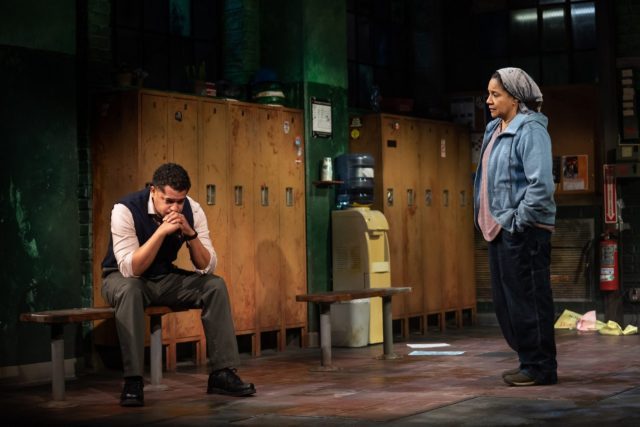
It’s the fall of 1957, and a group of actors are arriving at a Broadway theater to start rehearsals for Chaos in Belleville, a play by an unseen white man named Melton about racism, sharecropping, and lynching. The cast consists of the bitter Wiletta Mayer (LaChanze), a middle-aged Black actress who has grown sick and tired of playing mammies, maids, and slaves; Millie Davis (Jessica Frances Dukes), a younger Black actress who loves fancy outfits and likes to sting Wiletta about her advanced age; Sheldon Forrester (Chuck Cooper), an elderly Black character actor who usually doesn’t stir the pot but is concerned about certain aspects of Chaos; John Nevins (Brandon Micheal Hall), a young Black actor with dreams of success; Judy Sears (Danielle Campbell), a white Yale woke grad; and Bill O’Wray (Don Stephenson), an established white actor who declines to have lunch with his Black colleagues. Al Manners (Michael Zegen) is the white director who is so determined to have a hit that he fails to understand the inherent racism of the script and the needs of his cast; Eddie Fenton (Alex Mickiewicz) is the white stage manager and Manners’s right-hand man, and Henry (Simon Jones) is an elderly white doorman who has seen it all.

Wiletta (LaChanze) teaches John (Brandon Micheal Hall) a thing or two about the business as Sheldon (Chuck Cooper) looks on (photo by Joan Marcus)

“I think the theater is the grandest place in the world, and I plan to go right to the top,” John tells Wiletta, who tries to set him straight. “Show business, it’s just a business. Colored folks ain’t in no theater,” she says, explaining how he should act in front of white people, pretending to laugh at their jokes. “White folks can’t stand unhappy Negroes . . . so laugh, laugh when it ain’t funny at all,” she strongly advises.

John and Millie believe Chaos is an important work. “I hope I can do a good job and that people learn something from this play,” Millie says naively. Sheldon just hopes that everything goes smoothly, regardless of the content of the play. “Do, Lord, let’s keep the peace,” he says. “Last thing I was in, the folks fought and argued so, the man said he’d never do a colored show again . . . and he didn’t!”

Manners claims he is seeking authenticity, espousing, “I want truth. What is truth? Truth is simply whatever you can bring yourself to believe, that is all.” But his idea of truth is more about financial success than the inherent racism in the play, which starts to come out as some of the actors can’t hold back their thoughts any longer, including Judy, who shouts, “Oh, I get so mad about this prejudice nonsense! It’s a wonder colored people don’t go out and kill somebody, I mean actually, really do it . . . bloody murder, you know?”

Henry (Simon Jones) makes a point to Wiletta (LaChanze) in Trouble in Mind (photo by Joan Marcus)

Childress, who grew up in Charleston and Harlem and wrote such other plays as Florence and Wedding Band: A Love/Hate Story in Black and White (being revived in the spring by TFANA) in addition to the young adult novels A Hero Ain’t Nothin’ but a Sandwich and the Pulitzer Prize-nominated A Short Walk, cuts to the heart of racism in theater in Trouble in Mind; she was inspired to write it after appearing with Georgia Burke in the 1944 Broadway show Anna Lucasta, basing the character of Wiletta on Burke. She also references the idea of being forced to make script changes. “Melton is so stubborn, won’t change a line,” Eddie tells Manners, who replies “But he did.” Eddie adds, “Yes, but so stubborn.” Manners concludes, “A genius should be stubborn.”

Tony winner LaChanze (The Color Purple, The Secret Life of Bees) is radiant as Wiletta, who is bold and strong, caught in between wanting to continue her career but no longer able to hold back what she thinks. (As a bonus, LaChanze gets to belt out a song too.) In her Broadway debut, Dukes (Is God Is; By the Way, Meet Vera Stark) excels as Wiletta’s nemesis, each costume (by Emilio Sosa) making statements of their own.

Zegen (Bad Jews, Bob & Carol & Ted & Alice) overplays his hand as Manners, while Tony winner Cooper (The Life, Avenue X) is cooped up by Randolph-Wright’s (Motown the Musical, Ruined) often stagnant direction, not making enough use of Arnulfo Maldonado’s long, deep set. At one point Manners says, “I definitely know what I want and however unorthodox my methods, I promise never to bore you.” Unfortunately, that’s just what happens, especially in the second act. It’s as if Randolph-Wright has such reverence for Childress’s stand to make no revisions that he lets the pace drag as every word she wrote is delivered with the same emphasis, leaving the production feeling more like a historical document than the gripping drama it should be.

FLASH FORWARD: DEBUT WORKS AND RECENT FILMS BY NOTABLE JAPANESE DIRECTORS

Masayuki Suo takes the audience on a wild ride in Talking the Pictures

FLASH FORWARD
Japan Society online and in-person
333 East 47th St. at First Ave.
December 3-23, free – $10 online for three-day rental, $15 in person December 11 & 17, 7:00
212-715-1258
www.japansociety.org

Japan Society and the ACA Cinema Project (Agency for Cultural Affairs, Government of Japan) follow up their inaugural festival, “21st Century Japan: Films from 2001-2020,” with “Flash Forward: Debut Works and Recent Films by Notable Japanese Directors,” running December 3-23 online and in person.

The three-week series highlights the work of six established Japanese directors, pairing their debut with a more recent film. Available on demand as a three-day rental for ten dollars or fifteen dollars per bundle are Naomi Kawase’s 1997 Cannes Camera d’Or-winning Suzaku and 2018 Vision, Miwa Nishikawa’s 2003 Wild Berries and 2016 The Long Excuse, Shuichi Okita’s 2009 The Chef of South Polar and 2020 Ora, Ora Be Goin’ Alone, Junji Sakamoto’s 1989 Knockout and 2016 The Projects (see review below), and Masayuki Suo’s 1989 Fancy Dance and 2019 Talking the Pictures. Akihiko Shiota’s 1999 Moonlight Whispers was supposed to be teamed up with his 2019 Farewell Song but will not be shown because of music rights issues; it has been replaced by his fourth film, the 2002 drama Harmful Insect.

The “Filmmakers on the Rise” section comprises recent works by six directors who might be part of “Flash Forward” if it were held again in 2040: Masakazu Kaneko 2016 The Albino’s Trees, Yuko Hakota’s 2019 Blue Hour, Omoi Sasaki’s 2017 A Boy Sato, Eisuke Naito’s Forgiven Children, Kyoko Miyake’s 2013 My Atomic Aunt, and Hiroshi Okuyama’s 2019 Jesus. These films are available for free on demand. Also free are two online talks, “Conversations with the Filmmakers,” with Kawase, Nishikawa, Okita, Sakamoto, Shiota, and Suo, and the panel discussion “Debut Works and Beyond,” with Columbia assistant professor Takuya Tsunoda, UCLA assistant professor Junko Yamazaki, and writer, curator, and filmmaker Jasper Sharp, moderated by Yale professor Aaron Gerow.

Two in-person screenings at Japan Society celebrate the late master Sadao Yamanaka, who made more than two dozen films in the 1930s, few of which survive, before dying in Manchuria in 1938 at the age of twenty-eight. On December 11 at 7:00, a new 4K restoration of Yamanaka’s 1935 Tange Sazen and the Pot Worth a Million Ryo will have its North American premiere, followed December 17 at 7:00 by the international premiere of the 4K restoration of Yamanaka’s 1936 Priest of Darkness.

THE PROJECTS

Hinako (Naomi Fujiyama) and Seiji Yamashita’s (Ittoku Kishibe) lives change once again with the return of Shinjo (Takumi Saitoh) in The Projects

THE PROJECTS (DANCHI) (団地) (Junji Sakamoto, 2016)
film.japansociety.org

“Nothing is impossible in a housing project,” several people say in Junji Sakamoto’s delightfully absurdist and downright weird black comedy The Projects, which made its North American debut at Japan Society’s tenth annual Japan Cuts Festival in 2016. Elderly couple Hinako (Naomi Fujiyama) and Seiji Yamashita (Ittoku Kishibe) have moved to an inexpensive suburban Osaka housing project, known as a danchi, after closing their popular herbal remedies shop following the tragic death of their son, Naoya. The couple lives quietly, unable to process their grief or move forward, but they’re back in business when one of their strangest customers, the well-dressed, oddly speaking Shinjo (Takumi Saitoh), tracks them down and essentially demands, in his calm, direct manner, that they begin making his special remedy again. Meanwhile, Seiji, who would rather be left alone, is dragged into the race for head of the tenant association, running against Gyotoku (Renji Ishibashi), who is having an affair with a younger resident and is married to Kimiko (Michiyo Okusu), who is obsessed with properly separating the danchi’s garbage, and young upstart Yoshizumi (Takayuki Takuma), who is not afraid to discipline his son, Kitaro (Hiroaki Ogasawara), in full view of his neighbors. After Seiji loses, he decides to hide from everyone, retreating under the floorboards whenever someone stops by, which leads a gossiping group of ladies (Hikaru Horiguchi, Yukari Taki, Mayu Harada, Mari Hamada, and Miyako Takeuchi) to believe that Hinako has actually killed her husband and chopped up the body. As the media and police get involved, things get crazier and crazier as the totally bizarre conclusion approaches.

Fujiyama and Kishibe are absolutely charming as the Yamashitas, moving and talking with a sweetly warm, slow demeanor, asking little from a life that has let them down. Sakamoto wrote The Projects specifically for comedian and stage actress Fujiyama; the two last worked together on the award-winning 2000 film Face, Fujiyama’s first film, and the pairing is another marvel. Fujiyama is wonderful in the role, imbuing Hinako with a wry, very funny sense of humor that is splendidly complemented by Kishibe’s more serious Seiji. Lovingly shot by Ryo Ohtsuka and featuring a playful score by Gorô Yasukawa, The Projects is pure fun all the way through, with many laugh-out-loud moments even as it deals with some heavy subjects, right up to its out-of-this-world finale. Don’t let the title fool you; “projects” in Japan were much-desired apartment complexes originally built in the 1950s to supply suburban public housing for the growing post-WWII Japanese population. Although they are not as popular today, they are not the kind of projects associated with drugs and crime in America. The Projects is paired with Sakamoto’s 1989 debut, Knockout (Dotsuitarunen), in “Flash Forward: Debut Works and Recent Films by Notable Japanese Directors.”

JARED MEZZOCCHI: ON THE BEAUTY OF LOSS

Who: Jared Mezzocchi
What: Interactive virtual presentation
Where: Vineyard Theatre Zoom
When: Monday, December 6, $15, 8:00
Why: From November 11 to 21, the Vineyard Theatre presented Jared Mezzocchi’s interactive Zoom show On the Beauty of Loss, in which the Obie-winning director, actor, playwright, associate professor, and designer (The Curious Incident of the Dog in the Night-Time, How to Catch a Star) reflects on personal and communal grief, relating the 2004 death of his father to the 2020 passing of his grandfather. In the show, he re-creates the same road trip north that he made on both those occasions, putting them in context with the tragedies we’ve all endured during the coronavirus crisis, set to an original score by Lee Kinney.

In the above trailer, Mezzocchi, who codirected the virtual hit Russian Troll Farm, explains, “I was thinking to myself, it would be pretty cool to have a digital road trip where I invited a bunch of people in a car that was driving in real time and we worked together to figure out how to process grief while we are all still apart from one another. I’ve been writing this piece my whole life.” The Vineyard has added a special encore performance on December 6 at 8:00, the seventeenth anniversary of Mezzocchi’s father’s death; audience members can choose to either watch the livestream or participate over Zoom.