featured

SANDBLASTED

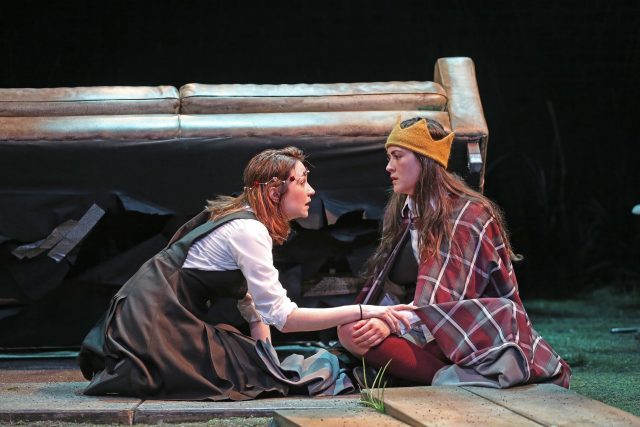
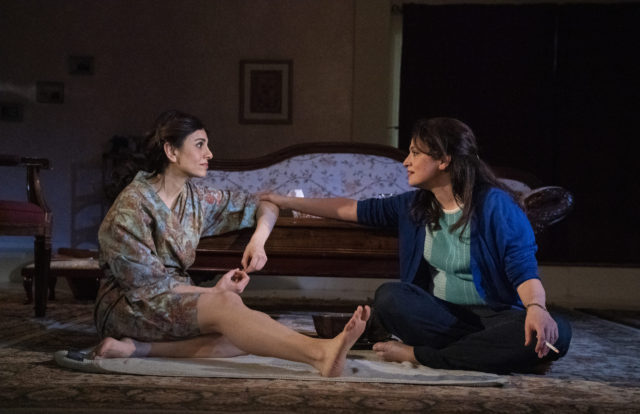
Odessa (Marinda Anderson) and Angela (Brittany Bellizeare) try to keep things together in sandblasted (photo by Carol Rosegg)

SANDBLASTED
Vineyard Theatre
Gertrude and Irving Dimson Theatre
108 East 15th St. between Union Square East & Irving Pl.
Tuesday – Sunday through March 13, $26.25-$103.95
www.vineyardtheatre.org

Charly Evon Simpson’s engaging, if undercooked, sandblasted is no mere day at the beach or breath of fresh air in a freezing cold winter, with Covid still upon us and masks necessary at the theater. The hundred-minute play, which opens today at the Vineyard, takes place on a stage filled with more than seventeen tons of sand, alternately representing the beach or the desert; there are doors in the back and stage right, a window stage left, and a ceiling of fluffy white clouds and blue sky. Matt Saunders’s set offers the characters warm and sunny relaxation, where they can sit in a chair and have a cold drink, as well as a space for unsteady traction, an arid, treacherous landscape. In both locales, Black women struggle to keep themselves together, literally and figuratively.

Thirtysomethings Angela (Brittany Bellizeare), a bundle of fear and anxiety, and the much cooler and hipper Odessa (Marinda Anderson) meet at the beach; brushing off sand, Odessa sees her left arm fall off. She is more disappointed than horrified; it turns out that women, particularly as they age, start losing pieces of their body. They are soon joined by the older and wiser Adah (Rolonda Watts), who offers perspective.

“I thought it would take a while longer for the larger parts of us to . . . to fall,” Angela says almost matter-of-factly. “Longer?” Adah asks. Angela replies, “Yeah, a lot of breaths, months of stewing, soaking, simmering, months of incubation. I thought it would take a large number of sleepless nights for a part so large to . . .” Adah says, “Just like you to trust in something like time and sense.” Angela concludes, “I just trust that time will get us, that time will outlive us.”

Rolonda Watts excels as a celebrity wellness guru in Vineyard/WP world premiere (photo by Carol Rosegg)

Adah is a famous celebrity wellness guru who may or may not have Black lady magic, supplying answers to many of the questions Black women have. When Angela mentions how inconvenient so much of their lives are, Adah explains, “But isn’t it always inconvenient? Isn’t it always the wrong place, wrong time?”

Angela and Odessa, a sort of Alpha and Omega themselves, believe it will take more than sun, tape, glue, spinach, and exercise to hold them together. Thinking that it might be easier to just hide her head in the sand, Angela says, “Sometimes I want to walk around in like one of those bubbles, just be a bubble walker.” Odessa responds, “No life that way, just a bubble life. What’s the point in living?” The allusion to Covid-19, which inequitably affects communities of color, is not lost on the audience. (And there are a few more to come.)

Angela’s hunk of a brother, Jamal (Andy Lucien), accompanies her to an Adah seminar entitled “Girls, stop falling apart!” but Adah doesn’t show up. Angela and Odessa decide to find her, hoping she can provide a cure; they set off on a journey seeking hope, understanding, and resolution, but it’s not going to be easy.

A coproduction with WP Theater, sandblasted evokes Samuel Beckett’s Happy Days and Waiting for Godot and Edward Albee’s Seascape and The Sandbox as well as Chiori Miyagawa’s America Dreaming, the 1994-95 Vineyard play that also took place on sand and dealt with otherness. Simpson’s (Behind the Sheet, Jump) writing is often poetic and works best when the story has a more existential, nonspecific nature, making references to skin color, grief, isolation, and systemic misogyny instead of putting them front and center.

Angela (Brittany Bellizeare) and her brother, Jamal (Andy Lucien), attend a seminar in sandblasted (photo by Carol Rosegg)

There are many beautiful, penetrating lines: “I think getting older isn’t about losing the fears you had as a kid. I think it is about having new fears that overtake them,” Angela theorizes. “Some say they don’t want to learn any new names, meet any new people, because then it is just another person to miss, to worry about, to grieve,” Odessa asserts. “I don’t know which of the many possible fights we’re in the middle of. Is the fight we should be fighting to heal? And no one else seems to know either,” Angela explains. And Odessa admits, “Some nights I think I’m the epitome of Black girl magic, and other nights I think I’m just another version of a magical negro and I wonder what it would be like to just live between the two.”

Anderson and Bellizeare make a classic comic duo, albeit with a very serious edge, as the fun and fancy-free Odessa and the tightly wound Angela, respectively, two women who might not have become friends at another time or another place. Watts, the longtime New York City television journalist and talk show host, is extraordinary as Adah, displaying an infectious confidence that glitters at every turn; she adds sparkle every time she’s onstage. Lucien does what he can as Jamal, a character who quickly becomes superfluous; I’m not sure he was necessary at all, save for providing a forced link between Angela and Odessa.

In her NYC debut, director Summer L. Williams can’t quite steady herself in the sand. The jumps back and forth in time are confusing, and several subplots never come full circle, falling away like body parts that are never reattached. In addition, Simpson can’t quite figure out how to end the show, which feels about ten or fifteen minutes too long; several of the last scenes feel extraneous, as they turn from the existential aspects of the story to provide more specific pathways for the future.

At one point, Angela talks about fulgurites, fragile tubes of glass that are formed when lightning strikes sand; some believe they have magical qualities. “I spent all this time being careful, treated myself like a fucking fulgurite for god’s sake,” Angela says. “So I’d live long, so I’d succeed, so I’d . . . and now this.” The resolution of the fulgurite thread in the play is too firm, too solid; some things are better left unsaid, onstage and on sand.

STRAWBERRY MANSION

Dream auditor James Preble (Kentucker Audley) meets a fantastical young woman (Grace Glowicki) in Strawberry Mansion

STRAWBERRY MANSION (Kentucker Audley & Albert Birney, 2021)
Quad Cinema
34 West 13th St. between Fifth & Sixth Aves.
Through Thursday, March 3
212-255-2243
quadcinema.com

Kentucker Audley and Albert Birney follow up their 2017 codirecting debut, Sylvio, about a well-dressed gorilla working as a debt collector while he pursues his goal of having his own puppet show, with the equally bizarre but utterly fabulous Strawberry Mansion, continuing at the Quad through March 3. It’s 2035, and government auditor James Preble (Audley) has been assigned to investigate Bella Isadora (Penny Fuller), an elderly woman who lives in a strawberry-colored house in the middle of nowhere, behind a sign that announces, “The End.” The soft-spoken, all-business Preble is tasked with reviewing Bella’s dreams, which are now taxable; she has stored them on two thousand analog VHS tapes, which have been outlawed. Preble puts on an outlandish metal headset and watches Bella’s fanciful dreams on the tapes, calculating what Bella will have to pay. But Bella also gives him her own homemade electric helmet, which takes Preble into another world, where he encounters Bella as a beautiful young woman (Grace Glowicki) offering him a freedom he’s never known, amid impending danger. When Bella’s family shows up — her mean son, Peter (Reed Birney), his witchy wife, Martha (Constance Shulman), and their dullard son, Brian (Ephraim Birney), Preble learns more about the deep intrigue he’s involved in and is soon fighting for his own survival as he seeks the truth.

Strawberry Mansion is endless fun, a neonoir surreal fantasy thriller that evokes Michel Gondry’s wildly imaginative duo, Be Kind, Rewind and The Science of Sleep. It’s like David Lynch and Guy Maddin codirected an episode of Pee-Wee’s Playhouse based on a Stranger Things script by John Carpenter and David Cronenberg. The film switches between a muted palette and fanciful, bright hues, with settings that have a DIY quality as the story bounces between different times and locations with a seemingly reckless abandon; well-deserved kudos go to cinematographer Tyler Davis, production designer Becca Brooks Morrin, costume designer Mack Reyes, art director Lydia Milano, propmaster Marnie Ellen Hertzler, and set decorator Paisley Isaacs for creating an alternate universe that will have you thoroughly delighted while scratching your head, but don’t think too hard about what it all means. Electronic musician Dan Deacon composed the ultracool score.

Strawberry Mansion is more than just a surreal adventure into a supremely weird future; it is also a clever satire of overconsumption, social media, and the advertising algorithms that dominate our daily lives. It seems the only food available is Cap’n Kelly fried chicken (and the new chicken shake with gravy!) and Red Rocket cola, which come in containers broadcasting their prominent logos. And the use of VHS tapes instead of digital media harkens back to a lost past that we can never get back. Technical advancement is not always for the best, as we keep learning every day. In fact, Audley and Birney shot Strawberry Mansion digitally, then had it transferred to 16mm to give it that special look and create the old-fashioned atmosphere.

Audley (Open Five, Holy Land) portrays Preble as a 1970/’80s-style private eye in a low-budget Saturday matinee, with a great ’stache, while Albert Birney (The Beast Pageant, Tux and Fanny) appears as a frog waiter and blue demon. Fuller, who has received two Tony and six Emmy nominations (winning one) in her distinguished sixty-year career (Applause, The Elephant Man), has an absolute blast as Bella, a smile perpetually on her warm, charming face.

Dream auditor James Preble (Kentucker Audley) has quite a job to do in Strawberry Mansion

It’s a family affair, as Albert Birney’s aunt, uncle, and cousin, Constance Shulman, Reed Birney, and their real-life son, Ephraim, play Bella’s kinfolk, with Tony winner Reed (The Humans, Mass) and Shulman (Orange Is the New Black, Doug) chewing up as much scenery as they can. Linas Phillips is Preble’s oddball friend, Peter, while Lawrence Worthington and Shannon Heartwood are Richard and Marcus Rat and Mack Reyes is the stowaway. Oh, and don’t forget Sugarbaby the turtle.

Strawberry Mansion has all the earmarks of a cult classic, the kind of flick that should have fans lining up at theaters for midnight screenings dressed like the characters, tossing around props, eating fried chicken, and calling out favorite lines. I’m not going to tell you who I’m going as, as that might reveal too much about me.

ENGLISH

Sanaz Toossi’s English takes place in a TOEFL class in Iran (photo by Ahron R. Foster)

ENGLISH
Atlantic Theater Company
Linda Gross Theater
336 West 20th St. between Eighth & Ninth Aves.
Tuesday – Sunday through March 20, $76.50
866-811-4111
atlantictheater.org

Concepts of home and personal identity lie at the heart of Sanaz Toossi’s poignant and involving English, which opens tonight at the Atlantic’s Linda Gross Theater. A coproduction with Roundabout Underground, the play is set in a small classroom in Karaj, Iran, in 2008, where Marjan (Marjan Neshat) is teaching basic English to four students who are planning on taking the TOEFL, the Test of English as a Foreign Language, for very different reasons. Marjan insists that they speak only English in the class rather than Farsi, their native tongue.

Roya (Pooya Mohseni) wants to be able to speak with her new granddaughter, who lives in Canada with Roya’s son and his wife and is not being raised to speak Farsi. “I hope you not forget. Nate is not your name,” she tells her son, who used to be known as Nader.

Elham (Tala Ashe) has passed her MCATs but needs to learn English so she can study gastroenterology in Australia. “My accent is a war crime,” she angrily admits.

Omid (Hadi Tabbal) has an upcoming green card interview in Dubai, but his English is already excellent, nearly accentless. When asked why people learn language, he says, “To bring the inside to the outside.”

Goli (Ava Lalezarzadeh) is an eighteen-year-old girl who wants to speak like Shakira. “People like accent,” she says, not ashamed of who she is.

After a presentation by Goli doesn’t go particularly well, Marjan, a married woman who spent nine years in Manchester before moving back to Iran with her family, says, “Don’t be sorry! We were speaking English with each other. I think it’s one of the greatest things two people can do together.”

Four students and a teacher learn about life and language in English (photo by Ahron R. Foster)

They play word games, do show-and-tell, and discuss English vs. Farsi. “I want to speak English. Before I speak Farsi good, I know I want to speak English,” Goli says. “English does not want to be poetry like Farsi. It is like some rice. English is the rice. You take some rice and you make the rice whatever you want.”

Roya resents having to learn English and is furious that her son has turned away from his culture, projecting that rage onto her teacher. “You talk about Farsi like it’s a stench after a long day’s work. Tell me, Marjan, what is it about where we’re from that you find so repulsive?” she argues.

As Elham’s frustration with English builds — she repeatedly uses Farsi in class, accumulating negative points — she gets into disagreements with everyone else, speaking frankly, without apology. “Goli, people hear your accent and they go oh my god it is so funny you are so stupid. . . . Okay if I have accent, bad TOEFL score. Omid has accent, no green card. Roya’s accent? Disaster.” Some of them equate the attempted erasure of their Iranian accent when speaking English with the loss of who they are, as if they are surrendering their unique culture. “Don’t you think people can do us the courtesy of learning our names?” Elham says to Marjan, who went by “Mary” when she lived in England.

“English isn’t your enemy,” Marjan insists. “English is not to be conquered. Embrace it. You can be all the things you are in Farsi in English, too. I always liked myself better in English.” But Marjan won’t acknowledge to herself that that is exactly the problem. “I feel like I’m disappearing,” she says later to Omid.

Goli (Ava Lalezarzadeh), Elham (Tala Ashe), and Roya (Pooya Mohseni) think about their futures in Atlantic world premiere (photo by Ahron R. Foster)

English is beautifully written by Toossi and gracefully directed by Knud Adams (Paris, The Headlands), giving each character room to develop. Although they go back and forth between English and Farsi, the latter is never heard; whenever they speak English, the actors use Iranian accents, but when they talk in Farsi, they lose the accent, sounding like plain old longtime Americans, a device that serves as a metaphor for colonialism, nation-building, and ethnocentrism. It’s no coincidence that the song Goli plays for show-and-tell is Shakira’s “Whenever, Wherever,” in which the Colombian-born singer and dancer proclaims, “Lucky you were born that far away so we could both make fun of distance / Lucky that I love a foreign land for the lucky fact of your existence.”

Marsha Ginsberg’s revolving cube set is open on two sides, evoking the inside and the outside. Enver Chakartash’s costumes meld traditional Iranian clothing, like head scarves, with American accents. The cast is exceptional, quickly forming a cohesive unit; it probably wouldn’t be too much of a stretch to assume they have each had to deal with the issue of making sacrifices to learn a new language and culture in some way, as all of them, in addition to the bilingual Toossi, were either born in Iran or Lebanon or their parents were. English was actually Toossi’s NYU thesis, written in response to Donald Trump’s Muslim travel ban and anti-immigration policies.

About halfway through the play, Marjan tells the class, “If you are here to learn English, I am going to ask you to agree that here in this room we are not Iranian. We are not even on this continent. Today I will ask you to feel any pull you have to your Iranian-ness and let it go. Keep it outside the wall of this classroom. In this room, we are native speakers. We think in English. We laugh in English. Our inhales, our exhales — we fill our lungs in English. No more Farsi. Can we agree to that? Yes? Thank you.” Toossi understands the kind of sacrifices it takes to make a new life in a new country while also realizing that the play’s audience is likely to be predominantly white non-Farsi speakers.

English continues at the Atlantic through March 20; Toossi’s Wish You Were Here, about a group of women (including one played by Neshat) facing tough choices as the 1978 revolution approaches, begins previews April 13 at Playwrights Horizons.

THE DAUGHTER-IN-LAW

The strained marriage between Minnie Hetherington (Amy Blackman) and Luther Gascoyne (Tom Coiner) is at center of D. H. Lawrence tale (photo by Maria Baranova)

THE DAUGHTER-IN-LAW
New York City Center Stage II
131 West 55th St. between Sixth & Seventh Aves.
Tuesday – Sunday through March 20, $35 – $80
minttheater.org
www.nycitycenter.org

D. H. Lawrence was best known for such novels as Sons and Lovers, Women in Love, and Lady Chatterley’s Lover, but he was also a poet, a painter, and a playwright. The Mint, which specializes in resurrecting long-forgotten, seldom-performed works, returns to the postlockdown stage with a revival of its 2003 adaptation of Lawrence’s 1913 drama, The Daughter-in-Law, which opened tonight at New York City Center Stage II, where it runs through March 20.

The two-act, two-and-a-half-hour show is part of the Nottingham-born Lawrence’s Eastwood Trilogy, which also includes 1909’s A Collier’s Friday Night and 1911’s The Widowing of Mrs. Holroyd. Collier’s and The Daughter-in-Law were not performed in his lifetime; Lawrence died in France in 1930 at the age of forty-four.

Most of the play is a gossipy delight. It takes place during the Great Unrest, as a strike threatens to close down a coal mine in Eastwood (Lawrence’s hometown in Nottingham). Joe Gascoyne (Ciaran Bowling) has broken his arm at the mine fooling around — there’ll be no disability pay for him. He lives with his mother, the domineering Mrs. Gascoyne (Sandra Shipley), who is no fan of marriage, instead preferring to have her boys around her. “Marriage is like a mouse trap, for either man or woman — you’ve soon come ter th’ end o’ th’ cheese,” she tells Joe, who responds, “Well, ha’ef a loaf’s better’nor no bread.” To which his mother advises, “Why, wheer’s th’ loaf as tha’d like ter gnawg a’ thy life.”

Mrs. Gascoyne (Sandra Shipley) and Mrs. Purdy (Polly McKie) have some unpleasantries to discuss in The Daughter-in-Law (photo by Maria Baranova)

Prim and proper Mrs. Purdy (Polly McKie) stops by the Gascoynes, where she beats around the bush before announcing that Mrs. Gascoyne’s oldest son, Luther (Tom Coiner), has impregnated her daughter, Bertha. An engaging conversation ensues, with the upshot being that Mrs. Purdy will get a payoff to save everyone’s reputation and preserve Luther’s weeks-old marriage to Minnie Hetherington (Amy Blackman). Minnie has what is considered a small fortune, acquired from a deceased uncle, and the Gascoynes believe she will have no choice but to cough up the cash for them.

The brutish Luther, covered in dirt and grime from the mine, comes home to Minnie, who likes pretty things and wants everything in its place, from the table and chairs to the silverware and fancy dishes. She has settled for Luther because no one else asked for her hand; she tells her husband, “You’ll be a dayman at seven shillings a day till the end of your life — and you’ll be satisfied, so long as you can shilly-shally through. That’s what your mother did for you — mardin’ you up till you were all mard-soft.” Luther replies, “Tha’s got a lot ter say a’ of a suddin. Thee shut thy mouth.” Minnie: “You’ve been dragged round at your mother’s apron-strings, all the lot of you, till there isn’t half a man among you.” Luther: “Tha seems fond enough of our Joe.” Minnie: “He is th’ best in the bunch.” Luther: “Tha should ha’ married him then.” Clearly, their union is not all sunshine and roses.

Over the course of two weeks, the Gascoynes bicker among themselves as they assume that Minnie will just pay the money and all will be well, with Joe, Luther, and their mother refusing to take responsibility for any of their actions while Minnie recalculates her future. It all leads to a ridiculously overblown, unbelievable, sentimental finale that turns the tables on just about everything that led up to it.

Joe (Ciaran Bowling) explains his situation to this mother (Sandra Shipley) in Mint revival of Lawrence play (photo by Maria Baranova)

Directed again by Martin Platt (The Power of Darkness, A Bold Stroke for a Wife), the production is pristine, a staple of the Mint. Bill Clarke’s set changes neatly from Mrs. Gascoyne’s rickety kitchen and dining room to Minnie’s far more presentable home. Holly Poe Durbin’s period costumes set the mood, along with Jeff Nellis’s soft lighting and Lindsay Jones’s sharp sound design. The play, performed with one intermission, is told primarily in the Ilson dialect, featuring such words as “blackleg,” “butty,” “clunch,” “wringer,” “mard,” “morm,” and “wallit”; it’s worth checking out the glossary in the program in advance.

The Daughter-in-Law often crackles, with a fine cast led by Blackman portraying a kind of early working-class feminist. The story is not complicated, nor is it clichéd; Lawrence told his editor, “It is neither a comedy nor a tragedy — just ordinary.” While the play is not autobiographical, Lawrence’s father was a miner, and his mother died of cancer in 1910; in 1912, he eloped with a married woman who had three children. Thus, the relationships of a son with his mother and lover are an interesting side note while not being definitive. And then comes the ending, which will have you feeling icky as you leave the theater, covered in dirt and grime that you won’t be able to easily wash off.

THE SAME

Walsh sisters Eileen (foreground) and Catherine (background) team up for first time in The Same (photo by Nir Arieli)

THE SAME
Irish Arts Center
726 Eleventh Ave. between Fifty-First & Fifty-Second Sts.
Wednesday – Sunday through March 6, $25-$65
irishartscenter.org

Prior to The Same, the closest award-winning Irish actresses and sisters Catherine and Eileen Walsh had come to working together was in Eugene O’Brien’s Eden; Catherine starred as Breda Farrell in the 2001 play, while Eileen, who is eight years younger, took over the role in the 2008 film. They cannot get much closer than they are in The Same, which opened yesterday at the Irish Arts Center’s lovely new 21,700-square-foot home in Hell’s Kitchen.

The two-character play was written specifically for the siblings by Tony winner Enda Walsh (Ballyturk, The Walworth Farce,) who is not related to them. The show, from the Cork-based site-specific specialist Corcadorca company, premiered in 2017 at the decommissioned Old Cork Prison, then later was staged at Galway Airport; both are fitting locations for the fifty-minute work, an intense psychological drama that explores complex issues of time and place, confinement and freedom, focusing on conceptions of past and present particularly as it relates to loss.

The New York City premiere, which runs through March 6, is set in an intimate space filled with randomly arranged cushioned chairs on a plush rug centered by a rectangular carpet. It’s general admission seating, so you can choose a spot right up front or in one of the rows behind. Around the room are two television monitors, a bingo machine, a bookcase with a boombox, and tables with a fishbowl, plants, magazines, games, and puzzles. Overhead is a light grid of 105 squares, some empty, hanging extremely low, as if closing in on the protagonists. (The immersive scenic design is by Owen Boss, with lighting by Michael Hurley and sound and music by Peter Power.)

All audience members must wear masks, but two women’s faces are not covered as you enter the room; even if you are unfamiliar with Catherine and Eileen Walsh, you instantly realize them as the performers. In character already, they fidget uncomfortably in their seats, looking unhappy and distressed while avoiding eye contact with anyone.

Lisa (Eileen Walsh) tries to figure out just where she is in Enda Walsh play (photo by Nir Arieli)

We soon learn that we are in some kind of medical facility or halfway house where Lisa (Eileen Walsh) is recovering from trauma that led to mental instability. In her opening monologue, she speaks of feeling alarm and apprehension as she arrived in a new city. “The dread was real — was felt real,” she says. “Right at the back of my throat and it slid further and grabbed my heart — and further still it slid and sat in my stomach like a bomb.”

The two women talk about personal choice, destiny, rain, and marzipan, mention such other characters as Claire, Gavin, Howard, and Avril, and serve food at a funeral. As time goes on, they begin to share memories, which include a childhood birthday party and the death of a mother. They engage in lyrical conversations that are as existential as they are poetic.

Lisa: Don’t you think we look the same?
Other Woman: No.
Lisa: Not the exact same — just the…
Other Woman: What?
Lisa: There’s similarities, I said.
Other Woman: No there isn’t.
Lisa: In the eyes — and the head too — and maybe the chin and the nose.
Other Woman: Talking fast.
Lisa: Facially we’re very similar me and you. But not the exact same — but similar only, don’t you see that at all?
Other Woman: No not at all.
Lisa: Or maybe just…
Other Woman: What, I said.
Lisa: Something else — something invisible — don’t you see that?
Other Woman: Don’t I see something invisible?
Lisa: “See” meaning sense, I mean. Don’t you sense a similarity between us?
Other Woman: She said.
Lisa: I felt it immediately when I was in that dead woman’s kitchen — didn’t you feel it too — it started just when I said my mother just died?
Other Woman: Maybe you need to eat something, I said, wanting it to stop.

Walsh sisters Catherine (foreground) and Eileen (background) sizzle in The Same at the new Irish Arts Center (photo by Nir Arieli)

In between scenes, bingo balls fly out of the machine, the radio blasts music, or the television turns on Judge Judy and game shows, which feature winners and losers. The sound of water emanates from various speakers as Lisa tries to keep her psyche from drowning. It might all feel random but it’s not necessarily, evoking the kinds of thoughts and memories that can cloud anyone’s mind. “Where is the start and end of me?” Lisa wonders. It’s a question all of us have asked ourselves.

Original director Pat Kiernan, who helmed Enda Walsh’s 1996 debut, Disco Pigs, starring Eileen Walsh, in addition to his later Misterman and The Ginger Ale Boy, keeps the audience guessing as the characters examine themselves. Nothing comes easy in the intricate plot, which takes so many subtle twists and turns you won’t be able to catch them all. The sisters sizzle together, Eileen (The Merchant of Venice, Phaedra’s Love, both also directed by Kiernan) practically collapsing into her body, Catherine (Sharon’s Grave, Enda Walsh’s The New Electric Ballroom) much more physically open. It all fits into a tight, emotional fifty minutes that feels like a bomb about to go off in your stomach, a play that benefits from being performed by a pair of extraordinary actresses who know each other so well.

TOP OF THE HEAP

Christopher St. John wrote, produced, directed, and stars in underrated blaxploitation flick Top of the Heap

TOP OF THE HEAP (Christopher St. John, 1972)
BAM Rose Cinemas
30 Lafayette Ave. between Ashland Pl. & St. Felix St.
February 18-24
718-636-4100
www.bam.org

George Lattimer is not just a cop; he’s a Black cop on the edge in Top of the Heap, screening at BAM February 18-24. The 1972 blaxploitation flick was written, produced, and directed by Christopher St. John, who stars as Lattimer, a Metropolitan Police sergeant in DC who is sick and tired of being treated like a Black man first and not an officer of the law. Surrounded by white men and Black women who take him for granted, he fantasizes about becoming an astronaut preparing to rocket to the moon. In the NASA scenes, he is slick and debonair, sporting ultracool facial hair and an infectious determination to succeed, but as the cop he is unsure of himself and his place in the world.

His mother (Beatrice Webster) has died but he doesn’t want to go to the funeral in his hometown in Alabama. His wife (Florence St. Peter) says he doesn’t communicate with her anymore. His white partner (Leonard Kuras) is corrupt. His daughter (Almeria Quinn) is downing pills. He gets no respect from his captain (John Alderson). His groovy nightclub-singing girlfriend (Paula Kelly, listed in the credits as playing “Black Chick”) makes fun of him. On an incident on a bus, he is mistaken for a criminal by a white rookie cop (Brian Cutler). Driving in his woody station wagon, he is almost hit by a cab driver (character actor extraordinaire Allen Garfield, who died from Covid in April 2020 at the age of eighty) who threatens to bust him up until he finds out he is a cop.

White people see Lattimer only as a Black man and all the racist stereotypes that come with that. Black men see him only as a cop, a traitor working for the man. His life and career are unraveling right before his eyes, and he is threatening to explode at any minute. “I can do any goddamn thing I want!” he cries out, but of course he can’t. When he visits his former colleague, retired police officer Tim Cassidy (Patrick McVey), the old man talks about being overwhelmed with fear and loneliness, feeling useless, all of the things that Lattimer is experiencing; just as America turns its back on the elderly, so it does on Black men like Lattimer just trying to get by day to day. When asked by a reporter what it’s like to be in space, Lattimer explains, “Isolation . . . Sort of like waiting at the mailbox for your welfare check.”

Nominated for the Golden Bear at the Berlin International Film Festival, the film features small touches that lift it above the realm of standard Blaxploitation. A poster in Lattimer’s daughter’s bedroom declares, “War is not healthy for children and other things.” In a fantasy sequence, his blond, sexy white Scandinavian nurse (Ingeborg Sørensen) is reading a copy of Ebony magazine before offering him her services. Soon-to-be heavyweight boxing champion Ken Norton shows up in a bar scene, ready to go at it with Lattimer. Meanwhile, the space fantasies evoke Gil Scott-Heron’s “Whitey on the Moon,” the 1970 song in which Scott-Heron declares, “The man jus’ upped my rent las’ night (’cause Whitey’s on the moon) / No hot water, no toilets, no lights (but Whitey’s on the moon).”

Imaginatively photographed by Richard A. Kelley and featuring a soundtrack by J. J. Johnson with percussive African rhythms and jazz fusion, the Afro-Futurist Top of the Heap is a potent exploration of the Black experience in the United States, as relevant today as it was fifty years ago. “Top of the Heap is a powerful, dynamic story as only a Black man can tell it,” the above original trailer proclaims.

It’s a shame that St. John and this film faded into obscurity; a member of the Actors Studio, St. John played Lumumbas leader Ben Buford in Shaft and had only a handful of film and television roles before quitting the business in 1988. In 2014, he and his son, Emmy-winning soap opera star Kristoff St. John, codirected the documentary A Man Called God, about their family’s involvement with an Indian cult. Kristoff passed away in 2019 at the age of fifty-two; St. John is now eighty.

Be sure to stay through the end of the credits, where a final bonus will make you wonder whether Jordan Peele is a Top of the Heap fan. Writer Josiah Howard, author of Blaxploitation Cinema: The Essential Reference Guide, will introduce the 7:00 screening at BAM on February 18.

THE AUTOMAT

Audrey Hepburn grabs a bite at the Automat in New York City (photo by Lawrence Fried, 1951)

THE AUTOMAT (Lisa Hurwitz, 2021)
Film Forum
209 West Houston St.
Opens Friday, February 18
212-727-8110
filmforum.org
automatmovie.com

New Yorkers are used to saying goodbye to iconic institutions, from the old Penn Station and Ebbets Field to the Carnegie Deli and the Stork Club. One of the hardest to bid farewell to was a most unusual eatery that catered to anyone who had a couple of nickels and time for a quick lunch or dinner: the Automat, a type of self-service restaurant that flourished in New York City and Philadelphia, predominantly during the first six decades of the twentieth century.

At the beginning of Lisa Hurwitz’s thoroughly satisfying yet elegiac debut documentary, The Automat, comedian Mel Brooks tells her, “I’m going to give you what I can in terms of time and effort, and I’ll try to write the song.” He continues, “I suggest you do some narration at the beginning to frame what you’re going to talk about. You know, with pictures — do you have enough pictures of Automats?”

Hurwitz has plenty of pictures of Automats and just the right narrator to open the film, Brooks himself, who explains, “Of course, when you say ‘Automat,’ or ‘Horn & Hardart,’ very few people know what you’re talking about. But one of the greatest inventions in insane centers of paradise were these places that had little glass windows framed in brass with knobs, and if you put two nickels into the slot next to the windows, the windows would open up, and you could take out a piece of lemon meringue pie for ten cents and you could eat it.”

Brooks is one of many people who more than just enjoyed going to the Automat; for them, it was an integral part of their lives, a place to gather with friends, colleagues, and family, schmooze a bit, and have a cheap but good meal. From 1902 to 1991, the Automat served young and old, rich and poor; race, religion, politics — none of that mattered in the egalitarian spaces.

The late Supreme Court Justice Ruth Bader Ginsberg recalls, “Yes, this is the great USA, with people of all different colors, and religions, and manner of dress, and yet we are all together.” The late Secretary of State Colin Powell notes, “All the Automats had that beautiful diversity that didn’t exist in most of the rest of the country, of economic standing, of color, of ethnicity, of language. You never knew what you’d run into in an Automat.” Among the others waxing poetic about the Automat are Carl Reiner, Elliott Gould, former Philly mayor Wilson Goode, and former Starbucks chairman and CEO Howard Schultz, who says, “The Automat for me was a seminal moment in my childhood, and I became a merchant the day that I was in that Automat.” Brooks declares, “The Automat had panache.”

Made over the course of seven years, the film also features interviews with Lorraine Diehl and Marianne Hardart, authors of The Automat: The History, Recipes, and Allure of Horn & Hardart’s Masterpiece; former Automat VP of engineering John Romas; Edwin K. Daly Jr., whose father was president of Horn & Hardart from 1937 to 1960; New York City historian Lisa Keller; H&H architect Roy Rosenbaum; architectural dealer and restorer Steve Stollman, who bought a lot of the old mechanisms when the restaurants closed; and historian Alec Shuldiner, whose PhD dissertation inspired Hurwitz to make the film.

Mel Brooks sings the praises of the Automat in loving documentary (photo by Carl Reiner)

There are tons of great photos and film clips in the documentary, including shots of Audrey Hepburn, Debbie Reynolds and Eddie Fisher, Jackie Gleason, Donna Reed, Abbott & Costello, and James Dean at the Automat and scenes from That Touch of Mink, The Bob Hope Show, The Flintstones, Warner Bros. cartoons A Hare Grows in Manhattan and Tree Cornered Tweety, Candid Camera, and such old movies as The Early Bird, No Limit, and Thirty Day Princess. Jack Benny hosts an opening there, giving out nickels to his guests. The Irving Berlin and Moss Hart musical Face the Music begins with the song “Lunching at the Automat.”

Hurwitz also deals with socioeconomic change that helped make the Automat so popular after the Great Depression and through both wars and, later, led to its downfall. The sentimental attachment everyone has for the Automat in the film is contagious, even if you never had the baked beans, ham and cheese sandwich, or creamed spinach; it was a special place to so many through several generations, and Hurwitz captures those sentimental feelings with panache while leaving you with an ache in your heart and stomach — and a song from Mel Brooks. The Automat opens February 18 at Film Forum, with Hurwitz participating in Q&As on Friday at 7:00, Saturday at 7:30, and Sunday at 5:40.