featured

A DIFFERENT WORLD: A CELEBRATION OF SONGS SHE WROTE

Who: Michael G. Garber, Miss Maybell, Charlie Judkins
What: Book talk with music
Where: Ceres Gallery, 547 West 27th St. between 10th & 11th Aves., #201
When: Thursday, September 11, free with advance RSVP (suggested donation $15), 6:30
Why: “This book celebrates women who wrote popular songs in the early twentieth century. These female composers and lyricists deserved greater opportunities and fame and to be more highly valued. Generations later, the same could be said for many of their sisters in songwriting in the early decades of the twenty-first century. Hopefully, looking at the past will inspire change in the future. To do this, we must travel in our minds back to what was, in effect, a different world.”

So begins historian, professor, scholar, and artist Michael G. Garber’s Songs She Wrote: 40 Hits by Pioneering Women of Popular Music (Rowman & Littlefield, March 2025, $36), an illustrated journey into that different world, focusing on women’s contributions to popular music, including ragtime, jazz, Broadway, and Hollywood. Featuring a foreword by Janie Bradford and Dr. Tish Oney, the book explores such tunes as Lucy Fletcher’s “Sugar Blues,” Lovie Austin and Alberta Hunter’s “The Down Hearted Blues,” Bessie Smith’s “Backwater Blues,” Dorothy Parker’s “Serenade from The Student Prince,” and Billie Holiday’s “God Bless the Child.”

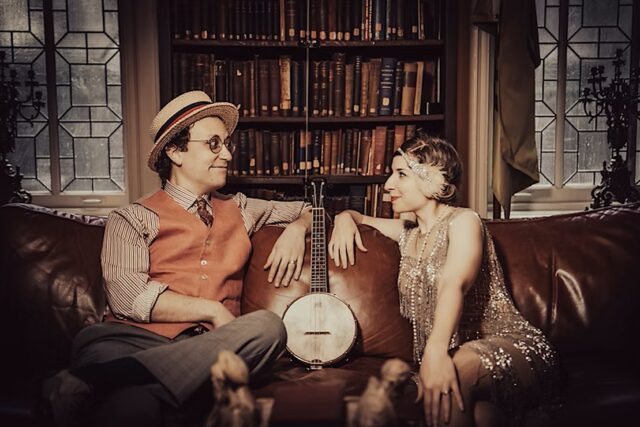
Charlie Judkins and Miss Maybell will perform as part of book event at Ceres Gallery

On September 11 at 6:30, in conjunction with the Tin Pan Alley American Popular Music Project, Garber (My Melancholy Baby: The First Ballads of the Great American Songbook, 1902–1913) will be at the nonprofit feminist Ceres Gallery for a free book talk with live performances by Jazz Age artists Miss Maybell and Charlie Judkins, surrounded by Carlyle Upson’s nature-based “Submerged” watercolors and Marcy Bernstein’s “Evocative Abstractions” paintings, which Bernstein says “invite viewers to look inward. They’re filled with allusions to the raw energy of creation itself,” a fitting sentiment that applies to Garber’s book as well. Admission is free with a suggested donation of $15.

[Mark Rifkin is a Brooklyn-born, Manhattan-based writer and editor; you can follow him on Substack here.]

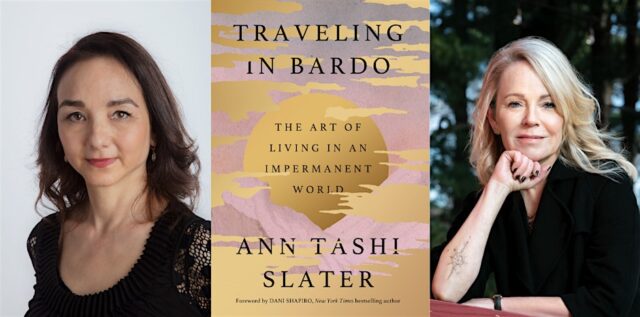
NOTHING LASTS FOREVER: TRAVELING IN BARDO WITH ANN TASHI SLATER

Ann Tashi Slater will discuss her new book at Rizzoli with Dani Shapiro on September 10

Who: Ann Tashi Slater, Dani Shapiro
What: Book launch with reading, conversation, and signing
Where: Rizzoli Bookstore, 1133 Broadway & West 26th St.
When: Wednesday, September 10, free with advance RSVP, 6:00
Why: “In a world where nothing lasts forever, how do we live?” writer, speaker, and traveler Ann Tashi Slater asks in her new book, Traveling in Bardo: The Art of Living in an Impermanent World (Balance, September 9, $29). Slater will address that question and more at the book launch at Rizzoli on September 10, where she will sit down with Dani Shapiro, author of such books as Signal Fires and Inheritance and host and creator of the podcast Family Secrets and who provided the foreword to the book.

“In my work, I explore how our personal histories and cultural roots shape us and how we find meaning in a world where everything — including we ourselves — changes and ends,” Slater explains on her website. “Traveling in Bardo interweaves explorations of impermanence in relation to marriage and friendship, parents and children, and work and creativity with stories of my Tibetan ancestors and Buddhist perspectives on the fleeting nature of existence, offering a new way to navigate change and live life fully.”

Slater will also give an in-person and virtual talk on September 12 at Columbia’s Weatherhead East Asian Institute with Lauran Hartley and take part in a Q&A and signing on September 16 at Tibet House.

[Mark Rifkin is a Brooklyn-born, Manhattan-based writer and editor; you can follow him on Substack here. Full disclosure: Mark’s wife is Ann Tashi Slater’s literary agent.]

THE LABOR OF LAUNDRY: LYNNE SACHS, LIZZIE OLESKER, AND FRIENDS AT UNNAMEABLE BOOKS

Who: Lizzie Olesker, Lynne Sachs, Silvia Federici, Veraalba Santa
What: Reading and performance
Where: Unnameable Books, 615 Vanderbilt Ave., Brooklyn
When: Monday, September 8, free, 7:00
Why:This is not a play. It is something else. / Call it a blueprint, a map, a documentation / of something that has already happened / but could happen again — / a rendering in book form of a performance. / Making a mark, words on a page instead of bodies in space. / A book that contains what’s remembered and what could be. / All of it written down and placed here, into this / Hand Book: A Manual,” Lizzie Olesker and Lynne Sachs write in the introduction to Hand Book: A Manual on Performance, Process, and the Labor of Laundry (Punctum, June 2025, 425). “We are a playwright and a filmmaker who discovered a shared interest in making work that magnifies quotidian elements of life in the city where we live. We met years ago in Brooklyn while sitting on a bench waiting for our young daughters to finish their music lessons. A conversation began about our lives as mothers and working artists. We couldn’t yet know that those early encounters would lead to a ten-year theater and film collaboration. Now in our sixties, our daughters fully grown, we continue to build an experimental model for making live performance and film, engaging in a dialogue on how art-making can alter our understanding of urban life.”

Olesker, an actor and playwright who has penned such shows as 5 Stages of Grief, A Kind (of) Mother, and Night Shift, and Sachs, a fiction writer and filmmaker who has directed such works as Which Way Is East, Your Day Is My Night, and Film About a Father Who, are the coauthors and codirectors of Hand Book, which Sachs describes as “a collection of writings and images from a performance and film set within a neighborhood laundromat.” In addition to sections by Olesker and Sachs, the illustrated, colorfully designed book (by Vincent W. J. van Gerven Oei) features contributions from Margarita Lopez (“A Thousand Pieces a Day”), Jasmine Holloway (“Taking on a Role”), Stephen Vitiello (“Shake, Rattle, and . . .”), Amanda Katz (“Sound of a Machine Door Closing”), Emily Rubin (“Loads of Prose: From the Beginning”), Veraalba Santa (“Score for a Folding Dance”), and others. The foreword, “A New Refusal and a New Struggle,” is by feminist historian, author, and activist Silvia Federici.

On September 8, Olesker, Sachs, Federici, and Santa will be at Unnameable Books in Brooklyn for a reading and performance. There will also be a reading and signing September 13 at noon at Printed Matter’s NY Art Book Fair
at MoMA PS1 and a performance, reading, and signing September 28 at 2:00 at Torn Page with Tony Torn and Alvin Eng. Sachs continues, “As authors, Lizzie and I along with our many collaborators construct a model for making art about essential work that often goes unrecognized. Turning a page becomes a quasi-cinematic encounter, calling to mind the intimacy of touching other people’s clothes, almost like a second skin, the textural care for things kept close to the body.”

[Mark Rifkin is a Brooklyn-born, Manhattan-based writer and editor; you can follow him on Substack here.]

THIS IS OUR KINGDOM: LINDA LINDA LINDA RETURNS FOR TWENTIETH ANNIVERSARY

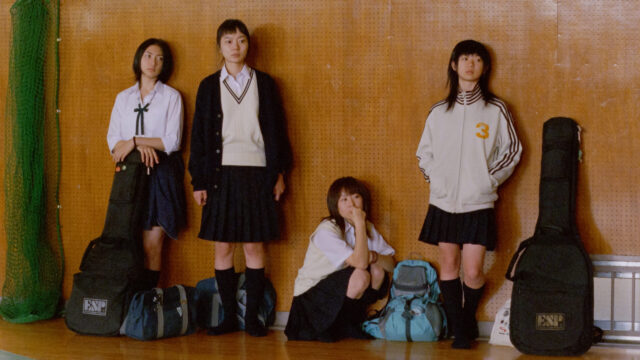
Four girls prepare to play in their high school rock festival in Linda Linda Linda

LINDA LINDA LINDA (Nobuhiro Yamashita, 2005)
IFC Center
323 Sixth Ave. at West Third St.
Opens Friday, September 5
www.ifccenter.com
gkids.com/films

The twentieth anniversary 4K restoration of Nobuhiro Yamashita’s 2005 teen cult classic, Linda Linda Linda, is reason to sing and dance and celebrate.

Opening at IFC Center on September 5, the film is a brilliant exploration of teen angst, a kind of Japanese John Hughes tale involving female friendship, jealousy, young love, and establishing one’s identity as an all-girl band prepares for the annual Shiba High Holly Festival. But unlike most Hughes flicks, there are few parents and teachers to be seen, and only in extremely minor roles; this is all about the children, on the cusp of adulthood.

The film begins with a teen crew making a video for the festival: “Don’t let anyone tell us that when we’re no longer kids, we grow up,” a student says. “When we grow up, we won’t quit being kids. Where are the real we? Should the real we be here? We’ve only got a little more time to be the real us. . . . ”

When guitarist and lead singer Moe Imamura (Shione Yukawa) has to drop out of the group after damaging the middle finger of her left hand, drummer Kyoko Yamada (Aki Maeda), bassist Nozomi Shirakawa (Shiori Sekine), and keyboardist Kei Tachibana (Yuu Kashii) have to make some fast changes if they are to perform at the show. Kei switches to guitar, but they need a vocalist. The Japanese trio briefly considers former band member Rinko Marumoto (Takayo Mimura), but she is in a fight with Moe.

Sitting outside, they decide to choose the next girl they see, and it turns out to be Son (Bae Doona), a Korean exchange student who is learning Japanese. Son initially says no but ultimately changes her mind and joins the band. They rehearse in Kei’s ex-boyfriend’s (Masaki Miura) studio, where at first they sound terrible as they practice songs by the Blue Hearts, a popular Japanese punk band that existed from 1985 to 1995.

With the pressure on to improve in time for their performance, they experience more adolescent growing pains, as Kyoko develops a crush on Kazuya Oe (Katsuya Kobayashi); the extremely nervous Makihara (Kenichi Matsuyama) confesses his love for Son; the bandmates go food shopping for dinner; master guitarist Takako Nakajima (Yuko Yamazaki) decides not to play at the event; and school music club leader Abe (Keisuke Koide) has her work cut out for her once the concert starts.

Written by Yamashita with Kōsuke Mukai and Wakako Miyashita and named for a Blue Hearts song, Linda Linda Linda feels as fresh and exhilarating today as it was twenty years ago. It’s thrilling watching the band members, always in their school uniforms of white shirt with a green bow, nearly knee-length dark socks and skirt, and light-yellow sleeveless vest, develop as individuals and a group; all the actors play their own instruments and do their own singing, which was not an issue with Shiori, who is the bassist for the Tokyo rock band Base Ball Bear, two of whose songs also appear in the film. The score was composed by guitarist James Iha of Smashing Pumpkins.

Bae (The Host, Air Doll), Aki (Battle Royale, I Never Shot Anyone), Yu (Lorelei: The Witch of the Pacific Ocean, Death Note), and Shiori are terrific as their characters discover new sides of themselves while coming together as a band, even knowing that it’s just for three songs and then they will all likely go their separate ways when they graduate. There’s a particular moving focus on Son, who spends time at the festival’s Japan-Korea Culture Exchange Exhibit, a fish out of water attempting to adapt to her new environs.

Adults exist only on the periphery; even Koyama (Masahiro Komoto), the teacher in charge of the music club, keeps an eye on them but doesn’t understand the dynamics involved. In one hilarious scene, he tries to send a message to the band through Rinko, but he stumbles over words and Rinko cuts him off, asking, “Can I go now?” as he stands with his hands on his hips, not quite knowing what to say but thinking about his own musical past and, perhaps, choices he made.

Hands and fingers serve as a leitmotif throughout the film, metaphors for the students taking more control of their lives as they prepare for the next step. Moe’s broken or sprained finger, suffered while playing basketball in gym class, sets everything in motion. Kei strums her guitar under a poster of Bob Marley smoking a joint, his giant hand practically blessing her. Son grabs a microphone like she’s holding on for dear life. A young girl throws darts at a poster of the different cuts of meat in a cow. The student making the festival video stands defiant, her fists clenched by her side as she declares, “We won’t let our high school days become a memory. . . . This is our kingdom.” And then there’s the strange gift Tomoki gives Kei with her mother (Lily) present.

Linda Linda Linda is a stirring, touching film about the pain and pleasure of youth, concluding with an unforgettable finale that is likely to have you jumping out of your seat, fists raised high in the air.

[Mark Rifkin is a Brooklyn-born, Manhattan-based writer and editor; you can follow him on Substack here.]

YOU’RE A GOOD MAN, CLIFF CASHEN: A CHRISTMAS MOVIE TO REMEMBER

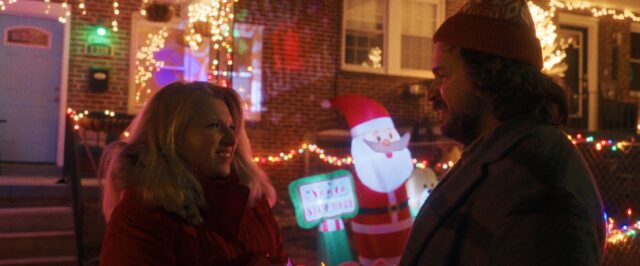
Didi (Liz Larsen) and Cliff (Michael Strassner) have a Christmas Eve to remember in The Baltimorons

THE BALTIMORONS
IFC Center, AMC Lincoln Square, Alamo Drafthouse Downtown Brooklyn
Opens Friday, September 5
www.baltimoronsmovie.com

“What’s wrong with you?” dentist Didi asks her emergency patient, Cliff, early in The Baltimorons. He immediately replies, “Everything.”

What’s right with the film? Just about everything.

The Baltimorons is a bittersweet, hilarious escapade from the Duplass Brothers, directed by Jay Duplass and written by Duplass and Baltimore native Michael Strassner. Strassner stars as Cliff Cashen, who, in the first scene, fails pathetically at trying to hang himself in his attic. Six months later, a sober Cliff is driving with his fiancée, Brittany (Olivia Luccardi), to her mother’s house for Christmas Eve dinner. Cliff is an improv comic, but Brittany is worried when fellow comedian Marvin (Rob Phoenix) texts him about participating in a show that night; Cliff has promised Brittany that, as part of his sobriety, he has given up comedy as well as booze.

On his way into the house, he trips over a loose brick and smashes his face against the side of the door, causing significant damage to his mouth and teeth. He finds Dr. Didi (Liz Larsen), apparently the only dentist working on the holiday, and meets her in her office. Cliff might be a bear of a guy, but he is a sensitive man-child who is afraid of needles; it’s also nearly impossible to know when he is telling the truth or joking around.

Upon leaving Didi’s office, Cliff sees that his Cadillac has been towed; with no other options, he accepts an offer from Didi — a divorced mother and grandmother whose ex-husband (Brian Mendes) just got married that morning — to drive him to the impound lot so he can reclaim his car, which was originally his father’s. That leads to a series of extremely funny, moving, and dangerous adventures in which doctor and patient seem stuck together, facing personal and professional challenges that make them take a hard look at who they are and where they are going.

Duplass, who previously worked with his younger brother, Mark Duplass, on such films as The Puffy Chair and Baghead and the series Togetherness, met Strassner through the latter’s Instagram (@strasshola), where Strassner posts wildly unpredictable short videos. They quickly clicked and were soon writing The Baltimorons, which is loosely based on Strassner’s real life. Duplass cast Tony winner Larsen (The Most Happy Fella, Law & Order) after seeing her play matriarch Shelly Pfefferman in A Transparent Musical; Duplass had portrayed one of that character’s children in the hit streaming series. The role of Didi was then adjusted to reflect some elements from Larsen’s life.

It all combines to give the film a realistic feel, with Baltimore a character unto itself; it’s very much a love letter to the city as Jon Bregel’s camera guides us to the since-collapsed Francis Scott Key Bridge, Federal Hill, the annual Miracle on 34th Street holiday lighting display in Hampden, the Rocket to Venus restaurant, and other locations; there are also several mentions of the Baltimore Ravens and their All-Pro quarterback, Lamar Jackson. (Although the film is not political, it is difficult to think of the National Guard and other military being sent in to save this lovely city.)

Strassner, who played Snoopy in You’re a Good Man, Charlie Brown when he was in the seventh grade, is a veteran of the Groundlings improv group and has appeared on numerous sitcoms, but he instantly takes hold of the film; it’s virtually impossible not to connect with Cliff, a complex gentle giant who went through a bad time and is now trying to reframe his life. Strassner balances solemnity and gravity with humor and Cliff’s infectious world view; although it essentially makes no sense for Didi to keep sticking to Cliff, it’s hard to imagine it wouldn’t be exactly what we would do if we were in her situation, and Larsen (The Most Happy Fella, Law & Order) excels as the distraught doctor, melding her obvious and necessary cautiousness with an inner desire to break free, to gain control of a life that is getting away from her. You don’t have to be a sober comic or a lonely dentist to appreciate, understand, and, most important, want to spend more and more time with these two oddly matched people in search of something else.

The Baltimorons is a Christmas movie to remember, worthy of a place in the holiday canon; Jordan Seigel’s charming score even recalls Vince Guaraldi’s music for A Charlie Brown Christmas. There’s a reason why the film won the Audience Award at four different festivals. See it now, but add it to your annual Christmas list as well.

The Baltimorons opens September 5 at IFC Center, AMC Lincoln Square, and Alamo Drafthouse in downtown Brooklyn; Duplass, Strassner, and Larsen will be at IFC for Q&As following the 7:15 screenings on Friday (moderated by athlete, author, and podcaster Rich Roll) and the 4:40 show on Saturday (moderated by actor David Krumholz); they will also be at Alamo for Saturday’s 7:00 show.

[Mark Rifkin is a Brooklyn-born, Manhattan-based writer and editor; you can follow him on Substack here.]

THE COURAGE TO RECOGNIZE CRUELTY: ROAD KILLS AT PARADISE FACTORY

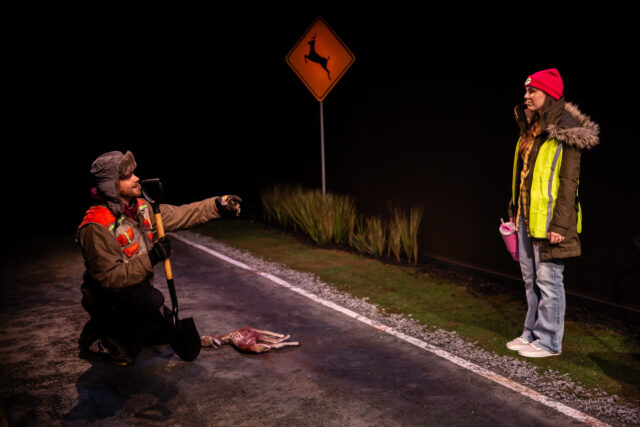
Owen (D. B. Milliken) has to teach Jaki (Mia Sinclair Jenness) the ins and outs of roadkill collection in world premiere play (photo by Nina Goodheart)

ROAD KILLS
Paradise Factory Theater
64 East Fourth St. between Second & Third Aves.
Thursday – Saturday through September 6, $19.50 – $53.25
www.goodapplescollective.com
www.paradisefactory.org

“If having a soul means being able to feel love and loyalty and gratitude, then animals are better off than a lot of humans,” British veterinary surgeon and author James Herriot wrote. Playwright Sophie McIntosh explores relationships between animals and humans — and humans with one another — in her powerful, beautifully staged new play, Road Kills, continuing at the Paradise Factory Theater through September 6.

The eighty-five-minute show takes place in a narrow, horizontal space, designed by Junran “Charlotte” Shi, with the audience sitting in three rows of folding chairs on one side; on the other side is a strip of grass, rocks, dirt, and a deer crossing sign. In between is an asphalt road, where a shocking image lies. The first row of seats are on a double yellow line, creating a level of intimacy and potential risk that hovers over the proceedings.

The play follows professional roadkill collector Owen Morris (D. B. Milliken) and Jaki Johnson (Mia Sinclair Jenness), a twenty-year-old college student who has been ordered to do six Saturdays of community service with Owen for an initially unnamed offense. It’s late fall in rural Wisconsin, so both are wearing parkas, with Owen in a red vest and Jaki in a yellow one, along with a red Green Bay Packers knit cap and a pink Stanley cup. (The props are by Sean Frank, with costumes by Saawan Tiwari; the temperature in the theater has been lowered for added effect, so a sweatshirt or other jacket is recommended for audience members.)

Owen and Jaki use shovels to carry the roadkill to a wheelbarrow; Owen asks Jaki, who would rather be anywhere else, to spot him, watching for oncoming traffic. “We’re in the middle of nowhere,” she argues. It turns out that the dead animal is stuck to the road, so removal will require additional finesse, as well as Jaki’s participation. Owen asks for some of Jaki’s coffee to help thaw the carcass, but she steadfastly refuses, claiming that it’s iced mocha — but as we soon learn, it’s got an extra kick to it.

She ultimately has to help pick up the carcass, but when she tosses it into the wheelbarrow like it’s a bag of garbage, Owen interjects, “Hey, careful. Don’t go throwing her around. . . . She deserves some respect.” Jaki then pukes in the wheelbarrow. Owen suggests they take a break before heading out to collect two other dead animals, but she insists on moving ahead because “Sigma Chi is throwing a Homecoming party tonight, and I’m not gonna miss it.”
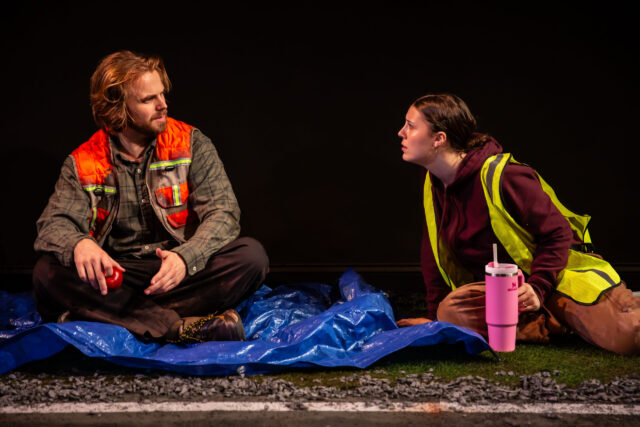
A picnic does not go quite as planned in Sophie McIntosh’s Road Kills (photo by Nina Goodheart)

It’s a terrific opening scene, firmly establishing the characters and the situation and immersing the audience in the setting. Each successive scene begins with a prerecorded mini audio drama in which a variety of drivers carelessly speed down the road, leaving carnage in their wake as the car lights flash by in the darkness. At each stop, Owen and Jaki share a little more about their lives; Owen, who is in his late twenties, inherited his job when he was sixteen from his father and lives with his mother and their dog, Annie. He is soft-spoken and displays a natural affinity for the dead animals and the environment. Jaki is attending the University of Wisconsin–Oshkosh, which she calls Sloshkosh, although she is destined to work on her family’s farm, which she is not happy about but thinks she has no other options. She talks openly about how much sex she is having with different guys, which makes Owen uncomfortable.

“You sure it’s safe to be . . . hooking up . . . with a stranger?” Owen says. Jaki responds matter-of-factly, “Aww, you worried about me? I’ll be fine. Just scared he’ll say my pussy smells like roadkill.”

The essential beliefs of each character are emphasized in this key exchange about Jaki’s family’s business:

Owen: Animals are — They’re us. I mean, we’re one of them, you know?
Jaki: Yeah, sure, humans are just supersmart monkeys. But I’ve seen Planet Earth. Even the chimps eat each other.
Owen: I know this isn’t . . . You may not see it this way. But when G-d made His creatures, great and small, He put His spirit into each of us. We didn’t get more or less than any other being — it’s not something you can measure like that. It’s . . . It’s all just life. And to take away the dignity of any man, any animal . . . it’s wrong.
Jaki: At least we don’t, like, mass murder our cattle.
Owen: Could be what you do is even worse. Violating them like that.
Jaki: Come on. It’s not like it’s — Like they have any concept of — You can’t rape a thing.
Owen: You really believe that?
Jaki: Yeah. And even if I didn’t . . . you know what they say. It’s a fuck-or-get-fucked world.

On one Saturday, Owen and Jaki meet Neil (Michael Lepore), and on another Jaki’s cousin Miles (Lepore) comes to get her; both interactions result in altercations that lead to the revelation of dark secrets.
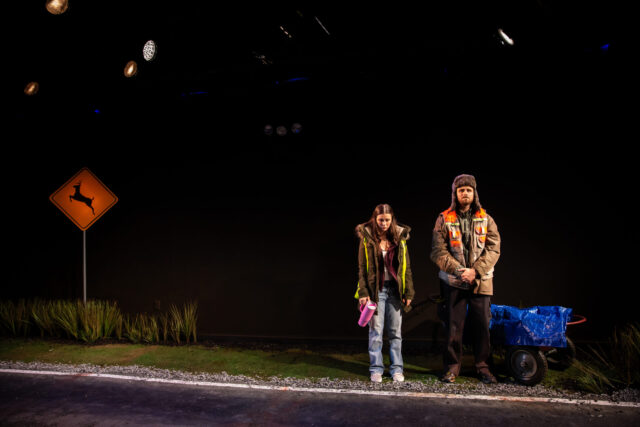
Jaki (Mia Sinclair Jenness) and Owen (D. B. Milliken) forge an intriguing relationship while performing an unusual job (photo by Nina Goodheart)

Wisconsin native McIntosh started researching and writing the play in 2019, when she was an undergrad. Over the years she drove the Wisconsin streets looking for roadkill, interviewed the wife of a Wisconsin roadkill collector, and took some of the cast and crew on a five-day trip as preparation. It all paid off, as Road Kills has an intensely realistic and relatable feel to it. It’s exquisitely directed by Nina Goodheart, who cofounded Good Apples Collective with McIntosh; they previously collaborated on cunnicularii, which also starred Milliken. Each scene is carefully choreographed, although there are some confusing moments, particularly when Owen and Jaki don’t bring the wheelbarrow close to the carcasses and instead have to pick the pieces off the road and walk them over. The production features stellar lighting by Paige Seber and sound by Max Van; despite being such a small space with primarily only two actors, there is always something new to see or hear. Milliken is warm and gentle as the easygoing Owen, while Jenness is fearless as the complicated Jaki, who has a bitter edge to everything she says and does.

As with her 2022 play, macbitches, McIntosh makes some harsh turns near the end, piling on too much as we learn more about Owen and Jaki. Good Apples describes itself as “a developmental orchard for new theatrical works that expose abuses of power, challenge taboos around desire and sexuality, and uplift the voices of queer and gender marginalized communities,” but the show nearly overloads on that in a short period of time. Still, it’s a powerful, provocative, and compelling statement on contemporary society.

Like American author, marine biologist, and environmentalist Rachel Carson wrote, “Until we have the courage to recognize cruelty for what it is — whether its victim is human or animal — we cannot expect things to be much better in this world.”

Also, and just as important, after experiencing Road Kills, you’re likely to be more careful than ever when you’re behind the wheel, and you’ll never hear John Denver’s “Annie’s Song” or Cat Stevens’s “Moonshadow” quite the same way again.

[Mark Rifkin is a Brooklyn-born, Manhattan-based writer and editor; you can follow him on Substack here.]

IFC AT TWENTY: BOYHOOD AND ANTICHRIST

BOYHOOD

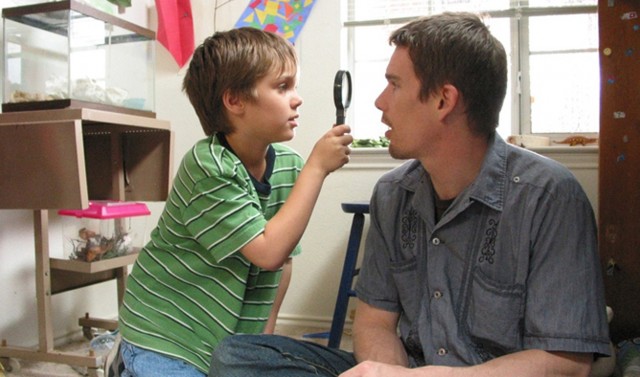
Mason Jr. (Ellar Coltrane) and Mason Sr. (Ethan Hawke) take a look at their lives in Richard Linklater’s brilliant Boyhood

BOYHOOD (Richard Linklater, 2014)
IFC Center
323 Sixth Ave. at West Third St.
Sunday, August 31, 1:45
Monday, September 1, 11:15 am
Wednesday, September 3, 1:00
www.ifccenter.com

IFC Center is celebrating its twentieth anniversary by screening twenty films, one from each year it’s been open. The first part of the series runs through September 4 and includes 2006’s Inland Empire, 2007’s Fay Grim, 2009’s Antichrist, and 2014’s Boyhood.

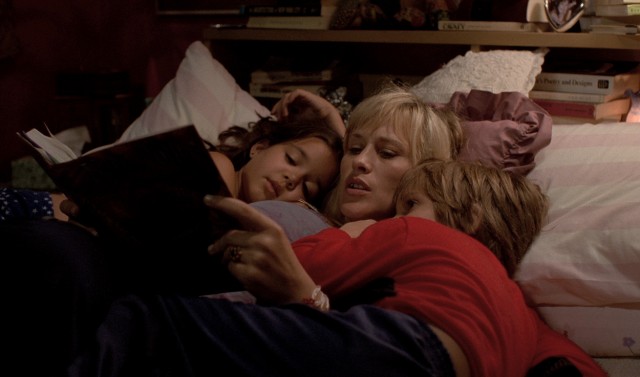
Since 2002, Austin auteur Richard Linklater has made a wide range of successful films, from the family-friendly School of Rock and Bad News Bears to the second and third parts of the more adult Before series (Before Sunset, Before Midnight), with Ethan Hawke and Julie Delpy, in addition to the Philip K. Dick thriller A Scanner Darkly and the Jack Black black comedy Bernie. But during that entire period he was also making one of the grandest films ever about childhood, the deceptively simple yet mind-blowingly complex Boyhood. The work follows Mason Evans Jr. (Ellar Coltrane) as he goes from six years old to eighteen, maturing for real as both the actor and the character grow up before our eyes. As the film begins, Mason, his older sister, Samantha (Linklater’s real-life daughter, Lorelei), and their mother, Olivia (Oscar winner Patricia Arquette), are preparing to move to Houston just as their usually absent father, Mason Sr. (Hawke), returns from a job in Alaska, supposedly ready to be a more regular part of their lives. But his emotional immaturity leads to divorce, and Mason Jr. spends the next dozen years dealing with school, stepfathers, and the normal machinations of everyday life, including sex, drugs, rock and roll, and, for him, a determination from an early age to become an artist. Along the way, his sister and parents experience significant changes as well as they all learn lessons about life, love, and loss.

BOYHOOD

Olivia (Patricia Arquette) reads to children Samantha (Lorelei Linklater) and Mason Jr. (Ellar Coltrane) in Boyhood

To make the film, the cast and crew met every year for three or four days of shooting, with writer-director Linklater moving the story ahead by incorporating real elements from Coltrane’s life that add to the natural ease and flow of the story. Despite the obvious difficulties of maintaining continuity over a dozen years, cinematographers Lee Daniel and Shane Kelly and editor Sandra Adair do a masterful job of keeping the narrative right on track. It’s breathtaking to see Mason Jr. go upstairs in one scene, then come downstairs a year later, ready for something new, dressed slightly differently, with a little more facial hair, to signal the change in time. (Linklater also uses the soundtrack to note the passing years, with songs by Coldplay, the Hives, Cat Power, Gnarls Barkley, the Flaming Lips, and others.) Mason Jr.’s unique relationship with each parent and his sister is utterly believable, complete with all the pluses and minuses that entails; at one point, Lorelei, tired of being in the movie, asked her father to kill off her character, and even that energy is apparent onscreen. In addition to Coltrane’s career-making performance, Hawke and Arquette are sensational, doing something no other actors before them have ever done. You won’t be bored for a second of this two-hour, forty-minute journey with a relatively average American family that helps define the modern human condition like no other single film before it. “Photography is truth . . . and cinema is truth twenty-four times a second,” Bruno Forestier (Michel Subor) tells Véronica Dreyer (Anna Karina) in Jean-Luc Godard’s Le Petit Soldat. With Boyhood, that statement has rarely been so true. Nominated for six Academy Awards, Boyhood is screening in the IFC Center series “20 Films for 20 Years” on August 31 and September 1 and 3, the first two on 35mm.

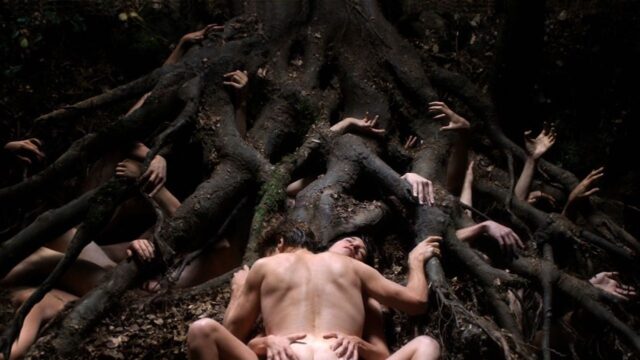
Lars von Trier’s Antichrist is yet another controversial work by the Danish filmmaker

ANTICHRIST (Lars von Trier, 2009)
IFC Center
Saturday, August 30, 7:05
Monday, September 1, 9:40
Wednesday, September 3, 4:25
Thursday, September 4, 11:15 am
www.ifccenter.com

Generally, Danish Dogme practitioner Lars von Trier makes films that critics and audiences alike are either repulsed by or deeply love. Controversial works such as Breaking the Waves, The Idiots, Dancer in the Dark, and Dogville win international awards while also driving people out of theaters. In fact, at the New York Film Festival press conference for Antichrist, he was asked how he feels when no one walks out on his work: “Then I have failed,” he replied with a sly grin. Well, there are sure to be many walkouts during Antichrist, a harrowing tale of grief, pain, and despair that begins with a gorgeously shot, visually graphic sex scene followed by a tragic accident. The rest of the film details how the unnamed couple (Willem Dafoe and Charlotte Gainsbourg) deal with the loss of their young child; a therapist, he opts to treat her more as a patient than as his wife, a highly questionable decision that threatens to tear them apart — both psychologically and physically, as the film turns into an extremely violent horror flick in the final scenes.

Somehow, I found myself pretty much right in the middle of this one, neither loving it nor hating it while admiring it greatly despite its odd meanderings, loose holes, sappy dialogue, and occasionally awkward scenarios. In certain ways, it’s a bizarre amalgamation of Alfred Hitchcock’s Spellbound, Ingmar Bergman’s Scenes from a Marriage, Stanley Kubrick’s The Shining (and various other Stephen King stories), Roman Polanski’s Rosemary’s Baby, Richard Donner’s The Omen, Robert Wise’s Audrey Rose, and Tobe Hooper’s The Texas Chainsaw Massacre. Or something like that. Antichrist is screening in the IFC Center series “20 Films for 20 Years” on August 30 and September 1, 3, and 4, the last at an ungodly 11:15 am

[Mark Rifkin is a Brooklyn-born, Manhattan-based writer and editor; you can follow him on Substack here.].