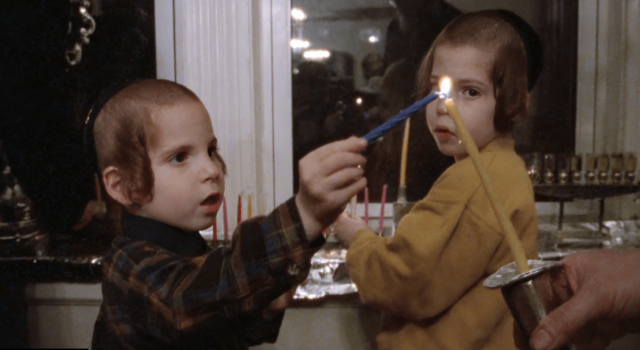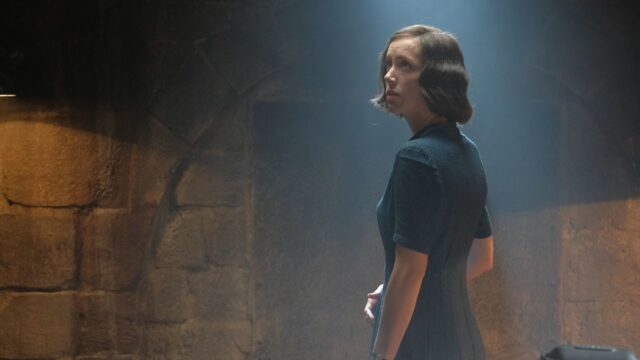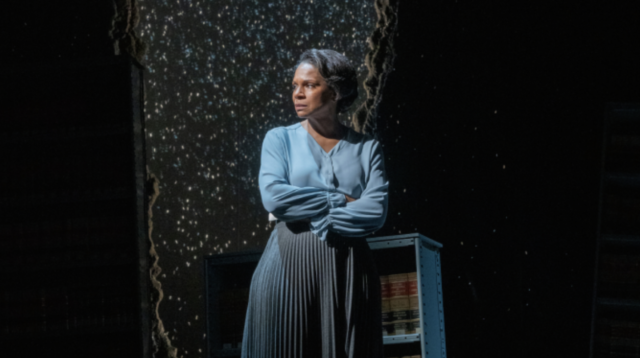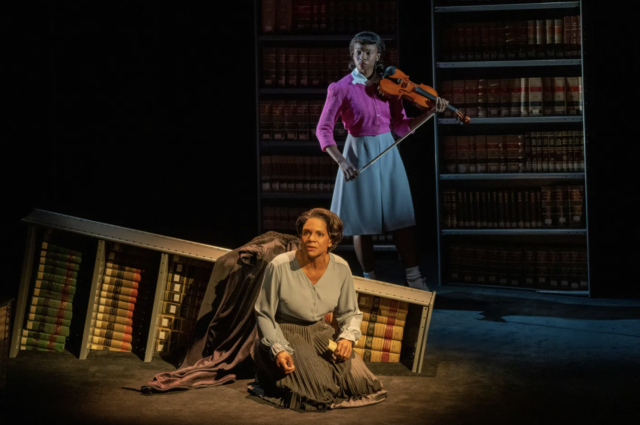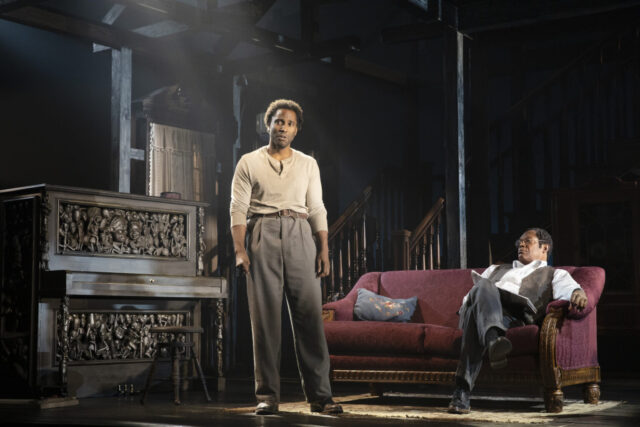
John David Washington plays the role Samuel L. Jackson originated in Broadway revival of August Wilson’s The Piano Lesson (photo by Julieta Cervantes)
THE PIANO LESSON
Ethel Barrymore Theatre
243 West 47th St. between Broadway & Eighth Ave.
Tuesday – Sunday through January 29, $74–$318
pianolessonplay.com
“We live in a recycled culture,” Stephen Sondheim told Frank Rich of the New York Times in March 2000. Sondheim explained that there are “two kinds of shows on Broadway — revivals and the same kind of musicals over and over again, all spectacles.”
Broadway revivals are a curious thing. They are often vehicles with built-in star power — Hugh Jackman in The Music Man, Bette Midler in Hello, Dolly! — offering new takes on beloved, household-name shows, for better or worse, something that is unique to theater. In pop music, artists cover hit songs but also do deep dives into another musician’s catalog, resurrecting little-known gems. In cinema, directors remake successful movies — there’s not a whole lotta interest in redoing bad films — but how many remakes were at least equal to or better than the original? (I’ll wait.) And in literature, well, you can’t rewrite a book that has already been written. “It has to do with seeing what is familiar,” Sondheim said to Rich. That’s why so many movies are made into Broadway musicals, generally packing in the crowds despite less-than-enthusiastic reviews.
Right now on Broadway you can see seven revivals on the Great White Way, with several more coming. There are currently four revivals in the fall season, only two of which are exemplary, honoring the spirit of the original. I’ve already raved about Kenny Leon’s adaptation of Suzan-Lori Parks’s superb Topdog/Underdog at the Golden.
At the Ethel Barrymore, Tony nominee LaTanya Richardson Jackson’s version of August Wilson’s The Piano Lesson is exquisite, a stirring adaptation of the fourth play in Wilson’s ten-part Pittsburgh Cycle, this one set in in 1936. (Each play takes place in a different decade of the twentieth century.) It’s a truly American story of race, colonialism, slavery, family, and the ghosts of a shameful history; the play premiered at Yale in 1987 and on Broadway three years later, earning five Tony nominations including Best Play.
At Yale, Samuel L. Jackson starred as Boy Willie, a dreamer with a plan to sell a truckload of watermelons and the family heirloom piano in order to buy a hundred acres of land where his forebears had toiled for the Sutters first as slaves, then as sharecroppers. Thirty-five years later, Jackson, who is married to LaTanya Richardson Jackson, is Doaker Charles, Boy Willie’s (John David Washington) sensible uncle, who lives with Boy Willie’s widowed sister, Berniece (Danielle Brooks), and her young daughter, Maretha (Nadia Daniel or Jurnee Swan). Berniece, whose husband, Crawley, died several years before, is not about to sell the piano, into which her great-grandfather, Willie Boy, carved powerful images of their ancestors and stories from their lives.
Boy Willie has unexpectedly arrived with his friend Lymon (Ray Fisher), a shy ladies’ man who takes a liking to Berniece, who is being courted by the local preacher, the boring Avery Brown (Trai Byers). It’s Avery who delivers one of the most important points of the play when he tells Berniece, who refuses to play the piano anymore, “You got to put all of that behind you, Berniece. That’s the same thing like Crawley. Everybody got stones in their passway. You got to step over them or walk around them. You picking them up and carrying them with you. All you got to do is set them down by the side of the road. You ain’t got to carry them with you. You can walk over there right now and play that piano. You can walk over there right now and God will walk over there with you. Right now you can set that stack of stones down by the side of the road and walk away from it. You don’t have to carry it with you. You can do it right now. . . . You can walk over here right now and make it into a celebration.”
Another surprise arrival is Doaker’s older brother, Wining Boy (Michael Potts), who serves as the comic relief. Wining Boy is a gambler and former piano player who shows up only when he needs money. “That piano got so big and I’m carrying it around on my back. I don’t wish that on nobody,” he tells Boy Willie. “Now, there ain’t but so many places you can go. Only so many road wide enough for you and that piano. And that piano get heavier and heavier. . . . But that’s all you got. You can’t do nothing else. All you know how to do is play that piano. Now, who am I? Am I me? Or am I the piano player? Sometime it seem like the only thing to do is shoot the piano player cause he the cause of all the trouble I’m having.”
In the second act, a partying Boy Willie brings home Grace (April Matthis), who might be the most perceptive of the group. “Something ain’t right here,” she tells Boy Willie and Lymon.
Beowulf Boritt’s set features the kitchen and living room, with the upstairs open, without doors or walls, hinting that secrets are going to be exposed. The cast is outstanding, led by the confident and self-assured Jackson. I’ve seen several other productions, with Brandon J. Dirden as Boy Willie at the Signature in 2012, directed by Wilson mainstay Ruben Santiago-Hudson, and with a Tony-nominated Charles S. Dutton as Boy Willie at the Walter Kerr in 1990, directed by Wilson’s longtime cohort Lloyd Richards; it’s a testament to the writing that all three productions were excellent, staying true to Wilson’s words and story, which were inspired by onetime Pittsburgh resident Romare Bearden’s 1983 painting, which itself was inspired by Henri Matisse’s 1916 The Piano Lesson and 1917 The Music Lesson. The play might take place in 1936, but it has a timeless quality that still hits hard in 2022.
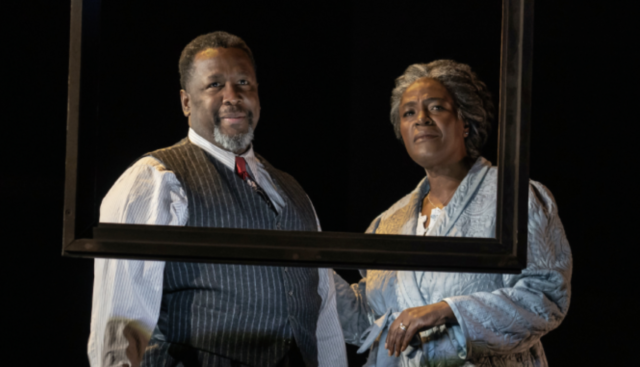
Wendell Pierce and Sharon D Clarke star in reimagined Death of a Salesman (photo by Joan Marcus
DEATH OF A SALESMAN
Hudson Theatre
141 West Forty-Fourth St. between Sixth & Seventh Aves.
Tuesday – Sunday through January 15, $58-$297
salesmanonbroadway.com
Unfortunately, the same cannot be said for Miranda Cromwell’s reimagining of Arthur Miller’s 1949 classic, Death of a Salesman, running at the Hudson Theatre through January 15. What seemed like a slam dunk turns out to be a forced, disjointed narrative despite the timelessness of the original.
The play still is set in Brooklyn in 1949, but the Loman family is Black: patriarch Willy (Wendell Pierce), his devoted wife, Linda (Sharon D Clarke), and their ne’er-do-well sons, former high school football star Biff (Khris Davis) and Happy (McKinley Belcher III), a womanizing dreamer not unlike Boy Willie in The Piano Lesson. The sixty-three-year-old Willy has been having difficulty on the road, losing customers and experiencing driving issues. We never learn exactly what it is he’s selling, but it’s not important; he represents hardworking Americans who toil down to the bone, rarely able to catch a break or get ahead in life.
As Willie slowly starts to realize that he’s not vital anywhere, his neighbor, Charley (Delaney Williams), keeps offering him a job closer to home, but Willy turns him down, instead relying on his boss, Howard (Blake DeLong), to honor his loyalty, but Howard has his eyes set to the future, one that does not include men like Willy.
Willy tries to find hope and solace in the words and wisdom of his late brother, Ben (the fabulously attired André De Shields), now only a ghost, and his despairing family starts to suspect something is seriously wrong.
One of the great characters in the American canon, Willy has been played onstage and -screen by Lee J. Cobb, Fredric March, George C. Scott, Dustin Hoffman, Brian Dennehy, and Philip Seymour Hoffman. Pierce is far too loud as Willy, nearly always shouting, bringing no nuance to the role. Clarke is terrific as his long-suffering wife, but Davis and Belcher III never firmly take control of their parts.
Crowell adds a strolling bluesman (Femi Temowo) who occasionally shows up to serenade the audience, but it feels too random. The dinner scene between Willy, Biff, and Happy is moved to a jazz club that seems out of place. Anna Fleischle’s set, primarily the interior of the Loman household, gets confusing with all its imaginary barriers. To me it was like everyone was trying too hard to put their own stamp on the tale, not trusting that the switch to making the family African American gave the play a new depth all by itself.
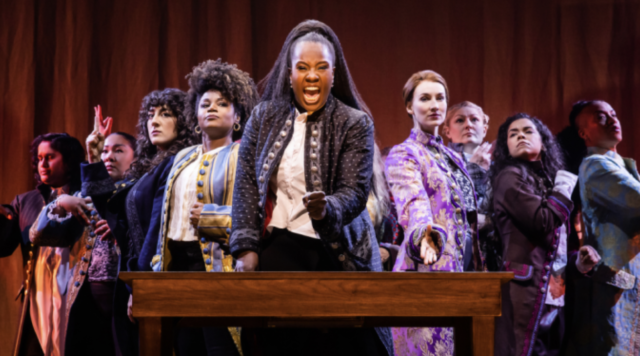
A casting gimmick tries to put 1776 into a different perspective (photo by Evan Zimmerman)
1776
American Airlines Theatre
227 West 42nd St. between Broadway & Eighth Ave.
Tuesday – Sunday through January 8, $56-$250
www.roundabouttheatre.org
When it comes to reinterpreting a hit, 1776 takes the cake — and hits the nadir. The 1969 Tony-winning Best Musical focuses on the debates leading up to the signing of the Declaration of Independence at the second Continental Congress, in Philadelphia. For this Roundabout revival at the American Airlines Theatre, directors Jeffrey L. Page and Diane Paulus have chosen a cast of women, transgender, and nonbinary actors portraying the Founding Fathers (and two of their wives). However, this is no Hamilton.
The show features music and lyrics by Sherman Edwards and a book by Peter Stone. It begins cleverly enough with a row of men’s shoes at the front of the stage, which the characters step into with a kind of feminist glee; it’s a lovely moment, but it’s all downhill from there as the casting becomes the point of the revival. Oh, look, Thomas Jefferson is played by a pregnant woman (Elizabeth A. Davis). Ben Franklin is portrayed by an actor who looks nothing like him (Patrena Murray). The casting feels like a gimmick that dominates everything else when it could have been so much more. It’s not that I’m averse to change; I loved Daniel Fish’s reinvention of Oklahoma! a few years ago. But the changes have to be pertinent, not just made for the sake of change.
At first, it’s engaging and relevant to what’s happening in the sociopolitical spectrum in 2022, as evidenced by John Adams’s (Crystal Lucas-Perry, later replaced by Kristolyn Lloyd) all-too-believable speech: “If you don’t want to see us hanging / On some far off British hill; / If you don’t want the voice of independency / Forever still, / Then, god, sir, get thee to it! / For Congress never will! / You see, we Congress / Piddle, twiddle, and resolve. Eh . . . / Not one damned thing do we solve. . . . Piddle, twiddle, and resolve, . . . / Nothing’s ever solved in Congress.”
Leading the fight against independence are the conservative John Dickinson of Pennsylvania (Carolee Carmello), George Read of Delaware (Nancy Anderson), and Edward Rutledge of South Carolina (Sara Porkalob). They argue about the rules of the vote, a clause involving slavery, and other elements, some of which are based on fact, others unverifiable, and others just plain inaccurate. The only two female characters, Abigail Adams (Allyson Kaye Daniel) and Martha Jefferson (Eryn LeCroy), were most likely not in Philadelphia at the time, although Adams’s “Compliments” is a standout, having more power than the more well known showstopper “Molasses to Rum,” performed by Rutledge.
There are also unnecessary projections that compare 1776 to today, particularly with regard to women in politics, something that did not need to be said but was clear from the rest of the show, which mostly falls flat. The televised January 6 Committee hearings were more interesting than this revival, which highlights the original’s many faults. The 1969 edition was nominated for five Tonys, winning three, while the 1997 revival earned three nominations, taking home none. I can’t imagine this one could top either of those come 2023 awards time.
There’s a reason why Sondheim won eight Tonys (as well as an Oscar, eight Grammys, a Pulitzer, and the Presidential Medal of Freedom) and so many of his shows are revived, on and off Broadway. As he told Rich in 2000, “‘Less is more’ is a lesson learned with difficulty. . . . Reduction releases power.” Just look at the current smash Broadway revival of Sondheim’s Into the Woods at the St. James.