featured

BRAINWASHED: SEX-CAMERA-POWER

Nina Menkes delves into such films as The Lady from Shanghai in Brainwashed

BRAINWASHED: SEX-CAMERA-POWER (Nina Menkes, 2022)
DCTV’s Firehouse Cinema
87 Lafayette St.
Opens Thursday, October 20
firehouse.dctvny.org
www.brainwashedmovie.com

In his seminal 1972 book Ways of Seeing, British essayist, novelist, and cultural thinker John Berger writes, “According to usage and conventions which are at last being questioned but have by no means been overcome, the social presence of a woman is different in kind from that of a man. A man’s presence is dependent upon the promise of power which he embodies. . . . The promised power may be moral, physical, temperamental, economic, social, sexual — but its object is always exterior to the man. A man’s presence suggests what he is capable of doing to you or for you. . . . By contrast, a woman’s presence expresses her own attitude to herself, and defines what can and cannot be done to her. Her presence is manifest in her gestures, voice, opinions, expressions, clothes, chosen surroundings, taste — indeed there is nothing she can do which does not contribute to her presence. Presence for a woman is so intrinsic to her person that men tend to think of it as an almost physical emanation, a kind of heat or smell or aura.”

American filmmaker Nina Menkes forever changes the way you’ll see and experience movies in her eye-opening documentary Brainwashed: Sex-Camera-Power. “As a filmmaker and as a woman, I found myself drowning in a powerful vortex of visual language from which it is very difficult to escape,” she explains at the beginning of the film, an adaptation of her illustrated lecture “Sex and Power: The Visual Language of Oppression.” Producer and director Menkes, whose filmography includes Queen of Diamonds, Magdalena Viraga, and Dissolution, speaks with sixteen women and two men and shows clips from more than one hundred and twenty-five films as she reveals how much the movie industry is reliant on the male gaze, creating fantasy spaces that celebrate men while objectifying women.

Dartmouth filmmaker and faculty member Iyabo Kwayana posits, “I think we have to consider that it is through the formal visual language that we are effectively communicating meaning, and we inherit so much subliminally that comes from this language and it has to do with how shots are composed and framed, how they’re assembled and ordered in a sequence of shots. All of that becomes the grammar and syntax by which meaning is conveyed to a viewer. So in a visual culture such as ours, in which there is a ravenous appetite towards the female as object, if the camera is predatory, then the culture is predatory as well.”

Menkes divides her talk into five sections that comprise what she calls “The List”: “Subject/Object,” “Framing,” “Camera Movement,” “Lighting,” and “Narrative Position.” Among the films she examines are The Lady from Shanghai, Super Fly, Contempt, Carrie, Lost in Translation, Cuties, Crazy Rich Asians, Sleeping Beauty, Do the Right Thing, Blade Runner 2049, and The Silence of the Lambs, revealing how ingrained it is to depict men and women differently, what Transparent producer, writer, and director Joey Soloway calls “propaganda for patriarchy.” Director and activist Maria Giese adds, “Hollywood has been the worst violator of Title VII [part of the 1964 Civil Rights Act] of any industry in the United States — even worse than coal mining.”

Actress Rosanna Arquette shares the abuse she suffered at the hands of Harvey Weinstein as well as the regrets she has about a nude scene she did in After Hours. Menkes includes nude scenes throughout the film, involving Brigitte Bardot, Jane Fonda, Nicole Kidman, and many other familiar stars, describing how they can be “attacks on our selfhood.” She demonstrates how the use of slow motion focuses on a woman’s erotic sensuality but a man’s power and violence. Menkes also explores how the depiction of women on celluloid impacts sexual abuse.

Global Media Center for Social Impact founder Sandra de Castro Buffington asks, “How is rape culture normalized? There are really three key elements that we see on the screen and in real life. One is the objectification of women’s bodies. Another is the glamorization of sexual assault, especially on the screen. And the third is disregard for women’s rights and safety, even if a hand is not laid on another person. These are all of the elements that create an environment that allows one group to gain and maintain power over another.”

California State University faculty member Rhiannon Aarons expounds, “I think this visual language really contributes to female self-hatred and insecurity in a way that is not insignificant. What is normalized as beauty is really seen specifically and dominantly through a male gaze. I think that really changes how we relate in the world in general and not necessarily in the best way.”

Menkes spends extra time delving into such films as Raging Bull, Bombshell, and Mandingo, demonstrating how women’s voices are silenced and power dynamics are ingrained in visual storytelling. She uses a critical scene from Portrait of a Lady on Fire to display how director Céline Sciamma exposes that subject-object power dynamic and turns it around. Among the other women providing important insight are psychoanalyst Dr. Sachiko Take-Reece, writer Jodi Lampert, UCLA Film and Television Archive director May Hong HaDuong, intimacy coordinator Ita O’Brien, producer-director Amy Ziering, cinematographer Nancy Schreiber, author Maya Montanez Smukler, film theorist Laura Mulvey, filmmakers Julie Dash, Eliza Hittman, Catherine Hardwicke, and Penelope Spheeris, and foley artist and activist Lara Dale, who said no to sexual exploitation, effectively ending her career as an actress. Two snippets from a “Sex and Power Talk Discussion” at the California Institute of the Arts feel extraneous, but every other minute of Brainwashed is riveting.

The film is insightfully edited by Cecily Rhett and smartly shot by Shana Hagan, with a compelling score by Sharon Farber; Menkes purposely hired women to head the major departments, something she points out that Oscar-winning director Kathryn Bigelow did not do on The Hurt Locker.

Reflecting on her 2007 feature Phantom Love, Menkes says, “All of my own narrative fiction films have been centrally concerned with expressing the abject feminine — and the wound that is carried deep inside.” We still have a long way to go to heal that wound, but Brainwashed sets us on a path to affect the way we see and interpret cinema. As actor and comedian Charlyne Li tells us, “There’s a saying that people say that if people were to get rid of all the sexual predators that there would be no film industry.”

Brainwashed opens October 20 at DCTV’s Firehouse Cinema, with Q&As with Menkes at the 7:00 screenings on October 20 (moderated by critic and podcaster Violet Lucca) and October 21 and with Geise and director and programmer Dara Messinger on October 22.

NIGHTMARE: GOTHIC

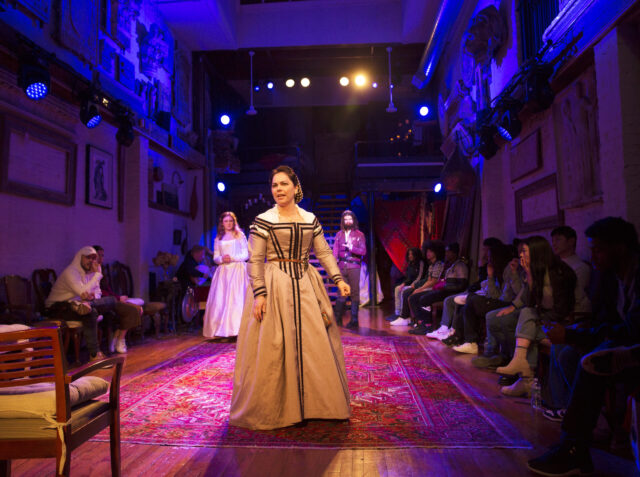
Nightmare: Gothic offers Victorian scares on the Lower East Side (photo by Joshua Hoffine)

NIGHTMARE: GOTHIC
Teatro SEA @ the Clemente
107 Suffolk St. between Rivington & Delancey Sts.
October 17-31, $30 GA, $45 VIP, 6:00 – 11:00 pm
nightmarenyc.com

Nobody loves Halloween scares quite as much as the folks at Psycho Clan do. For twenty years, cofounders Timothy Haskell and Paul Smithyman have been presenting varieties of immersive haunted house experiences as well as other holiday-themed (mis)adventures, including Nightmare Haunted House, This Is Real, Full Bunny Contact, and SANTASTICAL. Their latest horror presentation is Nightmare: Gothic, a half-hour immersion set amid Victoriana macabre, running October 17-31 at Teatro SEA @ the Clemente on the Lower East Side. The hunt is on to locate a missing child, but there are frightening barriers every step of the way.

“People have a very specific idea when they think ‘Goth’ and it is mostly of the romantic goth genre,” Haskell said in a statement. “We are, however, inspired by the Victorian Goth era. Think mid to late nineteenth century. Think Mary Shelley, Bram Stoker, The Picture of Dorian Gray, Kafka, the contemporary work of Edward Gorey, corsets, dark purples and black, hoop skirts, parasols . . . you get the idea.”

Advance tickets for Nightmare: Gothic are $30 for general admission and $45 for skip-the-line, arrive-any-time VIP access; groups of up to five people are welcome, but no one under twelve will be admitted, and those between thirteen and sixteen require a guardian. The event was conceived by cowriter and director Haskell (The Rise and Fall, Then Brief and Modest Rise Followed by a Relative Fall of . . . Jean Claude Van Damme as Gleaned by a Single Reading of His Wikipedia Page Months Earlier) and cowriter and production designer Smithyman, with sound by James Lo and lighting by Yang Yu.

Psycho Clan’s goal is “to haunt you well beyond the ephemeral,” so be ready for anything.

VAMPIRE WEEKENDS: THIRST

Park Chan-wook’s Thirst is part of “Vampire Weekends” midnight series at IFC

THIRST (Park Chan-wook, 2009)
IFC Center
323 Sixth Ave. at West Third St.
Friday, October 14, and Saturday, October 15, midnight
212-924-7771
www.ifccenter.com

Winner of the Jury Prize at Cannes, Park Chan-wook’s Thirst is a different kind of vampire movie. Inspired by Émile Zola’s novel Thérèse Raquin, the creepy Korean flick stars Song Kang-ho (The Host, Memories of Murder) as Sang-hyun, a friendly priest who volunteers to participate in a dangerous experimental program that is attempting to develop a vaccine for a deadly virus. Unfortunately, he succumbs to the disease, his body covered in nasty boils, but he surprisingly arises, reborn, with a deep desire to suck some blood. However, he still is the same friendly priest with a moral soul, so he is unwilling to kill to fill his belly. As he gains superhuman strength, he grows closer to Tae-ju (Kim Ok-vin), the virtually imprisoned adopted sister / wife of a goofy childhood friend (Shin Ha-kyun) who is cared for by his doting mother (Kim Hae-sook). But as Sang-hyun and Tae-ju get hot and heavy — one particular sex scene is among the hottest in a good movie since Jean-Jacques Beineix’s Betty Blue in 1986 — their thirst threatens to overwhelm them and everyone around them. Eschewing standard vampire lore — don’t look for garlic, crucifixes, bats, wooden stakes, or a Van Helsing-like character — Park (Joint Security Area, the Vengeance trilogy) examines the complex spirituality and sexuality of a man of the cross, a figure always dressed in black (reminiscent of Count Dracula) who is forced to challenge his faith and humanity. At 133 minutes, Thirst is a half hour too long, with several scenes that could have served as an ending, but hang in there; no one can tell a story like Park Chan-wook, even if he is an acquired taste — like, say, blood.

Thirst is screening at midnight on October 14 and 15 in the IFC Center series “Vampire Weekends,” consisting of half a dozen horror favorites being shown in conjunction with the release of Anne Rice’s Interview with the Vampire on AMC/AMC+. The series continues through November 5 with Tony Scott’s The Hunger, Robert Rodriguez’s From Dusk til Dawn, and Michael Rymer’s Queen of the Damned. Park’s latest film, Decision to Leave, which earned him Best Director honors at Cannes, was a selection of the sixtieth New York Film Festival and opens at Lincoln Center on October 19.

TALES FROM THE GIMLI HOSPITAL (REDUX)

TALES FROM THE GIMLI HOSPITAL

A trio of nurses deal with a deadly epidemic in early Guy Maddin cult classic, Tales form the Gimli Hospital

TALES FROM THE GIMLI HOSPITAL (REDUX) (Guy Maddin, 1988/2022)
IFC Center
323 Sixth Ave. at West Third St.
Opens Friday, October 14
212-924-7771
www.ifccenter.com
zeitgeistfilms.com

In a 2011 twi-ny talk focusing on a “reframed” version of his 1988 debut feature, Tales from the Gimli Hospital, Canadian director Guy Maddin said, “I thought, of all the films of mine that might actually thematically justify a revisiting from the director (something that truly ought not to be done under almost any circumstances!), then this was the title.” Well, Maddin has done it again with a 4K restoration of the film, which he is now calling Tales from the Gimli Hospital (Redux), featuring some trimming as well as the addition of a long-lost scene.

The Canadian DIY master reached into Icelandic sagas for the original, ultra-low-budget version. In many ways a kind of Scandinavian Frankenstein as if directed by Ingmar Bergman and George A. Romero, the mostly black-and-white Expressionist film is a story within a story (at times within another story) that an old woman, Amma (Margaret Anne MacLeod), is telling her grandchildren (Heather and David Neale) in a hospital room where their mother lies very ill. The dark, lurid fairy tale, set in “a Gimli we no longer know,” is about Einar the Lonely (assistant director Kyle McCulloch), a shy fish smoker who does not know how to relate to other people, particularly women. Felled by an epidemic, he is brought to the Gimli Hospital in Manitoba, where other men battle this dread disease, which leaves stitchlike scars on their face and body. Einar is discouraged that the patient in the bed next to him, the portly Gunnar (Michael Gottli), is treated much nicer by the nurses than he is, but he is helpless to do anything about it. Gunnar is soon telling Einar the story of his true love, Snjófridur (Angela Heck), a tragic tale with a surprising twist that brings everything full circle.

A unique visual stylist who regularly pays homage to the early days of cinema, Maddin, who directed and edited the picture (and wrote the script on Post-it Notes), purposely keeps things low-tech, including less-than-perfect sound dubbing and bumpy cuts, incorporating freak-show-like oddities alongside an ominous lo-fi soundtrack with old songs; Maddin (My Winnipeg, Careful) himself plays the weirdo surgeon who operates on Gunnar and Einar in rather strange fashion. The intentionally amateurish nature of the original work led to its being rejected by the Toronto International Film Festival (TIFF) for ineptitude; it went on to become an instant cult classic, holding the midnight-movie slot at the Quad for nearly a year. In 2011, Maddin, who is part Icelandic, reimagined the film in the special Performa presentation Tales from the Gimli Hospital: Reframed, a reedited version with a live score by Icelandic musicians. Tales from the Gimli Hospital (Redux), a 4K restoration that premiered at TIFF 2022, goes a few steps further.

“The new scene was shot in 1999 as an after-the-fact deleted scene as a way of celebrating a cast reunion after a serious car accident injured the actor Michael Gottli,” Maddin explains. “The act of shooting this scene was intended as a kind of rehab therapy for my dispirited thespian. But it turned out quite well, I think. It is inserted early on in the feature, during the scene in the hospital when a primitive Punch and Judy puppet show is deployed as an anesthetic distraction to a patient (Gottli) having his leg operated on by a man wielding a sickle. Such puppet shows were the only anesthetic available in the pioneer days of Gimli. The new scene suggests to the patient a hallucinated tale of gender transformation and some lusty BDSM involving yet another man with a fish net. I had promised Gottli I would insert this ‘deleted scene’ into the body of the feature if I ever got the chance.”

This stunning new iteration opens theatrically October 14 at IFC, preceded by Maddin’s dazzling six-minute award-winning TIFF short The Heart of the World, about science battling religion and two brothers in love with the same woman as the end of the planet approaches, with the director on hand for Q&As following the 8:10 shows on Friday and Saturday night. Maddin is both fascinating and fun to listen to, so snag your tickets now for what promises to be a special event.

LAZARUS 1972–2022

Christopher Caines stars as the title character in Ping Chong’s mesmerizing update of Lazarus

LAZARUS 1972–2022
La MaMa Downstairs Theater
66 East Fourth St. between Second & Third Aves.
Thursday – Sunday through October 16, $25-$30
www.lamama.org
www.pingchong.org

For his final work as artistic director for his troupe, Ping Chong revisits his past while looking to the future in Lazarus 1972–2022, a contemporary reimagining of his first independent piece. In 1972, Ping presented Lazarus at Meredith Monk’s loft studio; as part of Ping Chong and Company’s fiftieth anniversary, the thrilling update is running at La MaMa, just a few blocks from that studio, through October 16.

The evening begins with a film of the stars in the galaxy, followed by a video countdown of the Toronto-born Ping’s previous works. Then Watoko Ueno’s delicate, enchanting set is intricately put together by two women (Chaesong Kim and Nancy McArthur) dressed all in black who bring in a white glass table and a white chair and place dining items on them — a coffee cup and saucer, salt and pepper shakers, a serving tray, silverware in a napkin — arranging and rearranging them with great delicacy, each making a loud noise as they are put on the table. Behind the table is a backdrop with alternating vertical panels. A hanging lamp is occasionally set in motion, moving back and forth like a pendulum clock running out of time as it slows down. (The haunting lighting, which turns from white to red to blue to pitch-black, is by Hao Bai, with expert sound design by Ernesto Valenzuela.)

Eventually, Lazarus (Christopher Caines) enters the room; he is wearing black pants, a white button-down shirt, and black shoes, his face covered in white bandages except for his eyes and mouth. He evokes both Claude Rains in The Invisible Man and Edith Scob in Eyes without a Face, another character whose true self goes unseen by the world. In this case, Lazarus has risen to life in 2022 New York City and feels alienated from a society not so quick to welcome strangers, echoing Ping’s experience when he moved out of Chinatown, where he was raised. Lazarus deliberately repositions the items on the table and prepares to eat, but he is soon distracted.

Over the course of about an hour, Lazarus meets a mysterious lady in red (Jeannie Hutchins) and another young woman in black (Tiffany Tan), becomes a puppet, encounters a strange truck, and considers what is next for him in this unyielding city, which at one point flies past him on multiple screens. (The projections are by Kate Freer, with costumes by Stefani Mar.) The only words are spoken in voiceover by Louise Smith or Ping (“There is a room; there is nothing in the room.”); there is no dialogue, only sound, light, and movement in a mesmerizingly beautiful piece.

The Canadian-born Caines, who runs his own dance company, has performed previously with Ping and is hypnotic as Lazarus; you can feel his alienation and suspicion as his eyes and body shift to surprise noises or he just stands tall and still, waiting for something to happen to break him out of his loneliness. But don’t let me mislead you; the show is also very funny.

“Time passes, and with time passing the poignancy of loss multiplies, which is to say Lazarus has lived the fullness of life through time,” Ping writes in a program note. “By now, it must be obvious that I am Lazarus and Lazarus is me. The theme of Lazarus, the theme of Otherness, runs through all my work. Who could be more Other than Lazarus. . . . I have chosen to complete my life as an artist with this work that started it all. Coming full circle seemed appropriate.”

Lazarus 1972–2022 is a fitting finale for Ping, a longtime leader in the avant-garde theater that rose up in downtown New York City in the 1970s and who is now saying farewell having come full circle, for all our benefit.

LMCC TAKE CARE SERIES: SUN SEEKERS INDUCTION CEREMONY

“Sun Seekers Induction Ceremony” will take place in the Oculus on October 15 (photo courtesy LMCC)

Who: Amy Khoshbin, Jennifer Khoshbin, Merced Searer, Ching-I Chang, Malcom McMichael, Alex Koi, Jon Panikkar
What: LMCC Take Care Series
Where: The Oculus, Westfield World Trade Center, 185 Greenwich St.
When: Saturday, October 15, free with RSVP, 3:00
Why: Continuing through October 30 on Governors Island, Iranian-American sisters Amy and Jennifer Khoshbin’s “Sun Seekers” is an interactive sci-fi installation in which visitors are encouraged to remove their shoes and put away their cellphones, leaving behind the Wreck-tangle, and immerse themselves in the healing aspects of the natural world. The exhibition consists of four portals that incorporate sound, movement, touch, and smell. “Enter the sun portal, the source of all life,” one portal offers. “Close your eyes, breathe, and listen. Be reborn as a Sun Seeker.” As you walk among the works, encountering spinning seats, a musical chair, futuristic clothing, and a central portal you can enter, you discover “The Great Forgetting” and “The Great Remembering. ”

On October 15 at 3:00, Amy Khoshbin will host an hourlong “Sun Seekers Induction Ceremony” at the Oculus at the Westfield World Trade Center; part of the Lower Manhattan Cultural Council’s Take Care Series, the event, cowritten with Yuliya Tsukerman, features performers Merced Searer, Ching-I Chang, and Malcom McMichael and musicians Alex Koi and Jon Panikkar and gives the audience the opportunity to connect with the sun, the environment, and their bodies in a group healing ritual. Admission is free with advance RSVP.

BEING FUTURE BEING: LAND/CELESTIAL and INSIDE/OUTWARDS

Emily Johnson’s Being Future Being comes to New York Live Arts October 20-22

Who: Emily Johnson/Catalyst
What: Being Future Being
Where: New York Live Arts, 219 West 19th St., 212-727-7476
When: Land/Celestial: October 15, $10-$30, 3:00 & 5:00; Inside/Outwards: October 20-23, $15-$40, 7:30
Why: In a July 2021 illustrated lecture to students at the Bates Dance Festival in Maine, where she was presenting the outdoor section of her work in progress Being Future Being, maker, gatherer, and protector Emily Johnson (Yup’ik) said, “We spent a lot of time in class earlier today thinking of the ground lifting up with us and also thinking about how we are always in relationship to the ground and thinking about ways in which we might be in better ongoing relationship with ground, with land, with water, with air, with relations. And from that I want to say that one day, the civil rights and sovereignty of Indigenous peoples will be recognized in relation to land, and that power imbalance and extraction will not be the default relationship in our working lives, and that theft of and abuses on and lack of recognition of Indigenous land and water and peoples will not be tolerated. And that’s the kind of future I look forward to making with all of you; that’s the kind of future I enjoy being in already with all of you.”

In such participatory works as Then a Cunning Voice and a Night We Spend Gazing at Stars, Shore, and The Ways We Love and the Ways We Love Better — Monumental Movement Toward Being Future Being(s) in addition to her Kinstillatory Mappings series outside Abrons Arts Center, Johnson, a Bessie Award-winning dancer, choreographer, curator, writer, and social justice activist, brings people together with the land and its history, taking on power imbalance and extraction by forming communities organized around the local environment.

Emily Johnson gathers people together for The Ways We Love and the Ways We Love Better — Monumental Movement Toward Being Future Being(s) in September 2020 (photo by twi-ny/mdr)

Johnson’s Being Future Being: Inside/Outwards will hold its Lenapehoking premiere October 20-22 at New York Live Arts, featuring a commissioned score by composer Raven Chacon (Navajo), sound by Chloe Alexandra Thompson (Cree), visual design by Holly Mititquq Nordlum (Iñupiaq), masks and wearables by IV Castellanos (mx Indige Quechua/Guaraní), Quilt-Beings by Korina Emmerich (Coast Salish Territory, Puyallup tribe), quilts by Maggie Thompson (Fond du Lac Ojibwe), costumes by Raphael Regan (Sisseton-Wahpeton Eastern Band of Cherokee and Diné), scenic fabrication by Joseph Silovsky, and lighting by Itohan Edoloyi. The piece will be performed by Ashley Pierre-Louis, Jasmine Shorty (Diné), Stacy Lynn Smith, and Sugar Vendil.

In addition, on October 15 there will be a special offsite performance, Land/Celestial, in Lower Manhattan; ticket holders will be advised of the specific location that day. As a whole, the creation of Being Future Being has involved four groups of collaborators, which Johnson refers to as the Branch of Knowledge, the Branch of Scholarship, the Branch of Making, and the Branch of Action. Johnson will be joined by individuals from the four branches at a Stay Late discussion following the October 21 show.

“The work asks audiences to join in community processes that move from each presentation out into the world in what I call the Speculative Architecture of the Overflow, with actions that directly support local rematriative, protection, and Land Back efforts,” Johnson explains on her website. “The Overflow is resonance, moving in the in-between, in-the-collective, in-the-invitation to GATHER HERE. Can the Overflow become supported, beyond the moment of the performance gathering, a speculative architecture resisting BUILD, but living, ongoing in an otherwise?” Johnson always asks intriguing, important questions, but the ultimate answers will have to come from each one of us.