featured

STRAIGHT LINE CRAZY

Ralph Fiennes as Robert Moses in David Hare’s Straight Line Crazy (photo by Kate Glicksberg)

STRAIGHT LINE CRAZY
The Griffin Theater at the Shed
The Bloomberg Building at Hudson Yards
545 West 30th St. at Eleventh Ave.
Tuesday – Sunday through December 18
646-455-3494
theshed.org

David Hare’s sparkling, intense Straight Line Crazy, which opened Wednesday night at the Shed’s Griffin Theater, begins with Ralph Fiennes walking down Bob Crowley’s T-shaped stage, barefoot and wearing a suit. He does not need to introduce his character to the New York City audience; he is portraying infamous urban planner Robert Moses. Before he can say anything, the sold-out crowd erupts in entrance applause for the two-time Oscar and Emmy nominee and Tony winner. In a brief monologue, Moses says, explaining his penchant for swimming, “The further I swim the happier I am. At night, best of all. So how do I feel when people say ‘We were worried. You were gone so long. We called the coast guard.’ How do I feel? I tell them, ‘Why did you panic? Nothing’s going to happen to me.’”

A moment later, Helen Schlesinger, in frumpy attire — Crowley also designed the costumes — approaches, announcing, “I’m Jane Jacobs.” The audience again bursts into applause, but it’s not for the British television and theater actress as much as for her character, a woman whose name is instantly familiar to so many New Yorkers as Moses’s longtime archnemesis even though, as she points out, they never met. Explaining her original lack of interest in architecture, she states about her change of mind, “What made me think about architecture was that moment when I realized I was going to die. I remember thinking, what will be left of us? After we’re gone? And I remember reading that only two things remain. Cities and songs.”

Straight Line Crazy begins in 1926, as Moses, the chairman of the New York State Council of Parks (and later secretary of state and Parks and Recreation commissioner), is hard at work developing plans for the building of the Southern State and Northern State Parkways on Long Island. He sees the automobile as the future and is determined to bring access to Jones Beach to the masses, despite strong pushback from such wealthy landowners as the Morgans, the Whitneys, and the Fricks.

Jane Jacobs (Helen Schlesinger) won’t give up the fight against Robert Moses in Straight Line Crazy (photo by Kate Glicksberg)

“Every summer those few adventurous souls who dare to head this way are brought to a halt, as their overheated engines expire on badly maintained tracks,” Moses tells Henry Vanderbilt (Guy Paul). “Everything possible is done to discourage them. Well, no longer. My new parkways will make travelling as attractive as arriving.” Vanderbilt promises “impassioned and intransigent opposition to all your plans . . . unified, organized, and unyielding.” But there’s nothing Moses enjoys more than a good fight. When Vanderbilt calls him a revolutionary, Moses responds, “To the contrary. The very opposite. My aim is to forestall revolution, not to incite it.” However, his revolution is strictly for cars; he adamantly refuses to include any form of public transportation, no buses or trains.

Moses is a bold, severe man, unwilling to accept that he’s ever wrong, unable to consider compromises or concessions of any kind, unafraid of brazenly skirting the law. He speaks in aphorisms whether discussing plans with the two main members of his team, the fictional duo of Finnuala Connell (Judith Roddy) and Ariel Porter (Adam Silver), or the rambunctious, cigar-chomping New York governor, Al Smith (Danny Webb). “I made the mistake of thinking that if I proposed something which was logical, reasonable, and effective, people would at once see its merits and fall in behind it. . . . They blocked it at every turn,” Moses tells Porter. He says to Connell, “I’m a ditchdigger, I’m not an academic. I put academia behind me. It’s for the young. It’s for the inadequate. . . . The people lack imagination. The job of the leader is to provide it.”

In a swirling, exciting conversation with Smith, Moses explains, “I never ask favors. I ask my due.” On his way out, Smith tells Porter and Connell, “Hard to leave a meeting with Moses without feeling you’ve been robbed. But just as hard to know what the fuck you’ve been robbed of.”

Meanwhile, in the background, Jacobs starts making her case against Moses. “If you think fighting power is fun, I’d advise you to think again,” she says to the audience. The second act moves to 1955, as Jacobs is leading the battle against Moses’s plan to run a sunken highway right through the middle of Washington Square Park. While he claims it is to liberate traffic and offer a desperately needed throughfare into Lower Manhattan, Jacobs, along with fellow activists Shirley Hayes (Alana Maria), Sandy McQuade (Al Coppola), Carole Ames (Krysten Peck), Nicole Savage (Mary Stillwaggon Stewart), and Lewis Mason (Andrew Lewis), are arguing against the project.

Robert Moses (Ralph Fiennes) lets Gov. Al Smith (Danny Webb) know what’s on his mind in Straight Line Crazy (photo by Kate Glicksberg)

Also expressing her displeasure is one of Moses’s newest employees, Mariah Heller (Alisha Bailey), a Black architect with dreams of supporting the public good while harboring nightmares about how Moses’s destruction of the South Bronx negatively impacted her family. “You’re no different from anyone else, Mr. Moses,” she says to him. “Sometimes you’re right and sometimes you’re wrong. And in this particular instance, you’re handling things wrong.” Heller represents all the people of color who were seemingly cast aside by Moses through five decades of racist and classist public planning, as brought to light in Robert Caro’s seminal biography, The Power Broker, and by other historians.

But after all that time, Moses is as intransigent as ever. With Porter and Connell still at his side, Moses is even more cold and distant, ultimately a lonely, ill-tempered man whose reputation — for achievements that include Jones Beach, Lincoln Center, the West Side Highway, the United Nations, the state park system, and the Robert Moses Causeway — has been torn down by the wrecking ball of time, faster than it was built.

Directors Nicholas Hytner (Miss Saigon, The History Boys) and Jamie Armitage (Six, Southern Belles) manage to keep things interesting despite several stagnant scenes with lots of sitting and standing around as characters explicate and speechify. George Fenton’s original music, which is thankfully not used very often, is faint and distracting, complicating George Dennis’s sound design.

Webb (King Lear, Pennyworth) injects much-needed electricity as Smith, who is willing to go toe-to-toe with Moses, swilling bourbon, chomping on a stogie, and loudly pontificating on his relationship with the people of New York. You practically get swept up by the wind swirling around him as he marches across the stage.

Silver (Masters of the Air, Sons of the Prophet) and Roddy (Translations, Knives in Hens) are solid as two longtime Moses employees who understand their boss all too well and have remained loyal despite his failure to see them as individuals with lives outside the office. There’s not much Bailey can do in the thankless, anachronistic role of Heller, who openly calls Moses out on his racist tactics; her character seems forced, included primarily as a way for Hare (Plenty, Skylight) to address Moses’s biases.

Fiennes (Schindler’s List, The English Patient), who previously played architect Halvard Solness in Hare’s adaptation of Henrik Ibsen’s The Master Builder and teamed with Hare and Hytner in Hare’s coronavirus play, Beat the Devil, is dazzling as Moses, a larger-than-life figure played by one of the greatest actors of his generation. Fiennes’s previous stage appearances in New York City came on Broadway in 1995 in Hamlet, at BAM in 2000 in Coriolanus and Richard II, and back on Broadway in 2006 in Brian Friel’s Faith Healer, all as the title character. When he stands atop an enormous layout of New York on the floor, a man bigger than the city itself, you can the sovereignty that is surging inside him is palpable.

Fiennes’s turn as the iconoclastic Moses was greatly anticipated here: The show’s entire run sold out and resale tickets are available online for between $800 and $1800. It is a giant of a performance; Fiennes, who played Lord Voldemort in the Harry Potter films, commands the stage with a powerful authority and determination that matches that of Moses himself, although he is much more generous with the actors surrounding him than Moses was to his supporting cast.

It is also fitting that the show, a London Theatre production, takes place at the Shed, the entertainment venue at Hudson Yards, home to a chic, high-end mall and a tourist-attraction sculpture (the Vessel) with a sad history of attracting suicides, next to the West Side train lot, the High Line, and the Javits Center, where buses compete with car traffic. I think not even Moses would know what to make of it all.

BAM NEXT WAVE: A LITTLE LIFE

Ivo van Hove brilliantly stages Hanya Yanagihara’s epic novel at BAM (photo © Julieta Cervantes)

A LITTLE LIFE
Brooklyn Academy of Music
BAM Howard Gilman Opera House
30 Lafayette Ave. between Ashland Pl. & St. Felix St.
October 20-29, $45-$180
718-636-4100
www.bam.org
ita.nl/en

“You are so damaged,” Willem Ragnarsson (Maarten Heijmans) tells Jude St. Francis (Ramsey Nasr) in Ivo van Hove’s brilliant staging of Hanya Yanagihara’s 2015 bestselling novel, A Little Life, continuing at BAM’s Howard Gilman Opera House through October 29. It’s 250 minutes — with one blessed intermission — of torture porn of the highest order, a tragic tale that takes the emotional tenor of Lars von Trier’s Breaking the Waves and Aki Kaurismäki’s The Match Factory Girl to another level.

Adapted by Koen Tachelet and translated by Kitty Pouwels and Josephine Ruitenberg, the play is presented in Dutch with English supertitles. The first act can be confusing as the story develops; as with many works by von Hove and his Internationaal Theater Amsterdam, you’re not always sure where to look. Jan Versweyveld’s set is a large room with a sink and doctor’s office on one side, a desk and couch at the other, a cast-iron sink standing at the center. A pair of videos by Versweyveld and Mark Thewessen, repeating, slow footage of narrow, empty New York streets, flank the stage, playing throughout the show. The only live video — a mainstay of van Hove’s productions — is of a record spinning on a turntable in the back, behind which sit five rows of audience members. Supertitles are projected above the stage and off to the right and left.

Thus, for the first hour or so, I wasn’t sure where to direct my vision. The matter was further complicated when there was a disturbance among several audience members in the back and an usher that lasted for several minutes. Ultimately, the usher escorted a few people off by walking across the length of the stage. At first I wondered if it was part of the play, van Hove adding to my confusion. It might have just been a sick person.

Four friends discuss life and love in A Little Life at BAM (photo © Julieta Cervantes)

Eventually, I started figuring out who is who. Four close friends from college are hanging out, talking about life and love. Willem Ragnarsson (Maarten Heijmans) is a handsome actor. Malcolm Irvine (Edwin Jonker) is a talented architect deciding whether he should leave a small company and work for a corporate firm. Jean-Baptiste “JB” Marion (Majd Mardo) is an artist who takes photographs of his friends and paints them on canvas. And Jude St. Francis (Ramsey Nasr) is a lawyer under the tutelage of his mentor, Harold (Jacob Derwig). Their banter is reminiscent of Mart Crowley’s queer classic, The Boys in the Band.

But as the plot turns primarily to Jude and his horrific past, adversity piled on adversity at the hands of men he trusted, a darkness hovers over everything. Jude refuses to talk about what happened to him as a child except with his therapist, Ana (Marieke Heebink), who he imagines is almost always there with him. As he recalls in flashback his treatment by Brother Luke, Caleb, and a man named Traylor (all played by Hans Kesting), involving sexual abuse and brutal violence, he turns more and more inward, unable to face truths that can set him free from the prison he has built around himself, one in which he has to cut himself to fight off the inner pain. He seeks help from his doctor, Andy Contractor (Bart Slegers), but that is only for the physical damage inflicted on him, and inflicted by him.

In the far superior second act, Willem attempts to bring some kind of solace to Jude, who wears the same bloodied shirt throughout, except when he’s naked, which is often. As he digs deeper into his troubled existence, every time there is the possibility of hope, misfortune rears its ugly head. But it makes for gripping theater; it is intense and thrilling, anchored by a stunning performance by Nasr, who is also a poet, writer, and director. He portrays Jude with a yearning agony that echoes throughout the theater and into your soul.

But then the man sitting two rows in front of me annoyingly turned his phone on and held it up, and I saw that it was eleven o’clock. I am not a clock watcher at shows; I don’t want to know how much time is left, as it can impact my experience and expectations. But knowing that there were still about fifteen minutes till the end, I had no idea where von Hove could take it from there. In the short remaining span, I counted five places where I thought the play was over — wanted it to be over — but it kept going, even adding a completely unnecessary coda that angered me, manipulating my emotions, telling me how I was supposed to feel. Tony, Obie, and Oliveier winner van Hove (A View from the Bridge, Scenes from a Marriage, Kings of War) had trusted us until then, so the finale felt like he was piling on, in some ways echoing the constant torment that engulfed Jude.

In a program note, van Hove explains, “A Little Life is not a book, it is an excess, an excess of words, feelings, sexual abuse, automutilations, and heroic attempts at love and friendship.” It is all that and more, in a play with an excess of about fifteen minutes.

JILL SOBULE: F*CK7THGRADE

Jill Sobule and her band rock out in F*ck7thGrade at the Wild Project (photo by Eric McNatt)

F*CK7THGRADE
The Wild Project
195 East Third St. between Aves. A & B
Through November 19, $35-$45
thewildproject.com

I remember seventh grade all too well, a turning point in my development. I got bar mitzvahed. I asked a girl out for the first time, a cheerleader, and she said no. I went to my first concert, Paul McCartney and Wings at Madison Square Garden. A friend and I hid in the guidance counselors’ office when two big guys from an extramural basketball team we had beaten the night before — affiliated with a local church — were seeking to rearrange our faces. I watched other kids get bullied and hoped I would not suffer the same consequences. At a party, I kissed a girl.

Beloved singer-songwriter Jill Sobule uses that year of her life as a jumping-off point in her delightful, poignant, and utterly charming queer coming-of-age show, deftly titled F*ck7thGrade. Continuing at the Wild Project through November 8 and fully deserving of a longer run there or elsewhere [ed. note: the show has been extended through November 19], the ninety-minute production consists of Sobule sharing intimate moments from her past, standing front and center with her guitar, joined by her all-woman band, Secrets of the Vatican: Julie Wolf on keyboards, Kristen Ellis-Henderson on drums, and Nini Camps on bass, each of whom also plays various characters from throughout Sobule’s life.

“It fucking sucked being a teenager, didn’t it?” Sobule asks the audience, a mix of Sobule fans and adventurous theatergoers. “Did any of you feel awesome when you were thirteen? Raise your hand if you wanted to die. Well, I had it worse than any of you.”

Wearing an Orange Crush T-shirt, blue jeans, and red high-top Converse All-Stars (the costumes are by David F. Zambrana), Sobule alternates between personal stories and songs from throughout her career, from 1990’s Things Here Are Different to 2018’s Nostalgia Kills. Born in Denver in 1961, Sobule changed schools often while experimenting with drugs, wondering about her sexual orientation, and trying to find her place.

“The freaks got stoned, wore cooler clothes, and listened to better music. That sounded fun. I tried acid. We were thirteen,” she admits. She becomes infatuated with Mary (Camps), the new girl in school. “I loved how she smelled — a mix of Jean Naté and Marlboro Reds. And as I thought that, I suddenly was like: mmmm is this weird? This is weird, isn’t it.” That introduction leads into “Forbidden Thoughts of Youth,” in which Sobule sings, “Forbidden thoughts of youth — / They will never know — / My forbidden thoughts of you. / You will never know the truth.” That flirtation ends in a pathetically funny, very-seventh-grade way that many of us can identify with.

Jill Sobule shares her intimate story in poignant and funny F*ck7thGrade (photo by Eric McNatt)

Sobule relates how she traveled to Spain, started playing at open-mic nights, went to Nashville, and ultimately scored one of the biggest hits of the 1990s, the fabulously hooky “I Kissed a Girl,” but her instant success was bittersweet, as she was not allowed to actually kiss a girl in the video and the industry typecast her. She later delves into Katy Perry’s appropriation of the title.

As the show (which was delayed because of Covid, resulting in some rehearsals taking place over Zoom) nears its touching conclusion, Sobule comes to terms with various elements of her life — including her career, her feelings toward music, and her seventh-grade nemesis, Cathy Pepper — and Wolf, Ellis-Henderson, and Camps share their own memories as well.

Supplemented by a companion lobby exhibition of paintings by Marykate O’Neil, F*ck7thGrade features a lovely book by Liza Birkenmeier (littleghost, Dr. Ride’s American Beach House) and cogent direction by two-time Obie winner Lisa Peterson (Hamlet in Bed, Shipwrecked) on Rachel Hauck’s (Hadestown, What the Constitution Means to Me) set, basically a band rocking out in front of a row of high school lockers that occasionally are used. Oona Curley’s lighting and Elisabeth Weidner’s sound help further the intimacy between performer and audience. The leather-clad Camps, who is in the group Antigone Rising with Ellis-Henderson, is a standout as Sobule’s right-hand person, taking on multiple roles and singing harmony.

As always, Sobule is absolutely adorable, with her impish smile and short-cut blond hair; she might not be an actress, but you can feel and relate to her every emotion while laughing your head off. She points out that she had to learn all of Birkenmeier’s words and laments that she doesn’t have a monitor like Springsteen did. Her eyes connect with the crowd as she plays such memorable numbers as “Raleigh Blue Chopper,” “I Hate Horses,” “Strawberry Gloss,” ”I Put My Headphones On,” and “Mexican Wrestler,” all of which are likely to send you back to your own past.

Her tunes are an intoxicating mix of folk, pop, country, and blues rock. Early on, she sings, “I could play a bar chord when I was six, / play ‘Hey Joe’ with the Hendrix lick. / Yeah, I was a star, but Mr. Hill said: / ‘Girls fingerpick. It’s the boys who shred,’” so she makes sure to demonstrate that she can indeed shred. By the time she finishes up with two participatory songs, you’ll be a Jill Sobule fan, if you weren’t already. And, if you haven’t already, you’ll think to yourself, “Yeah, fuck seventh grade.”

9000 PAPER BALLOONS

9000 Paper Balloons tries to bridge the distance between generations

Who: Maiko Kikuchi and Spencer Lott
What: A Contemporary Puppet Theater Piece
Where: Japan Society, 333 East Forty-Seventh St. at First Ave.
When: October 28–30, $30
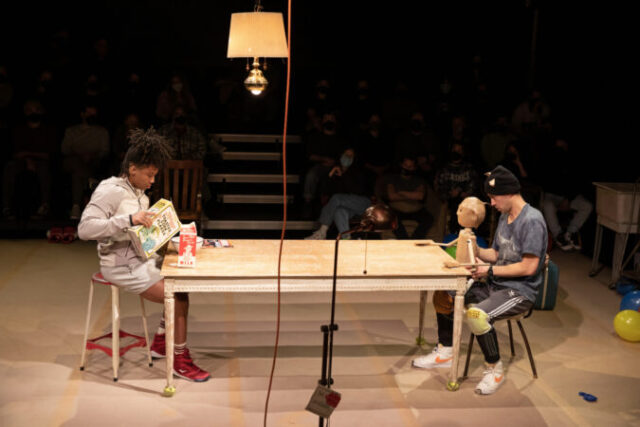
Why: During WWII, Japan employed Fu-Go balloon bombs, hydrogen balloons made of paper or rubberized silk that carried incendiary devices and an anti-personnel explosive, launching more than nine thousand from Honsho in 1944-45 with the express purpose of flying across the Pacific Ocean and starting forest fires on the West Coast of the United States. American puppeteer Spencer Lott and Japanese animator Maiko Kikuchi share the true tale of this little-remembered weapon in 9000 Paper Balloons, making its in-person world premiere October 28–30 at Japan Society; Lott will portray his grandfather, a navigator on a US bomber plane, while Kikuchi will play her grandfather, who fought for Japan and was a prisoner of war.

“Distance is definitely a central theme to the play, the distance between our generation and our grandfathers, the difference between America and Japan, the distance between a fighter jet and a paper balloon,” Lott said in a statement. “We know that war capitalizes on that distance, both real and perceived. War is a throughline in our play, but our central question is, How can we collapse the distance between us? We are witnessing moments in 2022 that remind us that the distance between our generation and the WWII generation may not be all that distant after all.”

The play, which was presented virtually by HERE in November 2021, is told in the form of a ghost story, with live-feed cameras, animation projections, masks, dioramas, and more than one hundred puppets, with a fascinating behind-the-scenes look at how it’s all done as the narrative unfolds; it is directed by Aya Ogawa, who was most recently at Japan Society with their intimate and personal The Nosebleed, in which they played their own father and son. The October 28 performance will be followed by a reception with the creators, and the October 29 show will conclude with an artist Q&A.

“Because of a war, one that happened eighty years ago, there is a gap between us and our grandfathers and this gap exists in so many families, this play is our desperate attempt to collapse the distance between us and our grandparents,” Kikuchi and Lott have also said. “We aren’t pretending that this puppet show is going to end conflict or AAPI violence, but in a world that is heavy with social and political strife, we think it’s a good opportunity to gather in the dark, together as a community, and share a remarkable story that is as much about ingenuity as it is war.”

WELCOME TO IMAGI*NATION: THE TRILOGY

Welcome to imagi*Nation asks the audience to participate in deciding what happens next (photo by Julia Discenza)

WELCOME TO IMAGI*NATION: THE TRILOGY
Sanctuary Space at the Center at West Park
165 West Eighty-Sixth St.
October 27-29, $25, 7:30
www.eventbrite.com
www.carmencaceres.com

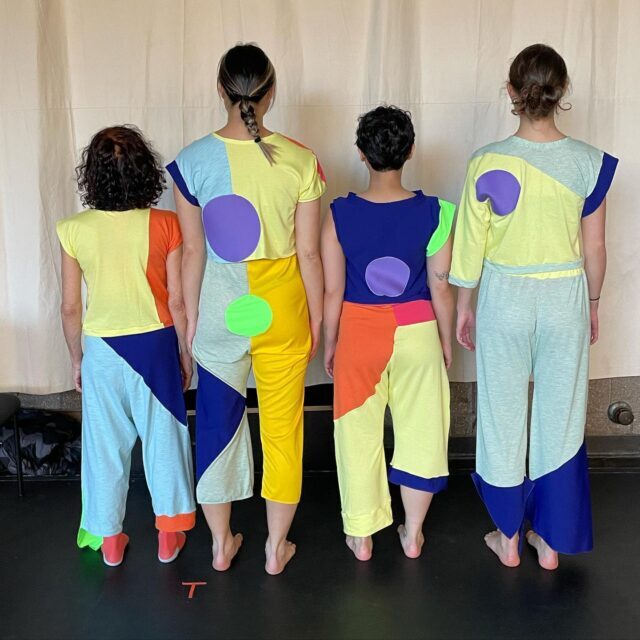
Audiences get to choose their own adventure in the world premiere of New York-based Argentinian choreographer Carmen Caceres and DanceAction’s Welcome to imagi*Nation, taking place October 27-29 at the Sanctuary Space at the Center at West Park. The three-part work focuses on the the battle over natural resources, labor shortages, and immigration policy, inspired by Caceres’s own story as well as Eduardo Galeano’s 1971 tome Open Veins of Latin America: Five Centuries of the Pillage of a Continent. “The book flows with the grace of a tale,” Isabel Allende writes in the introduction. “His arguments, his rage, and his passion would be overwhelming if they were not expressed with such superb style, with such masterful timing and suspense. Galeano denounces exploitation with uncompromising ferocity, yet this book is almost poetic in its description of solidarity and human capacity for survival in the midst of the worst kind of despoliation.”

Welcome to imagi*Nation is performed by Caceres (who also designed the costumes), Israel Harris, Jenna Purcell, Lydia Perakis, Mallory Markham-Miller, Mar Orozco Arango, and Sofia Baeta, playing multiple characters, with video by Daniel Hess and music by Emilio Teubal and others. “From the very beginning of the process, this has been an extremely personal project,” Caceres said in a statement. “Having moved to the US as an immigrant over a decade ago, I’ve been thrown right into a whirlpool of issues that are rarely considered in the policymaking arena but dramatically affect everyone who needs to adapt to a new reality, language, and identity. I learned that for every choice you make, you leave something behind. This work — drawing from my own life and those of my collaborators/performers and inspired by Galeano’s seminal study of the struggle over power, resources, and access between the US and the South American countries — is an invitation for the audience to experience this firsthand, by engaging with potentially life-changing decisions on behalf of my characters.”

MOVIE NIGHTS WITH MACHINE

Eyes of Laura Mars is part of fashionable Machine Dazzle film series at MAD

Who: Machine Dazzle
What: Movie Night with Machine
Where: The Theater at MAD, Museum of Arts & Design, 2 Columbus Circle at 58th St. & Eighth Ave.
When: October 25 & 27, December 20, January 10, $10, 7:00
Why: Walking around the Museum of Arts and Design exhibition “Queer Maximalism x Machine Dazzle” is like wandering through a glorious movie set, with colorful costumes and artworks that tell one heckuva bizarre story; you fully expect the mannequins to suddenly come to life and enter this surreal world. The retrospective of the work of performance artist Machine Dazzle, on view through February 19, is supplemented with a film series hosted by the queer experimental theater genius, born Matthew Flower in Upper Darby, Pennsylvania, in 1972, consisting of movies that influenced him as a child of the 1970s and ’80s. It kicked off October 13 with the epic Clash of the Titans and continues October 25 with Robert Wise’s underrated Star Trek: The Motion Picture (can’t wait to hear what Machine will have to say about the Federation uniforms!) and October 27 with Irvin Kershner’s tense neo-noir thriller Eyes of Laura Mars, about a glamorous fashion photographer who is being stalked by a serial killer; the cast includes Faye Dunaway, Tommy Lee Jones, Brad Dourif, René Auberjonois, and Raúl Juliá, and one scene takes place in Columbus Circle, where the museum moved in 2008.

Machine will be on hand to introduce the screening and participate in a discussion afterward; it should be too much fun listening to him talk about the costumes and scenery, and there will be giveaways, costume contests, custom-designed step-and-repeats, photoshoots, and other cool stuff. Be sure to come back December 20 for Robert Greenwald’s Xanadu, when we can all pay tribute to the late Olivia Newton-John and celebrate Machine’s fiftieth birthday, followed January 10 by Guy Hamilton’s Agatha Christie adaptation Evil Under the Sun, featuring Peter Ustinov as Detective Hercule Poirot and also starring Maggie Smith, Jane Birkin, James Mason, Roddy McDowall, and Diana Rigg. In addition, on November 8 from 9:00 am to 1:00 pm, the museum will host “Teacher Workshop: Activism and the Art of Machine Dazzle,” comprising a curator-led tour, an art workshop, and refreshments.

DECOLONIZING MOVIES — THE UN-TARZAN SERIES: THE BATTLE OF ALGIERS

THE BATTLE OF ALGIERS

Members of the FLN hide from French paratroops in Gillo Pontecorvo’s neo-Realist classic The Battle of Algiers

THE BATTLE OF ALGIERS (Gillo Pontecorvo, 1966)
Aaron Davis Hall
160 Convent Ave.
Thursday, October 27, free with RSVP, 6:00
Series continues monthly through May 11
citycollegecenterforthearts.org

Curated by the great Dr. Jerry Carlson, longtime host of the television show City Cinematheque, City College’s free “Decolonizing Movies: Un-Tarzan Series” believes that “movies were never innocent in the colonial enterprise. Yet brave filmmakers continue to push back and create alternative decolonizing visions.” The series opened September 29 with Ousmane Sembène’s Black Girls and returns October 27 with a screening of Italian director Gillo Pontecorvo’s The Battle of Algiers.

In Pontecorvo’s gripping neo-Realist war thriller, a reporter asks French paratroop commander Lt. Col. Mathieu (Jean Martin), who has been sent to the Casbah to derail the Algerian insurgency, about an article Jean-Paul Sartre had just written for a Paris paper. “Why are the Sartres always born on the other side?” Mathieu says. “Then you like Sartre?” the reporter responds. “No, but I like him even less as a foe,” Mathieu coolly answers. In 1961, French existentialist Sartre wrote in the preface to Frantz Fanon’s Wretched of the Earth, the seminal tome on colonialism and decolonialism, “In Algeria and Angola, Europeans are massacred at sight. It is the moment of the boomerang; it is the third phase of violence; it comes back on us, it strikes us, and we do not realize any more than we did the other times that it’s we that have launched it,” referring to European colonization. “There are those among [the oppressed creatures] who assert themselves by throwing themselves barehanded against the guns; these are their heroes. Others make men of themselves by murdering Europeans, and these are shot down; brigands or martyrs, their agony exalts the terrified masses. Yes, terrified; at this fresh stage, colonial aggression turns inward in a current of terror among the natives. By this I do not only mean the fear that they experience when faced with our inexhaustible means of repression but also that which their own fury produces in them. They are cornered between our guns pointed at them and those terrifying compulsions, those desires for murder which spring from the depth of their spirits and which they do not always recognize; for at first it is not their violence, it is ours, which turns back on itself and rends them; and the first action of these oppressed creatures is to bury deep down that hidden anger which their and our moralities condemn and which is however only the last refuge of their humanity. Read Fanon: you will learn how, in the period of their helplessness, their mad impulse to murder is the expression of the natives’ collective unconscious.” Sartre’s brutally honest depiction of colonialism serves as a perfect introduction to Pontecorvo’s film, made five years later and then, unsurprisingly, banned in France. (In 1953, the Martinique-born Fanon, who fought for France in WWII, moved to Algeria, where he became a member of the National Liberation Front; French authorities expelled him from the country in 1957, but he kept working for the FLN and Algeria up to his death in 1961. For more on The Wretched of the Earth, see the documentary Concerning Violence: Nine Scenes from the Anti-Imperialistic Self-Defense.)

Terrorism and counterinsurgency take to the streets in Oscar-nominated THE BATTLE OF ALGIERS

Terrorism and counterinsurgency take to the streets in Oscar-nominated THE BATTLE OF ALGIERS

In The Battle of Algiers, Pontecorvo (Kapò, Burn!) and screenwriter Franco Solinas follow a small group of FLN rebels, focusing on the young, unpredictable Ali la Pointe (Brahim Haggiag) and the more calm and experienced commander, El-hadi Jafar (Saadi Yacef, playing a character based on himself; the story was also inspired by his book Souvenirs de la Bataille d’Alger). Told in flashback, the film takes viewers from 1954 to 1957 as Mathieu hunts down the FLN leaders while the revolutionaries stage strikes, bomb public places, and assassinate French police. Shot in a black-and-white cinema-vérité style on location by Marcello Gatti — Pontecorvo primarily was a documentarian — The Battle of Algiers is a tense, powerful work that plays out like a thrilling procedural, touching on themes that are still relevant fifty years later, including torture, cultural racism, media manipulation, terrorism, and counterterrorism. It seems so much like a documentary — the only professional actor in the cast is Martin — that it’s hardly shocking that the film has been used as a primer for the IRA, the Black Panthers, the Pentagon, and military and paramilitary organizations on both sides of the colonialism issue, although Pontecorvo is clearly on the side of the Algerian rebels. However, it does come as a surprise that the original conception was a melodrama starring Paul Newman as a Western journalist.

All these years later, The Battle of Algiers, which earned three Oscar nominations (for Best Foreign Language Film in 1967 and Best Director and Best Original Screenplay in 1969) and underwent a 4K restoration for its fiftieth anniversary, still has a torn-from-the-headlines urgency that makes it as potent as ever. “Decolonizing Movies: Un-Tarzan Series” continues November 12 with Tomás Gutiérrez Alea’s The Last Supper, December 7 with Robert M. Young’s The Ballad of Gregorio Cortez, and January 26 with Lino Brocka’s Manila in the Claws of Light.