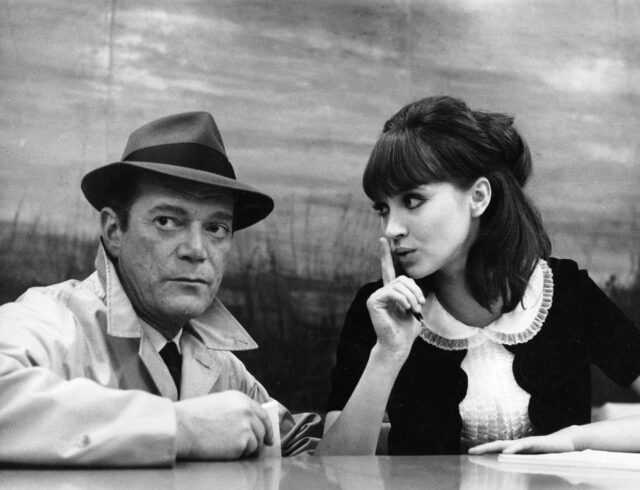
World premiere of 4K restoration of Jean-Luc Godard’s Alphaville kicks off “Rialto at 25” at MoMA (photo courtesy the Kobal Collection)
RIALTO AT 25
MoMA Film, Museum of Modern Art
11 West 53rd St. between Fifth & Sixth Aves.
April 19 – May 22, $8-$12
212-708-9400 www.moma.org www.rialtopictures.com
In 1997, Bruce Goldstein started Rialto Pictures, joined the following year by Adrienne Halpern. For more than a quarter-century, Rialto has been dedicated to reissuing and restoring classic foreign and independent films, both famous and forgotten, often debuting them at Film Forum, where Goldstein has long served as master programmer. MoMA pays tribute to copresidents Goldstein and Halpern with “Rialto at 25,” a five-week series consisting of thirty-one films released by the beloved distribution company, beginning with Henri-Georges Clouzot’s 1947 murder mystery, Quai Des Orfèvres, and the world premiere of a brand-new 4K restoration of Jean-Luc Godard’s 1965 futuristic thriller, Alphaville.
Organized by MoMA Film curator Dave Kehr, the festival also includes Jean-Pierre Melville’s Army of Shadows, Francis Ford Coppola’s The Conversation, John Carpenter’s Escape from New York, Robert Hamer’s Kind Hearts and Coronets, Marcel Carné’s Le Jour Se Lève, Akira Kurosawa’s Ran, Carol Reed’s The Third Man, Joe Dante’s The Howling, and Alberto Cavalcanti’s Went the Day Well?
“I began Rialto Pictures out of sheer frustration. Many classic movies, particularly European films, had no distribution in the United States, with prints either impossible to get or unavailable to repertory cinemas,” Goldstein said in a statement. “And, just as bad, a lot of important classics — like Renoir’s Grand Illusion and Godard’s Breathless — were seen for decades only in miserable 16mm copies, with bad image and sound. By getting the rights to movies like these myself, I could make brand new 35mm prints and show them — not just in New York — but in movie theaters across the country.”
Rialto has amassed a profoundly remarkable collection that is well represented in the MoMA series; among the other highlights and surprises are Federico Fellini’s Nights of Cabiria (with a seven-minute restored scene), Jules Dassin’s Rififi, Orson Welles’s The Trial, Joseph Losey’s Mr. Klein, John Boulting’s Brighton Rock, and Luis Buñuel’s The Discreet Charm of the Bourgeoisie and That Obscure Object of Desire. In addition, MoMA has created a special forty-five-minute compilation of Rialto trailers.
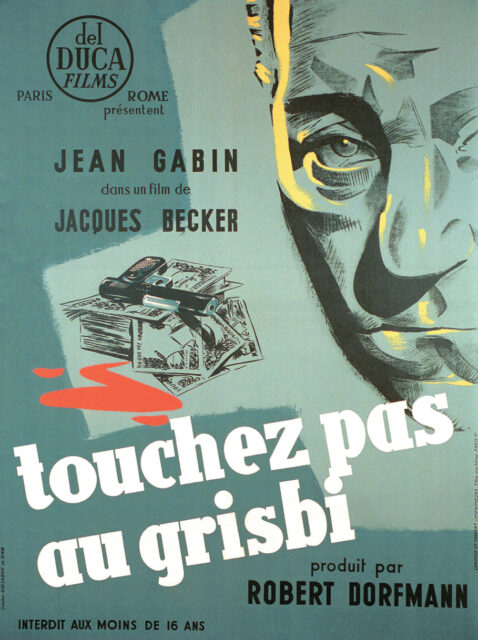
On April 29, Goldstein will present the illustrated talk “The Art of Subtitles”; several screenings will feature introductions or discussions; and originally commissioned Rialto posters will be on view. Goldstein will introduce Jacques Deray’s La Piscine on April 26 and Dino Risi’s Una Vita Difficile on May 14, translator and subtitler Michael F. Moore will introduce Francesco Rosi’s Christ Stopped at Eboli on April 22, Whit Stillman and actors Dylan Hundley and Carolyn Farina will participate in a discussion following a screening of Metropolitan on April 27, actor Madjid Niroumand will talk about Amir Naderi’s Davandeh with Goldstein after a screening on April 28, and Julien Duvivier’s Panique will be introduced on April 26 by Pierre Simon, the son of Georges Simenon, on whose novel the film is based. You might as well just move in to MoMA from April 19 to May 22, but keep looking over your shoulder.
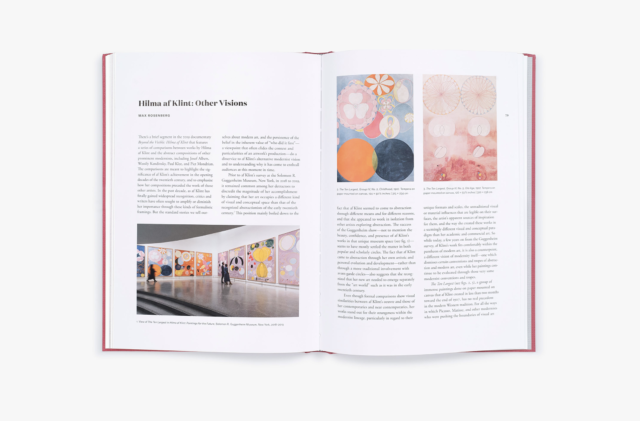
Hilma af Klint: Tree of Knowledge is one of two books about the Swedish abstractionist launching at New Museum on April 20 (courtesy David Zwirner)
Who: Massimiliano Gioni, Julia Voss, Tracey Bashkoff What: Book launches and panel discussion Where:New Museum Theater, 235 Bowery at Prince St. When: Thursday, April 20, $10, 6:30 Why: From October 2018 to April 2019, the Guggenheim hosted the smash exhibition “Hilma af Klint: Paintings for the Future,” the first major US solo show dedicated to the Stockholm-born abstract artist. That was followed by Halina Dyrschka’s documentary Beyond the Visible, which delved further into af Klint’s life and career. On April 20, the New Museum is hosting “Two New Texts on Hilma af Klint,” serving as a book launch for Hilma af Klint: Tree of Knowledge (David Zwirner, 2023, $55), featuring contributions from Julia Voss, Susan Aberth, Suzan Frecon, Max Rosenberg, Helen Molesworth, Joy Harjo, and William Glassley, and Voss’s Hilma af Klint: A Biography (University of Chicago, 2022, $35). New Museum artistic director Massimiliano Gioni will be joined by Voss and Guggenheim curator Tracey Bashkoff celebrating both books and the art of af Klint (1862–1944), who is finally having her long-deserved moment.
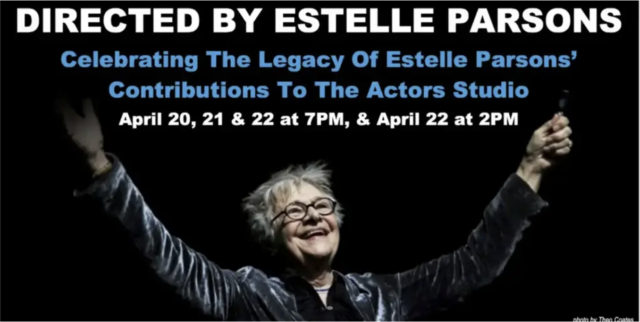
Who: Estelle Parsons, Actors Studio members What: Seventy-fifth anniversary celebration Where:The Actors Studio, 432 West Forty-Fourth St. between Ninth & Tenth Aves. When: April 20-22, free with RSVP Why: In March 2017, legendary Oscar and Obie winner and five-time Tony nominee Estelle Parsons directed Stephen Adly Guirgis’s The Last Days of Judas Iscariot at LaMama, featuring members of the Actors Studio. As part of its ongoing seventy-fifth anniversary celebration, the influential studio is now presenting “Directed by Estelle Parsons,” in which the ninety-five-year-old Parsons will direct productions of Maria Irene Fornés’s The Danube on April 20 and 21 at 7:00, the first two acts of Anton Chekhov’s Uncle Vanya on April 22 at 2:00, and the new Re-Entry on April 22 at 7:00. Co-associate artistic director of the Actors Studio and the mastermind behind the Theater and Climate Change Series, Parsons won her Oscar for Bonnie and Clyde, made her Broadway debut in 1955 in Happy Hunting, has appeared in such other shows as The Seven Descents of Myrtle,And Miss Reardon Drinks a Little,Miss Margarida’s Way, and Morning’s at Seven, and has directed such other plays as Guirgis’s Our Lady of 121st St.,Oedipus,Romeo and Juliet,Macbeth,As You Like It,Salome, and Orgasmo Adulto Escapes from the Zoo. Seating is free and extremely limited, so reserve your spot now.
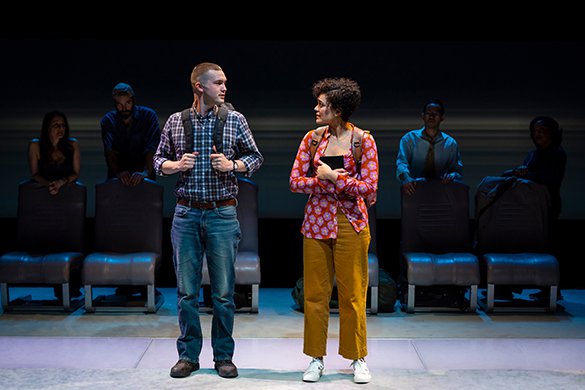
TJ (Will Harrison) and Jane (Camila Canó-Flaviá) consider what might be in The Coast Starlight (photo by T. Charles Erickson)
THE COAST STARLIGHT
Lincoln Center Theater at the Mitzi E. Newhouse
150 West 65th St. between Broadway & Amsterdam Ave.
Through April 16, $103
212-362-7600 www.lct.org
Sliding Doors meets Pirandello’s Six Characters in Search of an Author and the Twilight Zone episode “Five Characters in Search of an Exit” in Keith Bunin’s The Coast Starlight, making its New York City debut through April 16 at Lincoln Center’s Mitzi E. Newhouse Theater.
The ninety-five-minute play takes place on board the Coast Starlight, a real Amtrak train that travels from Los Angeles to Seattle in thirty-six hours. The premise is wholly relatable: Various individuals get on the train and sit in the same car, where they wonder about the identity of their fellow travelers and consider what might happen if they engaged one another in conversation. Who hasn’t been on a train, bus, or plane and thought about who was sitting nearby, thinking about who they might be and maybe even saying hello.
“One day, back in 1896, I was crossing over to Jersey on the ferry, and as we pulled out, there was another ferry pulling in, and on it there was a girl waiting to get off,” Mr. Bernstein (Everett Sloane) says in Citizen Kane. “A white dress she had on. She was carrying a white parasol. I only saw her for one second. She didn’t see me at all, but I’ll bet a month hasn’t gone by since that I haven’t thought of that girl.” There’s an inherent sadness in every fleeting glimpse we humans have of each other, that maybe life would have turned out differently if we had made a different choice in that instant.
For years, Missed Connections listings have appeared, first in newspapers and magazines, now online, from people who saw a stranger somewhere, regret not having introduced themselves, and are now trying to find that person. It was captured beautifully in Adrian Tomine’s November 8, 2004, New Yorker cover depicting a young man and a young woman in aligning subway trains, both reading the same book, looking at each other as if they understand they were meant to be together but might never get the chance.
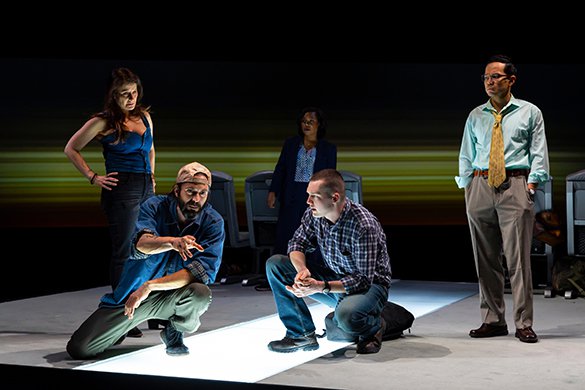
Characters engage in imaginary conversations in moving play at Lincoln Center (photo by T. Charles Erickson)
In The Coast Starlight, the half dozen characters are all heading somewhere, but it’s not necessarily where they want to be going, and their inner and outer journeys could potentially be changed if only they had said something. “It’s an awful thing to feel like you don’t have a home,” Jane (Camila Canó-Flaviá) says about halfway through.
TJ (Will Harrison) is a navy medic about to go AWOL to avoid being sent back to Afghanistan. Jane is an aspiring animator visiting her boyfriend who she may not love anymore. Noah (Rhys Coiro) is a veteran and a drifter caring for his ailing mother. Liz (Mia Barron) is a loud, lively woman who has just ditched her lover at an Extraordinary Couples Workshop. Ed (Jon Norman Schneider) is a harried, drunk traveling salesman working for a questionable invention company. And Anna (Michelle Wilson) is a married mother who has just had to identify the body of her dead brother.
The play is primarily a series of imaginary conversations, as if the characters decided to speak to one another, sharing intimate details of who they are and what they want out of their daily existence.
“I wanted to lean across the aisle and say to her: I have no idea where I’m headed today — I just decided I’d get on a train and head north,” TJ says about Jane, who responds to the audience, “If he’d told me that, I’m not sure what I would’ve said. TJ: “Then I wanted to tell her: I’ve lived in California for a year and till this morning I’ve never been north of San Diego.” Jane: “And then I probably would’ve said: Well, I’ve never been to San Diego.” TJ: “You should definitely go sometime. It’s totally weird.”
“I wanted to tell all of you: Obviously I’m nowhere near the person I intended to be,” Ed says. “But I’m the only person I can be under the circumstances. I know how shitty today was and I hold no illusions about tomorrow.”
These six diverse people are not having their best day, and they have no idea what the future has in store for them. They are lost souls contemplating what happens next, not necessarily looking forward to it. Worried that he’s going to be caught and brought back to face justice for military desertion, TJ says, “Then I remembered nobody could be looking for me because I wasn’t missing yet.”
A whirlwind conclusion brings it all into perspective, focusing on the concept of “What if?”
Arnulfo Maldonado’s set is a rotating platform with six movable train seats. Daniel Kluger’s sound, Lap Chi Chu’s lighting, and Ben Pearcy’s projections (for 59 Productions) makes the audience feel that they’re also on the train, motoring north through gorgeous scenery, although only flashes of light and color stream by. Ásta Bennie Hostetter’s everyday-dress costumes help give identity to the characters.
Directed by Tyne Rafaeli (Epiphany,I Was Most Alive with You), the play occasionally gets lost itself, the dialogue running off the rails; it’s not clear why the stage spins or why the actors continually rearrange their seats, and Kluger’s interstitial music is too standard.
Harrison (Daisy Jones and the Six) is affecting in his off Broadway debut, speaking in a manner that emphasizes how unanchored TJ is. Canó-Flaviá (Dance Nation,Mac Beth) is warm and gentle as Jane, Coiro (Dinner at Eight,Boy’s Life) is compelling as the unpredictable Noah, and Barron (Dying for It,Domesticated) nearly rips the roof off the Newhouse in her entrance scene, screaming into her cellphone as if no one else is around. Wilson (Confederates,Sweat) is touching as Anna, while Schneider (Once Upon a [korean] Time,Awake and Sing!) does his best with a character who is more tangential, not as deeply nuanced.
At one point Jane imagines telling TJ about James Turrell’s Dividing the Light Skyspace at Pomona College. She explains, “The artist who made it, he believes that the sky is way too enormous for us to really comprehend it. So he builds these little rooms all over the world with holes cut in their ceilings so you can look up at the sky like it’s a picture in a frame. It’s so much cooler than I’m making it sound. I promise you’ll never look at the sky the same way again.”
It’s an apt metaphor for the Coast Starlight, both the train and the play. (Notably, Pearcy was an assistant to Turrell for ten years.) I’ve been on long train rides, and I’ve sat several times in Turrell’s first US Skyspace, Meeting, which is on permanent view at MoMA PS1. I’m not sure that, having seen Bunin’s show, I will be more amenable to engage strangers in conversation, but I’m likely to wonder a whole lot more about who they might be.
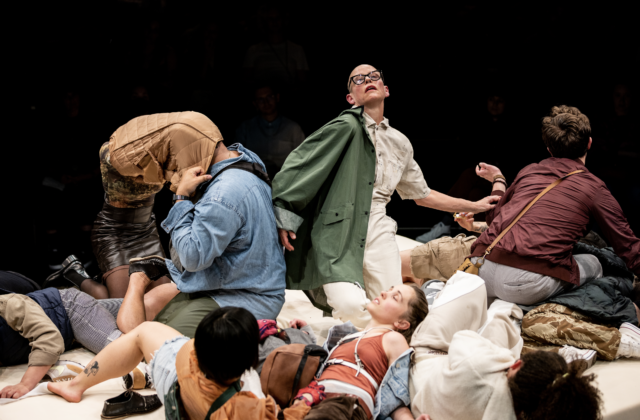
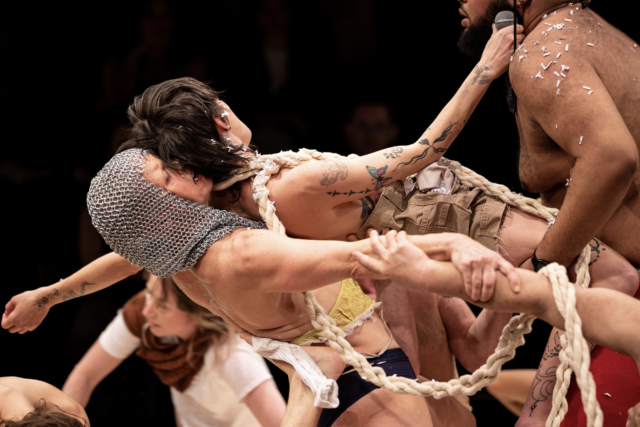
Humanity gets caught up in the maelstrom in Faye Driscoll’s Weathering (photo by Maria Baranova / courtesy New York Live Arts)
WEATHERING
New York Live Arts
219 West Nineteenth St. between Seventh & Eighth Aves.
April 5-8, 12-15, $32-$50, 7:30
212-924-0077 newyorklivearts.org www.fayedriscoll.com
Faye Driscoll’s latest work, Weathering, is, well, everything.
The seventy-minute piece, continuing at New York Live Arts through April 15, takes place on a squishy white movable platform raft designed by Jake Margolin and Nick Vaughan. The audience sits on all four sides of the object. One by one, ten performers — James Barrett, Kara Brody, Miguel Alejandro Castillo, Amy Gernux, Shayla-Vie Jenkins, Jennifer Nugent, Cory Seals, Eliza Tappan, Carlo Antonio Villanueva, and Jo Warren, in Karen Boyer’s costumes of everyday dress, some with backpacks, bags, and other accoutrements — step on and off the platform, eventually all standing in place and freezing, becoming what Driscoll calls a flesh sculpture.
Stage managers Emily Vizina and Ryan Gamblin, in all black, go to opposite corners and gently push the platform so it spins around, extremely slowly at first. The dancers barely move a muscle, but as the platform rotates, you can start to tell that the performers have shifted ever so slightly, lowering a knee, reaching out a hand, turning a foot, almost imperceptibly; the effect is like you are watching a living, creeping flipbook. Soon they begin touching, the connections electrifying, as if the contact is life affirming, which is especially potent as we emerge from Covid restrictions that kept us physically apart from one another. As the bodies interweave, they close gaps, filling spaces of loss and absence.
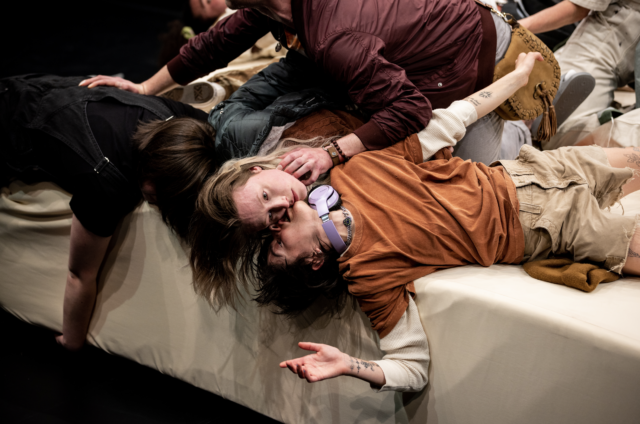
Performers encounter all five senses while spinning around the New York Live Arts stage (photo by Maria Baranova / courtesy New York Live Arts)
Driscoll incorporates all five senses as she and the stage managers occasionally spray the performers (and the audience) with citrus-smelling water and some of the dancers let out small groans and grunts as they put their mouths on an arm, leg, or neck that approaches them, somewhere in between the hunger for sex and the hunger of zombies seeking sustenance.
As the score builds — the sound and music direction is by Sophia Brous, with live sound and sound design by Ryan Gamblin and composition, field recordings, and sound design by Guillaume Malaret — the raft is spun around faster and faster. Personal items fall haphazardly to the ground: keys, a wallet, cellphones. Clothes start coming off, revealing more of who these people are and challenging what we might have previously thought about them while harkening back to our primeval existence, equating the beginning and the end. Chaos ensues, as the audience tries to capture as much of the action as it possibly can, not wanting to miss a single thing, as if every little movement, every sound, every change could upset the balance of this mini-universe.
Driscoll is telling us to pay attention, letting us know that humanity is failing and we are destroying the planet. The raft, evoking Earth and its orbit, sometimes slides slightly out of control, nearly hitting the people in the first row.
Faye Driscoll’s Weathering continues at NYLA through April 15 (photo by Maria Baranova / courtesy New York Live Arts)
The faster the raft goes, the more the audience is overcome by an intoxicating joy mixed with impending doom; it is absolutely exhilarating to follow each of the performers’ journeys, ten individuals striving to survive on their own and as a group, just as we in the audience are.
The show is accompanied by the companion reader Durations of Short Detail, with short pieces by dramaturg Dages Juvelier Keates (“We Are So Close”), dancer and choreographer Jesse Zaritt (“To Hold and Be Held”), and Driscoll, whose poem “Chariots of Flesh” relates, “We’ve been trembling in the trench for / Days? / Weeks? / Years? / Lifetimes? / Despite thick fog / I am overcome / By the smell of your clean shaven skin / Face, eyes, gaze, nose, mouth, fear / I try to pound you out but you latch onto my arm, / wrap your leg around me and reverse position / You try to pound me out but I latch onto your arm, / wrap my leg around you and reverse position / We are desperate to know the outcome / Desperate to know the outcome / Desperate to know the outcome. . . .”
As she has in such previous pieces as the Thank You for Coming trilogy,You’re Me, and There is so much mad in me, Driscoll investigates the intrinsic relationship between performer and audience, the imperative bond, but there is a lot more at stake in Weathering, nothing less than the future of the human race.
I don’t know that we can save the world through art, but with creators such as Driscoll, we can have a hell of a lot of terrifying fun trying.
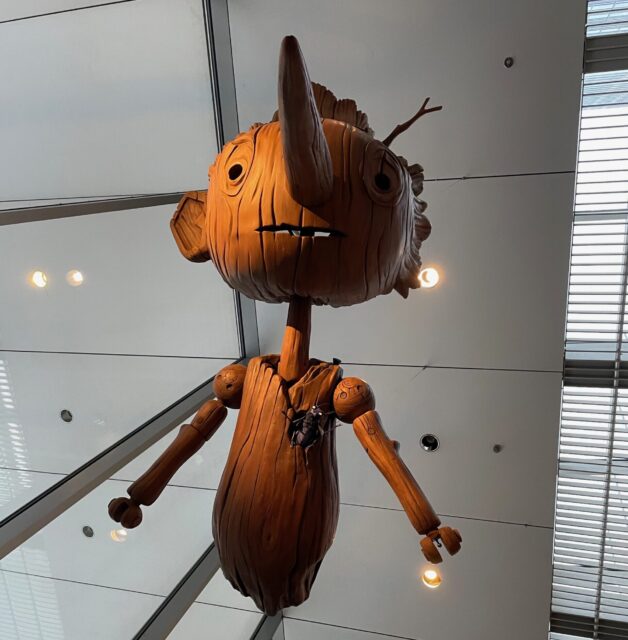
A large-scale Pinocchio hovers over a MoMA hallway (photo by twi-ny/mdr)
GUILLERMO DEL TORO: CRAFTING PINOCCHIO
MoMA, Museum of Modern Art
The Debra and Leon Black Family Film Center
The Paul J. Sachs Galleries
11 West 53rd St. between Fifth & Sixth Aves.
Through April 15, $14-$25 (sixteen and under free)
212-708-9400 www.moma.org crafting pinocchio slideshow
You don’t have to have seen Guillermo del Toro’s Oscar-winning stop-motion-animated Pinocchio or even liked it in order to appreciate the magical “Crafting Pinocchio” exhibition at MoMA, on view for just a few more days. Expect long lines to check out models, maquettes, drawings, dioramas, and video that goes behind the scenes of the making of the film, which started out as a chapter book illustrated by Gris Grimly.
“After the book was published, me and some friends started to develop how this could be a movie. And we came up with a list of directors, and Guillermo was top on the list,” Grimly explains on the audioguide. “Shortly after that, I got a call from a gallery that was selling my artwork, and they said that Guillermo came in and bought a piece of my Pinocchio artwork. And I said, ‘You’ve got to be kidding me!’ They called him up and we had lunch. And this was 2004, I think. It’s been a long time coming. This has been like twenty some years.”
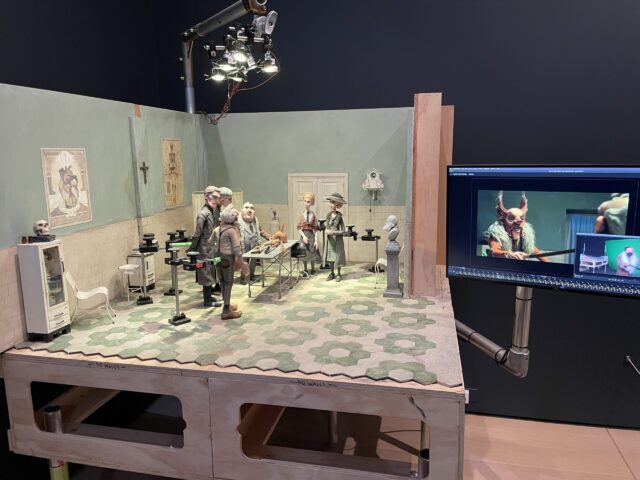
Doctors examine Pinocchio in scene from Oscar-winning film (photo by twi-ny/mdr)
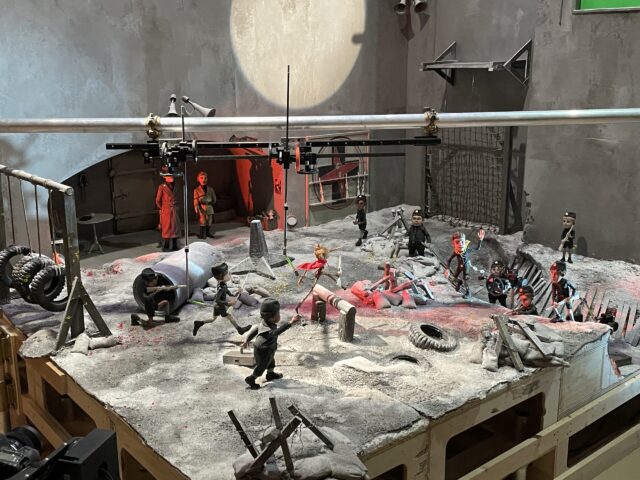
The exhibit is an enticing collection that will bring out the little kid in you. You’ll learn about the creation of such characters as Cricket (voiced by Ewan McGregor), Geppetto (David Bradley), Pinocchio (Gregory Mann), Podesta (Ron Perlman), Dottore (John Turturro), Candlewick (Finn Wolfhard), Spazzatura (Cate Blanchett), the Black Rabbits (Tim Blake Nelson), Count Volpe (Christoph Waltz), the Wood Sprite (Tilda Swinton), and Mussolini (Tom Kenny) and encounter scenes set in Geppetto’s home, the doctor’s office, the battlefield, and the circus where Pinocchio performs.
“This is a fable very close to my heart, and one that I think has lived in many incarnations,” del Toro says on the guide. “And I trust the one we’re offering to you is a particularly beautiful one. This is a tale about becoming who you are, not transforming yourself for others, which goes counter to the traditional take on Pinocchio.” The film itself will be screened at MoMA on April 14 and 15 at 3:00.
Exhibit goes behind the scenes of the making of Guillermo del Toro’s Pinocchio (photo by twi-ny/mdr)
In the film center downstairs are a number of old copies of Carlo Collodi’s story in multiple languages from around the world, an inside look at the music in del Toro’s movie, and clips and posters from Pinocchio and such other del Toro works as Nightmare Alley,The Shape of Water,Pan’s Labyrinth,Hellboy, and The Devil’s Backbone.
On the audioguide, del Toro adds, “We wanted to create a story about a world that behaves like a puppet and obeys everything they’re told, and a puppet that chooses to be disobedient and finds his own morality, his own soul, and his own humanity by that disobedience.” The MoMA show captures just how del Toro accomplished that.
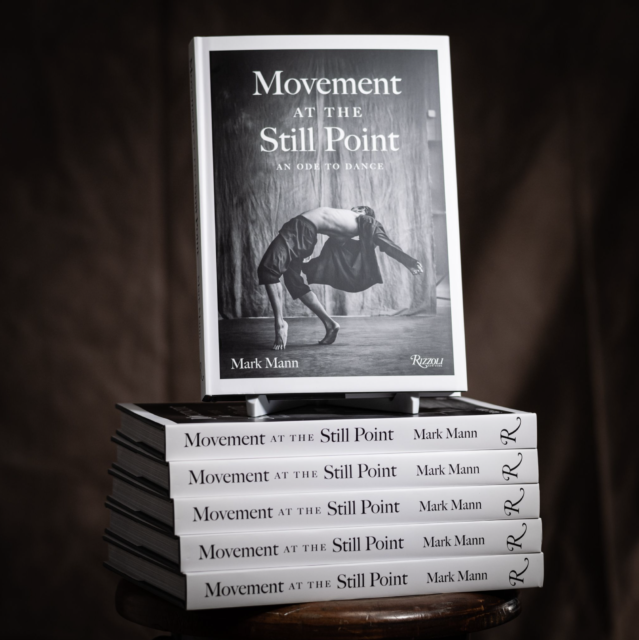
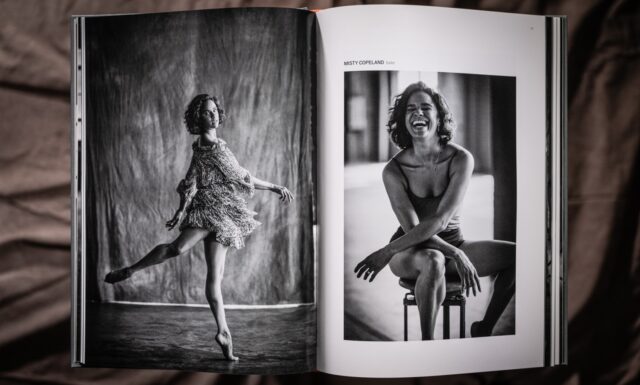
Who:Mark Mann, Sara Mearns, Megan LeCrone, Georgina Pazcoguin, Lloyd Knight, Xin Ying, Terese Capucilli, Skye Mattox, Karla Garcia, David Guzman, Ricardo Zayas, Morgan Marcell, Ryan Vandenboom, Curtis Holland, Rena Butler, Amadeo “Remy” Mangano, Ousmane “Omari” Wiles, Dardo Galletto, Alonso Guzman, Evan Ruggiero, Jie-Hung Connie Shiau, Maleek Washington, Francesca Harper, Carmen de Lavallade, Gus Solomons Jr., more What: Book launch with live performances Where:The Joyce Theater, 175 Eighth Ave. at Nineteenth St. When: Monday, April 10, $81-$131, 7:30 Why: Photographer Mark Mann has assembled quite a group of all-stars to launch his coffee-table book, Still Point: An Ode to Dance (Rizzoli, March 2023, $60), at the Joyce on April 10. The book features photographs of more than 140 people in the dance world, several dozen of whom will be at the Joyce to celebrate with Mann, including New York City Ballet’s Sara Mearns, Martha Graham principals Lloyd Knight and Xin Ying, Broadway’s Skye Mattox and Ryan Vandenboom, voguers Amadeo “Remy” Mangano and Ousmane “Omari” Wiles, tango dancers Dardo Galletto and Alonso Guzman, tap dancer Evan Ruggiero, Ailey II artistic director Francesca Harper, and legends Carmen de Lavallade and Gus Solomons Jr. “Mark is one of a rare breed of photographers who understands dancers: how we move, the way we say things with our bodies that other people say in words, how much we love to perform for an audience — even an audience of one,” Chita Rivera writes in the foreword. “So I put on my top hat, white tie and tails, and we did our own little dance, and it shows in the images he made of me, and of all the dancers in this beautiful collection.”
Misty Copeland is among more than 140 dancers who posed for Mark Mann’s new book (photo courtesy Mark Mann / Rizzoli USA)
The Glasgow-born Mann, who had not photographed the dance community before, was inspired to do the project when commiserating with his sister-in-law, choreographer Loni Landon, about the pandemic lockdown, during which there were no live, in-person performances and Mann’s professional portraiture business had dried up. He accidentally discovered an empty warehouse space on the West Side, where he invited subjects to pose for him, with his beloved medium format Leica S that he calls Gretta. “When our first dancer, Rena Butler, came into the studio in February of 2021, I was speechless,” Mann explained in a statement. “I realized I was watching a performance tailored exclusively for my camera, and for the first few minutes I was so captivated that I actually forgot I was supposed to be taking photos. In that moment, as I began to photograph, my whole life as a photographer was turned upside down.”
In the book, many of the subjects contribute personal thoughts about their chosen discipline. “During the shoots, we spoke to the dancers about identity. The pandemic challenged a lot of us in terms of facing our true selves in a moment when we lost what had defined us,” Landon writes in the afterword. “Everyone figured out how to survive in their own way. It was astonishing to see perseverance paired with vulnerability — the resilience of these artists.” They now take the next step together on April 10 at the Joyce.