featured

BEES & HONEY

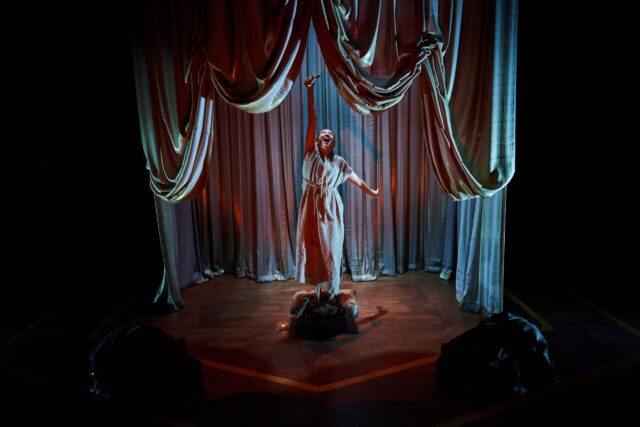
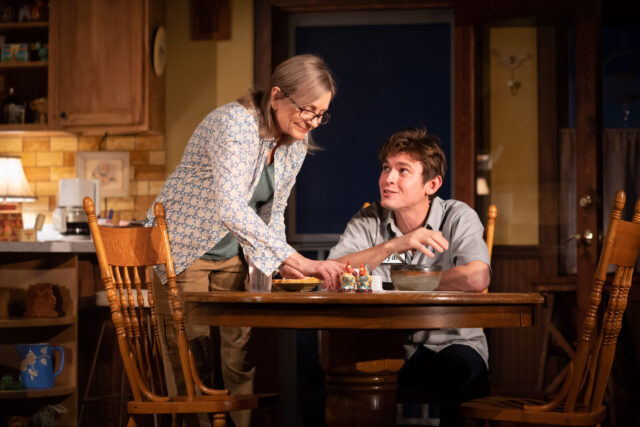
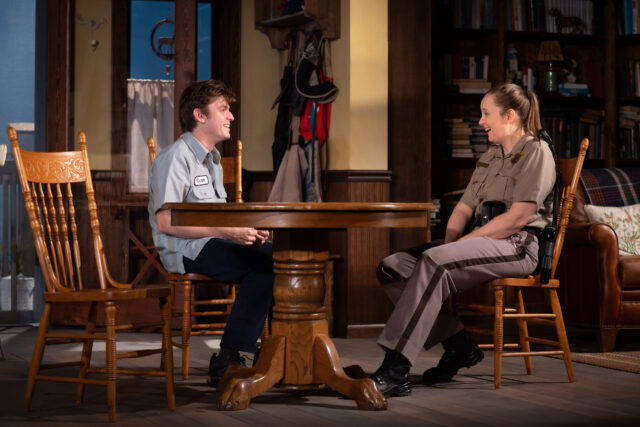
Maribel Martinez and Xavier Pacheco star in world premiere of Guadalís Del Carmen’s Bees & Honey (photo by Julieta Cervantes)

BEES & HONEY
MCC Theater
Susan & Ronald Frankel Theater
511 West Fifty-Second St. between Tenth & Eleventh Aves.
Through June 11, $54-$74
mcctheater.org

“Love me as I love you, good mommy / Give me your love without measure / Look for me like a bee to the honeycomb / Remove the sorrow / Drink the honey of my life,” Dominican musician and multiple Grammy winner Juan Luis Guerra sings in Spanish with his group 4.40 on his 1990 song “Como Abeja al Panal” (“Like a Bee to Its Honeycomb”).

The bachata hit serves as the inspiration for Guadalís Del Carmen’s bittersweet Bees & Honey, a coproduction of MCC and the Sol Project running through June 11. The 130-minute play (with intermission) is like a Latiné telenovela directed by Douglas Sirk, infused with the rhythms of the Dominican music genre known as bachata, exemplified by Guerra’s “Bachata Rosa,” which is playing when the show begins.

“Oh my god, I love this song. So romantic. I know, right?” Johaira (Maribel Martinez) tells the audience. Manuel (Xavier Pacheco) says, “Damn. This song takes me back. Man, I love me a good bachata. Bailao ahí, bien pegaíto like glue. Ain’t nothing like it.” A moment later, Johaira explains, “Bachata brought me and Manuel together almost eight years ago.” The opening is a prelude to what is to come: a flashback of those eight years.

Johaira is in a white bathrobe, sitting on a couch with her feet up. Manuel is in a chair off to her left. They talk to the audience individually, as if they are unaware the other is there as they share their origin story. Reza Behjat’s lighting switches spots on one and then the other. They interact directly with the audience; when Manuel sticks out his fist to bump with a gentleman in the first row, he waits for the man to reciprocate before continuing.

Johaira (Maribel Martinez) and Manuel (Xavier Pacheco) face tough times in Bees & Honey (photo by Julieta Cervantes)

Alternating between Spanish and English, Johaira and Manuel talk about what was going through their minds the night they met at a club near Dyckman St. in Washington Heights; the action then cuts to that encounter and follows the rest of their relationship chronologically. While the actors no longer address the audience directly, the connection has already been made.

Manuel, who has long, tight dreads and sometimes wears a doo rag, is a former drug dealer who is now a mechanic with plans to open his own shops in all five boroughs (“maybe a location in Staten Island,” he says tentatively). Johaira is a prosecutor working a high-profile case that she hopes will lead her to become chief deputy in a new sexual-assault division. Manuel likes playing online video games with his friends while Johaira tries to get him more interested in the rest of the world, beginning with having him read bell hooks’s The Will to Change: Men, Masculinity, and Love and teaching him about power structures.

As Johaira’s case approaches its conclusion, Manuel seeks loans for his business, and they plan to start a family, they encounter more and more roadblocks, some societal, some self-imposed.

Martinez (Black Joy Project, Will You Come with Me?) and Pacheco (The Tempest, Richard III) are terrific as the seemingly mismatched lovers; you can’t help but root for them even as Del Carmen (Not for Sale) heaps on the melodrama, throwing tragedy after tragedy at them that can’t be eliminated with a video game controller or a legal objection.

Shoko Kambara’s comfortable set is a kitchen and living room with a bookshelf, tchotchkes, window air conditioner, working sink, and silver fridge; part of the floor and two doors in the back are painted by Washington Heights artist and muralist Danny Peguero in bright colors, featuring graffiti-like characters and architecture, adding to the Dominican feel. (More of Peguero’s art is on view in the lobby.)

Director Melissa Crespo (Espejos: Clean, Native Gardens) uses the set to its fullest, although there is a lot of entering and exiting that grows tedious. Germán Martínez’s sound design warmly incorporates Dilson’s original score with the dialogue to maintain a compelling atmosphere.

Devario D. Simmons’s costumes help define the characters, from Manuel’s work shirt with his name on it to Johaira’s wardrobe — which shifts from all white to all black to a colorful island dress — while celebrating their bodies; a significant part of the show is dedicated to the couple’s appreciation of their physical beings. “Love watching you squeeze that ghetto booty into them fancy power suits,” Manuel tells Johaira. When Manuel explains that he will not wear skinny jeans, Johaira says, “Yeah, ya butt and thighs are too juicy for ’em.”

The soap-opera elements threaten to overwhelm the play, but Bees & Honey is a tasty confection filled with plenty of sting.

PRIMA FACIE

Jodie Comer makes a scintillating Broadway debut in Prima Facie (photo by Bronwen Sharp)

PRIMA FACIE
Golden Theatre
252 West Forty-Fifth St. between Broadway & Eighth Aves.
Tuesday – Sunday through July 2, $31-$335
primafacieplay.com

Jodie Comer is scintillating in her Broadway debut as a British barrister who has the tables turned on her in Suzie Miller’s Prima Facie, continuing at the Golden Theatre through July 2. In fact, it’s only the second professional stage appearance ever for the thirty-year-old Liverpool-born native, who had a supporting role in Fiona Evans’s The Price of Everything in 2010 but gained fame portraying assassin Villanelle in the television series Killing Eve.

In the Olivier-winning Prima Facie — which means “on the face of it” and is pronounced PRIME-ah FAY-see by the author, a former human rights and criminal defense lawyer herself— Comer portrays Tessa Ensler, a hotshot member of the Kings Counsel who specializes in sexual assault cases, often defending men accused of attacking women. For the first half of the ninety-minute play, she prowls across Miriam Buether’s caged set, contained within a neon frame that flashes bright light; Comer rearranges two tables and a handful of rolling chairs as she goes from law school and a courtroom to a bar, her office, her apartment, and her childhood home, where her mother and brother live. A ceiling-high bookshelf surrounds her on three sides, packed with white law journals.

In a fury of words and movement, she boasts about how the law to her is all about winning, doing whatever is necessary for her client. “It’s not emotional for me. It’s the game. The game of law,” she proclaims. She describes her cat-and-mouse legal style with relish. “There’s blood in the water and I let the witness swim on. No one can help him. And he swims right into it,” she explains. “I fire four questions like bullets. Bang. Bang. Bang bang,” she exults with glee. She makes it clear that it’s not about guilt or innocence, telling her colleagues that whether her clients did what they’re accused of or not is none of her concern. “You don’t play God, you don’t decide, or judge,” she says. Later, she explains, “The only way the system works is because we all play our roles. My role is defense, the prosecutor prosecutes; we each tell a story and the jury decide which story is the one they believe. They take the responsibility. . . . If a few guilty people get off, then it’s because the job was not done well enough by the prosecutor and the police.”

But Tessa’s world is rocked when she is sexually assaulted by her coworker Julian Brookes, a man she might have been building a relationship with and who she had previously slept with. Suddenly she is in the witness stand, being grilled by an attorney whose job it is to find holes in her story and to make it look like the act was not a crime but consensual. Even as she spots some of the same tricks she uses when she is the barrister, she realizes that the law is not necessarily about finding out what really happened. “The system I’ve dedicated my life to is called upon, by me, to find the truth. To provide justice,” she says as the prosecution starts its case.

Tessa Ensler (Jodie Comer) watches herself being interviewed in play about sexual assault and the law (photo by Bronwen Sharp)

Originally presented in Australia in 2019, Prima Facie arrives in New York at a watershed moment in American history. On May 9, 2023, a jury found former president Donald Trump liable for sexual assault, battery, and defamation, ordering him to pay $5 million in damages to journalist E. Jean Carroll, who he quickly defamed again. Last month, US Supreme Court associate justice Clarence Thomas was accused of numerous financial ethics violations; his 1991 confirmation hearings were delayed when Anita Hill accused him of sexual harassment. In October 2018, Brett Kavanaugh started serving as an associate justice on the Court following a contentious confirmation hearing that focused on sexual misconduct claims made by Christine Blasey Ford.

Those episodes called into question if, when, and how women’s accusations against men should be believed, bitterly dividing the nation along political lines, with people supporting the man or the woman depending on party. Meanwhile, public confidence in the justice system has been dropping, with approval ratings for state and federal courts and the US Supreme Court all trending downward.

Prima Facie is not a comeuppance for a lawyer who suddenly finds herself a wronged survivor but a cautionary tale warning that all women are susceptible to such treatment, no matter how knowledgeable about the law and regardless of the truth itself. Miller (Sunset Strip, Caress/Ache) puts everyone on notice, showing that the legal system is no game, despite what Tessa was taught in law school and as Kings Counsel, what happens when “a woman’s experience of sexual assault does not fit the male-defined system of truth.”

The fight is relentless; there’s a reason why Miller gave Tessa the last name Ensler, after playwright and activist Eve Ensler, now known as V, who was sexually and physically abused by her father and since 2011 has led V-Day, a global organization dedicated to ending violence against all women and girls on the planet.

Director Justin Martin (The Jungle, Low Level Panic) lets Emmy winner Comer cut free in the first half of the play but slows things down once Tessa reports the crime and is questioned at the police station and later in court. Comer is a whirling dervish at the start, dancing on tables, quickly changing costumes (by Buether) from suit to robes to party outfit, and tossing her peruke (legal wig) like it’s both a charm and a burden she fully controls.

But once Tessa is raped by Julian and decides to pursue charges, Comer explores the character’s self-doubt as Tessa’s grip on the law loosens amid systemic pitfalls that make sexual assault so difficult to prove, beginning with the distrust of the survivor’s claim that it was not consensual. At one point, we observe Tessa watching a video of her interrogation by police, stunned by her lack of confidence in relating her story. “I’d only ever seen video footage of rooms like this one,” she says. “Watching a client’s interrogation while sitting with my feet on the desk in chambers. All my sass and outrage at the tricks the police play. It’s different when you’re in here.”

Natasha Chivers’s lighting illuminates the bookshelves in soft blues and glowing white before suddenly turning to complete darkness; the video design, by William Williams for Treatment Studio, features a monitor suspended from above like a ghost. Ben and Max Ringham’s effective sound highlights an underlying propulsiveness and British musician Rebecca Lucy Taylor’s (aka Self Esteem) cinematic score.

The play, which has partnered with the Schools Consent Project and other organizations, does get preachy as the conclusion approaches and doesn’t hide its point of view — the program comes with a pull-out poster that lists disturbing facts about sexual assault and proclaims, “On the Face of It, Something Has to Change” — but Comer rises above the occasional didacticism by her sheer force of will. It’s a remarkable stage debut for a vastly talented television, film, and now theater actor on the rise.

During Carroll’s civil case against Trump, she was asked why she didn’t scream when he allegedly attacked her; it became a core issue of discussion. During the trial in Prima Facie, Tessa is asked, “Did you say anything else? Scream?” It’s a chilling moment that is likely to make you want to scream yourself.

FAT HAM

Fat Ham reimagines Shakespeare’s Hamlet taking place at a family barbecue (photo by Joan Marcus)

FAT HAM
American Airlines Theatre
227 West Forty-Second St. between Broadway & Eighth Ave.
Tuesday – Sunday through July 2, $45-$242
212-539-8500
www.fathambroadway.com

Last July I saw James Ijames’s delightfully delicious Fat Ham at the Public Theater. The show has made the smoothest of transitions to Broadway at the American Airlines Theatre, with the same cast, crew, and set. If anything, the play is now even better, nominated for five Tonys, for Best Play, Best Featured Actress, Best Costume Design, Best Lighting Design, and Best Direction. Below is an update of my original review, slightly amended to account for the move to the Great White Way, with revised photos and a tiny tweak to the script.

There’s no “To be or not to be” in James Ijames’s rousing, spirited adaptation of one of William Shakespeare’s most famous tragedies, Hamlet. In the Pulitzer Prize–winning Fat Ham, continuing at the American Airlines Theater through July 2, there’s no “To thine own self be true,” no “There are more things in Heaven and Earth, Horatio,” no “Good-night, sweet prince,” no “Something is rotten in the state of Denmark.” But to give you the tasty flavor of Ijames’s big queer Black take on the familiar tale, his Hamlet, known as Juicy (Marcel Spears), says, “Ah, there’s the rub” only after Rev (Billy Eugene Jones) shares the secret to smoking pork.

The ninety-five-minute show, coproduced by the National Black Theatre and the Public, takes place in the backyard of, according to the script, “a house in North Carolina. Could also be Virginia, or Maryland or Tennessee. It is not Mississippi, or Alabama or Florida. That’s a different thing all together.” The time is “a kind of liminal space between the past and the present with an aspirational relationship to the future that is contingent to your history living in the south. All that to say . . . I’m writing this play from inside the second decade of the twenty-first century. This world aesthetically sits anywhere in the four to six decades preceding the current moment.”

At its core, the story echoes the original. Juicy’s father, the king (Claudius; Jones), has been murdered by his brother, Rev, who then married his brother’s widow, Tedra (Gertrude; Tony nominee Nikki Crawford). Juicy hangs out with his best friend, Tio (Horatio; Chris Herbie Holland). Everyone assumes that Juicy is destined to wed his supposed true love, Opal (Ophelia; Adrianna Mitchell). Her very protective brother, Larry (Laertes; Calvin Leon Smith), is in the military and suffers from PTSD. Tedra’s best friend, Rabby (Polonius; Benja Kay Thomas), Larry and Opal’s mother, loves drinking and celebrating the Lord.

The play opens with Juicy on the back porch of a suburban home helping prepare for a barbecue party for Rev and Tedra’s bethrothal as Tio watches porn on his phone. “Your daddy ain’t been dead a week and he already Stanley steamering your mom. Cold,” Tio says. “Stanley steamering your mom . . . ,” Juicy quizzically repeats. Tio clarifies, “Eating your momma’s box? Doing the nasty with your mom? That better?” This is not your grandparents’ Hamlet.

Rev (Billy Eugene Jones) leads a prayer before family and friends partake of barbecue in Fat Ham (photo by Joan Marcus)

A few minutes later, Juicy is visited by the ghost of his father, Pap, dressed in white, eerie smoke drifting around his neck and shoulders. Pap wants his son to avenge his death — and to stop eating candy bars unless he wants to get “the suga,” which runs in the family. Pap orders Juicy to split Rev open: “Make his thighs into hams. His intestines into chitlins. Pickle his feet and boil his head down to a skull! Crisp up his belly and dry out his balls and grind them up into a fine powder. Lay that all out on the table, invite over your nearest and dearest, and feast. And then make me a plate.” Pap also belittles his son’s education choices, studying human resources at the University of Phoenix. “Scam. Who goes to college online to learn how to manage human beings. Them things don’t go,” he scolds.

The potential relationship between Juicy and Opal has a bit of a problem that only the two of them are aware of: They are both gay. Meanwhile, Larry has a dark secret of his own. But the party goes on, as Rev sings Teena Marie and Juicy warbles Radiohead’s “Creep,” a kind of replacement for the “To be or not to be” soliloquy: “I don’t care if it hurts / I wanna have control / I want a perfect body / I want a perfect soul / I want you to notice / When I’m not around / So fuckin’ special / I wish I was special / But I’m a creep / I’m a weirdo / What the hell am I doin’ here? / I don’t belong here.” The lyrics represent what so many young queer Black men experience, not wanting to be made to feel invisible and less than.

Juicy uses charades to tell his uncle he knows what he did: “The play’s the thing / Wherein I’ll catch the conscience of . . . the . . . King. Preacher. He is a preacher in this play,” he tells the audience. The game is on as Rev and Juicy battle it out.

Fat Ham is outrageously funny, featuring superb over-the-top performances by the ensemble. Spears (Othello, A Midsummer Night’s Dream) has a tender gentleness, a softness, to his every move; dressed in all black (the contemporary costumes are by Dominique Fawn Hill), he would fit right in as Usher in Michael R. Jackson’s A Strange Loop, another “big Black queer” character with a complicated relationship with his family and other people who’s trying to figure out just who he is and what he wants out of life. Human resources is probably not Juicy’s best career path. Perhaps Ijames named him after the Notorious B.I.G. song “Juicy,” in which Biggie Smalls declares, “You know very well / Who you are / Don’t let ’em hold you down / Reach for the stars / You had a goal / But not that many / ’Cause you’re the only one / I’ll give you good and plenty.”

Juicy’s (Marcel Spears) father (Billy Eugene Jones) is smokin’ in Fat Ham (photo by Joan Marcus)

Ijames (White, Kill Move Paradise) interjects Shakespeare at just the right moments, as when, after Larry and Juicy share an intimate moment, the latter turns to the audience and delivers one of the Bard’s masterpieces, the poetic speech that begins “What a piece of work is a man!” But Ijames keenly changes one pronoun, and the meaning of the prose is altered following the scene we just watched,

Stacey Derosier’s lighting keeps things bright and cheery, as does Darrell Grand Moultrie’s choreography on Maruti Evans’s backyard set. Director Saheem Ali (Nollywood Dreams, Merry Wives) ably balances the wackiness with the serious nature of so much of Ijames’s dialogue alongside whimsical references to Ms. Cleo, OnlyFans, and sexy muppets. But it’s not all lighthearted fun.

At one point, Tio, talking about what he is learning from his therapist, explains to Juicy, “He said . . . These cycles of violence are like deep. Engrained. Hell, engineered. Hard to come out of. Like, your Pop went to jail, his Pop went to jail, his Pop went to jail, his Pop went to jail, and what’s before that? Huh? Slavery. It’s inherited trauma. You carrying around your whole family’s trauma, man. And that’s okay. You okay. But you don’t got to let it define you.”

Juicy is determined not to follow in his father’s footsteps, trying to overcome the systemic institutional racism that dooms so many Black men and tears apart families. That’s not exactly the same thing as the handing down of the crown from generation to generation of white men and boys — but it has the potential to become the half-million-dollar crown Biggie was famous for wearing.

THE STRANGE CASE OF UDO KIER: THE FORBIDDEN ROOM

Udo Kier plays multiple roles in Guy Maddin and Evan Johnson’s unpredictably strange and wonderful homage to lost early cinema, The Forbidden Room

THE FORBIDDEN ROOM (Guy Maddin & Evan Johnson, 2015)
Anthology Film Archives
32 Second Ave. at Second St.
Saturday, June 3, 4:15
Series continues through June 4
anthologyfilmarchives.org
theforbiddenroom-film.com

Guy Maddin and Evan Johnson’s The Forbidden Room is a deliriously mesmerizing epic tone poem, a crafty, complex avant-garde ode to cinema as memory, and memory as cinema. An homage to the lost films of the silent era, it is the illegitimate child of Bill Morrison and David Lynch, of Jack Smith and Kenneth Anger, of D. W. Griffith and Josef von Sternberg. The impossible-to-describe narrative jumps from genre to genre, from submarine thriller to Western adventure to murder yarn, from romantic melodrama and crime story to war movie and horror tale, complete with cannibals, vampires, poisoned leotards, “valcano” eruptions, caged lunatics, butt obsession, squid theft, explosive jelly, a fantastical mustache, and skeletal insurance defrauders. Intertitles that often fade away too soon to decipher help propel the plot, contain lines from John Ashbery and the Bible, and blast out such words as “Deliverer of Doom,” “Diablesa!” and “Trapped!” Text in intricate fonts announces each new character and actor, including Maddin regular Louis Negin as the Sacrifice Organizer, Slimane Dazi as shed-sleeper and pillow-hugger Baron Pappenheim, Lewis Furey as the Skull-Faced Man, and Roy Dupuis as a “mysterious woodsman” determined to rescue captured amnesiac Margot (Clara Furey) from the evil clutches of the Red Wolves. Also involved in the bizarre festivities are Geraldine Chaplin, Mathieu Amalric, Charlotte Rampling, Maria de Medeiros, and the great Udo Kier in multiple roles.

Although shot digitally, the film explores photographic emulsion and time-ravaged nitrate while treating celluloid as an art object unto itself, looking like Maddin (Tales from the Gimli Hospital, My Winnipeg) and Johnson stomped on, burned, tore up, and put back together the nonexistent physical filmstrip. Thus, major kudos are also due Maddin’s longtime editor, John Gurdebeke, and music composers Galen Johnson, Jason Staczek, and Maddin himself for keeping it all moving forward so beautifully. The film was photographed by Benjamin Kasulke and Stéphanie Anne Weber Biron in alternating scenes of black-and-white, lurid, muted color, and sepia tones that offer constant surprises. The Forbidden Room might be about the magic of the movies, but it is also about myth and ritual, dreams and fantasy as it explores storytelling as psychodrama. Oh, and it’s also about taking baths, as Marv (Negin) so eagerly explains throughout the film. But most of all, The Forbidden Room is great fun, a truly unpredictable and original work of art that is a treat for cinephiles and moviegoers everywhere.

The Forbidden Room is screening on June 3 at 4:15 in the Anthology Film Archives series “The Strange Case of Udo Kier,” which continues through June 4 with such other Kier gems as Just Jaeckin’s The Story of O, Gus Van Sant’s My Own Private Idaho, Rainer Werner Fassbinder’s The Third Generation, and Monika Treut and Elfi Mikesch’s Seduction: The Cruel Woman.

FREE TICKET ALERT: RIVER TO RIVER FESTIVAL 2023

Molly Lieber and Eleanor Smith will present Zero Station at R2R 2023 (photo courtesy LMCC)

RIVER TO RIVER FESTIVAL
Multiple downtown venues
June 9-18, free
Some events require advance RSVP beginning June 1 at noon
lmcc.net/river-to-river

The twenty-second annual River to River Festival runs June 9-18, ten days of cutting-edge art, dance, music, tours, and participatory events at such locations as the Seaport, the Clemente, Governors Island, and Battery Park City. Everything is free, although advance RSVP is recommended or required for several happenings; tickets are available beginning June 1 at noon.

This year’s festival is also a celebration of the fiftieth anniversary of the Lower Manhattan Cultural Council (LMCC), the sponsoring organization that has been a resource for independent artists since 1973; many alumni are involved in R2R 2023 to honor that milestone.

This year’s lineup includes Molly Lieber and Eleanor Smith continuing their exploration of hypersexualization, trauma, and othering in Zero Station. Antonio Ramos and the Gangbangers stage the dance-theater ceremony CEREMONIA, focusing on cultural misappropriation and reappropriation. Seventeen artists will share one-on-one encounters through a lottery in Lotto Royale. Scholar and historian Linda Jacobs will lead walking tours of Little Syria on Washington St. And Guinean musician and activist Natu Camara will close things out with a grand finale concert in Rockefeller Park.

Tickets are sure to go fast, so don’t hesitate if you want to catch any of these unique and special presentations. Below is the full schedule.

Friday, June 9
through
Friday, June 30

Exhibition: “El Camino: Stories of Migration,” by Nuevayorkinos, Fulton Market building windows at the Seaport, opening June 9 at 4:00

Saturday, June 10
and
Sunday, June 11, 11:00 am – 5:00 pm

Participatory Tape Installation: Mahicantuck, “River that flows two ways,” by Marta Blair, Belvedere Plaza, Battery Park City

Saturday, June 10
and
Sunday, June 11, 1:00 – 6:00

Performance Lottery: Lotto Royale, one-on-one encounters with luciana achugar, Lauren Bakst, Amelia Bande, Raha Behnam, mayfield brooks, Moriah Evans, Julia Gladstone, Nile Harris, Niall Jones, Jennifer Monson, Elliot Reed, Alex Rodabaugh, nibia pastrana santiago, Keioui Keijaun Thomas, ms. z tye, Mariana Valencia, and Anh Vo, RSVP required

Saturday, June 10
through
Sunday, June 18

Studio Residency and Public Program: Archive Barchive, by AUNTS, with talks, performances, toasts, and other gatherings, Studio A4, the Arts Center at Governors Island

Marta Blair invites the community to participate in River to River installation (photo courtesy Marta Blair)

Sunday, June 11, 11:00 am
Tuesday, June 13, 11:00 am
Thursday, June 15, 11:00 am
and
Saturday, June 17, 3:00

Walking Tours: Little Syria, New York: Walking Tours of Washington Street, with Linda Jacobs of the Washington Street Historical Society, Washington St. & Battery Pl., RSVP recommended

Monday, June 12, 7:30
Performance: Zero Station, by Molly Lieber and Eleanor Smith, Flamboyan Theater, the Clemente, RSVP recommended

Thursday, June 15, 7:00
Performance: CEREMONIA, by Antonio Ramos and the Gangbangers, La Plaza, the Clemente, RSVP required

Friday, June 16, 4:00
Performance: Talk to Me About Water, by Amelia Winger-Bearskin, Lower Gallery, the Arts Center at Governors Island, 110 Andes Rd., RSVP required

Friday, June 16, 7:00
Performance: duel c, by Andros Zins-Browne, Outlook Hill, Governors Island, RSVP required

Saturday, June 17, noon – 6:00
Open Residency: LMCC’s Workspace Open Studios, 101 Greenwich St., RSVP recommended

Saturday, June 17, 4:00
Poetry in the Park: al Qalam: Poetry in the Park featuring New York Arabic Orchestra, with Hani Bawardi and Rita Zihenni, the Battery Labyrinth

Saturday, June 17, 6:30
Performance: River to River 2023 Closing Concert with Natu Camara, Rockefeller Park, Battery Park City

GALLIM AT THE JOYCE

Brian “HallowDreamz” Henry and GALLIM’s Andrea Miller will present new collaboration at the Joyce (photo courtesy GALLIM)

GALLIM
The Joyce Theater
175 Eighth Ave. at 19th St.
May 31 – June 4, $51-$71
212-691-9740
www.joyce.org
www.gallim.org

Brooklyn-based GALLIM returns to the Joyce this week to celebrate its fifteenth anniversary, presenting new and repertory pieces May 31 – June 4. “After a necessary process of metamorphosis during the last three pandemic years, GALLIM emerges with a new generation of dancers, creativity, diverse perspectives, experiences, and backgrounds that inspire and enrich our work,” founding creative director and Guggenheim Fellow Andrea Miller said in a statement.

The evening begins with state, a short trio that A.I.M by Kyle Abraham debuted at the Joyce in 2018; it will be performed by India Hobbs, Vivian Pakkanen, and Emma Thesing, with music by Reggie “RIVKA” Wilkins. FROM (DESDE) is a 2019 collaboration with Juilliard for eight dancers, set to Nicolas Jaar’s ”John the Revelator” and “Killing Time.” The highlight is likely to be the world premiere of song, a collaboration with Krump master Brian “HallowDreamz” Henry that features live painting by abstract expressionist Sharone Halevy and music by RIVKA; HallowDreamz is a former gang member from Bed-Stuy and now dancer and teacher who explores survival in this solo.

Following intermission, Castles is an abridged reimagining of 2013’s Fold Here, inspired by Raymond Carver’s short story “Cathedral,” about a blind man visiting his late wife’s family in Connecticut who asks the narrator to describe cathedrals being shown on a television program they are watching; the company performs to original music by Andrzej Przybyłowski and Will Epstein and songs by Brian Eno, Paul Whiteman, and Tim Hecker. No Ordinary Love is an excerpt from 2022’s Duets for Jim, a duet performed by Chalvar Monteiro from Alvin Ailey and Issa Perez or Thesing and Marc Anthony Gutierrez, with music by Sade.

The finale is 2019’s company piece SAMA, which combines the ancient Greek word for body and the Slovenian word for by herself, with music by Jaar, Vladimir Zaldwich, and Frédéric Despierre, as the body searches for space amid the digital revolution.

“In this first full season following the pandemic, we celebrate our history and our collaborators while pursuing work that honors diversity, inclusion, equity, and access,” GALLIM executive director Erin Fogarty added. “This is the crucial path to creating meaningful art and continuing much needed conversations across generations, genres, and disciplines.”

(The June 1 performance will be followed by a Curtain Chat.)

FRIENDSHIP: SUMMER, 1976 / KING JAMES

Diana (Laura Linney) and Alice (Jessica Hecht) are forced to become friends in Summer, 1976 (photo © Jeremy Daniel, 2023)

SUMMER, 1976
Samuel J. Friedman Theatre
261 West Forty-Seventh St. between Broadway & Eighth Ave.
Tuesday – Sunday through June 18, $84-$338
www.manhattantheatreclub.com

“Life is an awful, ugly place to not have a best friend,” Sarah Dessen writes in her 1998 young adult novel Someone Like You.

YA novels are often obsessed with portraying teen friendships, while adult friendships generally receive less attention. Two current plays anchored by terrific performances remedy that neglect, focusing exclusively on adult same-sex cisgender platonic relationships. In Pulitzer Prize winner David Auburn’s Summer, 1976 two women meet through their young children, while in Pulitzer Prize finalist Rajiv Joseph’s King James two men bond over their love of basketball star LeBron James. While neither two-character show is a slam dunk, they both got plenty of game.

In MTC’s Summer, 1976 at the Samuel J. Friedman Theatre, Diana (Laura Linney) and Alice (Jessica Hecht) spend most of the ninety-minute play sitting on opposite sides of a long, rectangular table, their chairs facing the audience, who they address directly. At the beginning, Diana, an artist and teacher at Ohio State, tells us how much she doesn’t like Alice’s daughter, Holly. Alice, whose husband, Doug, is an economist at the university, then explains how she “sort of immediately hated” Diana but realizes she will have to put up with her because Alice’s daughter, Gretchen, is getting along with Holly. Diana is a much stricter mother who doesn’t hide what she believes is her superiority over Alice. “Parents who can’t or won’t control their kids aren’t upset when you do it for them. They’re grateful and ashamed,” she says, describing Alice as a “sleepy-eyed little hippie.”

Laura Linney and Jessica Hecht play two very different women in David Auburn world premiere (photo © Jeremy Daniel, 2023)

After passing a joint to the serious, sophisticated Diana, the free-spirited Alice complains, “She fucking bogarted it for like five minutes, and I was like, come on, lady, I only took it out because it was the only way I could imagine getting through the next ten minutes before I could make an excuse and leave.” But soon after that they actually become friends, sharing intimate details about their fears and desires, discussing interior decoration choices, a sexy house painter, the sanctity of marriage, highbrow vs. lowbrow television, music, and literature, and a complicated “cashless, self-sustaining system” Doug has developed to barter baby-sitting time in their community.

The final scene takes place about twenty-five years later, when we learn how their two-month friendship impacted the rest of their lives.

John Lee Beatty’s set features a three-sided gridlike wooden backdrop with two doorways that the characters can use as an exit but don’t, sticking around to hear what the other one has to say. Japhy Weideman’s lighting and Hana S. Kim’s projections change day to night, adding blue sky and twinkling stars. Tony winner Daniel Sullivan (If I Forget, Lost Lake) can’t quite get a firm grasp of Auburn’s (Proof, The Columnist, Lost Lake) narrative, which is too slight and gets bumpier as the conclusion approaches.

Tony nominee and four-time Emmy winner Linney (My Name Is Lucy Barton, The Little Foxes) and Tony nominee Hecht (Letters from Max, The Orchard) form a terrific duo, the former firm and direct, the latter loose and quixotic. For much of the show they are separated by the length of the table, occasionally reaching for each other but unable to make contact.

At a talkback following the matinee I saw, they couldn’t stop touching hands and shoulders, as if they suddenly required meaningful physical connection. It also was clear that the two of them have become real-life friends because of the show, which added a lovely note to the afternoon.

Matt (Chris Perfetti) and Shawn (Glenn Davis) bond over basketball and LeBron in King James (photo by Craig Schwartz)

KING JAMES
MTC at New York City Center – Stage I
131 West Fifty-Fifth St. between Sixth & Seventh Aves.
Tuesday – Sunday through June 18, $79-$99
www.manhattantheatreclub.com

Rajiv Joseph shoots and scores with King James, making its New York premiere at MTC at New York City Center.

The play is divided into four quarters, like a basketball game, as two lonely twenty-one-year-old Cleveland Cavaliers fans unexpectedly come together as they follow the exploits of superstar LeBron James, beginning in 2004 and jumping to 2010, 2014, and 2016, four seasons that served as turning points in the career of the leading scorer in the history of the sport — as well as for the two characters.

In February 2004, during the King’s rookie campaign, inexperienced bartender Matt (Chris Perfetti) is desperate to sell the remainder of his family’s season tickets so he can pay off at least some of his numerous debts. Matt, who wants to open a downtown sports bar, is biding his time at the empty La Cave du Vin, playing around with a ball of newspaper and a trash bin, when wannabe writer Shawn (Glenn Davis) arrives, seeking to purchase the tickets. Both men are from Cleveland Heights, Ohio, not far from LeBron’s hometown of Akron; Matt grew up going to games with his father, while Shawn has never been to the arena to see a Cavs match.

After they come to an agreement, their friendship builds over the years: Shawn gets to know Matt’s parents, who run a curiosity shop called Armand’s, the name of their treasured stuffed armadillo; they argue over whether LeBron is better than Michael Jordan; Matt repeatedly explains what the problem with America is; and LeBron moves on to several different teams, forcing Matt and Shawn to reevaluate their loyalty as well as their relationship.

“Being a fan is like having a religion,” Matt says. Shawn replies, “Yeah, and like most religions, it’s rotten to the core. Like at Sunday school, the way they talked to us about Jesus? That’s exactly how I feel right now. Like I’m being punished because He happened to be a Savior.” Matt wisely asks, “Jesus or LeBron?”

Shawn is always the more introspective of the two, pushing LeBron’s choices onto his own identity. “LeBron for the win. LeBron for the win, all these times, and then he just fucking leaves,” he opines after James signs with the Miami Heat. “And I’m like . . . You get burned and you’re like . . . Who am I? Why am I like this? I don’t know. I think maybe I just need to work on myself for a little bit.” It’s those kinds of rationalizations and realizations that lift King James above a mere play about sports to a drama about anyone searching inside themselves, looking to have a better season; the beauty of the show is that you don’t have to know anything about basketball to appreciate it, although it certainly helps if the names Mark Price, Brad Daugherty, David Robinson, and Isiah Thomas ring a bell.

Unfortunately, it takes one seriously bad bounce when it forces race into the equation — Matt is white and Shawn is Black — but it manages to overcome that miss well before time runs out.

Shawn (Glenn Davis) and Matt (Chris Perfetti) reach a turning point in MTC production (photo by Craig Schwartz)

Todd Rosenthal’s set switches from La Cave du Vin, an elegant wine bar that used to be a church, complete with stained glass that gives it a holy feel, further equating LeBron with Jesus, to Armand’s, a messy shop overstuffed with random tchotchkes and knickknacks that are like lost parts of people’s lives. Samantha C. Jones’s costumes range from Cavs jerseys to the cheesy bowling-style shirts Armand’s employees must wear. DJ Khloe Janel keeps the joint rocking in a booth to the right of the stage, where she pumps tunes by Prince, Fleetwood Mac, and others before and after the show and during halftime — er, intermission — just as if we were at an NBA arena. Feel free to sing and dance and say hello.

Tony-winning director Kenny Leon (Topdog/Underdog, A Soldier’s Play) coaches it all like a champion, keeping the rock in play, slowing things down and then going in for the jam.

Joseph (Bengal Tiger at the Baghdad Zoo, Describe the Night) grew up a Cavaliers fan in the 1980s and ’90s, so he clearly knows his stuff, understanding just how much sports is and isn’t life. (The play arrives in New York City at a fascinating point as James, currently a Los Angeles Laker, might retire following a four-game sweep at the hands of the Denver Nuggets for the Western Conference Championship.)

Joseph wrote the part of Shawn specifically for Davis (Bengal Tiger at the Baghdad Zoo, Downstate), knowing when to shoot and when to dish it off to Perfetti (Moscow x 6, The Low Road), who takes the ball and runs with it, hitting layups and swishing from beyond the three-point line.

Basketball metaphors aside, King James is an all-star (sorry) examination of male friendship, the ups and the downs, the victories and the defeats — which I know only too well, having been a Knicks fan for more than fifty years.

As O. Henry wrote in Heart of the West, “No friendship is an accident,” which is ably demonstrated by both Summer, 1976 and King James.