featured

THE ONLY THING MORE POWERFUL THAN HATE IS LOVE: KRAMER/FAUCI AT SKIRBALL

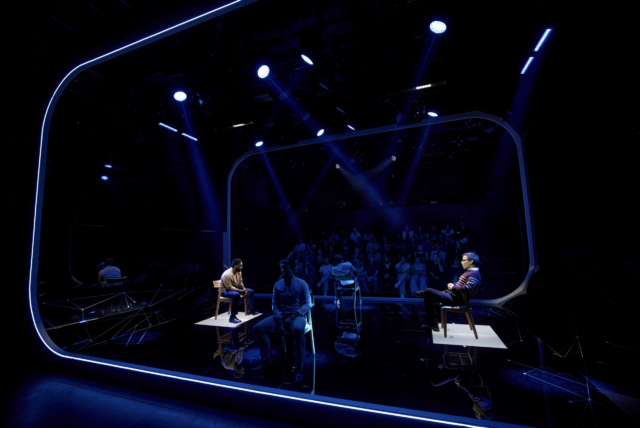
Thomas Jay Ryan, Jennifer Seastone, Will Brill, and Greig Sargeant bring a C-Span discussion to vivid life in Kramer/Fauci (photo by Maria Baranova)

KRAMER/FAUCI
NYU Skirball Center for the Performing Arts
566 La Guardia Pl.
February 11-21, $60-$90
nyuskirball.org

Daniel Fish again proves his genuine creative genius with the wildly entertaining and unpredictable Kramer/Fauci, running at NYU Skirball through February 21.

On November 30, 1993, C-Span host Steve Scully spoke about the AIDS crisis with Dr. Anthony Fauci, the director of the National Institute of Allergy and Infectious Diseases at the National Institutes of Health, and playwright and activist Larry Kramer, author of the novel Faggots and the play The Normal Heart and cofounder of Gay Men’s Health Crisis and ACT UP (AIDS Coalition to Unleash Power). For sixty minutes, while Fauci was in the studio with Scully and Kramer was beamed in onscreen from New York City, they discussed government funding, drug research, bigotry, public awareness, and more, in addition to taking phone calls from viewers.

Fish has transformed that visually dry program into an exciting, rich theatrical experience with such unusual elements as a woman on roller skates, a hilarious colorful costume, and a whole lot of bubbles.

As audience members enter the auditorium, six rows of nine lights apiece are blazing from the back of the stage, reminding me of a flag too bright to bear looking at — except for a colleague of mine who had (knowingly?) brought sunglasses. The show starts slowly in the empty space: Scully (Greig Sargeant) sits in the middle in a chair, Dr. Fauci (Will Brill), in a crisp suit, stands closer to the front to Scully’s right, and Kramer (Thomas Jay Ryan), in a turtleneck, hovers against the back wall to Scully’s left. The three begin reciting the exact transcript from the interview, as Scully raises a question about President Clinton’s formation of a new task force. Fauci provides a relatively straightforward bureaucratic response, but Kramer gives a hint of what’s to come when he criticizes the technology C-Span is using — he is unable to see Scully or Fauci but can only hear them, although he complains about the earpiece as well — and says, “This is a task force to identify what the stumbling blocks are, we know what they are: a lot of bureaucracy, a lot of red tape, a lot of stupid laws by Congress, and a lot of idiots, uhhhhhhh, putting their two cents worth, uh uhhh, how are you gonna get rid of all of these things is what I want to know and I have yet to hear a task force form to tell me that.”

After several minutes of physical stasis, Fauci and especially Kramer start moving around the stage as they argue over how recent administrations dealt with AIDS, what the real number of people afflicted with the disease are (and will be), how much money is needed for research, and why more is not being done. When Scully brings up the topic of the AIDS epidemic being normalized, Fauci begins, “Larry and I have had conversations about this many, many times over the years, and I a-appreciate it and in many respects, remire . . . admire the, the rage that he has about a very, very difficult problem. But I think you have to . . .” Kramer cuts him off, proclaiming, “Tony, if you start that business about science isn’t done that way, I’m gonna come on there and slap your face.” Fauci peacefully responds, “Nah . . . nah . . . All right, Larry, hang on for a sec. I love you, Larry . . . Uh . . . The fact is that the real solutions will in fact, come from the science.”

Scully occasionally cuts away to play audio footage of news conferences and to take calls, each of which is delivered by Jennifer Seastone in a few different voices, first riding in circles on roller skates and later donning an oddball costume. (The costumes are by Terese Wadden, with set by Jim Findlay, lighting by Scott Zielinski, and sound by Tei Blow.) Movement director Beth Gill soon has Kramer making his way over to Fauci and the roving callers, hugging one of Skirball’s golden pillars, and approaching the audience. It ranges from absurdly comical to substantially confrontational, all of it fascinating and compelling.

And then, the bubbles.

Expect the unexpected in Daniel Fish’s inventive re-creation of a C-Span program on AIDS (photo by Maria Baranova)

In A (radically condensed and expanded) Supposedly Fun Thing I’ll Never Do Again, the New Jersey–born, New York City–based Fish used tennis balls and existing text in a play about the work of Infinite Jest author David Foster Wallace. Fish earned a Tony for his unique staging of Oklahoma!, in which the audience was served chili at intermission. In White Noise, he used bold, giant projections and an actor sitting in a large, dark circle in the middle of a screen to tell part of Don DeLillo’s treatise on consumerism gone mad. And in Elektra, Sophocles’s title character, played by Brie Larson, was a kind of punk goddess spitting out some of Beyoncé’s “Daddy Lessons” while an unexplained blimp floated nearby.

For Kramer/Fauci, the actors wear earpieces that feed them the lines in order to maintain the precise pace and tone of the original program. Tony winner Brill (Stereophonic, Oklahoma!) is cool, calm, and collected as the cool, calm, and collected Fauci, who might not have gained as much fame for his work on AIDS but became a divisive and highly public figure during the Covid-19 pandemic. Two-time Drama Desk Award winner Ryan (Eureka Day, Dance Nation) is sensational as Kramer, a deeply concerned, knowledgeable, and emotional activist who is fed up with the government’s response to what he insists is a plague, not merely an epidemic or crisis.

The play centers on the complex friendship between Fauci and Kramer, who strongly disagree on how to deal with AIDS. It is summed up best in this exchange, which, like everything else, is taken verbatim from the transcript, with every pause and repetition:

Kramer: It’s all of this rhetoric of yours and everybody else in the bureaucracy. You know, I want to say something about, about Tony Fauci because I think the world must think I ha—, I hate him or something the way I’m going on tonight. I love Tony, actually I d—, I think I probably have a more complicated relationship with Tony than anybody in my entire life. He is a man, an ordinary man who was being asked to play God and he is being punished because he cannot be God. And that is a terrible situation to be in to be the lightning rod for all of us. Uhhhh . . . he has had to deal with Reagan and Bush and defend those monsters, for all we know he probably kept the labs open when John Sununu and Gary Bauer, and other awful bigots, probably wanted them closed, and he had to do it at a price, probably uh at a price for his own soul that we’ll never know that that he had to say things that in his heart he never believed. But he is there and he has been the, this this this incredible fighter for us and for AIDS. I just get angry when he puts on this bureaucratic suit and out comes this boilerplate, uhhhhh, that like Donna Shalala said the same, they, all his rhetoric that doesn’t mean anything. Tony, more than anyone in this world, knows how awful everything is, knows what has to be done, knows that he should have been given a lot more money to do it, knows who all these terrible people are, and yet he can never say it in public like I can say it in public.
Scully: Dr. Fauci, let me go back to an earlier question . . .
Kramer: Why don’t you respond to that, Anthony?
Scully: Oh, go ahead, Doctor.
Fauci: I love you, Larry. [Laughs.]

The play is eerily prescient of so much of the ensuing debate about public health. Most of us well remember what happened during Covid-19, when Fauci was at odds with the Trump administration, and today the battle over vaccines rages on with new updates every day, while the LGBTQ community has a growing fight on its hands, about a lot more than just the taking down of a Pride flag. However, Fish doesn’t reference any of that, instead keeping his focus on communicating the drama of this extraordinary debate between two dedicated, extremely intelligent men trying to do what’s best for an ailing population. How he chooses to punctuate and illustrate the power of their conflict with stunning, dumbfounding, and yet somehow near-perfect staging is where his genius lies.

[Mark Rifkin is a Brooklyn-born, Manhattan-based writer; you can follow him on Substack here.]

EXTINCTION TIME: THE DINOSAURS AT PLAYWRIGHTS HORIZONS

Jacob Perkins’s The Dinosaurs takes place at a basement AA meeting (photo by Julieta Cervantes)

THE DINOSAURS
Playwrights Horizons, the Judith O. Rubin Theater
416 West 42nd St. between Ninth & Tenth Aves.
Tuesday – Sunday through March 8, $83.50 – $103.50
www.playwrightshorizons.org

If I never see another play set entirely at an AA or grief counseling meeting consisting of a group of people sitting on folding chairs near some coffee and donuts, it will be too soon.

Now, it’s not that I’m unsympathetic or lack compassion for people facing real problems, but the format has just been worn down with too many similar shows, particularly since the pandemic.

The topic of addiction can be treated magnificently, as it was in Joe White’s recent Blackout Songs, a scintillating story about a man and a woman who fall in and out of love and lust after meeting at an AA gathering. And spit&vigor’s Anonymous, which is back for a well-deserved encore run in its tiny black-box space on Macdougal St., cleverly immerses the audience in its addictive tale of addiction held in a circle of chairs, some occupied by audience members. In addition, such works as Dave Malloy’s Octet and Bess Wohl’s Liberation practically reinvented the use of the physical arrangement, though neither was about alcoholism.

However, Jacob Perkins’s The Dinosaurs, making its world premiere at Playwrights Horizons through March 1, wastes a terrific cast in a stale, seemingly unfinished production about six women dealing with the disease.

The seventy-five-minute play begins as Jane (April Matthis) enters an empty white room, its black ceiling hung with rows of bright fluorescent lights, a dark alcove in the back with random items. As Jane stands deep in thought, a hesitant, uncomfortable-looking woman named Rayna but known as Buddy (Keilly McQuail) arrives and talks to Jane about how she spills the inside of donuts on her clothing but never gives up the sweet treat. “I guess we just can’t help ourselves,” Jane says. “We always keep on going back for more.” Buddy discusses the etymology of the word “cupcake,” then leaves, apparently not ready for this kind of meeting.

Jane starts bringing out folding chairs from a back room, arranging them in a semicircle. Joan (Elizabeth Marvel) comes in with the coffee and helps with the chairs and table. She checks that the milk has not reached its expiration date. Jane hears chirping that Joan doesn’t. There are numerous such pronouncements throughout that serve as supposed insight.

Next, eighty-year-old Jolly (Kathleen Chalfant) breezes in with a box of donuts and scones, which surprises Jane and Joan, who assumed Jolly would be late and/or forget the snacks. “It must’ve taken you a lifetime,” Joan says, to which Jolly replies, “‘It always takes the time / it needs to take,’” paraphrasing Pulitzer Prize winner Mary Oliver, a poet whose quotes are a favorite of recovering addicts.

They are soon joined by Joane (Maria Elena Ramirez), who gossips about a teenage boy at her son’s school who “bagged an older woman,” and they debate whether charges should be brought. While Jane tries to understand the loneliness that must have made the woman do what she did, Joan argues, “Empathy has its limits.”

At last, Janet (Mallory Portnoy) pops in and the Saturday Survivors meeting officially gets underway, as Jolly recites the preamble, which concludes, “Our primary purpose is to stay sober and help other alcoholics to achieve sobriety.”

The rest of the play awkwardly moves through time and space as the participants make shares that are abruptly cut off, unfinished; Buddy returns, questioning the existence of a higher power, but only Jane can see and hear her; Janet relates a dream she had that is overloaded with obvious symbolism; and Joan recounts in an unwieldy manner a series of sobriety dates she has experienced, a clunky way to point out how addicts can fall on and off the wagon.

A small group of women gossip and share personal stories in The Dinosaurs (photo by Julieta Cervantes)

Each time one of the women says, “My name is [—] and I’m an alcoholic,” the others annoyingly shout out the name in unison. Perhaps that is linked to why the five regulars all have names that begin with the same letter, as if they are parts of the same person. (Or maybe not.) They also make plans for the following week’s fifty-second annual anniversary party, the theme of which is gratitude and will feature live performances by several group members.

Hovering over it all is a broken clock on the wall that is perpetually at 2:13, not only representing the importance of time when it comes to recovery but also, perhaps, referring to Bible verses about faith (Timothy 2:13, Philippians 2:13, Titus 2:13, Proverbs 2:13).

Perkins (The Gold Room, The Interview) is a writer, actor, and clinical mental health counselor and researcher who was inspired to write The Dinosaurs based on his own experiences “in a church basement on East 22nd Street on a Saturday morning” as well as by Giovanni Boccaccio’s The Decameron, spurred on by a biennial prize sponsored by the Clubbed Thumb theatrical company for works inspired by Boccaccio’s fourteenth-century epic about the Black Death. In his “Playwright’s Perspective” essay, he explains, “This is a play about an internal plague and the renaissance that came from a group of people telling each other stories; the kinds of stories that have saved my life again and again.”

Unfortunately, The Dinosaurs feels like a work-in-progress in need of more structure and balance. Tony-nominated, Obie-winning director Les Waters (The Thin Place, Grief Camp) can’t get a handle on the narrative, which is wobbly and uneven, and the actors occasionally seem lost in a fog.

The play also doesn’t succeed as an advertisement for AA, which it too often appears to aspire to; I don’t envision returning to it, nor can I recommend it to others.

There’s a case to be made that these kinds of plays should go extinct.

“Not everyone gets this,” Joan says at one point.

Count me among the confused.

[Mark Rifkin is a Brooklyn-born, Manhattan-based writer; you can follow him on Substack here.]

A THEATRICAL TRAGEDY: CORIOLANUS AT TFANA

General Caius Martius (McKinley Belcher III) faces a political crisis in The Tragedy of Coriolanus (photo by Hollis King)

THE TRAGEDY OF CORIOLANUS
Theatre for a New Audience, Polonsky Shakespeare Center
262 Ashland Pl. between Lafayette Ave. & Fulton St.
Tuesday – Sunday through March 1, $95-$125
www.tfana.org

The Tragedy of Coriolanus has never been one of William Shakespeare’s most popular plays. It has never made it to Broadway, had been presented at the Public’s free Shakespeare in the Park summer series only twice (in 1965 and 1979), and has been adapted into a film just once, by Ralph Fiennes in 2011.

But then the Trump era started taking shape, and the problem play found new life. In 2016, Michael Sexton and Red Bull set the story amid the Occupy movement and involved the audience in the tale of the shifting power relationship between a conquering hero and the common people. In 2019, Daniel Sullivan directed a riveting version at the Delacorte, making it feel deeply relevant to what was happening in the United States without wearing its heart on its sleeve.

Now Ash K. Tata takes it on for Theatre for a New Audience at the Polonsky Shakespeare Center, in a bewildering production that had a not-insignificant number of theatergoers leaving at intermission at the preview I attended.

Afsoon Pajoufar’s set features an angled one-story facade, partially torn protest signs pasted all over it, declaring, “Corn at Cost” and “Price of Grain Is Too High.” Under a balcony and inside a narrow hallway is the unseen Roman senate, where General Caius Martius (McKinley Belcher III) is welcomed home as a champion for defeating the Volscians at Corioli and is christened Coriolanus; he is supported by his loyal right-hand man, the Roman consul Menenius Agrippa (Jason O’Connell), who watches his interaction with the people carefully, as Rome is undergoing plebeian reforms. Coriolanus suddenly and inexplicably is unwilling to treat the commoners, or rabble, with any kind of respect and refuses to pay heed to Menenius’s warnings.

Volumnia (Roslyn Ruff) tries to instill sense in her son (McKinley Belcher III) in confusing adaptation (photo by Hollis King)

Coriolanus alienates the people, who are led by Sicinius Velutus (William DeMeritt) and Junius Brutus (Zuzanna Szadkowski), as well as the senate and military, under commander in chief Cominius (Barzin Akhavan), resulting in his banishment. Meanwhile, his family — devoted mother Volumnia (Roslyn Ruff), wife Virgilia (Meredith Garretson), and son Martius (Merlin McCormick) — is confused by his choices, especially when it is reported that he may have joined forces with his archenemy, Tullus Aufidius (Mickey Sumner), the spy Adrian (Kevin Alicea), and the traitor Nicanor (Jack Berenholtz).

Despite Coriolanus’s potential treachery, Menenius continues to defend him, believing he will ultimately do what’s best for Rome.

“His nature is too noble for the world. / He would not flatter Neptune for his trident, / Or Jove for’s power to thunder. His heart’s his mouth. / What his breast forges, that his tongue must vent, / And, being angry, does forget that ever / He heard the name of death,” Menenius tells a fellow senator (Pomme Koch), Sicinius, Brutus, and a group of other citizens. Sicinius asks, “Where is this viper, / That would depopulate the city, and / Be every man himself? . . . He shall be thrown down the Tarpeian rock / With rigorous hands. He hath resisted law, / And therefore law shall scorn him further trial / Than the severity of the public power, / Which he so sets at nought.”

Tata tries to make the story of one man’s descent into ego and power, being above the law, relate to today’s America, but instead of delving further into the characters and celebrating Shakespeare’s language, he attempts to transform the play into a living, breathing video game; through the entire show, surveillance cameras project the action on a central three-sided mini-Jumbotron, although the images are blurry and the pixels often break up, accompanied by digital text and targets that are nearly impossible to decipher. In addition, all military maneuvers are projected across the stage and onto the building, accompanied by screeching noise, which quickly becomes repetitive and invasive. (The lighting is by Masha Tsimring, sound by Brandon Bulls, original music is by David T. Little, and projections by Lisa Renkel and POSSIBLE.)

Coriolanus (McKinley Belcher III) and Aufidius (Mickey Sumner) are at each other’s throats in gimmicky Bard production (photo by Hollis King)

Among the other puzzling elements are the wide range of Avery Reed’s costumes, from Virgilia’s striking, sexy red dress and Volumnia’s half-modern, half-ancient-Greek outfit to the armies’ paramilitary uniforms and the dress of the rabble, with bright reds, yellow, and blues popping out as if part of the play is in Technicolor; the inconsistent use of either knives or rifles in combat; the switching of Aufidius’s gender to create an unlikely romance; how some characters use a passage in the back to enter and exit while others go through a cutout in a long curtain; and the green-and-white beach chair Coriolanus sits in as he tosses cans of PBR to the commoners.

Tata never achieves a steady flow to the narrative; instead it stops and starts, with bumps and lags that drag it down. During intermission, messages are projected on the mini-Jumbotron as if there is a live chat going on, with such posts as “So glad the Tribunes stood up to this clown,” “Give us the grain and leave, patrician trash,” and “He literally called us rats. I’m done.”

I wish I cared enough to add my own contribution.

Though I guess I have here.

[Mark Rifkin is a Brooklyn-born, Manhattan-based writer; you can follow him on Substack here.]

FIGHTING FATE: THE OTHER PLACE AT THE SHED

Alexander Zeldin’s The Other Place was inspired by Sophocles’s Antigone (photo by Maria Baranova)

THE OTHER PLACE
The Shed’s Griffin Theater
545 West 30th St. at Eleventh Ave.
Tuesday – Sunday through March 31, $24-$124
theshed.org

British dramatist Alexander Zeldin follows up his staggering 2023 Love at Park Ave. Armory, about the homeless crisis being experienced by English citizens and refugees, with the intense dysfunctional-family drama The Other Place at the Shed’s Griffin Theater, in which he explores the many forms of grief.

The play is set in the present day, in a lavish home amid a major renovation. It’s been ten years since successful businessman Chris’s (Tobias Menzies) brother, Adam, died, and Chris has decided that it is time to scatter Adam’s ashes in a garden in St. Margaret’s Park. Chris’s wife, Erica (Lorna Brown); their son, Leni (Lee Braithwaite); Chris’s best friend and contractor, Tez (Jerry Killick); and Chris’s niece, Issy (Ruby Stokes), are all waiting for Issy’ sister, Annie (Emma D’Arcy), to join them. Annie and Issy are Adam’s daughters, and Annie has been long estranged from the family, facing her own demons. She is particularly at odds with her uncle Chris, who she believes has wrongly usurped her father’s estate and exploited her delicate mental health. When Annie arrives, there is almost instant conflict.

Annie believes her father’s ashes should remain in the house that he loved, and she goes to extremes to prevent the scattering from happening.

“Are you unwell again?” Chris asks her, continuing, “Are you on medication? . . . I paid for a very expensive psychiatrist —” Annie shoots back, “Didn’t ask you to.”

Soon the two are cursing at each other as they fight over the ashes, with Issy caught in the middle, Erica upset with what’s happening, Leni paying little attention, and Terry trying to calm everyone down. And it only gets worse when Annie decides to sleep in a tent in the backyard, under the tree where her father hanged himself.

Sisters Issy (Ruby Stokes) and Annie (Emma D’Arcy) fight for the family legacy in The Other Place (photo by Maria Baranova)

The eighty-minute play is loosely inspired by Sophocles’s Antigone, the Greek tragedy about honor and shame involving sisters Antigone and Ismene; their brothers, Polynices and Eteocles, who were killed on opposite sides of a civil war; and their uncle Creon, who becomes king and declares that while Eteocles will receive a hero’s burial, Polynices’s body will be left to decay in the desert in disgrace, a fate Antigone refuses to accept and the blind prophet Tiresias predicts will be a mistake. (The siblings’ parents were Oedipus and Jocasta, who suffered their own horrible deaths.)

Writer-director Zeldin (Beyond Caring, Faith Hope and Charity) makes few specific references to Antigone, although he gives the characters names that start with the same letter as in Sophocles’s classic, but several of the underlying themes are the same, from family responsibility and legacy to pride and loyalty. At the center is the fraught relationship between Chris and Annie and how it affects the others, leading to a shocking twist, followed by a tragic conclusion.

“What I think is there are people who are suffering and you can’t go through your life as if they aren’t there and you don’t help them. If everyone did that, what kind of world would that be?” Erica asks early on. “Euh, like this one,” Leni responds. “That’s funny,” Annie says. “Thanks, Leni,” Chris adds sarcastically.

Rosanna Vize’s set is an open living room and kitchen, with newly installed sliding glass doors in the back that both reflect the actors and provide views of the forestlike backyard, depending on the positioning of a large, overhead rectangular lightbox that at one point rotates until it magically disappears. (The lighting is by James Farncombe; Vize also designed the contemporary costumes.) Josh Anio Grigg’s sound features one unnecessary jump scare while regularly competing with Yannis Philippakis’s original synthesizer score, which ranges from an ominous, ghostly drone to more cinematic flourishes that can become intrusive.

The play was written specifically for D’Arcy (House of the Dragon, Bluets), who is fearless as Annie, who resents having to return home but feels the need to protect what was hers and her father’s. Menzies (Outlander, The Hunt) is an excellent foil as the dark, determined Chris, who wants to finally move on from his brother’s death, exemplified by the changes he is making to the inside and outside of the house, rebuilding the family psyche.

Stokes (The Habits, Till the Stars Come Down) provides solid support as Issy, who finds herself in a bad situation with no easy way out. Braithwaite’s (Pinocchio, Laughing Boy) and Brown’s (Two Ladies, Wings) characters are underdeveloped and feel extraneous, while Killick (The Confessions, Bloody Mess) does what he can with Tez, who seems to be in a different play. (Perhaps that’s “the other place” in the otherwise unclear title?)

When Erica declares, “Sorry, it’s just such a mess, the bloody builders. Honestly it’s a been a warzone in here, like Iraq or I don’t know!,” she’s not referring only to the renovation. A few minutes later, Annie says, “More people are harmed from within the family than outside of it. That’s literally a fact.” Meanwhile, Issy keeps up hope, telling everyone, “The scattering will be healing and we can all come back here and have years of peace.”

But as Creon says in Antigone, “To yield is grievous, but the obstinate soul / That fights with Fate, is smitten grievously.”

[Mark Rifkin is a Brooklyn-born, Manhattan-based writer; you can follow him on Substack here.]

INCIPIENT INTIMATIONS AND PROVOCATIVE MELONSMELLONOUS OSCULATION: ERS’S ULYSSES AT THE PUBLIC

Elevator Repair Service adaptation of Ulysses is fun frolic through 1920 masterpiece (photo by Joan Marcus)

ULYSSES
The Public Theater, Martinson Hall
425 Lafayette St. by Astor Pl.
Tuesday – Sunday through March 1, $109
www.publictheater.org
www.elevator.org

Who knew that Ulysses was such raunchy fun? Certainly not me, who, like many others, have cracked open but never fully read James Joyce’s 1920 masterpiece.

Since 1991, the downtown avant-garde theater troupe Elevator Repair Service has been staging unique adaptations, from Shakespeare’s Measure for Measure and Chekhov’s The Seagull to Euripides’s The Bacchae and Albee’s Who’s Afraid of Virginia Woolf? The daring company now continues its reinterpretations of classic literature, which include William Faulkner’s The Sound and the Fury, The Select (Ernest Hemingway’s The Sun Also Rises), and Gatz, an eight-hour extravaganza featuring every single word of F. Scott Fitzgerald’s The Great Gatsby, with a frisky frolic through what is considered to be one of the greatest books ever written.

“Hello and welcome to Ulysses,” longtime ERS cast member and codirector Scott Shepherd announces at the beginning. “Get ready. As one critic said, not much happens in Ulysses, apart from everything you can possibly imagine.” Shepherd prepares the audience by explaining that Joyce purposely filled the novel with enigmas and puzzles and experimental turns, writing many chapters in different styles, in order to “keep the professors busy for centuries arguing about what he meant, and that’s how he would insure his immortality. And like many things Joyce said, it’s a joke, but also not a joke, because here we are, more than a hundred years later, and the professors are still arguing.”

The set, by the collective known as dots, is centered by a long table in the front, where seven actors playing forty characters often sit before getting up and participating in absurdist scenes. A clock on a far wall keeps track of the time, which goes back and forth on Thursday, June 16, 1904, in Dublin. Shepherd and codirector John Collins have trimmed the story down to a lean 165 minutes with intermission; whenever they skip a few sentences, paragraphs, or pages, the words are speedily projected on the table and/or wall, initially accompanied by screeching sounds that eventually calm down a bit as the actors grab on to the table, as if the time jumps have them holding on for dear life.

Dr Malachi Mulligan (Scott Shepherd) examines “bisexually abnormal” asylum escapee Dr Bloom (Vin Knight) in Ulysses (photo by Joan Marcus)

The narrative consists of eighteen episodes, from “Telemachus” and “Nestor” to “Ithaca” and “Penelope,” reimagining Homer’s eighth-century BC saga The Odyssey, adding references to King Lear and Hamlet. The action travels from Eccles St., Essex Bridge, and the post office to Davy Byrne’s pub, the library, and the Ormond Hotel, following the (mis)adventures of protagonist Leopold Bloom (Vin Knight), a simple man married to Marion, also known as Molly (Maggie Hoffman), a singer who is having an affair with her goofy manager, Blazes Boylan (Shepherd), who struts around with his silly locks of hair spewing out from under his straw hat, and Stephen Dedalus (Christopher-Rashee Stevenson), who previously appeared in Joyce’s A Portrait of the Artist as a Young Man and returns here as a deeply pensive history professor mourning the loss of his mother (Stephanie Weeks) while avoiding his father, Simon (Kate Benson).

Among the other figures who pop in and out of the less-than-neatly-laid-out plot are university students Armstrong (Dee Beasnael) and Haines (Benson), Dr Punch Costello (Weeks), the expert spitter known as the citizen (Benson), newspaper editor Myles Crawford (Benson), antisemitic headmaster Mr Deasy (Knight), pub gossipers Joe Hynes (Stevenson) and John Wyse Nolan (Weeks), Nosey Flynn (Weeks) from Dubliners, and medical student Buck Mulligan (Shepherd), who is the subject of Joyce’s beloved opening: “Stately, plump Buck Mulligan came from the stairhead, bearing a bowl of lather on which a mirror and a razor lay crossed. A yellow dressinggown, ungirdled, was sustained gently behind him on the mild morning air. He held the bowl aloft and intoned: ‘Introibo ad altare Dei.’”

Don’t try to get caught up in the plot, as it’s not the point, although Odyssey fans are likely to spot numerous similarities between Homer’s and Joyce’s characters; instead, Ulysses, in the book and in this vastly entertaining ERS staging, is about human consciousness and the love of language, with tongues firmly in cheeks. Exquisite verbiage pours forth at any moment — “Ah! Godblazeqrukbrukarchkrasht!” Boylan declares to Marion, who responds, “O! Weeshwashtkissinapooisthnapoohuck?” — as well as spectacular, unforgettable lines, such as when Stephen says, “History is a nightmare from which I am trying to awake.” Also showing up are such fab phrases as “the scrotumtightening sea,” “ineluctable modality of the visible [and the audible],” “Shut your eyes and see,” “the incipient intimations of proximate dawn,” and “the heaventree of stars hung with humid nightblue fruit.” Oh, and let’s not forget “He kissed the plump mellow yellow smellow melons of her rump, on each plump melonous hemisphere, in their mellow yellow furrow, with obscure prolonged provocative melonsmellonous osculation.”

Here is an exemplary passage, the narration divided between two of the performers:

SW: Mr Leopold Bloom ate with relish the inner organs of beasts and fowls.
KB: He liked thick giblet soup,
SW: nutty gizzards,
KB: a stuffed roast heart,
SW: liverslices fried with crustcrumbs,
KB: fried hencods’ roes.
SW: Most of all he liked grilled mutton kidneys which gave to his palate a fine tang of faintly scented urine.

Leopold Bloom (Vin Knight) takes a gander at the dirty Sweets of Sin in ERS adaptation (photo by Joan Marcus)

“The pity is, the public will demand and find a moral in my book — or worse they may take it in some more serious way, and on the honour of a gentleman, there is not one single serious line in it,” Joyce told Djuna Barnes in a 1922 interview for Vanity Fair. “In Ulysses I have recorded, simultaneously, what a man says, sees, thinks, and what such seeing, thinking, saying does, to what you Freudians call the subconscious — but as for psychoanalysis, it’s neither more nor less than blackmail.”

ERS takes that spirit and runs with it, from Enver Chakartash’s playful costumes, Marika Kent’s mischievous lighting, and Ben Williams’s brash sound to Matthew Deinhart’s text projections and Patricia Marjorie’s hilarious props, which range from paper airplanes to doll babies. The six actors hit just the right note throughout as they switch in an instant from one character to narrator to another character, never missing a beat.

You don’t have to have read the book or seen Joseph Strick’s 1967 film adaptation to understand what is going on, since nothing happens, and everything. Just sit back, relax, and enjoy the wild, unpredictable shenanigans as ERS celebrates another literary treasure as only it can.

As Stephen says early on, “When one reads these strange pages of one long gone one feels that one is at one with one who once . . .”

[Mark Rifkin is a Brooklyn-born, Manhattan-based writer; you can follow him on Substack here.]

NEW YORK STORIES: TENEMENT TALES AT FILM FORUM

William Wyler’s 1937 Dead End is part of Film Forum “Tenement Stories” series

TENEMENT STORIES: FROM IMMIGRANTS TO BOHEMIANS
Film Forum
209 West Houston St.
February 6-26
www.filmforum.org
www.tenement.org

“The words of the prophets are written on subway walls and tenement halls,” Paul Simon sang in 1964.

Film Forum, which just named Tabitha Jackson its new director, has teamed up with the Tenement Museum to present the wide-ranging sixty-plus-movie series “Tenement Stories: From Immigrants to Bohemians,” in which there are plenty of prophets. Running February 6–26, the program includes classic favorites, lesser-known gems, and plenty of surprises that take place in old New York, from D.W. Griffith’s The Musketeers of Pig Alley with Lillian Gish and The New York Hat with Mary Pickford and Lionel Barrymore, both released in 1912, to Film Forum repertory artistic director Bruce Goldstein’s 2010 Les Rues de Mean Streets (screening with Martin Scorsese’s 1973 Mean Streets) and 2020 Uncovering the Naked City (shown with Jules Dassin’s 1948 The Naked City) in addition to Aicha Cherif’s 2025 Heat (accompanying Diego Echeverria’s 1984 Los Sures).

“In the silent and early talkie eras, Hollywood churned out cinematic fantasies about the super-rich, but there were also many movies set in New York’s so-called tenement districts, particularly the Lower East Side of Manhattan, once the most densely populated place on earth,” Goldstein said in a statement. “That and other neighborhoods, like Harlem, East Harlem, and parts of Brooklyn and the Bronx, also had an avid moviegoing population — in the 1930s and ’40s, the Lower East Side alone had over thirty movie theaters, from fleapits to palaces — so people were seeing versions of their own lives reflected onscreen. The same neighborhoods would show up in later movies, but with New York’s changing population represented.”

The festival boasts films by Francis Ford Coppola, King Vidor, Charlie Chaplin, Buster Keaton, Hal Ashby, Ken Jacobs, Sergio Leone, John Huston, D. W. Griffith, Leon Ichaso, Raoul Walsh, Preston Sturges, Sean Baker, and many more; among the stars are James Cagney, Loretta Young, Bette Davis, Humphrey Bogart, Robert De Niro, Harvey Keitel, Edward G. Robinson, Ginger Rogers, James Woods, Elizabeth McGovern, Joe Pesci, Natalie Wood, Rita Moreno, Dick Gregory, Marilyn Monroe, Sidney Poitier, Ruby Dee, Al Pacino, Diane Keaton, Jack Kerouac, and Allen Ginsberg.

Tenement Museum president Annie Polland added, “Abraham Cahan, editor of the Jewish Daily Forward, famously wrote to his readers, ‘Under your tenement roofs is real life — the very stuff of which the greatest books are written.’ In 1900, 75% of Manhattanites lived in a tenement — a shared experience for decades of New Yorkers and their descendants. Every day the Tenement Museum shares the stories of those tenement dwellers — immigrant, migrant, and refugee families — by taking people into their re-created homes. The Film Forum series shows these real life dramas through film, letting you time travel through the tenements, from the Yiddish-speaking sweatshop in Uncle Moses, to a young Irish American girl’s awakening in A Tree Grows in Brooklyn, to Martin Scorsese’s portrait of his parents in ItalianAmerican,, to more recent tenement life, as seen through the eyes of Latino, Chinese, Iranian, and other New Yorkers.”

On February 8 and 13, the museum is hosting “Love at the Tenement,” a Valentine’s Day holiday tour of 97 Orchard St., followed by “Crime in the Tenements: Fact and Fiction,” which will have their own real-life tenement stories.

There will be numerous special presentations during the series, including live piano accompaniment by Steve Sterner; introductions by Cathy Sorsese, Uncle Floyd Show alum Michael Townsend Wright, and Kaity Tong; postscreening conversations with Peter McCrea, Cherif, and Mari Rodríguez Ichaso; and a Yiddish vaudeville performance by Allen Lewis Rickman, Yelena Shmulenson, Steve Sterner, and Shane Baker, who have been involved in such Yiddish treats as The Essence: A Yiddish Theatre Dim Sum and Tevye Served Raw. On February 16, “16mm Treasures from the New York Public Library” comprises four shorts introduced by NYPL collection manager Elena Rossi-Snook.

Below is a look at several of the films, which shine a light on the history of New York City since the turn of the twentieth century, particularly as a new home for immigrant families.

THE KID

A Tramp (Charlie Chaplin) and an abandoned child (Jackie Coogan) form a family in The Kid

THE KID (Charles Chaplin, 1921)
Sunday, February 8, 11:00 am
filmforum.org

Charlie Chaplin’s first feature, The Kid, was a breakthrough for the British-born silent-film star, a touching and tender sixty-eight-minute triumph about a poor soul getting a second chance at life. When a baby arrives at his doorstep, a Tramp (Chaplin) first tries to ditch the boy, but he ends up taking him to his ramshackle apartment and raising him as if he were his own flesh and blood. Although he has so little, the Tramp makes sure the child, eventually played by Jackie Coogan, has food to eat, clothes to wear, and books to read. Meanwhile, the mother (Edna Purviance, Chaplin’s former lover), who has become a big star, regrets her earlier decision and wonders where her son is, setting up a heartbreaking finale.

In addition to playing the starring role, Chaplin wrote, produced, directed, and edited the film and composed the score for his company, First National, wonderfully blending slapstick comedy, including a hysterical street fight with an angry neighbor, with touching melodrama as he examines poverty in post-WWI America, especially as seen through the eyes of the orphan boy, played beautifully by Coogan, who went on to marry Betty Grable, among others, and star as Uncle Fester in The Addams Family. Chaplin’s innate ability to tell a moving story primarily through images reveals his understanding of cinema’s possibilities, and The Kid holds up as one of his finest, alongside such other silent classics as 1925’s The Gold Rush and 1931’s City Lights. The film is screening with Chaplin’s 1917 short Easy Street, with live piano accompaniment by Steve Sterner.

The Naked City features more than one hundred NYC locations

THE NAKED CITY (Jules Dassin, 1948)
Thursday, February 12 , 12:50
Wednesday, February 18, 8:10
www.filmforum.org

Jules Dassin’s police procedural was one of the first films shot on location in New York City, bringing to life the grit of the streets. Barry Fitzgerald stars as Lt. Muldoon, an Irish cop who knows the game, never allowing anything to get in the way of his sworn duty to uphold the law while never getting too emotionally involved. A model has turned up dead, and young detective Jimmy Halloran (Don Taylor) is heading up the investigation, which includes such suspects as swarthy Frank Niles (Howard Duff). Producer Mark Hellinger’s narration is playful and knowing, accompanying William Daniels’s great camerawork through Park Avenue and the Lower East Side, stopping at little city vignettes that have nothing to do with the story except to add to the level of reality. The thrilling conclusion takes place on the Williamsburg Bridge. The film will be followed by Bruce Goldstein’s 2020 documentary Uncovering the Naked City, which visits many of The Naked City’s locations.

Harold Lloyd has a crazy time in Coney Island in Speedy

SPEEDY (Ted Wilde & Clyde Bruckman, 1928)
Sunday, February 15, 1:00
filmforum.org

Much like the end of the silent film era itself, the last horse-drawn trolley is doomed in Harold Lloyd’s final silent film. Big business is playing dirty trying to get rid of the trolley and classic old-timer Pop Dillon. Meanwhile, Harold “Speedy” Swift, a dreamer who wanders from menial job to menial job (he makes a great soda-jerk with a unique way of announcing the Yankees score), cares only about the joy and wonder life brings. But he’s in love with Pop’s granddaughter, Jane, so he vows to save the day. Along the way, he gets to meet Babe Ruth. Ted Wilde was nominated for an Oscar for Best Director, Comedy, for this thrilling nonstop ride through beautiful Coney Island and the pre-depression streets of New York City. The 4K restoration will feature live piano accompaniment by Steve Sterner.

The Connection is a gritty, jazzy New York City story

THE CONNECTION (Shirley Clarke, 1962)
Thursday, February 19, 4:20
Friday, February 20, 8:00
Tuesday, February 24, 1:00
filmforum.org

“Now look, you cats may know more about junk, see,” square film director Jim Dunn (William Redfield) says midway through The Connection, “but let me swing with this movie, huh?” Adapted by Jack Gelber from his play and directed and edited by Shirley Clarke, The Connection is a gritty tale of drug addicts awaiting their fix that was banned for obscenity after only two matinee screenings back in October 1962. In 2012, a sharp new fiftieth-anniversary print was released, beautifully restored by Ross Lipman of the UCLA Film & Television Archive. In a New York City loft, eight men are waiting for their man: Leach (Warren Finnerty), the ringleader who has an oozing scab on his neck; Solly (Jerome Raphael), an intelligent philosopher who speaks poetically about the state of the world; Ernie (Garry Goodrow), a sad-sack complainer who has pawned his horn but still clutches tight to the mouthpiece as if it were a pacifier; Sam (Jim Anderson), a happy dude who tells rambling stories while spinning a hula hoop; and a jazz quartet consisting of real-life musicians Freddie Redd on piano, Jackie McLean on sax, Larry Richie on drums, and Michael Mattos on bass. Dunn and his cameraman, J. J. Burden (Roscoe Lee Browne), are in the apartment filming the men as Dunn tries to up the drama to make it more cinematic as well as more genuine. “Don’t be afraid, man,” Leach tells him. “It’s just your movie. It’s not real.” When Cowboy (Carl Lee) ultimately shows with the stuff, Bible-thumping Sister Salvation (Barbara Winchester) at his side, things take a decidedly more drastic turn.

Mixing elements of the French New Wave with a John Cassavetes sensibility and cinema verité style, Clarke has made an underground indie classic that moves to the beat of an addict’s craving and eventual fix. Shot in a luridly arresting black-and-white by Arthur Ornitz, The Connection is like one long be-bop jazz song, giving plenty of time for each player to take his solo, with standout performances by McLean musically and Raphael verbally. The film-within-a-film narrative allows Clarke to experiment with the mechanics of cinema and challenge the audience; when Dunn talks directly into the camera, he is speaking to Burden, yet he is also breaking the fourth wall, addressing the viewer. Cutting between Burden’s steady camera and Dunn’s handheld one, Clarke adds dizzying swirls that rush past like a speeding subway train. A New York City native, Clarke made such other films as The Cool World and Portrait of Jason and won an Academy Award for her 1963 documentary Robert Frost: A Lover’s Quarrel with the World. The restoration is part of Milestone Films’ Shirley Clarke Project, which has preserved and restored a quartet of her best work, inclduing the 1985 documentary Ornette: Made in America.

Young Elgar Winthrop Julius Enders’s (Beau Bridges) spoiled life of privilege is about to dramatically change in The Landlord

Young Elgar Winthrop Julius Enders’s (Beau Bridges) spoiled life of privilege is about to dramatically change in The Landlord

THE LANDLORD (Hal Ashby, 1970)
Friday, February 20, 3:40
Saturday, February 21, 6:10
Thursday, February 26, 4:50
filmforum.org

When rich kid Elgar Winthrop Julius Enders (Beau Bridges) finally decides to do something with his spoiled life of privilege, he takes a rather curious turn, buying a dilapidated tenement in a pregentrified Park Slope that resembles the South Bronx in Hal Ashby’s poignant directorial debut, The Landlord. At first, the less-than-worldly Elgar doesn’t quite know what he’s gotten himself into, believing it will be easy to kick out the current residents and then replace the decrepit building with luxury apartments. He pulls up to the place in his VW bug convertible, thinking he can just waltz in and do whatever he wants, but just as his car is vandalized, so is his previously charmed existence, as he gets to know wise house mother Marge (Pearl Bailey), the sexy Francine (Diana Sands), her activist husband, Copee (Louis Gossett Jr.), and Black Power professor Duboise (Melvin Stewart), none of whom is up-to-date with the rent. Meanwhile, Elgar starts dating Lanie (Marki Bey), a light-skinned half-black club dancer he assumed was white, infuriating his father, William (Walter Brooke), and mother, Joyce (a delightful, Oscar-nominated Lee Grant), who are in the process of setting up their daughter, Susan (Susan Anspach), with the white-bread Peter Coots (Robert Klein).

Elgar has a whole lot of learning to do in Hal Ashby’s New York City-set black comedy

Elgar has a whole lot of learning to do in Hal Ashby’s New York City–set black comedy

Based on the novel by Kristin Hunter, The Landlord is a telling microcosm of race relations and class conflict in a tumultuous period in the nation’s history, as well as that of New York City, coming shortly after the civil rights movement and the free-love late ’60s. The film is masterfully shot by Astoria-born cinematographer Gordon Willis (Klute, Annie Hall, Manhattan, all three Godfather movies), who sets the bright, open spaces of the Enderses’ massive estate against the dark, claustrophobic rooms of the dank tenement. Screenwriter Bill Gunn (Ganja and Hess) and Ashby avoid getting overly preachy in this at-times outrageous black comedy, incorporating slapstick along with some more tender moments; the scene in which Joyce meets Marge is a marvel of both. And just wait till you see Coots’s costume at a fancy fundraiser. The Landlord began quite a string for Ashby, who followed it up with Harold and Maude, The Last Detail, Shampoo, Bound for Glory, Coming Home, and Being There in a remarkable decade for the former film editor (In the Heat of the Night), who died in 1988 at the age of fifty-nine.

[Mark Rifkin is a Brooklyn-born, Manhattan-based writer whose maternal grandparents grew up in Lower East Side tenements; you can follow him on Substack here.]
CHAIN LINKS: ONE-ACT WINTER FESTIVAL RETURNS WITH BEVY OF STARS

CHAIN WINTER ONE-ACT FESTIVAL
Chain Theatre
312 West Thirty-Sixth St. between Eighth & Ninth Aves.
February 5 – March 1, live and virtual, $24–$35
www.chaintheatre.org

The Chain Winter One-Act Festival is back with an impressive lineup of plays through March 1, featuring twenty-eight programs consisting of between two and four works totaling sixty to eighty minutes. Soap opera fans will be especially excited, as many of the participants come from that genre (As the World Turns, All My Children, One Life to Live, Falcon Crest).

This year is highlighted by Jeryl Brunner’s Sweet Tart, directed by two-time Oscar nominee Jesse Eisenberg and starring Emmy nominee Ralph Macchio and his daughter, Julia Macchio, who played Vanessa on Cobra Kai. Sweet Tart is on a can’t-miss bill with Lyle Kessler’s Shit Kickers, starring two-time Emmy winner and Oscar nominee Carol Kane and Margaret Ladd, and John Arthur Long’s The Fusion Experiment, with David Rey and Christina Elise Perry, helmed by Chain artistic director Kirk Gostkowski. [Ed. note: It was announced on February 23 that Carol Kane will no longer be appearing in Shit Kickers; she will be replaced by Sachi Parker.]

“We don’t do safe — we do real,” Gostkowski said in a statement. “This is where audiences and artists meet on equal ground to explore the world as it is, and imagine what it could be.”

Two-time Obie-winning playwright José Rivera presents the world premiere of the fabulously titled Look What Crashed through the Portal and Ended up in Brooklyn, Emmy winner Jennifer Pepperman writes and directs Ray, David Zayas Jr. directs Diego Aguirre, Joseph Russo, and Jacob Lumet Cannavale in Aguirre’s Stalled, and three-time Emmy winner Cady McClain takes the lead in three-time Emmy-winning director Christopher Goutman’s The Oblique. Other shows to watch out for are Annabel McConnachie’s Waiting for Gadot, Sarah Swift’s True Crime, John Corins’s Brad Pitt and the Exploding Head, and Melanie Acampora’s Too Much Fondant.

General admission tickets begin at $24; if it’s too cold for you to venture outside, four of the programs will be livestreamed.

[Mark Rifkin is a Brooklyn-born, Manhattan-based writer and editor; you can follow him on Substack here.]