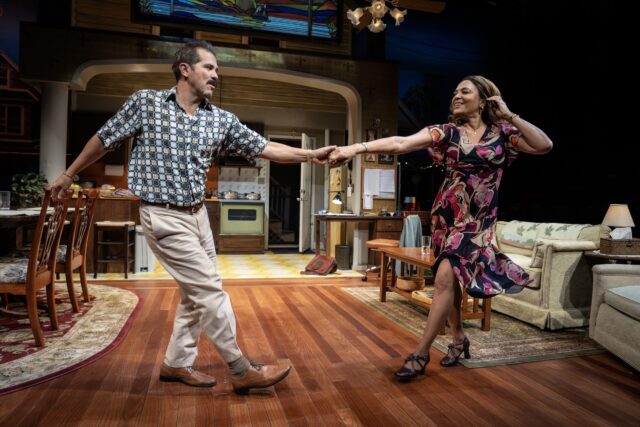
Nelson (John Leguizamo) and Patti Castro (Luna Lauren Velez) go for a spin in em>The Other Americans (photo by Joan Marcus)
THE OTHER AMERICANS
The Anspacher Theater at the Public Theater
425 Lafayette St.
Tuesday – Sunday through November 23, $60-$125 publictheater.org
The Other Americans is John Leguizamo’s first foray into writing a play with an ensemble cast. He is most well known for such solo autobiographical shows as Latin History for Morons and Freak, in which he portrays all the characters, and he stars in this one as well.
The show starts out impressively. As ticket holders take their seats at the Public’s Anspacher Theater, Latin songs such as Héctor Lavoe’s “Rompe Saraguey” and Larry Harlow, Frankie Dante, and Orquesta Flamboyan’s “Atájala: Se acaba la guerra” set the mood, while Arnulfo Maldonado’s stage design, featuring a detailed open house set within a community, the windows and some furniture practically reaching into the audience, invites everyone into what promises to be an intimate family drama.
It’s 1998 in Forest Hills, and Nelson Castro (Leguizamo) is desperately trying to save his laundromat business after having moved from the less-ritzy Jackson Heights — a socioeconomic step up that is proving to be a big strain.
“I stand to lose everything,” he tells someone over the phone. “C’mon, man. I’ma have the payment to ya by the end of the week. On my mother.”
When he greets his wife, Patti (Luna Lauren Velez), he doesn’t admit to the depth of the financial problems he is experiencing but does say to her, “I just can’t understand, I just don’t understand . . . how everybody gets to fail up but us. Cause how does some white guy walk into the same bank but with no business experience, ask for a loan, and he gets it. Over me. Me, who’s got decades of professional expertise and savvy and I end up with nada, culo, dick, cero!”
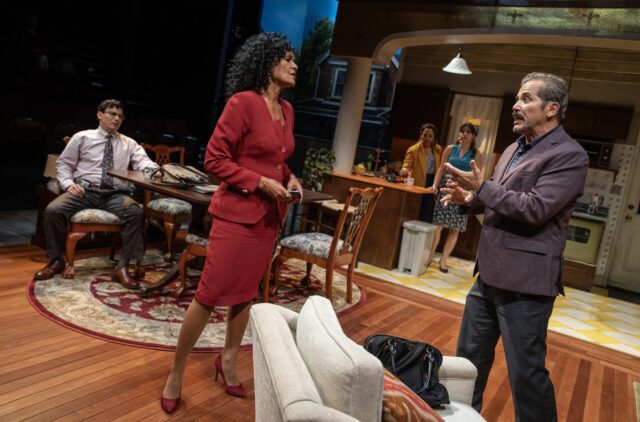
Patti is busily preparing for the return of their twenty-year-old son, Nick (Trey Santiago-Hudson), who is coming home after a ten-month stint in rehab. They are having a small party for Nick, with Toni (Rebecca Jimenez), his older sister, who is getting married to Eddie (Bradley James Tejeda), who works for Norma (Rosa Evangelina Arredondo), Nelson’s younger half sister, a successful, fashionable businesswoman, and Veronica (Sarah Nina Hayon), Patti’s no-filter, fast-talking best friend who is nine months pregnant.
Soon, as Nelson keeps trying to raise money by legal and perhaps not-so-legal means, he fails to see how his life is falling apart all around him.
A Latino family faces serious challenges in John Leguizamo play (photo by Joan Marcus)
The Other Americans is like a modern Latino update of such classic 1970s social-issue television series as All in the Family,The Jeffersons, and Good Times. Tony- and Obie-winning director Ruben Santiago-Hudson (Jitney,Lackawanna Blues) does a strong job of navigating the cast through the set, and there are several tender moments, like when Nelson and Patti dance a duet, but there are not enough of them, as the balance between comedy and tragedy falters.
The show eventually gets bogged down by genre clichés and clearly targeted plot twists, and it takes 135 minutes (including intermission) instead of a half hour (including commercials). Leguizamo is too one-note as Nelson; while we understand the challenges he is facing, the character’s stubbornness gets to be too much. Velez is wonderful as Patti, who tries to find the positive in everything while not becoming a pollyanna. However, although the climax is obvious, the play ends with a powerful coda that packs a gut punch. If only there were more of that.
[Mark Rifkin is a Brooklyn-born, Manhattan-based writer and editor; you can follow him on Substack here.]
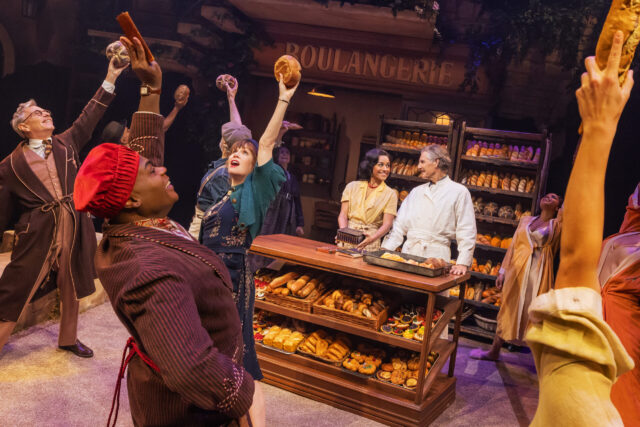
The French village of Concorde rejoices when a new baker comes to town (photo by Matthew Murphy and Evan Zimmerman)
THE BAKER’S WIFE
Classic Stage Company, Lynn F. Angelson Theater
136 East Thirteenth St. between Third & Fourth Aves.
Tuesday – Sunday through December 21, $66-$206 www.classicstage.org
Why did it take nearly half a century for The Baker’s Wife to at last get a major New York City production? That’s a question you’ll likely be asking yourself after seeing this delightful musical at Classic Stage, marveling at what you’ve just experienced.
The show — based on Marcel Pagnol’s 1938 classic film La Femme du Boulanger, which was adapted from Jean Giono’s 1935 semiautobiographical novel Jean le Bleu — was on a pre-Broadway national tour in 1976 when it was abruptly pulled by producer David Merrick. It was reworked for a 2005 run at the Paper Mill Playhouse in New Jersey and was presented by the Gallery Players in Brooklyn for sixteen performances in 2015 and by J2 Spotlight for a ten-day showcase in 2022. Thus, this revival has been a long time coming.
The fun begins as you enter the theater, which has been transformed by Jason Sherwood into the 1935 village of Concorde in Provence, bedecked on all four sides with wandering plants, old-fashioned signage, a bakery (Boulangerie), balconies above the shop and in a far corner, double windows that open up, and small tables that seat characters at a café as well as a handful of audience members. Several men are already onstage, two playing a guitar and an accordion, the others engaged in a game of pétanque. The play proper begins as husband-and-wife café owners Claude (Robert Cuccioli) and Denise (Judy Kuhn) set the tables; Denise then turns to the audience and explains that nothing much ever changes in their town — except that their baker died and they are anxiously awaiting their new pâtissier, as they have been without bread and pastries for seven weeks, which is unconscionable.
“He could have arranged for another baker. He knew he was going to die,” Antoine (Kevin Del Aguila), the local lush, complains about the previous dough expert. The teacher, Martine (Arnie Burton), replies, “How did he know? He was drunk, he fell in a pit, and broke his neck.”
As calm and peaceful as everything appears at first, the rousing song “If It Wasn’t for You” establishes that all is not so well in Concorde, which in French means “harmony.” The priest (Will Roland) is not happy that the mayor, le Marquis (Nathan Lee Graham), is cavorting like a pimp with his “nieces,” the sexy trio of Simone (Savannah Lee Birdsong), Inez (Samantha Gershman), and Nicole (Hailey Thomas). The priest is also at odds with Martine and his recent teaching. Claude bosses around Denise, while Barnaby (Manu Narayan) suppresses his wife, Hortense (Sally Murphy). The hunky Dominique (Kevin William Paul) is not about to tie himself down with one woman, assisted by his friend Philippe (Mason Olshavsky). And the stern spinster Therese (Alma Cuervo) just wants to be left alone. “Ooh, life is hard enough for me / With all my cares and labors / Why must I be burdened with / Such irritating neighbors?!,” they sing.
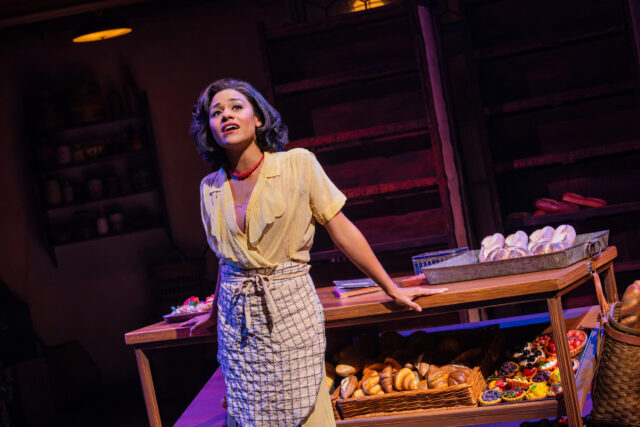
When the baker, Aimable Castagnet (Scott Bakula), finally arrives, the villagers assume that the stunning young woman with him is his daughter, but it is actually his wife, Geneviève (Ariana DeBose). While the amiable Aimable is excited about this new opportunity, Geneviève seems a bit tentative, as if moving to this far-off location might be a little overwhelming. He asks her if she really likes it, and she says that she does, but it isn’t long before she is considering the attention heaped on her by Dominique, who wants to show her around the area and take her to the waterfall. She reminds him that she is married, and he wonders if Aimable would be jealous. “Jealous? Why should he be jealous?” she says. He answers like a rapscallion, “Because someone like you . . . If you were mine, I wouldn’t leave you alone for a second.”
Geneviève asks Aimable if he ever gets jealous, and he responds, “Jealous? Because other men find you beautiful? Why should I be jealous? I have a diamond and it’s shining in their eyes. Let them be jealous of me. . . . I’m going up to take a little nap.” When he tells her he loves her and she does not say the same in kind, it’s clear he might have something to worry about, but he is too wrapped up in his own world to figure out what is happening. And after something does, it affects his baking skills to the point that the villagers have to take extreme action to get their beloved bread every day.
Geneviève (Ariana DeBose) takes stock of her life in The Baker’s Wife at Classic Stage (photo by Matthew Murphy and Evan Zimmerman)
There’s a central flaw in the casting of the show — even though Geneviève is young and gorgeous and Aimable is a clueless, boring man more than twice her age, one can still imagine why she would be attracted to him because he is played by Bakula, who might be a senior citizen but is a handsome and virile guy in his later years. In the film, the baker, portrayed by Raimu, is a shlubby, silly, clownlike figure, and it’s easy to imagine him being potentially cuckolded. With Bakula in the husband role, Geneviève’s attraction to Dominique seems to happen far too quickly. But the quality of the performances makes that a minor quibble that is skillfully overcome.
Seductively directed by Gordon Greenberg (The Heart of Rock and Roll; Dracula, a Comedy of Terrors), who has been associated with the show since 2002, The Baker’s Wife features lovely music and lyrics by Oscar and Grammy winner and five-time Tony nominee Stephen Schwartz (Pippin,Wicked) and a thoughtful if straightforward book by Tony winner Joseph Stein (Fiddler on the Roof,Zorba). The enchanting music direction by conductor Charlie Alterman and orchestrations by David Cullen range from the villagers’ delicious “Bread,” expressing their glee at Aimable’s first morning as their baker (“What is there like fresh, warm bread?”), and Geneviève’s “Meadowlark,” the show’s breakout hit (“Who does he think he is?” she declares about Dominique), to “Romance,” in which the women surprisingly find themselves not surrounded by men (“How quickly the bloom is off the rose”), and Denise’s exquisite “Chanson,” which opens the first and second acts (“And then one day, suddenly / Something can happen / It might be quite simple / It may be quite small / But all of a sudden / Your world seems different”). The nine-piece band is highlighted by Alterman’s keyboards and Jacob Yates’s accordion, which help maintain the charming French feel, as does Stephanie Klemons’s fun and playful choreography.
DeBose (Pippin,Hamilton) and Bakula (Guys and Dolls,The Connector) — who played Dominique forty years ago — are wonderful together, the former capturing Geneviève’s youthful fascination, the latter embodying Aimable’s inability to see reality. Among the other standouts are Tony nominees Kuhn (Fun Home,Chess) and Cuccioli (Jekyll & Hyde,Les Misérables) as the café owners who eventually reach an important understanding, Murphy (The Minutes,Downstate) as the meek Hortense, and Tony nominee Del Aguila (Some Like It Hot,Frozen) as Antoine, who is in a way the conscience of the community.
The musical is also a celebration of women and the freedom to make their own choices. “Men! Pigs! Thank God I never married,” Therese declares. To which the marquis adds, “You know what’s wrong with the marriage vows? . . . Till death do us part. . . . That’s too long . . . much too long.”
Just as there are many types of bread, bread serves as a metaphor about life’s ups and downs. “Man does not live by bread alone,” it says in the Bible, which also states, “Give us this day our daily bread.” Mother Teresa explained, “There is more hunger for love and appreciation in this world than for bread.” The phrase “breaking bread” means that people have united over food. In most cultures it is the man who is responsible for “putting bread on the table.” And when someone is in prison, it is said that they will have to exist on “bread and water.”
In The Baker’s Wife, bread brings people together, in friendship, in romance, and in community, although it can also tear them apart, as when Barnaby refuses to allow Hortense to have a strawberry tart because he hates them, or when Aimable burns the bread one morning. But as Omar Khayyam once said, “A loaf of bread, a jug of wine, and thou.”
And a delectable musical.
[Mark Rifkin is a Brooklyn-born, Manhattan-based writer and editor; you can follow him on Substack here.]
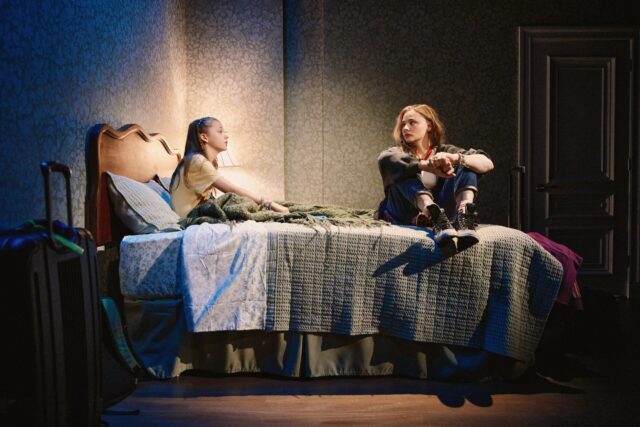
Rhea (Amy Landecker) is suspicious when Maddie (Chloë Grace Moretz) and Caroline (River Lipe-Smith) show up at her door (photo by Emilio Madrid)
CAROLINE
MCC Theater
Susan & Ronald Frankel Theater
511 West Fifty-Second St. between Tenth & Eleventh Aves.
Through November 16, $137 mcctheater.org
“Hi there, what can I get for you?” a diner waitress asks a mother and daughter at the beginning of Preston Max Allen’s deeply affecting Caroline.
It might seem like a harmless, standard question, but it gets right to the heart of the show, making its world premiere at MCC Theater. The waitress is portrayed by Amy Landecker, who later plays Rhea, mother to Maddie (Chloë Grace Moretz) and grandmother to nine-year-old Caroline (River Lipe-Smith). Maddie and Caroline, who has a broken arm, are on their way from West Virginia to Evanston, Illinois, fleeing Maddie’s abusive boyfriend and seeking help from Maddie’s parents, who have not seen her in a long time and don’t even know she has a daughter.
Maddie, who has been sober for eight years, had a troubled childhood: drinking at fifteen, doing drugs, sleeping around, stealing money from her parents, leaving home at seventeen, and getting pregnant. She hasn’t spoken to her mother and father in eleven years. When she shows up at the house she grew up in, her mother is surprised to see her and is cold and untrusting, especially when Maddie is demanding of what she wants, and doesn’t want, from her.
“Do you think I want to be here?” Maddie says. “If you don’t want us here, we’ll go. But I was hoping that maybe we could be mature about this.” Rhea, trying to suss out the situation, states, “Do you think we wanted this? Do you think we didn’t do every single thing in our power to help you? We fought for years for you. We hemorrhaged our savings trying to give you a recovery you didn’t want to have. . . . You have no idea what we went through. You can’t possibly remember what you went through, so don’t come into this house and try to tell me about my intentions.”
Rhea agrees to let them stay for one night until they agree on an acceptable plan going forward. She uses much of the time to get to know Caroline, who is trans, something that Maddie initially keeps from her mother. The three generations of women try to figure out what comes next as they argue about the past and prepare for a better future.
Caroline (River Lipe-Smith) and Maddie (Chloë Grace Moretz) try to figure out what’s next in potent world premiere at MCC (photo by Emilio Madrid)
Allen (We Are the Tigers,Storytime) writes compelling, honest dialogue that avoids the trappings of Hallmark movie-of-the-week melodrama, while the direction by Tony winner David Cromer (A Case for the Existence of God,Our Town) is swift, always in motion, on Lee Jellinek’s set, which is divided into three changing sections that include a diner table, motel bedroom, living room, and kitchen, expertly lit by Tyler Micoleau.
Landecker (Bug,Transparent) and Moretz (The Library,Kick-Ass) are terrific as Rhea and Maddie, who have work to do if they are going to reestablish their family; it takes a while to adjust to Lipe-Smith’s delivery (A Christmas Carol,Kinky Boots) but it smooths out significantly as the play goes on.
There are no men in the play; Caroline’s father is dead, Maddie’s father is away on business, and her ex-boyfriend is out of the picture. For ninety minutes, three women discuss responsibility, individuality, and what it means to be a mother and a daughter. Allen and Cromer provide no easy answers as the characters face difficult decisions that are not about to result in facile conclusions wrapped up in a neat bow.
[Mark Rifkin is a Brooklyn-born, Manhattan-based writer and editor; you can follow him on Substack here.]
Christopher Nelius’s Whistle is the opening-night selection of the 2025 DOC NYC festival
DOC NYC 2025 IFC Center
323 Sixth Ave. at West Third St. Village East by Angelika
181-189 Second Ave. at 12th St. SVA Theatre
333 West Twenty-Third St. between Eighth & Ninth Aves.
November 12-21, $13-$30 per screening, ten-ticket package $170 www.docnyc.net
The 2025 iteration of the annual DOC NYC festival, ten days of documentary shorts, features, and animated works at IFC Center, the Village East, the SVA Theatre, and online, gets underway November 12 with the opening-night selection, Christopher Nelius’s Whistle, about Carole Anne Kaufman, the Whistling Diva, and other mouth musicians at the Masters of Musical Whistling festival in Hollywood. Kaufman will participate in a postscreening Q&A with fellow whistlers Jay Winston, Lauren Elder, Molly Lewis, Anya Ziordia Botella, and Davitt Felder. There are two centerpiece films: Carl Deal and Tia Lessin’s Steal This Story, Please! follows around activist journalist and Democracy Now! host Amy Goodman, who will appear with the directors at two shows, November 13 and 14, while Celia Aniskovich’s The Merchants of Joy delves into the New York City Christmas tree trade. The closing night film is Ivy Meeropol’s Ask E. Jean, which tells the story of E. Jean Carroll, who successfully sued Donald Trump twice.
The festival is divided into such sections as “Resilience,” “Fight the Power,” “Investigations,” and “Sonic Cinema” in addition to several competitions; among the many highlights are Raoul Peck’s Orwell: 2+2=5, Alan Berliner’s Benita, Ian Bell’s WTO/99, Joe Beshenkovsky and James A. Smith’s Mata Hari, Isa Willinger’s No Mercy, Tyler Measom and Craig A. Williams’s If These Walls Could Rock, and Amy Berg’s It’s Never Over, Jeff Buckley.
Below is a closer look at some of the standouts; keep watching this space for more reviews as DOC NYC continues.
Elizabeth Lo is given remarkable access to a love triangle in award-winning documentary Mistress Dispeller
MISTRESS DISPELLER (Elizabeth Lo, 2024)
Village East
Thursday, November 13, 9:20 www.docnyc.net
In her debut feature-length documentary, 2020’s Stray, Elizabeth Lo tracked a remarkable homeless canine named Keytin as the golden mutt lived a dog’s life on the streets of Istanbul, allowing Lo to capture his every move, telling the dog’s story from his perspective.
Lo has followed that up with Mistress Dispeller, in which the participants in a love triangle allow Lo to capture their every move, telling their story from each of their unique perspectives.
Taking inspiration from Chantal Akerman’s Jeanne Dielman, 23 Quai due Commerce, 1080 Bruxelles and Akira Kurosawa’s Rashomon, Lo’s film explores a relatively new “love industry” in China, mistress dispellers, who, for fees of tens of thousands of dollars and more, are hired by women who believe their husbands are having an affair; over the course of two or three months, the dispeller, using a false identity, ultimately convinces the mistress to end the illicit romance through a structured technique. They do so in a calm, unobtrusive way, treating all three parties with dignity and respect.
It took three years for Lo to find mistress dispeller Wang Zhenxi, then get permission to document one of her cases, in which Mrs. Li wants to end her husband’s affair with the younger Fei Fei. Wang poses as a cousin of Mr. Li’s who is interested in learning the married couple’s favorite pastime, badminton. Wang carefully orchestrates various meetings in which she spends time alone with the mistress, studies her motivations and emotions, and comes up with a plan. Lo’s mounted, still camera is in every room, every car — but not necessarily Lo, who sometimes leaves the camera recording as she exits the space, permitting her subjects to talk more openly without her watching. “I am just a vessel in their lives,” Wang says, and so is Lo. (Lo had previously interviewed Mrs. Li’s younger brother, who was a dispelled male mistress and recommends Wang in the film.)
Although it is made clear from the start that this is not some kind of game, there are winners and losers. “It’s just like a war. You either win or lose everything,” Wang explains. Fei Fei admits, “Winning or losing isn’t the question. Actually, neither is important to me anymore. Because there are many more important things than winning.” But later she states, “I can’t keep losing though, right? Everyone wants to win. Why can’t the winner be me?”
Lo directed, produced, and photographed the film in addition to writing and editing it with Charlotte Munch Bengtsen. She gives equal weight to Mr. Li, Mrs. Li, and Fei Fei while delving into Wang’s methods. Time and money is never discussed; instead, Lo focuses on the care Wang employs in her business, determined to achieve a satisfying result for all involved. The access Lo is supplied is astounding; of course, only Mrs. Li knows what’s happening at first, but soon Mr. Li understands as well, while Fei Fei discovers the deception only at the conclusion.
Lo does not seek to elicit any judgments, but she includes several scenes in which Mrs. Li and Fei Fei carefully tend to their personal style, taking care to dress well and get their hair done, while Mr. Li, the object of each woman’s affection, is not exactly a fashion plate or a great conversationalist. However, the film does not ask us to question the love — and we know from the start that Wang’s goal is to restore the marriage, with the mistress out of the picture.
In a program note, Fei Fei says, “I am willing to participate in filming because, considering the long river of life, this is a small part of it. But it’s also something that’s significant to me right now. I see this as a documentary of my life. It is also a portrait of love. From the beginning of our encounter, to the middle of the relationship, and the end, it’s all part of this process of love. . . . Love doesn’t disappear, it just diverts. It’s just a process of love moving around. It’s quite meaningful to make time to recall and witness the process for yourself — whether the path you take is right or not. . . . When others see this film, they might gain some insights from it.”
Meanwhile, Mrs. Li explains, “Teacher Wang taught me a lot. About love, and other things. She said, ‘Look, you are going through this, this difficulty, and we should film it, so more women, more people, can face their families and learn how to handle a situation like this. . . .’ I want more people to know that love doesn’t come easy, especially for people at our age. Don’t give up so easily.”
The film also touches on aspects of contemporary Chinese dating, from matchmaking seminars and fairs to online channels. Lo occasionally cuts away for drone shots of cities and mountainous landscapes, incorporating all of China into the narrative, merging the inner and outer worlds of the people and the country.
Mistress Dispeller screens November 13 at the Village East, with Lo and producer Emma D. Miller on hand for a Q&A.
Award-winning filmmaker explores the life and career of Benita Raphan in new documentary
BENITA (Alan Berliner, 2025)
IFC Center
Friday, November 14, 7:00
Village East
Sunday, November 16, 11:30 am www.docnyc.net
Shortly after learning of his friend and longtime collaborator Benita Raphan’s suicide on June 10, 2021, documentarian Alan Berliner was asked by her family if he would complete the film she was working on when she died, at the age of fifty-eight. They gave him full access to her extensive archives, comprising notebooks, outtakes, drawings, photographs, and other ephemera. Berliner spent a year doing research and ultimately decided instead to make a film about her, in an attempt to better understand Betina as a person and filmmaker and, perhaps, why she hanged herself.
“Think of this film as an experiment in collaboration,” Berliner says at the start of the aptly titled Benita. “Benita left behind thousands of pieces; my job was to splice them together, to make a mash-up of our different filmmaking styles, to do whatever it takes to bring Benita’s creative spirit to life. But as much as anything, I also just wanted the joy of being able to work with Benita, one final time.”
Berliner conducted new interviews with more than a dozen people from Betina’s private life and professional career, including her mother, Roslyn Raphan; her friends Lucy Eldridge, Shari Spiegel, Miriam Kuznets, and Eric Latzky; her former boyfriend Eric Hoffert of the Speedies; composers Hayes Greenfield and Robert Miller, and SVA chair Richard Wilde. Together they paint a portrait of an eclectic, unusual, and caring avant-garde artist who was able to charm people into participating in the creation of her films — for free. Among the numerous words they use to describe her are “complex,” “serious,” “charismatic,” “a singular soul,” “a nonconformist,” “unpredictable,” “an irregular verb,” “nervous,” “anxious,” “intense,” “incredibly humble,” “fragile,” “vulnerable,” and “a scientist in an artist’s body.”
“I want to work on fun stuff, and her stuff is fun,” sound designer Marshall Grupp says.
“I wanted to help her, I wanted her to succeed,” notes postproduction facilitator Rosemary Quigley.
Producer, director, writer, editor, and narrator Berliner incorporates scenes from about half of Benita’s thirteen short films, focusing on ones that explore creativity, intelligence, and mental illness: 2002’s 2+2 (mathematician John Nash), 2004’s The Critical Path (architect Buckminster Fuller), 2008’s Great Genius and Profound Stupidity (author Helen Keller), and 2018’s Up to Astonishment (poet Emily Dickinson).
“Benita’s films aren’t really meant to be understood,” Berliner (First Cousin Once Removed,Intimate Stranger) explains. “She’s more interested in helping you make connections and stirring up feelings about her subjects using abstraction, layering, and rapid editing, sometimes all at once, to express things that can’t always be put into words, things like dreams, stream of consciousness, or visual metaphors. When Benita takes us inside the complicated minds of her subjects, she’s also trying to show us what it’s like inside her own.”
The film excerpts reminded me of the work of experimentalists Hollis Frampton, Stan Brakhage, and Maya Deren and such surrealists as Luis Buñuel and Salvador Dalí yet wholly original. Clips in which Benita is filming her shadow as she walks down the sidewalk or crunching on ice are poetically beautiful and memorable.
A 2019 Guggenheim fellow, Benita wrote down such thoughts as “Don’t be afraid to have bad ideas,” “Mistakes are an opportunity to start again & do it right,” and “Celebrate the confusion.” However, her more recent words ranged from “afraid” and “lost” to “I’m not myself” and “falling apart.”
She spent more time by herself near the end, dedicating many of her days to her dogs, including one who had severe psychological issues and another she named Rothko, after abstract painter Mark Rothko, who committed suicide in 1970 at the age of sixty-six. “Dogs don’t repeat any of your secrets,” she wrote.
Berliner captures Benita’s inner strength and unique style, but it’s not always possible to figure out why someone chooses death over life; mental illness is too often too difficult to diagnose, especially among friends and relatives.
Benita is making its world premiere at DOC NYC, screening November 14 at IFC Center and November 16 at the Village East, with Berliner, the recipient of last year’s DOC NYC Lifetime Achievement Award, on hand for Q&As following each show.
Documentary explores Seattle protests against the WTO in 1999 (photo by Rustin Thompson)
WTO/99 (Ian Bell, 2025)
Village East
Friday, November 14, 9:00
IFC Center
Monday, November 17, 1:00
Online November 15-30 www.wto99doc.com www.docnyc.net
Young and old march through the streets, forming blockades and human chains. Signs denounce globalization and corporatization. Angry farmers and union workers demand they be heard. Cries of fascism ring out. Local police, state troopers, and the National Guard douse protesters with pepper spray and tear gas, toss flash-bang grenades, and shoot the crowd with rubber bullets. Mysterious agitators in all black smash store windows. Donald Trump and Roger Stone weigh in on free trade and tariffs.
A documentary about government intervention into blue cities in 2025? A “No Kings” rally gone bad? Clips from the Rodney King and George Floyd protests?
No, Ian Bell’s riveting WTO/99 is composed exclusively of archival footage of the Battle of Seattle, when, beginning on November 30, 1999, tens of thousands of local, national, and international men and women took to the streets to protest the WTO Ministerial Conference being held in the largest municipality in the State of Washington. Bell includes no talking heads, no experts, no eyewitnesses, only film and video taken by news organizations and individuals. No one is identified by name, and occasional interstitial text notes the time and day, with just little bits of information.
Two early exchanges set the tone. After buying a gas mask, a pair of twentysomethings are preparing to head into Seattle. “I know we are all hoping this is gonna be peaceful, but do you think that the police will use tear gas?” the man asks. The woman answers, “I’m gonna say that, no, they’re not going to use tear gas.” The man says, “What do you think would make them go to that extreme?” The woman responds, “They would go to those extremes if there was a need for it. That’s the positive attention that I want to set out there for them, that they would do it if there’s a need, and I don’t think that there will be.”
On the TV show Seattle Police: Beyond the Badge, a law enforcement official explains, “We’re not looking to provoke anything; in fact, Seattle has a long and well-deserved history of working well with demonstrators, regardless of their views.”
Both sides might have been hoping for peace, but violence escalates as the WTO has to rearrange its schedule. Mayor Paul Schell proclaims, “The city is safe,” despite evidence to the contrary.
Among the familiar faces getting in sound bites are Bernie Sanders, Bill Clinton, Al Gore, Roger Stone, Michael Moore, Amy Goodman, Tom Hayden, Ralph Nader, Howard Schultz, and Alan Keyes. At a club, a supergroup consisting of Dead Kennedys leader Jello Biafra, Soundgarden guitarist Kim Thayil, Nirvana bassist Krist Novoselic, and Sweet 75 drummer Gina Mainwal rock out for the cause.
In his feature documentary directorial debut, Seattle native Bell and co-editor Alex Megaro weave in events coming from both sides in a fury that matches what is happening on the ground; much of the footage is jerky and low-tech, adding to the chaos. “I think we all need to thank the inventor of video cameras,” one man says.
The film evokes such other poignant works about protests and rallies as Stefano Savona’s Tahrir: Liberation Square, David France’s How to Survive a Plague, and Daniel Lindsay and T. J. Martin’s LA 92, but WTO/99 feels particularly relevant now, given what is happening with ICE and the National Guard in cities all across the country.
“I’ve never seen the United States come to this,” another man says, but now it seems to be happening every week, available for everyone to watch on their smartphones as the discord unfolds in real time.
WTO/99 is screening November 14 at the Village East, followed by a Q&A with Bell, Megaro, producer Laura Tatham, and archival producer Debra McClutchy, and November 17 at IFC Center; it will be available online November 15– 30.
Meredith Monk looks at her past, present, and future in Billy Shebar’s celebratory and deeply affecting documentary
MONK IN PIECES: A CONCEPT ALBUM (Billy Shebar, 2025)
Village East
Wednesday, November 19, 3:45 www.docnyc.net monkinpieces.com
Near the beginning of Billy Shebar’s revelatory documentary, Monk in Pieces, composer Philip Glass explains that Meredith Monk “was a self-contained theater company. She, amongst all of us, I think, was the uniquely gifted one — is the uniquely gifted one.” It’s an important correction because Monk, at eighty-three, is still hard at work, creating live performances and films that defy categorization.
While several of her earliest projects were met with derision in critical circles, today she is revered for her remarkable output, although it is still impossible to put her into any kind of box. At one point in the documentary, a chorus of Monk scholars sings her praises; one says, “She’s achieved so much, has received so many accolades, and yet she’s this unknown,” a second notes, “She kind of falls through the cracks of music history,” and a third admits, “We don’t know how to talk about her.”
Written, directed, and produced by Shebar — whose wife, coproducer Katie Geissinger, has been performing with Monk since 1990 — and David Roberts, Monk in Pieces does a wonderful job of righting those wrongs, celebrating her artistic legacy while she shares private elements of her personal and professional life. Born and raised in Manhattan, Monk details her vision problem, known as strabismus, in which she is unable to see out of both eyes simultaneously in three dimensions, which led her to concentrate on vocals and the movement of her physical self. She studied Dalcroze Eurhythmics: “All musical ideas come from the body; I think that’s where I’m coming from,” she says. All these decades later, her distinctive choreography and wordless tunes are still like nothing anyone else does.
Meredith Monk shares a special moment with her beloved turtle, Neutron
Unfolding at a Monk-like unhurried pace, the ninety-five-minute documentary is divided into thematic chapters based on her songs, including “Dolmen Music,” “Double Fiesta,” “Memory Song,” “Turtle Dreams,” and “Teeth Song,” while exploring such presentations as Juice (1969), the first theatrical event to be held at the Guggenheim; Education of the Girlchild (1973), in which a woman ages in reverse; Quarry (1976), a three-part opera about an American child sick in bed during WWII; Impermanence (2006), inspired by the sudden death of her partner, Mieke von Hook; and her masterwork, Atlas (1991), in which the Houston Grand Opera worries about her numerous requests and production costs, whether the piece will be ready in time, and if it even can be considered opera. There are also clips from Ellis Island,Book of Days,Facing North, and Indra’s Net, her latest show, which was staged at Park Ave. Armory last fall. In addition, Monk reads from her journals in scenes with playful animation by Paul Barritt.
Monk opened up her archives for the filmmakers, so Shebar, Roberts, and editor Sabine Krayenbühl incorporate marvelous photos and video from throughout Monk’s career, along with old and new interviews. “It was her voice that was so extraordinary, not only the different kind of sounds she could make, but the imagination she was using in producing the sound . . . totally individual,” Merce Cunningham says. WNYC New Sounds host John Schaefer gushes, “I don’t know when words like multimedia and interdisciplinary began to become in vogue, but Meredith was all of those things.” Her longtime friend and collaborator Ping Chong offers, “She had to fight to be acknowledged in the performing arts world because critics were saying that what she was doing was nonsensical, was crazy, was not serious; in a way, it’s a fight to survive. Pain is where art comes from. . . . Art has to come out of need. And now she’s an old master.”
And Björk, who recorded Monk’s “Gotham Lullaby,” touts, “Meredith’s melody making is like a timeless door that’s opened, like a gateway to the ancient is found. It definitely affected my DNA. . . . Her loft that she has lived in for half a century is an oasis in a toxic environment.” Among the other collaborators who chime in are longtime company member Lanny Harrison; composer Julia Wolfe; and David Byrne, for whom she created the opening scene of his 1986 film, True Stories, and who says he learned from Monk that “you can do things without words and it still has meaning, it still has an emotional connection.”
Some of the most beautiful moments of the film transpire in Monk’s loft, where she tends to her beloved forty-two-year-old turtle named Neutron, puts stuffed animals on her bed, meditates while staring at windows lined with Tibetan prayer flags, composes a new song, looks into a mirror as she braids her trademark pigtails, and sits at her small kitchen table, eating by herself. Surrounded by plants and personal photographs, she moves about slowly, profoundly alone, comfortable in who she is and what she has accomplished, contemplating what comes next.
“What happens when I’m not here anymore?” Monk, who received the 2014 National Medal of Arts from President Barack Obama, asks while working with director Yuval Sharon, conductor Francisco J. Núñez, and performer Joanna Lynn Jacobs on a remounting of Atlas for the LA Philharmonic in 2019. “It’s very rare that anybody gets it.”
Monk in Pieces goes a long way toward rectifying that, filling in the cracks, helping define her place in music history.
Monk in Pieces screens November 19 at 3:45 at the Village East; followed by a Q&A with Monk, Shebar, Krayenbühl, and producer Susan Margolin.
[Mark Rifkin is a Brooklyn-born, Manhattan-based writer and editor; you can follow him on Substack here.]
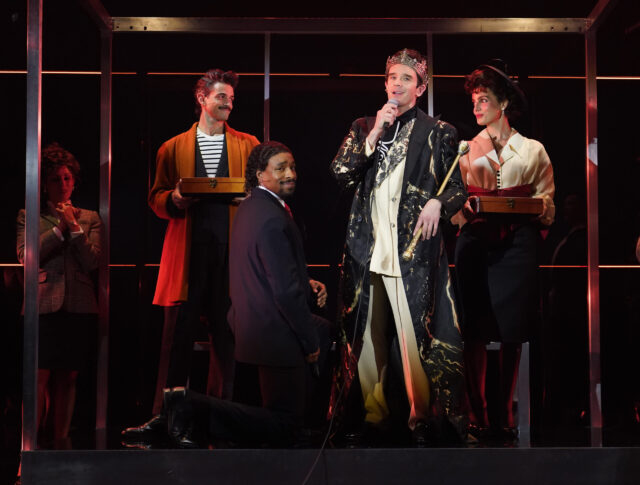
Michael Urie stars as Richard II in Red Bull production at Astor Place Theatre (photo by Carol Rosegg)
RICHARD II
Astor Place Theatre
434 Lafayette St.
Through December 21, $38-$300 www.redbulltheater.com
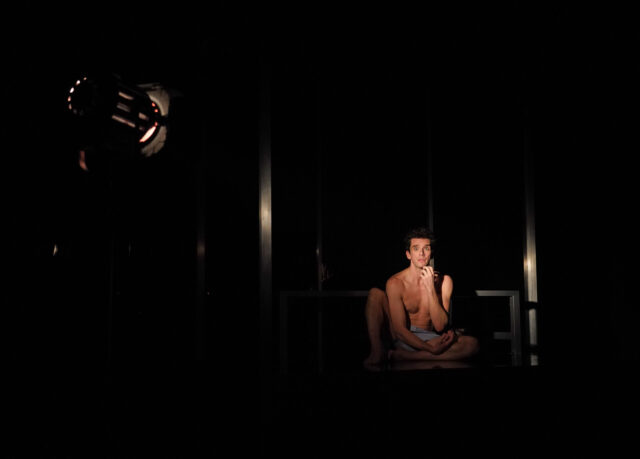
Craig Baldwin’s Red Bull adaptation of William Shakespeare’s Richard II gets off to a powerful start. As ticket holders enter the Astor Place Theatre, the king, portrayed by Michael Urie, is already onstage, kneeling in a glass cube serving as a cell, his bare back facing us. He is looking into a mirrored rear wall that reflects his face as well as members of the audience.
When the play proper begins, the jailed ruler says, “I have been studying how I may compare / This prison where I live unto the world: / And for because the world is populous / And here is not a creature but myself, / I cannot do it; yet I’ll hammer it out.” The opening soliloquy, which concludes with Richard asking, “Music do I hear?,” is followed by Aumerle (David Mattar Merten), the son of the duchess of York (Kathryn Meisle), singing along to the Eurythmics’ 1983 smash “Sweet Dreams (Are Made of This).”
The rest of the production could use a lot more hammering out as it travels between the 1960s, the 1980s, and the late fourteenth century, transforming the tragic tale of a king’s downfall into a time-warping gay fantasia that never finds its sense of purpose, its lofty ambitions misguided and bewildering.
The grandson of King Edward III, Richard took the throne when he was ten years old, and in this version, he has never grown out of his childlike nature, making seemingly arbitrary decisions to suit his whim at any given moment. Now in his early thirties, he finds himself caught in a battle between his cousin, Henry Bolingbroke (Grantham Coleman), and Thomas Mowbray, the Duke of Norfolk (Daniel Stewart Sherman); each man has accused the other of being a traitor to the king and his realm. They face off in a senseless, energy-draining game of Russian roulette with six-shooters, emceed by the courtier Bushy (Sarin Monae West) as if it’s a professional wrestling match, complete with crowd sound effects that make Thomas the villain. When neither wins, the king banishes Henry for ten years, which his father, John of Gaunt (Ron Canada), negotiates down to six, while Mowbray is exiled for the rest of his life.
Shortly after the duel, a dying Gaunt worries about the future of England in Richard’s hands; in a wheelchair and breathing through an oxygen tank, he warns, “Now He that made me knows I see thee ill; / Thy death-bed is no lesser than thy land / Wherein thou liest in reputation sick; / And thou, too careless patient as thou art, / Commit’st thy anointed body to the cure / Of those physicians that first wounded thee: / A thousand flatterers sit within thy crown.”
Soon, Bolingbroke is amassing an army to overthrow Richard, who has gone to Ireland to deal with rebel forces. Henry is supported by Lord Northumberland (Emily Swallow) and York, while the Bishop of Carlisle (Canada), the queen (Lux Pascal), Sir Stephen Scroop (Sherman), Bushy, Green (James Seol), Sir William Bagot (Ryan Spahn), and Aumerle (David Mattar Merten), the duchess’s son, remain loyal to the king.
Flashbacks reveal the king’s memories of better times, particularly hanging out with his favorites in a sauna and a drug-laden nightclub, where he does not hide his affection for Aumerle, even with his wife present. But when Henry and Richard meet again, the Bishop of Carlisle predicts, “The blood of English shall manure the ground, / And in this seat of peace tumultuous wars / Shall kin with kin and kind with kind confound.”
“Confounding” is exactly right.
Craig Baldwin’s adaptation of William Shakespeare’s Richard II searches for its center (photo by Carol Rosegg)
Richard II is not one of Shakespeare’s most popular plays; it has never been made into a film, and major productions are few and far between. For example, it has been staged by the Public Theater’s Shakespeare in the Park series only twice, in 1961 and 1987 (although it was scheduled for 2020 but instead was done as a radio play with André Holland in the lead). The Royal Shakespeare Company brought it to BAM in 2016 starring a fabulous David Tennant “portraying the dandy king with a bittersweet bisexual abandon and more than a touch of Jesus,” I wrote back then.
As much as I, and nearly the entire New York theater community, adore Michael Urie (The Government Inspector,Once Upon a Mattress), even he is not able to weave his way through the chaos and maelstrom (and fog). Onstage the entire 135 minutes, Urie does shine in a few instances, with some funny asides and gestures to the audience, but it’s hard to believe that he’s a king. The marquee depicts him wearing a pink spray-painted crown, eyes sadly cast down, so there’s more than a hint of the direction Baldwin will be taking, as many historians believe Richard was gay, but the show lacks focus; it’s all over the place. (Baldwin and Urie previously collaborated on Michael Kahn’s 2018–19 production of Hamlet for DC’s Shakespeare Theatre Company, in which Urie portrayed the melancholy Dane.)
Rodrigo Muñoz’s costumes switch from contemporary clothing, military garb, and Studio 54 chic to sauna towels, bathing suits, and Black Panther outfits, sometimes mixing in the same scene, as if the actors are in different shows. Northumberland wheels a news camera onto the set occasionally, preparing us for a live video feed that doesn’t happen; I wondered if there was a technical issue or it was done by choice. Jeanette Yew’s lighting keeps it mostly dark, although there are several moments when actors move around spotlights to shine on themselves or others, killing any pace. And “Sweet Dreams” upends the atmosphere more than once.
In a program note, CUNY English professor Mario DiGangi posits, “Why should we care about all these Yorks, Gloucesters, and Lancasters?”
As far as this production of Richard II is concerned, that’s a good question.
[Mark Rifkin is a Brooklyn-born, Manhattan-based writer and editor; you can follow him on Substack here.]
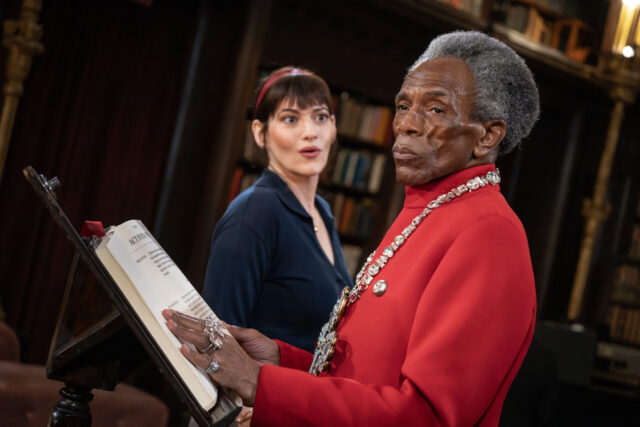
Cleante (Hannah Beck) has plenty of reason to not trust Tartuffe (André De Shields) in playful revival (photo by Joan Marcus)
ANDRÉ DE SHIELDS IS TARTUFFE
House of the Redeemer
7 East Ninety-Fifth St. between Fifth & Madison Aves.
Through November 23, $72 – $162 www.tartuffenyc.com www.houseoftheredeemer.org
Two classic plays dealing with power and control are currently running off Broadway, one wisely built around its beloved star, the other celebrating the author but detracting from the story.
Star power needs to shine in a suitable setting, and André de Shields has one befitting his resplendence in the House of the Redeemer. Built in 1914–16, the mansion was originally owned by Edith Shepard Fabbri, a great granddaughter of Commodore Cornelius Vanderbilt, and her husband, Ernesto Fabbri, an associate of J. Pierpont Morgan’s. By midcentury it was deeded to the Episcopal Church, run by the Sisters of St. Mary until 1980, and designated a New York City Landmark in 1974.
Today it is home to concerts, Bible study, yoga, morning and evening prayers, cancer patients from Sloan-Kettering, and, through November 23, the gallantly titled and playfully rendered André De Shields Is Tartuffe. The scandalous 1664 French farce is being presented to a limited audience of one hundred a night in the historic library, which was constructed in an Italian ducal palace in the early 1600s and transported in two parts to New York City from Italy during WWI, serving as the centerpiece of the mansion.
The audience, sitting on three sides of the action, does not get to see the centerpiece of the show until the third act. Upon arriving at the House of the Redeemer, ticket holders are led into a salon with portraits, lenticular photos of Tartuffe, and a note from him that reads, “Tonight’s exorcism will redeem you as my true sycophants. The hour is upon you to seek within the sacred shelves of this salon and library six keys, six crosses, and six scrolls which will quicken your souls to a new dawn, a new day, a new life, and a new way . . . of . . .” There are also copies of D. H. Lawrence’s Lady Chatterley’s Lover, Jonathan Swift’s A Modest Proposal, and other books in the room, setting the literary mood. In the library, music director Drew Wutke is playing such sing-along pop songs as Billy Joel’s “Only the Good Die Young,” Journey’s “Don’t Stop Believin’,” and the Proclaimers’ “I’m Gonna Be (500 Miles)” as the cast interacts with the audience, effectively shifting the tone.
Under Keaton Wooden’s whimsical direction, Ranjit Bolt’s 1991 verse translation unfurls on Kate Rance’s elegant set: just a few chairs, a pink couch, a lectern, and a Persian carpet. A long table at one end boasts seasonal decorations and a few more open books. The play begins with the characters introducing themselves: patriarch Orgon (Chris Hahn), who is hiding financial difficulties from his family; his second wife, Elmire (Amber Iman); his children, Damis (Tyler Hardwick) and Marianne (Alexandra Socha); his mother, the aristocratic Mme. Pernelle (Todd Buonopane), who goes everywhere with her (stuffed) dog, Flipote; the all-knowing housemaid, Dorinne (Phoebe Dunn), who never hesitates to speak her mind; Valère (Charlie Lubeck), who is engaged to Marianne; and Cleante (Hannah Beck), Elmire’s philosophical sister who is in love with Damis’s sibling.
Orgon and his mother have fallen under the spell of a man the others refer to as an “evil, scheming, cleverly charismatic, pretty sleazy, and potentially ruinous priest” named Tartuffe (De Shields). The stage is set early on, in this wonderful piece of dialogue:
Mme P: I’ve heard you say things that were sane. / And yet, to me, this much is plain: / My son should bar you — drive you hence. / He would if he had any sense. / You stand on shaky moral ground, / The mode of life that you expound / Is one that no one should pursue — / No decent person, in my view. Damis: Your friend Tartuffe would jump for joy . . . Mme P: You should pay him more heed, my boy. / Tartuffe’s a good man — no, the best, / And if there’s one thing I detest / It is to see a fool like you / Carping at him the way you do. Damis: The man is a censorious fraud / And yet he’s treated like a lord! / He’s seized control, that’s what he’s done / No one can have an ounce of fun / Do anything but sleep and eat / Unless it’s sanctioned by that creep. Dorine: Name just one thing he hasn’t banned, / Condemned as “sinful,” out of hand — / We have some harmless pleasure planned / And straight off he prohibits it, / The pious, pompous, piece of — Mme P: – SHHHHH! / How else are you to get to Heaven? / He should ban six things out of seven / And you should love him, all of you — / In fact, my son should force you to.
Orgon is besotted with Tartuffe, who he claims has changed his life and set him free; he declares with no remorse, “Yes, I could see my family die / And not so much as blink an eye.” When he announces that he is going to give Marianne to Tartuffe instead of to Valère, no one is happy, especially Marianne, but she lacks the ability to defy her father’s wishes. And Orgon’s devotion to Tartuffe only grows more intense and problematic as time goes on.
A family is torn apart by a con man in André De Shields Is Tartuffe (photo by Joan Marcus)
Ah, yes, and then there’s De Shields himself. He is once again given the most grand of grand entrances, as he was in Cats: The Jellicle Ball. I wrote at the time about the Tony, Obie, and Grammy winner, “This is André De Shields’s world; we only live in it.” Tartuffe only reinforces that statement.
“Here comes Tartuffe!” Dorine declares, but she is really proclaiming, “Here comes André!” In the script, it merely says, “Tartuffe enters. It deserves its own page.” There is nothing else.
Twin doors open, and there is he, Tartuffe, in a spectacular cardinal-like floor-length red robe, a giant bejeweled cross around his neck and chest, shiny rings on almost every finger, and dark sunglasses. (The costumes, a mix of period chic and standard contemporary, are by Tere Duncan.) He preens to the audience as he prepares to chew as much scenery as possible through the rest of the play, with Tartuffe making bold confessions, secretly seeking romance, and lying through his teeth, his personal hypocrisy evoking that of the Catholic church and the upper classes. He is a magnetic con man — with fantastic silver hair — who knows precisely how to play the game, ready to improvise as necessary.
When Damis tells Orgon how the priest tried to seduce Elmire, Tartuffe admits, “Why should I try to hoodwink you? / Brother, your son speaks true: I am / A sinner, yea, a wicked man! / My rank iniquities are rife / And every instant of my life / Is foul with sin! Yes, all the time / I add another heinous crime / To a long list. I roll among / The other swine in swathes of dung! / Small wonder Heaven is content / To sit and watch my punishment. / Whatever charge he wants to lay, / Nothing, not one word, will I say / In my defense — I lack the pride. / Let me be loathed and vilified. / Believe him! Give your wrath full rein! / Cast me into the street again / Like any felon. Shame? Disgrace? / I merit them in any case, / Lay ignominy at my door, / I’ve earned it, fifty times and more!” But Orgon attacks his son as his love and respect for Tartuffe intensifies.
The show is a hilarious romp, with stand-out performances by Tony, Emmy, and Grammy winner De Shields, Tony nominee Iman, and Dunn, who is always worth watching, even when Dorinne is not in a scene. It can get a little goofy at times, and if you’re in the second or third row you might have some trouble seeing every detail, but it’s all so sweet-natured that you can forgive it its minor sins.
Among those who have previously portrayed Tartuffe onstage and on film are Raúl E. Esparza, Emil Jannings, Gérard Depardieu, Antony Sher, and John Wood; later this month, Matthew Broderick will play Tartuffe in a new adaptation by Lucas Hnath at New York Theatre Workshop. None of them get to have their name in the title.
Professor Henry Higgins (Mark Evans) has plans for Eliza Doolittle (Synnøve Karlsen) in Gingold production Bernard Shaw’s Pygmalion (photo by Carol Rosegg)
BERNARD SHAW’S PYGMALION
Theatre Row
410 West 42nd St. between Ninth & Dyer Aves.
Wednesday – Sunday through November 22, $36.50 – $92.50 gingoldgroup.org bfany.org
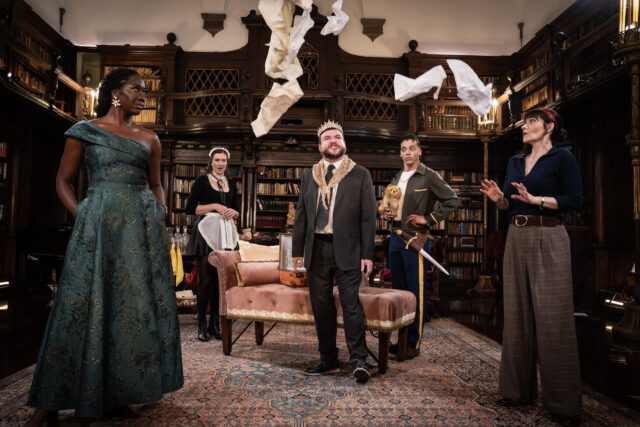
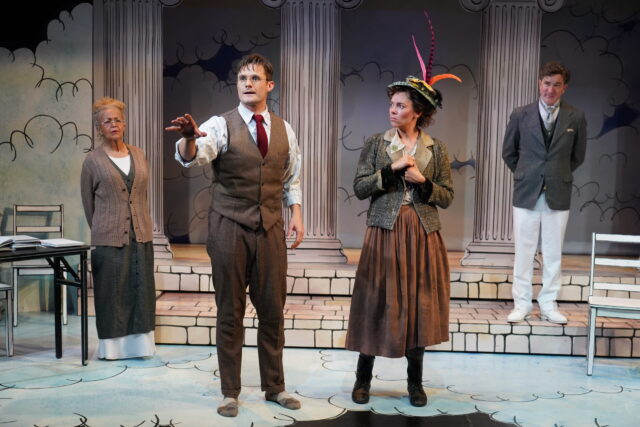
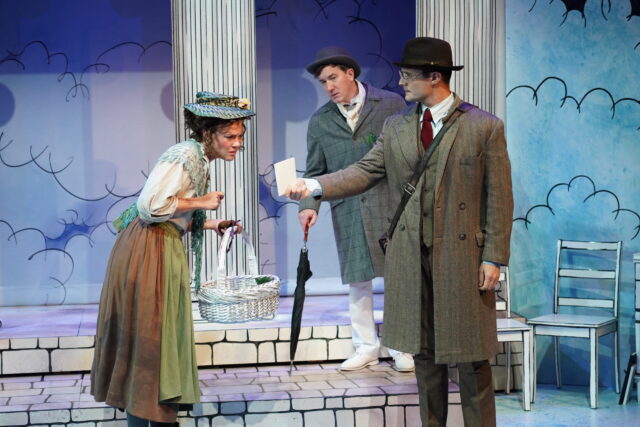
Upon entering the theater to see Gingold Theatrical Group’s twentieth anniversary production of Bernard Shaw’s Pygmalion — yes, the playwright’s name is part of the title — audience members are greeted by a series of posters featuring Al Hirschfeld drawings of George Bernard Shaw, including Shaw standing on the shoulders of William Shakespeare and Shaw painting a self-portrait with a colorful background. Lindsay Genevieve Fuori’s set is like a Hirschfeld tableaux, with a few chairs and tables, two steps leading to the facade of an opera house / temple with four ionic columns, a gable, and a raking cornice, and clouds with a hint of blue; in addition, there is a gold phonograph and a black recording machine that uses wax cylinders.
Hovering above is a caricature of Shaw as a winged angel, looking down as if he is a puppet master pulling all the strings. Several times during the show, thunder and lightning emerge from Shaw, reasserting his power and control over the proceedings. It comes off more as distraction than homage, artificially interrupting the narrative. Also disturbing any sense of flow is the intermittent appearance of four gods (Carson Elrod, Teresa Avia Lim, Lizan Mitchell, and Matt Wolpe, in multiple roles) who address the audience directly. They are based on a framing concept Shaw had drafted for the 1938 film adaptation but eventually scrapped; the dialogue Gingold founding artistic director David Staller uses is verbatim from the 1945 production with Gertrude Lawrence and Raymond Massey.
“Once upon a time, when we gods had a little more respect, you humans loved us. You built temples to us. We were always with you. Watching. Weaving our spells. And laughing at you,” Goddess 1 (Mitchell) says at the beginning. Goddess 2 (Lim) concurs, adding, “We laughed at you a lot. We still do.” There are not many laughs in this romantic comedy, and the satirical social commentary gets lost in the shenanigans.
The play, famously turned into the beloved 1956 musical My Fair Lady by Alan Jay Lerner and Frederick Loewe, was inspired by the Greek myth of the sculptor Pygmalion, a lonely man who carves a statue of a perfect woman he calls Galatea and then begs the gods to make real, which they do, but, as Goddess 1 explains, “There was a catch. A clause. A little hiccup that Pygmalion hadn’t thought to negotiate. The statue came to life, but with her own thoughts and feelings, with her own will. This possibility had somehow never occurred to Pygmalion. Oh, you funny humans. You men, in particular. And this, people: This is the story of that artist as reimagined by our friend, Mr. George Bernard Shaw.”
In Pygmalion, professor Henry Higgins (Mark Evans) is a persnickety phonetician lacking manners or social skills. When he encounters a poor, raggedy flower seller named Eliza Doolittle (Synnøve Karlsen) who speaks in what he considers a low-class Cockney accent, he makes a bet with his only friend, the far more practical Col. Pickering (Elrod). “You see this creature with her kerbstone English: the English that will keep her in the gutter to the end of her days,” he says to Pickering, right in front of Eliza, as if she’s not a person but a piece of clay. “Well, sir, in six months I could pass that girl off as a duchess at an Ambassador’s Garden Party.”
And so Higgins goes about molding Eliza into what he believes will be an honorable and respectable woman of society without paying attention to what Eliza wants, which is just to run her own flower shop. She defends herself by repeating over and over, “I’m a good girl, I am!” but that has no impact on Higgins, who treats her like she’s nothing more than a scientific experiment, referring to her as “so deliciously low. So horribly dirty. . . . I shall make a duchess of this draggle-tailed guttersnipe.”
Professor Henry Higgins (Mark Evans) has something to show Eliza Doolittle (Synnøve Karlsen) as Freddy (Matt Wolpe) looks on (photo by Carol Rosegg)
Meanwhile, Higgins’s mother (Mitchell) is not a fan of her son’s plan, pointing out to him and Pickering when they discuss the problem of transforming Eliza into a lady, “No, you two infinitely stupid male creatures: the problem of what is to be done with her afterwards.” Eliza’s estranged father, Alfred (Wolpe), is seeking a payoff to look the other way. Higgins’s housekeeper, Mrs. Pearce (Mitchell), insists that Higgins treat Eliza like a woman with her own mind. And Freddy (Wolpe), the sister of the prim and proper Clara (Lim), takes a shine to Eliza.
However, in inventing a new Eliza, Higgins gets more than he bargained for.
Goddess 1 strikes at the heart of the play when she says, “This is about human nature and human ridiculousness. It’s about . . . what is it about? About how easy it is to hide from ourselves. To hide from life. To wear the mask.” But Staller, who has previously helmed productions of such Shaw works as Mrs. Warren’s Profession, Heartbreak House,Arms and the Man, and Caesar & Cleopatra, with mixed results, can’t capture the essence of Shaw’s words in his staging. The humor falls flat, the acting is inconsistent, and the movement is too stagnant.
Staller might be among the most knowledgeable Shaw scholars on the planet — Gingold’s Project Shaw has presented all-star readings of every Shaw play, including “The Shewing-Up of Blanco Posnet” with André De Shields — but Bernard Shaw’s Pygmalion feels like a piece of marble that still requires a lot of chiseling and forming. Cue the lightning and thunder.
[Mark Rifkin is a Brooklyn-born, Manhattan-based writer and editor; you can follow him on Substack here.]
Zoë Kim shares her childhood trauma with a glowing orb in Did You Eat? (photo by Emma Zordan)
DID YOU EAT? (밥 먹었니?)
The Shiva Theater at the Public Theater
425 Lafayette St.
Tuesday – Sunday through November 16, $80 publictheater.org
In 1992, Baptist minister and radio host Gary Chapman wrote The Five Love Languages: How to Express Heartfelt Commitment to Your Mate, in which he described five “love languages”: words of affirmation, quality time, receiving gifts, acts of service, and physical touch.
In her autobiographical solo show Did You Eat?, Zoë Kim offers her own take on love languages, as they apply to her relationship with her parents, herself, and her place in the world as a Korean American. It’s a brave but uneven journey that explores severe trauma but doesn’t quite dig deep enough during its too-brief sixty-five minutes, as she tells her story to a glowing white orb that represents her inner child.
Kim was born in Seoul to a dysfunctional family mired in resentment. Her father, Appa, was the youngest of thirteen children and the only son. His parents, who were poor, heaped all their attention on the boy, considering him to be “their only hope.” Kim explains, “Every piece of food and clothing went to keep him fed and warm. It was normal for him to wake up on a winter morning to find one of his sisters frozen or starved to death. None of his twelve sisters made it to adulthood. Harabeoji’s [Grandfather’s] future was worth the lives of twelve daughters.”
While studying for her PhD, Umma (Kim’s mother) was forced by Harabeoji to give up her dreams of becoming a scientist and instead get married. She did not want to be a mother, but she got pregnant immediately; Appa was planning on having many sons, but when Kim was born, he was more than disappointed, and Umma and Appa spent the rest of their lives taking it out on their daughter, in different ways. “The day you are born is a tragic day,” she says to the orb. As a child, she blames herself for the breakup of her parents’ marriage and the lack of love she receives from them, praying to the gods to turn her into a boy.
However, she spends a lot of time with her grandmother, Halmeoni, who introduces Kim to theater, music, and poetry. “Feeding you is her love language,” she notes happily, even as she points out how miserable Harabeoji is to Halmeoni. “You learn that your love language is to make her laugh.”
At fifteen, Kim, who does not speak any English, is sent to boarding school in America, where she is determined to thrive, fighting her fears as she attempts to balance being Korean and American. At sixteen, her father tries to kill her. “Your American dream is vaporized,” she says, and is soon battling “anxiety, depression, rage, shame, guilt, and hurt,” believing that she brought it all on herself, that she deserves all the bad things that are being heaped upon her. “Will I ever be okay?” she asks.
We might be watching her in a play that has had success since its workshop debut at the 2023 Edinburgh Festival Fringe and is now being presented at the Public by the Ma-Yi Theater Company, but that doesn’t necessarily mean she’s okay, given what she’s had to deal with since birth.
The title of the show refers to how Umma would say things to her that meant something else. For example, “Did you eat?” actually was “How are you?,” and “Are you eating?” was “I’m worried about you.” It was as if Umma could not speak to her daughter directly, would not communicate with her in a caring and loving way, skirting around reality.
Director Chris Yejin and choreographer Iris McCloughan keep Kim on the move, adding a potent level of physicality that counters the inner turmoil with a sense of impending freedom rather than doom. In a midriff-baring costume designed by Harriet Jung that reveals impressive abs, Kim flits across Tanya Orellana’s geometric set, consisting of an abstract arrangement of white platforms, walls, and doors, amid Minjoo Kim’s colorful lighting and Yee Eun Nam’s projections, which range from English translations of Korean dialogue to photos of old hands and animations of rain and falling letters.
While Kim is an engaging figure onstage, the narrative and movement occasionally dip into cliché and repetition, especially when it comes to her overuse of the concept of love languages, and it’s not always immediately clear when she shifts between characters. In addition, the orb is at times distracting, a precious prop that can be too sentimental.
At the end of the show, I was happy that Kim had overcome so many obstacles, but on the way home I couldn’t help but feel that I was still hungry, that I wanted more. Perhaps that will be sated by the next two parts of what Kim is calling the Hunger Trilogy.
[Mark Rifkin is a Brooklyn-born, Manhattan-based writer and editor; you can follow him on Substack here.]