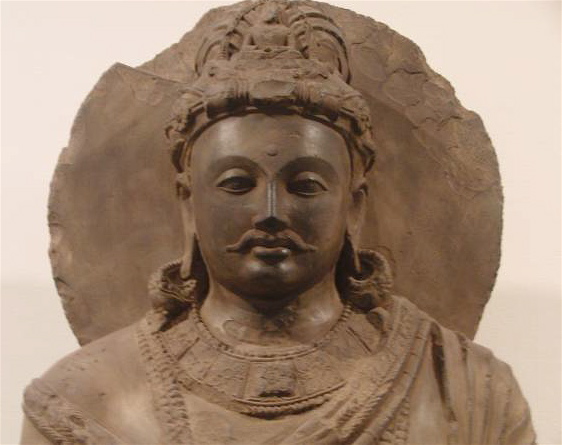
“Large Seated Bodhisattva in Meditation,” Gandhara culture in Pakistan or Afghanistan, grey schist stone, circa ninth century (photo by twi-ny/mdr)
Tibet House US
22 West 15th St. between Fifth & Sixth Aves.
Extended through January 7, free, 12 noon – 5:00 pm
212-807-0563
www.tibethouse.us
Originally scheduled to end October 20 and then November 16, Tibet House’s revelatory five-part exhibition, “The Buddha Image: Out of Uddiyana,” has been extended yet again through January 7, and you should do whatever it takes to make sure you see it before it closes. Investigating the origin of the Buddha image, which some believe began in the Uddiyana (“royal garden”) kingdom of Northern Pakistan, the show includes dozens of remarkable artifacts divided into five sections: Gandharan Stone Sculptures, Stupas and Reliquaries, Gandharan and Swat Metal Buddhas, Pilgrimage, and Silk Road. Accumulated by Nik Douglas for the Buckingham Collection over the course of some forty-four years, the objects date back back more than nineteen centuries. Walking through the many treasures, you’ll wonder why they’re not part of a permanent museum collection. Among the most unusual of the sculptures are bronze and stone depictions of bodhisattvas with mustaches, in addition to fasting, emaciated buddhas, nearly skeletal as they continue to meditate. Glass cases display rock crystal stupas with gold/electrum alloy from the first and second century, while others contain Chinese gilt bronze buddhas from the sixth century. You can almost feel the electricity emanating from several works that depict a buddha and his consort staring deep into each other’s eyes, including the many-armed “Large Chakrasamvara Yabyum (‘Wheel of Becoming’)” and “Large Amitayus Yabyum (‘Buddha of Boundless Life’).” The early-nineteenth-century Sino-Tibetan “Huge Figure of the Kurukulla Dakini” features a central figure surrounded by fire, wearing a necklace of shrunken heads, standing on a woman. One of the most spectacular pieces can be found just to the left of the entrance, nearly hidden away in its own alcove: “Large and Complete Yamantara (‘Remover of the Fear of Death’),” a bull-headed, multi-armed, many-faced bodhisattva surrounded by mysterious, exciting iconography. In his foreword to the exhibition catalog, Tibet House president Robert Thurman writes, “We hope that the manifestations gathered in the exhibition will find their way here and there to continue to inspire individuals to use their precious human lives in the evolutionarily most meaningful way to create real human values in themselves and others.” We feel exactly the same way.