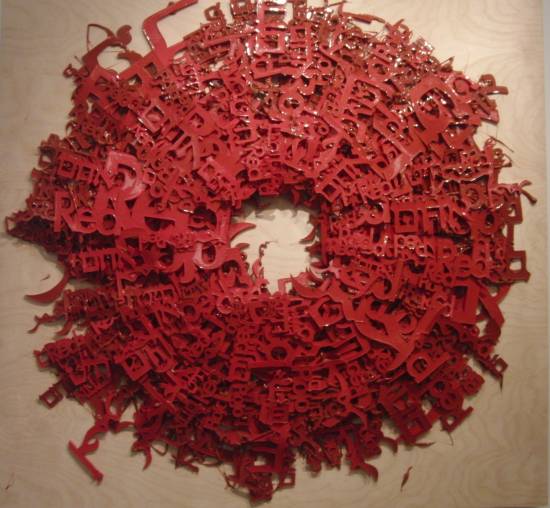
Yael Kanarek, “Wavelength range of roughly 630-740 nm#2,” silicone on wood, 2010 (photo by twi-ny/mdr)
Ogilvy & Mather
The Chocolate Factory, floors 4 and 8-11
636 11th Ave. between 46th & 47th Sts.
Monday – Thursday, 11:00 am – 5:00 pm, through October 14
Admission: free with RSVP to curator Jun Lee at jun.lee@ogilvy.com
For the third exhibition held in Ogilvy & Mather’s new offices in the Chocolate Factory on the Far West Side (following “Re-Creation,” which consisted of art using recycled and repurposed manufactured materials), curator Jun Lee has turned to the written word for inspiration. Combining text and image not unlike how the famed advertising company does in coming up with ad campaigns for its clients, “New Language” features intriguing and involving work from fifteen established and emerging artists spread out across five floors, depicting words as images, abstract concepts, and, well, words themselves. Lisa Anne Auerbach designs wool sweaters with such sayings as “I Love My Feral Cat,” “This Lane Is Your Lane,” and “Everything I Touch Turns to Mold.” Seong Chun sews hard-to-read text on crocheted paper in “Untitled (Systemic 164).” In the digital video “The Five Classic Typefaces,” Kyeung Yeom pays tribute to Helvetica and other famous fonts. Glenda León incorporates Braille, a kind of physical language, into her “Mundo Interpretado V” motorized music boxes. Yael Kanarek’s “Wavelength range of roughly 630-740 nm#2” is made up of multiple repetitions of the word “red” in English, Hebrew, Arabic, Yiddish, and Spanish, rendered in red silicone on wood, the words spinning on top of one another like an experimental Tower of Babel. A. J. Bocchino color codes “New York Times Headlines” from 1929, 1930, and 2008 to create a visual comparison of the Great Depression and the current recession. (Meanwhile, outside the nearby windows one can see billboards and signs for a car wash and a lumberyard, other ways in which word and image are used to make a point.)
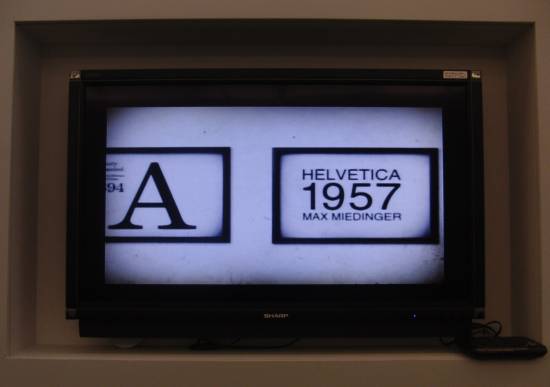
Kyeung Yeom, still from “The Five Classic Typefaces,” digital video, 2007 (photo by twi-ny/mdr)
In “Karaoke Wrong Number,” Rachel Perry Welty lip-synchs messages left on her answering machine meant for someone else, adding verbal language to the mix. (She goes back to the written word for “Rachel Is,” making use of her Facebook status updates.) For his “Amnesia” steel wall sculpture, Iván Capote twists and turns letters until they are virtually unrecognizable, playing with memory as well as such learning disorders as dyslexia. The most fun piece is also the most interactive; for Jonathan Harris and Sep Kamvar’s “We Feel Fine,” visitors can navigate a screen of some fifteen hundred tiny particles, each single dot representing an emotion that someone posted on the Internet beginning with the words “I feel” or “I am feeling.” Although “New Language” is open to the public by RSVP to Lee at jun.lee@ogilvy.com, it is also meant for the employees. In a press release announcing the exhibition, Tham Khai Meng, Ogilvy & Mather’s worldwide creative director, said, “We are a company of artists, writers, designers, and creative people who use creativity to drive commerce. Our employees need to always be looking for inspiration, and art is the ultimate medium for new forms of expression.”