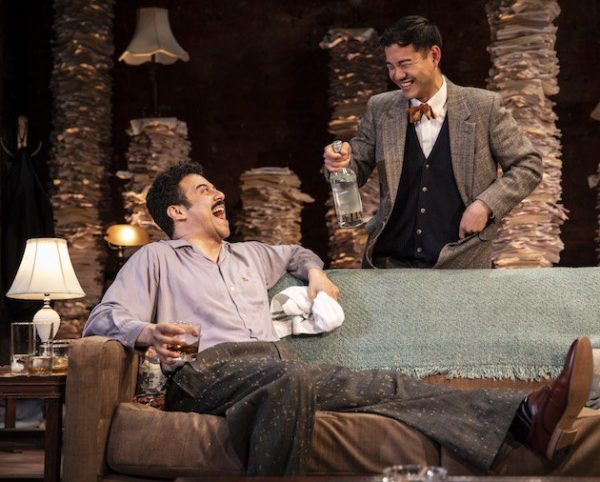
Tennessee Williams (Juan Francisco Villa) and William Inge (Daniel K. Isaac) loosen up in The Gentleman Caller (photo by Maria Baranova)
Abingdon Theatre Company
Cherry Lane Mainstage Theatre
38 Commerce St.
Monday – Saturday through May 26, $67 (use code GC45 for $45 tickets)
212-989-2020
abingdontheatre.org
www.cherrylanetheatre.org
In the fall of 1944, St. Louis Star-Times arts critic William Inge invited up-and-coming playwright Tom “Tennessee” Williams to his garden apartment to interview him about his latest work, The Gentleman Caller, which was scheduled to open right after Christmas in Chicago (where it would be retitled The Glass Menagerie). Although the two men became friends — Williams referred to their “long association” in a personal homage he wrote for the New York Times in 1973 following Inge’s death — it has never been firmly established how close they actually were and whether they indeed may have been lovers. Playwright Philip Dawkins makes that jump in a big way in The Gentleman Caller, which is having its New York premiere at the Cherry Lane Theatre through May 26. The two-character, two-hour, two-act Abingdon Theatre Company production is like a piece of fan fiction; although Dawkins did extensive research in writing the play, he still uses creative license as he relates what might have happened when the thirty-three-year-old Williams and the thirty-one-year-old Inge met, first on November 10, 1944, in Inge’s apartment and again that New Year’s Eve in a Chicago hotel room. Sara C. Walsh’s dramatic set features approximately a dozen lamps of all different heights, each constructed of stacks of typed manuscript pages; there are also pages scattered across the corners and back of the stage. At the center is a couch, with a chair to the right, a rolling wet bar to the left, and a record player in the right corner. In the second act, the couch turns into a bed but most everything else remains the same.
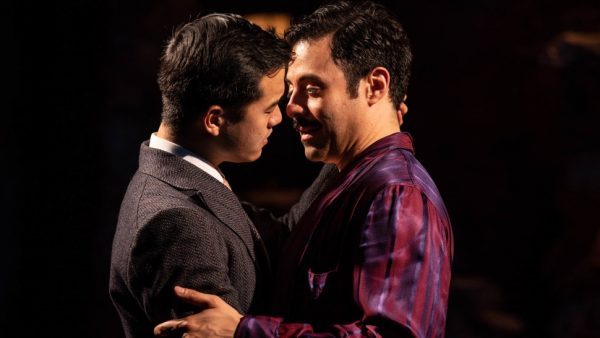
William Inge (Daniel K. Isaac) and Tennessee Williams (Juan Francisco Villa) get close at the Cherry Lane Theatre (photo by Maria Baranova)
Williams (Juan Francisco Villa) serves as the narrator of the work, reminiscent of Tom in The Glass Menagerie, as if he’s looking back at the past, occasionally making side comments in an affected southern drawl to the audience. The snarky, swishy, no-holds-barred, extremely self-aware Williams is the opposite of Inge (Daniel K. Isaac), a stiff, rigid, overly serious, and unimaginative introvert. Within minutes, the deeply closeted Inge is climbing on top of Williams, then is horribly embarrassed by his actions. A few moments later, Williams, discussing where he goes to be with men, says, “Hotels are wonderful inventions, especially for inveterate homosexuals like ourselves.” Inge quickly responds, “I’m not a homosexual,” to which Williams replies, “And my name’s not Tennessee, but we all gotta answer to something’. Drink up. You’ll need it. ’Specially if you’re not a homosexual.” The two men drink a lot — while it affects Williams, Inge barely changes — as they discuss the theater, sex, suicide, isolation, sin, secrets, truth, and fantasy. Williams gets particularly excited when he discovers that Inge has written a play as well. All along the way, Tennessee makes such grand statements as “Mmm, one ought never to trust a playwright”; “Confess your sins to a priest, and he tells you privately what to do to save yourself. Confess your sins on stage and they crucify you in the town square”; and “A sanctuary is a prison to those that cannot leave it.”

“Ignite me,” Williams says to Inge, asking him to light his cigarette. However, the play never really catches fire. Most critically, there is no sense of connection between the Mississippi-born Williams and Kansas native Inge, or Villa and Isaac. There are some charming moments — Villa gets a well-deserved round of applause for using his feet in a most unusual sexual way — but it’s all just a little bit too quaint and calculated. And the ethnic-blind casting doesn’t help matters; Villa is of Colombian descent, while Isaac is Korean American, causing confusion. Plays about what went on behind closed doors between two well-known figures are always a gamble, running the gamut from Frost/Nixon and The Audience, both by Peter Morgan, to Mike Bencivenga’s Billy & Ray, about the Hollywood collaboration between Billy Wilder and Raymond Chandler, and Gino DiIorio’s Sam and Dede, or My Dinner with Andre the Giant, which turns a real meeting between Samuel Beckett and the adolescent Andre the Giant into a lifelong friendship. (In addition, Wall Street Journal theater critic Terry Teachout’s Billy and Me, also about Williams and Inge, opened in Palm Beach in December.) But Dawkins (Charm, The Burn) and director Tony Speciale (The Dork Knight, Unnatural Acts) are unable to balance the truth with poetic license, resulting in a choppy narrative with questionable plot developments, although Zach Blane’s lighting is exceptional. “Accuracy is overrated, don’t you think? I’m much more fascinated by honesty,” Williams says. “Is there a difference?” Inge responds. Williams (The Rose Tattoo, The Night of the Iguana) would go on to win two Pulitzer Prizes, for A Streetcar Named Desire and Cat on a Hot Tin Roof, while Inge (Bus Stop; Come Back, Little Sheba) would win a Pulitzer for Picnic. However deliriously fun a bit of “what if” speculation about theater giants may be, The Gentleman Caller doesn’t add much insight into how the relationship between these two great playwrights might have influenced their lives and careers.