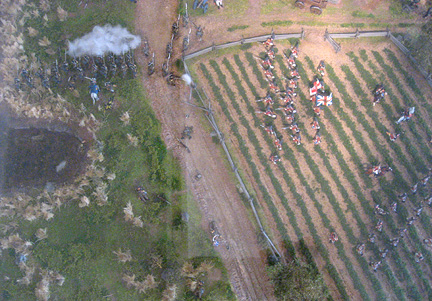
Diorama re-creates the Battle of Brooklyn in the Old Stone House (photo by twi-ny/mdr)
The Old Stone House Historic Interpretive Center (and other locations)
Washington Park / J.J. Byrne Playground
Fifth Ave between Third & Fourth Sts., Brooklyn
August 20-29
718-765-3195
www.theoldstonehouse.org
www.nycgovparks.org
Built in 1699 as a Dutch farmhouse, the Old Stone House in the middle of Washington Park / J.J. Byrne Playground served as the main site of the August 27, 1776, Battle of Brooklyn (also known as the Battle of Long Island), the first battle following the signing of the Declaration of Independence. It proved critical in the final outcome of the American Revolution, as the bravery of the Maryland 400 enabled General George Washington’s troops to evacuate successfully and live to fight another day. The Old Stone House’s annual celebration of Battle Week, honoring this historic fight, begins this weekend with a Revolutionary War Flag exhibit at Federal Hall in Manhattan, continuing through August 25. On August 21, a memorial march remembering the Maryland 400 will start at Eighth St. and Third Ave. at 10:00 am and head to the Old Stone House, where there will be a Battle Days opening reception and a van tour. Among the other Battle Week events are an Evergreens Cemetery walking tour and a bike tour on August 22, canoe trips on August 25, a neighborhood walk on August 27, and a memorial ceremony for the Prison Ships Martyrs and a cruise on August 28. The festivities come to a rousing close on August 29 with a commemoration ceremony and a tour in Green-Wood Cemetery and a parade and reenactment on Battle Hill.
To learn more about the battle, spend a little time in the Old Stone House (suggested admission $3). If it’s not crowded, the enthusiastic caretaker will lead you on a personal tour of the artifacts that detail the history of the house and the battle, including lithographs of the different incarnations of the building, maps, a timeline of the battle, quotes from soldiers, a mannequin in period costume, a copy of Alonzo Chappel’s painting of the firefight, descriptions of such major players as Brigadier General William Alexander (Lord Stirling), Major General Israel Putnam, General Sir William Howe, and General Washington, and the splendid miniature re-creation of a pivotal moment in the battle, complete with dead soldiers, lonely three-corner hats, and cotton representing musket smoke.