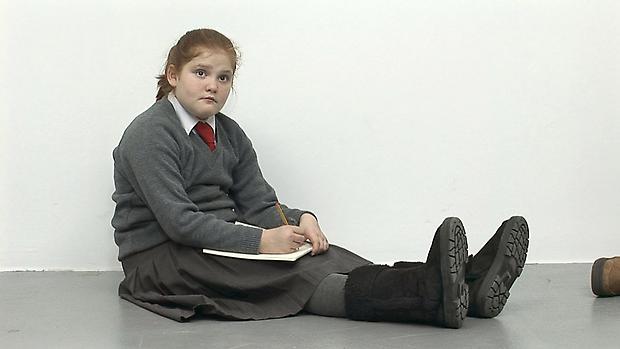
Rineke Dijkstra, still from “Ruth Drawing Picasso,” single-channel video, Tate Liverpool, 2009
Marian Goodman Gallery
24 West 57th St. between Fifth & Sixth Aves.
Monday – Friday through August 21
Admission: free
212-977-7160
www.mariangoodman.com
In the 2008 book IMAGE MAKERS, IMAGE TAKERS: INTERVIEWS WITH TODAY’S LEADING CURATORS, EDITORS, AND PHOTOGRAPHERS, Dutch artist Rineke Dijkstra says, “I make normal things appear special.” Dijkstra, who turns fifty-one this week, takes portraits of everyday people, most often staring directly into the camera, that are subtle yet revealing, exploring the act of seeing in both subject and viewer. Her current show at the Marian Goodman Gallery expands on that theme with a trio of video installations that explore art, interpretation, and innocence as seen through the eyes of children. In the three-channel projection “I See a Woman Crying (Weeping Woman),” Dijkstra shoots a group of nine schoolkids who are looking at something ever so slightly off-camera. Their individual thoughts and ideas reveal aspects of themselves, then directly influence the group discussion as a whole. We first watched the film without knowing what they were specifically talking about, which was simply fascinating; we then took it in again, knowing that they were looking at a reproduction of Picasso’s “Weeping Woman” that was attached to the camera’s tripod, which gave the work a new perspective. In “Ruth Drawing Picasso,” a young girl, in school uniform and boots, is sitting on the floor of the Tate Liverpool, sketching that very same painting. The intensity in the girl’s eyes, her careful concentration, and the sound of pencil hitting paper come together in absolutely thrilling ways. Ruth occasionally looks to her left, where another student, off-camera, is apparently doing the same thing, as if she is checking how her work compares to the other girl’s, wanting so much to do well. And in the four-channel video “The Krazyhouse, Liverpool, UK (Megan, Simon, Nicky, Philip, Dee),” Dijkstra depicts young kids, shown individually on one screen at a time (placed on each wall of a dark room), dancing to songs that they chose. Shot against a white background, the subjects start slowly, a little nervous, before eventually letting loose, allowing the music and the experience to take over. It’s an energizing work that examines adolescent self-esteem and the ability to free oneself from self-consciousness and societal restrictions. The exhibit, which is supplemented by a series of portraits, indeed makes “normal things appear special.”